
Desalination and salt production (liquid salt)
1. Introduction
Growing need for desalination
Of the Earth's 1.4 billion km3 of water, only 2.5% is freshwater and 0.3% readily accessible to humans Ref 121. Increasing population, urbanization, climate change and economic developments have resulted in more than 2 billion people experiencing high water stress (UN-Water, 2018). Estimates for 171 countries indicate that 31 countries experience water stress between 25% and 70%, 22 countries exceed 70% and 11 countries surpass 100% (UN-Water, 2018). By 2050, 40% of the world's population is projected to live under severe water stress (Salinas-Rodriguez and others, 2021). Oceans cover 140 million square miles (approximately 363 million square km) of the earth's surface and nearly 2.4 billion people live within 100 km of the coast Ref 103. To address water scarcity, saline water desalination offers promising solutions. More than 150 countries are using desalination to supply potable water to more than 300 million people Ref 123. It is well established that unconventional water sources such as desalination will play a key role towards meeting the Sustainable Development Goal 6 targets for sustainable water management in the coming years Ref 105.
Desalination systems overview
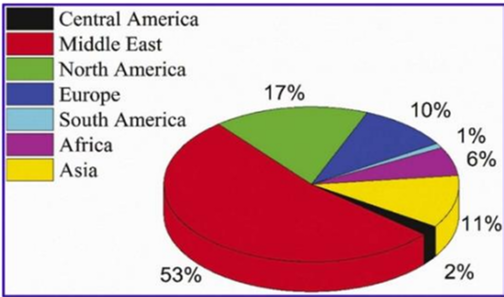
Desalinated water is used or can be used in various economic sectors such as industry, agriculture, food processing, healthcare and recreation Ref 2. Among these, the municipal sector uses 62.3%, while industries use 30.2% of desalinated water production Ref 18. In 2019, the desalination market was highest in the Middle East and North Africa region (45.32%), followed by East Asia and Pacific (17.52%), North America (11.34%), Western Europe (8.75%), Southern Asia (2.94%), Eastern Europe and Central Asia (2.26%) and sub-Saharan Africa (1.78%). In 2020, approximately 97.2 million m3 per day of freshwater was produced globally from 20,971 projects, supported by 16,896 installed desalination plants Ref 28.
On the technological front, the most commonly used commercial desalination methods include reverse osmosis, multi-stage flash distillation and multi-effect distillation and electrodialysis Ref 6. In 2000, thermal technologies and reverse osmosis accounted for 93% of total water volume produced by the desalination process. Since then, both the number and capacity of reverse osmosis plants have risen exponentially, while thermal technologies have seen marginal increases Ref 50. Membrane desalination technology (involving reverse osmosis) accounts for approximately 85% of total worldwide desalination plants and generates approximately 69% of global desalination capacity. Whereas thermal desalination involves multi-stage flash distillation and multi-effect distillation, providing approximately 18% and 7% of global desalination capacity, respectively. It accounts for 2.1 and 5.6% of total desalination plants, respectively Ref 31 Ref 26. In terms of intake sources, desalination plant productions involve 61% seawater, 21% brackish water, 8% rivers, 6% wastewater, 4% pure water and 1% brine Ref 50.
Salt production and desalination brine systems
Salt is a strategic commodity and fundamental part of society that satisfies human and industrial needs. Traditionally, sea salt has been produced through natural evaporation of seawater in large and shallow basins. Worldwide, salt extraction is approximately 40% through solar evaporation of seawater, 35% from inland brine and 25% from mining of rock salt and brine solutions, although global productions are fluctuating Ref 98. In 2023, global salt production was estimated to be approximately 270 million metric tons, with China, the United States of America and India being the largest producers of salt (USGS, 2024). Conveying desalination discharges to conventional salt production ponds offers an integrated approach to recovering valuable salt from brine Ref 114. Seawater desalination plants produce more than 150 million m3 of brine per day globally, 80% of which is discharged within 10 km of coasts Ref 34. Brine production in Saudi Arabia, the United Arab Emirates, Kuwait and Qatar accounts for 55% of the total global share Ref 50. Reject brine from desalination plants contains high total dissolved solids contents typically ranging between 55 mg/L and 70 mg/L Ref 76. Findings suggest that the integration of brine management with salt recovery processes can offer opportunities for salt production and recovery; however, further investigations are needed to establish these strategies.
Integration strategies for desalination, salt production and raw materials extraction
Methods commonly used for brine disposal include sea discharge, land disposal, evaporation, membrane distillation, forward osmosis, deep electrodialysis, capacitive deionization, well injection and sewage disposal Ref 61. Disposal method selection depends upon brine quantity, quality, discharge location, the availability of dump sites and operational and transportation costs. Some 5% to 33% of total desalination cost is spent on brine disposal processes (Backer and others, 2022). Minerals recovery and waste-to-value products offer more cost-effective solutions for handling brine. Minimal liquid discharge and zero liquid discharge systems for brine treatment enhance freshwater recovery and minimize wastewater effluent. The global minimal liquid discharge and zero liquid discharge market was worth $0.71 billion in 2018 and is expected to rise to $1.76 billion by 2026, showing a 12.1% compound annual growth rate (CAGR) during the projected period Ref 76. Most modern seawater desalination plants use reverse osmosis membranes with a recovery of 30%-50% water depending on the seawater salt concentration and the processes involved. Significant salt concentration increase makes recovery of sodium chloride more economical than conventional production methods Ref 92. Beside sea salt extraction, brines and bitterns (ultra-concentrated brine left after the sea salt precipitation) have been assessed as an important source of critical raw materials such as boron, magnesium, rubidium and many other trace elements for which extraction technologies have been recently developed and tested at the pilot scale Ref 85. Overall, data suggests that sea salt production and mineral recovery from brine can serve as a promising integration strategy for desalination plants and can be established with additional studies.
2. Pressures and impacts
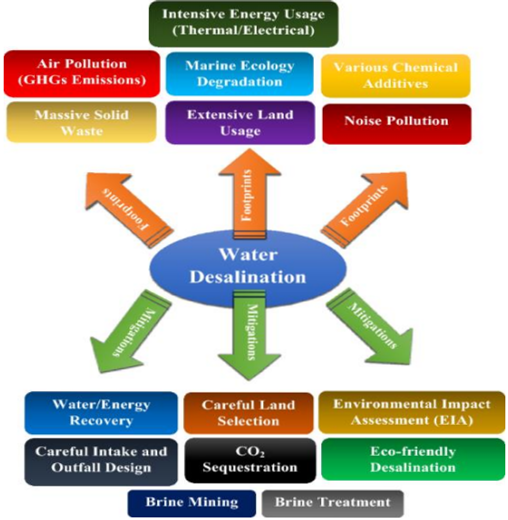
While desalination systems offer reliable water supply and socioeconomic welfare, they also lead to potential negative impacts on the environment. The following picture depicts desalination impacts and potential mitigation measures:
Figure I Desalination environmental impacts and mitigation avenues
Environmental impacts of brine discharges
Concentrated brine discharge to sea is the main waste product of desalination plants. Brine discharges from desalination plants lead to higher salinity, elevated temperatures and release of source water conditioning chemicals. The desalination wastewater salinity ranges 55 to 70 parts per thousand (ppt) compared with regular ocean salinity of 35 to 45 parts per thousand worldwide Ref 110. Brine produced through reverse osmosis process has approximately twice the salinity of seawater, while thermal desalination processes produce brines of approximately 1.5 times seawater salinity. Brine plumes of waste dissipate rapidly, and salinity stress is often limited to organisms located directly in the vicinity of the outflow Ref 72 Ref 75. Spatial distribution of brine plume (including perimeter, flow direction and buoyancy) varies according to discharge volume, rate and dispersion technology Ref 82. An increase in salt concentration raises water density and turbidity and fosters stratification of receiving water Ref 65. Various chemicals used and produced during the desalination process end up in brine discharges. These compounds include chlorine, anti-scalants, coagulants, flocculants, strong acids or bases, oxidizing agents, reducing agents, antifouling agents, foaming inhibitors and heavy metals that are released into the water Ref 82 Ref 28 Ref 72. These compounds have the potential to alter the pH of the water, increase the amount of nutrients and produce more algae Ref 28. Overall, it is well established that brine discharge for desalination plants pose serious environmental concerns.
Impacts on marine life and source environment
Environmental impacts of desalination plants on marine life and source environment depend upon factors such as nature of feed water, desalination technology used and waste brine management Ref 66. On the water intake side of desalination plants, marine life is affected through three main processes: entrapment, impingement and entrainment. Entrapment involves trapping marine species in systems with long offshore pipelines and screens at the onshore end. During impingement, aquatic organisms are sucked against the intake screens and cannot escape. Entrainment occurs where smaller species pass through the intake screens and are impact subsequently killed during the desalination processes Ref 71. The primary impact of conventional open-ocean intake systems impingement and entrainment of marine organisms. Submerged pipelines or open intakes of desalination plants remove fish eggs and small marine organisms (such as plankton and larvae) from seawater Ref 66 Ref 82. Entrainment also affects membrane biofouling associated with the intake of seawater and toxins in the seawater from harmful algal blooms Ref 10. It is well established that desalination plant water intake structures widely impact nearby marine life.
For locations with closed or shallow circulations, sluggish currents and abundant marine life, the impact of the brine plume can be significant on the local marine ecosystem Ref 78. The temperature rise due to brine discharges causes lowering of dissolved oxygen content in receiving waters, increased metabolism rate of its faunal inhabitants and elicits physiological and behavioural responses in organisms Ref 65. Concentrate disposal can locally harm benthic communities if poorly diluted discharge is allowed to flow across the marine bottom Ref 66. Brine discharges may cause depletion of benthic community abundance and diversity Ref 96. Brine effluent impacts coastal species (such as bacteria, zooplankton, seagrass, fish larvae and corals). Studies have suggested alteration of activity and diversity of bacteria and microalgae, reduction in meiofauna abundance and impacts on the physiology of seagrass meadows near outfall sites Ref 82. These processes can lead to the disruption of marine habitats and ecosystems by altering the connections between ecosystem elements. In this context, the development of marine protected areas (MPAs) in coastal waters requires careful planning around the location of desalination facilities so that connectivity between MPAs is not lost owing to the impacts of brine or thermal plumes Ref 42. See section 3 of the present Assessment for additional information on MPAs. Overall, studies indicate that brine discharges have wide-ranging impacts on marine life and require continued investigations to establish specific trends, which are recognized, but findings are still incomplete.
Air pollution impact of desalination plants
Energy requirements for the desalination process depend upon the technology used, system details and the salinity of the water being used as source Ref 56. Desalination is an energy intensive process that still relies heavily on fossil fuels. Intensive application of energy is mainly associated with fossil fuel burning, electricity generation, plant lighting, freshwater and brine transportation Ref 9. Large-scale reverse osmosis plants produce water at a rate of between 2.5 kWh and 4 kWh per m3 compared with approximately 0.3 kWh per m3 for the treatment of conventional sources of potable water Ref 80 Ref 126. Desalination plants utilize 5% of the total energy consumed by the water sector, and that value is expected to rise to 20% by 2040 (IEA, 2016). Only 1% of total desalinated water uses renewable sources. The expected growth of desalination, if not coupled with renewable energy, will cause a projected 180% increase in carbon emissions by 2040 Ref 23. In addition to direct use of renewables, indirect use for desalination will also be important. When electricity production from intermittent and variable renewables exceeds demand, surplus power can be used for desalination at low cost without having to shut down generation to stabilize the grid.
The air pollution initiated by desalination plants is significant owing to greenhouse gas emissions, primarily carbon dioxide (CO2) and acid rain gases, and other air contaminants produced during the production of electricity or steam from fossil fuels heavily influence the quality of air and accelerate global warming remarkably Ref 93. While energy consumption varies according to the energy mix, the type of plant and its size, it can nevertheless be estimated that at least 120 million tons of CO2 per year are generated by desalination sectors each year Ref 34. By 2040, installed desalination capacity worldwide is estimated to contribute 218 million tons of CO2 annually Ref 91. Lowering the carbon footprint of desalination technologies is becoming essential to reduce global warming and climate change impacts. This can be done by adopting measures towards sustainability, including improving the existing desalination systems and plants and relying on more sustainable energy sources. Mitigative strategies such as careful selection of land and intake and outfall design, brine mining, brine treatment, the application of green desalination technologies, water and/or energy recovery, environmental impact assessment and CO2 sequestration can help to reduce undesirable environmental footprints Ref 93. The use of renewable energy and mitigation strategies to minimize air pollution and climate change impacts is well established.
Socioeconomic and sociopolitical impacts
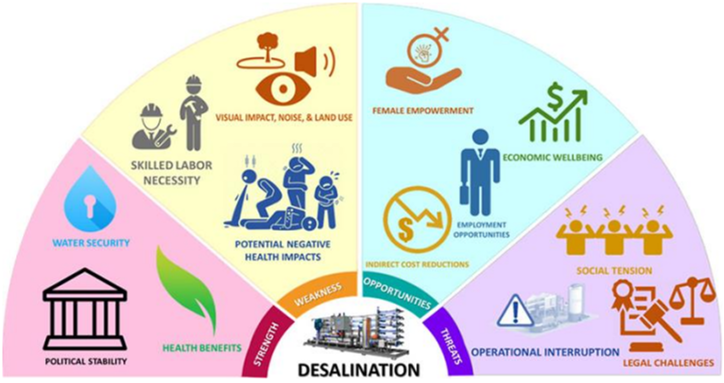
Desalination in the twenty-first century is inextricably tied to the changing paradigms of water management. Globalization of desalination is driven by techno-political factors, water management decentralization, the growing role of infrastructure as a source of revenue for financial actors entering the field of water management and pressure to facilitate economic growth in particular economic sectors Ref 119. The acceptance and proliferation of desalination systems are impacted by various environmental, economic and sociopolitical factors that are quite often intermingled and difficult to isolate Ref 47. This is especially true in regions heavily affected by climate change, where water crises and increased geopolitical risks arise. Strengthening cooperation between countries of the regions is needed to address these issues Ref 8. Desalination is generally available to regions that can either afford the upfront costs and operational expenditure or have an attractive financial risk profile for investors. This can lead to uneven development, where profitable areas are supplied with high-quality water and unprofitable areas are left unserviced. There is a growing body of research showing that desalination, depending on how it is deployed, can exacerbate social inequalities Ref 73 Ref 108. The strength, weakness, opportunities and threats (SWOT) analysis of the desalination sector identifies water availability, health benefits and political stability as key strengths, with employment and female empowerment as potential opportunities Ref 47. See subsection 5B, chapter 5, for additional details on these aspects. Further studies are needed to understand the global extent of social and economic impacts of desalination systems, as current findings remain inconclusive.
Figure II Sociopolitical factors impacting the desalination sector
3. Sustainability pathways
Technology
To achieve technological sustainability, efforts are focused on reducing costs and energy consumption and minimizing environmental impacts. Advances such as energy-efficient pumps, energy recovery devices and high-flux membrane materials have significantly reduced the energy consumption of reverse osmosis systems over the years Ref 5. The incorporation of carbon-based, metal-oxide based and cellulose-nanocrystals based nanoparticles in desalination membranes enhances performance, positively impacting sustainability Ref 89. Alternative system configurations, such as closed-circuit reverse osmosis, osmotically mediated reverse osmosis and multi-pass low-rejection reverse osmosis, potentially allow reduced specific energy consumption and increased water recovery Ref 57. Energy recovery devices such as pressure exchangers, Pelton wheels, Francis Turbines and hydraulic turbochargers have already been widely adopted in reverse osmosis systems to harvest hydraulic energy from brine Ref 27 Ref 97. Alternative technologies such as forward osmosis, capacitive deionization , membrane distillation , electrodialysis and electrodialysis reversal are aimed at cost minimization, improved plant operations, reduction in fossil fuel consumption, the use of renewable energy sources and cutting down greenhouse gas emissions Ref 32 Ref 61.
Apart from energy and greenhouse gas-related sustainability concerns, brine disposal remains a major challenge, particularly for inland desalination plants Ref 61. Sustainable brine management strategies are focused on reducing wastewater effluent volumes and recovering valuable materials such as water, minerals, salts and metals. To achieve this, brine discharge treatment technologies can be combined and integrated with minimal and zero liquid discharge systems. The zero liquid discharge approach is aimed at recovering 100% of freshwater while eliminating liquid waste and producing solid salt Ref 79. Another potential strategy is the recovery of osmotic energy from high-salinity brine, although its cost-effectiveness has yet to be demonstrated at commercial scale Ref 57 Ref 112. To mitigate the environmental impacts of high discharge temperatures on oceans, various approaches are employed, including heat recovery exchangers and low- temperature thermal desalination technologies Ref 26 Ref 70. In addition, water extraction from brine supports the Sustainable Development Goal 6 targets. As desalination technologies continue to evolve, advancements in recovery and reuse of water and other key materials from brine discharges are highly likely.
Environment
Environmentally safe and sustainable management of desalination systems is essential for long-term sustainability. Key mitigation strategies include site-specific environmental impact assessments, long- term monitoring programmes tailored to desalination sites and the application of the best available technologies for managing brine effluent Ref 40. The integration of renewable energy sources - such as solar, wind and geothermal - provides viable solutions for powering desalination plants, optimizing processes and reducing both energy costs and specific energy consumption Ref 1 Ref 77 Ref 88. Figure III illustrates the current status of various renewable energy technologies:
Figure III Commercialization status of various desalination technologies
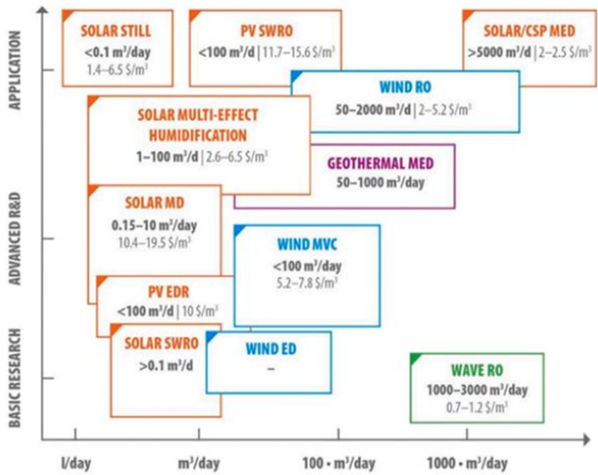
Solar energy use with battery storage on a large scale is a promising option. Solar photovoltaic powered reverse osmosis offers an effective alternative Ref 17. With plenty of sunlight, Arab countries are the biggest users of solar-powered desalination plants, followed by the United States, Australia, China, Central European countries, Mediterranean countries and Japan Ref 6. The following schematics show solar energy usage in desalination plants.
Figure IV Solar-powered desalination plants
Wind energy has matured into reliable technology, with many seawater reverse osmosis plants implemented in Australia Ref 111. After solar energy, wind power is the second-most frequently used renewable energy source for desalination plants. Constantly rising wind power production accounted for 18% (1,134 TWh) of the world's electricity production from renewable energy sources in 2017 in onshore and offshore applications. Direct wind power use for desalination plants would partially alleviate power grid flexibility and reduce environmental impact by up to 75% as compared with fossil fuels Ref 38. Hydraulic pressure stored in deep seawater can also output stable and successive energy flow Ref 25. Also, countries such as India, China, United States, Pakistan and Iran account for between 56% and 62% of global desalination demand for the irrigation sector. Through irrigation efficiency growth rate improvements, global desalination demand can be reduced by as much as 30% and 60% by 2050 Ref 19. Additional studies are needed for the desalination sector, to explore and establish the environmental benefits of replacing traditional fossil fuels with alternative renewable energy sources.
Management
Proper management of the desalination sector is necessary to minimize maladaptation and legal issues Ref 20. Key challenges include the disproportionate burden of tap water pricing on vulnerable households as compared with continental water sources Ref 109 and reduced incentives for adaptation owing to the perception of seawater as an infinite resource Ref 37, inter alia. To achieve sustainable desalination management, desalination plants are focused on optimizing resource use, ensuring operational continuity and implementing risk-mitigation strategies (Al- Saidi and others, 2023). The integration of systems such as geographic information systems (GIS) and supervisory control and data acquisition (SCADA) plays a crucial role in preventing water shortages. GIS enables visualization, analysis and asset management of desalination networks, while also assisting with data representation and spatial analysis through advanced tools Ref 51. Compliance with environmental regulations requires the continuous monitoring of operational impacts and adherence to legal thresholds Ref 8. Desalination plants implement comprehensive systems to predict, monitor and mitigate potential ecological impacts throughout all project phases, from planning and design to construction and operation Ref 110.
Economy and market
To cope with increasing water stress, the desalination industry is growing rapidly and emerging as one of the leading solutions. The majority of this growth has been in seawater rather than brackish water desalination. Desalination requires complex technology and significant capital expenditure with upfront investment. The capital expenditure for a desalination plant is estimated at between $0.65 million and $1.2 million for every 100 m3 per day of desalinated water Ref 34. Plant operating costs are high, mainly involving energy use, labour, replacements and chemicals. Of these, expenses from thermal and electrical energy are expected to be 50% of the total cost Ref 69. Average desalinated water production cost ranges from $0.5 per m3 for large plants to more than $1.25 per m3 for smaller plants. For mega plants in the Persian Gulf, production cost has reached competitive pricing of below $0.5 per m3 Ref 34. Since 2010, global installed capacity for water production from desalination plants has increased at an average rate of 7% per annum, corresponding to approximately 4.6 million m3 per day yearly Ref 33. By 2027, the global desalination market - which was estimated to be worth $17.7 billion in 2020 - is projected to grow to $32.1 billion. From 2020 to 2027, the desalination sector is expected to expand at a robust compound annual growth rate (CAGR) of 9.51% worldwide Ref 28. Figure V shows the size and spatial distribution of desalination facilities (>1000 m3 per day) Ref 50. Given past trends and current water scarcity challenges, it is highly likely that the number of desalination plants and global installed capacity will continue to increase in the future.
Figure V Global distribution of operational desalination facilities and capacities (>1000 m3 per day) by sectors user of produced water
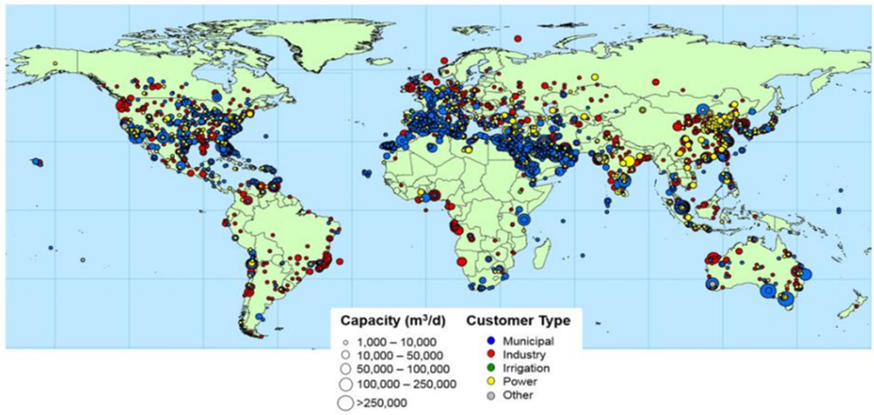
The power industry remains the largest owner of installed capacity for industrial purposes. The Seawater and Engineering-Procurement-Construction (EPC) model is the most frequently used feed water and plant delivery methods, accounting for 57% and 71.7% of global installed capacity, respectively. Capital cost accounts for the larger share of specific water production cost Ref 30. The number and capacity of desalination plants by geographic region, country income level and sectoral use of desalinated water suggest that half of the global desalination capacity is located in the Middle East and North Africa region, with Saudi Arabia, the United Arab Emirates and Kuwait being both the major producers in the region and globally Ref 50. In addition, the Middle East and North African States are committing to long-term action plans that involve the development of desalination plants. In most countries in these regions, desalination capacity is expected to double by 2030 or 2050 at the latest. Although the desalination sector is dominated by the Middle Eastern countries, there is also a trend towards geographical dispersal, with markets growing in North Africa, Asia and the Americas (Eyl- Mazzega and others, 2022). Coupled with this, the importance of desalination to a growing number of industries (e.g. mining in Chile, the manufacture of semiconductors in Taiwan Province of China), climate change and other pressures on traditional water resources, desalination is likely to continue to grow as an important frontier of the blue economy Ref 21. Europe, Africa and many other regions are experiencing a sharp rise in desalination capacities that did not support desalination in the past Ref 30. Overall, the global footprint of desalination plants will very likely continue to expand.
4. Social components
Benefits
Seawater desalination offers numerous environmental, socioeconomic and health benefits to humanity Ref 48. The most obvious benefit of desalination is providing drinking and domestic water to millions of people in large cities and especially dry regions (such as the Gulf Cooperation Council region) where reliable water supply is needed to sustain regional economies (Moossa and others, 2022). Many countries, such as The Bahamas, Maldives and Malta, meet all their water needs through the desalination process Ref 105. Apart from drinking and domestic water supplies, desalinated water is used in agriculture, industries, medical facilities, aquaculture and many other sectors. Water scarcity has led to the use of desalinated water for crop irrigation, especially in arid and semi-arid agricultural countries in the Mediterranean and Middle East and North Africa regions, such as south-eastern Spain and Israel Ref 60. When coupled with water reuse for irrigation, desalination can reduce groundwater extraction, enhance the water cycle and support adaptation to and mitigation of climate change impacts Ref 83. Another important benefit is salt production (liquid salt). Traditionally, evaporative ponds have been used in many countries with high evaporation rates to produce salt. With the emergence of desalination plants, use of this technology for salt production has been widely reported in the literature Ref 3 Ref 4. Regarding employment, job trends suggest that the global transition to 100% renewable energy across the power, heat, transport and desalination sectors is a widely recognized and firmly supported approach that will create more stable, local jobs essential for economic growth while reducing unemployment. Direct energy jobs across these industries are projected to rise from approximately 57 million in 2020 to nearly 134 million by 2050 Ref 84.
With its multiple benefits, desalination is increasingly being utilized beyond drinking water, proving its reliability and effectiveness across various applications.
Disbenefits
Despite its benefits, desalination has some serious drawbacks associated from its siting, functioning to the final use of produced water. Direct seawater intake at desalination plants can absorb planktonic organisms, fish eggs and larvae, inter alia, affecting traditional small-scale fishing Ref 66. In the same vein, brine discharge may affect local marine flora and fauna, and discharges can reduce fish populations owing to salinity and temperature increase, thus affecting activities that depend on marine resources Ref 54 Ref 72. Other impacts of the plants siting are related to land-use conflicts as desalination may compete with recreational coastal activities. Water scarcity has also led to the use of desalinated water for crop irrigation in the Mediterranean and Middle East and North Africa regions Ref 60. Although desalinated water is an abundant and climate-independent source, the use of desalinated seawater in agriculture is associated with a series of drawbacks such as high boron concentrations, a lack of plant nutrients (as compared with continental water sources), an accumulation of sodium in soil structure and the high cost. These downsides of desalination technology make it viable mostly for high- value crops Ref 52 Ref 60. Lastly, the use of desalinated water for human consumption may not guarantee water security or eliminate scarcity on smaller scales, such as that of the household Ref 62 Ref 35, while its integration into urban supply networks may increase the cost of tap water Ref 86, modify its organoleptic characteristics (Shomar and Hawari, 2017) and receive lower consumer approval Ref 46. What is more, studies on the health impacts of long-term desalinated water consumption indicate a decrease in magnesium levels Ref 15 Ref 55, a below-average iodine intake Ref 74 and a wide variability in concentrations of inorganic chemicals that are below or above the World Health Organization (WHO) recommended limits for drinking water Ref 87. Owing to multiple disadvantages, extensive studies are needed to properly establish correlations between desalinated water, human health impacts and effects on agricultural practices.
Equity
Various benefits and disbenefits associated with desalination are unevenly distributed, creating winners and losers. These highly context-specific benefits or burdens of desalination reflect on and reinforce existing socioeconomic inequalities. In a society where water system is characterized by entrenched inequality and structural problems, the introduction of desalination is likely to exacerbate these issues, whereas in a context characterized by a greater degree of equity, the benefits and dis-benefits of desalination are likely to be more evenly spread Ref 36 Ref 62. There is a growing body of research analysing the implications of desalination for equity and environmental justice (O'Neil and Williams, 2024). The high cost of desalination facilities compared with conventional water source options almost always contributes to rising water prices for consumers, unless subsidized by States or charities, which can create a burden on poorer households. Furthermore, it has been demonstrated that, in contexts where water supply systems are fragmented, or where there is no universal networked access to water, the introduction of desalination can further drive fragmentation, often supplying more affluent areas with high-quality water and leaving less profitable areas underserviced (Fragkou, 2018; Velásquez and Wachtendorf, 2023). As desalination technologies are increasingly rolled out in the global South, there is growing concern that in certain contexts they may have the unintended consequence of increasing water inequalities Ref 64 Ref 120. Inequalities exacerbated by desalination plants are site specific, widely spread across the sector and unresolved.
Gender
A World Bank utility survey from 64 utilities in 28 economies around the world suggests that women are underrepresented in the water sector. Despite a growing understanding of the importance of incorporating women in water management and industry, women represent barely 18% of water utilities employees and occupy approximately 23% of engineering and managerial positions in the water sector. This reflects the low presence of women in science, technology, engineering and mathematics (STEM) professions, which is a global trend that is gradually changing Ref 124. There are some specific examples of this situation being overturned in the desalination sector, such as training programmes in the field of reverse osmosis exclusively for women in Saudi Arabia (SWM), 2022). In line with this trend, women also tend to have less knowledge of coastal processes and marine ecosystems, which prevents them from taking informed decisions or participating in coastal decision-making processes related to desalination Ref 43. Existing data establishes that the desalination workforce is disproportionately distributed among genders, with an underrepresentation of women.
Public perception and acceptance
Public awareness and acceptance is an important aspect with infrastructure projects built to serve the public good. Regarding desalination, social preference and general public perception have been greatly influenced by coastal environmental effects and high energy consumption. Despite the benefits of new desalination projects, they often face strong opposition from a significant portion of society Ref 47. Opposition to or acceptance of desalination projects also depend on biological, ecological and environmental impacts, "not-in-my-back-yard" attitudes, the influence of sociodemographic variables (such as gender, age, education and race) on public acceptance Ref 41, concerns about marine impacts and lack of institutional trust Ref 44inter alia. As the use of seawater desalination continues to grow and large-scale desalination plants become more common, public opposition to desalination projects has also grown. While multiple surveys and studies have shown that the general public is supportive of seawater desalination, many environmental organizations and other public advocacy groups have become outspoken critics of desalination projects Ref 58 Ref 41 Ref 29. Desalination projects have been adapting to these concerns by developing greener, more sustainable approaches and establishing public-private partnerships for project development and governance. However, public perception of and support for desalination systems remain uncertain and are not yet well established.
5. Governance
Standards and frameworks
Clear rules, standards and frameworks contribute to achieving an open and transparent decision-making process for the permission and regulation of desalination projects (UNEP, 2008). These standards typically involve guidelines for the monitoring of design, construction, water quality, water excellence parameters, pollution, emissions, impacts on marine life and related aspects. In 1984, WHO first published the Guidelines for Drinking-Water Quality for safe drinking water supplies, covering a broad spectrum of contaminants and aimed at typical drinking water sources and technologies. There have been several updates and editions of the Guidelines (1993, 1996, 1997, 2006, 2008, 2017 and 2022) Ref 115 Ref 116. In 2003, UNEP/MAP published Sea water desalination in the Mediterranean: assessment and guidelines" to offer a common management approach for desalination projects, and it has been widely used by the Contracting Parties for monitoring desalination projects (UNEP/MAP, 2003). The UNEP report, Desalination Resource and Guidance Manual for Environmental Impact Assessments, was published in 2008, in association with WHO, offering guidance to regulators, project designers and decision makers to anticipate and address all relevant concerns associated with desalination projects and achieve maximum beneficial use of water (UNEP, 2008). To cover health and environmental aspects of desalination developments and supplement the Guidelines, WHO also prepared the document "Safe Drinking-water from Desalination" in 2011 Ref 117.
Legality and transboundary conflicts
Technical approval, financing and legal due diligence are essential for the successful completion of desalination projects. The formalization of projects and the relationships among the stakeholders involved are established through various contracts, including partnership agreements, framework agreements, agreements between lenders and guarantors, financing contracts, construction and operations contracts, water purchase and sale contracts, as well as lease and land use contracts Ref 67. Federal and state-level regulatory standards and permits are important for proper execution and handling of sensitive environmental aspects Ref 7 Ref 125. Regarding transboundary relations, the role of desalination is increasing in national strategies. Desalination provides countries with greater flexibility in negotiations; however, it can also reduce incentives for cooperation. These dynamics are most common in basins where at least one country is highly developed. However, desalination is also playing a role in transboundary basins such as the Nile and Mekong Ref 53. Some studies suggested that desalination can lead to greater cooperation between neighbouring States, either by reducing dependence on transboundary resources, such as rivers or aquifers, or by opening up new opportunities for cooperation, such as energy-for-water agreements Ref 12 Ref 16. Others, by contrast, have suggested that these technologies may exacerbate uneven power relations and tensions between States Ref 53.
Stakeholders engagement
To ensure transparency and address any community concerns, stakeholders' engagement is necessary during the planning, decision-making and implementation process (UNEP, 2008). From the 1980s, global acceptance of integrated water resource management has led to the decentralization of water management. Integrated water resource management also increased prospects for greater accountability, environmental sustainability, transparency, equity and stakeholder participation in water management processes Ref 81. International and regional guidelines from organizations such as UNEP, the Organisation for Economic Co-operation and Development (OECD), the International Dispensary Association foundation, the European Union and the United States Environmental Protection Agency provide frameworks to standardize these practices and stakeholder involvement in water governance. For example, OECD requirements for stakeholder engagement in water governance are focused on recognizing different actors with a stake, their varied responsibilities, encouraging stakeholders' capacity development, assessing and evaluating engagement processes, promoting conducive institutions, paying attention to underrepresented groups and identifying appropriate stakeholder engagement initiative Ref 113. Among integrated water resource management principles, stakeholder participation in desalination projects is considered a democratic right in many places because it is claimed to increase accountability, legitimacy and trust in governance Ref 81. Stakeholder engagement is a valuable tool for developing the common understanding of context that is needed for making sustainable water management decisions Ref 63.
Significant emphasis is placed on the role of the private sector in delivering desalination projects through public-private partnerships. This focus is evident both within the industry and among Governments and utilities in countries where desalination is widely deployed. One major impact of the expansion of desalination has been the acceleration of trends towards the privatization of water supply - or at least an increasing influence of private sector actors in water resource management Ref 59 Ref 118. Economically, these financial actors provide essential capital for infrastructure projects but may also lead to higher tariffs, disproportionately affecting low-income households. In this context, public-private partnerships have gained popularity as a means to integrate private sector actors into the provision of government services. Global trends indicate a growing reliance on public-private partnerships in the desalination industry, particularly in countries such as Australia, Israel and the United States. Research also suggests that the public sector depends on private partners for the design, construction and operation of desalination plants, regardless of the level of public financing Ref 39. While public-private partnerships play a crucial role in fostering balanced growth within the desalination sector, their long-term effectiveness remains an area of ongoing evaluation.
Cultural considerations and Indigenous rights
An estimated 476 million Indigenous people live in more than 90 countries around the world. Globally, they represent 18.7% of the extremely poor and approximately 33% of those living in extreme poverty in rural areas (OHCHR, 2022a). Indigenous Peoples' social, cultural and economic conditions distinguish them from non-Indigenous sections of society Ref 22. Traditionally, water quality in Indigenous territories has been preserved owing to their sustainable practices and the inaccessibility of many of these areas. However, the growing impacts of extractivism on natural resources and climate change have increasingly threatened access to safe drinking water, posing challenges under international human rights standards. Water pollution and lack of consultation on policies and projects affecting water and sanitation rights have undermined their access to clean water (OHCHR, 2022a). Lack of access to safe drinking water also disproportionately affects Indigenous women and girls (OHCHR, 2022b). In this context, the establishment of desalination plants in regions inhabited by Indigenous Peoples can pose challenges to cultural considerations and traditional practices. This is why it is crucial to consider that water and culture are strongly interlinked when implementing a desalination project. Indigenous knowledge related to water management and governance should be understood. The inclusion of cultural context is necessary in finding sustainable solutions in water governance Ref 11 Ref 45. The relationship between the desalination sector and its impact on global Indigenous societies is not yet properly established and hence needs to be investigated further.
References
- Abdelkareem, Mohammad Ali, and others (2018). Recent progress in the use of renewable energy sources to power water desalination plants. Desalination, 435, pp. 97-113.
- Al-Jabri, Salem, and others (2019). Comparative Analysis of Economic and Institutional Aspects of Desalination for Agriculture in the Sultanate of Oman and Spain. Desalination and Water Treatment, 156, pp. 1-6.
- Ahmed, Mushtaque, and others (2001). Brine disposal from reverse osmosis desalination plants in Oman and the United Arab Emirates. Desalination 133, No. 2, pp. 135-147.
- Ahmed, Mushtaque, and others (2003). Feasibility of salt production from inland RO desalination plant reject brine: a case study. Desalination 158, Nos. 1-3, pp. 109-117.
- Ahmed, Farah Ejaz, and others (2021). Emerging desalination technologies: Current status, challenges and future trends. Desalination, 517, pp. 115183.
- Almasoudi, Saleh M., and J. Bassam (2024). Desalination technologies and their environmental impacts: A review. Sustainable Chemistry One World, pp. 100002.
- Alonso, J. Jaime Sadhwani, and Noemi Melián-Martel (2018). Environmental regulations-inland and coastal desalination case studies. Sustainable Desalination Handbook, Butterworth-Heinemann, pp. 403- 435.
- Al-Saidi, Mohammad, and others (2023). Governing desalination, managing the brine: A review and systematization of regulatory and socio-technical issues. Water Resources and Industry, pp. 100225.
- Ameen, Fahad, and others (2017). The carbon footprint and environmental impact assessment of desalination. International journal of environmental studies, 75, No. 1, pp. 45-58.
- Anderson, Donald, and others (2017). Harmful Algal Blooms (HABs) and desalination: A guide to impacts, monitoring and management, Paris, France, Intergovernmental Oceanographic Commission of UNESCO, IOC Manuals and Guides No. 78, 539 pp.
- Angelakis, and others (2021). Desalination: From ancient to present and future. Water, 13, No. 16, pp. 2222.
- Aviram, Ram, and others (2014). Desalination as a game-changer in transboundary hydro-politics. Water Policy, 16, No. 4, pp. 609-624.
- Awaad, Hassan A., and others. Availability and Feasibility of Water Desalination as a Non-Conventional Resource for Agricultural Irrigation in the MENA Region: A Review. Sustainability 12, no. 18: pp. 7592, 2020.
- Backer, Sumina Namboorimadathil, and others. Brine solution: current status, future management and technology development, Sustainability 14, no. 11: 6752, 2022.
- Ben Zaken, Sara, and others (2020). Water desalination, serum magnesium and dementia: a population- based study. Journal of Water and Health, 18, No. 5, pp. 722-727.
- Bromberg, Gidon, and others (2020). A Green Blue Deal for the Middle East. EcoPeace.
- Bundschuh, Jochen, and others (2021). State-of-the-art of renewable energy sources used in water desalination: Present and future prospects. Desalination, 508, pp. 115035.
- Cai, Meiquan, and others (2023). Impact of pipeline materials on water quality stability of desalinated seawater in the pipeline network. Desalination, 556: 116558.
- Caldera, Upeksha, and Christian Breyer (2020). Strengthening the global water supply through a decarbonised global desalination sector and improved irrigation systems. Energy, 200, 117507.
- Campero, Cecilia, and Leila M. Harris (2019). The legal geographies of water claims: seawater desalination in mining regions in Chile. Water, 11, No. 5, pp. 886.
- Campero, Cecilia, and others (2023). Technologies of dispossession in the blue economy: Socio- environmental impacts of seawater desalination in the Antofagasta Region of Chile. The Geographical Journal, 189, No. 2, pp. 231-245.
- Cap-Net UNDP (2018). Training Manual: Indigenous Peoples & Integrated Water Resources Management. https://www.waterlex.org/wp-content/uploads/2021/04/Indigenous-IWRM-Jan2019-low- web.pdf.
- Caretta, Martina A., and others (2022). Climate Change 2022: Impacts, Adaptation, and Vulnerability. Contribution of Working Group II to the Sixth Assessment Report of the Intergovernmental Panel on Climate Change. Cambridge University Press, Cambridge, UK and New York, NY, USA, pp. 551-712.
- Cipollina Andrea, and others (2012). Integrated production of fresh water, sea salt and magnesium from sea water, Desalination and Water Treatment, 49, pp. 390-403.
- Cui, Yifan, and others (2021). A Hydrostatic Pressure-Driven Desalination System for Large-Scale Deep Sea Space Station. International Journal of Chemical Engineering, 2021, No. 1, pp. 8898472.
- Curto, Domenico, and others (2021). A review of the water desalination technologies. Applied Sciences, 11, No. 2, pp. 670.
- Das, Abhimanyu, and others (2024). Pressure exchanger batch reverse osmosis with zero downtime operation. Desalination, 574, pp. 117121.
- Do Thi, Huyen Trang, and others (2021). Comparison of desalination technologies using renewable energy sources with life cycle, PESTLE, and multi-criteria decision analyses. Water 13, No. 21, pp. 3023.
- Dolnicar, Sara, and others (2011). What affects public acceptance of recycled and desalinated water? Water research, 45, No. 2, pp. 933-943.
- Eke, Joyner, and others (2020). The global status of desalination: An assessment of current desalination technologies, plants and capacity. Desalination, 495, pp. 114633.
- Elsaid, Khaled, others (2020a). Environmental impact of desalination technologies: A review. Science of the total environment, 748, pp. 141528.
- Elsaid, Khaled, and others (2020b). Environmental impact of emerging desalination technologies: A preliminary evaluation. Journal of Environmental Chemical Engineering, 8, No. 5, pp. 104099.
- European Union (EU) (2024). Desalination. https://blue-economy-observatory.ec.europa.eu/eu-blue- economy-sectors/desalination_en#3.
- Eyl-Mazzega, Marc-Antoine, and Élise Cassignol (2022). The geopolitics of seawater desalination. Études de l'Ifri. Paris: Institut Français des Relations Internationales.
- Fragkou, Maria Christina, and Jamie McEvoy (2016). Trust matters: Why augmenting water supplies via desalination may not overcome perceptual water scarcity. Desalination, 397, pp. 1-8.
- Fragkou, Maria Christina (2018). Disclosing water inequalities at the household level under desalination water provision: The case of Antofagasta, Chile. In Tapping the oceans. Edward Elgar Publishing, pp. 76- 97.
- Fragkou, Maria Christina, and Jessica Budds (2020). Desalination and the disarticulation of water resources: Stabilising the neoliberal model in Chile. Transactions of the Institute of British Geographers, 45, No. 2, pp. 448-463.
- Greco, Francesca, and others (2021). Integration of wind energy and desalination systems: a review study. Processes, 9, No. 12, pp. 2181.
- Greer, Robert A., and others (2021). Public-private partnerships in the water sector: the case of desalination. Water Resources Management, 35, pp. 3497-3511.
- Gude, Gnaneswar (2018). Sustainable desalination handbook: plant selection, design and implementation. Butterworth-Heinemann.
- Haddad, Brent, and others (2018). Social issues and public acceptance of seawater desalination plants. Sustainable desalination handbook, pp. 505-525. Butterworth-Heinemann.
- Heck, Nadine, and others (2017). Management priorities for seawater desalination plants in a marine protected area: A multi-criteria analysis. Marine Policy, 86, pp. 64-71.
- Heck, Nadine, and others (2018a). Predictors of coastal stakeholders' knowledge about seawater desalination impacts on marine ecosystems. Science of the Total Environment, 639, pp. 785-792.
- Heck, Nadine, and others (2018b). Management preferences and attitudes regarding environmental impacts from seawater desalination: Insights from a small coastal community. Ocean & Coastal Management, 163, pp. 22-29.
- Heinrichs, Danielle H., and Rodrigo Rojas (2022). Cultural values in water management and governance: where do we stand? Water, 14, No. 5, pp. 803.
- Hurlimann, Anna, and Sara Dolnicar (2016). Public acceptance and perceptions of alternative water sources: A comparative study in nine locations. International Journal of Water Resources Development, 32(4), pp. 650-673.
- Ibrahim, Yazan, and others (2021). The sociopolitical factors impacting the adoption and proliferation of desalination: A critical review. Desalination 498, 114798.
- Ihsanullah, Ihsanullah, and others (2021). Desalination and environment: A critical analysis of impacts, mitigation strategies, and greener desalination technologies. Science of the Total Environment, 780, pp. 146585.
- International Energy Agency (IEA) (2016). Water Energy Nexus, Excerpt from the World Energy Outlook 2016. https://www.iea.org/reports/water-energy-nexus.
- Jones, Edward, and others (2019). The state of desalination and brine production: A global outlook. Science of the Total Environment, 657, pp. 1343-1356.
- Kamal, Noha, and Mahmoud S. Ali (2024). Improving the operational efficiency of water desalination systems through the integration of GIS-SCADA. Urban Water Journal, 21, No. 1, pp. 131-142.
- Kaner, Avigail, and others (2017). Feasibility of desalination as an alternative to irrigation with water high in salts. Desalination, 416, pp. 122-128.
- Katz, David (2021). Desalination and hydrodiplomacy: Refreshening transboundary water negotiations or adding salt to the wounds? Environmental Science & Policy, 116, pp. 171-180.
- Kelaher, Brendan, and Coleman, Melinda (2022). Spatial extent of desalination discharge impacts to habitat-forming species on temperate reefs. Marine pollution bulletin, 175, pp. 113368.
- Koren, Gideon, and others (2017). Seawater desalination and serum magnesium concentrations in Israel. Journal of Water and Health, 15, No. 2, pp. 296-299.
- Lienhard, John, and others (2016). Low Carbon Desalination: Status and Research, Development, and Demonstration Needs, Report of a workshop conducted at the Massachusetts Institute of Technology in association with the Global Clean Water Desalination Alliance. MIT Abdul Latif Jameel World Water and Food Security Lab, Cambridge, Massachusetts.
- Lin, Shihong (2019). Energy efficiency of desalination: fundamental insights from intuitive interpretation. Environmental science & technology, 54, No. 1, pp. 76-84.
- Liu, Ta-Kang, and others (2022). Exploring the social acceptability for the desalination plant project: Perceptions from the stakeholders. Desalination, 532, pp. 115757.
- Loftus, Alex, and Hug March (2016). Financializing desalination: Rethinking the returns of big infrastructure. International Journal of Urban and Regional Research, 40, No. 1, pp. 46-61.
- Martínez-Alvarez, V., and others (2016). Seawater desalination for crop irrigation - A review of current experiences and revealed key issues. Desalination, volume 381, pp. 58-70.
- Mavukkandy, Musthafa, and others (2019). Brine management in desalination industry: From waste to resources generation. Desalination, 472, pp. 114187.
- McEvoy, Jamie (2014). Desalination and Water Security: The Promise and Perils of a Technological Fix to the Water Crisis in Baja California Sur, Mexico. Water Alternatives, 7(3), pp. 518-541.
- Megdal, Sharon B., and others (2017). Water governance, stakeholder engagement, and sustainable water resources management. Water, 9, No. 3, pp. 190.
- Millington, Nate, and Suraya Scheba (2021). Day zero and the infrastructures of climate change: Water governance, inequality, and infrastructural politics in Cape Town's water crisis. International Journal of Urban and Regional Research, 45, No. 1, pp. 116-132.
- Miri, Rachid, and Abdelwahab Chouikhi (2005). Ecotoxicological marine impacts from seawater desalination plants. Desalination, 182, No. 1-3, pp. 403-410.
- Missimer, Thomas, and Robert Maliva (2018). Environmental issues in seawater reverse osmosis desalination: Intakes and outfalls. Desalination, 434, pp. 198-215.
- Montano, Borja, and others (2021). The financial and legal feasibility of a desalination project. Desalination, 517, pp. 115238.
- Moossa, Buzaina, and others. Desalination in the GCC countries-a review. Journal of Cleaner Production, 357, pp. 131717, 2022.
- Nassrullah, Haya, and others (2020). Energy for desalination: A state-of-the-art review. Desalination, 491, pp. 114569.
- Natarajan, Sendhil Kumar, and others (2022). A review on low-temperature thermal desalination approach. Environmental Science and Pollution Research, 29, No. 22, pp. 32443-32466.
- Nielsen, Kristin, and others (2024). Potential environmental impacts of coastal desalination intake structures: Urgent data gaps and policy needs. Environmental Science & Technology Letters, 11, No. 5, pp. 384-393.
- Omerspahic, Mustafa, and others (2022). Characteristics of desalination brine and its impacts on marine chemistry and health, with emphasis on the Persian/Arabian gulf: a review. Frontiers in Marine Science, 9, pp. 845113.
- O'Neill, Brian F., and Joe Williams (2024). Progress in understanding the social dimensions of desalination and future research directions. Global Environmental Change, 87, pp. 102877.
- Ovadia, Yaniv S., and others (2016). Can desalinated seawater contribute to iodine-deficiency disorders? An observation and hypothesis. Public Health Nutrition, 19, No. 15, pp. 2808-2817.
- Panagopoulos, Argyris, and others (2019). Desalination brine disposal methods and treatment technologies-A review. Science of the Total Environment, 693, pp. 133545.
- Panagopoulos, Argyris (2021a). Beneficiation of saline effluents from seawater desalination plants: fostering the zero liquid discharge (ZLD) approach-a techno-economic evaluation. Journal of Environmental Chemical Engineering, 9, No. 4, pp. 105338.
- Panagopoulos, Argyris (2021b). Water-energy nexus: desalination technologies and renewable energy sources. Environmental Science and Pollution Research, 28, No. 17, pp. 21009-21022.
- Panagopoulos, Argyris, and Katherine-Joanne Haralambous (2020). Environmental impacts of desalination and brine treatment-Challenges and mitigation measures. Marine Pollution Bulletin, 161, pp. 111773.
- Panagopoulos, Argyris (2022). Brine management (saline water & wastewater effluents): Sustainable utilization and resource recovery strategy through Minimal and Zero Liquid Discharge (MLD & ZLD) desalination systems. Chemical Engineering and Processing-Process Intensification, 176, pp. 108944.
- Paraschiv, Spiru, and others (2023). An overview of energy intensity of drinking water production and wastewater treatment. Energy Reports, 9, Proceedings of 2022 7th International Conference on Renewable Energy and Conservation, pp. 118-123.
- Patel, Ekta J. (2023). Debating Desalination: Stakeholder Participation and Decision-Making in Southern California. Water Alternatives, 16, No. 2, pp. 509-540.
- Petersen, Karen, and others (2018). Impacts of seawater desalination on coastal environments. In Sustainable desalination handbook, Butterworth-Heinemann, pp. 437-463.
- Pistocchi, Alberti, and others (2020). Can seawater desalination be a win-win fix to our water cycle? Water Research, 182, pp. 115906.
- Ram, Manish, and others (2022). Job creation during a climate compliant global energy transition across the power, heat, transport, and desalination sectors by 2050. Energy, 238, pp. 121690.
- Randazzo, Serena and others (2024). Unlocking hidden mineral resources: Characterization and potential of bitterns as alternative sources of critical raw materials. Journal of Cleaner Production, 436, pp. 140412.
- Ricart, Sandra, and others (2021). Extending natural limits to address water scarcity? The role of non- conventional water fluxes in climate change adaptation capacity: A review. Sustainability, 13, No. 5, pp. 2473.
- Rizk, Zeinelabidin S. (2009). Inorganic chemicals in domestic water of the United Arab Emirates. Environmental geochemistry and health, 31, pp. 27-45.
- Saavedra, Aldo, and others (2021). Comparative analysis of conventional and emerging technologies for seawater desalination: Northern Chile as a case study. Membranes, 11, No. 3, pp. 180.
- Saleem, Haleema, and Syed Javaid Zaidi (2020). Nanoparticles in reverse osmosis membranes for desalination: A state of the art review. Desalination, 475, pp. 114171.
- Salinas-Rodríguez, Sergio, and others (2021). Introduction to desalination, Seawater Reverse Osmosis Desalination: Assessment and pretreatment of fouling and scaling, IWA Publications.
- Shahzad, Muhammad Wakil, and others (2017). Energy-water-environment nexus underpinning future desalination sustainability. Desalination, 413, pp. 52-64.
- Sharkh, Basel Abu, and others (2022). Seawater desalination concentrate - a new frontier for sustainable mining of valuable minerals. Clean Water, 5, No. 1, pp. 9.
- Shokri, A., and M. Sanavi Fard (2023). A comprehensive overview of environmental footprints of water desalination and alleviation strategies. International Journal of Environmental Science and Technology, 20, No. 2, pp. 2347-2374.
- Shomar, Basem, and Jalal Hawari. Desalinated drinking water in the GCC countries-The need to address consumer perceptions. Environmental research, 158, pp. 203-211.
- Smart Water Magazine (SWM) (2022). https://smartwatermagazine.com/news/engie/first-reverse- osmosis-desalination-training-and-hiring-program-launched-saudi-women.
- Sola, Iván, and others (2020). Sustainable desalination: Long-term monitoring of brine discharge in the marine environment. Marine Pollution Bulletin, 161, pp. 111813.
- Takabatake, Hiroo, and others (2021). Advanced technologies for stabilization and high performance of seawater RO membrane desalination plants. Membranes11, No. 2, pp. 138.
- Tridge (20210. Industry Report: Salt, Industry_Report _-_ Salt_final.pdf (tridge.com).
- UNEP/MAP (2003). Sea water desalination in the Mediterranean: Assessment and guidelines. MAP Technical Reports Series. Nairobi.
- United Nations Human Rights (UNHR) (2022a). Water & Sanitation: Indigenous peoples face growing challenges to access safe water. https://www.ohchr.org/en/stories/2022/10/indigenous-peoples-face- growing-challenges-access-safe-water.
- United Nations Human Rights (UNHR) (2022b). Indigenous Peoples' Deep-Seated Care for Water and Water Bodies is a Genuine Expression of Sustainability and an Eco-System Approach such as the World is Now Trying to Implement, Special Rapporteur Tells Human Rights Council.
- https://www.ohchr.org/en/press-releases/2022/09/indigenous-peoples-deep-seated-care-water-and-water- bodies-genuine.
- United Nations (UN) (2017). The Ocean Conference, Factsheet: People and Oceans, https://sustainabledevelopment.un.org/content/documents/Ocean_Factsheet_People.pdf.
- United Nations Environment Programme (UNEP) (2008). Desalination Resource and Guidance Manual for Environmental Impact Assessments. United Nations Environment Programme, Regional Office for West Asia, Manama, and World Health Organization, Regional Office for the Eastern Mediterranean, Cairo.
- UNEP (2021). Five Things to Know About Desalination. https://www.unep.org/news-and- stories/story/five-things-know-about-desalination.
- United Nations Water (UN Water) (2018). Sustainable Development Goal 6 Synthesis Report on Water and Sanitation.
- United States Geological Survey (USGS) (2024). National Minerals Information Center, Mineral Commodities Summary 2024.
- Velásquez, Carolina, and Tricia Wachtendorf (2023). Desalination and the Reproduction of Water Injustices in the San Andrés Island Water Crisis. Water Alternatives, 16, No. 2, pp. 632-658.
- Vicuña, S., and others (2022). Desalination: Opportunities and challenges to address water insecurity in Chile. Scientific Ministerial Advisory Committee on Climate Change; Ministry of Science, Technology, Knowledge and Innovation. Government of Chile (in Spanish).
- Voutchkov, Nikolay, and others (2019). Sustainable Management of Desalination Plant Concentrate- Desalination Industry Position Paper-Energy and Environment Committee of the International Desalination Association (IDA). The International Desalination Association World Congress on Desalination and Water Reuse, pp. 1-32.
- Voutchkov, Nikolay (2023). Striving for desalination's gold sustainability standard. Feature article 2023, The Source, International Water Association.
- Wang, Qun, and others (2019). Investigation of the reduced specific energy consumption of the RO-PRO hybrid system based on temperature-enhanced pressure retarded osmosis. Journal of Membrane Science, 581, pp. 439-452.
- Wehn, Uta, and others (2019). Stakeholder engagement in water governance as social learning: lessons from practice. OECD Principles on Water Governance, pp. 34-59. Routledge.
- Wenten, Gede, and others (2017). Integrated processes for desalination and salt production: A mini- review. AIP Conference Proceedings, AIP Publishing, vol. 1818, No. 1.
- WHO (2008). Desalination for safe water supply, guidance for the health and environmental aspects applicable to desalination, World Health Organization Geneva, Eastern Mediterranean Regional Office Cairo.
- WHO (2009). WHO Guidelines for Drinking-water Quality: Policies and Procedures used in updating the WHO Guidelines for Drinking-water Quality, Public Health and the Environment World Health Organization Geneva.
- WHO (2011). Safe Drinking-water from Desalination, WHO/HSE/WSH/11.03.
- Williams, Joe (2018). Assembling the water factory: Seawater desalination and the techno-politics of water privatisation in the San Diego-Tijuana metropolitan region. Geoforum, 93, pp. 32-39.
- Williams, Joe (2022). Desalination in the 21st century: a critical review of trends and debates. Water Alternatives, 15, No. 2, pp. 193-217.
- Williams, Joe, and others (2023). Unconventional waters: A critical understanding of desalination and wastewater reuse. Water Alternatives, 16(2), pp. 429-443.
- World Bank (2013). 7 Things You May Not Know About Water, World Bank Blogs.
- https://blogs.worldbank.org/en/opendata/7-things-you-may-not-know-about- water# :~: text=2)%2097.5%25%20of%20the%20world's,rest%20is%20frozen%20or%20underground.
- World Bank (2019a). The role of desalination in an increasingly water-scarce world. World Bank, Washington, D.C.
- World Bank (2019b). Women in Water Utilities: Breaking Barriers. World Bank, Washington, D.C. http://hdl.handle.net/10986/32319.
- Younos, Tamim, and Juneseok Lee (2019). Desalination: opportunities and challenges. Water Environ. Technol, pp. 22-27.
- Zarzo, Domingo, and Daniel Prats (2018). Desalination and energy consumption. What can we expect in the near future? Desalination, 427, pp. 1-9.