
Coastal development
Writing team: Dahai Liu (coordinating author) (China), Kwasi Appeaning Addo (lead member), Jahson Berhane Alemu, Louis Celliers, Piyali Chowdhury, Anya Dunham, Matthew Eliot, Alex Faerman, Yuting Hou, Olanlo Kadjogbe Abra, Jenna Lamphere, Mina Ogbanga, Aline Sbizera Martinez, Vanessa Stelzenmüller, Curt Daron Storlazzi, Pascal Thoya, Karenne Tun (co-lead member), Ant Türkmen, Ourania Tzoraki and Wenxiu Xing.
Key points
As a focal point of global urbanization, the coastal zone faces multiple pressures from human activities, land-sea interactions and natural disasters. Over the past five years, population, communities and infrastructure in coastal zones have consistently grown, alongside gradual economic recovery. Coastal pollution has become more complex owing to climate change and the coronavirus disease (COVID-19) pandemic, necessitating enhanced monitoring and control measures. Public participation has been diversified but still faces difficulties in awareness-raising, policy strengthening, equity and comprehensiveness.
For the coastal zone, integrated management will continue to be needed in order to achieve a balance between economic performance and ecological environment. Climate change will be a key factor to consider in every aspect of coastal zone development. To build inclusive, safe and disaster-resilient communities while reducing negative environmental impacts and achieving a sustainable coastal economy, greater emphasis must be placed on green-grey infrastructure, ecosystem-based approaches, institutional integration and sociocultural aspects. In addition, urgent breakthroughs are needed in areas such as data collection, technology synthesis, integrated land-sea management, transboundary cooperation and policies and technical innovations related to natural and nature-based features and nature-based solutions.
1. Introduction
The coastal zone is broadly defined as the transition region where the land meets the ocean, encompassing both the shoreline and the adjacent marine environment and the terrestrial environment influenced by the presence of the sea. More specifically, the near-coastal zone is defined as land within 100 km of the coast and at an elevation of up to 100m Ref 130. The low-elevation coastal zone, which is often used as a proxy for land potentially at risk for future coastal hazards, refers to land with an elevation of up to 10 m Ref 91.
The coastal zone supports a myriad of productive and valued ecosystems that are interdependent. These areas are essential for human settlements and cultural values, including for fisheries, tourism, recreation and trade, with associated susceptibility to pressures from various activities. Coastal zones are also susceptible to natural hazards such as tropical storms, tsunamis and sea level rise. As climate change accelerates, the intensity of these hazards is expected to increase, making the management of these areas more critical and complex. Under multiple threats, integrated approaches must be adopted to balance ecological health, economic performance and social well-being.
In recent years, topics such as the impacts of human activities, land-sea interactions, climate change adaptation and science-management-policy translation mechanisms have been receiving increasing attention. This chapter contains an analysis of the current status of urbanization, economy and pollution of coastal zones at a global level and a summary of the development of relevant nature- and ecosystem- based solutions and approaches, as well as public participation, to provide management insights for future development.
2. Pressures and impacts
Status and trends in populations and infrastructure
The coastal zone contains some of the world's most densely populated and fastest growing urban areas, as well as many smaller communities. Globally, approximately 2.15 billion people live in the near-coastal zone and 898 million live within the low-elevation coastal zone Ref 121. This represents a significant increase from 1990, when an estimated 1.2 billion people lived in the near-coastal zone (Small and Nicholls, 2023). Coastal populations are especially concentrated in East, South-East and South Asia Ref 17. Although estimates vary, the number of people living in the near-coastal zone and low-elevation coastal zone could increase to 2.9 billion and 1.2 billion, respectively, by 2100 Ref 121. In some coastal areas, the population is anticipated to grow by more than 60% within the next decade Ref 46.
Coastal infrastructure includes coastal and foreshore defence structures, residential and commercial developments, transport and tourism/recreational facilities and energy and food production-related structures Ref 40. A quantitative assessment of the global extent of such structures was not available at the time of publication of The Second World Ocean Assessment. Bugnot and others (2021) estimated the combined physical footprint of marine built structures (covered in sect. 4, chap. 6) and coastal built structures (described here) to be at least 32,000 km2 worldwide as at 2018, expected to increase to 39,400 km2 by 2028 (see figure I). The area of seascape modified around structures was 1.0- 3.4×10⁶ km2 in 2018. The exclusive economic zone with the greatest amount of marine built structures was China, followed by the Republic of Korea and the Philippines. Most of the physical footprint of wind and tidal farms was located on the coast of the United Kingdom of Great Britain and Northern Ireland, with the rest spread along the coasts of North America, India, Germany and in the Asian North Pacific. Tunnels and bridges were mainly located in the northern hemisphere; breakwaters for coastal defence occupied the greatest amount of area in Italy; and 34% of marinas were in the United States and Canada. However, the physical footprint of breakwaters for regions with substantial coastal modification (for example, China) was not available Ref 13. The availability and quality of data on the extent of infrastructure vary depending on structure type and geographic location. Data for regional industries such as recreational marinas and aquaculture are particularly incomplete Ref 13. It is especially challenging to quantify structures that are static throughout much of their lifespan but are occasionally moved to other locations, such as floating docks, homes, lodges and aquaculture facilities Ref 57.
The projected increase of human population living in the low-elevation coastal zone Ref 71 will continue to prompt many of the world's coastal cities to extend their boundaries seaward by filling in coastal wetlands and shallow seas. Sengupta and others (2023) quantified coastal reclamation by 135 major coastal cities around the world, finding that 78% (106 out of 135) of these cities had reclaimed a total of 253,000 ha of additional land from 2000 to 2020. Reclamation is a global-scale phenomenon in the twenty-first century, especially prominent in East Asia, the Middle East and South-East Asia, followed by Western Europe and West Africa. The most common (>70 cities) land uses on reclaimed spaces are port extensions Ref 128, a trend that may continue owing to sustained increases in container shipping volume around the world Ref 163. Of the top 50 countries expected to experience the fastest population growth from 2020 to 2100, 86% are African, of which 72% are coastal Ref 150. Many of these countries are characterized by some of the largest remaining stretches of "unaltered" coastlines Ref 40, by contrast with, for example, the United States, where more than 50% of natural shorelines have been replaced by seawalls, breakwaters and other hard structures Ref 47.
Figure I Global extent of marine and coastal construction: area of physical footprint in 2018 (dark blue bars) and predicted for 2028 (light blue bars) (a); and modification of surrounding seascapes, by type of built structures (b)
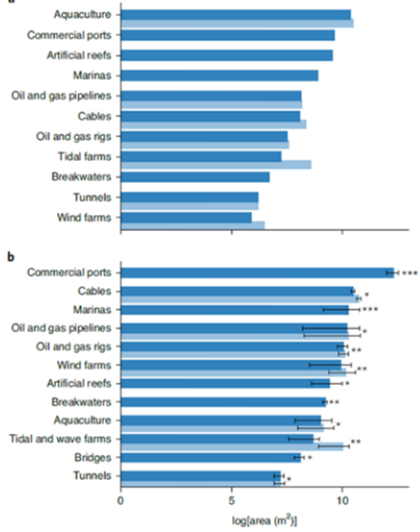
Note: Marine structures (oil and gas pipelines and rigs and cables) are covered in sect. 4, chap. 6. Future projections were available only for aquaculture, submarine cables, wave, tidal and wind farms and oil and gas pipelines and rigs; no wave farms were operational up to 2018, hence only future projections are presented.
* Scale of seascape modifications: adjacent (<100 m); ** scale of seascape modifications: local (>100 m to <10 km); *** scale of seascape modifications: regional (>10 to hundreds of km).
Increasing climate risks for urbanization
Growth in coastal urban areas and communities increases the coastal hazard exposure for populations (Magnan and others, 2022), infrastructure such as ports Ref 63 and roadways Ref 70, economic assets Ref 72 and cultural heritage Ref 122. As noted in chapter 8 of The Second World Ocean Assessment, the vulnerability of coastal and communities to the impacts of climate change is also increasingly concerning Ref 151. However, the quantification of climate risks is difficult owing to a variety of uncertainties, including future socioeconomic policy scenarios, anticipated physical processes and model limitations Ref 125. Risk is therefore often reported in terms of expected levels of impact and central confidence bounds, as opposed to probabilities.
According to the Intergovernmental Panel on Climate Change (IPCC), there is high confidence that projected climate risks will increase with greater exposure to ocean-driven hazards Ref 48. IPCC (2022) reports with medium confidence that, if global mean sea level rises by 0.15 m relative to 2020 levels, the population exposed to a 100-year coastal flood is projected to increase by 20%. There is high confidence that coastal flood risk will rapidly increase by 2-3 orders of magnitude by 2100 and medium confidence that this will result in the exposure of $7-14 trillion of coastal infrastructure assets Ref 48. While there is significant regional variation, risks are especially acute for urban areas and communities located in the Arctic Ref 139, on low-lying or subsiding small islands Ref 136 and along estuarine and deltaic coasts (Nienhaus and others, 2023). Under all climate and socioeconomic scenarios, IPCC (2022) reports with very high confidence that such high-risk areas and communities will experience severe disruption by 2100, with some experiencing such disruption as early as 2050.
Risks to coastal urban areas and communities depend not only on hazard exposure but also vulnerability, in terms both of social conditions (i.e. susceptibility) and capacity to respond (i.e. resilience) Ref 133. While vulnerability varies by country, in a recent cross-country comparison, developed countries were found to be significantly less susceptible and better equipped to deal with climate risks than developing countries Ref 126. Developing countries are often more susceptible owing to poor natural and built environments, poverty and weak socioeconomic status Ref 53. Developing countries also tend to have less capacity to combat climatic events, as compared with developed countries that have greater stocks of capital that can be mobilized to combat climate risks Ref 94. While no country can escape climate risk, exposure, susceptibility and resilience interact in a dynamic process that results in an uneven distribution of vulnerability that is not strictly environmental but also social and economic (Thomas and others, 2018).
Economic performance
The coastal economy refers to all economic and industrial activities that take place in or around coastal areas. The activities represent a significant proportion of global gross domestic product (GDP) owing to their economic diversity. The coastal economy is also a major driver of employment in many coastal regions, especially in developing countries, where it provides crucial opportunities for local communities. The COVID-19 pandemic had a significant impact on the global coastal economy, with disruptions to trade, tourism and supply chains. Coastal areas experienced economic contraction at the start of the pandemic, but recovery has varied by region and sector. Coastal tourism saw a dramatic decline in 2020, with a decrease in international arrivals of more than 70% as compared with 2019, according to the World Tourism Organization (UNWTO).
In 2021, economic recovery was uneven. Coastal areas in developed countries, such as the United States, and in Europe, generally experienced a faster recovery thanks to economic stimulus plans and effective vaccination campaigns. Conversely, coastal areas in developing countries had slower recoveries owing to structural challenges and a heavier reliance on tourism. According to data from the World Bank and the International Monetary Fund (IMF), the global coastal economy has shown an average growth of 3% to 4% per year since 2022, with significant variations depending on the region and sector. Since 2021, trade volumes have rebounded, with robust growth in imports and exports. Data from the World Trade Organization (WTO) show an average growth in global trade volumes of 5% to 6% per year since 2022.
Coastal pollution
Coastal pollution is a pervasive and growing problem worldwide, threatening the health of marine ecosystems, human well-being and the economy. The coastal zone is vulnerable to pollution owing to its proximity to human activities such as industrialization, agriculture and urbanization. Pollution in coastal areas includes plastic debris Ref 28, nutrients Ref 50 Ref 61, metals Ref 77 and persistent organic compounds (Nunes and others, 2011), inter alia. Different geographical regions have faced different challenges over the past few years, such as the rapid industrialization and inadequate waste management in Asia-Pacific, the dense shipping lanes, oil rigs and agricultural run-off in the Mediterranean and the limited waste management infrastructure in Africa Ref 146.
There are also many new perspectives that deserve attention. Global issues of marine pollution are interlinked with climate change, and understanding these connections is key to managing these combined risks Ref 76 Ref 43. For instance, extreme weather events contribute to debris of various shapes and weights known to exacerbate the overall damage to the coastal environment through collision and damming loads Ref 110 Ref 20. Haarr and others (2022) argue that the geographical distribution of empirical data on marine litter stranded on coastal zones corresponds relatively poorly to the estimated geographical differences in annual mismanaged plastic waste Ref 74. Western Asia, Europe (excluding Eastern Europe), the Caribbean, North America and Oceanic countries contribute relatively little mismanaged plastic waste but have been comparatively well studied. Conversely, Africa, Asia (excluding Western Asia) and Central America were poorly studied, although they have high rates of mismanaged plastic waste. This suggests a mismatch between poorly managed plastic waste and research initiatives documenting the problem. Plastics are the most abundant waste category in coastal environments Ref 58, and it should be noted that the global COVID-19 outbreak is estimated to have contributed an extra 3.4 billion single-use facemasks/face shields daily Ref 9. An assessment of the direct economic costs of marine litter for a coastal region demonstrated that marine litter created costs and inconvenience for stakeholders engaged in marine activities, leading to significant financial burdens for small communities Ref 124.
3. Sustainability pathways
Climate change adaptation
Natural coastal habitats can provide an effective first line of defence against climate change-related issues Ref 119 Ref 138. However, these natural protection services may be compromised as coastal habitats are degraded or lost owing to sea level rise, water level fluctuations and encroaching coastal development Ref 4 Ref 117 Ref 23 Ref 100. The proliferation of marine-built structures provides a suite of benefits but can also have unintended and sometimes hidden costs. The artificialization of the global coastline and the threats posed by the warming climate are driving humanity to develop novel solutions that halt biodiversity and habitat loss and enhance the marine built environment. Under these circumstances, enhancing environmental quality in heavily urbanized areas, adapting urban areas and the conservation, restoration or construction of coastal natural and nature-based features can provide a potential pathway to accomplish the multiple goals of managing coastal hazards, restoring native biodiversity and sustaining ecosystem functions and services Ref 89 Ref 97 Ref 2 Ref 12 Ref 42. Hence, integrating natural and nature-based features and ecoengineering into nature-based solutions is beneficial for addressing challenges posed by climate change, benefiting both people and nature.
Natural ecosystems in urban areas, such as estuarine margins and coastal beachfronts, can be restored to enhance ecological health and resilience. Such actions can be achieved through soft or hybrid ecoengineering approaches Ref 25 Ref 97 Ref 42. Ecological or green coastal and marine ecoengineering involves the use of natural materials and processes to enhance coastal resilience and restore ecosystems, such as planting mangroves or marsh grasses. Hybrid green-grey ecoengineering combines ecological approaches with traditional grey engineering techniques, such as integrating oyster reefs with seawalls or building concrete base structures and outplanting corals on top of them to provide both ecological and structural benefits. Currently, these initiatives are mostly concentrated along coastlines in temperate regions Ref 12. While integrated green-grey infrastructure is gaining significant attention from a policy standpoint, there is still limited research from engineering, scientific or economic perspectives regarding its integration and implementation Ref 73 Ref 106 Ref 19.
This underscores the urgent need to expand and accelerate such practices in other regions of the world, particularly in developing nations, which often have more people living in vulnerable areas and where coastal urbanization is occurring more rapidly Ref 40 Ref 92 Ref 121. Hard, grey coastal and marine ecoengineering offers a viable solution in urbanized areas modified by artificial structures, relying on local knowledge to achieve these goals Ref 135. It can adapt traditional engineered structures such as seawalls and breakwaters with more complex designs to enhance local biodiversity and ecosystem services Ref 97 Ref 157. This method could also be applicable to future interventions where green approaches are not feasible Ref 97, distinguishing itself from traditional engineering by prioritizing environmental sustainability. It is important to recognize that the above methods may not be universally applicable or inherently sustainable (Parkinson and Ogurcak 2018). Implementing grey, green or hybrid ecoengineering requires careful planning and further research, with caution to prevent "greenwashing" or "bluewashing" Ref 25 Ref 41. Adaptive monitoring programmes with appropriate quantitative measures are also needed to evaluate and enhance the efficiency of interventions to protect coastal cities (Bredes and others, 2024).
Despite the growing body of knowledge on nature-based solutions, gaps remain (Lacambra and others, 2024; Seddon and others, 2020). For instance, measures to quantify the effectiveness of natural and nature-based features at mitigating coastal hazards and adapting to climate impacts are still lacking (Viehman and others, 2023). Owing to the site-specific nature, decision makers often lack information on assessing their suitability in different environments. Research on natural and nature-based features suitability and monitoring is yet to be institutionalized into policy, regulations and decision-making. The development of risk-based valuations of the ecosystem services attributed to natural and nature-based features has been limited by the lack of high-resolution data on bathymetry, topography, ecosystems and economic asset and the difficulty in modelling complex hydrodynamic and ecological processes Ref 120. A better understanding of the hydrodynamics, morphodynamics and ecology across a variety of spatial and temporal scales, as well as across a range of types of natural and nature-based features, is critical for clearly defining the benefits of natural and nature-based features and advancing nature-based solutions.
The gaps in understanding also proliferate owing to a lack of studies on the broader effectiveness and the context-dependence of coastal nature-based solutions, including the scale of implementation, ecological characteristics and socioeconomic conditions. Specifically, there is a need for more empirical evidence on the long-term effectiveness and cost-benefit analysis of nature-based solutions as compared with traditional grey infrastructure. Chausson and others (2020) found that performance indicators, including cost, were broadly assessed for approximately 10% of coastal nature-based solution projects, including coral reef, mangrove, seagrass and saltmarsh restoration. This uncertainty also extends to grey infrastructure; however, a key difference between nature-based solutions and grey infrastructure is that nature-based solution adaptation services are hypothesized to increase over time, while grey infrastructure adaptation services may decline Ref 39.
Monitoring and control network
Coastal areas face ongoing threats from various pollutants and challenges from natural processes, such as coastal erosion, sea level rise and the degradation of cliffs and beaches. Effective monitoring and control networks are crucial to mitigate these impacts and preserve coastal environments.nAn example is presented for harmful algal blooms (red tides) and hypoxia (also known as "dead zones"), which can usually be monitored using in situ measurement, remote sensing and numerical modelling methods Ref 108. Detecting and forecasting their movement using available remote sensing and high-fidelity modelling technology is essential since traditional ship-based field sampling and analysis are very limited in both space and temporal frequency. Many countries have established red tide or algal bloom monitoring systems relying on satellite imagery, on-site observations, models and buoy data Ref 75 Ref 51. For example, the National Centers for Coastal Ocean Science (NCCOS) of the National Oceanic and Atmospheric Administration (NOAA) of the United States developed the Algal Bloom Monitoring System to routinely deliver near real-time products for use in locating, monitoring and quantifying algal blooms in coastal and lake regions of the United States (NOAA, 2023). The monitoring of pollutants such as sewage discharge, marine debris and microplastics in the ocean through remote sensing can be effectively accomplished by using sensitivity analysis, optical simulation and satellite image spectral analysis. To improve the accuracy and reliability of marine pollutant monitoring and forecasting, it is important to integrate remote sensing, numerical and artificial intelligence and machine learning modelling (e.g. Ou and others, 2022) with other monitoring tools such as ship sensors, buoy sensors, aircraft sensors and biosensor networks.
In terms of coastal erosion, technologies such as satellite imagery, drones and geographic information systems (GIS) are essential for tracking changes in the coastline. Near real-time data collection allows for the early identification of erosion hotspots and timely intervention. Effective mitigation strategies can be designed based on the comprehensive understanding of erosion patterns and their causes. For sea level rise, tide gauges, satellite altimetry and climate models are critical tools for measuring and projecting changes. These provide accurate data, enabling managers to assess risks and plan adaptive measures. Early warning systems and predictive models can help prepare communities and infrastructure for future sea level scenarios. Restoration of cliffs and beaches is essential for maintaining natural coastal defences against erosion and flooding, which often includes beach nourishment, revetments and sea walls. It is worth mentioning that all shoreline monitoring and management require a comprehensive coastal erosion modelling study in order to assess potential impacts and design appropriate mitigation measures.
The forecast modelling process typically includes the following steps. First is gathering historical and current data on waves, tides, sediment transport and shoreline changes with technologies such as instrument moorings, satellite imagery, aerial photography and field surveys. Second is utilizing computational models such as Delft3D, MIKE 21, the Regional Ocean Modeling System (ROMS) and SWAN (and the coupling of these models, e.g. COAWST (Warner and others, 2010)) to simulate coastal processes and predict future changes under various scenarios. These models can assess the impact of new infrastructure on flooding and/or erosion patterns and identify vulnerable areas. Third is evaluating different development and mitigation scenarios to understand their potential impacts on coastal flooding and/or erosion. This includes the construction of breakwaters, jetties and other structures, as well as natural solutions such as beach nourishment and vegetation planting (it should be noted that, for eroded shores, vegetation planting requires structures that protect the planted trees from wave action to be effective). Then follows risk assessment, which identifies areas at high risk of erosion and recommended mitigation strategies. This involves a combination of engineering solutions and ecosystem-based approaches. The final step is implementing continuous monitoring programmes to track the effectiveness of mitigation measures and adapt them as necessary on the basis of observed changes and new data.
Integrated land and sea management
The ecosystem approach - a strategy for the integrated management of land, water and living resources that promotes conservation and sustainable use in an equitable way Ref 15 - and similar concepts such as ecosystem-based management and ecosystem approach Ref 69, require integrated land and sea management, owing to the connectivity of terrestrial ecosystems, including watersheds and estuaries, with near-shore marine ecosystems. The concept is reflected in the classic pathway of integrated coastal zone management, which has been a policy option for more than 50 years and has been implemented in more than 100 States and regions, to promote integrated environmental protection and economic growth in the coastal zone Ref 169 Ref 129. At present, it is also increasingly emphasized in both land planning and marine spatial planning (also referred to as maritime spatial planning) to focus on the interaction of various elements at the land-sea interface, such as sociocultural, coastal erosion and climate change factors Ref 86 Ref 132.
From the perspective of planning practices, land and sea used to be studied and planned separately as two relatively independent parts, regardless of their synergistic effects. Currently, coordinated planning has become a direct means of resolving use conflicts and realizing synergistic development in many States and regions. For example, over the past five years, China has carried out reforms in spatial planning with the concept of land-sea coordination, which emphasizes seamless land and marine planning, paying attention to the coherence of different ecosystems, promoting the marine, coastal and land industry as a system and driving inland development through the marine economy. In the current Coastal Zone Plan, which is an important component of territorial spatial planning, the idea of land-sea coordination is fully emphasized through the integration of sectoral responsibilities, departmental cooperation, shoreline categorization and control and the idea of multiple plans in one Ref 79 Ref 159. Another example is the United Kingdom Marine Policy Statement (2011), which makes it clear that marine planning must interact with existing terrestrial planning, especially in physically overlapping areas. Land- use plans and marine plans share many common goals. Relevant policies suggest that the coordination of marine and terrestrial planning could be achieved through maintaining the coherence of different documents, enhancing the cooperation and communication between land and sea planning authorities, sharing data in the decision-making process and following the methods and principles of integrated coastal zone management. The consideration of land-sea interactions has also been clearly stated in various documents related to European Union maritime spatial planning, but specific pathways still need to be explored with more research and practices. These initiatives could support global efforts for sustainability, as the United Nations Environment Programme (2023) highlights the need to connect land and sea planning to better manage coastal and marine resources.
Transboundary management practices
Transboundary management requires coordinated and cooperative governance of marine resources and ecosystems that span the borders of multiple States or regions, which also often involves coastal zone areas. Marine spatial planning is the most prominent governance process that implements national regulations of human activities Ref 134. In transboundary settings such as in Europe Ref 84 or in the Yellow Sea Ref 83, where socioeconomic interests are confined to national management boundaries, but ecosystem health and resilience depend on ecosystem processes and exposure to human pressures at different scales, national marine spatial planning processes also face the challenge of international consultations Ref 34. Thus, transboundary management is confronted with a high level of complexity regarding the coordination of actions but also the enforcement and the monitoring of compliance, a lack of which can undermine the effectiveness of management regulations Ref 22. Next to the regulation of human activities, the implementation of marine conservation areas or marine protected areas (MPAs) may require transboundary coordination for enforcement and management efforts to ensure the protection of those areas of high conservation value and their respective assets. Examples of such transboundary management efforts can be found in the Mediterranean Sea area (the Network of Marine Protected Areas in the Mediterranean (MedPAN) or the Pelagos Sanctuary for Mediterranean marine mammals); South-East Asia and the Pacific (Coral Triangle Initiative on Coral Reefs, Fisheries, and Food Security (CTI-CFF)), the Wadden Sea (Trilateral Wadden Sea Cooperation) or the Caribbean Sea (Punta de Manabique Wildlife Refuge and Sarstoon-Temash National Park).nTo bridge the gap between European maritime spatial planning frameworks and the unique challenges of the Yellow Sea, it is imperative to foster enhanced collaboration between European nations and the States bordering the Yellow Sea. The Yellow Sea Large Marine Ecosystem has a history of regional cooperation, providing a foundation for further collaboration on transboundary management Ref 145. This collaborationnshould be focused on the sustainable management of shared maritime resources, robust environmental protection measures and the achievement of sustainable development goals. The European Union's International Ocean Governance agenda emphasizes the importance of multilateral cooperation to address global ocean challenges, which can serve as a model for the Yellow Sea region. By engaging in joint initiatives, sharing best practices Ref 32 and knowledge on enabling conditions Ref 171 and aligning policies, these regions can develop harmonized maritime spatial planning approaches that effectively manage transboundary marine ecosystems and address common environmental concerns. The importance of marine spatial planning in advancing ecosystem-based sea use management is crucial for addressing the complex interactions between human activities and the marine environment Ref 168. Such efforts would not only enhance the ecological health of the Yellow Sea Ref 83 but also promote socioeconomic benefits for the coastal communities dependent on these vital marine resources. Regional environmental governance initiatives, such as those focused on the Yellow Sea and Bohai Sea, offer valuable insights into the complexities of land-sea coordination in addressing pollution and promoting sustainable development Ref 78.nThe European Union underscores the paramount importance of multilateral cooperation in addressing global ocean challenges through its International Ocean Governance agenda. As a proponent of multilateral responses to global issues, the European Union endeavours to fortify the international rules-based framework. The European Union collaborates on ocean governance with bilateral, regional and multilateral partners globally, with its primary legal instrument being the United Nations Convention on the Law of the Sea. Through the European Union Maritime Security Strategy, the European Union addresses challenges impacting the security of the ocean, such as cross-border and organized crime, threats to freedom of navigation, threats to biodiversity, climate-related challenges and environmental degradation. The European Union's approach to ocean governance aligns with its broader foreign policy goals, promoting sustainable development, security and stability beyond its borders Ref 31.nBased on past cases of transboundary marine spatial planning, experiences of transboundary management can be summarized as follows. First is the very considerable role of transboundary and regional organizations, which can coordinate different administrative bodies, facilitate cooperation and promote research and implementation in the form of various funds. The second is the need to actively play an expert consultation role, which could bring together universities and research institutes from different regions to promote exchange and implementation. Third, the analysis and integration of different management systems and institutions, the interoperability, unification and disclosure of data and information from various sources and including various users and departments in the decision-making system are the key factors for ensuring the success of transboundary management. Fourth, communication, exchange, the identification of similarities and differences and negotiation and coordination among different management bodies are necessary throughout the process of all types of transboundary management practices.
4. Social components
Enhancing public participation
Coastal zone management is a public policy process for which community and public involvement in environmental decision-making is a critical element of governance Ref 33.bWorkshops, meetings, interviews, surveys, participatory mapping, social network analysis and virtual space are all methods to engage stakeholders and practise public participation (Ison and others, 2024;Sartorius and others, 2024). Each of these methods uniquely engages the public and gathers input, for example, workshops and meetings enable direct interaction, whereas interviews and surveys offer more in-depth responses. Participatory mapping empowers communities to visualize their environment, while social media and virtual spaces provide platforms for broader, more dynamic engagement.
While the concept is simple, the reality of encouraging participation is not. The decision on who to include is itself challenging and fundamental to the success of the process to broaden engagement in the governance of the coast Ref 118 Ref 16. The importance of public participation, social equity and agency is a growing topic in both the research into and the implementation of coastal policies Ref 103 Ref 99 Ref 95. The practice of public participation is thus an issue strongly related to the transformation of society to sustainability, increasing social equity and enabling the inclusion of human-nature connectedness, agency and leadership in the participation processes relating to coastal management Ref 140 Ref 160 Ref 37.
Public participation has long been legally embedded in the formal planning process for major developments through the process of environmental impact assessment Ref 66. It is also already part of most coastal management frameworks Ref 131 Ref 55. Participatory GIS mapping is used as a direct means of co-producing knowledge with stakeholder and community interests Ref 14. Public participatory GIS (PPGIS) has been demonstrated to be a valuable tool for policy advice and promoting the inclusion and empowerment of underrepresented populations in the decision-making process. Moreover, PPGIS allows for assessing the perception and acceptability of land and marine use planning from a social perspective Ref 154. For instance, the New Hampshire Living Shoreline Site Suitability Assessment applied GIS-based methods to identify appropriate sites for nature-based shoreline stabilization, integrating ecological, physical and social criteria into coastal planning Ref 5. There are also several emerging approaches. Citizen science is an integral part of a burgeoning global initiative aimed at involving the community in scientific research Ref 36. This approach fosters collaboration between non-professionals and scientists in a reciprocal process Ref 45. For instance, CoastSnap is a community beach monitoring programme that transforms everyday smartphones into tools for measuring coastal responses to cyclones, sea level rise, human modifications and other factors Ref 54. It is expected to significantly enhance understanding of changing coastlines and provide the scientific community with robust quantitative data. Co-production of knowledge is intended to improve decision quality through deliberation and collaborative management by fostering viable, fair and inclusive decision options and solutions Ref 144. For example, co-production of climate services for coastal flooding and the use of story maps offer the possibility to visualize scientific information and climate data in an accessible format and, as web-based tools, reach a large audience Ref 156. Another example is the United Nations Educational, Scientific and Cultural Organization (UNESCO)- Intergovernmental Oceanographic Commission (IOC) Tsunami Ready Recognition Programme, a voluntary, performance-based community recognition programme that promotes an understanding of the concept of readiness as an active collaboration among national and local warning and emergency management agencies and government authorities, scientists, community leaders and the public to build resilient communities through the fulfilment of a set of established indicators Ref 152.
COVID-19 posed a significant challenge for many coastal management processes. It also demonstrated that it is possible to work online with minimal impact on collaboration and engagement. While there are clear environmental benefits to public participation "going digital", it is crucial to recognize potential drawbacks. Public participation may become disengaged from coastal zone issues and management owing to a lack of digital literacy, the high costs of emerging technologies (such as virtual reality platform development) and the limited capacity to create and implement digital solutions Ref 90.
Enhancing participation through arts-based methods significantly contributes to coastal sustainability by raising awareness, fostering learning and promoting engagement and enjoyment among project participants Ref 87. Greater focus is required in urban policy and academic research on the implications of creating temporary urban art spaces for immediate inclusive engagement with end users and for sustained community development (e.g. the British Coast; see Zebracki, 2018). Art-science approaches could also offer valuable avenues for communication and enquiry Ref 111. Developing socioecological scenarios also involves a participatory process that engages stakeholders Ref 3. Scenario development as a tool describes various potential future states and has been utilized, for example, to aid coastal adaptation planning (Gray and others, 2020). The robust and structured stakeholder engagement process fostered strong local ownership of both the scenarios and the overall process Ref 3. Social media has emerged as a powerful tool for driving change by influencing conversations and boosting interest and participation Ref 155. These platforms are now well established as quick and effective means of disseminating information Ref 24. Social media can play a crucial role in engaging society with reliable information, altering habits and promoting sustainable behaviour Ref 107.
Human rights, equity, gender, and Indigenous, traditional owner and local community knowledge- related issues
Social equity in coastal zone management is increasingly recognized as crucial for effective and just conservation practices. It involves considering the distribution of benefits and burdens among different stakeholders, ensuring fair access to resources and promoting inclusive decision-making processes Ref 7. The call for equity in coastal zone management stems from the exclusion of persons in marginalized situations, including Indigenous Peoples and small-scale fishers, who rely on marine ecosystems for their livelihoods and cultural identity, from the decision-making process and benefits derived from exploitation of marine resources Ref 8. Despite the growing recognition, social equity is often overlooked in national-level blue economy initiatives that prioritize large, influential stakeholders Ref 7 Ref 141.
Take small-scale fishers as an example, who are traditional owners of fishing grounds, mostly inherited from their ancestors. Recent blue economy initiatives have encroached upon their traditional spaces, resulting in land-grabbing, displacement and environmental degradation Ref 7. As a result, these fishers face diminished access to vital marine resources, threatening both their livelihoods and adversely impacting their human rights and well-being. The reduction in ecosystem services, such as fish stocks and clean waters, further exacerbates their challenges, leaving them vulnerable to poverty and food insecurity Ref 7. Similarly, women, who carry a significant role in small-scale fisheries, mariculture and post-harvest processing, contributing to both household income and food security, are often undervalued and overlooked in decision-making processes Ref 29 Ref 115. They face numerous barriers in coastal zone development, including limited access to resources such as land, credit and technology. Cultural norms and gender-based discrimination further restrict their participation in governance and policymaking Ref 44 Ref 115.
The inclusion of Indigenous Peoples, local communities, women and girls, children and youth and persons with disabilities in decision-making, particularly by using traditional knowledge, is essential but often overlooked in favour of top-down approaches Ref 88 Ref 113. To address these inequalities, a paradigm shift in policies is needed: one that integrates diverse perspectives, traditional knowledge and participatory approaches into marine policy and management Ref 7. Ensuring the participation of local communities not only promotes fair distribution of benefits but also enhances the sustainable use of natural resources and biodiversity conservation, which are closely linked to climate change adaptation efforts (Cisneros- Montemayor and others, 2019). These rights have been recognized in legal frameworks such as the United Nations Declaration on the Rights of Indigenous Peoples (UNDRIP), the Indigenous and Tribal Peoples Convention (ILO 169) and the Voluntary Guidelines for Securing Sustainable Small-Scale Fisheries, which have provided guidance for the inclusion of Indigenous Peoples and local communities in ocean governance at the national and local levels Ref 88 Ref 64, which should be further emphasized in the future.
5. Governance
Coastal zone development faces multiple social, economic and environmental pressures from the continuing growth of populations, communities and infrastructures, especially impacts related to climate change. In the face of these circumstances, the approach to coastal zone governance must be integrated and adaptive, whether it is for economic growth, relieving various pressures or near-shore pollution management or for responding to climate change, land-sea integration and transboundary management issues. For example, the goals of coastal economic growth are multiple and aimed at maximizing economic benefits while ensuring environmental sustainability and the resilience of coastal communities. An integrated approach will help overcome challenges and maximize benefits for all stakeholders to ensure sustainable management of the coastal zone. When looking at marine pollution from a complex systems perspective, it is not possible to separately consider land-based impacts and coastal governance. The coastal zone is the sink for many of the products and wastes of human activities, and it requires management in a much larger context Ref 82.
Currently, coastal governance structures vary widely among States around the globe. In nations such as the United States, Brazil, India and Japan, responsibility for coastal management is often decentralized to regional or local governments within a framework established at the national level. In States such as Australia and Germany, where the coastal zone is not controlled with significant central government involvement, more streamlined and coherent policies may be implemented over a larger geographical area. The Council of Europe promotes local governance in coastal management, emphasizing that local authorities can best understand and address the specific challenges in cooperation with local stakeholders (Toledo and others, 2024). Many States have established relevant legislative frameworks for coastal governance, but implementation enforcement varies significantly Ref 67. At the global level, recommendations for coastal zone governance tend to be biased towards a characteristic goal, although integrated pathways are constantly emphasized. For example, IPCC suggests that a mix of infrastructural, nature-based, institutional and sociocultural innovations is needed to reduce the climate change-compounded risks to coastal urban areas and communities. Overall, despite the consensus on an integrated management pathway for coastal zone development, current research and regional management structures still tend to be fragmented or single targeted. There is an urgent need for targeted guidelines or initiatives for coastal zone governance at the global level that encompass legislation, institutionalization, hierarchical relationships, the balancing of socioeconomic-environmental elements and adaptation to climate change.
References
- Adams, L.W., and others (2021). Making marinas bivalve friendly for enhanced biodiversity outcomes. Marine Pollution Bulletin, vol. 169, art. 112464.
- Airoldi, L., and others (2021). Emerging solutions to return nature to the urban ocean. Annual Review of Marine Science, vol. 13, pp. 445-477.
- Allan, A., and others (2022). Developing socio-ecological scenarios: A participatory process for engaging stakeholders. Sci Total Environ, vol. 807, art. 150512.
- Arkema, K.K., and others (2013). Coastal habitats shield people and property from sea-level rise and storms. Nature Climate Change, vol. 3, pp. 913-918.
- Balasubramanyam, V., and K. Howard (2019). New Hampshire Living Shoreline Site Suitability Assessment. Tech. Report. https://www.des.nh.gov/sites/g/files/ehbemt341/files/documents/2020-01/r- wd-19-19.pdf.
- Barbesgaard, M. (2018). Blue growth: Savior or ocean grabbing? The Journal of Peasant Studies, vol. 45, No. 1, pp. 130-149.
- Bennett, N. J., and others (2021). Blue growth and blue justice: Ten risks and solutions for the ocean economy. Marine Policy, vol. 125, art. 104387.
- Bennett, N. (2022). Mainstreaming equity and justice in the ocean. Frontiers in Marine Science, vol. 9, art. 873572.
- Benson, N.U., D.E. Bassey, and T. Palanisami (2021). COVID pollution: impact of COVID-19 pandemic on global plastic waste footprint. Heliyon, vol. 7, No. 2.
- Bessa. F., and others (2018). Occurrence of microplastics in commercial fish from a natural estuarine environment. Mar Pollut Bull, vol. 128, pp.575-584.
- Bredes A.L., and others (n.d.). A 20-Year Systematic Review of Wave Dissipation by Soft and Hybrid Nature-Based Solutions (Nbs). Available at SSRN: https://ssrn.com/abstract=4866957 or http://dx.doi.org/10.2139/ssrn.4866957.
- Bridges, T.S., and others (2021). International Guidelines on Natural and Nature-Based Features for Flood Risk Management. Vicksburg, MS: U.S. Army Engineer Research and Development Center. Retrieved from https://ewn.erdc.dren.mil/?page_id=4351.
- Bugnot, A.B., and others (2021). Current and projected global extent of marine built structures. Nature Sustainability, vol. 4, pp. 33-41.
- Burdon, D., and others (2019). Expanding the role of participatory mapping to assess ecosystem service provision in local coastal environments. Ecosystem Services, vol. 39.
- CBD (2000). COP5 Decisions. Fifth Meeting of the Conference of the Parties to the Convention on Biological Diversity. Nairobi, Kenya. Retrieved from https://www.cbd.int/decision/cop?id=7148.
- Celliers, L., and others (2023). Stratification of stakeholders for participation in the governance of coastal social-ecological systems. Ambio, vol. 52, pp. 1418-1430.
- Center for International Earth Science Information Network (2024). Population Density: Maps. Retrieved July 23, 2024. https://sedac.ciesin.columbia.edu/data/set/gpw-v4-population-density-rev11/maps.
- Chausson, A., and others (2020). Mapping the effectiveness of nature-based solutions for climate change adaptation. Global Change Biology, vol. 26, No. 11, pp. 6134-6155.
- Chavez, V., and others (2021). Coastal green infrastructure to mitigate coastal squeeze. Journal of Infrastructure Preservation and Resilience, vol. 2, art. 7.
- Chowdhury, P., and others (2024). Mixed debris interaction with obstacle array under extreme flood conditions. Journal of Flood Risk Management, art. e12987.
- Ciisneros-Montemayor, A.M., and others (2019). Social equity and benefits as the nexus of a transformative Blue Economy: A sectoral review of implications. Marine Policy, vol. 109, art. 103702.
- Cormier, R., and others (2018). The science-policy interface of risk-based freshwater and marine management systems: from concepts to practical tools. Journal of Environmental Management, vol. 226, pp. 340-346.
- Crosby, S.C., and others (2016). Salt marsh persistence is threatened by predicted sea-level rise. Estuarine, Coastal and Shelf Science, vol. 181, pp. 93-99.
- Da Costa, J.P., and others (2020). The role of legislation, regulatory initiatives and guidelines on the control of plastic pollution. Frontiers in Environmental Science, vol. 8.
- Dafforn, K.A., and others (2015). Application of management tools to integrate ecological principles with the design of marine infrastructure. Journal of Environmental Management, vol. 158, pp. 61-73.
- Dafforn, K.A., and others (2015). Marine urbanization: an ecological framework for designing multifunctional artificial structures. Frontiers in Ecology and the Environment, vol. 13, pp. 82-90.
- Das, J. (2023). Blue Economy, blue growth, social equity and small-scale fisheries: A global and national level review. Studies in Social Science Research, vol. 4, No. 1, pp. 38.
- De Deus, B.C.T., and others (2024). Coastal plastic pollution: A global perspective. Marine Pollution Bulletin, vol. 203, pp. 116478.
- De Mattos, S.M.G., and others (2022). Coastal Small-Scale Fisheries in Brazil: Resentment Against Policy Disarray. In Blue Justice (pp. 35-54). Springer.
- Deloitte (2023). Global Port Trends 2030.
- Delmartino, F. (2009). Environmental Governance: A Multi-level Governance Approach. EU Studies in Japan, pp. 1-18.
- Douvere, F. (2008). The importance of marine spatial planning in advancing ecosystem-based sea use management. Marine Policy, vol. 32(5), pp. 762-771.
- Edwards, S.D., and others (1997). Participation in coastal zone management initiatives: A review and analysis of examples from the UK. Ocean & Coastal Management, vol. 36, pp. 143-165.
- Elliott, M., Á. Borja, and R. Cormier (2023). Managing marine resources sustainably - ecological, societal and governance connectivity, coherence and equivalence in complex marine transboundary regions. Ocean & Coastal Management, vol. 245, art 106875.
- Elmqvist, T., and others (2015). Benefits of restoring ecosystem services in urban areas. Current Opinion in Environmental Sustainability, vol. 14, pp. 101-108.
- Elrick-Barr, C.E., and others (2023). Understanding coastal social values through citizen science: The example of Coastsnap in Western Australia. Ocean & Coastal Management, vol. 238, art. 106563.
- Engen, S., and others (2024). Co-creating coastal sustainability goals and indicators. Sustainability Science, vol. 19, pp. 1327-1343.
- EU (European Union) (2020). Marine Pollution. Retrieved from (link unavailable).
- Feagin, R.A., and others (2021). Infrastructure investment must incorporate Nature's lessons in a rapidly changing world. One Earth, vol. 4, No. 10, pp. 1361-1364.
- Firth, L.B., and others (2016). Ocean sprawl: Challenges and opportunities for biodiversity management in a changing world. In Hughes, R.N., Hughes, D.J., and Smith, I.P., eds. Oceanography and Marine Biology: An Annual Review, vol. 54, pp. 193-269.
- Firth, L.B., and others (2020). Greening of grey infrastructure should not be used as a Trojan horse to facilitate coastal development. Journal of Applied Ecology, vol. 57, pp. 1762-1768.
- Firth, L., and others (2024). Coastal greening of grey infrastructure: an update on the state-of-the-art. Proceedings of the Institution of Civil Engineers, vol. 177, No. 2, pp. 35-67.
- Ford, H.V., and others (2022). The fundamental links between climate change and marine plastic pollution. Science of the Total Environment, vol. 806, art. 150392.
- Frangoudes, K., and others (2019). Situated transformations of women and gender relations in small-scale fisheries and communities in a globalized world. Maritime Studies, vol. 18, No. 3, pp. 241-248.
- Garcia-Soto, C., and others (2021). Marine citizen science: Current state in Europe and new technological developments. Frontiers in Marine Science, vol. 8.
- Geiß, C., and others (2024). Anticipating a risky future: long short-term memory (LSTM) models for spatiotemporal extrapolation of population data in areas prone to earthquakes and tsunamis in Lima, Peru. Natural Hazards and Earth System Sciences (NHESS), vol. 24, pp. 1051-1064.
- Gittman, R.K., and others (2016). Ecological consequences of shoreline hardening: a meta-analysis. BioScience, vol. 66, pp. 763-773.
- Glavovic, B.C., and others (2022). Cross-Chapter Paper 2: Cities and settlements by the sea. In Climate Change 2022: Impacts, Adaptation and Vulnerability. Contribution of Working Group II to the Sixth
- Assessment Report of the Intergovernmental Panel on Climate Change, H .- O. Portner, D.C. Roberts, M. Tignor, E.S. Poloczanska, K. Mintenbeck, A. Alegria, M. Craig, S. Landsdorf, S. Loschke, and V. Moller, eds. New York: Cambridge University Press.
- Grizzetti, B., and others (2021). How EU policies could reduce nutrient pollution in European inland and coastal waters. Global Environmental Change, vol. 69, pp. 102281.
- Guan, W., M. Bao, X. Lou, Z. Zhou, and K. Yin (2022). Monitoring, modeling and projection of harmful algal blooms in China. Harmful Algae, vol. 111, art. 102164.
- Haarr, M.L., J. Falk-Andersson, and J. Fabres (2022). Global marine litter research 2015-2020: geographical and methodological trends. Science of The Total Environment, vol. 820, art. 153162.
- Hamidi, A.R., and others (2020). Household vulnerability to floods and cyclones in Khyber Pakhtunkhwa, Pakistan. International Journal of Disaster Risk Reduction, vol. 46, pp, 101496.
- Harley, M.D., and M.A. Kinsela (2022). CoastSnap: A global citizen science program to monitor changing coastlines. Continental Shelf Research, vol. 245, art. 104796.
- Harvey, N., and B. Clarke (2019). 21st Century reform in Australian coastal policy and legislation. Marine Policy, vol. 103, pp. 27-32.
- HM Government, Northern Ireland Executive, Scottish Government, Welsh Assembly Government (2011). UK Marine Policy Statement.
- Iacarella, J.C., I.C. Davidson, and A. Dunham (2019). Biotic exchange from movement of 'static' maritime structures. Biological Invasions, vol. 21, pp. 1131-1141.
- Iñiguez., M.E., and others (2016). Marine debris occurrence and treatment: A review. Renewable and Sustainable Energy Reviews, vol. 64, pp. 394-402.
- International Monetary Fund. (2022,2023). World Economic Outlook.
- https://www.imf.org/en/Publications/WEO.
- Islam, M. S., and M. Tanaka (2004). Impacts of pollution on coastal and marine ecosystems including coastal and marine fisheries and approach for management: a review and synthesis. Marine Pollution Bulletin, vol. 48, Nos. 7-8, pp. 624-649s.
- Ison, S., and others (2024). Participatory research in complex marine conservation settings: A review of recent trends and lessons for the future. Ocean & Coastal Management, vol. 253, No. 3, art. 107053.
- Izaguirre, C., and others (2021). Climate change risks to global port operations. Nature Climate Change, vol. 11, pp. 14-20.
- Jentoft, S. (2007). Limits of governability: Institutional implications for fisheries and coastal governance. Marine Policy, vol. 31, pp. 360-370, 2007.
- Jentoft, S., and others (2017). The small-scale fisheries guidelines: Global implementation (vol. 14). Springer.
- Johnson, D.E., and S. Dagg (2003). Achieving public participation in coastal zone environmental impact assessment. Journal of Coastal Conservation, vol. 9, pp. 13-18.
- Kay, R., and Alder, J. (2017). Coastal Planning and Management, Coastal Planning and Management. CRC Press.
- Keeler, B.L., and others (2019). Social-ecological and technological factors moderate the value of urban nature. Nature Sustainability, vol. 2, pp. 29-38.
- Kirkfeldt, T.S. (2019). An ocean of concepts: Why choosing between ecosystem-based management, ecosystem-based approach and ecosystem approach makes a difference. Marine Policy, vol 106, art. 103541.
- Koks, E.E., and others (2019). A global multi-hazard risk analysis of road and railway infrastructure assets. Nature Communications, vol. 10, art. 2677.
- Kulp, S.A., and B.H. Strauss (2019). New elevation data triple estimates of global vulnerability to sea- level rise and coastal flooding. Nature Communications, vol. 10, art. 4844.
- Kummu, M., and others (2016). Over the hills and further away from the coast: global geospatial patterns of human and environment over the 20th-21st centuries. Environmental Research Letters, vol. 11, art. 034010.
- Kuwae, T., and S. Crooks (2021). Linking climate change mitigation and adaptation through coastal green-gray infrastructure: a perspective. Coastal Engineering Journal, vol. 63, No. 3, pp. 188-199.
- Lebreton, L., and A. Andrady (2019). Future scenarios of global plastic waste generation and disposal. Palgrave Communications, vol. 5, No. 1, pp. 1-11.
- Lee, C., T. Park, Y. Park, and W. Lim (2013). Monitoring and trends in harmful algal blooms and red tides in Korean coastal waters, with emphasis on Cochlodinium polykrikoides. Harmful Algae, vol. 30, pp. S3- S14.
- Lincoln, S., and others (2022). Marine litter and climate change: inextricably connected threats to the world's oceans. Science of The Total Environment, vol. 837, art. 155709.
- Li, C., and others (2022). Heavy metal pollution in coastal wetlands: A systematic review of studies globally over the past three decades. Journal of Hazardous Materials, vol. 424, pp. 127312, 2022.
- Liu, C.H., and others (2021). Regional environmental governance of the Yellow Sea and Bohai Sea from the perspective of land and sea coordination: Conference report. Marine Policy, 127.
- Liu, D., and Xing, W. (2019) Analysis of China's coastal zone management reform based on land-sea integration. Marine Economics and Management, vol. 2, No. 1, pp. 39-49.
- Liu, Y., and others. Termination of the 2018 Florida red tide event: A tracer model perspective. Estuarine, Coastal and Shelf Science, vol. 272, pp. 107901, 2022.
- Lozano-Rivera, P., and others (n.d.). Nature-Based Solutions. Coral Reefs, vol. 26, pp. 17-000.
- Lu, Y., and others (2018). Major threats of pollution and climate change to global coastal ecosystems and enhanced management for sustainability. Environmental Pollution, vol. 239, pp. 670-680.
- Ma, C., and others (2023). A risk-based approach to cumulative effects assessment for large marine ecosystems to support transboundary marine spatial planning: a case study of the Yellow Sea. Journal of Environmental Management, vol. 342, art. 118165.
- Mackelworth, P., and others (2024). Ecologically and biologically significant areas (EBSAs) as an enabling mechanism for transboundary marine spatial planning. Marine Policy, vol. 166, art. 106231.
- Magnan A.K., and others (2016). Over the hills and further away from the coast: global geospatial patterns of human and environment over the 20th-21st centuries. Environmental Research Letters, vol. 11, art. 034010.
- Maragno, D., and others (2020). Land-sea Interaction: Integrating Climate Adaptation Planning and Maritime Spatial Planning in the North Adriatic Basin. Sustainability, vol. 12, art. 5319.
- Matias, A., and others (2023). The role of art in coastal and marine sustainability. Cambridge Prisms: Coastal Futures 1: 1-22.
- Mauro, F., and Hardison, P. (2000). Traditional Knowledge of Indigenous and Local Communities: International Debate and Policy Initiatives.
- Mayer-Pinto, M., and others (2017). Building 'blue': An eco-engineering framework for foreshore developments. Journal of Environmental Management, vol. 189, pp. 109-114.
- Mckinley, E., and others (2021). Going digital - Lessons for future coastal community engagement and climate change adaptation. Ocean & Coastal Management, vol. 208, art. 105629.
- McGranahan, G., and others (2007). The rising tide. Environment and Urbanization, vol. 19, pp. 17-37.
- Merkens, J .- L., and others (2016). Gridded population projections for the coastal zone under the Shared Socioeconomic Pathways. Global and Planetary Change, vol. 145, pp. 57-66.
- Merkens, S., and others (2016). Gridded population projections for the coastal zone under the shared socioeconomic pathways. Global and Planetary Change, vol. 145, pp. 57-66.
- Millner, A., and others (2015). Adaptation to climate change and economic growth in developing countries. Environment and Development Economics, vol. 20, pp. 380-406.
- Morris, A., and others (2024). Advancing equitable partnerships: Frontline community visions for coastal resiliency knowledge co-production, social cohesion, and environmental justice. Geoforum, vol. 154, No. 1, art. 104051.
- Morris, R.L., and others (2019). Design Options, Implementation Issues and Evaluating Success of Ecologically Engineered Shorelines. In Hawkins, S.J., and others, eds. Oceanography and Marine Biology: An Annual Review, vol. 57. CRC Press, Boca Raton, pp. 169-228.
- Morris, R.L., and others (2018). Fish-smart seawalls: a decision tool for adaptive management of marine infrastructure. Frontiers in Ecology and the Environment, vol. 16, pp. 278-287.
- Morris, R.L., and others (2018). From grey to green: efficacy of eco-engineering solutions for nature- based coastal defence. Global Change Biology, vol. 24, pp. 1827-1842.
- Muhl, E .- K., and others (2023). Transitioning toward "deep" knowledge co-production in coastal and marine systems: Examining the interplay among governance, power, and knowledge. Ecology and Society, vol. 28, No.4, art. 17.
- Narayan, S., and others (2017). The value of coastal wetlands for flood damage reduction in the Northeastern USA. Scientific Reports, vol. 7, art. 9463.
- Nienhuis, J.H., and others (2023). River Deltas and Sea-Level Rise. Annual Review of Earth and Planetary Sciences, vol. 51, pp. 79-104.
- NOAA (n.d.). Harmful Algal Bloom Monitoring System. https://coastalscience.noaa.gov/science- areas/habs/hab-monitoring-system/.
- Norström, A.V., and others (2020). Principles for knowledge co-production in sustainability research. Nature Sustainability, vol. 3, pp. 182-190.
- Nunes. M., and others (2011). PCDD/ Fs and dioxin-like PCBs in sediment and biota from the Mondego estuary (Portugal). Chemosphere, vol. 83, pp.1345-1352.
- Organisation for Economic Co-operation and Development (2023). OECD Territorial Reviews: Regional Development Including Coastal Areas. www.oecd.org/territorial-reviews.
- O'Shaughnessy, K.A., and others (2020). Design catalogue for eco-engineering of coastal artificial structures: a multifunctional approach for stakeholders and end-users. Urban Ecosystems, vol. 23, pp. 431-443.
- Otero, P., J. Gago, and P. Quintas (2021). Twitter data analysis to assess the interest of citizens on the impact of marine plastic pollution. Marine Pollution Bulletin, vol. 170, art. 112620, 2021.
- Ou, Y., and Xue, Z.G. (2024). Hydrodynamic and biochemical impacts on the development of hypoxia in the Louisiana-Texas shelf-Part 1: roles of nutrient limitation and plankton community. Biogeosciences, vol. 21(10), pp. 2385-2424.
- Ou, Yanda., and others (2022). Hydrodynamic and biochemical impacts on the development of hypoxia in the Louisiana-Texas shelf-Part 2: statistical modeling and hypoxia prediction. Biogeosciences, vol. 19(15), pp. 3575-3593.
- Park, H., and others (2021). Experimental study of debris transport driven by a tsunami-like wave: application for non-uniform density groups and obstacles. Coastal Engineering, vol. 166, art. 103867.
- Paterson, S.K., and others (2020). Examining the potential of art-science collaborations in the Anthropocene: A case study of Catching a Wave. Frontiers in Marine Science, vol. 7, art. 340.
- Paxton, A.B., and others (2023). What evidence exists on the performance of nature-based solutions interventions for coastal protection in biogenic, shallow ecosystems? A systematic map protocol. Environmental Evidence, vol. 12, No. 1, p. 11.
- Peci Lyons, S., and others (2023). Enabling indigenous innovations to re-centre social licence to operate in the Blue Economy. Marine Policy, vol. 147, art. 105348.
- Pikner, T., and others (2022). Sociocultural Dimension of Land-sea Interactions in Maritime Spatial Planning: Three Case Studies in the Baltic Sea Region. Sustainability, vol. 14, No. 4, art. 2194.
- Preez, M.D. (2018). Gender and Small-scale Fisheries in Africa.
- Qian. Y., and others (2015). Metal pollution in coastal sediments. Curr Pollut Rep, vol. 4, pp. 203-219.
- Quataert, E., and others (2015). The influence of coral reefs and climate change on wave-driven flooding of tropical coastlines. Geophysical Research Letters, vol. 42, pp. 6407-6415.
- Reed, M.S., and others (2018). A theory of participation: What makes stakeholder and public engagement in environmental management work? Restoration Ecology, vol. 26, pp. S7-S17.
- Reguero, B.G., and others (2018). Comparing the cost effectiveness of nature-based and coastal adaptation: A case study from the Gulf Coast of the United States. PLoS One, vol. 13, art. e0192132.
- Reguero, B.G., and others (2021). The value of U.S. coral reefs for flood risk reduction. Nature Sustainability, vol. 4, pp. 688-698.
- Reimann, L., A.T. Vafeidis, and L.E. Honsel (2023). Population development as a driver coastal risk: current trends and future pathways. Cambridge Prisms: Coastal Futures, vol. 1, art. e14.
- Reimann, L., and others (2018). Mediterranean UNESCO World Heritage at risk from coastal flooding and erosion due to sea level rise. Nature Communications, vol. 9, art. 4161.
- Reimann, L., and others (2023). Population development as a driver of coastal risk: Current trends and future pathways. Cambridge Prisms: Coastal Futures, vol. 1, e14.
- Rodríguez, Y., A. Ressurreição, and C.K. Pham (2020). Socio-economic impacts of marine litter for remote oceanic islands: the case of the Azores. Marine Pollution Bulletin, vol. 160, art. 111631.
- Rising, J., and others (2022). The Missing Risks of Climate Change. Nature, vol. 610, pp. 643-651.
- Saeed, S. and others (2023). Climate Change Vulnerability, Adaptation, and Feedback Hypothesis: A Comparison of Lower-Middle, Upper-Middle, and High-Income Countries. Sustainability, vol. 15(5), pp. 4245.
- Sartorius, J.V., and others (2024). Participation and co-production in climate adaptation: Scope and limits identified from a meta-method review of research with European coastal communities. WIREs Climate Change, art. e880.
- Sengupta, D., and others (2023). Mapping 21st century global coastal land reclamation. Earth's Future, vol. 11, art. e2022EF002927.
- Singh, G.G., and others (2021). Governing the Land-sea Interface to Achieve Sustainable Coastal Development. Frontiers in Marine Science, vol. 8, art. 709947.
- Small, C., and R.J. Nicholls. A global analysis of human settlement in coastal zones. Journal of Coastal Research, vol. 19, pp. 584-599, 2003.
- Sowman, M., and N. Malan (2018). Review of progress with integrated coastal management in South Africa since the advent of democracy. African Journal of Marine Science, vol. 40, pp. 121-136.
- Stancheva, M., and others (2021). Coastal erosion driven land-sea interactions in maritime spatial planning - a case of Bulgaria. Journal of Coastal Conservation, vol. 25, pp. 1-19.
- Steven, A.D.L., and others (2020). Coastal Development: Resilience, Restoration and Infrastructure Requirements. Washington, D.C .: World Resources Institute. www.oceanpanel.org/blue-papers/coastal- development-resilience-restoration-and-infrastructure- requirements.
- Stelzenmüller, V., and others (2018). A risk-based approach to cumulative effect assessments for marine management. Science of the Total Environment, vol. 612, pp. 1132-1140.
- Strain, E.M.A., and others (2018). Eco-engineering urban infrastructure for marine and coastal biodiversity: Which interventions have the greatest ecological benefit? Journal of Applied Ecology, vol. 55, pp. 426-441.
- Storlazzi, C.D., and others (2018). Most atolls will be uninhabitable by the mid-21st century because of sea-level rise exacerbating wave-driven flooding. Science Advances, vol. 4, pp. 9741.
- Storlazzi, C.D., and others (2025). Hybrid coral reef restoration can be a cost-effective solution to provide protection to vulnerable coastal populations. Science Advances, vol. 11, pp. 4004.
- Sun, F., and R.T. Carson (2020). Coastal wetlands reduce property damage during tropical cyclones. Proceedings of the National Academies of Sciences, vol. 117, No. 11, pp. 5719-5725.
- Tanguy, R., and others (2024). Pan-Arctic Assessment of Coastal Settlements and Infrastructure Vulnerable to Coastal Erosion, Sea-Level Rise, and Permafrost Thaw. Earth's Future, No. 12, pp. e2024EF005013.
- Tallent, T., and Zabala, A. (2024) Social equity and pluralism in Nature-based Solutions: Practitioners' perspectives on implementation. Environmental Science & Policy, vol. 151.
- Thoya, P., and others (2022). Policy gaps in the East African Blue Economy: Perspectives of small-scale fishers on port development in Kenya and Tanzania. Frontiers in Marine Science, vol. 9.
- Toledo, I., and others (2025). Local authorities or national frameworks? A global review on coastal protection policies. Environmental Development, vol. 53, pp. 101119.
- Thomas, K., and others (2019). Explaining differential vulnerability to climate change: A social science review. Wiley Interdisciplinary Reviews: Climate Change, vol. 10(2), pp. e565.
- Turnhout, E., and others (2020). The politics of co-production: Participation, power, and transformation. Current Opinion in Environmental Sustainability, vol. 42, pp. 15-21.
- UNDP (2021). The YSLME Story: Management and Governance for the Restoration and Protection of the Yellow Sea Large Marine Ecosystem. UNDP/GEF Yellow Sea Large Marine Ecosystem (YSLME) Phase II Project, Incheon, RO Korea. pp. 96.
- UNEP (United Nations Environment Programme) (2019). Marine Pollution. Retrieved from (link unavailable).
- United Nations, Department of Economic and Social Affairs (UN DESA) (2024). Tuvalu Coastal Adaptation Project.
- United Nations Environment Programme (2023). Coastal and marine resources: Sustainable management and impact analysis. www.unep.org/coastal-marine-resources.
- United Nations Web TV (2021). Barbados: Sea-level Rise & Coastal Erosion - United Nations Chief sees Climate Impacts ahead of COP26.
- United Nations (2017). Population division, world population prospects. https://population.un.org/wpp/.
- United Nations (2021). The Second World Ocean Assessment. https://www.un.org/regularprocess/woa2.
- UNESCO (2025). Tsunami Ready. https://tsunami.ioc.unesco.org/en/tsunami-ready.
- Viehman T.S., and others (2023). Coral restoration for coastal resilience: a framework for multi-scale integration of ecology, hydrodynamics, and engineering. Ecosphere, vol. 14, pp. e4517.
- Vieira da Silva, C., and others (2021). Participatory Geographic Information Systems (PGIS): Alternative approaches to identify potential conflicts and positional accuracy in marine and coastal ecosystem services. Marine Policy, vol. 131, art. 104650, 2021.
- Vince, J., and B.D. Hardesty (2018). Governance solutions to the tragedy of the commons that marine plastics have become. Frontiers in Marine Science, vol. 5, art. 214.
- Vollstedt, B., and others (2021). Co-production of climate services: A story map for future coastal flooding for the city of Flensburg. Climate Services, vol. 22, art, 100225.
- Vozzo, M. L., and others (2021). Making seawalls multifunctional: The positive effects of seeded bivalves and habitat structure on species diversity and filtration rates. Marine Environmental Research, vol. 165, art. 105243.
- Warner, J.C., and others (201). Development of a coupled ocean-atmosphere-wave-sediment transport (COAWST) modeling system. Ocean modelling, vol. 35(3), pp. 230-244.
- Wang, S., and others (2024). Benefits and approaches of incorporating land-sea interactions into coastal spatial planning: evidence from Xiamen, China. Frontiers in Marine Science, vol. 11, art. 1137147.
- West, S., and others (2024). Relational approaches to sustainability transformations: Walking together in a world of many worlds. Ecosystems and People, vol. 20, No. 1, art. 2370539.
- Williams, A., and others (2017). The management of coastal erosion. Ocean & Coastal Management, vol. 156, pp. 4-20.
- World Bank (2023). Coastal development: challenges and opportunities. www.worldbank.org/coastal- development.
- World Shipping Council (2024). Containers lost at sea-2023 update. Available at
- https://static1.squarespace.com/static/5ff6c5336c885a268148bdcc/t/6667a1b5a8b88c3efac6665e/1718067 641677/Containers_Lost_at_Sea_2024_FINAL.pdf. Accessed on 9 July 2024.
- World Trade Organization (2020-2023)I . World Trade Statistical Review.
- https://www.wto.org/english/res_e/reser_e/statistics_e.htm.
- World Travel and Tourism Council (2021). Economic Impact Report. https://wttc.org/Research/Economic-Impact.
- Yatim, M.H.M., and others (2016). Institutional mapping towards developing a framework for sustainable marine spatial planning. Remote Sensing, pp. 159-166.
- Ye, G., and others (2015). Is integrated coastal management an effective framework for promoting coastal sustainability in China's coastal cities? Marine Policy, vol. 56, spp. 48-55.
- Zebracki, M. (2018). Regenerating a coastal town through art: Dismaland and the (l)imitations of antagonistic art practice in the city. Cities, vol. 77, pp. 21-32.
- Zuercher, R., and others (2022). Enabling conditions for effective marine spatial planning. Marine Policy, 143.