
Offshore renewables
Writing team: Ewa Malgorzata Spiesz (coordinating author), Rayenda Brahmana, Ana Brito e Melo, Andrea Copping, Freya Croft, Isa Olalekan Elegbede, Rafael González-Quirós (co-lead member), Deborah Greaves, Shenghui Li, Eric Mwangi Njoroge, Henrique Paiva de Paula, Jose Rodrigo Rojas, Katherine Viik (lead member) and Rebecca Williams.
Key points
- Ocean-based renewable energy, such as offshore renewable energy (ORE), could deliver around 10% of the global CO2 emission reductions required by 2050 to sustain a 1.5℃ pathway, and ORE will be a vital tool in meeting the goal of tripling the world's installed renewable energy capacity, as set during the twenty-eighth session of the Conference of the Parties to the United Nations Framework Convention on Climate Change.
- ORE development has high potential for boosting employment and providing local economic benefits. Social equity should be prioritized to ensure that the expansion of ORE does not disproportionately affect already marginalized communities or perpetuate existing inequities.
- Effective policy strategies such as technology push instruments (e.g. research and development grants), market pull instruments (e.g. feed-in tariffs and contracts for difference) and marine spatial planning are necessary to advance the ORE sector and increase the roll-out of ORE technologies.
- Understanding the potential cumulative environmental effects of offshore renewables and implementing effective mitigation measures can reduce harm to marine environments and potentially lead to net positive gains for habitats and ecosystem processes.
- The development of offshore renewables can be part of the solution to the climate crisis if a sense of responsibility is maintained, best practices are followed in measuring potential environmental and socioeconomic effects by using standardized sustainability assessments, unacceptable changes are mitigated and plans are made to reverse course if irreparable damage is found to be being done.
1. Introduction
Developing ORE globally will be pivotal to the energy transition and the decarbonization of the economy Ref 56 Ref 107. Not only can ORE play a role in mitigating global warming and reducing emissions by providing a clean and reliable source of energy, but it also provides opportunities for coastal economic revitalization through enhanced innovation, job creation and the provision of renewable energy to remote coastal locations, such as islands, for a just transition. It offers a clean growth pathway, transitioning the workforce and industries to meeting future development needs, while providing a sustainable means of meeting the growing energy demand.
Offshore wind energy will soon be generated on a large scale at sea, at which point it will be used to supplant conventional energy sources on national grids. Other more emerging marine energy technologies (wave energy, tidal current energy, ocean thermal energy conversion, salinity gradient energy and offshore floating solar) can complement the large-scale generation of electricity using offshore wind by filling gaps to ensure the secure, continuous and equitable provision of energy in off-grid applications. A key off- grid ORE application is electrifying islands and remote coastal communities, which currently generate electricity mainly from fossil fuels. Offshore renewables can provide stability and resiliency as wind and solar energy and energy storage are incorporated into sustainable microgrids Ref 77. Similarly, certain marine energy sources can generate power to be used at sea, replacing battery power on ocean observation and navigation platforms, replacing fossil fuels as aquaculture facilities move further offshore and eventually replacing coastal and transoceanic shipping fuels Ref 77. These emerging ORE solutions can be used to meet the growing need for electricity to power offshore data and computing centres, which are needed to support artificial intelligence.
The present subchapter provides an overview of ORE technologies, including their development status, opportunities, challenges and environmental and socioeconomic considerations, followed by an outline of an ideal pathway for ORE development up until 2050, wherein success will hinge on the ability to address the identified knowledge gaps.
2. Offshore renewable energy technologies that are emerging and available on the market
Development status
The present part of the subchapter contains an introduction to the different ORE technologies, including offshore wind energy, wave energy, tidal energy, offshore floating solar, salinity gradient energy and ocean thermal energy conversion, with a short description of each technology's working principles, resource potential and status. It is important to note that ORE technologies can also be referred to as marine renewable energy technologies (as in the second World Ocean Assessment Ref 29) or ocean energy technologies (Ocean Energy Europe, 2024). According to a report commissioned by the High-level Panel for a Sustainable Ocean Economy, ORE could deliver around 10% of the global CO2 emissions reductions required by 2050 to sustain a 1.5℃ pathway Ref 65. Use of ORE depends on the efficiency, maturity and cost-effectiveness of the technologies. The working principles and stages of development of various ORE technologies are listed in table 1.
Table 1 Development status of various offshore renewable energy technologies
| Offshore energy technology | Development status | Technology readiness level | Working principle |
|---|---|---|---|
| Offshore wind energy | Mature and in commercial operation | 9 | Wind turbines convert wind energy to kinetic energy via a rotating turbine, and then to electricity directly or via a drivetrain (i.e. the components that transfer the power from the moving blades to the generator) and a generator. Gravity base foundations are used for depths of up to 10 m, monopiles are economic for water depths of 20-40 m and jacket foundations are considered competitive for water depths of up to 70 m. |
| Floating offshore wind | Pre-commercial to early commercial phase | 8 | For deeper offshore areas, floating turbines are anchored to the seabed via mooring lines and have spar, semi-submersible or tension-leg platform designs (Jiang, 2021). |
| Wave energy | Demonstration phase to full-scale prototype phase (depending on technology type) | 6-7 | Wave energy converters are devices that convert energy from surface waves to electricity. There are three basic wave energy converter types (Falcao, 2010) which can be subclassified into:
|
| Tidal current energy | Demonstration phase (pilot projects in operational environment), then first farms, up to pre-commercial phase | 7-8 | Marine turbines are submerged devices that are used to extract energy from tidal currents. Tidal current turbines operate in seawater but have similarities to wind turbines in that they possess blades, drivetrains and support structures. Marine turbines require far smaller rotor diameters than wind turbines to achieve a similar power output, as seawater is much denser than air. Different configurations and prototypes of tidal turbine designs have been developed and megawatt-size turbines have been tested at sea (Ocean Energy Systems, 2021). Flow speed is a key factor in assessment of the available energy (Khare and others, 2019). |
| Tidal range energy | Mature and in commercial operation | 9 | Marine turbines are submerged devices that are used to extract energy from tidal ranges (where turbines form part of the system with a tidal barrage or tidal lagoon). |
| Offshore floating solar energy | Demonstration phase | 5-6 | Solar energy is created by the power from the sun as electromagnetic radiation, or solar irradiance. The intensity of solar irradiance is variable and depends on latitude, season, time of day, weather conditions, solar cycle, etc. In the ocean, solar energy could be extracted using solar panels (photovoltaic systems) fitted to dedicated floating platforms or to existing offshore structures. |
| Salinity gradient energy | Demonstration phase | 5-6 | Salinity gradient energy, also called blue energy, can be produced from the salinity difference between seawater and fresh water. This energy is typically generated using either:
|
| Ocean thermal energy conversion | Demonstration phase (early demonstration phase for offshore ocean thermal energy conversion; onshore, the technology is already at technology readiness levels 7- 8) | 4-7 | Ocean thermal energy conversion uses the thermal gradient between deeper cold seawater and warmer surface water to generate electricity using a heat engine. Areas of largest temperature gradient between deep and surface water (above 20°℃, which is the lower threshold for ocean thermal energy conversion applications) occur in a belt in the tropics, especially in the western part of the Pacific Ocean and in the Indian Ocean. |
Source: Prepared by the writing team.
Note: Technology readiness level ranges from 1, which is an innovative idea, to 9, which is a solution ready for market.
Opportunities and challenges
Opportunities and challenges related to the development of ORE are set out in table 2. In the first instance, ORE is likely to need price support until supply chain investments are made and industry learning is consolidated (see part 3 below). Governments can play a valuable role in reducing market risks, thereby reducing financing costs and ensuring lower fuel bills for consumers. To encourage market readiness, Governments might consider appropriate policies, stakeholders, grid connections and financing Ref 93 Ref 26, and some good examples of regulatory frameworks to address such bottlenecks already exist. However, some countries are still at an early planning stage, meaning that the supply chain and operational readiness to deploy are limited. Developing economies may face additional financing barriers, and some may have particular market structures that hinder the penetration of ORE into the energy mix Ref 26 Ref 38. In all markets, the concept of risk-sharing, usually between the Government and the private sector, is integral to market stimulation as bidding in auctions and tenders requires a project developer to carry a large amount of the financial uncertainty and risk Ref 87 given that project approval can be very lengthy.
Table 2 Opportunities and challenges of various ORE technologies
| ORE technology | Opportunities | Challenges |
|---|---|---|
| All ORE technologies | ORE technologies could deliver around 10% of the global CO2 emissions reductions required by 2050 to sustain a 1.5℃ pathway and will be a vital tool in meeting the goal of tripling global installed renewable energy capacity, as set during the twenty-eighth session of the Conference of the Parties to the United Nations Framework Convention on Climate Change. Harnessing the power of the oceans enhances energy independence and security for coastal communities. ORE technologies causes less noise disturbance than onshore solutions and are located close to demand centres, as almost three quarters of the world's population lives within 50 km of the coast. | Relatively high levelized cost of energy, initial capital outlay, credit accessibility and insurance, inadequate support mechanisms and power pricing schemes. Port and harbours require investment to facilitate growth. A stable supply chain of critical materials used for renewable energy devices is lacking and the process of developing new sources is lengthy. Extreme weather events, limited availability of suitable points of interconnection, lack of servicing and maintenance capabilities, lack of experience in cable installations. Extreme weather events, limited availability of suitable points of interconnection, lack of servicing and maintenance capabilities, lack of experience in cable installations. Ocean-use conflict, insufficient marine spatial planning, lack of public awareness, social acceptance and reliable metocean data. Differing viewpoints on the impact of ORE technologies on marine ecosystems and the visual effects on coastal landscapes. |
| Fixed offshore wind | High capacity factors offshore and generally very large project size (GW scale). Proven technology with significant cost reduction achieved in mature markets. Generation of economic growth through the creation of green jobs, which can be sustained over the 25-year lifetime of a project. The supply chain stimulates the economies of coastal communities, giving rise to new opportunities for local development, investments, knowledge transfer and capacity-building (Commercial, 2023; Oersted report, 2024) (see also part 3). | Limited to shallow water depths. Port and harbours require investment to facilitate growth. Decommissioning and recycling of materials. |
| Floating offshore wind | Higher capacity factor compared to fixed-bottom wind and other renewables. 80% of global potential is in deeper water (IRENA, 2024; Associates, 2023). The environmental impacts of floating offshore wind are lower than fixed- bottom offshore wind, particularly during installation, decommissioning and operation. According to the International Union for Conservation of Nature (IUCN), floating wind results in less seabed disturbance and generates less underwater noise. Floating wind may result in fewer conflicts with ocean users as it is located so far from the coast. However, continuous data collection and assessment are needed to further support these statements (Kausche and others, 2018; Associates, 2023). The technology is delivering power to grids, with multiple floating wind farms already in service, including in China, Portugal and Scotland. The United States and other countries have conducted auctions specifically for floating offshore wind energy. Notably, the Bureau of Ocean Energy Management held an offshore wind lease sale in the Pacific region, focusing on areas off the coast of California. | Need for enabling regulatory frameworks for floating offshore wind development. Innovation in foundations, moorings and grid infrastructure ongoing, with several component concepts being explored (no convergence achieved yet) (Associates, 2023). Investment needed to achieve greater project scales. Technological consolidation required for increased standardization and certification and to facilitate stable growth (Kausche and others, 2018; Associates, 2023). While progress is evident, further cost reductions and scaling up are still needed to achieve full commercial maturity. |
| Wave energy | Immense potential and promise, predictable source of enregy (Barua and Salauddin Rasel, 2024). The theoretical potential annual global wave energy production is estimated to be 29,500 TWh (Ocean Energy Europe, 2024; Barua and Salauddin Rasel, 2024). Global cumulative installed wave energy potential is 23.3 MW (51% of which is in Europe) (Ocean Energy Europe, 2024). | Technology for grid integration, mass production and commercialization not yet matured (Earth.org, 2023; Barua and Salauddin Rasel, 2024). High costs of installation and ongoing maintenance. Impact on marine life not fully understood (Earth.org, 2023). |
| Tidal current energy | The estimated global tidal energy available for extraction per year ranges between 150 and 800 TWh, with theoretical potential estimates up to 1200 TWh (IRENA, 2024). The global cumulative installed tidal current energy potential (i.e. the total capacity of all tidal current devices that have been installed, even if some of them have now been removed, operating at their maximum in ideal conditions) is 36.3 MW (nearly 77% of which is in Europe) (Ocean Energy Europe, 2024). Significant growth in recent years (Ocean Energy Europe, 2024). Highly predictable resource. Advancements in technology are improving efficiency and cost- effectiveness. Growing evidence of low environmental impact (Ocean Energy Europe, 2024). | High initial costs and infrastructure requirements. Concentration of resource in specific regions, limiting widespread implementation (Green.org, 2024; ODoherty and others, 2018; Onoufriou and others, 2021). Continuing permitting challenges due to uncertainty of effects |
| Tidal range energy | Highly predictable resource. Established technology. | High-cost infrastructure. Significant impact on marine ecosystems. |
| Offshore floating solar energy | Significant resource potential. The sector has been rapidly developing over the past five years in Europe (particularly in Belgium, France and the Kingdom of the Netherlands), as well as in China and Singapore, where two pilot deployments have shown survivability through major storms. Multi-source offshore energy parks or co-use of offshore space by combination ORE technologies, such as offshore wind with offshore floating solar or wave energy, have been promising developments in diversification in (and complementarity of) electricity sources, which will help to overcome the inherent intermittence of renewable energy sources, including ORE sources. | In seas with relatively high waves, survivability can be an issue due to the large forces exerted by waves, meaning higher strength floating platforms are needed (Vo and others, 2021). Survivability and maintenance can be issues in offshore locations due to wave action and distance to shore, although automated maintenance is under development. |
| Salinity gradient energy | Salinity gradient energy is highly available and predictable; plants can be located either at naturally occurring gradient sites, such as where rivers flow into the sea, or alongside other infrastructure, such as desalination plants (Cipollina, 2016). Blue energy can be produced without any operational CO2 emissions. Environmental impact can be minimized as neither water nor salt is consumed in the process and the installations can be located underground or in low-rise buildings. No significant noise pollution (Kempener, 2014). The worldwide theoretical potential for salinity gradient power has been estimated at 1,650 TWh/year (Skråmestø and others, 2009). | Technological challenges to scaling up include quality of the membranes; biofouling; development of the membrane modules; pre-treatment of water; production of durable and affordable membranes at scale. Operation and maintenance costs are high. |
| Ocean thermal energy conversion | Continuously available, significant resource potential and a very high capacity to produce energy (Ocean Energy Systems, 2021; Herrera and others, 2021). Can be utilized for baseload power generation, refrigeration, seawater desalination and deep-water aquaculture, greatly improving economic benefits. | Low energy conversion efficiency (Chen and Huo, 2023). Need to improve thermal efficiency using solar energy or industrial heat. High project capital costs exacerbated by relatively low power outputs (IRENA, 2014; Ocean Energy Systems, 2021). |
Source: Prepared by the writing team.
Prospective development, including regional potential
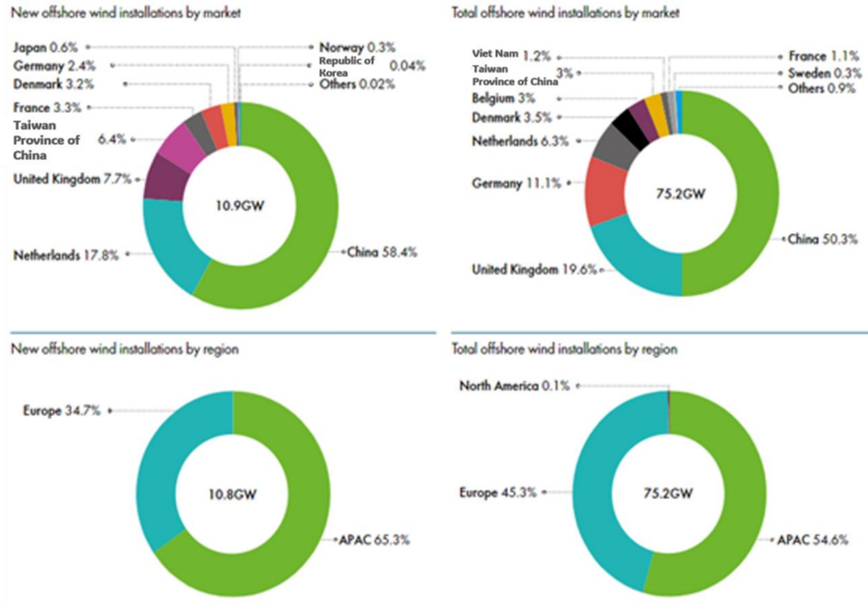
Global installed capacity of offshore wind was 75.2 GW in 2023, (Global Wind Energy Council, 2024) which is more than double what it was at the time of writing of the second World Ocean Assessment Ref 29. The International Renewable Energy Agency (IRENA) and International Energy Agency project that at least 380 GW offshore wind will be needed by 2030, and over 2,000 GW by 2050, to keep the world on track for 1.5℃. In 2023, 11 GW offshore wind was connected to the grid, which is a 24% year-on-year increase, the second highest yet (see figure I).
Figure I New and total offshore wind installations worldwide in 2024
Membership of the Global Offshore Wind Alliance, a diplomatic, multi-stakeholder initiative founded by the Global Wind and Energy Council, IRENA and the Government of Denmark, has grown to include over 20 Governments. These Governments have pledged to collaborate on installing 380 GW offshore wind by 2030 and 2,000 GW by 2050 (Global Offshore Wind Alliance, 2024).
There is still an implementation gap between declared targets and the rate of annual installations. Permitting, finance, supply chain and grids are areas that remain key enablers to achieve growth targets and to propel offshore wind power development into a new phase of even faster growth. The World Bank Group found that blended and concessional finance would be important in enabling emerging markets and developing economies to gain access to financing for offshore wind. A report published in 2024 in the United Kingdom of Great Britain and Northern Ireland found that the offshore wind workforce needs to grow sixfold, offshore wind capacity needs to increase sevenfold and current capacity and project build- out rates need to be four times faster if the goals set are to be reached by 2050 (Supergen ORE Hub, 2024).
The planned uptake of tidal stream energy in Europe has increased since 2023, with the United Kingdom and France contracting 70 MW of tidal stream capacity through revenue support systems. This is expected to lead to a global capacity of well beyond 127 MW by2030 (Ocean Energy Europe, 2024).
A total of 13.3 MW of wave energy has been installed in Europe since 2010, of which 1 MW is currently deployed. The other installations have been decommissioned following the completion of testing and demonstration programmes (Ocean Energy Europe, 2024). The rate of deployment of wave energy devices had slowed but is growing again towards levels recorded before the coronavirus disease (COVID- 19) pandemic. Beyond Europe, the United States of America and China have announced development targets and voiced support for ORE (Ocean Energy Europe, 2024).
Project development, including supply chain and grid connection challenges
To unlock the full potential of ORE and achieve ambitious targets, a robust supply chain for installation components, installation and maintenance vessels, and the development of harbours for installation purposes are critical. In Europe, America and Asia, several countries have set ambitious targets - some by 2030 - for offshore developments, necessitating rapid harbour development and an increase in the qualified workforce. In Oceania, the Government of Australia has identified six regions for offshore wind development, which will require new or expanded onshore ports and grid infrastructure to support the industry.
Current renewable energy production and decarbonization targets are driving a rapid expansion of offshore renewables worldwide, which will help to mitigate climate change. Many of the ORE components require "critical materials", including cobalt, copper, graphite, iridium, lithium, manganese, nickel, platinum and selected rare earth elements. Since sources of these materials are often very localized, their supply involves structural vulnerability to supply chain disruptions. Various attempts at the diversification of sources of critical materials have been proposed, such as the Critical Raw Materials Act by the European Commission (European Commission, 2024). Special attention is needed for the supply of copper as demand is rising across multiple sectors, including ORE, other renewable energy technologies, and specific types of car batteries. Copper could soon become a major bottleneck, due not only to limited geological availability, but also to rapid acceleration in demand.
Deep-sea mining could become an option for more equitable access to critical materials, but does carry a set of potential uncertainties and environmental risks, including disruptions to ocean carbon sequestration processes, which could amplify climate change Ref 106. A more sustainable and strategic approach is "urban mining", which is using recycled copper from electronic waste. Urban mines potential is nearly equivalent to land-based reserves. Given that copper is highly recyclable, fostering circular economy strategies is essential.
Another method of critical materials extraction that is currently in an advanced stage of research and development is from seawater containing critical minerals at low concentrations. Extraction requires the use of large volumes of seawater; the process is being examined in conjunction with emerging ORE technologies such as ocean thermal energy conversion Ref 98. The environmental impact of this new method is to be determined but can likely cause less impact compared to deep-sea mining.
The lack of a stable supply chain for critical materials used for renewable energy devices and the lengthy process of developing new sources (e.g. exploration and mining infrastructure development) may result in critical materials becoming another bottleneck in ORE large-scale roll-out. On the positive side, the situation may increase research and development in circular strategies for raw materials used in renewables.
Comprehensive project sustainability assessments are vital for fostering resilient ORE investments and ensuring sustainable energy development. Such assessments should include the risks posed by projects to the sustainability of marine ecosystems. Assessments should consider both positive impacts (handprints) and negative impacts (footprints), as well as impacts on ecosystem services, such as cycle assessments of components used and other aspects of sustainability Ref 45. Key risks (i.e. technology-related, deployment-related, regulatory, financial and reputational) can be effectively managed to protect the environment. These risks and their potential impacts are summarized in table 3.
Table 3 Risks associated with the deployment of offshore energy installations
| Risk dimension | Definition | Cause of risk | Mitigation | Environmental impact | References |
|---|---|---|---|---|---|
| Technology risk | Risk of failure or underperformance of ORE technologies | Equipment manufacturers Technology developers Research institutions | Insurance Proven technology Comprehensive technology evaluations | Hazardous material spills | Gatzert and Kosub (2016) Zhou and Yang (2020) Vanegas- Cantarero and others (2022) |
| Deployment/ survival | Risk of challenges in the installation and maintenance of ORE infrastructure | Contractors Environmental conditions | Project risk assessments Experienced contractors Regular maintenance | Disruption to marine habitats and biodiversity Debris that harms marine life | Chuo and others, 2021 |
| Regulatory | Risk from changes in laws or regulations affecting ORE projects | Legislators Regulatory agencies Changes in government policy | Engage with policymakers Monitor regulations Ensure compliance | Gatzert and Kosub (2016) Zhou and Yang (2020) | |
| Financial | Risk arising from scarcity of capital or insufficient income- generating streams | Traditional financial institutions Investors Market behaviour | Diverse funding sources (e.g. crowdfunding or peer-to-peer lending) Strong investor relations | Compromised environmental protections during construction and operation | Gatzert and Kosub (2016) Steffen (2020) Zhou and Yang (2020) |
| Reputational | Risk of damage to a company's image due to environmental or operational issues | Media Environmental organizations Public perception | Transparent communication Public engagement Strong environmental, social and governance practices | Decreased support for renewable energy initiatives Heightened scrutiny impeding project development | Zhou and Yang, 2020 |
Source: Prepared by the writing team.
3. Socioeconomic aspects
The increased uptake of ORE is expected to lead to change in some coastal communities, which will bring about social and economic impacts Ref 58. The socioeconomic impacts of global ORE development should be evaluated alongside other offshore energy sectors, such as oil and gas, which may have partly comparable impacts (United Nations Environment Programme Finance Initiative, 2022). The social impacts of ORE have not been comprehensively considered and there is a need for further research in this space (European Court of Auditors, 2023). As outlined in table 4, the consideration of socioeconomic impacts requires clarification on distribution, geographical and temporal scope and the nature of the impact Ref 58.
Table 4 Complexities of identifying the socioeconomic impacts of the development of offshore renewable energy infrastructure
| Socioeconomic impact criterion | Examples |
Distribution Understanding the ways in which the harms and benefits are distributed. Are specific groups more marginalized than others? Do specific groups benefit more than others? Are there issues of equity or environmental justice? The term "environmental justice" in the present World Ocean Assessment refers to mechanisms for ensuring justice and compliance with human rights obligations in relation to environmental issues. | The development of large-scale ORE infrastructure may affect already marginalized communities, both positively and negatively (Bourg-Meyer, 2022). In fact, the most marginalized communities are often those most negatively affected during the development of ORE. Mechanisms may be used to ensure that there is an appropriate distribution of the harms and benefits, such as community benefit schemes, compensation for loss of livelihood and provisions to support women and minority-owned businesses in the supply chain (Bourg-Meyer, 2022). Ensuring equitable distribution of impacts begins in the energy planning process, including siting, and involves early, frequent and appropriate community engagement. Equitable processes include appropriate engagement and decision- making, such as giving communities a voice in decision- making processes. Such processes are most successful when appropriate mechanisms for transparency and accountability are included. |
Spatial scale How to define the community by which to measure the impacts of ORE infrastructure? | There are many components that comprise ORE infrastructure and this spatial scope is important as the social impacts may be broad in geographical scope when the whole supply chain is considered. Furthermore, there is no clear delineation of what constitutes a community in relation to offshore infrastructure as there would be for infrastructure on land. The infrastructure is offshore, but the people who are affected live onshore and potentially comprise a range of different groups that based in different locations and are affected in different ways. |
Temporal scope Over what time period should the impacts be considered? | There are several phases in the life cycle of ORE infrastructure, with different activities taking place in each one. These activities will generate different impacts and there may also be impacts associated with transitions between phases. Understanding the cumulative impacts of ORE developments on coastal communities is therefore significant. Research suggests that there is a need for more long-term longitudinal studies on the socioeconomic impacts of ORE (Bingaman and others, 2022). |
| Nature | The nature of the impact can be tangible, intangible, direct or indirect. Impacts can also be negative (e.g. loss of income or damage to visual amenity) or positive (e.g. reduction in air pollution leading to increased health outcomes, or an equitable community benefits scheme). Specific sectors or groups of people may be more affected that others. Existing ocean users such as fishers are a good example of this. In terms of fisheries, there are social impacts due to the displacement of fishing activities to enable ORE developments. The displacement of fishing activities can lead to further impacts and displacements within the community, which are likely to be different from place to place. These impacts are not only felt in economic terms but also in social terms through loss of tradition and social fabric. |
Source: Prepared by the writing team.
Social considerations in the continued development of offshore renewables
As outlined in table 5, identifying the social impacts of ORE is complex. However, the need to embed equity in the development of ORE and energy transitions more broadly is the crux of all social considerations. It is imperative that the increased uptake of ORE does not reinforce the status quo or exacerbate wealth inequality and existing inequities. Equity therefore needs to be foregrounded in the processes and outcomes of ORE development, which will subsequently help to advance some sustainability goals (Villavicencio Calzadilla and Mauger, 2017). While the development of ORE has been linked to the advancement of the Sustainable Development Goals, the relationship between these two phenomena is often complex and the development of ORE-related infrastructure can both enable and inhibit the advancement of the Goals Ref 105. Processes such as planning, procurement and investment are significant in ensuring the sustainable development of the ORE industry (Bourg- Meyer, 2022).
The social aspect of ORE could involve creating jobs for members of underrepresented groups, including women, ethnic minorities, Indigenous Peoples, sexual minorities, persons with reduced mobility and young persons. Although the energy transition is under way in many countries, there is still a gap in job creation for underrepresented groups, according to the International Labour Organization (ILO). Furthermore, initiatives such as the Offshore Wind Sector Deal, published in the United Kingdom in 2019, can play a crucial role in fostering inclusive representation in the ORE sector. The deal was an industry commitment that set targets to increase diversity by raising the representation of women in the offshore wind workforce from 16% in 2018 to at least 33% - with an ambition to reach 40% - by 2030.
Beyond voluntary commitments, legal frameworks in several countries also support inclusivity in offshore wind development. In the United States, impact assessments for offshore wind projects under the National Environmental Policy Act evaluate the social impacts of offshore wind projects. Similarly, in Canada, the Impact Assessment Act requires assessments of ORE projects to consider gender minorities and other underrepresented groups, promoting fair participation in the sector. In the United Kingdom, the Equality Act (2010) provides a legal foundation for advancing diversity and inclusion across industries, reinforcing efforts like the Offshore Wind Sector Deal.
In order to put the rights of Indigenous Peoples at the forefront of energy transitions, including in the development of ORE, the principles of free, prior, and informed consent, as set forth in the United Nations Declaration on the Rights of Indigenous Peoples, should be upheld (Organisation for Economic Co-operation and Development (OECD), 2024; United Nations, 2007). Furthermore, mechanisms should be enabled to support Indigenous, traditional owner and local community knowledge and Indigenous-led research and governance and to enhance the importance of Indigenous knowledge systems Ref 50. At the same time, increasing Indigenous representation requires recognizing the systemic barriers to participation and leadership for Indigenous Peoples Ref 50.
Decisions relating to the use of ocean space should acknowledge the plurality of human relationships with the ocean Ref 22. Social acceptance can influence the success of the development of ORE projects (European Court of Auditors, 2023). Research shows that often there is a disconnect between the broad support for the development of offshore renewables among the general public and local resistance in adjacent communities Ref 49. Place-based understanding and approaches will therefore be essential in the continued development of ORE.
Conflict arising in relation to the use of marine space, including spatial exclusion of fishers, can be mitigated by marine spatial planning Ref 54. Conflict should not be seen as necessarily negative, as it is often through conflict that better social and environmental outcomes can be achieved. However, it is important that appropriate mechanisms for navigating this conflict be developed Ref 76 Ref 103 Ref 94.
Economic considerations
ORE development, including wind power, tidal power, wave power and other technologies, creates demand for a wide range of components and services, leading to new jobs and local economic development. ORE development therefore holds significant potential for job creation, provided that training programmes expand and workforce initiatives adapt to evolving demands. The High-level Panel for a Sustainable Ocean Economy found that offshore wind has a higher capacity for jobs than the fossil fuel industry and in general has a better gender balance Ref 78. The International Renewable Energy Agency (IRENA) estimated that a 500-MW offshore wind project directly creates 2.1 million person-days of work, or about 10,000 person-years of work, over its lifetime. Offshore wind presents an opportunity to revitalize coastal towns, cities and communities, where new investments can regenerate areas that have previously seen economic decline.
The projections of potential employment from ORE for certain countries and regions are shown in table 5. However, significant challenges remain in ensuring job supply for the growth of the ORE sector. As the sector expands, the demand for skilled workers will increase, especially with the ambitious development goals set by multiple nations. Job creation is constrained by factors that include the number of large-scale projects, regulatory complexities, technological advancements, and financing and investments, as well as training and skills development. The ORE sector requires a specialized workforce Ref 97 Ref 100 but, in many regions, there are not enough training programmes to meet the sector's needs, leading to skills gaps in areas such as advanced engineering and operational expertise (Skoudopoulos, 2019; López-Morado and others, 2024). The high costs of training, alongside rapidly evolving technologies, complicate efforts to equip the workforce Ref 100. Investing in robust training frameworks and education initiatives is essential to meet growing employment demands and ensure the long-term sustainability of the sector Ref 24.
Table 5 Projected job creation potential of the offshore wind energy sector
| No. | Region/country | Time frame | Capacity | Jobs created |
|---|---|---|---|---|
| 1 | United Kingdom | 2030 | 43-50 GW | 100 000ª |
| 2 | United States | 2030 | 30 GW | 15 000-58 000 |
| 3 | European Union | 2030 | 70 GW | 77 000 |
| 4 | China | 2025 | 140 GW | – |
| 5 | Japan | 2030 | 10 GW | 35 000 jobs |
| 6 | Republic of Korea | 2030 | 14 GW | 770 000ª |
ª According to industry-level projections.
Source: Prepared by the writing team.
Socioeconomic impact assessments
Socioeconomic impacts are assessed as part of the environmental impact assessment process when developers are applying for a licence or consent. The intention is to identify the potential impacts and to explore mitigation and enhancement measures.ⓘ However, impact assessments may not adequately show the risks and opportunities (Scotland Marine Assessment, 2020) nor accurately reflect social and cultural values that are not readily transferable as quantifiable metrics. Both qualitative and quantitative methods will be needed to accurately measure the full scope of socioeconomic impacts Ref 58.
4. Governance of offshore renewables
Strong governance mechanisms and supportive policies are essential to attract the necessary financial investment to support the expansion of ORE while also working towards social and environmental outcomes. Governance is a system of organization and operation that includes components such as decision-making, compliance and accountability. Supportive policies will enable the technology to reach commercial-scale implementation while ensuring that this expansion aligns with sustainable objectives. It is crucial to foster policies that promote long-term consistent deployment trajectories and an accelerated cost reduction rate. In the present part, various policy strategies that have been effectively used as governance mechanisms to encourage the advance of the sector are explored.
Policy based on both "technology push" and "market pull" instruments is effective for the development of OREs. Those instruments are essential for guiding technology through the various stages of the innovation chain, effectively supporting its development from the conceptual stage to initial adoption and widespread use. Some policy measures are aimed predominantly at advancing technologies in their early stages, while others play a crucial role in later stages, moving towards broad market acceptance.
The International Vision for Ocean Energy, outlined in the road map by the International Energy Agency Technology Collaboration Programme on Ocean Energy Systems, serves as a strong example of how the balance between push and pull policies is critical for advancing ocean energy technologies.
"Technology push instruments" are designed to encourage the research and development of new technological ideas and advance them to the stages of demonstration and initial commercialization. Notable examples include tax credits for research and development, grants, prizes, concessional financing and matched equity funding. Such support is critical in the early stages of technology development and implementation as it makes innovative projects more attractive to private investors. Government funding for research and development is vital for technological innovation in this sector and should include funding for both basic and applied research, as well as support for demonstration projects to prove their feasibility and performance under real sea conditions. It is important that such measures be focused on areas identified as priorities to enhance the performance of devices and reduce costs associated with development, implementation, maintenance and decommissioning. Such support mechanisms are particularly suited for promoting international collaboration, which is a key factor in accelerating cost reduction. Multilateral development banks, such as the World Bank and the Asian Development Bank, can play a significant role in promoting new technologies because they offer funding and risk mitigation that can attract additional private sector investment, which is particularly important for large-scale demonstration projects.
A strong illustration of technology push in action is seen in projects funded under the European Green Deal and Horizon Europe. These initiatives include multi-source offshore energy parks (European Scalable Offshore Renewable Energy Sources (EU-SCORES), 2024), tidal array energy parksⓘ and wave energy parks supported by the European Union Innovation Fund Ref 19. The Europe Wave programme, supported by the Basque Country and Scotland along with the European Commission, represents another example of coordinated efforts to drive innovation in ocean energy technologies.
"Market pull" instruments are essential for developing a commercial marine energy sector. The two most relevant financial instruments used to encourage the development of marine renewable energies have been feed-in tariffs and contracts for difference, which have each been implemented in various countries. Feed-in tariffs offer long-term contracts to energy producers, guaranteeing them a fixed price for the electricity generated, which helps to mitigate the financial risk associated with the high initial costs of marine renewable energy projects. Similarly, contracts for difference stabilize revenues for energy producers by ensuring that they receive a fixed price for the energy produced, regardless of market fluctuations. An illustrative case is the United Kingdom, where contracts for difference are the Government's main mechanism for supporting low-carbon electricity generation. There have been six auctions, or allocation rounds, to date, which have seen a range of different renewable technologies competing against each other for a contract. They have been successfully implemented to boost the offshore wind energy sector and, more recently, the tidal energy sector.
In the United States, east coast offshore wind projects have been experiencing financial stress. Macroeconomic factors, such as rising costs of materials, supply chain disruptions and increases in the cost of capital due to increased interest rates, have, in combination with regulatory issues, brought about these challenges. Many contracts were agreed prior to the COVID-19 pandemic and certain geopolitical events, and did not include sufficient indexation linkages. Furthermore, issues such as slow permitting and differing supply chain requirements at the state level have increased risk and cost of capital. This experience highlights the need for better financial support mechanisms and risk mitigation strategies, such as indexation of offtake contracts, but also the need for clear governance and regulation that harmonizes requirements between state and federal regimes and recognizes the importance of efficient permitting procedures.
Another crucial aspect of governance for the development of marine renewable energy is the setting of clear and ambitious targets, accompanied by a clear and specific plan to deliver on those targets, with yearly milestones. Such targets demonstrate the Government's commitment to encourage investment and foster technological innovation in renewable energy (examples of offshore wind in Europe are set out in table 6). This is particularly important in the ORE sector, where the long-term financial viability of projects is critical for investors. In addition, these targets allow policymakers to align regulations, subsidies and support mechanisms with a common objective. Most importantly, targets and associated road maps and plans give confidence to investors and manufacturers to invest in facilities and projects. Targets act as catalysts for an energy transformation. For example, the European Union has set a target of 300 GW of offshore wind capacity by 2050, a significant increase from the approximate 12 GW in recent years. This ambitious goal is part of a broader strategy to achieve carbon neutrality and strengthen the energy independence of the bloc. The Kingdom of the Netherlands has set an ambitious target of achieving 3 GW of offshore floating solar capacity by 2030, showcasing its commitment to diversifying and expanding its renewable energy portfolio.
Table 6 Offshore wind energy capacity targets (GW)
| Year | ||||||
|---|---|---|---|---|---|---|
| 2027 | 2030 | 2035 | 2040 | 2045 | 2050 | |
| European Union | 111 | 317 | ||||
| United Kingdom | ||||||
| Kingdom of the Netherlands | 43-50ª | |||||
| Germany | 22.2 | 50 | 70 | |||
| Denmark | 30 | 40 | >70 | |||
| Belgium | 12.9 | |||||
| France | 5.7 | 8 | ||||
| Poland | 18 | 45 | ||||
| Norway | 10.9b | |||||
| Ireland | 30 | |||||
| Spain | 7 | 20 | 37 | |||
| Portugal | 3 | |||||
| Greece | 2 | |||||
| 2 |
Source: Prepared by the writing team.
Note: ª including 5 GW floating offshore wind; b in operation or under development by 2027 (Global Wind Energy Council, 2024).
A well-designed regulatory framework is especially essential for the development of emerging offshore renewables. As the sector progresses globally, concerns about the potential effects of such devices on marine animals, habitats and the broader environment remain a significant challenge. To address those concerns effectively, a regulatory framework that provides clarity and predictability for developers is needed. Such a framework would outline the requirements and procedures necessary for the implementation of projects at sea to ensure that projects are both feasible and sustainable. To encourage growth in the sector, it is important that regulatory frameworks include effective licensing processes that minimize bureaucratic barriers, thereby speeding up the deployment of new technologies and ensuring that project timelines are manageable, while not compromising on social and environmental standards. Equally important is the need for efficient environmental impact assessments. As understanding of the potential environmental effects of ORE projects grows, environmental impact assessments should be streamlined to focus on assessing risks that are significant and warrant careful study. In addition, the regulatory framework should incorporate mechanisms to retire environmental risks (i.e. recognizing and managing risks once sufficient data is gathered), thereby enabling the industry to move forward confidently while maintaining high environmental standards. Notably, adaptive management strategies, which allow for adjustments based on real-time environmental monitoring, have been promoted in various countries.
Another important aspect of governance is marine spatial planning, which allows for the strategic allocation of marine spaces and ensures that OREs can coexist with other maritime activities, such as navigation, fishing and tourism. Marine spatial planning helps to manage the spatial and temporal distribution of human activities in marine environments, optimizing resource use while minimizing conflicts and environmental impacts. An innovative application of marine spatial planning is the adoption of multi-use strategies, which involve the co-location of different activities in the same marine area. By gathering data and knowledge for the planning area and engaging with affected stakeholders, marine spatial planning processes can support co-location of different activities in the same area.
As an example, China is now conducting three-dimensional development of ocean space to encourage more efficient and intensive utilization of marine resources. This approach involves the division of marine areas into vertical layers (e.g. the surface, water body, seabed and subsoil) to determine the use of the marine area on the basis of actual conditions, as well as co-location of offshore floating solar photovoltaics and aquaculture, offshore wind farms and marine ranching, and offshore wind farms and tourism. The European Union's maritime spatial planning directive exemplifies how marine spatial planning can be effectively implemented: the directive requires European Union member States to develop maritime spatial plans that balance economic, social and environmental objectives, including the integration of ORE with other marine uses, thereby supporting the European Union's goals for sustainable growth of maritime economies and the responsible use of marine resources. The directive emphasizes a collaborative approach, involving stakeholders at all levels in the planning process to ensure that the plans reflect a broad range of interests and insights. Similarly, the "area passports" concept in the Kingdom of the Netherlands represents an innovative approach to enabling the coexistence of multiple offshore activities, such as energy production, aquaculture and other uses of the North Sea. Area passports help stakeholders to understand which activities can be integrated into a particular area, promoting multi-use strategies that optimize the use of marine resources while minimizing conflicts.
5. Environmental impacts
Understanding the risks that ORE production pose to marine animals, habitats and ecosystem processes requires specificity that links each part of an offshore device or system to species, habitats and processes. Using a stressor-receptor framework allows the attributes of each stressor (portion of device or operation that can cause stress, injury or death) to be linked to the specific receptor (animals, populations, habitats, oceanographic and ecosystem processes) of concern Ref 62. The key stressors and receptors of concern for offshore renewable technologies are listed in table 2. Eight major stressors have been recognized by the marine energy and offshore wind communities Ref 56 Ref 83:
- Collision risk: animals colliding with moving turbine blades (under water for tidal and ocean current turbines, in the air for wind turbines)
- Underwater noise: natural sounds under water being masked by noise from marine energy and offshore wind energy
- Electromagnetic fields: emissions from power export cables and underwater substations
- Changes in habitats on the seafloor and in the water column
- Changes in oceanographic conditions due to the presence and operation of devices
- Entanglement with multiple mooring lines securing systems
- Displacement: presence of many devices affecting animal migration and movements
- Chemical releases: onboard chemicals (for offshore wind, ocean thermal energy conversion and salinity gradient energy) released into the ocean
Levels of confidence for some of the stressor-receptor interactions are still being established, while the results for some technologies, such as offshore floating solar, are inconclusive and require further research. However, the general environmental risks and impacts related to the deployment of infrastructure offshore are similar to those related to offshore non-renewables described in subchapter 3B.
Table 7 Offshore technology stressors, receptors and potential mitigation strategies
| Stressor | Offshore technology | Receptors | Potential effects | Mitigation | Citations |
|---|---|---|---|---|---|
| Collision risk | Wave | Seabirds | Considerable underwater structures, especially any moving parts, present an enhanced risk of collision or entrapment | Depends on the technology employed, but risk is generally low as seabirds spend limited time under water | Greaves and others (2016) |
| Tidal, ocean current | Marine mammals, fish, sea turtles, diving seabirds | Injury, death | Monitor for collision; potential for turbine shutdown | Garavelli (2024) | |
| Ocean thermal energy conversion | n/a | ||||
| Salinity gradients | n/a | ||||
| Fixed offshore wind | Birds and bats (when present) | Injury, death | Monitor for collision by using radar technology and thermal and optical cameras to detect animal movement; potential for turbine shutdown Deploy earning warning systems such as adjusting turbine operation, warning or deterring birds, reducing the number of lights or lowering light intensity, and using vision-based mitigation (e.g. monochromatic painting of a blade to increase visibility) | Martin and Banks (2023) Croll and others (2022) Ladeke and others (2017) May and others (2020) | |
| Floating offshore wind | Birds and bats (when present) | Injury, death | Monitor for collision by using radar technology, thermal and optical cameras to detect animal movement; potential for turbine shutdown Early warning systems such as adjusting turbine operation, warning or deterring birds, reducing the number of lights or lowering light intensity, monochromatic painting of a blade to increase visibility | Schneider and others (2024) Croll and others (2022) | |
| Offshore floating solar photovoltaics | n/a | ||||
| Underwater noise | Wave | Marine mammals, some species of fish | Installation noise can cause physical harm and/or cause animals to leave an area temporarily or permanently; operational noise can mask critical navigation and communication functions | Monitor for underwater noise to ensure that it does not exceed regulatory or safe levels | Garavelli (2024) |
| Tidal, ocean current | Copping (2023) | ||||
| Ocean thermal energy conversion | |||||
| Salinity gradients | n/a | ||||
| Fixed offshore wind | Marine mammals, some species of fish | Installation noise can cause physical harm and/or cause animals to leave an area temporarily or permanently; operational noise can mask critical navigation and communication functions | Schedule activities to avoid sensitive periods, deploy noise mitigation strategies (e.g. bubble barrier) and use innovative low-noise piledriving techniques Establish noise-free zones or buffer zones around sensitive species' habitats | Bennun and others (2021) Ioannou and others (2019) Msigwa and others (2022) Stoeber and Thomsen (2021) Brandt and others (2018) Agardy and Notarbartolo di Sciara (2007) | |
| Floating offshore wind | |||||
| Offshore floating solar photovoltaics | n/a | ||||
| Electromagnetic fields | Wave | Electro- and magneto- sensitive species: some elasmobranchs (e.g. sharks, rays and skates), some bony fish, and some crustaceans (e.g. crab and lobster) | Small amounts of electricity from marine energy electromagnetic field signals are below harmful levels | Use shielded cables and bury cables to protect animals from signals | Garavelli (2024) Ayyildiz and Erdogan (2024) |
| Tidal, ocean current | |||||
| Ocean thermal energy conversion | Offshore floating ocean thermal energy conversion cables could emit sufficient electromagnetic fields to potentially cause harm | Copping (2023) | |||
| Salinity gradients | .. | ||||
| Fixed offshore wind | Offshore wind cables transmit enough power to potentially cause harm | Bury cables to protect animals from signals | Taormina and others (2018) | ||
| Floating offshore wind | Schneider (2023) Hermans and others (2024) Benjamins and others (2024) | ||||
| Offshore floating solar photovoltaics | Unknown, but full-scale installations likely the same as offshore wind | ||||
| Habitat changes | Wave | Anchors, foundations and cables on the seafloor; mooring lines and floats/platforms in the water column | Where cables are buried, benthic habitats can be disrupted and can take weeks or months to recover. Loss of soft bottom habitats creates new hard bottom habitats (can be beneficial for some organisms). Pelagic organisms may be attracted to or avoid lines and floats. | Ensure careful siting of farms to avoid rare or fragile habitats | Garavelli (2024) |
| Tidal, ocean current | |||||
| Ocean thermal energy conversion | Copping (2023) | ||||
| Salinity gradients | n/a | n/a | |||
| Fixed offshore wind | Anchors, foundations and cables on the seafloor; mooring lines and floats/platforms in the water column | Cables often buried, recovery of benthic habitats in weeks to months generally. Loss of soft bottom habitats creates new hard bottom habitats (can be beneficial for some organisms). Pelagic organisms may be attracted to or avoid lines and floats | Ensure careful siting of farms to avoid rare or fragile habitats | Maxwell and others (2022) | |
| Floating offshore wind | Rezaei and others (2023) | ||||
| Offshore floating solar photovoltaics | Blocking of wind and solar radiation, changes in turbulence and mixing within the water column, and the associated impacts on sediment resuspension near the seabed | Schneider (2023) | |||
| Oceanographic system changes | Wave | Wave height (decreased by energy) | At large scale development, changes in circulation, wave height, sediment transport, possibly water quality and food web changes | Monitor the situation and model potential changes | Garavelli (2024) |
| Tidal, ocean current | Water movement (altered by energy capture) | ||||
| Ocean thermal energy conversion | Large volumes of cold deep ocean water pumped to surface for mixing with warm tropical surface water, which may affect animals | The return to the deep ocean of cold water that has been pumped to the surface for heat exchange can cause thermal stress and local changes in oceanographic conditions | Discharge cold ocean water below thermocline at depth to ensure return to appropriate density | Copping (2023) | |
| Salinity gradients | Osmotic exchange of salt and freshwater from ocean and large rivers, which may affect animals | Changes in salinity resulting from brine disposal could alter water chemistry for nearshore organisms | |||
| Fixed offshore wind | Flow around turbines bases will be altered, causing scour, which may affect animals | Changes in sediment transport and possibly in water quality and the food web | Monitor the situation and model potential changes | ||
| Floating offshore wind | Floating platforms will change surface flow, which may affect animals | At large-scale development: changes in circulation, wave height, sediment transport, and possibly in water quality and the food web | Rezaei and others (2023) | ||
| Offshore floating solar photovoltaics | Large platforms covering the sea surface, anchored to the seafloor, which may affect animals | At large-scale development: changes in circulation, sediment transport, shading, and possibly in water quality and the food web | |||
| Entanglement | Wave | Large marine animals | Large marine animals might become trapped by mooring lines and cables | Monitor for potential risk (applicable for floating devices only) Design turbines and supporting structures to minimize snagging risks and that are made of biodegradable materials | Garavelli (2024) Bennun and others (2021) |
| Tidal, ocean current | |||||
| Ocean thermal energy conversion | Copping (2023) | ||||
| Salinity gradients | n/a | ||||
| Fixed offshore wind | n/a | ||||
| Floating offshore wind | Large marine animals | Large marine animals might become trapped by mooring lines and cables | Monitor for potential risk Design turbine and supporting structures to minimize snagging risks and use biodegradable materials | Maxwell and others (2022) Bennun and others (2021) | |
| Offshore floating solar photovoltaics | Copping and others (in press) Benjamins and others (2024) | ||||
| Displacement | Wave | Migratory, benthic and pelagic animals | Migratory animals may be forced from their routes, resulting in bioenergetic losses, increased predation and increased competition, potentially affecting population success Benthic or pelagic animals may be kept from their habitats for feeding, shelter and reproduction | Ensure sensible site selection to avoid sensitive foraging areas, protected areas (e.g. Natura 2000 areas in the European Union) and major migratory routes Monitor for potential risk | Greaves and others (2016) Garavelli (2024) Croll and others (2022) |
| Tidal, ocean current | |||||
| Ocean thermal energy conversion | |||||
| Salinity gradients | n/a | ||||
| Fixed offshore wind | Migratory, benthic and pelagic animals | Migratory animals may be forced from their routes, resulting in bioenergetic losses, increased predation and increased competition, potentially affecting population success Benthic or pelagic animals may be kept from their habitats for feeding, shelter and reproduction | Ensure sensible site selection to avoid sensitive foraging areas, protected areas (e.g. Natura 2000 areas in the European Union) and major migratory routes, and design installation spacing to allow for animal passage Monitor for potential risk | Croll and others (2022) Stoeber and Thomsen (2021) Bonar and others (2015) Benjamins and others (2024) | |
| Floating offshore wind | |||||
| Offshore floating solar photovoltaics | |||||
| Chemical releases | Wave | n/a as generally no petroleum products onboard | Spills and hazardous releases may cause injury or death to organisms from bacteria and phytoplankton to whales, altering habitats and ecosystem processes. | (Managed under hazardous waste and water quality plans in most nations) Create realistic exposure scenarios to evaluate potential consequences and advocate improved regulatory frameworks (e.g. the Anemoi project) | |
| Tidal, ocean current | De Witte (2023) Galparsoro (2022) | ||||
| Ocean thermal energy conversion | Ammonia or other heat exchange medium could leak into air or ocean, lubricants on board could leak | ||||
| Salinity gradients | Use of chemicals at plant could leak into coastal waters | ||||
| Fixed offshore wind | Lubricants for turbines could leak into ocean | De Witte (2023) Galparsoro (2022) | |||
| Floating offshore wind | |||||
| Offshore floating solar photovoltaics | Spills and use of plastics and other materials for operations and maintenance |
Source: Prepared by the writing team.
Abbreviation: n/a, not applicable.
6. Impact mitigation strategies
Amid deep concerns about the potential negative impacts of ORE installations, there is growing discussion about strategies for mitigating such impacts in order to achieve a biodiversity-compatible energy transition Ref 47 Ref 81 Ref 20. There is also growing interest in the potential positive impacts of ORE deployments on marine ecosystems, such as offshore wind turbines fostering localized increases in marine biodiversity and small-scale fisheries limiting industrial-scale fishing activities. Even though uncertainties exist due to insufficient evidence Ref 23, the present part of the subchapter outlines the existing mitigation strategies for marine renewable energies through specific risk scales, project timescales and spatial scales.
Understanding the effects of ORE on ecosystems is crucial for sustainable oceans Ref 33. However, many knowledge gaps, especially concerning the cumulative impacts of ORE over long distances and long periods, still need to be addressed, as regulations generally focus on one species or habitat at a time Ref 36. Reconciling renewable energy production with environmental protection using a precautionary approach requires a balanced strategy that integrates careful planning, robust regulations and adaptive management, and will involve finding compromises among and balancing the interests of different stakeholders. Such a strategy might include both spatial and technical solutions, as well as considerations related to the licensing of marine renewable projects and general compensation measures.
Mitigating the risks of offshore renewable energy (ORE) technologies is associated with the stage in the project life cycle that considers the duration and extent of the pressure exerted by the devices and the scale of the project (timescale of risk mitigation). It can include actions "before the fact" (i.e. avoiding impact), including design, deployment methods, operational strategies, maintenance methods and decommissioning actions (see table 8).
Table 8 Environmental impact mitigation strategies hierarchy throughout the ORE life cycle
| Mitigation hierarchy | Project phase | Key points and approaches |
|---|---|---|
| Avoid | Design and planning | Careful siting to avoid ecologically sensitive areas; marine spatial planning |
| Operational strategies | Adaptive operations (e.g. turning installations off during species migration to enable safe passage) | |
| Minimize | Deployment methods | Incorporating spatially explicit biodiversity data for considering potential cumulative impacts on biodiversity; designing devices that minimize disruption to natural water flow; employing advanced technologies and minimizing physical footprint; timing construction to minimize impact;routing construction vessels to minimize disturbances |
| Restore | Operational strategies | Implementing real-time monitoring systems and adaptive management; routing maintenance vessels routing to minimize disturbances; coupling adaptive operations with systematic environmental monitoring; minimizing vision-based impact (e.g. painting installations in monochromatic patterns to improve their visibility) |
| Maintenance methods | Post-construction restoration of habitats, adding nature-inclusive design (or biodiversity-positive) elements e.g. structures with positive artificial reef effect designed to mimic natural characteristics of marine habitats | |
| Offset | Operation and decommissioning actions | Sustainable transition to artificial reefs or industry tourism destinations; seawater reoxygenation; ecological compensation (including out-of-kind) |
Source: Prepared by the writing team.
The impact mitigation hierarchy provides developers with a logical framework to address the potential negative impacts of development on biodiversity and ecosystem services. It is applicable to projects in any sector, including ORE, and is based on the sequential and iterative application of four actions: avoid, minimize, restore and offset. Several existing mitigation measures can be applied across all phases of an ORE project. The environmental impact mitigation strategies hierarchy, which considers optimal environmental impact minimization throughout the life cycle of ORE, is fundamental to best practice environmental management Ref 48. Multiple decisions in the process of concession, installation and operation of ORE can help to avoid environmental impacts through sensible adaptive operations. Adaptive operations include site selection to avoid important seabird feeding areas, construction timing to minimize effects on spawning fish, and the routing of construction and maintenance vessels to minimize wildlife disturbances. Systematic environmental impact monitoring can provide the data necessary to devise and improve such adaptive operation strategies (see part 5). One measure that helps to reduce the environmental impact of offshore wind farms is a vision-based mitigation strategy of painting one of the wind turbine blades black or using achromatic patterns on the blades. A study conducted onshore on Smøla in Norway has shown that such a mitigation strategy could reduce the annual bird fatality by 70% Ref 84.
Other solutions under the impact mitigation hierarchy are aimed at restoring biodiversity. One example is artificial reefs, which are structures designed to mimic the natural characteristics of reefs or other marine habitats Ref 110. They can be strategically placed on the seabed as scour protection for energy infrastructure or in the vicinity of energy infrastructure to enhance biodiversity and restore food web complexity Ref 86. The structures serve as substrates for the attachment of various marine species and provide shelter and foraging opportunities for fish, crustaceans and other aquatic organisms. By fostering the establishment of diverse marine life communities, artificial reefs contribute to the overall health and resilience of offshore ecosystems. Lastly, impact mitigation measures can include efforts to offset environmental impacts and enhance biodiversity. Ecological compensation may also be "out-of-kind", meaning that it is provided in a different location from where the impact is made. One example could be the reoxygenation of seawater using oxygen that is a by-product of offshore green hydrogen production, but the technology is yet to be validated in offshore conditions.
All of the above-mentioned measures can be called nature-inclusive design or biodiversity-positive design as they go beyond mitigating the impacts of the development and create a net positive impact. The increasing incorporation of such measures into offshore installations is becoming necessary for the successful application of offshore project developers to build wind and/or multi-source offshore energy parks, in line with non-price criteria in offshore wind tenders (for example, in the Kingdom of the Netherlands and the United Kingdom).
To ensure sustainable ORE development, mitigation strategies should be applied at multiple spatial scales in alignment with global, regional and local governance frameworks. Such strategies should integrate ecological and social considerations, particularly net marine gain, which is the net positive effect on marine biodiversity and ecosystems resulting from development projects.
International policies and frameworks provide a foundation for sustainable offshore energy development. Global instruments, such as the United Nations Convention on the Law of the Sea, which sets out the legal framework within which all activities within oceans and seas must be carried out, and initiatives such as the Sustainable Development Goals offer high-level guidance on biodiversity protection and climate action.
The transboundary impacts of ORE projects necessitate coordinated regional strategies to mitigate cumulative and shared effects. Regional environmental agreements, such as the Convention for the Protection of the Marine Environment of the North-East Atlantic (OSPAR Convention), and cross-border cooperation can ensure that environmental standards are upheld across multiple jurisdictions. Environmental and social impact assessments and environmental impact assessments have been used for mitigating local impacts, applying a conservative approach to uncertainty and managing the cumulative effects of multiple projects in a single region to balance renewable energy generation with environmental protection Ref 48.
At the national and local levels, strategies should be tailored to mitigate the direct impacts of offshore wind projects. Such strategies should cover local innovative and sustainable pathways, including localized environmental impact assessments, marine spatial planning, and the creation of marine protected areas (MPAs) to strategically manage the location of offshore energy infrastructure, minimizing impacts on critical marine habitats and species Ref 72.
7. Pathways to achieving sustainability: a vision for offshore renewable energy in 2030, 2040 and 2050
The present part of the subchapter provides a positive vision of future developments in the ORE sector. As the vision is based on predictions rather than evidence, the statements can be considered inconclusive.
By 2030 global and local decision makers will understand that a healthy ocean is the basis of a sustainable blue economy, and that they must move beyond a business-as-usual approach, simultaneously targeting economic development, ecological sustainability and human well-being. The ocean and the wind near the ocean's surface will be sustainable energy sources and could unlock new opportunities in the fight against climate change. Offshore energy development will be widespread, tools such as marine spatial planning and adaptive management (learning by doing) will be applied, offshore space will be used for multiple purposes and standardized quantitative assessments of the sustainability of the blue economy will be routine. Efforts to understand the interactions of offshore infrastructure with nature, design nature- inclusive offshore installations and deploy adaptive operations to ensure no harm will have resulted in environmentally friendly installations that provide net marine biodiversity gain. Such efforts will also have allowed for the sustainable growth of ORE, avoiding and minimizing environmental impacts on the oceans.
By 2040, robust and sustainable business models and financing structures will have been developed that support economically sustainable commercial arrays of multiple types of offshore energy production, including offshore wind, wave and tidal, ocean thermal energy conversion, salinity gradient energy and floating solar. The design of global technology facilitation mechanisms will enable knowledge-sharing and access to science, technology and innovation in ORE technologies, helping to close the equity gap in access and enabling the roll-out of economically and environmentally sustainable technologies in developing countries.
By 2040, comprehensive quantitative socioenvironmental impact assessment tools will be widely applied by decision makers. This will result in fair assessments of the impacts - both local and global, both adverse and beneficial - of offshore energy on the oceans, as well as solutions that ensure energy justice and equity. The tools will be accessible, enabling the development of a sustainable blue economy on all continents while preserving the health of the ocean. New offshore installations worldwide will be focused on nature preservation and nature-inclusive design to protect and restore ocean biodiversity.
In 2050, the ORE sector, as part of a sustainable blue economy, will encompass multiple sectors and cross-sectoral activities related to the ocean and sustainability, including environmental sustainability, economic growth, social inclusion and equity. Increasing coordination and cooperation among different marine sectors will maximize the sustainable use of the oceans. The further promotion of ORE technologies in developing countries, including through concessional and preferential terms, mutual understanding and fair equity sharing, will result in a large-scale roll-out of sustainable offshore technologies all around the world.
By 2050, the surface of the oceans occupied by ORE will have increased tenfold compared with the time of writing, while yield will have increased fortyfold as technological advancements will have allowed for moving further away from shore. Offshore space will combine multiple sources of ORE (offshore wind, offshore floating solar or wave energy), aquaculture, hydrogen production and critical mineral recovery for the best use of ocean space. Nature-inclusive and environmentally friendly designs will have helped to avoid and minimize environmental impacts and increase biodiversity, thereby mitigating climate change and the biodiversity crisis.
Most Governments will have set renewable energy goals, including the rapid scale-up of ocean energy technologies beyond offshore bottom-fixed wind, such as offshore floating wind, wave, tidal, offshore floating solar and ocean thermal technology conversion, resulting in 4 TW of ocean energy installed worldwide by 2050 and the limitation of global warming to 1.5℃.
8. Summary
Understanding risks related to ORE development can lead to designs, deployment methods, operational modes, maintenance tasks and decommissioning pathways that will minimize disturbances and harm to marine animals, habitats and ecosystem processes. Similarly, effective mitigation measures can be designed to minimize such risks. With the application of nature-based designs and operational modes, sustainable ORE development can support both climate change mitigation and biodiversity protection and improvements.
The increased uptake of ORE is expected to lead to change in coastal communities. Social equity should be prioritized in the consideration of the socioeconomic impacts. The rights of Indigenous Peoples and communities need to be foregrounded in the planned and continued development of ORE. Such development has a high potential for employment and local economic benefits, but investment in training, education and capacity-building is essential to overcome potential challenges. Assessing the impacts on coastal communities will require further research and will need to include both qualitative and quantitative analyses.
Knowledge gaps to be filled to enable the ORE vision, as outlined in part 7, are:
- Lack of research and innovation in new and emerging technologies, including those that will achieve hybrid solutions, grid integration, cost reduction, derisking, a circular economy for ORE components and a whole system approach.
- Lack of access, especially for developing countries, to accurate data or methodologies on resource characterization, environmental risks, application of nature-based social and economic assessments, life cycle assessments and technology assessments, and financial direction, as well as data on seabed conditions and living marine resources.
- Lack of access in many nations to knowledge and best practices for developing and implementing marine governance.
- Lack of qualified personnel in key government departments and agencies to deal with certain aspects of the project development life cycle, such as permitting.
- Lack of financing possibilities for ORE technologies in the least developed countries and limited financing possibilities in some of the emerging markets and developing economies, resulting in slow uptake of ORE technologies. Sustainable Development Goal target 17.6, which is to enhance knowledge-sharing and cooperation on and access to science, technology and innovation through a global technology facilitation mechanism, sets out a pathway for closing the gap in access to ORE technologies.
- Limited promotion of the development, transfer, dissemination and diffusion of ORE technologies to developing countries on favourable terms, including on concessional and preferential terms, as mutually agreed, as set out in Sustainable Development Goal target 17.7.
- Lack of open access to data and information that follows Findable, Accessible, Interoperable and Reusable (FAIR) and FAIR, Artificial Intelligence Readiness and Reproducibility (FARR) principles, so that all decision makers and developers have access to the same high-quality information. Currently, large amounts of environmental data that could be open and readily available are being held as proprietary information.
References
- UK Government CfD (2024). https://www.gov.uk/government/collections/contracts-for-difference.
- Oersted report (2024). Advantages of offshore wind. https://us.orsted.com/renewable-energy- solutions/offshore-wind/what-is-offshore-wind-power/advantages-of-offshore-wind.
- Unite Nations (2007). United Nations declaration on the rights of indigenous peoples - resolution, 2007. https://www.un.org/development/desa/indigenouspeoples/wp-content/uploads/sites/19/2018/11/UNDRIP_E_web.pdf. Adopted by the General Assembly, A/RES/61/295, 2.
- IRENA (2014). Ocean thermal energy conversion. technology brief. Technical report, International Renewable Energy Agency.
- IRENA (2020). Innovation outlook: Ocean energy technologies. Technical report, International Renewable Energy Agency (IRENA). Scotland's marine assessment. https://marine.gov.scot/.
- OES (2021). Tidal current energy developments. highlights. Technical report, Ocean Energy Systems.
- IRENA (2023). Geopolitics of the energy transition: Critical materials. https://www.irena.org/Publications/2023/Jul/Geopolitics-of-the-Energy-Transition-Critical-Materials.
- EC (2024). European commission critical raw materials act, 2024. URL https://eur-lex.europa.eu/legal- content/EN/TXT/?uri=OJ:L_202401252.
- EUSCORES (2024). European scalable offshore renewable energy sources project https://euscores.eu/, 2024. URL https://euscores.eu/.
- GOWA (2024) Global offshore wind alliance (gowa) https://www.irena.org/energy- transition/partnerships/gowa.
- GWEC (2024). Global wind report 2024. Technical report, Global Wind Energy Council.
- OECD (2024) Development Co-operation Report 2024: Tackling Poverty and Inequalities through the Green Transition. OECD, July. ISBN 9789264548398. doi: 10.1787/357b63f7-en.
- OEE (2024). Ocean energy stats & trends 2023. Technical report, Ocean Energy Europe.
- Saoirse wave energy (2024). https://saoirsewaveenergy-prd-web-01-01.azurewebsites.net/info.
- Seaworthy project (2024). https://floatingpowerplant.com/commercial-demonstrator-project/.
- United Nations (2024). Oceans and the law of the sea: oceans and the law of the sea. resolution 79/144 adopted by the general assembly on 12 December 2024. Technical report.
- Agardy, T., and Notarbartolo di Sciara (2007 A global scientific workshop on spatio-temporal management of noise. Technical report, In Report of the Scientific Workshop (vol. 51). Puerto Calero, Lanzarote: Leviathan Sciences.
- Allison, Edward H., and others (2023). The Human Relationship with Our Ocean Planet, pages 393-443. Springer International Publishing. ISBN 9783031162770. doi: 10.1007/978-3-031-16277-0_11.
- Andersson, Mathias H., and Marcus C. Ahman (2010). Fish and sessile assemblages associated with wind-turbine constructions in the baltic sea. Marine and Freshwater Research, 61 (6): 642. ISSN 1323- 1650. doi: 10.1071/mf09117.
- Arbic, B.K., and others (2024). Ocean decade vision 2030 white papers challenge 9: Skills, knowledge, technology, and participatory decision making for all.
- Associates (2023) 34.BVG Associates. Guide to a floating offshore wind farm. URL https://guidetofloatingoffshorewind.com/wp-content/uploads/2023/10/BVGA-16444-Floating-Guide- r2.pdf.
- Aswani, R.S., and others (2021). Is geopolitics a threat for offshore wind energy? a case of indian ocean region. Environmental Science and Pollution Research, 28 (25): 32683-32694, February. ISSN 1614- 7499. doi: 10.1007/s11356-021-12779-z.
- Ayyildiz, Ertugrul, and Melike Erdogan (2024). A comprehensive approach to evaluate risk mitigation strategies in offshore wind farms using spherical fuzzy decision making analysis. Ocean Engineering, 311: 118881. ISSN 0029-8018. doi: https://doi.org/10.1016/j.oceaneng.2024.118881.
- Barua, Arnob, and Md. Salauddin Rasel (2024). Advances and challenges in ocean wave energy harvesting. Sustainable Energy Technologies and Assessments, 61: 103599, January. ISSN 2213-1388. doi: 10.1016/j.seta.2023.103599.
- Bebianno, Maria, and others (2021). World Ocean Assessment II, Chapter 8a, Coastal communities and maritime industries. 04 2021. ISBN 978-92-1-1-130422-0.
- Benjamins, Steven, and others (2024). Potential environmental impacts of floating solar photovoltaic systems. Renewable and Sustainable Energy Reviews, 199: 114463, 05 2024. doi: 10.1016/j.rser.2024.114463.
- Bennun, L., and others (2021). Mitigating biodiversity impacts associated with solar and wind energy development: guidelines for project developers. IUCN, International Union for Conservation of Nature, February. ISBN 9782831721019. doi: 10.2305/iucn.ch.2021.04.en.
- Bingaman, Samanta, and others (2022). Winds of change: examining attitude shifts regarding an offshore wind project. Journal of Environmental Policy & Planning, 25 (1): 55-73, June. ISSN 1522-7200. doi: 10.1080/1523908x.2022.2078290.
- Board (2023) EU Marine Board. European offshore renewable energy: towards a sustainable future. future science brief. Technical report.
- Bonar, Paul A.J., and others (2015). Social and ecological impacts of marine energy development. Renewable and Sustainable Energy Reviews, 47: 486-495. ISSN 1364-0321. doi: https://doi.org/10.1016/j.rser.2015.03.068.
- Bourg-Meyer, Sam (2022). Offshore wind and equity: State of the states report. Technical report, Clean Energy States Alliance.
- Boyes, Suzanne J., and Michelle Elliott (2014). Marine legislation. the ultimate horrendogram: International law, European directives & national implementation. Marine Pollution Bulletin, 86: 39-47, September. ISSN 0025-326X. doi: 10.1016/j.marpolbul.2014.06.055.
- Brandt, M.J., and others (2018) . Disturbance of harbour porpoises during construction of the first seven offshore wind farms in germany. Marine Ecology Progress Series, 596: 213-232, 2018. ISSN 1616-1599. doi: 10.3354/meps 12560.
- Cevasco, D., and others (2021). Reliability, availability, maintainability data review for the identification of trends in offshore wind energy applications. Renewable and Sustainable Energy Reviews, 136: 110414, February. ISSN 1364-0321. doi: 10.1016/j.rser.2020.110414.
- Chen, Wei, and Erguang Huo (2023). Opportunities and challenges of ocean thermal energy conversion technology. Frontiers in Energy Research, 11, May. ISSN 2296-598X. doi: 10.3389/fenrg.2023.1207062.
- Chou, Jui-Sheng, and others (2021). Risk analysis and management of construction and operations in offshore wind power project. Sustainability, 13 (13): 7473, July. ISSN 2071-1050. doi: 10.3390/su13137473.
- Cipollina, Micale G. (2016). Sustainable Energy from Salinity Gradients. Elsevier. ISBN 9780081003121. doi: 10.1016/c2014-0-03709-4.
- Commercial (2023). Allianz Commercial. A turning point for offshore wind. global opportunities and risk trends. opportunities and risks in offshore wind. Technical report, Allianz Report, 2023.
- Copping, H. (2023). Feasibility, environmental effects, and social acceptance of ocean thermal energy conversion. Technical report, Report by Pacific Northwest National Laboratory (PNNL). Report for US Department of Energy (DOE.
- Croll, Donald A., and others (2022). Framework for assessing and mitigating the impacts of offshore wind energy development on marine birds. Biological Conservation, 276: 109795, December. ISSN 0006-3207. doi: 10.1016/j.biocon.2022.109795.
- De Luca Pena, Laura Vittoria, and others (2024) .. Assessing the sustainability of blue economy activities using an ecosystem and life cycle-based approach: Possibilities, challenges and implications for an informed policy making. Ocean & Coastal Management, 257: 107360. ISSN 0964-5691. doi: https://doi.org/10.1016/j.ocecoaman.2024.107360.
- De Witte, Bravo (2023). Towards minimal chemical pollution and greater sustainability of offshore wind energy production. URL https://ilvo.vlaanderen.be/en/news/towards-minimal-chemical-pollution-and- greater-sustainability-of-offshore-wind-energy-production.
- Degraer, Steven, and others (2015). Preface: the winmon.be 2013 conference: steps towards an efficient and effective offshore wind farm environmental impact assessment. Hydrobiologia, 756 (1): 1-2, May. ISSN 1573-5117. doi: 10.1007/s10750-015-2286-1.
- Department of Climate Change and Water (2023). Guidance-key environmental factors for offshore windfarm environmental impact assessment under the environment protection and biodiversity conservation act 1999.
- Devine-Wright, Patrick, and Yuko Howes (2010). Disruption to place attachment and the protection of restorative environments: A wind energy case study. Journal of Environmental Psychology, 30 (3): 271- 280, September. ISSN 0272-4944. doi: 10.1016/j.jenvp.2010.01.008.
- Doyon, Andreanne, and others (2021). Unsettling transitions: Representing indigenous peoples and knowledge in transitions research. Energy Research & Social Science, 81: 102255, November. ISSN 2214-6296. doi: 10.1016/j.erss.2021.102255.
- Earth.org (2023). The pros and cons of wave energy https://earth.org/the-pros-and-cons-of-wave-energy/, 2023.
- Europe (2024) Ocean Energy Europe. Wave energy. https://www.oceanenergy-europe.eu/ocean- energy/wave-energy.
- Falcao, Antonio F. de O. (2010). Wave energy utilization: A review of the technologies. Renewable and Sustainable Energy Reviews, 14 (3): 899-918, April. ISSN 1364-0321. doi: 10.1016/j.rser.2009.11.003.
- European MSP Platform (2019), Executive Agency for Small, Medium sized Enterprises, European MSP Platform, University of Liverpool., Thetis., and ECORYS. Addressing conflicting spatial demands in MSP: considerations for MSP planners: final technical study. Publications Office. doi: 10.2826/151447.
- Galparsoro, I., and others (2022). Mapping potential environmental impacts of offshore renewable energy. etc/ icm report 2/2022: European topic centre on inland, coastal and marine waters. Technical report.
- Garavelli , L., and others, eds. (2024). Oes-environmental 2024 state of the science report: Environmental effects of marine renewable energy development around the world. report for ocean energy systems (oes). Technical report.
- Gatzert, Nadine, and Thomas Kosub (2016). Risks and risk management of renewable energy projects: The case of onshore and offshore wind parks. Renewable and Sustainable Energy Reviews, 60: 982-998. ISSN 1364-0321. doi: https://doi.org/10.1016/j.rser.2016.01.103.
- Glasson, John, and others (2020). Guidance on assessing the socio-economic impacts of offshore wind farms (owfs). doi: 10.24384/AX1S-JR48.
- Greaves, Deborah, and others (2016). Environmental impact assessment: Gathering experiences from wave energy test centres in europe. International Journal of Marine Energy, 14: 68-79, June. ISSN 2214- 1669. doi: 10.1016/j.ijome.2016.02.003.
- Green.org (2024). Advantages and disadvantages of wave and tidal energy. URL https://green.org/wave- and-tidal-energy/advantages-and-disadvantages-of-wave-and-tidal-energy/.
- Han, Xiong-Wei, and others (2021). Review technologies and materials for water salinity gradient energy harvesting. Journal of The Electrochemical Society, 168 (9): 090505, September. ISSN 1945-7111. doi: 10.1149/1945-7111/ac201e.
- Hasselman, Daniel J., and others (2023). Scaling up our understanding of environmental effects of marine renewable energy development from single devices to large-scale commercial arrays. Science of The Total Environment, 904: 166801, December. ISSN 0048-9697. doi: 10.1016/j.scitotenv.2023.166801.
- Hermans, Annemiek, and others (2024). Do electromagnetic fields from subsea power cables effect benthic elasmobranch behaviour? a risk-based approach for the dutch continental shelf. Environmental Pollution, 346: 123570, April. ISSN 0269-7491. doi: 10.1016/j.envpol.2024.123570.
- Herrera, Jorge, and others (2021). Ocean thermal energy conversion and other uses of deep sea water: A review. Journal of Marine Science and Engineering, 9 (4): 356, March. ISSN 2077-1312. doi: 10.3390/jmse9040356.
- Hoegh-Guldberg, O., and Northrop, E. (2023). The ocean as a solution to climate change: Updated opportunities for action. Technical report, Commissioned by High Level Panel for Sustainable Ocean Economy.
- Hub (2024). Supergen ORE Hub. Ore outlook 2040uk offshore renewable energy in 2040: building a sustainable and competitive ore sector on a pathway to net zero by 2050. URL https://supergen- ore.net/uploads/resources/Final-version-Supergen-ORE-Hub-2040-ORE-Outlook-report.pdf.
- UNEPFI (United Nations Environment Program Finance Initative) (2022). Harmful marine extractives: Understanding the risks & impacts of financing non-renewable extractive industries. offshore oil and gas. URL https://www.unepfi.org/wordpress/wp-content/uploads/2022/04/Harmful-Marine-Extra- ctives_Offshore-Oil-Gas.pdf.
- Insights (2023). Groove Insights. Wave and tidal energy market: Challenges, opportunities, and growth drivers and major market players forecasted for period from 2023-2030. .
- Ioannou, Anastasia, and others (2019). Informing parametric risk control policies for operational uncertainties of offshore wind energy assets. Ocean Engineering, 177: 1-11. ISSN 0029-8018. doi: https://doi.org/10.1016/j.oceaneng.2019.02.058.
- IRENA (2024). Floating offshore wind outlook. Technical report, International Renewable Energy Agency.
- Jiang, Zhiyu (2021). Installation of offshore wind turbines: A technical review. Renewable and Sustainable Energy Reviews, 139: 110576, April. ISSN 1364-0321. doi: 10.1016/j.rser.2020.110576.
- Julio Cordano (2024) Niall O'Dea Julio Cordano. Informal summary report of the 2024 ocean and climate change dialogue on the topic "technology needs for the ocean, including climate action and finance links"2024. Technical report, UNFCCC.
- Kausche, Michael, and others (2018). Floating offshore wind - economic and ecological challenges of a tlp solution. Renewable Energy, 126: 270-280. ISSN 0960-1481. doi: https://doi.org/10.1016/j.renene.2018.03.058.
- Kempener, Rudd, and Frank Neumann (2014). Ocean energy technology. salinity gradient energy technology brief. Technical report, International Renewable Energy Agency (IRENA).
- Khare, Vikas, and others (2019). Prefeasibility Assessment of a Tidal Energy System, pages 115-188. Elsevier ISBN 9780128148815. doi: 10.1016/b978-0-12-814881-5.00003-x.
- Knol-Kauffman, Maaike, and others (2023). Sustainability conflicts in the blue economy: planning for offshore aquaculture and offshore wind energy development in norway. Maritime Studies, 22 (4), October. ISSN 2212-9790. doi: 10.1007/s40152-023-00335-z.
- LiVecchi, Al, and others (2019). Powering the Blue Economy: Exploring Opportunities for Marine Renewable Energy in Various Maritime. April. doi: 10.2172/1525367.
- Lubchenco, Jane, and Peter M. Haugan, eds. (2023). The Blue Compendium: From Knowledge to Action for a Sustainable Ocean Economy. Springer International Publishing. ISBN 9783031162770. doi: 10.1007/978-3-031-16277-0.
- Lopez-Morado, Maria, and others (2024). Bridging the skills gap of workers in the offshore renewable energies industry by creating a set of guidelines to promote innovative training. In 2024 IEEE Global Engineering Education Conference (EDUCON), pages 1-7. IEEE, May. doi: 10.1109/educon60312.2024.10578932.
- Ladeke, Jens (2017). Offshore wind energy: Good practice in impact assessment, mitigation and compensation. Journal of Environmental Assessment Policy and Management, 19 (01): 1750005, March. ISSN 1757-5605. doi: 10.1142/s1464333217500053.
- Marauhn, Thilo, and others (2022). Mitigating negative impacts of marine renewable energy on biodiversity: The role of international environmental law. Prawo Morskie, (No XLII): 47-75. doi: 10.24425/pm.2022.142866.
- Martin, Graham, and Alex N. Banks (2023). Marine birds: Vision-based wind turbine collision mitigation. Global Ecology and Conservation, 42: e02386, April. ISSN 2351-9894. doi: 10.1016/j.gecco.2023.e02386.
- Maxwell, Sara M., and others (2022). Potential impacts of floating wind turbine technology for marine species and habitats. Journal of Environmental Management, 307: 114577, April. ISSN 0301-4797. doi: 10.1016/j.jenvman.2022.114577.
- May, Roel, and others (2020). Paint it black: Efficacy of increased wind turbine rotor blade visibility to reduce avian fatalities. Ecology and Evolution, 10 (16): 8927-8935, July. ISSN 2045-7758. doi: 10.1002/ece3.6592.
- Msigwa, Goodluck, and others (2022). Considerations on environmental, economic, and energy impacts of wind energy generation: Projections towards sustainability initiatives. Science of The Total Environment, 849: 157755, November. ISSN 0048-9697. doi: 10.1016/j.scitotenv.2022.157755.
- Nauta, Janne, and others (2023). Biodegradable artificial reefs enhance food web complexity and biodiversity in an intertidal soft-sediment ecosystem. Journal of Applied Ecology, 60 (3): 541-552, January. ISSN 1365-2664. doi: 10.1111/1365-2664.14348.
- Niezrecki, D. (2024). Why US offshore wind power is struggling the good the bad and the opportunity. the conversation, May. URL https://theconversation.com/why-us-offshore-wind-power-is-struggling-the- good-the-bad-and-the-opportunity-228983.
- O'Doherty, Tim, and others (2018). Tidal energy technology, March 2018.
- OES (2021a). White paper on ocean thermal energy conversion (OTEC). Technical report, IEA Technology Programme for Ocean Energy Systems.
- European Court of Auditors of Auditors (2023). Offshore renewable energy in the EU: ambitious plans for growth but sustainability remains a challenge. Special report 22, 2023. Publications Office. doi: 10.2865/85796.
- Onoufriou, Joe, and others (2021). Quantifying the effects of tidal turbine array operations on the distribution of marine mammals: Implications for collision risk. Renewable Energy, 180: 157-165, December. ISSN 0960-1481. doi: 10.1016/j.renene.2021.08.052.
- Rezaei, Fatemeh, and others (2023). Towards understanding environmental and cumulative impacts of floating wind farms: Lessons learned from the fixed-bottom offshore wind farms. Ocean & Coastal Management, 243: 106772, September. ISSN 0964-5691. doi: 10.1016/j.ocecoaman.2023.106772.
- Sajith, Shambhu, and others (2024). Challenges and opportunities for offshore wind energy from global to indian context: directing future research. International Journal of Energy Sector Management, July. ISSN 1750-6220. doi: 10.1108/ijesm-11-2021-0020.
- Saunders, Fred, and others (2024). Introductory commentary: Marine conflicts and pathways to sustainability in an era of blue growth and climate change. Maritime Studies, 23 (1), January. ISSN 2212- 9790. doi: 10.1007/s40152-023-00347-9.
- Schneider, L., Heye, S., Troost, T. (2023). Impact of offshore floating solar on the marine environment. Deltares review 11208338-000-zks-0008, Deltares.
- Schneider, Stephanie R., and others (2024). Autonomous thermal tracking reveals spatiotemporal patterns of seabird activity relevant to interactions with floating offshore wind facilities. Frontiers in Marine Science, 11, AprilISSN 2296-7745. doi: 10.3389/fmars.2024.1346758.
- Sdoukopoulos, E., and others (2019). Boosting offshore renewable energy in Europe: Skills shortages and gaps in education and training., pages 559-566.
- Sharkh, Basel Abu, and others (2022). Seawater desalination concentrateâ€"a new frontier for sustainable mining of valuable minerals. npj Clean Water, 5 (1), March. ISSN 2059-7037. doi: 10.1038/s41545-022- 00153-6.
- Skråmestø, Øystein S., and others (2009). Power production based on osmotic pressure. URL https://ui.adsabs.harvard.edu/abs/2008Desal.220 .. 476S/abstract.
- Stefek, Jeremy, and others (2022).U.S. Offshore Wind Workforce Assessment. October. doi: 10.2172/1893828.
- Steffen, Bjarne (2020). Estimating the cost of capital for renewable energy projects. Energy Economics, 88: 104783, May. ISSN 0140-9883. doi: 10.1016/j.eneco.2020.104783.
- Stoeber, Uwe, and Frank Thomsen (2021). How could operational underwater sound from future offshore wind turbines impact marine life? The Journal of the Acoustical Society of America, 149 (3): 1791-1795, March. ISSN 1520-8524. doi: 10.1121/10.0003760.
- Tafon, Ralph, and others (2021). Oceans of conflict: Pathways to an ocean sustainability pact. Planning Practice & Research, 37 (2): 213-230, May. ISSN 1360-0583. doi: 10.1080/02697459.2021.1918880.
- Taormina, Bastien, and others (2018). A review of potential impacts of submarine power cables on the marine environment: Knowledge gaps, recommendations and future directions. Renewable and Sustainable Energy Reviews, 96: 380-391, November. ISSN 1364-0321. doi: 10.1016/j.rser.2018.07.026.
- Tian, Jing, and others (2024). Is renewable energy sustainable? potential relationships between renewable energy production and the sustainable development goals. npj Climate Action, 3 (1), May. ISSN 2731- 9814. doi: 10.1038/s44168-024-00120-6.
- Toro, Norman, and others (2020). Seabed mineral resources, an alternative for the future of renewable energy: A critical review. Ore Geology Reviews, 126: 103699. ISSN 0169-1368. doi: https://doi.org/10.1016/j.oregeorev.2020.103699.
- UNFCCC (2024). Nationally determined contributions under the paris agreement. synthesis report by the secretariat. Technical report, UN Climate Change Conference - Baku, November.
- Vanegas-Cantarero, Maria M., and others (2022). Beyond lcoe: A multi-criteria evaluation framework for offshore renewable energy projects. Renewable and Sustainable Energy Reviews, 161: 112307. ISSN 1364-0321. doi: https://doi.org/10.1016/j.rser.2022.112307.
- Villavicencio Calzadilla, Paoloa, and Romain Mauger (2017). The uns new sustainable development agenda and renewable energy the challenge to reach sdg7 while achieving energy justice. Journal of Energy & Natural Resources Law, 36 (2): 233-254, October. ISSN 2376-4538. doi: 10.1080/02646811.2017.1377951.
- Vivier, Baptiste, and others (2021). Marine artificial reefs, a meta-analysis of their design, objectives and effectiveness. Global Ecology and Conservation, 27: e01538. ISSN 2351-9894. doi: https://doi.org/10.1016/j.gecco.2021.e01538.
- Vo, Thi Thu Em, and others (2021). Overview of possibilities of solar floating photovoltaic systems in the offshore industry. Energies, 14 (21): 6988, October. ISSN 1996-1073. doi: 10.3390/en14216988.
- Zhou, Shan, and Pu Yang (2020). Risk management in distributed wind energy implementing analytic hierarchy process. Renewable Energy, 150: 616-623. ISSN 0960-1481. doi: https://doi.org/10.1016/j.renene.2019.12.125.