
Tropical and subtropical coral reefs
Writing team: Michael John Sweet (coordinating author), Maria Beger, Francesca Benzoni, Emma Camp, Javier del Campo, Kerri Laura Dobson, Nohora Galvis, Mehdi Ghodrati Shojaei (co-lead member), Gillian Goby, Simon Harding, Danwei Huang, Viatchelav Ivanenko, Zoe Richards, Buki Rinkevich, Marie-Lise Schläppy, Curt Dalon Storlazzi, Parviz Tavakoli-Kolour, Karenne Tun (lead member), Sancia van der Meij, Jenny Villalobos, Christian R. Voolstra and Brian K. Walker.
Key points
- Global declines in coral cover persist, owing to increasing ocean temperatures associated with climate change, continued coastal development, pollution, sedimentation, diseases and the destruction and overextraction of marine resources (through fishing and coral harvesting). These stressors have an impact on coral biodiversity, reef-associated fauna and the architectural complexity of reef frameworks, compromising the food security and livelihoods of the millions of people who depend on these ecosystems (virtually certain, well established).
- The frequency and severity of disturbances caused by heatwaves, disease outbreaks and tropical storms have increased (virtually certain, established but incomplete), curtailing the recovery time between such disturbances. This pattern is projected to continue on its current trajectory (at best) or accelerate (very likely).
- The ecosystem services provided by coral reefs are substantial, not only in terms of biodiversity, but also in terms of direct economic benefits (including coastal protection, livelihoods for millions and nurseries for commercial species), as well as less tangible benefits, such as cultural and aesthetic (intrinsic) value (virtually certain, well established).
- Conservation, restoration and regeneration efforts are under way on a global scale, but few initiatives are implemented on a long-term, sustainable basis, with socioeconomic considerations, such as livelihoods, taken into account (virtually certain, well established). A wide range of approaches and tools is being developed, many of which are designed to mitigate or halt reef declines. These are often restricted to local reef-wide projects, however, and the potential for upscaling is sometimes criticized (unresolved). Documented results are also almost always undermined by a clear disconnect between these and other policy decisions, such as the extraction and burning of fossil fuels and coastal development (likely). Regardless of scalability concerns, all programmes need to be embedded within a broader evidence-based conservation framework.
- Global efforts are required to facilitate reef ecosystem survival and continued function by reducing emissions and ongoing climate change (virtually certain, established but incomplete). The reefs of today will not be the reefs of tomorrow (virtually certain) and shifting baselines need to be considered when setting objectives with respect to conservation, restoration and regeneration (virtually certain, established but incomplete).
1. Introduction
Coral reefs stand as one of the planet's most valuable natural assets, supporting approximately 25% of marine life and providing some level of support to approximately 1 billion people across more than 100 nations Ref 47 Ref 103. For example, 70% of the protein intake among Pacific Islanders comes from reef-associated fisheries (Charlton and others, 2016), and reefs are heralded as the medicine chests of the twenty-first century Ref 11.
The value of goods and services provided by coral reefs is estimated at $2.7 trillion. This includes $7 billion per year in food security and livelihoods, $6 billion in shoreline protection and $36 billion in services to the global tourism industry Ref 105.
2. Environmental changes since the second World Ocean Assessment
Changes in overall status
Global coral reef conditions have continued to deteriorate since the second World Ocean Assessment, with multiple compounding threats intensifying across all major reef systems (see figure I). Recent evidence demonstrates both an accelerating decline in, and increasingly complex challenges to, reef survival Ref 54.
Marine heatwaves between 2018 and 2025 have triggered widespread coral mortality through recurring global-scale coral bleaching events Ref 41 Ref 73. Due to local stressors, there remains uncertainty regarding coral recovery rates Ref 38 Ref 14 Ref 118. The scientific evidence demonstrates (with high levels of certainty) that the global temperature rise should be constrained to no more than 1.5℃ to 2℃ above pre- industrial levels in order to avoid the most serious consequences of climate change for coral reefs Ref 64. It has been proposed by some that this threshold represents a critical biological limit, or "tipping point", beyond which reef ecosystems face potentially irreversible consequences. Others argue, however, that the term "tipping point" can sometimes cause confusion and even distract from the urgent climate action that is needed Ref 60.
Regardless of the terminology, nearly all scientists agree that reefs will be affected by a temperature rise of as little as 1.0℃ above pre-industrial levels, and coral-dominated communities (as we know them today) will essentially disappear under Representative Concentration Pathway (RCP) 6.0 and RCP 8.5 as defined in the Fifth Assessment Report of the Intergovernmental Panel on Climate Change (IPCC). Even under less severe warming scenarios (RCP 4.5) the outlook looks dire, with sharp declines in reef cover occurring; however, some scientists remain optimistic that recovery is possible, with sufficient genetic variability persisting Ref 67 (established, but incomplete). Indeed, limiting warming to 2℃ or less may allow coral reefs to survive until 2100 without drastic shifts in community composition Ref 65.
It is, however, rather alarming to note that more current scientific assessments are understood to indicate that even maintaining temperature rises below 1.5℃ presents substantial risks to reef ecosystem survival (established, but incomplete) Ref 34. There is already evidence that temperature rises in some regions have approached or even crossed the upper end of this range and that warming above 1.5℃ on a global scale is expected by as early as 2034. Ocean warming above 2.7℃ is further expected around 2100 (likely, well established). If realized, this exceeds even the optimistic thermal safety margins for coral survival.
Major regional shifts in reef composition and reef-associated fish species are already being documented Ref 43 Ref 22. This is alongside decreased habitat complexity Ref 42, increasing impacts from nutrient pollution Ref 74 and reduced recovery periods between stress events Ref 45. Hypoxic conditions are present on 84% of surveyed reefs, with 13% experiencing severe oxygen depletion Ref 83. Disease prevalence has reached unprecedented levels (Burke and others, 2023), and reefs are being exposed to intensifying ocean acidification Ref 58, shifting salinity patterns and increasing freshwater flood impacts Ref 94 (see figure I).
Figure I
Factors contributing the changes observed to coral reefs Driving forces
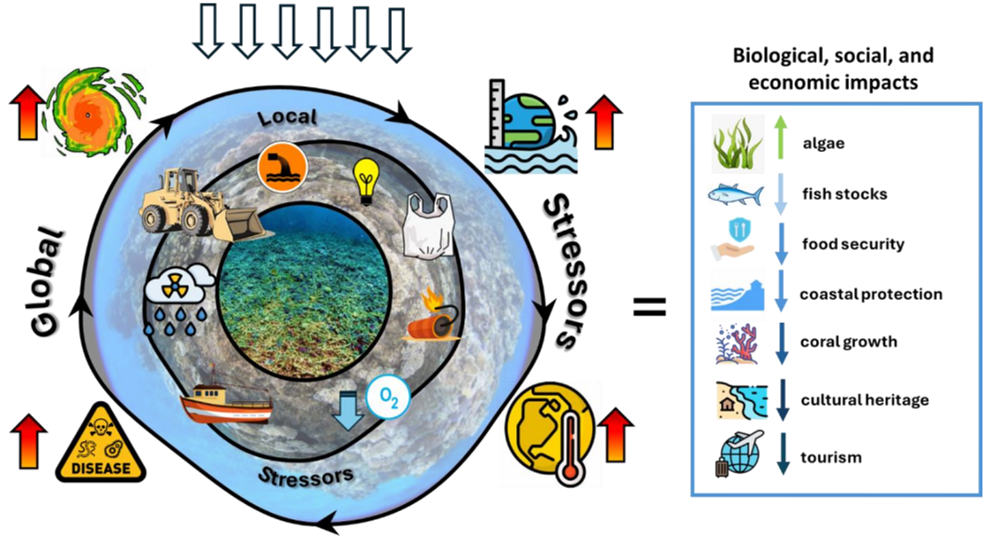
Note: This infographic highlights the main factors contributing to the changes observed to coral reefs; it shows drivers, cumulative global and adaptive local stressors, the current state of reefs, the resulting impacts and responses. Driving forces include ongoing human activities, such as rapid economic growth, the linear economy, overconsumption, overpopulation, corruption, overexploitation of reef resources for short-term economic gain and insufficient investment in sustainable practices and conservation efforts. Stressors act at the global (outer circle) and local (inner circle) scales, and in many cases are cumulative or additive. Local stressors are region- and site-specific and occur in addition to global stressors, ultimately affecting how coral reefs respond to bleaching and disease. Reefs, in general, are experiencing decreased coral cover, habitat degradation, reduced biodiversity, disrupted food webs and the loss of foundation species and ecological functioning, resulting in several biological, social and economic impacts. To save these ecosystems, urgent action must be taken to reduce the carbon footprint, transition to a circular economy and increase political support for conservation It should be noted that the focus is on cumulative impacts; the scale of each stressor has not been indicated.
The notion of subtropical and temperate reef refuges is being refuted and earlier hopes for natural adaptation through poleward expansion or deep refugia have proved overly optimistic. Indeed, temperate coral reefs experience lower winter temperatures than those in tropical locations, affecting the diversity of the community of fish species that can become established Ref 12; coral bleaching and subsequent mortality events are more frequent and more severe in temperate locations Ref 62; and such reefs exhibit high coral endemicity Ref 72 and high environmental stochasticity Ref 7. Furthermore, any apparent gains that do occur at subtropical locations are almost certainly unlikely to offset losses seen in the tropics Ref 1. Even previously identified "bright spots" (where corals survive present-day heatwaves) Ref 26 Ref 48 Ref 14 have shown vulnerability to extreme events, as demonstrated in the South Atlantic. Once considered a refuge from bleaching events, this region suffered 80-90% mortality of dominant reef-building corals during a 50-day marine heatwave in 2019 Ref 39.
Despite isolated cases of recovery or even coral cover stability Ref 23, the overall global trajectory indicates compromised reef resilience (see figure II). Indeed, the increasing frequency of disturbances leaves insufficient time for recovery between events Ref 45. This results in demographic shifts, the homogenization of reef-associated communities, compromised resilience of the reef ecosystem at large, simplification in habitat structure and decreased structural complexity Ref 93 Ref 69 Ref 104.
Figure II
Compromised reef resilience and decadal decline of coral cover with an even bleaker future outlook
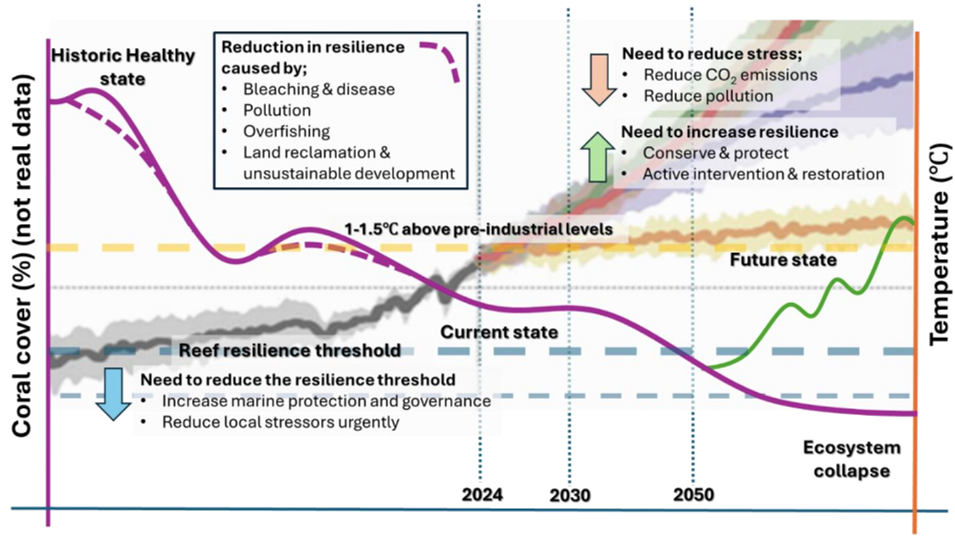
Note: The overall trajectory of global coral reefs indicates compromised resilience and a decline in coral cover (purple line). Coral cover lines are not based on real data and represent a generalized trend of what is occurring on a global scale. A further reduction in reef resilience is highlighted by the dashed lines, indicating more rapid decline in some areas than in others. There is an unarguable need to reduce the stress faced by reefs (namely by reducing or reversing climate change (orange arrow)), while simultaneously attempting to increase resilience (green arrow). There are two key approaches to increasing resilience: reducing the reef resilience threshold (blue arrow and blue dashed lines) and increasing reef resilience (green arrow). Average increases in sea surface temperature (°C) and possible scenarios of future change are depicted in the graph. The data are derived from the sixth assessment report of IPCC. The critical threshold of 1-1.5℃ should not be breached if functional coral reef ecosystems are to remain. There is a very real possibility that ecosystem collapse may occur if significant action is not undertaken immediately. Reducing all stressors, where possible, and improving general water quality (orange arrow) will likely result in many reefs around the world being restored or regenerated to a functional state (green line). Indeed, corals remain remarkably resilient and able to adapt to a degree of climate change.
3. Region-specific changes
Mediterranean
The Mediterranean presents an alarming and unique case of accelerated warming, with rates three times the global average Ref 31 Ref 28. The marine heatwave of 2022 was particularly severe, with surface temperatures reaching 31℃ and thermal anomalies extending to unprecedented depths, exceeding 27℃ at 20 m Ref 21 Ref 80. These episodes of intense warming have triggered mass mortality events among sessile benthic species, affecting octocoral populations in particular Ref 20.
South Atlantic Ocean and wider Caribbean
The Caribbean region represents one of the most dramatic examples of long-term reef decline, with coral cover having reduced by more than 80% since systematic monitoring began in the 1970s Ref 51 Ref 101 Ref 87. Although this value has been queried in a recent report produced by the Global Coral Reef Monitoring Network (Souter and others, 2020), the situation in this region has certainly been exacerbated by the 2023 thermal stress event, which began months earlier and caused 2-3 times the heat stress of previous events Ref 56. In Little Cayman, for example, approximately 80% of corals either bleached or showed signs of mortality during this period and 54% were found dead during the final survey (Doherty and others, 2025). This catastrophic loss in coral is despite approximately 57% of the coastal environment being classified as no-take marine protected areas (MPAs).
Of particular concern in the Caribbean is the shift in coral community composition from critical framework-building genera, such as Acropora and Orbicella Ref 114, to more stress- tolerant species, such as Agaricia, Porites and Siderastrea Ref 5 Ref 53 Ref 113.
The emergence in 2014 of stony coral tissue loss disease has further affected reefs in this region Ref 88 Ref 3. The disease is persistent and has caused local extinctions of some species Ref 75. While treatment efforts using antibiotics and probiotics have shown some success Ref 76 Ref 86, reinfection remains a significant challenge Ref 61 Ref 121.
Indian Ocean, Arabian Sea, Bay of Bengal, Red Sea, Gulf of Aden and Persian Gulf, Strait of Malacca and South China Sea
Recent bleaching events have shown marked variation in impact across subregions Ref 105. For example, the reefs in the Mozambique Channel and south-western Madagascar show surprising resilience, whereas those in Kenya, Seychelles and the United Republic of Tanzania have experienced severe degradation Ref 77.
The reefs in the Persian Gulf and the Red Sea were historically heralded for their thermal tolerance Ref 79; however, these are now also in decline Ref 4. Coral cover in the Persian Gulf dropped from 27% in 2019 to 12% in 2022 Ref 16, while some reefs in the central and southern Red Sea have declined by up to 45% Ref 4. In the Red Sea, coral community responses do appear to be region-specific, with communities in the southern and central regions more commonly affected by mass bleaching events than those in the north Ref 52. Coral cover has declined from over 40% (2014) to under 5% (2018) in such locations as Al Lith, Farasan Banks and Farasan Islands Ref 52. Coral cover in the eastern Arabian Sea also dropped significantly, from 45% in 2014 to 20% in 2019 Ref 32.
Pacific Ocean
Studies appear contradictory regarding coral cover in this region. For example, the authors of some studies present reefs as having stable trends in cover over the past decade Ref 23, whereas those of other studies report accelerating loss beyond previous projections Ref 105.
There is evidence to suggest that the consequential effects of climate warming are often delayed in certain regions, primarily as a result of such factors as large interdecadal variations in the coral triangle area Ref 120.
In the East Asia region, more coral on average was reported in 2019 than in 1983 Ref 105. To take the example of Malaysia, however, 50.7% of corals bleached in 2024, and this later resulted in 34.1% dying - although again regional variation was reported, with the north-eastern parts of the peninsula being more affected Ref 112.
The Great Barrier Reef also showed a slight increase in reported regional hard coral cover in the early part of 2024 compared with the levels reported in 2022 and 2023 (Australian Institute of Marine Science (AIMS), 2024). This finding preceded the bleaching event of 2024-2025, however, during which temperature anomalies in the Great Barrier Reef exceeded the 95th percentile of pre-1900 baseline measurements Ref 55. In 2024 and 2025, the southern Great Barrier Reef saw severe and widespread bleaching to levels not previously recorded Ref 15. At One Tree Reef, for example, 80% of monitored coral colonies bleached and 53% died shortly afterwards. Colony collapse occurred in 95% of the Acroporas assessed Ref 15. The protected status and offshore location of One Tree Reef did not protect the corals from heat stress, bleaching and mortality.
It is concerning that evidence of local extinctions of coral and population depletions across multiple species has already begun to appear in many surveys with similar small, region-wide spatial scales Ref 92. This indicates that although general trends in coral cover may be stable (in part), a fundamental shift in community composition is occurring Ref 24.
For more nearshore areas, cumulative pressures (such as sediment and nutrient run-off) have been highlighted as a particular concern in the region. Indeed, the reduction of pollutant loads has been slow due to only modest improvements in land management to date Ref 89.
4. Knowledge gaps, challenges and capacity changes
Although advances have been made to address the knowledge gaps identified in the second World Ocean Assessment, there are still key points that present significant challenges. These include understanding barriers to political will, strengthening governance and increasing recognition of the socioeconomic value of habitats with respect to, for example, local nutrition and food security. It is also important to focus on understanding how to enhance reef resilience and monitoring reef status and drivers of change, ensuring that cumulative global and local stressors, their resulting impact and responses are taken into account (see table below).
The future of coral reef ecosystems hinges on the ability to align global emissions policies with local protection efforts. The ramifications of not addressing these concerns will extend far beyond coastal communities, affecting food security, economic stability and social justice worldwide.
As climate impacts on reefs intensify, there is increased understanding of the benefits (and limitations) of resilience-based tools and adaptive interventions that can be applied in coral conservation and regeneration efforts Ref 70 Ref 102.
Knowledge of the sustainable management of coral reef fisheries is also improving Ref 119. Indeed, the authors of the latter study conclude that most reef fish stocks open to extraction are currently compromised, especially in the context of aiming for maximum long-term production. Reef fish are critically important for food and nutrition security and the livelihoods of millions of the most vulnerable people in the world. In this context, additional efforts to achieve sustainable management and governance of these fisheries (through a multidimensional lens, for example) are not only desirable, but imperative Ref 6. It is also widely agreed that such management systems need to be suited to the small-scale nature of most coral reef fisheries, which tend to be located in regions of the world with limited technical and institutional capacities Ref 27. Catch, poverty eradication, shared governance, advancing gender equality and nutrient supply all need to be considered. This can be done by ensuring that: (a) small-scale fisheries are built into trade statistics; (b) there is fair distribution of catch benefits, with fishers' tenure rights secured; and (c) aquatic foods are affordable and accessible to all.
Major capacity gaps that remain in this space include insufficient policy support, a lack of scalable restoration methodologies and limited access to and on-the-ground training on the most advanced and promising monitoring technologies Ref 68. Reef restoration practices that are self- sustaining (regarding their finances and funding) should be highlighted as examples of good practice if they exist already. Regular and consistent monitoring should be integrated into all management strategies and practices Ref 116, and there needs to be a general improvement in coordination for capacity development Ref 78.
It must be acknowledged that future coral reefs will differ from historical baselines (see figure II). Management and conservation initiatives should explore best practices that enable a transition to the best possible new state and ensure a level of support for biodiversity and the livelihoods and dependence of coastal economics and people as reef ranges shift. Critical assessment of any outcomes and impacts is essential and should now be mandatory. The protection of high-value genotypes in biobanks is likely to become a priority, with the aim of conserving genetic diversity and even the survival of species. Clear and open efforts must be made to differentiate between the environmental costs of destroying coral reefs for developmental purposes, which benefits a few, from the economic benefits of effective reef protection, which benefits everyone.
While advances have been made to address the knowledge gaps reported in the second World Ocean Assessment (including gaps in relation to the responses of reef communities to climate change, the socioeconomic value of coral reefs and the distribution and ecology of mesophotic coral reefs), key gaps remain pertaining to the enhancement of reef resilience in the face of climate change, strengthening reef governance and management, and recognizing the socioeconomic value of coral reefs. Suggested action points for each of these themes are set out in the table below.
Table
Knowledge gaps and suggested action points
| Theme 1: enhancing reef resilience in the face of climate change |
| Establish standardized ecological and socioeconomic international or national coral reef monitoring and restoration networks and support existing global programmes. Track longer-term trends and stress impacts, such as climate impacts, including storms and anoxic events, and disease and invasive species outbreaks (see sect. 4, chap. 6), and map newly discovered reefs and sentinel coral colonies. |
| Identify climate-resistant coral species and genotypes. Explore and, where possible, scale up intervention strategies, such as cryopreservation, biobanking, assisted evolution and assisted gene flow. |
| Develop a centralized database integrating diverse reef-related data (including photogrammetry, acoustics, diversity assessments and environmental parameters.). Create “digital twins” to improve decision-making. |
| Launch a comprehensive marine biodiversity assessment programme involving integrated taxonomic and molecular research to consider cryptic taxa and explore the risk of silent extinctions of species and loss of genetic diversity. |
| Theme 2: strengthening reef governance and management |
| Implement a framework for active reef interventions, ensuring local appropriateness and effectiveness. Participatory methods that include Indigenous Peoples should be strongly encouraged. |
| Increase Member States’ capacity to collect, analyse and use data to inform fisheries management decisions and policies aimed at maximizing food production and livelihoods while maintaining the structure and functioning of coral reef ecosystems. |
| Develop and execute a reef adaptation strategy linked to sustainable ocean plans addressing rapidly changing environmental conditions. |
| Establish a coral reef community empowerment programme to increase local capacity for the management of reef fisheries. Listen to stakeholders and include them in decision-making. |
| Create national standards for reef-related nature-based solutions aligning with international best practice. |
| Increase the number of scientific studies on local, regional and global causation, relating transdisciplinary indicators of anthropogenic impacts to the health state of coral reef organisms and ecosystem integrity worldwide. |
| Improve the design and enforcement of existing MPAs. Banning nets and spearguns on reefs, for example, would increase global reef fish stocks by approximately 10.5% – essentially matching all conservation efforts to date (Caldwell and others, 2024). |
| Implement policies to minimize land-based sources of pollution. Targeted environmental impact assessments should be undertaken to identify key point-sources of localized pollution. Turn lights off (especially around the coral spawning window), improve waste management and establish buffer zones along coastlines to reduce sediment, nutrient and contaminant inputs. |
| Theme 3: recognizing the socioeconomic value of coral reefs |
| Commission a comprehensive economic valuation of national coral reef ecosystems. Differentiate between the environmental costs of destroying coral reefs for development and the economic benefits of effective protection. |
| Integrate reef value assessments into national infrastructure and development planning. Citizen science helps to involve communities in efforts to improve management effectiveness. |
| Explore innovative pathways to protection, intervention or restoration, such as reef insurance |
In conclusion, if the planet's carbon footprint is not significantly lowered, coral reefs of the kind seen today will almost certainly cease to exist, and the reefs of the future will be very different ecosystems, likely less complex, harbouring lower biodiversity and offering reduced ecosystem services.
This unfolding crisis represents both an ecological and a human rights issue (Sweet and others, 2021; Camp and others, 2024;see also subsect. 5B, chap. 2) It disproportionately affects vulnerable populations, including those in communities with lower socioeconomic status, poor coastal States, States with weak governance and high corruption, and small island nations or large ocean States.
The occurrence of the fourth global mass coral bleaching event in 2024-2025 affected over 77% of the world's reefs and marks another stark milestone in reef decline Ref 91. Furthermore, the increasing frequency and severity of such stress events are compromising coral resilience by reducing recovery windows between disturbances Ref 45. Immediate climate action must include emission reductions and integration with economic policy.
Local management requires addressing immediate threats through policy, while ensuring effective fisheries management and marine conservation, building local support with stakeholders and fostering marine spatial planning.
MPAs cover 8% of the oceans; however, it has been reported that approximately a quarter of the largest MPAs lack effective implementation and policies with respect to a third appear incompatible with conservation goals Ref 84. These findings have been attributed to the fact that many MPAs are reported as lacking regulations or management, and some allow high-impact activities. Despite these challenges, when properly designed and managed, protected areas are well documented to support upwards of 10% higher fish biomass, improved ecosystem resilience and enhanced recovery potential Ref 8 Ref 18.
It should also be recognized that there are some examples of effective enhancement of reef ecosystem-based adaptation Ref 10. Indeed, some have even shown measurable effects on reducing climate risks Ref 10. Nonetheless, current restoration practices have been criticized as costly endeavours and fundamentally remain a local intervention at best. Some have gone so far as to state that coral reefs need "evidence-based management not heroic interference" Ref 108. Indeed, restorative practices will certainly not solve the global degradation of coral reefs due to anthropogenic climate change, and few would challenge that statement. It is important to note, however, that the cost of inaction, the cost of further degradation and the ultimate resulting loss of ecosystem services must also be weighed Ref 81 Ref 110.
The increasing acknowledgement of the ecosystem services offered by coral reefs Ref 90, along with an increased desire to use nature-based solutions to address the issues faced by humanity (Storalazzi and others, 2025), has resulted in the creation of large pre-disaster hazard mitigation funding pathways (ranging from tens of millions of dollars to billions of dollars) and post-disaster recovery funds, many of which are being channelled into reef restoration and preservation Ref 107. This is entirely justified, as the anticipated continued decline of reefs threatens not only marine biodiversity, but also the 1 billion people who depend on them.
The response to this crisis will determine not only the future of coral reefs, but also the well-being of human communities who depend on them for food, nutritional security and livelihoods (Food and Agriculture Organization of the United Nations (FAO), Duke University and WorldFish, 2023). Protecting, managing, conserving and restoring reefs should not be viewed as an altruistic quest; instead, it should be seen for what it is - a pragmatic goal to sustain human civilization and all life on Earth.
References
- Adam, A.A., Garcia, R.A., Galaiduk, R., Tomlinson, S., Radford, B., Thomas, L. and Richards, Z.T. (2021). Diminishing potential for tropical reefs to function as coral diversity strongholds under climate change conditions. Diversity and Distributions, 27(11), pp. 2245-2261.
- AIMS (2024). AIMS LTMP Report GBR coral status 2023-2024 final. Australian Institute of Marine Science.
- Alvarez-Filip, L., González-Barrios, F.J., Pérez-Cervantes, E., Molina-Hernández, A., and Estrada- Saldívar, N. (2022). Stony coral tissue loss disease decimated Caribbean coral populations and reshaped reef functionality. Communications Biology, 5(1), 440. https://doi.org/10.1038/s42003-022-03398-6.
- Anton, A., Randle, J.L., Garcia, F.C., Rossbach, S., Ellis, J.I., Weinzierl, M., and Duarte, C.M. (2020). Differential thermal tolerance between algae and corals may trigger the proliferation of algae in coral reefs. Global Change Biology, 26(8), 4316-4327. https://doi.org/10.1111/gcb.15141.
- Aronson, R.B., Macintyre, I.G., Precht, W.F., Murdoch, T.J., and Wapnick, C.M. (2002). The expanding scale of species turnover events on coral reefs in Belize. Ecological Monographs, 72(2), 233-249.
- Basurto, X., Gutierrez, N.L., Franz, N., and others (2025). Illuminating the multidimensional contributions of small-scale fisheries. Nature, 637, 875-884. https://doi.org/10.1038/s41586-024-08448-z.
- Beger, M., Sommer, B., Harrison, P.L., Smith, S.D.A., and Pandolfi, J.M. (2014). Conserving potential coral reef refugia at high latitudes. Diversity and Distributions, 20(2), 245-257.
- Benedetti-Cecchi, L., Bates, A.E., Strona, G., Bulleri, F., Horta e Costa, B., Edgar, G.J., and Kushner, D.J. (2024). Marine protected areas promote stability of reef fish communities under climate warming. Nature Communications, 15(1), 1822.
- Benkwitt, C.E., D'Angelo, C., Dunn, R.E., Gunn, R.L., Healing, S., Mardones, M.L., and Graham, N.A. (2023). Seabirds boost coral reef resilience. Science Advances, 9(49), eadj0390.
- Bindoff, N.L., Cheung, W.W., Kairo, J.G., Aristegui, J., Guinder, V.A., Hallberg, R., and O'Dongue, S. (2019). Changing ocean, marine ecosystems, and dependent communities. In IPCC Special Report on the Ocean and Cryosphere in a Changing Climate.
- Blockley, A., Elliott, D.R., Roberts, A.P., Sweet, M. (2017). Symbiotic Microbes from Marine Invertebrates: Driving a New Era of Natural Product Drug Discovery. Diversity 2017, 9, 49. https://doi.org/10.3390/d9040049.
- Booth, D.J. (2020). Opposing climate-change impacts on poleward-shifting coral-reef fishes. Coral Reefs, 39(3), 577-581. https://doi.org/10.1007/s00338-020-01919-5.
- Brodnicke, O.B., M.R. Jensen, P.F. Thomsen, T. Brorly, B.L. Andersen, S.W. Knudsen, K. Præbel, and others (2024). Field collections and environmental DNA surveys reveal topographic complexity of coral reefs as a predictor of cryptobenthic biodiversity across small spatial scales. Environmental DNA 6, no. 3: e545.
- Brown, K.T., Lenz, E.A., Glass, B.H., Kruse, E., McClintock, R., Drury, C., and Barott, K.L. (2023). Divergent bleaching and recovery trajectories in reef-building corals following a decade of successive marine heatwaves. Proceedings of the National Academy of Sciences, 120(52), e2312104120. https://doi.org/10.1073/pnas.2312104120.
- Byrne, M., Waller, A., Clements, M., Kelly, A.S., Kingsford, M.J., Liu, B., Reymond, C.E., Vila-Concejo, A., Webb, M., Whitton, K. and Foo, S.A. (2025), Catastrophic bleaching in protected reefs of the Southern Great Barrier Reef. Limnol. Oceanogr. Lett. https://doi.org/10.1002/lol2.10456
- Burt, J. (2024). From Phoenix to Sisyphus: Climate Change Impacts and Intervention Strategies for Arabian Gulf Coral Reefs. Journal of Coastal Research, 113, 839-845. https://doi.org/10.2112/JCR- SI113-165.1.
- Burke S., Pottier P., Lagisz M., Macartney E.L., Ainsworth T., Drobniak S.M., Nakagawa S. (2023). The impact of rising temperatures on the prevalence of coral diseases and its predictability: A global meta- analysis. Ecol Lett., 26(8):1466-1481. doi: 10.1111/ele.14266. Epub 2023 Jun 6. PMID: 37278985.
- Caldwell, I.R., McClanahan, T.R., Oddenyo, R.M., Graham, N.A., Beger, M., Vigliola, L., and Green, A.L. (2024). Protection efforts have resulted in ~10% of existing fish biomass on coral reefs. Proceedings of the National Academy of Sciences, 121(42), e2308605121.
- Camp, E.F., Braverman, I., Wilkinson, G., and Voolstra, C.R. (2024). Coral reef protection is fundamental to human rights. Global Change Biology, 30(9), e17512.
- Capdevila, P., Zentner, Y., Rovira, G. L., Garrabou, J., Medrano, A., and Linares, C. (2024). Mediterranean octocoral populations exposed to marine heatwaves are less resilient to disturbances. Journal of Animal Ecology.
- Castellanos-Galindo, G.G., and others (2020). A new wave of marine fish invasions through the Panama and Suez Canals. Nature Ecology & Evolution. https://doi.org/10.1038/s41559-020-01301-2.
- Ceccarelli, D.M., Logan, M., Evans, R.D., Jones, G.P., Puotinen, M., Petus, C., Russ, G.R., Sinclair- Taylor, T., Srinivasan, M., and Williamson, D.H. (2024). Regional-scale disturbances drive long-term decline of inshore coral reef fish assemblages in the Great Barrier Reef Marine Park. Global Change Biology, 30(10), p. e17506.
- Chan, Y.K.S., Affendi, Y.A., Ang, P.O., and others (2023). Decadal stability in coral cover could mask hidden changes on reefs in the East Asian Seas. Communications Biology, 6(1), 1-11. https://doi.org/10.1038/s42003-023-05000-z.
- Chan, Y.K.S., Ng, C.S.L., Tun, K.P.P., Chou, L.M., and Huang, D. (2024). Decadal decline of functional diversity despite increasing taxonomic and phylogenetic diversity of coral reefs under chronic urbanisation stress. Ecological Indicators, 164, 112143. https://doi.org/10.1016/j.ecolind.2024.112143.
- Charlton K.E., Russell J., Gorman E., Hanich Q., Delisle A., Campbell B., Bell J. (2016). Fish, food security and health in Pacific Island countries and territories: a systematic literature review. BMC Public Health, March 24; 16:285. doi: 10.1186/s12889-016-2953-9. PMID: 27009072; PMCID: PMC4806432.
- Cinner, J., Huchery, C., MacNeil, M. and others (2016). Bright spots among the world's coral reefs. Nature 535, 416-419 (2016). https://doi.org/10.1038/nature18607.
- Cinner, J., and others (2020). Meeting fisheries, ecosystem function, and biodiversity goals in a human-dominated world. Science, 368, 307-311. DOI:10.1126/science.aax9412.
- Copernicus (2024) Copernicus: 2024 is the first year to exceed 1.5℃ above pre-industrial level.
- Cornwall, C.E., Comeau, S., Donner, S.D., Perry, C., Dunne, J., van Hooidonk, R., and Logan, C.A. (2023). Coral adaptive capacity insufficient to halt global transition of coral reefs into net erosion under climate change. Global Change Biology, 29(11), 3010-3018.
- Davies, T.W., Levy, O., Tidau, S., and others (2023). Global disruption of coral broadcast spawning associated with artificial light at night. Nature Communications 14, 2511. https://doi.org/10.1038/s41467- 023-38070-y.
- Dayan, H., McAdam, R., Juza, M., Masina, S., and Speich, S. (2023). Marine heat waves in the Mediterranean Sea: An assessment from the surface to the subsurface to meet national needs. Frontiers in Marine Science, 10, 1045138.
- De, K., Nanajkar, M., Mote, S., and others (2023). Reef on the edge: resilience failure of marginal patch coral reefs in Eastern Arabian Sea under recurrent coral bleaching, coral diseases, and local stressors. Environmental Science and Pollution Research, 30, 7288-7302. https://doi.org/10.1007/s11356-022- 22651-3.
- Deloitte (2024). Need a reason to save the Great Barrier Reef? Deloitte Access Economics report. Deloitte Australia.
- Dixon, A.M., Puotinen, M., Ramsay, H.A., and Beger, M. (2022). Coral reef exposure to damaging tropical cyclone waves in a warming climate. Earth's Future, 10, e2021EF002600. https://doi.org/10.1029/2021EF002600.
- Dobson, K.L., Jury, C.P., Toonen, R.J., and others (2024). Ocean acidification does not prolong recovery of coral holobionts from natural thermal stress in two consecutive years. Communications Earth & Environment, 5, 515. https://doi.org/10.1038/s43247-024-01672-5.
- Doherty M.L., Johnson, J.V., Goodbody-Gringley, G. (2025). Widespread coral bleaching and mass mortality during the 2023-2024 marine heatwave in Little Cayman. PLOS One, 20(5): e0322636. https://doi.org/10.1371/journal.pone.0322636.
- Donovan, M.K., Adam, T.C., Shantz, A.A., Speare, K.E., Munsterman, K.S., Rice, M.M., and Burkepile, D.E. (2020). Nitrogen pollution interacts with heat stress to increase coral bleaching across the seascape. Proceedings of the National Academy of Sciences, 117(10), 5351-5357. https://doi.org/10.1073/pnas.1915395117.
- Donovan, M.K., Burkepile, D.E., Kratochwill, C., Shlesinger, T., Sully, S., Oliver, T.A., and van Woesik, R. (2021). Local conditions magnify coral loss after marine heatwaves. Science, 372(6545), 977-980. https://doi.org/10.1126/science.abd9464.
- Duarte, G.A., Villela, H.D., Deocleciano, M., Silva, D., Barno, A., Cardoso, P.M., and Santoro, E.P. (2020). Heat waves are a major threat to turbid coral reefs in Brazil. Frontiers in Marine Science, 7, 179.
- Dube, K. (2024). A comprehensive review of climatic threats and adaptation of marine biodiversity. Journal of Marine Science and Engineering, 12(2), 344.
- Eakin, C.M., Sweatman, H.P.A., and Brainard, R.E. (2019). The 2014-2017 global-scale coral bleaching event: insights and impacts. Coral Reefs. https://doi.org/10.1007/s00338-019-01844-2.
- Edgar, G.J., Stuart-Smith, R.D., Heather, F.J., Barrett, N.S., Turak, E., Sweatman, H., and Baker, S.C. (2023). Continent-wide declines in shallow reef life over a decade of ocean warming. Nature, 615(7954), 858-865.
- Edmunds, P.J., Adjeroud, M., Baskett, M.L., Baums, I.B., Budd, A.F., Carpenter, R.C., Fabina, N.S., Fan, T.Y., Franklin, E.C., Gross, K. and Han, X. (2014). Persistence and change in community composition of reef corals through present, past, and future climates. PLoS One, 9(10), p.e107525.
- Eisenhauer, N., Bonn, A., and Guerra, C.A. (2019). Recognizing the quiet extinction of invertebrates. Nature Communications, 10, 50. https://doi.org/10.1038/s41467-018-07916-1.
- Emslie, M.J., and others (2024). Increasing disturbance frequency undermines coral reef recovery. Ecological Monographs, 94(3), 31619. https://doi.org/10.1002/ecm.1619.
- FAO, Duke University, and WorldFish (2023). Illuminating Hidden Harvests - The contributions of small-scale fisheries to sustainable development. Rome. https://doi.org/10.4060/cc4576en.
- Fisher, R., O'Leary, R.A., Low-Choy, S., Mengersen, K., Knowlton, N., Brainard, R.E. and Caley, M.J. (2015). Species richness on coral reefs and the pursuit of convergent global estimates. Curr Biol. 2015 Feb 16;25(4):500-5. doi: 10.1016/j.cub.2014.12.022. Epub 2015 Jan 29. PMID: 25639239.
- Fox, M.D., Cohen, A.L., Rotjan, R.D., and others (2021). Increasing coral reef resilience through successive marine heatwaves. Geophysical Research Letters, 48(17), e2021GL094128. https://doi.org/10.1029/2021GL094128.
- Galil, B.S. (2023). A Sea, a Canal, a Disaster: The Suez Canal and the Transformation of the Mediterranean Biota. In The Suez Canal: Past Lessons and Future Challenges, C. Lutmar, and Z. Rubinovitz, eds. (pp. 1-20). Palgrave Studies in Maritime Politics and Security. https://doi.org/10.1007/978-3-031-15670-0_10.
- Gardner, T.A., Côté, I.M., Gill, J.A., Grant, A., and Watkinson, A.R. (2005). Hurricanes and Caribbean coral reefs: impacts, recovery patterns, and role in long-term decline. Ecology, 86(1), 174-184.
- Gardner, T.A., Côté, I.M., Gill, J.A., Grant, A., and Watkinson, A.R. (2003). Long-term region-wide declines in Caribbean corals. Science, 301(5635), 958-960.
- Gonzalez, K., Daraghmeh, N., Lozano-Cortés, D., and others (2024). Differential spatio-temporal responses of Red Sea coral reef benthic communities to a mass bleaching event. Sci Rep, 14, 24229. https://doi.org/10.1038/s41598-024-74956-7.
- Green, D.H., Edmunds, P.J., and Carpenter, R.C. (2008). Increasing relative abundance of Porites astreoides on Caribbean reefs mediated by an overall decline in coral cover. Marine Ecology Progress Series, 359, 1-10.
- Gutierrez, L., Polidoro, B., Obura, D., Cabada-Blanco, F., Linardich, C., Pettersson, E., Pearce-Kelly, P., Kemppinen, K., Alvarado, J.J., Alvarez-Filip, L., Banaszak, A., Casado de Amezua, P., Crabbe, J., Croquer, A., Feingold, J., Goergen, E., Goffredo, S., Hoeksema, B., Huang, D., Kennedy, E., Kersting, D., Kitahara, M., Kružić, P., Miller, M., Nunes, F., Quimbayo, J.P., Rivera-Sosa, A., Rodríguez-Martínez, R., Santodomingo, N., Sweet, M., Vermeij, M., Villamizar, E., Aeby, G., Alliji, K., Bayley, D., Couce, E., Cowburn, B., Nuñez Lendo, C.I., Porter, S., Samimi-Namin, K., Shlesinger, T., Wilson, B. (2024). Half of Atlantic reef-building corals at elevated risk of extinction due to climate change and other threats. PLoS One. 2024 Nov 15;19(11):e0309354. doi: 10.1371/journal.pone.0309354. PMID: 39546544; PMCID: PMC11567617.
- Henley, B.J., McGregor, H.V., King, A.D., Hoegh-Guldberg, O., Arzey, A.K., Karoly, D.J., and Linsley, B.K. (2024). Highest ocean heat in four centuries places Great Barrier Reef in danger. Nature, 632(8024), 320-326.
- Hoegh-Guldberg, O., and others (2023). Coral reefs in peril in a record-breaking year. Science, 382, 1238-1240. https://doi.org/10.1126/science.adk4532.
- Humanes, A., Lachs, L., Beauchamp, E., Bukurou, L., Buzzoni, D., Bythell, J., and Guest, J.R. (2024). Selective breeding enhances coral heat tolerance to marine heatwaves. Nature Communications, 15(1), 8703.
- IPCC (2019). IPCC Special Report on the Ocean and Cryosphere in a Changing Climate. H.-O. Pörtner, D.C. Roberts, V. Masson-Delmotte, P. Zhai, M. Tignor, E. Poloczanska, K. Mintenbeck, A. Alegría, M. Nicolai, A. Okem, J. Petzold, B. Rama, N.M. Weyer (eds.). Cambridge University Press, Cambridge, UK and New York, NY, USA, 755 pp.
- Jury, C.P., and Toonen, R.J. (2024). Widespread scope for coral adaptation under combined ocean warming and acidification. Proceedings of the Royal Society B: Biological Sciences, 291(2031). https://doi.org/10.1098/rspb.2024.1161.
- Kopp, R.E., Gilmore, E.A., Shwom, R.L. and others (2025). Tipping points confuse and can distract from urgent climate action. Nat. Clim. Chang., 15, 29-36. https://doi.org/10.1038/s41558-024-02196-8.
- Kozachuk, A. (2024). Frequent Disease Intervention on the Largest Corals Prolongs Colony Life During Coral Disease Outbreaks [Unpublished manuscript].
- Lachs, L., Sommer, B., Cant, J., Hodge, J.M., Malcolm, H.A., Pandolfi, J.M., and Beger, M. (2021). Linking population size structure, heat stress and bleaching responses in a subtropical endemic coral. Coral Reefs, 40, 777-790.
- Lapointe, B.E., Brewton, R.A., Herren, L.W., Porter, J.W., and Hu, C. (2019). Nitrogen enrichment, altered stoichiometry, and coral reef decline at Looe Key, Florida Keys, USA: a 3-decade study. Marine Biology, 166(8), 108.
- Lenton, T. M., Armstrong Mckay, D. I., Loriani, S., Abrams, J. F., Lade, S., Donges, J. F., Buxton, J. E., Milkoreit, M., Powell, T., Smith, S., and Zimm, C. (2023). Global Tipping Points Report 2023. Bezos Earth Fund.
- Logan, C.A., Dunne, J.P., Ryan, J.S. and others (2021). Quantifying global potential for coral evolutionary response to climate change. Nat. Clim. Chang. 11, 537-542. https://doi.org/10.1038/s41558- 021-01037-2.
- Liew, Y.J., Howells, E.J., Wang, X., Michell, C.T., Burt, J.A., Idaghdour, Y., and Aranda, M. (2020). Intergenerational epigenetic inheritance in reef-building corals. Nature Climate Change, 10(3), 254-259.
- McManus, L.C., Forrest, D.L., Tekwa, E.W., Schindler, D.E., Colton, M.A., Webster, M.M., Essington, T.E., Palumbi, S.R., Mumby, P.J., Pinsky, M.L. (2021). Evolution and connectivity influence the persistence and recovery of coral reefs under climate change in the Caribbean, Southwest Pacific, and Coral Triangle. Global change biology. Sep;27(18):4307-21.
- Madin, E.M., Darling, E.S., and Hardt, M.J. (2019). Emerging technologies and coral reef conservation: Opportunities, challenges, and moving forward. Frontiers in Marine Science, 6, 727.
- Magel, J. M. T., Burns, J. H. R., Gates, R. D., and others (2019). Effects of bleaching-associated mass coral mortality on reef structural complexity across a gradient of local disturbance. Scientific Reports, 9, 2512. https://doi.org/10.1038/s41598-018-37713-1.
- Mcleod, E., Anthony, K.R.N., Mumby, P.J., and others (2019). The future of resilience-based management in coral reef ecosystems. Journal of Environmental Management, 233, 291-301.
- Miller, M.W., Quiroz, S.M., Lachs, L., Banaszak, A.T., Chamberland, V.F., Guest, J.R., and Villalpando, M.F. (2024). Assisted sexual coral recruits show high thermal tolerance to the 2023 Caribbean mass bleaching event. PLoS One, 19(9), e0309719.
- Mizerek, T.L., Madin, J.S., Benzoni, F., and others (2021). No evidence for tropicalization of coral assemblages in a subtropical climate change hot spot. Coral Reefs, 40, 1451-1461.
- Moriarty, T., Leggat, W., Heron, S.F., Steinberg, R., and Ainsworth, T.D. Bleaching, mortality and lengthy recovery on the coral reefs of Lord Howe Island. The 2019 marine heatwave suggests an uncertain future for high-latitude ecosystems. PLOS Clim. 2, e0000080 (2023).
- Nalley, E.M., Tuttle, L.J., Conklin, E.E., Barkman, A.L., Wulstein, D.M., Schmidbauer, M.C., and Donahue, M.J. (2023). A systematic review and meta-analysis of the direct effects of nutrients on corals. Science of The Total Environment, 856, 159093.
- Neely, K.L., Lewis, C.L., Lunz, K.S., and Kabay, L. (2021). Rapid population decline of the pillar coral Dendrogyra cylindrus along the Florida Reef Tract. Frontiers in Marine Science, 8, 656515.
- Neely, K.L., Macaulay, K.A., Hower, E.K., and Dobler, M.A. (2020). Effectiveness of topical antibiotics in treating corals affected by Stony Coral Tissue Loss Disease. PeerJ, 8, e9289.
- Obura, D., Gudka, M., Samoilys, M., and others (2022). Vulnerability to collapse of coral reef ecosystems in the Western Indian Ocean. Nature Sustainability, 5, 104-113. https://doi.org/10.1038/s41893-021- 00817-0.
- Obura, D.O., Aeby, G., Amornthammarong, N., Appeltans, W., Bax, N., Bishop, J., and Gramer, L. (2019). Coral reef monitoring, reef assessment technologies, and ecosystem-based management. Frontiers in Marine Science, 6, 580. https://doi.org/10.3389/fmars.2019.00580.
- Osman, E.O., Smith, D.J., Ziegler, M., Kürten, B., Conrad, C., El-Haddad, K.M., and Suggett, D.J. (2018). Thermal refugia against coral bleaching throughout the northern Red Sea. Global Change Biology, 24(2), e474-e484.
- Ozer, T., Gertman, I., Gildor, H., and Herut, B. (2022). Thermohaline Temporal Variability of the SE Mediterranean Coastal Waters (Israel) - Long-Term Trends, Seasonality, and Connectivity. Frontiers in Marine Science, 8, 799457. https://doi.org/10.3389/fmars.2021.799457.
- Peixoto, R.S., Voolstra, C.R., Sweet, M., and others (2022). Harnessing the microbiome to prevent global biodiversity loss. Nature Microbiology, 7, 1726-1735. https://doi.org/10.1038/s41564-022-01173-1.
- Peixoto, R.S., Voolstra, C.R., Baums, I.B., Camp, E.F., Guest, J., Harrison, P.L., and others (2024). The critical role of coral reef restoration in a changing world. Nat Clim Chang., 1-4. doi:10.1038/s41558-024- 02202-z.
- Pezner, A.K., Courtney, T.A., Barkley, H.C., Chou, W.C., Chu, H.C., Clements, S.M., and Liang, Y.B. (2023). Increasing hypoxia on global coral reefs under ocean warming. Nature Climate Change, 13(4), 403-409.
- Pike, E., Maccarthy, J., Hameed, S., Narayan, S., Grorud-Colvert, K., Sullivan-Stack, J., and Morgan, L. (2024). Ocean protection quality is lagging behind quantity: Applying a scientific framework to assess real marine protected area. Conservation Letters.
- Pinheiro, H.T., MacDonald, C., Santos, R.G., Ali, R., Bobat, A., Cresswell, B.J., and Rocha, L.A. (2023). Plastic pollution on the world's coral reefs. Nature, 619(7969), 311-316. https://doi.org/10.1038/s41586- 023-06113-5.
- Pitts, K.A., Scheuermann, M., Lefcheck, J.S., Ushijima, B., Danek, N., McDonald, E.M., Milanese, A.R., Schul, M.D., Meyer, J.L., Toth, K.A., and Ferris, Z. (2025). Evaluating the effectiveness of field-based probiotic treatments for stony coral tissue loss disease in southeast Florida, USA. Frontiers in Marine Science, 12, p.1480966.
- Precht, W.F., Aronson, R.B., Gardner, T.A., Gill, J.A., Hawkins, J.P., Hernández-Delgado, E.A., and Nugues, M.M. (2020). The timing and causality of ecological shifts on Caribbean reefs. In Advances in Marine Biology (vol. 87, No. 1, pp. 331-360). Academic Press.
- Precht, W.F., Gintert, B.E., Robbart, M.L., Fura, R., and Van Woesik, R. (2016). Unprecedented disease- related coral mortality in Southeastern Florida. Scientific Reports, 6(1), 31374.
- Queensland Government, State of the Environment Report (2020). Land-based run-off pressure on the Great Barrier Reef | State of the Environment Report 2020 (des.qld.gov.au).
- Reguero, B.G., Storlazzi, C.D., Gibbs, A.E. and others. (2021). The value of US coral reefs for flood risk reduction. Nat. Sustain. 4, 688-698. https://doi.org/10.1038/s41893-021-00706-6.
- Reimer, J.D., Peixoto, R.S., Davies, S. W., and others (2024). The Fourth Global Coral Bleaching Event: Where do we go from here? Coral Reefs, 43, 1121-1125. https://doi.org/10.1007/s00338-024-02504-w.
- Richards, Z.T., Juszkiewicz, D.J., and Hoggett, A. (2021). Spatio-temporal persistence of scleractinian coral species at Lizard Island, Great Barrier Reef. Coral Reefs, 40, pp. 1369-1378.
- Richardson, L.E., Graham, N.A.J., Pratchett, M.S., Eurich, J.G., Hoey, A.S. (2018). Mass coral bleaching causes biotic homogenization of reef fish assemblages. Glob. Chang. Biol. 2018 Jul;24(7):3117-3129. doi: 10.1111/gcb.14119. Epub 2018 Apr 6. PMID: 29633512.
- Röthig, T., Trevathan-Tackett, S.M., Voolstra, C.R., Ross, C., Chaffron, S., Durack, P.J., and Sweet, M. (2023). Human-induced salinity changes impact marine organisms and ecosystems. Global Change Biology, 29(17), 4731-4749.
- Ruiz-Allais, J.P., Benayahu, Y., and Lasso-Alcalá, O.M. (2021). The invasive octocoral Unomia stolonifera (Alcyonacea, Xeniidae) is dominating the benthos in the Southeastern Caribbean Sea. Memoria de la Fundación La Salle de Ciencias Naturales, 79(187).
- Salami, A.A., and Babatunde, O.R. (2024). Environmental challenges, the impacts of climate change in North Africa region: A review. Natural Resources Deterioration in MENA Region: Land Degradation, Soil Erosion, and Desertification, 281-294.
- Salimi, P.A., Creed, J.C., Esch, M.M., Fenner, D., Jaafar, Z., Levesque, J.C., Montgomery, A.D., Salimi, M.A., Edward, J.P., Raj, K.D., and Sweet, M. (2021). A review of the diversity and impact of invasive non-native species in tropical marine ecosystems. Marine Biodiversity Records, 14(1), 1.
- Santoro, E.P., Borges, R.M., Espinoza, J.L., Freire, M., Messias, C.S., Villela, H.D., Pereira, L.M., Vilela, C.L., Rosado, J.G., Cardoso, P.M., and Rosado, P.M. (2021). Coral microbiome manipulation elicits metabolic and genetic restructuring to mitigate heat stress and evade mortality. Science Advances, 7(33), eabg3088.
- Schill, S.R., Asner, G.P., McNulty, V.P., Pollock, F.J., Croquer, A., Vaughn, N.R., Escovar-Fadul, X., Raber, G., and Shaver, E. (2021). Site selection for coral reef restoration using airborne imaging spectroscopy. Frontiers in Marine Science, 8, 698004.
- Schleussner, C.F., Ganti, G., Lejeune, Q., and others (2024). Overconfidence in climate overshoot. Nature, 634, 366-373.
- Schutte, V.G., Selig, E.R., and Bruno, J.F. (2010). Regional spatio-temporal trends in Caribbean coral reef benthic communities. Marine Ecology Progress Series, 402, 115-122.
- Shaver, E.C., McLeod, E., Hein, M.Y., Palumbi, S.R., Quigley, K., Vardi, T., Mumby, P.J., Smith, D., Montoya-Maya, P., Muller, E.M., and Banaszak, A.T. (2022). A roadmap to integrating resilience into the practice of coral reef restoration. Global Change Biology, 28(16), 4751-4764.
- Sing Wong, A., Vrontos, S., and Taylor, M.L. (2022). An assessment of people living by coral reefs over space and time. Global Change Biology, 28(23), 7139-7153.
- Sommer, B., Hodge, J.M., Lachs, L., Cant, J., Pandolfi, J.M., and Beger, M. (2024). Decadal demographic shifts and size-dependent disturbance responses of corals in a subtropical warming hotspot. Scientific Reports, 14(1), 6327.
- Souter, D., Planes, S., Wicquart, J., Logan, M., Obura, D., and Staub, F. (2021). Status of coral reefs of the world: 2020: Executive summary. Global Coral Reef Monitoring Network.
- Storlazzi, C.D., Reguero, B.G., Alkins, K.C., Shope, J.B., Cole, A.D., Gaido-Lasserre, C., Viehman, T.S., and Beck, M.W. (2025). Hybrid coral reef restoration can be a cost-effective solution to provide protection to vulnerable coastal populations, Science Advances, 11, eadn4004, doi: 10.1126/sciadv.adn4004.
- Stovall, A.E., Beck, M.W., Storlazzi, C., Hayes, J., Reilly, J., Koss, J., and Bausch, D. (2022). Coral reef restoration for risk reduction (CR4): A guide to project design and proposal development. University of California Santa Cruz. https://doi.org/10.5281/zenodo.7268962.
- Streit, R.P., Morrison, T.H. and Bellwood, D.R. (2024). Coral reefs deserve evidence-based management not heroic interference. Nat. Clim. Chang. 14, 773-775. https://doi.org/10.1038/s41558-024-02063-6.
- Suggett, D.J., Edwards, M., Cotton, D., Hein, M., and Camp, E.F. (2023). An integrative framework for sustainable coral reef restoration. One Earth, 6(6), 666-681.
- Suggett, D.J., Guest, J., Camp, E.F., Edwards, A., Goergen, L., Hein, M., Humanes, A., Levy, J.S., Montoya-Maya, P.H., Smith, D.J., and Vardi, T. (2024). Restoration as a meaningful aid to ecological recovery of coral reefs. npj Ocean Sustainability, 3(1), 20.
- Sweet, M., Burian, A., and Bulling, M. (2021). Corals as canaries in the coalmine: Towards the incorporation of marine ecosystems into the 'One Health' concept. Journal of Invertebrate Pathology, 186, 107538.
- Szereday, S., Chen, S.Y., Chew, K.L., Lee, L.K., Yusop, P.A.M., Fatta, A., Legada, C.J., Yaman, M.S., Zainudin, N.B.F., and Chelliah, A. (2025). The 4th global coral bleaching event in Malaysia: insights, outcomes, and paths forward. Coralku Publications.
- Toth, L.T., Stathakopoulos, A., Kuffner, I.B., Ruzicka, R.R., Colella, M.A., and Shinn, E.A. (2019). The unprecedented loss of Florida's reef-building corals and the emergence of a novel coral-reef assemblage. Ecology, 100(9), e02781.
- Toth, L.T., Storlazzi, C.D., Kuffner, I.B. and others (2023). The potential for coral reef restoration to mitigate coastal flooding as sea levels rise. Nat Commun 14, 2313. https://doi.org/10.1038/s41467-023- 37858-2.
- Van Der Mheen, M., and Pattiaratchi, C. (2024). Plastic debris beaching on two remote Indian Ocean islands originates from a handful of Indonesian rivers. Environmental Research Letters.
- Voolstra, C.R., Peixoto, R.S., and Ferrier-Pagès, C. (2023). Mitigating the ecological collapse of coral reef ecosystems: Effective strategies to preserve coral reef ecosystems. EMBO Reports, 24(4), e56826.
- Voolstra, C.R., Suggett, D.J., Peixoto, R.S., and others (2021). Extending the natural adaptive capacity of coral holobionts. Nature Reviews Earth & Environment, 2, 747-762.
- Walker, A.S., Kratochwill, C.A., and van Woesik, R. (2024). Past disturbances and local conditions influence the recovery rates of coral reefs. Global Change Biology, 30(1), e17112.
- Zamborain-Mason, J., Cinner, J.E., MacNeil, M.A. and others (2023). Sustainable reference points for multispecies coral reef fisheries. Nat Commun 14, 5368. https://doi.org/10.1038/s41467-023-41040-z.
- Zinke, J, Gilmour, J.P., Fisher, R., and others (2018). Gradients of disturbance and environmental conditions shape coral community structure for south-eastern Indian Ocean reefs. Diversity and Distributions, 24 (5). pp. 605-620. ISSN 1366-9516.
- Zummo, A. (2024). One-Time Broadscale SCTLD Intervention Effectiveness on Montastraea cavernosa in an Endemic Zone. Master's thesis, Nova Southeastern University. NSUWorks. https://nsuworks.nova.edu/hcas_etd_all/178.