
Marine benthic invertebrates
Writing team: Lis L. Jørgensen (coordinating author), Lara Atkinson, Evangelia Chatzinikolaou, Anya Dunham, Elva Escobar, Chris Frid, Daniela Yepes Gaurisas, Bruce C. Glavovic, Hiroko Muraki Gottlieb, Huw J. Griffiths, Laurent Guérin, Pat Hutchings, Izwandy Idris, Sebastian Herrera Kasic, Mehdi Bolouki Kourandeh, Hongjun Li, Elizabeth Logerwell, Marcel Miranda, Amarachi Onyena, André Pardal, Christina Pavloudi, Rachel Przeslawski, Jayachandran Paravanparambil Rajakumar, Lennert Schepers, Mehdi Ghodrati Shojaei (lead member), Kerry Sink, Paris Stefanoudis, Leen Vandepitte, Gordon James Watson and Denis Zakharov.
Key points
- Seafloor hotspots and 7,252 new benthic invertebrates have been described since the publication of the second World Ocean Assessment, and there has been a five-fold increase in critically endangered species and a doubling of endangered species.
- Marine benthic invertebrates are vital for ocean health but are increasingly impacted by human activities.
- There is often limited understanding of the implications of these impacts and inadequate provisions to contain them.
- Research and cooperation are still unbalanced among regions.
- Marine invertebrates are still poorly documented, particularly in the deep ocean and in the territorial waters of developing States and island States, which potentially host a high number of endemic taxa.
- Consistent funding for biodiversity monitoring is needed to prevent knowledge gaps from widening.
- Meaningful and ethical use of Indigenous knowledge and representation of early career professionals are required.
- Seabed mining raises concerns about negative impacts, calling for coordination and cooperation between the Conference of the Parties to the Agreement under the United Nations Convention on the Law of the Sea on the Conservation and Sustainable Use of Marine Biological Diversity of Areas beyond National Jurisdiction and the International Seabed Authority (ISA).
1. Introduction
Since the public of the second World Ocean Assessment, benthic species and habitats have been affected by human activities worldwide (figure I).
Figure I
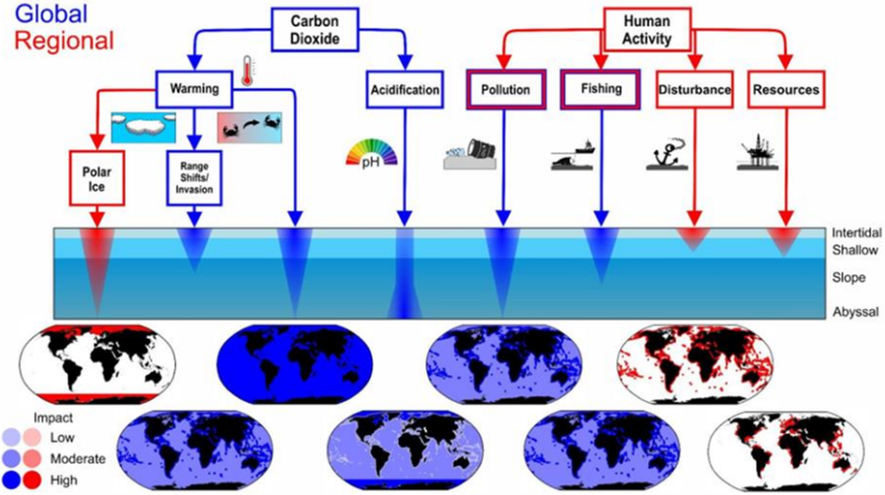
Benthic invertebrates are vital for ocean health and human well-being but are threatened by climate change, human activities (including bottom trawling) and pollution (including microplastics and contaminants).
2. Environmental change since the second World Ocean Assessment
Changes in overall status
Biodiversity
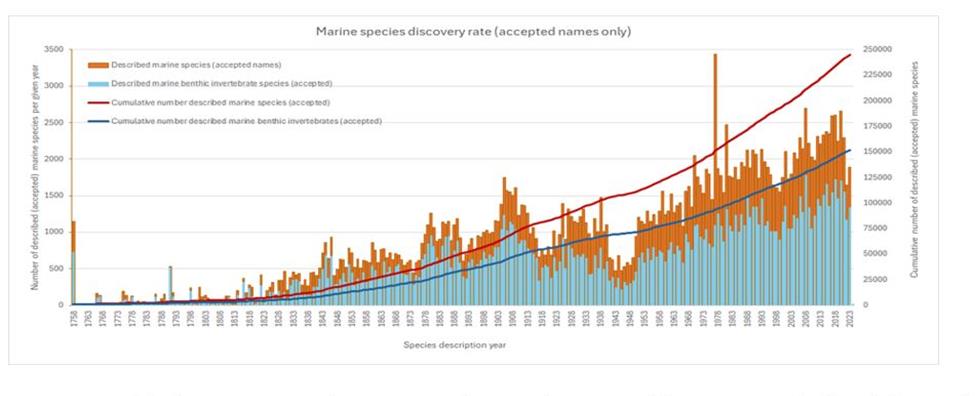
The World Register of Marine Species (WoRMS), as at 29 August 2024, held 246,517 valid marine species names, including 151,902 marine benthic invertebrates. Of all the new marine species discovered each year, about 60% are benthic invertebrates. From 2019 to 2023, of the 10,742 new marine species described, 7,252 (67.5%) were benthic invertebrates (figure II).
Figure II Global marine species discovery rate (accepted species only) since 1758
Source: Prepared by the writing team.
Of the 32 marine phyla with invertebrate species, 26 include benthic species (figure III). Among these, 21,271 species (14%) live at depths greater than 500 m.
Figure III Global number of marine benthic invertebrate species, by group (phylum), showing total species numbers
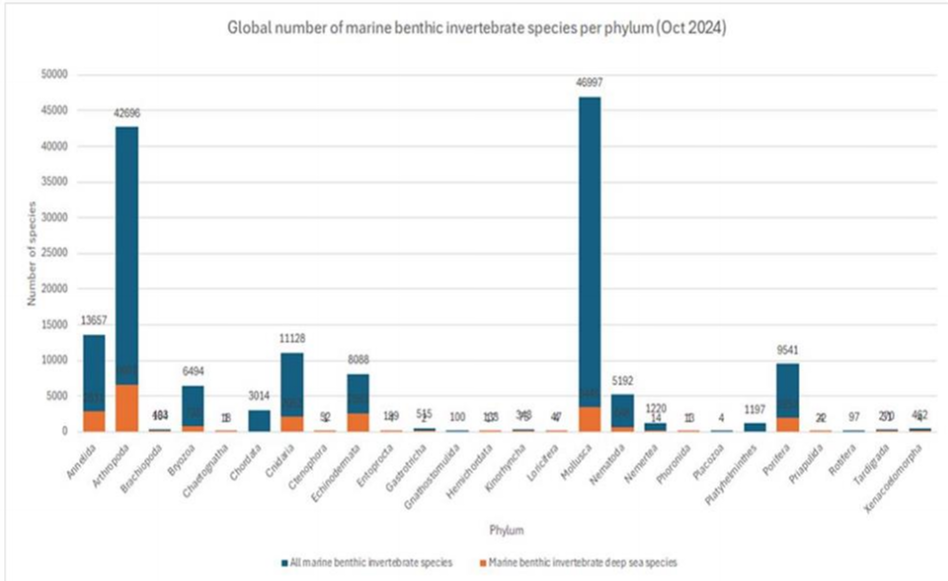
Table 1 Number of marine benthic invertebrate species per category of the International Union for Conservation of Nature Red List of Threatened Species
| Red List category | Total number of marine invertebrate benthic species | |
|---|---|---|
| 1964-2018 | 2018-2023 | |
| Extinct | 2 | 2 |
| Critically endangered | 18 | 91 |
| Endangered | 45 | 88 |
| Vulnerable | 237 | 292 |
| Near threatened | 184 | 239 |
| Near-threatenedª | 4 | 4 |
| Least concern | 1,104 | 1,184 |
| Data deficient | 624 | 657 |
Source: Prepared by the writing team.
a This number category includes four "conservation-dependent" species.
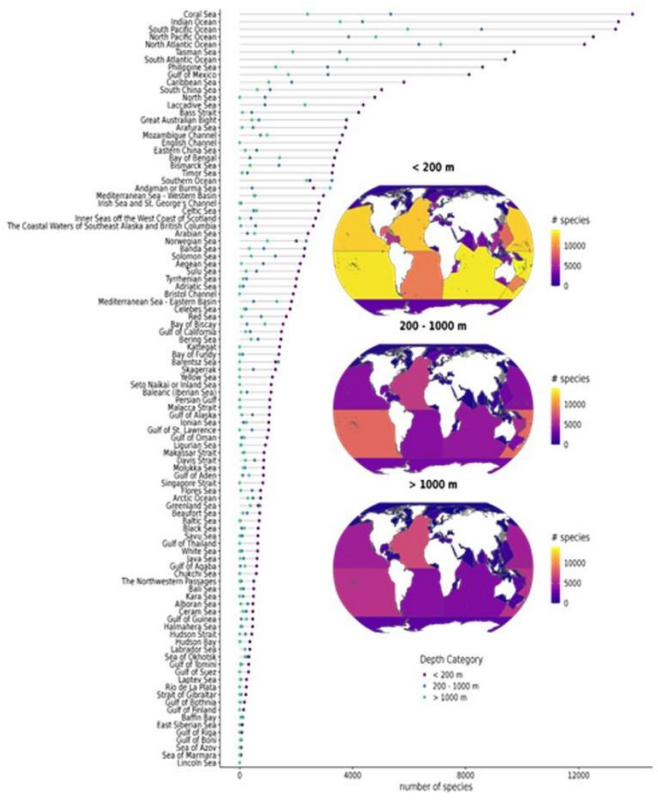
According to WoRMS, the Ocean Biodiversity Information System, and the Marine Regions website (accessed Oct 2024), marine benthic invertebrates are found in all International Hydrographic Organization areas. However, significant regional variations reflect current knowledge gaps (figure IV).
Figure IV Total number of recorded marine invertebrate benthic species for all International Hydrographic Organization sea areas for <200 m, 200-1000 m and >1000 m depth.
Source: Prepared by the writing team.
Note: The boundaries of the International Hydrographic Organization sea areas follow Claus and others, 2014, and International Hydrographic Organization sea areas, version 3 Ref 67, available online at http://www.marineregions.org/. https://doi.org/10.14284/323). Species occurrences: Ocean Biodiversity Information System (OBIS), 2024. Species group information: WoRMS. Bathymetry data: European Marine Observation and Data Network (EMODnet), 2016; General Bathymetric Chart of the Oceans (GEBCO), 2015; and Provoost and Bosch, 2018.
Impacts of change on and interaction with other components of the marine system
Marine benthic ecosystems are crucial for ocean health and human well-being but are under growing pressure from human activities (Sweetman and others, 2017; Halpern and others, 2019; Gissi and others, 2021; Mamede 2024) (table 2 and regional information).
Unprecedented environmental changes are causing range shifts, novel species assemblages and extirpations. Research and scientific guidance are essential for understanding ocean changes and their effects on benthic resources, ecosystem services and socioeconomic impacts, and for developing effective mitigation strategies Ref 90 Ref 197 Ref 41.
Table 2 Anthropogenic stressors and activities affecting benthic marine invertebrates and ecosystems worldwide
| Human stressors and activities | References |
|---|---|
| Global warming and ocean acidification | Isla and Gerdes, 2019; Pineda-Metz and others, 2020; Venegas and others, 2023 |
| Fishing, especially bottom trawling | Couce and others, 2020 |
| Resource extraction, including mining and hydrocarbon exploitation | Henry and others, 2017 |
| Bioinvasion by non-native species, including invasive, exotic | Zaiko and others, 2024 |
| Marine- and land-based contaminants, including an estimated 3.05 million tons of microplastics in deep ocean sediments and perturbations caused by drifting plastic bags in the deepest ocean | Gao and others, 2022; Harris and others, 2023; Ribó and others, 2023; Shahnawaz and others, 2024; Jamieson and Onda, 2022 |
| Oil spills | Goes and others, 2023 |
| Urbanization | Momota and Hosokawa 2021; Dreujou and others, 2023 |
| Dredging and dumping | Prishchepenko and others, 2023; Neira and others, 2024 |
| Offshore wind farms | Lloret and others, 2022 |
| Anchor scour damage | Davis and others, 2022 |
| Marine invertebrate interactions with harmful algal blooms and implications for One Health | Turner and others, 2021 |
| Coastal defence and offshore structure installations | Wolanski and others, 2020 |
Source: Prepared by the writing team.
Contaminants and microplastics accumulate in the seabed, harming benthic invertebrates and ocean ecosystems Ref 146 Ref 133. Widespread damage to benthic habitats and biodiversity affects marine ecosystem services in various ways across regions, highlighting the need for targeted seabed management Ref 228 Ref 138 Ref 142.
Governance of the seabed within and beyond national jurisdiction
Deep seabed mining management has drawn significant attention from various stakeholders, including governments, research institutions, intergovernmental organizations, non-governmental organizations and the private sector. Concerns are focused on its harm to benthic invertebrates Ref 10 Ref 51 Ref 188 Ref 208 Ref 212 and inadequate management of seabed mining impacts Ref 174. There have been calls by some for a moratorium, a precautionary pause or a ban (Deep Sea Conservation Coalition, 2024; World Wildlife Fund (WWF), 2024).
For the seabed outside of the national jurisdiction, the Agreement under the United Nations Convention on the Law of the Sea on the Conservation and Sustainable Use of Marine Biological Diversity of Areas beyond National Jurisdiction, once it comes into force, will provide management measures, including area-based management tools, such as marine protected areas (MPAs) and environmental impact assessments Ref 111 that could complement the existing measures for management of the seabed. To be effective, such management measures will require strong coordination and cooperation between the Conference of the Parties to the Agreement and ISA and regional fisheries management organizations (RFMOs) to ensure the conservation and sustainable use of areas beyond national jurisdiction (Muraki Gottlieb and others, 2025). Furthermore, capacity-building and the transfer of marine technology in the Agreement that encompasses all of the substantive elements, including the fair and equitable sharing of benefits of marine genetic resources of areas beyond national jurisdiction, will help to reduce gaps in scientific knowledge and to support further management measures, which is essential, especially for developing countries. For areas within national jurisdiction, select regional seabed management aspects are summarized in table 3.
Table 3 Select examples of regional management of the seabed since 2019
| Regions | Governance of the seabed |
| Arctic Ocean | Central Arctic Ocean The Agreement to Prevent Unregulated High Seas Fisheries in the Central Arctic Ocean entered into force in June 2021. The Agreement prevents the signatory countries from engaging in commercial fishing for 16 years and establishes a joint programme of scientific research and monitoring to further the understanding of ecosystems in an Arctic with retreating sea ice cover, as part of a long-term strategy to safeguard healthy marine ecosystems and ensure the conservation and sustainable use of fish stocks The entry into force on 17 January 2026 of the Agreement on Marine Biological Diversity of Areas beyond National Jurisdiction may provide opportunities to address a legal gap wherein no existing legal instrument or body has the legal competence to designate area-based management tools, including MPAs, in portions of the Central Arctic Ocean that lies in areas beyond national jurisdiction. Barents Sea Northward expansion of commercial bottom fish has increased the risk of bottom trawling damage to vulnerable benthic species and habitats in pristine, previously ice-covered areas in the Northern Barents Sea. In 2019, the Government of Norway agreed to close 443,000 km2 of seabed to bottom- contact gear (Jørgensen and others, 2020). Canadian Arctic Conservation areas have been established to protect habitat-forming cold-water corals and sponges (CWCS) (Department of Fisheries and Oceans of Canada, 2024). |
Baltic Sea, North- east Atlantic Ocean, Mediterranean Sea and Black Sea | North Atlantic Ocean While 18 benthic habitats are already the focus of status assessments in the maritime area of the Convention for the Protection of the Marine Environment of the North-East Atlantic (OSPAR Convention), remote and deep-water habitats remain understudied. Regulations concerning pollution or pressure and the creation of MPAscontinue to be enacted across all regions. Currently, 10.8% of the OSPAR maritime area has been designated an MPA, but challenges remain with respect to generating sufficient ecological coherence Ref 167. Green finance (e.g. nutrient, carbon or biodiversity credits) could provide the investment greatly needed for effective management and to support restoration at the seascape level Ref 180. |
| South Atlantic Ocean and wider Caribbean | South-West Atlantic Cumulative impact assessment and conservation planning is under way to strengthen MPAs in the Brazilian exclusive economic zone Ref 141. Marine spatial planning is ongoing in the Brazilian exclusive economic zone. Africa (South Africa and Namibia) In 2019, South Africa increased its MPA from 0.4% to 5% of its ocean territory through the implementation of 20 new MPAs Ref 200. In South Africa and Namibia, trawl fisheries are receiving eco- certification, and routine benthic monitoring is carried out through commercial fishing activities. Enhanced mitigation measures are being undertaken for seabed damage caused by trawl fishing. Ecosystem-based management was identified as a suitable approach to effectively govern the most impactful human activities in marine systems Ref 203. |
| Indian Ocean, Arabian Sea, Bay of Bengal, Red Sea, Gulf of Aden and Persian Gulf | Persian Gulf and the Sea of Oman The Islamic Republic of Iran, Oman, Qatar and the United Arab Emirates have established MPAs to protect critical habitats.
Arabian Sea, Lakshadweep Sea and Bay of Bengal MPAs have been introduced (for coral, seagrass and sea cucumbers), and fishing regulations and pollution control have been implemented. Marine resource management is supported by initiatives such as the Bay of Bengal Programme. Relevant national authorities enforce pollution control measures and regulate scientific research activities. Andaman Sea, Strait of Malacca and South China Sea
|
| North Pacific Ocean | Various regions in the North Pacific There are a number of recent conservation initiatives focused on preserving benthic biodiversity (e.g. Tang.cwan - hačxwiqak - Tsigis MPA and glass sponge reef marine refuges in Canada; the Lianyungang Ganyu Wetlands and Dongling Tongzhou Bay intertidal zone in China; and the Muan tidal wetland protected area in the Republic of Korea). |
| South Pacific Ocean | South-East Pacific To achieve sustainable management of the marine resources in the South-east Pacific, coastal community harvest of benthic marine invertebrates must be included in data and reporting that informs fisheries management. In Chile and Peru, there is no authority to monitor community harvesting of benthic invertebrates or associated ecosystem impacts (Undersecretariat for Fisheries and Aquaculture of Chile (SUBPESCA), 2024; Marine Institute of Peru (IMARPE), 2024). New marine parks and associated management plans have been established in various parts of the South Pacific, including a large network around Australia, although only around 25% of it is fully protected. |
| Southern Ocean | Antarctica The Protocol on Environmental Protection to the Antarctic Treaty officially designates Antarctica as a ”natural reserve, devoted to peace and science”. The Commission for the Conservation of Antarctic Marine Living Resources is the international body responsible for the conservation of marine life and ecosystems in waters surrounding Antarctica. |
Source: Prepared by the writing team.
Region-specific changes
Arctic Ocean
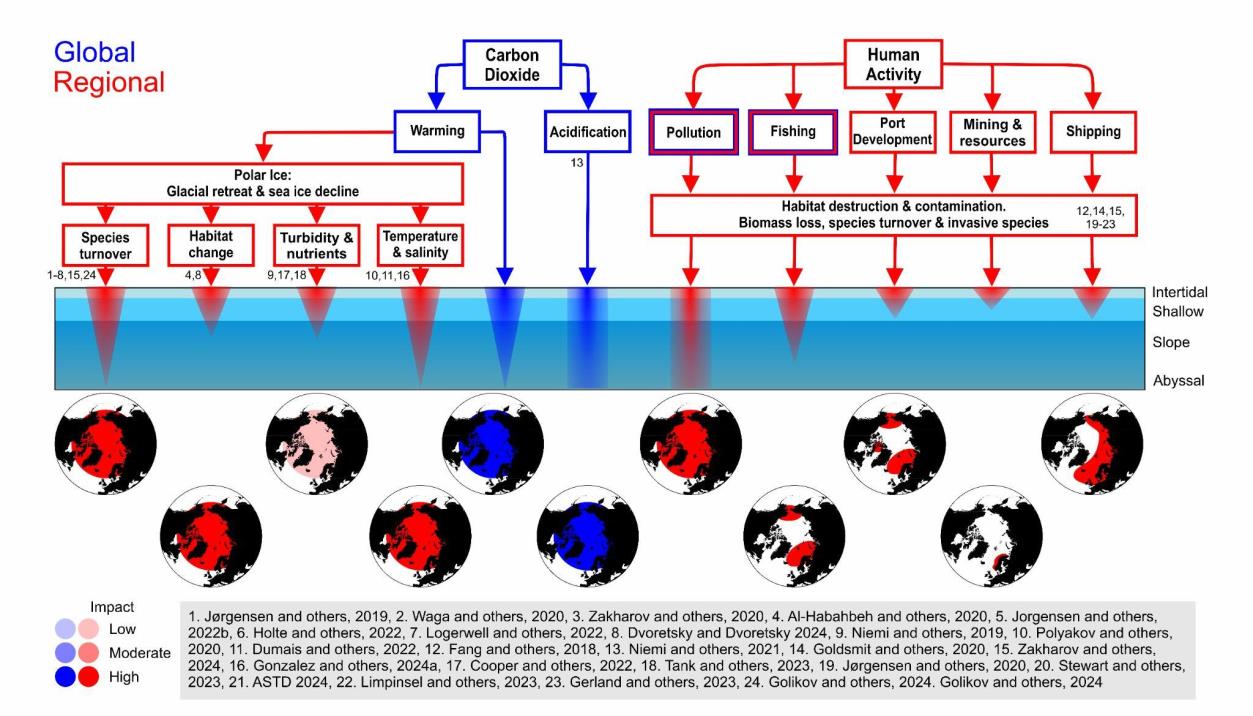
The Arctic is an ecologically and culturally important marine region that remains largely untouched but is facing rapid environmental changes. Recent studies have established quantitative baselines of marine benthic biodiversity in previously underresearched areas Ref 176 Ref 231 Ref 244 Ref 55 Ref 78 Ref 20 Ref 106 Ref 118 Ref 124 Ref 130 Ref 32 Ref 148 Ref 183 Ref 221. The Arctic faces major global and local threats such as warming, acidification, fishing, mineral extraction, port development and increased vessel traffic (figure V and citations therein). Microplastics are also a growing concern Ref 65. Recent ecological changes include infaunal and epibenthic invertebrate population declines and species moving northward Ref 139 Ref 106 Ref 209 Ref 75 Ref 83. The status of commercially important crab and shrimp stocks varies from variable to healthy Ref 157 Ref 86. As the potential for commercial fishery expansion, new shipping routes and oil and gas extraction increases in the region, further mapping and monitoring efforts are necessary.
Figure V Arctic Ocean: global and local stressors, associated pressures, and recently documented consequences for marine benthic invertebrates
North Atlantic Ocean, Baltic Sea, Black Sea, Mediterranean Sea and North Sea
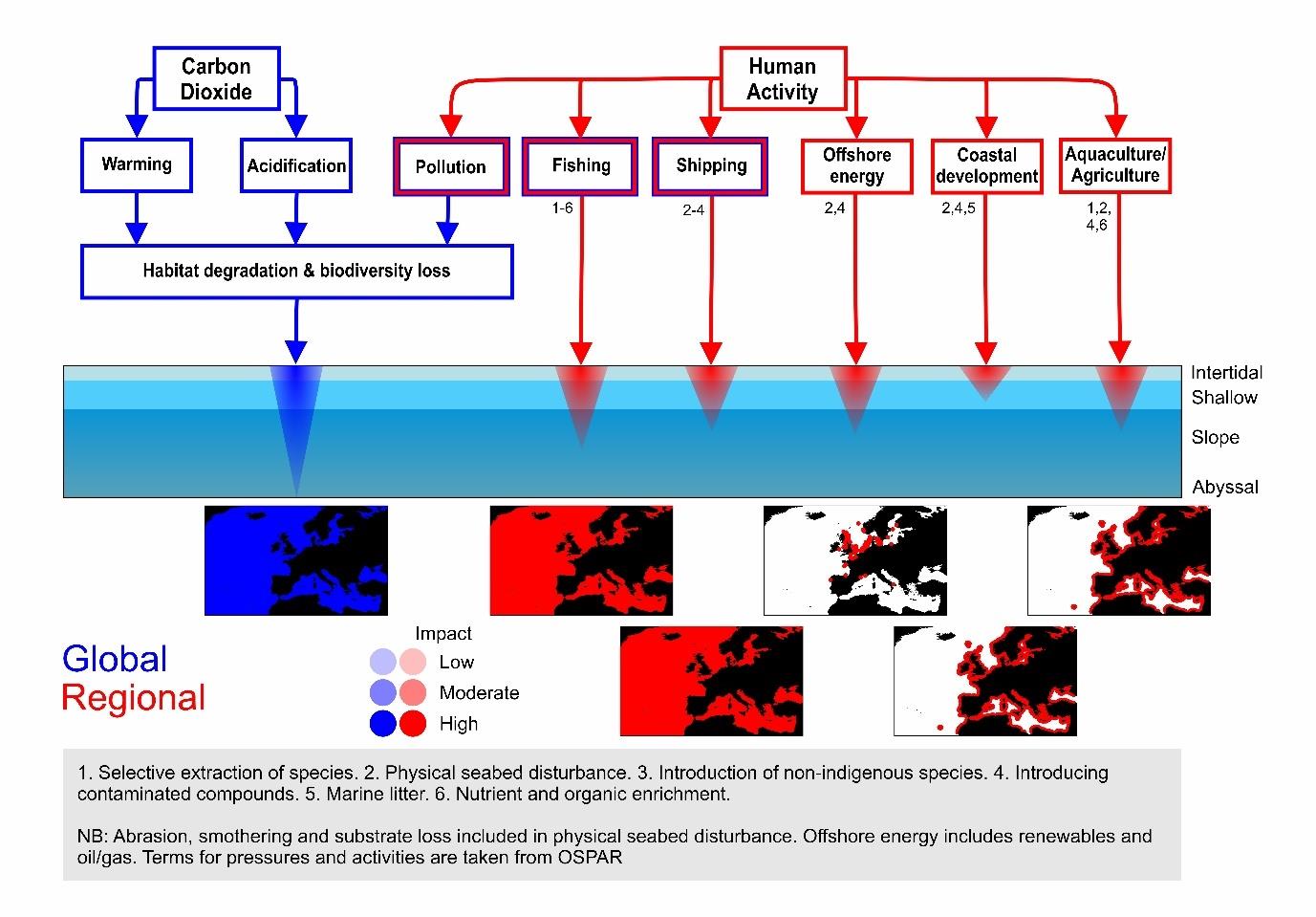
Except for oceanic ridges and hydrothermal vents, benthic habitats across subregions remain in poor status Ref 19 with benthic diversity moderate or low for most subregions and none showing increases Ref 166. Global warming affects habitats at all depths (Mediterranean Experts on Climate and Environmental Change (MedECC), 2020; see also figure VI). Fishing affects 48% of OSPAR-assessed areas via species extraction and seabed disturbance. Agriculture, aquaculture and tourism all drive nutrient enrichment, while green technologies increase contaminant inputs Ref 166. Pressures disrupt ecosystem functions, exacerbate the effects of other stressors such as epizootic events Ref 128 and compromise ecosystem services Ref 100. Benthic biodiversity improvements can benefit coastal communities through processes such as nutrient bioremediation Ref 230.
Figure VI North Atlantic Ocean, Baltic Sea, Black Sea, Mediterranean Sea and North Sea: global and local stressors, associated pressures and recently documented consequences for marine benthic invertebrates
South Atlantic Ocean and wider Caribbean
Despite limited and fragmented data, progress has been made. Research now focuses on deep environments, habitat mapping, identification of foundational species, and ecology Ref 211 Ref 62. Changes have been noted in shallow habitats, including coral bleaching and mortality, shifts in benthic communities and commercially valuable invertebrate stocks, and the spread of non-indigenous species (NIS) (see figure VII and studies cited therein). Climate-driven physical changes increasingly affect benthic ecosystems. Local threats include fishing, coastal development, shipping, mining, aquaculture causing overexploitation, illegal fishing, pollution, bioinvasions and habitat damage (figure VIII). Shifts in fishery stocks also have significant socioeconomic impacts Ref 225 Ref 61. Considering the rapid changes under way, along with the potential expansion of the petroleum industry Ref 193, seabed mining Ref 26 Ref 168, and the installation of offshore wind farms Ref 88, there is a need to expand the monitoring of benthic communities in this region, especially in deep habitats.
Figure VII South Atlantic Ocean and Wider Caribbean: global and local stressors, associated pressures and recently documented consequences on marine benthic invertebratesArrows width indicates relative importance of stressors at global and local scales
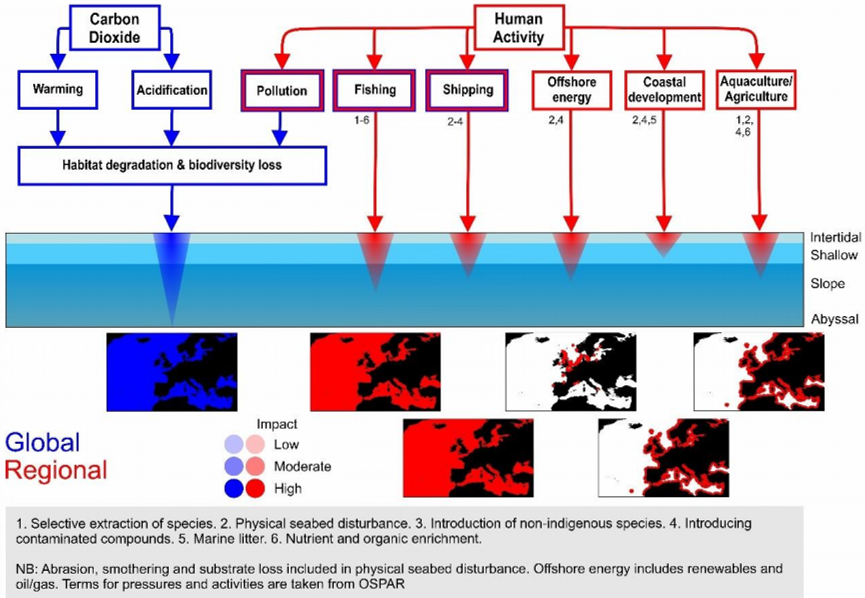
Note: Arrow width indicates relative importance of stressors at global and local scales.
Indian Ocean, Arabian Sea, Bay of Bengal, Red Sea, Gulf of Aden and Persian Gulf
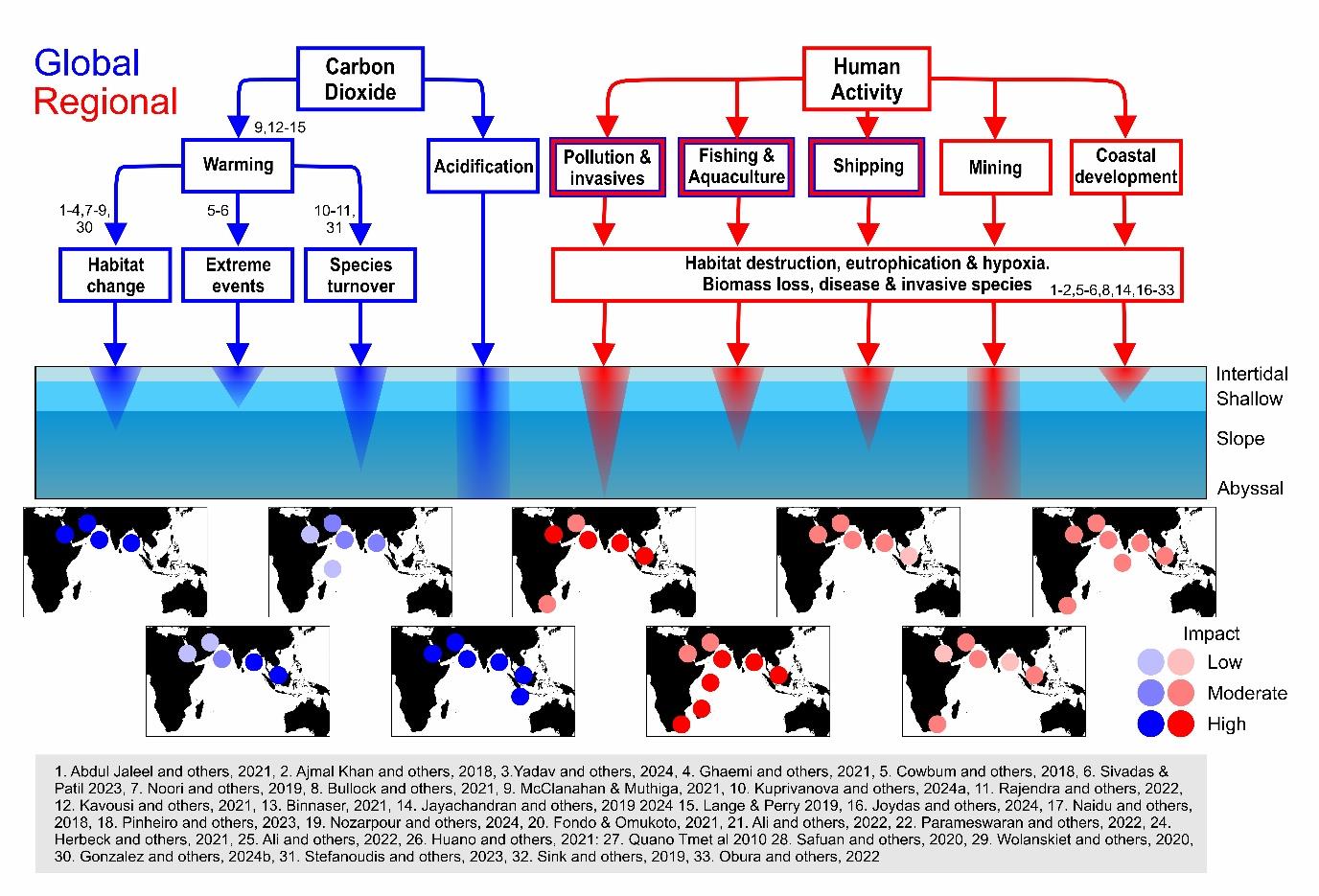
Multiple global and local stressors impact marine invertebrates in this region (figure VIII). Thermal stress causes coral bleaching and declines in abundance, even at depth Ref 50. Overfishing and destructive fishing practices degrade benthic habitats and threaten food security Ref 162. Marine debris leads to marine life entanglement Ref 171, while oil spills and invasive species disrupt native biodiversity Ref 121. Coastal development and untreated wastewater discharge alter benthic communities Ref 201 with prospective offshore mining likely to worsen impacts Ref 66. Long-term studies on these pressures are limited Ref 201, but new biodiversity surveys (such as Amjad and others, 2024) and ecological research provide insights into ecosystem resilience Ref 47 Ref 207. Functional ecology can help in the assessment of biodiversity roles and responses to environmental changes, while biogeography and metacommunity ecology can help to identify large-scale patterns and habitat connections for conservation planning. Experimental research can provide information on how marine invertebrates respond to natural variability, climate change and pollutants. Key ecosystem services at risk include food security through fisheries, coastal protection and tourism (United Nations Environment Programme-National Center for Wildlife (UNEP-NCW), Nairobi Convention and Western Indian Ocean Marine Science Association (WIOMSA), 2024).
Figure VIII Indian Ocean, Arabian Sea, Bay of Bengal, Red Sea, Gulf of Aden and Persian Gulf: global and local stressors, associated pressures and recently documented consequences for marine benthic invertebrates
North Pacific Ocean
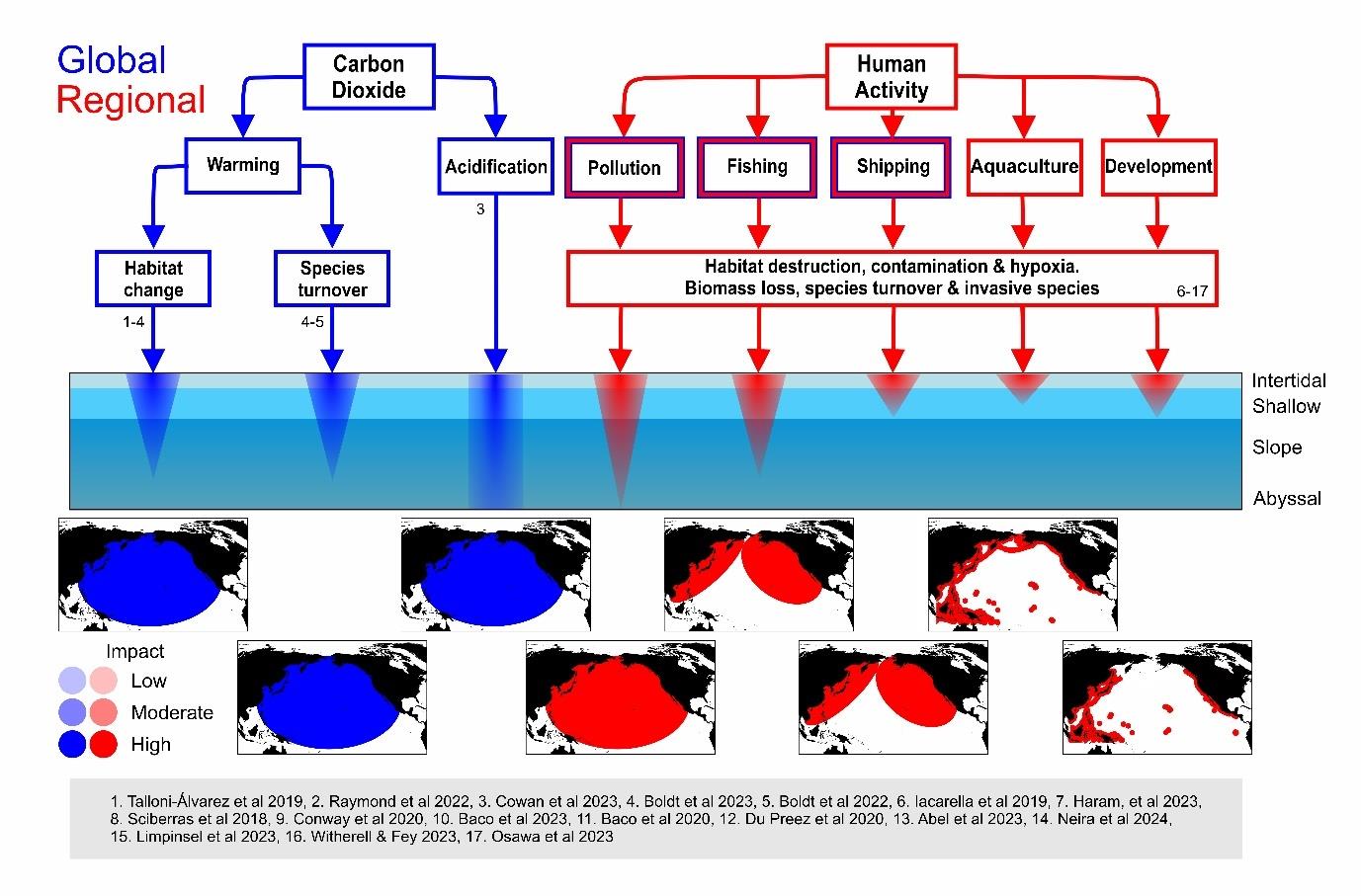
Ocean temperatures have increased over the long term Ref 95 Ref 31 Ref 24 Ref 6 Ref 39 Ref 97, leading to widespread intertidal die-offs from heatwaves and hypoxia Ref 31 Ref 105, species turnover, range shifts and the spread of invasive species Ref 29 Ref 227 Ref 108 Ref 239 Ref 53. The Puget Trough and the Piip volcano are hotspots of seafloor biodiversity in the North Pacific Ref 231 Ref 194 (figure IX).
Trawl fisheries are a major fishery type in the region Ref 152. Many invertebrate stocks, including crabs, oysters, geoduck, Pacific oysters and northern abalone,-have declined across the North Pacific, with severe losses species such as the Bering Sea snow crab Ref 214. Aquaculture faces challenges from ocean acidification, hypoxia, temperature anomalies and invasive species Ref 6 Ref 39 Ref 186. In 2021, a sea star outbreak in the Jiaozhou Bay in China caused major damage to shellfish farming and fisheries.
Figure IX North Pacific Ocean: global and local stressors, associated pressures and recently documented consequences for marine benthic invertebrates
South Pacific Ocean
Deep-sea biodiversity of the South Pacific has recently expanded through taxonomic discoveries on the south-eastern Australian slope and abyss Ref 93 Ref 163 by means of, inter alia, species inventories Ref 131, the discovery of new species Ref 69 Ref 237 Ref 22 Ref 94 Ref 74 Ref 247 and taxonomic revisions Ref 246. Underwater imagery and samples from the Coral Sea have provided new data on black corals Ref 107, carnivorous sponges Ref 59 and mesophotic reefs Ref 109.
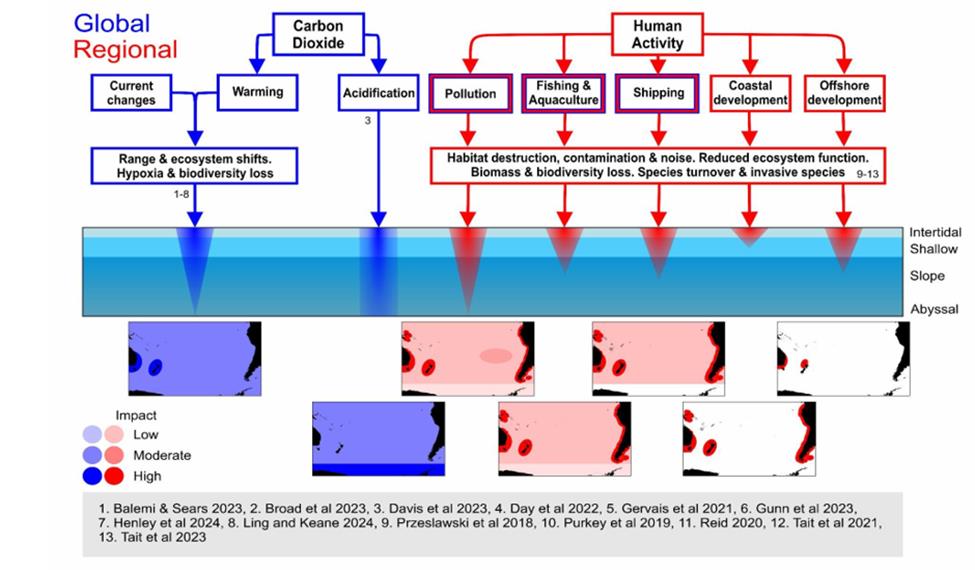
Warming waters have caused range shifts of benthic invertebrates across the region Ref 42 Ref 76, leading to ecosystem changes, especially in photic zones, such as kelp gardens shifting to urchin barrens Ref 137 Ref 16.
Warming waters and marine heatwaves (figure X) have reduced key habitat for marine invertebrates, such as giant kelp forests Ref 215 and coral reefs Ref 104, including through repeated bleaching events around Lord Howe Island, the world's southernmost coral reef Ref 153. In Australia, extreme flooding, bushfires and heatwaves have been associated with freshwater plumes, sedimentation, turbidity and high temperatures, all of which have been shown to negatively impact certain benthic invertebrates Ref 135 Ref 80 Ref 17.
Figure X South Pacific: global and local stressors, associated pressures and recently documented consequences for marine benthic invertebrates
Southern Ocean
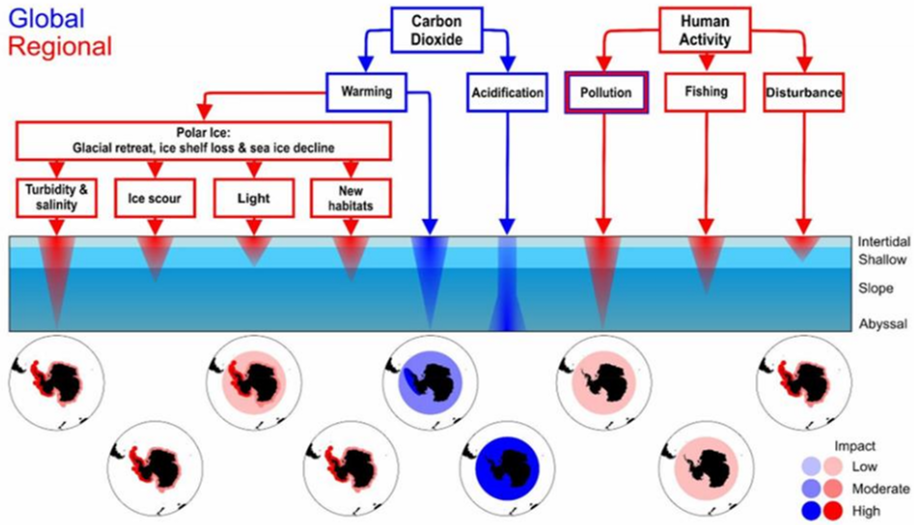
The ecosystems of Antarctica host a diverse, highly endemic community shaped by isolation and freezing temperatures. Projected changes (figure XI) will likely reach tipping points in physiological limits, primary productivity, ecosystem function and competition by the end of this century Ref 91. These changes will affect Antarctic benthic ecosystem health, stability and uniqueness as endemic cold-water species decline and cosmopolitan species move south. Benthic changes remain poorly understood, with research focused mostly on a few shallow water taxa, requiring advanced technologies to address geographic, depth, seasonal and taxonomic gaps Ref 91.
Cold-adapted species face threats from local and global drivers, including warming, acidification and changes to the cryosphere. The impacts vary by location, depth and community type, with the most significant changes observed in the shallows of the west Antarctic Peninsula Ref 91. These include the emergence of newly exposed coastline (leading to new habitats), reduced sea ice and increased iceberg scouring and turbidity, leading to higher mortality, lower diversity and reduced primary production, carbon storage and spatial competition Ref 91.
Figure XI Southern Ocean: global and local stressors, associated pressures and recently documented consequences for marine benthic invertebrates
3. Implications for achieving the targets of the Sustainable Development Goals of the 2030 Agenda for Sustainable Development
The preservation and sustainable management of marine ecosystems, a key focus of the Sustainable Development Goals, is closely tied to benthic fauna, which are crucial for ecosystem health and resilience. This connection is particularly evident in Goal 14, which is aimed at conserving and sustainably using the oceans, seas and marine resources. The conservation of benthic fauna also supports Goal 13 (climate action) and Goal 15 (life on land), as healthy marine ecosystems help to regulate the climate and maintain global ecological balance.
The negative biodiversity and ecosystem trends outlined in the present subchapter hinder progress towards the achievement of relevant Goals. Effective implementation of the Agreement on Marine Biological Diversity of Areas beyond National Jurisdiction to complement existing management measures and strengthened ocean management at the regional and national levels are crucial for advancing Goal 14. Increasing conservation-focused ocean management measures at the regional and national levels can support the achievement of Goal 14, contributing to addressing climate change (Goal 13) and reducing biodiversity loss (Kunming-Montreal Global Biodiversity Framework).
4. Key remaining knowledge and capacity gaps
(a) Marine invertebrates are underdocumented in the deep ocean, developing States and island States, and there are few experts on certain taxa;
(b) Increased digitization and genomic research are needed to identify cryptic species, integrate species information and improve accessibility;
(c) Documenting larval and juvenile settlement in deeper ecosystems remains challenging;
(d) Research on the biological pump and human impacts is needed;
(e) Local research and cooperation need improvement:
(i) To activate skills and resources to use citizen and community science programmes to fill knowledge gaps;
(ii) To develop effective succession planning and career development opportunities for early and mid-career marine scientists;
(iii) To meaningfully and ethically consider Indigenous Peoples and First Nations and local knowledge;
(iv) To secure consistent funding for long-term biodiversity monitoring;
(f) The recording of benthic invertebrates during assessments of commercial fisheries using bottom trawl should be used as a supplement to small-scale grab or underwater video methods;
(g) Ocean digital twins should be developed that compile available data and allow the development of future scenarios and predictions;
(h) Imaging techniques, possibly combined with artificial intelligence, can be used to monitor infrequently assessed, remote and inaccessible benthic ecosystems;
(i) Improved seabed management in relation to increasing human activities is needed;
(j) Networking across regions and disciplines is vital for understanding marine biodiversity, gathering key information, monitoring changes and conducting research on biodiversity patterns and processes, improving the societal relevance of research Ref 219.
Acknowledgements
The authors thank Pieter Provoost and Ward Appeltans (Ocean Biodiversity Information System of the International Oceanographic Data and Information Exchange); Wim Decock (World Register of Marine Species of the Flanders Marine Institute); and Ken Fong, Karen Dunmall and John O'Brien (Department of Fisheries and Oceans of Canada).
References
- Abel, Serena M., and others (2023). Journey to the deep: Plastic pollution in the hadal of deep-sea trenches. Environmental Pollution, vol. 333, art. 122078.
- Abdul Jaleel, K.U., and others (2021). Response of macrozoobenthic communities to summer monsoon upwelling and related hypoxia in the south eastern Arabian Sea shelf. Marine Environmental Research, vol. 166, art. 105278.
- Ajmal Khan, Syed, and others (2018). Impact of the 2004 tsunami on the macrofauna of the continental slope of the southeast coast of India. Marine Ecology, vol. 39, art. e12527.
- Al-Habahbeh, Amalia K., and others (2020). Arctic coastal benthos long-term responses to perturbations under climate warming. Philosophical Transactions of the Royal Society A: Mathematical, Physical and Engineering Sciences, vol. 378, art. 20190355.
- Ali, M., and others (2022). Issues and challenges in sustainable development of fisheries and aquaculture of the Southeast Asian Region: Fishery management: Management of fishing capacity and combating IUU fishing. The Southeast Asian State of Fisheries and Aquaculture.
- Alma, and others (2023). Physiological responses of scallops and mussels to environmental variability: Implications for future shellfish aquaculture. Marine Pollution Bulletin, 194(B): 115356.
- Alves, Catherine, and others (2022). Twenty years of change in benthic communities across the Belizean Barrier Reef. PLoS One, vol. 17, art. e0249155.
- Alzugaray, Romina, and others (2018). The Caribbean spiny lobster (Panulirus argus) fishery in Cuba: current status, illegal fishing, and environmental variability. Bulletin of Marine Science, vol. 94, No. 2, pp. 393-408.
- Amjad, Farah, and others (2024). An underwater imagery identification guide for shallow, mesophotic and deep-sea benthos in Maldives. Biodiversity Data Journal, vol. 12, art. e120128.
- Amon, Diva J., and others (2022). Assessment of scientific gaps related to the effective environmental management of deep-seabed mining. Marine Policy, vol. 138, art. 105006.
- Andrews, Nathan, and others (2021). Oil, fisheries and coastal communities: A review of impacts on the environment, livelihoods, space and governance. Energy Research & Social Science, vol. 75, art. 102009.
- ASTD (2019, 2024). Arctic Ship Traffic Database. https://map.astd.is/.
- Azovsky, Andrey I., and Valentin N. Kokarev (2019). Stable but fragile: long-term dynamics of arctic benthic macrofauna in Baydaratskaya Bay (the Kara Sea). Polar Biology, vol. 42, pp. 1307-1322.
- Baco, Amy R., and others (2023). Bottom-contact fisheries disturbance and signs of recovery of precious corals in the Northwestern Hawaiian Islands and Emperor Seamount Chain. Ecological Indicators, vol. 148, art. 110010.
- Baco, Amy R., and others (2020). Observations of vulnerable marine ecosystems and significant adverse impacts on high seas seamounts of the northwestern Hawaiian Ridge and Emperor Seamount Chain. Marine Policy, vol. 115, art. 103834.
- Balemi, Celia A., and Nick T. Shears (2023). Emergence of the subtropical sea urchin Centrostephanus rodgersii as a threat to kelp forest ecosystems in northern New Zealand. Frontiers in Marine Science, vol. 10, art. 1224067.
- Barros, Thayanne L., and others (2022). Wildfires cause rapid changes to estuarine benthic habitat. Environmental Pollution, vol. 308, art. 119571.
- Bell, James J., and others (2023). Marine heat waves drive bleaching and necrosis of temperate sponges. Current Biology, vol. 33, No. 1, pp. 158-163.
- Bevilacqua, Stanislao, and others (2020). The status of coastal benthic ecosystems in the Mediterranean Sea: Evidence from ecological indicators. Frontiers in Marine Science, vol. 7, art. 475.
- Bilous, Miranda, and others (2022). Coastal marine biodiversity in the western Canadian Arctic. Arctic Science, vol. 8, No. 4, pp. 1127-1147.
- Binnaser, Yaser S. (2021). Global warming, marine invertebrates, and Saudi Arabia Coast on the Red Sea: An updated review. Egyptian Journal of Aquatic Biology & Fisheries, vol. 25, No. 4, pp. 221-240.
- Blake, James A. (2023). New species of Scalibregmatidae (Annelida) from slope and abyssal depths off eastern Australia. Records of the Australian Museum, vol. 75, No. 3, pp. 271-298.
- Boldt, Jennifer L., and others, eds. (2023). State of the physical, biological and selected fishery resources of Pacific Canadian marine ecosystems in 2022. Canadian Technical Reports of Fisheries and Aquatic Sciences 3542.
- Boldt, Jennifer L., and others, eds. (2022). State of the physical, biological and selected fishery resources of Pacific Canadian marine ecosystems in 2021. Canadian Technical Reports of Fisheries and Aquatic Sciences 3482.
- Bove, Colleen. B., and others (2022). A century of warming on Caribbean reefs. PloS Climate, vol. 1, no. 3, art. e0000002.
- Bridges, Amelia E.H., and others (2023). Review of the central and south Atlantic shelf and deep-sea benthos: science, policy, and management. In Oceanography and Marine Biology: An Annual Review Volume 61, Stephen J. Hawkins, and others, eds. Taylor & Francis.
- Broad, Alison, and others (2023). Anchor scour from shipping and the defaunation of rocky reefs: A quantitative assessment. Science of the Total Environment, vol. 863, art. 160717.
- Bullock, Robert, and others (2021). The conservation status of marine biodiversity of the Western Indian Ocean. Gland, Switzerland: IUCN.
- Buser, Thaddaeus (2023). Eastern and Northern Bering Sea - Miscellaneous species. In Ecosystem Status Report 2023: Eastern Bering Sea, Stock Assessment and Fishery Evaluation Report, Elizabeth Siddon, ed. North Pacific Fishery Management Council, Anchorage, Alaska.
- Chanrajchakij, Issara (2012). Issues and challenges in sustainable fisheries development of the Southeast Asian Region: Fisheries management: Responsible fishing and practices in Southeast Asia. The Southeast Asian State of Fisheries and Aquaculture, 73-74.
- Chen, LinLin, and others (2020). Long-term changes of marine subtidal benthic communities in North East Asia (Yellow and Japan seas) in a global change context: A review. Aquatic Conservation: Marine and Freshwater Ecosystems, vol. 30, pp. 1451-1475.
- Christie, Laurissa R., and others (2023). Community-led coastal ecosystem assessments in the Hudson Bay Complex (Igloolik, Kinngait, and Naujaat, NU and Whapmagoostui, QC): Synthesis of 2020-2021 field programs. Canadian Technical Report of Fisheries and Aquatic Sciences, vol. 3540.
- Claassens, Louw, and others (2022). How developed is the South African coast? Baseline extent of South Africa's coastal and estuarine infrastructure. Ocean & Coastal Management, vol. 222, art. 106112.
- Claus, Simon and others (2014). Marine regions: Towards a global standard for georeferenced marine names and boundaries. Marine Geodesy, vol. 37, No. 2, pp. 99-125.
- Conway, Kim W., and others (2022). Sponge reefs on the Northeast Pacific margin: geomorphic and biological variability. In Seafloor Geomorphology as Benthic Habitat: GeoHab Atlas of Seafloor Geomorphic Features and Benthic Habitats (Second Edition), Peter T. Harris, and Elaine Baker, eds. Elsevier.
- Cooper, Lee W., and others (2022). Changes in the oxygen isotope composition of the Bering Sea contribution to the Arctic Ocean are an independent measure of increasing freshwater fluxes through the Bering Strait. PLOS One, vol. 17, pp. 1-17.
- Couce, Elena, and others (2020). Reconstructing three decades of total international trawling effort in the North Sea. Earth System Science Data, 12(1), pp.373-386.
- Couce, Elena, and others (2022). Capturing threshold responses of marine benthos along gradients of natural and anthropogenic change. Journal of Applied Ecology, vol. 57, pp. 1137-1148.
- Cowan, Malcolm W., and others (2023). Role of the Vibrio community, reproductive effort, and environmental parameters in intertidal Pacific oyster summer mortality in British Columbia, Canada. Aquaculture, vol. 565, art. 739094.
- Cowburn, Benjamin, and others (2018). Can luxury and environmental sustainability co-exist? Assessing the environmental impact of resort tourism on coral reefs in the Maldives. Ocean & Coastal Management, vol. 158, pp. 120-127.
- Crespo, Daniel, and Miguel A. Pardal (2022). Ecological and economic importance of benthic communities. In Life Below Water, Encyclopedia of the UN Sustainable Development Goals, W. Leal Filho and others, eds. Springer Cham.
- Davis, Tom R., and others (2023). Impacts of climate change on densities of the urchin Centrostephanus rodgersii vary among marine regions in Eastern Australia. Diversity, vol. 15, No. 3, art. 419.
- Day, Ryan D., and others (2022). The impact of seismic survey exposure on the righting reflex and moult cycle of southern rock lobster (Jasus edwardsii) puerulus larvae and juveniles. Environmental Pollution, vol. 309, art. 119699.
- Deep Sea Conservation Coalition (2024). Marine Expert Statement. https://seabedminingsciencestatement.org/.
- De Lacerda, Luiz D., and others (2021). 20-years cumulative impact from shrimp farming on mangroves of Northeast Brazil. Frontiers in Forests and Global Change, vol. 4, art. 653096.
- De Leo, Fabio C., and others (2020). Continental Slope and Submarine Canyons: Benthic Biodiversity and Human Impacts. In Brazilian Deep-Sea Biodiversity, Paulo Y.G. Sumida, and others, eds. Springer, Cham.
- Delfan, Nastaran, and others (2021). Patterns of structural and functional diversity of macrofaunal communities in a subtropical mangrove ecosystem. Estuarine, Coastal and Shelf Science, vol. 252, art. 107288.
- Department of Forestry, Fisheries and the Environment (DFFE) (2023). Status of the South African marine fishery resources 2023. Cape Town.
- DFO (2024). Tuvaijuittuq Marine Protected Area. https://www.dfo-mpo.gc.ca/oceans/mpa- zpm/tuvaijuittuq/index-eng.html.
- Diaz, Clara, and others (2023). Mesophotic coral bleaching associated with changes in thermocline depth. Nature Communications, vol. 14, No. 1, p. 6528.
- Drazen, Jeffrey, and others (2020). Midwater ecosystems must be considered when evaluating environmental risks of deep-sea mining. Proceedings of the National Academy of Sciences of the United States of America, vol. 117, No. 30.
- Dreujou, Elliot, and others (2023). Multiple human activities in coastal benthic ecosystems: Introducing a metric of cumulative exposure. Elementa: Science of the Anthropocene, vol 11, No. 1, art. 00024.
- Drinkwin, Joan, and others (2019). Salish Sea Transboundary Action Plan for Invasive European Green Crab. Puget Sound Partnership.
- Duarte, Gustavo A., and others (2020). Heat waves are a major threat to turbid coral reefs in Brazil. Frontiers in Marine Science, vol. 7, art. 179.
- Dumais, Philippe-Olivier, and others (2022). Description and spatial modelling of benthic communities distribution in the Canadian Arctic Archipelago. Frontiers in Marine Science, vol. 9, art. 898852.
- Du Preez, Cherisse, and others (2020). Cold-water corals and other vulnerable biological structures on a North Pacific seamount after half a century of fishing. Frontiers in Marine Science, vol. 7, art. 00017.
- Dvoretsky, Alexander G, and Vladimir G. Dvoretsky (2024). Filling knowledge gaps in Arctic marine biodiversity: Environment, plankton, and benthos of Franz Josef Land, Barents Sea. Ocean & Coastal Management, vol. 249, art. 106987.
- Eggertsen, Linda, and others (2024). Complexities of reef fisheries in Brazil: a retrospective and functional approach. Reviews in Fish Biology and Fisheries, vol. 34, pp. 511-538.
- Ekins, Merrick, and John N.A. Hooper (2023). New carnivorous sponges from the Great Barrier Reef, Queensland, Australia collected by ROV from the RV FALKOR. Zootaxa, vol. 5293, No. 3, pp. 435-471.
- EMODnet Bathymetry Consortium (2016). EMODnet Digital Bathymetry. https://sextant.ifremer.fr/record/c7b53704-999d-4721-b1a3-04ec60c87238/.
- Engelhard, Georg H., and others (2024). Climate risk assessment of the fisheries in Namibia. Reviews in Fish Biology and Fisheries, vol. 34, pp. 1231-1260.
- Etnoyer, Peter J., and others (2022). Diversity and time-series analyses of Caribbean deep-sea coral and sponge assemblages on the tropical island slope of Isla de Roatán, Honduras. Marine Biodiversity, vol. 52, art. 8.
- European Academies' Science Advisory Council (2023). Deep-Sea Mining: Assessing evidence on future needs and environmental impacts.
- https://easac.eu/fileadmin/user_upload/EASAC_Deep_Sea_Mining_Web_publication _. pdf.
- Fang, Chao, and others (2018). Microplastics contamination in benthic organisms from the Arctic and sub-Arctic regions. Chemosphere, vol. 209, pp. 298-306.
- Fennessy, Sean T. (2024). Chapter 12: Shelf, deep sea and offshore pelagic. In Western Indian Ocean Critical Habitats Outlook, J.P.M. Paula, ed. Nairobi, Kenya, UNEP and WIOMSA.
- Flanders Marine Institute (2024a). IHO Sea Areas, Version 3. http:/marineregions.org.
- Flanders Marine Institute (2024b). The intersect of the Exclusive Economic Zones and IHO sea areas, Version 5. https://www.marineregions.org/.
- Flaxman, Beth, and Elena K. Kupriyanova (2024). New species of Laetmonice (Aphroditidae, Annelida) from bathyal and abyssal depths around Australia. Records of the Australian Museum, vol. 76, No. 4, pp. 195-210.
- Fondo, Esther N., and Johnstone O. Omukoto (2022). Observations of industrial shallow-water prawn trawling in Kenya. Oceanography, vol. 34, No. 4, pp. 44 45.
- Fontela, Marcos, and others (2021). Anthropogenic CO2 and ocean acidification in Argentine Basin Water Masses over almost five decades of observations. Science of the Total Environment, vol. 779, art. 146570.
- Gao, Haihe, and others (2022). Macro-and/or microplastics as an emerging threat effect crop growth and soil health. Resources, Conservation and Recycling, vol. 186, art. 106549.
- GEBCO (2015). The GEBCO_2014 Grid, version 20150318n.d. IHO-IOC GEBCO Gazetteer of Undersea Feature Names, www.gebco.net.
- Georgieva, Magdalena N., and others. (2023) The annelid community of a natural deep-sea whale fall off eastern Australia. Records of the Australian Museum, vol. 75, No. 3, pp. 167-213.
- Gerland, Sebastian, and others (2023). Still Arctic? The changing Barents Sea. Elementa: Science of the Anthropocene, vol. 11, No. 1, art. 00088.
- Gervais, Connor R., and others (2021). Species on the move around the Australian coastline: A continental-scale review of climate-driven species redistribution in marine systems. Global Change Biology, vol. 27, No. 14, pp. 3200-3217.
- Ghaemi, Maryam, and others (2021). Spatial distribution of nutrients and chlorophyll a across the Persian Gulf and the Gulf of Oman. Ocean & Coastal Management, vol. 201, art. 105476.
- Gianasi, Bruno L., and others (2022). Biodiversity of coastal epibenthic macrofauna in Eastern Canadian Arctic: Baseline mapping for management and conservation. Frontiers in Marine Science, vol. 9, art. 873608.
- Gissi, Elena, and others (2021). A review of the combined effects of climate change and other local human stressors on the marine environment. Science of the Total Environment, vol. 755, art. 142564.
- Glasby, Tim M., and others (2023). Black summer bushfires caused extensive damage to estuarine wetlands in New South Wales, Australia. Ecological Management and Restoration, vol. 24, No. 1, pp. 27- 35.
- Goes, Enatielly R., and others (2023). A seafloor sensitivity index to oil spills in tropical marine protected areas. Continental Shelf Research, vol. 266, art. 105069.
- Goldsmit, Jesica, and others (2020). What and where? Predicting invasion hotspots in the Arctic marine realm. Global Change Biology, vol. 26, pp. 4752-4771.
- Golikov, Alexey V., and others (2024). Long-term annual trawl data show shifts in cephalopod community in the western Barents Sea during 18 years. Frontiers in Marine Science, vol. 11, art. 1392585.
- Gomes, Luiz E.O., and Angelo F. Bernardino (2020). Drought effects on tropical estuarine benthic assemblages in Eastern Brazil. Science of the Total Environment, vol. 703, art. 135490.
- González-De Zayas, Roberto, and others (2020). Stable isotopes used to assess pollution impacts on coastal and marine ecosystems of Cuba and México. Regional Studies in Marine Science, vol. 39, art. 101413.
- Gonzalez, Silvana, and others (2024a). Spatiotemporal variability of Pacific Arctic marine ecosystems. In Proceedings of the Alaska Marine Science Symposium, 29 January-2 February 2024, Anchorage, AK, USA.
- Gonzalez, Karla, and others (2024b). Differential spatio-temporal responses of Red Sea coral reef benthic communitpies to a mass bleaching event. Scientific Reports, vol. 14, art. 74956.
- Gorayeb, Adryane, and others (2024). Emerging challenges of offshore wind energy in the Global South: Perspectives from Brazil. Energy Research & Social Science, vol. 113, art. 103542.
- Gress, Erika, and Dominic A. Andradi-Brown (2018). Assessing population changes of historically overexploited black corals (Order: Antipatharia) in Cozumel, Mexico. PeerJ, vol. 6, art. e5129.
- Griffiths, Jennifer R., and others (2017). The importance of benthic-pelagic coupling for marine ecosystem functioning in a changing world. Global Change Biology, vol. 23, pp. 2179-2196.
- Griffiths, Huw J., and others (2024). Antarctic benthic ecological change. Nature Reviews Earth & Environment, vol. 5, No. 9, pp. 645-664.
- Gunn, K.L., and others (2023). Recent reduced abyssal overturning and ventilation in the Australian Antarctic Basin, vol. 13, pp. 537-544.
- Gunton, Laetitia M., and others (2021). Annelids of the eastern Australian abyss collected by the 2017 RV "Investigator" voyage. ZooKeys, vol. 1020, pp. 1-198.
- Gunton, Laetitia M., and others (2023). New species of Melinna (Melinnidae, Annelida) from the Australian abyss with comments on M. albicincta, M. cristata and M. elisabethae, in RV Investigator- Abyssal Annelida, EK Kupriyanova and LM Gunton, eds. Records of the Australian Museum.
- Guo, Jinqiang, and others (2020). Hypoxia, acidification and nutrient accumulation in the Yellow Sea Cold Water of the South Yellow Sea. Science of The Total Environment, vol. 745, art. 141050.
- Halpern, Benjamin S., and others (2019). Recent pace of change in human impact on the world's ocean. Scientific Reports, vol. 9, art. 11609.
- Han, In-Seong, and others (2023). Long-term pattern changes of sea surface temperature during summer and winter due to climate change in the Korea Waters. Fisheries and Aquatic Sciences, vol. 26, pp. 639- 648.
- Haram, Linsey E., and others (2023). Extent and reproduction of coastal species on plastic debris in the North Pacific Subtropical Gyre. Nature Ecology & Evolution, vol. 7, pp. 687-697.
- Harris Peter T., and others (2023). A marine plastic cloud - Global mass balance assessment of oceanic plastic pollution. Continental Shelf Research, vol. 255, art. 104947.
- Heckwolf, Melanie J., and others (2021). From ecosystems to socio-economic benefits: A systematic review of coastal ecosystem services in the Baltic Sea. Science of the Total Environment, vol. 755, p. 2, art. 142565.
- Herbeck, Lucia S., and others (2021). Pond aquaculture effluents feed an anthropogenic nitrogen loop in a SE Asian estuary. Science of the Total Environment, vol. 756, art. 144083.
- Herbert-Read, James E., and others (2022). A global horizon scan of issues impacting marine and coastal biodiversity conservation. Nature Ecology & Evolution, vol. 6, No. 9, pp. 1262-1270.
- Henry, Lea-Anne, and others (2017). Historic scale and persistence of drill cuttings impacts on North Sea Benthos. Marine Environmental Research, vol. 129, pp. 219-228.
- Henley, Benjamin J., and others (2024). Highest ocean heat in four centuries places Great Barrier Reef in danger. Nature, vol. 632, pp. 320-326.
- Hesketh, A. V., and Harley, C.D.G. (2023). Extreme heatwave drives topography-dependent patterns of mortality in a bed-forming intertidal barnacle, with implications for associated community structure. Glob. Change Biol. 29, 165-178.
- Holte, Børge, and others (2022). Infaunal and epifaunal secondary production in the Barents Sea, with focus on snow crab (Chionoecetes opilio) prey resources and consumption. ICES Journal of Marine Science, vol. 79, No. 9, pp. 2524-2539.
- Horowitz, Jeremy, and others (2022). Five new species of black coral (Anthozoa; Antipatharia) from the Great Barrier Reef and Coral Sea, Australia. Zootaxa, vol. 5213, No. 1, 1-35.
- Hu, Li-sha, and others (2021). Northward shift of a biogeographical barrier on China's coast. Diversity and Distributions, vol. 28, pp. 318-330.
- Huang, Yi-Cheng, and others (2024). First record of the invasive biofouling mussel Mytella strigata (Hanley, 1843) (Bivalvia: Mytilidae) from clam ponds in Taiwan. BioInvasions Record, vol. 10, No. 2, pp. 304-312.
- Huang, Zhi, and others (2024). Marine heatwaves in the Great Barrier Reef and Coral Sea: Their mechanisms and impacts on shallow and mesophotic coral ecosystems. Science of the Total Environment, vol. 908, art. 168063.
- Humphries, Fran, and others (2025). Bridging divides: The evolution of marine genetic resource governance beyond national jurisdiction. In Decoding marine genetic resource governance under the BBNJ Agreement, Fran Humphries, ed. Springer.
- Iacarella, Josephine C., and others (2019). Biotic exchange from movement of 'static' maritime structures. Biological Invasions, vol. 21, pp. 1131-1141.
- Ibrahim, Nur F., and others (2024). Review of Oweniidae Rioja, 1917 (Annelida, Palaeoannelida) from Malaysia, with a description of two new species and a key to South China Sea species. Zoosystema, vol. 46, No. 20, pp. 513-542.
- IHO Sea Areas (2018). Flanders Marine Institute. IHO Sea Areas, version 3. Available at https://www.marineregions.org/. https://doi.org/10.14284/323.
- IMARPE (2024). Biodiversity and stock assessment research on benthic invertebrates in Peruvian waters. Boletín del Instituto del Mar del Perú. Available at
- https://revistas.imarpe.gob.pe/index.php/boletin/article/download/biodiversidad_marina/410/1014
- Isla, Enrique, and Dieter Gerdes (2019). Ongoing ocean warming threatens the rich and diverse macrobenthic communities of the Antarctic continental shelf. Progress in Oceanography, vol. 178, art. 102180.
- Jacobs, Kevin, and others (2022). Biodiversity monitoring stations for benthic macrofauna and meiofauna in the Disko Fan and Hatton Basin Conservation Areas. Canadian Technical Report of Fisheries and Aquatic Sciences, vol. 3487.
- Jamieson, Alan J., and Deo Florence L. Onda (2022). Lebensspuren and müllspuren: Drifting plastic bags alter microtopography of seafloor at full ocean depth (10,000 m, Philippine Trench). Continental Shelf Research, vol. 250, art. 104867.
- Jayachandran, Paravanparambil R., and others (2024). Unveiling the ecological status of the Arabian Gulf's marine ecosystem: Insights from benthic community analysis. Marine Pollution Bulletin, vol. 205, art. 116571.
- Jayachandran, Paravanparambil R., and others (2019). First record of the alien invasive biofouling mussel Mytella strigata (Hanley, 1843) (Mollusca: Mytilidae) from Indian waters. BioInvasions Records, vol. 8, No. 4, pp. 828-837.
- Jørgensen, Lis L., and others (2019). Impact of multiple stressors on sea bed fauna in a warming Arctic. Marine Ecology Progress Series, vol. 608, pp. 1-12.
- Jørgensen, Lis L., and others (2020). Responding to global warming: New fisheries management measures in the Arctic. Progress in Oceanography, vol. 188, art. 102423.
- Jørgensen, Lis L., and others (2022a). International megabenthic long-term monitoring of a changing Arctic ecosystem: Baseline results. Progress in Oceanography, vol. 200, art. 102712.
- Jørgensen, Lis L., and others (2022b). Benthic transition zones in the Atlantic gateway to a changing Arctic Ocean. Progress in Oceanography. Progress in Oceanography, vol. 204, art. 102792.
- Joydas, Thadickal V., and others (2024). Advancing ecological assessment of the Arabian Gulf through eDNA metabarcoding: opportunities, prospects, and challenges. Frontiers in Marine Science, vol. 11, art. 1276956.
- Kanhai, La Daana K., and others (2022). The status of marine debris/litter and plastic pollution in the Caribbean Large Marine Ecosystem (CLME): 1980-2020. Environmental Pollution, vol. 300, art. 118919.
- Katsanevakis, Stelios, and others (2022). The fan mussel Pinna nobilis on the brink of extinction in the Mediterranean. In Imperiled: The Encyclopedia of Conservation, Dominick A DellaSala and Michael I. Goldstein, eds. Oxford, Elsevier.
- Kavousi, Javid, and others (2021). Four consecutive coral bleaching events in the Northern Persian Gulf: 2014-2017. Annals of Marine Science, vol. 5, No. 1, pp. 007-014.
- Kenchington, Ellen, and others (2022). Biodiversity monitoring stations for benthic megafauna in the Disko Fan Conservation Area. Canadian Technical Report of Fisheries and Aquatic Sciences, vol. 3499.
- Kupriyanova, Elena K., and others (2024a). Catalogue of the Annelida collected by the IN2021_V04 and IN2022_V08 expeditions to the Australian Christmas Island and Cocos (Keeling) Islands Territories. Museum Victoria Science Reports, vol. 30, pp. 1-71.
- Kupriyanova, Elena K., and others (2024b). Confirming the invasion by tubeworm Ficopomatus cf. uschakovi (Pillai, 1960) (Annelida, Serpulidae) in Mexico. BioInvasions Records, vol. 13, No. 4, pp. 979- 991.
- Ladewig, Samantha M., and others (2023). Real-world impacts of microplastic pollution on seafloor ecosystem function. Science of the Total Environment, vol. 858, art. 160114.
- Lange, Ines D., and Chris T. Perry (2019). Bleaching impacts on carbonate production in the Chagos Archipelago: Influence of functional coral groups on carbonate budget trajectories. Coral Reefs, vol. 38, No. 4, pp. 619-624.
- Larkin, Meryl F., and others (2024). La Niña pushes an endangered temperate soft coral species to the brink of localised extinction. Estuaries and Coasts, vol. 47, pp. 448-459.
- Limpinsel, Douglas, and others (2023). Impacts to essential fish habitat from non-fishing activities in Alaska: EFH 5-year review from 2018-2023. National Marine Fisheries Service, Alaska Region, Juneau, Alaska. U.S. Dep. Commerce, NOAA Tech. Memo. NMFS-F/AKR-30.
- Ling, Scott D., and John P. Keane (2024). Climate-driven invasion and incipient warnings of kelp ecosystem collapse. Nature Communications, vol. 15, No. 1, art. 400.
- Lloret, Josep, and others (2022). Unravelling the ecological impacts of large-scale offshore wind farms in the Mediterranean Sea. Science of the Total Environment, vol. 824, art. 153803.
- Logerwell, Elizabeth A., and others (2022). Winners and losers in a warming Arctic: Potential habitat gain and loss for epibenthic invertebrates of the Chukchi and Bering Seas, 2008-2100. Deep Sea Research Part II: Topical Studies in Oceanography, vol. 206, art. 105210.
- Lovell, Tricia A. (2023). Understanding the drivers, scale and impact of abandoned, lost and otherwise discarded fishing gear in small-scale fisheries: an Eastern Caribbean perspective. Frontiers in Marine Science, vol. 10, art. 1139259.
- Magris, Rafael A., and others (2020). A blueprint for securing Brazil's marine biodiversity and supporting the achievement of global conservation goals. Diversity and Distributions, vol. 27, No. 2, pp. 195-388.
- Mamede, Renato (2024). Ecology and biogeography of marine benthos. Diversity, vol. 16, art. 502.
- Marine Regions (2024). Flanders Marine Institute. MarineRegions.org. Available at www.marineregions.org. Accessed on 2024-10-04.
- Martello, Melina F., and others (2024). Projected climate-driven shifts in coral distribution indicate tropicalisation of Southwestern Atlantic reefs. Diversity and Distributions, vol. 30, art. e13851.
- Martinez, Aline S., and others (2022). Reviewing the effects of contamination on the biota of Brazilian coastal ecosystems: scientific challenges for a developing country in a changing world. Science of The Total Environment, vol. 803, art. 150097.
- Mason, Victoria G., and others (2022). Microplastics alter multiple biological processes of marine benthic fauna. Science of the Total Environment, vol. 845, art. 157362.
- McClanahan, Tim R. and Nyawira A. Muthiga (2021). Oceanic patterns of thermal stress and coral community degradation on the island of Mauritius. Coral Reefs, vol. 40, No. 1, pp. 53-74.
- McNicholl, Darcy G., and others (2024). Anguniaqvia Niqiqyuam Marine Protected Area Coastal Monitoring: Synthesis of 2017-2021 Summer and Winter Field Programs. Canadian Technical Report of Fisheries and Aquatic Sciences, vol. 3595.
- MedECC (2020). Climate and Environmental Change in the Mediterranean Basin - Current Situation and Risks for the Future. First Mediterranean Assessment Report. Union for the Mediterranean, Plan Bleu, UNEP/MAP, Marseille, France.
- Momota, Kyosuke, and Shinya Hosokawa (2021). Potential impacts of marine urbanization on benthic macrofaunal diversity. Scientific Reports, vol. 11, art. 4028.
- Monsalve, Eduardo R., and Eduardo Quiroga (2022). Farmed shrimp aquaculture in coastal wetlands of Latin America - A review of environmental issues. Marine Pollution Bulletin, vol. 183, art. 113956.
- Morgan, Nicole B., and Amy R. Baco (2021). Recent fishing footprint of the high-seas bottom trawl fisheries on the Northwestern Hawaiian Ridge and Emperor Seamount Chain: A finer-scale approach to a large-scale issue. Ecological Indicators, vol. 121, art. 107051.
- Moriarty, Tess, and others (2023). Bleaching, mortality and lengthy recovery on the coral reefs of Lord Howe Island. The 2019 marine heatwave suggests an uncertain future for high-latitude ecosystems. PLoS Climate, vol. 2, No. 4, art. e0000080.
- Gottlieb, H. Muraki, and others (2025). BBNJ Agreement: A New Infrastructure to Foster Benefit Sharing of Marine Genetic Resources. In Decoding Marine Genetic Resource Governance Under the BBNJ Agreement (pp. 29-54). Chap: Springer Nature Switzerland.
- Naidu, S.A., and others (2018). Microplastics in the benthic invertebrates from the coastal waters of Kochi, Southeastern Arabian Sea. Environmental geochemistry and health, vol. 40, pp. 1377-1383.
- Neira, Carlos, and others (2024). Waste barrel contamination and macrobenthic communities in the San Pedro Basin DDT dumpsite. Marine Pollution Bulletin, vol. 203, art. 116463.
- Niemi, Andrea, and others (2019). State of Canada's Arctic Seas. Canadian Technical Report of Fisheries and Aquatic Sciences, vol. 3344.
- Niemi, Andrea, and others (2021). Biological impact of ocean acidification in the Canadian Arctic: Widespread severe pteropod shell dissolution in Amundsen Gulf. Frontiers in Marine Sciences, vol. 8, art. 600184.
- Noori, Roohollah, and others (2019). Recent and future trends in sea surface temperature across the Persian Gulf and Gulf of Oman. PloS One, vol. 14, No. 2, art. e0212790.
- Nozarpour, Rahil, and others. Functional diversity of the macrofauna communities in arid mangroves of the Persian Gulf and Gulf of Oman. Regional Studies in Marine Science, vol. 74, art. 103534, 2024.
- Ocean Biogeographic Information System (OBIS) (2019). https://www.obis.org/.
- Obura, David, and others (2022). Vulnerability to collapse of coral reef ecosystems in the Western Indian Ocean. Nature Sustainability, vol. 5, No. 2, pp. 104-113.
- O'Hara, Timothy D., and others (2020). The lower bathyal and abyssal seafloor fauna of eastern Australia. Marine Biodiversity Records, vol. 13, art. 11.
- Osawa, Yumiko, and others (2023). Bathymetric segregation among demersal benthos and its contributions to the differences in the bycatches on bottom fisheries in the Emperor Seamounts area, Northwestern Pacific Ocean. Regional Studies in Marine Science, vol. 68, art. 103261.
- Osborne, Emily, and others (2022). Ocean acidification in the Gulf of Mexico: Drivers, impacts, and unknowns. Progress in Oceanography, vol. 209, art. 102882.
- OSPAR (2024). Oslo and Paris Convention for the Protection of the Marine Environment of the North- East Atlantic Assessments. https://oap.ospar.org/en/.
- OSPAR (2023). Benthic Habitats Thematic Assessment. https://oap.ospar.org/en/ospar- assessments/quality-status-reports/qsr-2023/synthesis-report/key-messages/#benthic-habitats-continue-to- be-damaged.
- Paiva, Sandra V., and others (2023). Marine carbonate mining in the southwestern Atlantic: current status, potential impacts, and conservation actions. Marine Policy, vol. 148, art. 105435.
- Parameswaran, Usha V., and others (2022). Standing stock and composition of macrozoobenthos in the south-eastern Arabian Sea: A revisit after a decade. Journal of Sea Research, vol. 183, art. 102200.
- Pardal, André, and others (2024). Urbanisation on the coastline of the most populous and developed state of Brazil: the extent of coastal hardening and occupations in low-elevation zones. Anthropocene Coasts, vol. 7, art. 15.
- Pattiaratchi, Charitha, and others (2022). Plastics in the Indian Ocean-sources, transport, distribution, and impacts. Ocean Science, vol. 18, No. 1, pp.1-28.
- Pereira, Pedro H.C., and others (2022). Unprecedented coral mortality on Southwestern Atlantic coral reefs following major thermal stress. Frontiers in Marine Science, vol. 9, art. 725778.
- Perez, Jose A.A., and Rodrigo Sant'Ana (2022). Tropicalization of demersal megafauna in the western South Atlantic since 2013. Communications Earth & Environment, vol. 3, art. 227.
- Picken, Chris, and others (2024). From what-if to what-now: Status of the deep-sea mining regulations and underlying drivers for outstanding issues. Marine Policy, vol. 169, art. 105967.
- Pineda-Metz, Santiago E.A., and others (2020). Benthic fauna declined on a whitening Antarctic continental shelf. Nature Communications, vol. 111, art 2226.
- Pierrejean, Marie, and others (2020). Spatial distribution of epifaunal communities in the Hudson Bay system. Elementa: Science of the Anthropocene, vol. 8, No. 1, art. 00044.
- Piñango, Andrés, and others (2022). Ocean acidification and long-term changes in the carbonate system properties of the South Atlantic Ocean. Global Biogeochemical Cycles, vol. 36, art. e2021GB007196.
- Pinheiro, Hudson T., and others (2023). Plastic pollution on the world's coral reefs. Nature, vol. 619, pp. 311-316.
- Polyakov, Igor V., and others (2020). Borealization of the Arctic Ocean in response to anomalous advection from Sub-Arctic Seas. Frontiers in Marine Science, vol. 7, art. 00491.
- Preston, Joanne, and others (2025). Seascape connectivity: Evidence, knowledge gaps and implications for temperate coastal ecosystem restoration practice and policy. Nature Ocean Sustainability (in press).
- Prishchepenko, D.V., and others (2024). Main trends and results of 300-years anthropogenic impact on the geological environment and ecosystem of the Eastern Gulf of Finland. Continental Shelf Research, vol. 265, art. 105058.
- Provoost, Pieter, and Samuel Bosch (2018). Obistools: Tools for data enhancement and quality control. Ocean Biogeographic Information System. Intergovernmental Oceanographic Commission of UNESCO. https://cran.r-project.org/package=obistools.
- Prozorkevich, Dmitry, and others (2024). Survey report (Part 2) from the joint Norwegian/Russian Ecosystem Survey in the Barents Sea and the adjacent waters August-October 2023. IMR-PINRO Report Series, vol. 9.
- Przeslawski, Rachel, and others (2018). Multiple field-based methods to assess the potential impacts of seismic surveys on scallops. Marine Pollution Bulletin, vol. 129, No. 2, pp. 750-761.
- Purkey, Sarah G., and others (2019). Unabated bottom water warming and freshening in the South Pacific Ocean. Journal of Geophysical Research: Oceans, vol. 124, 1778-1794.
- Qu, Liang, and others (2024). Research progress on starfish outbreaks and their prevention and utilization: Lessons from Northern China. Biology, vol. 13, art. 537.
- Quang Tri, Doan, and others (2019). Quantitative assessment of the environmental impacts of dredging and dumping activities at sea. Applied Sciences, vol. 9, No. 8, p. 1703.
- Rabone, Muriel, and others (2023). How many metazoan species live in the world's largest mineral exploration region? Current Biology, vol. 33, No. 12, pp. 2383-2396e5.
- Rajendra, Seepana, and others (2022). Status and Distribution of Opisthobranchs of Great Nicobar Biosphere Reserve, India. In Faunal Ecology and Conservation of the Great Nicobar Biosphere Reserve, Chandrakasan Sivaperuman and others, eds. Springer.
- Raymond Wendel W., and others (2022). Assessment of the impacts of an unprecedented heatwave on intertidal shellfish of the Salish Sea. Ecology, vol. 103, No. 10, art. e3798.
- Reid, David J. (2020). A review of intensified land use effects on the ecosystems of Botany Bay and its rivers, Georges River and Cooks River, in southern Sydney, Australia. Regional Studies in Marine Science, vol. 39, art. 101396.
- Ribó, Marta, and others (2023). Microplastic pollution distribution: Differences between marine reserves and urbanised areas. Continental Shelf Research, vol. 267, art. 105115.
- Rodrigues, Meghie (2023). Oil from the Amazon? Drilling plan for river mouth prompts alarm. Nature, vol. 619, pp. 680-681.
- Rybakova, Elena, and others (2023). Mega- and macrofauna of the hydrothermally active submarine Piip Volcano (the southwestern Bering Sea). Deep Sea Research Part II: Topical Studies in Oceanography, vol. 208, art. 105268.
- Safuan, Che Din Mohd, and others (2020). First record of tropical storm (Pabuk-January 2019) damage on shallow water reef in Pulau Bidong, south of South China Sea. Regional Studies in Marine Science, vol. 35, art. 101216.
- Samaniego, Joseluis, and others (2021). Current understanding of the potential impact of Carbon Dioxide Removal approaches on the Sustainable Development Goals in selected countries in Latin America and the Caribbean. Summary for policy makers. Carnegie Climate Governance Initiative (C2G)/ Economic Commission for Latin America and the Caribbean (ECLAC).
- Schratzberger, Michaela, and Paul J. Somerfield (2020). Effects of widespread human disturbances in the marine environment suggest a new agenda for meiofauna research is needed. Science of the Total Environment, vol. 728, art. 138435.
- Sciberras, Marija, and others (2018). Response of benthic fauna to experimental bottom fishing: A global meta-analysis. Fish and Fisheries, vol. 19, No. 4, pp. 698-715.
- Shahnawaz, Mohd, and others, eds. (2024). Microplastic Pollution. Singapore: Springer.
- Sink, Kerry J., and others (2023). Integrated systematic planning and adaptive stakeholder process support a 10-fold increase in South Africa's Marine Protected Area estate. Conservation Letters, vol. 16, art. e12954.
- Sink, Kerry J., and others (2019). South African National Biodiversity Assessment 2018 Technical Report Volume 4: Marine Realm. South African National Biodiversity Institute, Pretoria. South Africa.
- Sivadas, Sanitha K., and Amit J. Patil (2023). Moving beyond traditional macrofaunal community structure studies in the Indian Ocean continental shelf: A research synthesis based on research weaving. Environmental Science and Pollution Research, vol. 30, pp. 19536-19563.
- Skein, Lisa, and others (2022). Scoping an integrated ecosystem assessment for South Africa. Frontiers in Marine Science, vol. 9, art. 975328.
- Soares, Marcelo O., and others (2021). Impacts of a changing environment on marginal coral reefs in the Tropical Southwestern Atlantic. Ocean & Coastal Management, vol. 210, art. 105692.
- Soares, Marcelo O., and others (2022a). The most extensive oil spill registered in tropical oceans (Brazil): the balance sheet of a disaster. Environmental Science and Pollution Research, vol. 29, pp. 19869-19877.
- Soares, Marcelo O., and others (2022b). Alien hotspot: Benthic marine species introduced in the Brazilian semiarid coast. Marine Pollution Bulletin, vol. 174, art. 113250.
- Stefanoudis, Paris V., and others (2023). Trait-based approaches reveal that deep reef ecosystems in the Western Indian Ocean are functionally distinct. Science of the Total Environment, vol. 872, art. 162111.
- Stenvers, Vanessa I., and others (2023). Experimental mining plumes and ocean warming trigger stress in a deep pelagic jellyfish. Nature Communications, vol. 14, art. 7352.
- Stewart, Joshua D., and others (2023). Boom-bust cycles in gray whales associated with dynamic and changing Arctic conditions. Science, vol. 382, No. 6667, pp. 207-211.
- SUBPESCA (2024). [BUSCAMERB: New app to consult shellfish and crustacean fishing areas data]. We Are Aquaculture. Available at https://weareaquaculture.com/news/technology/new-chilean-app-to- consult-shellfish-and-crustacean-fishing-areas-data.
- Sumida, Paulo Y.G., and others, eds. (2020). Brazilian Deep-Sea Biodiversity. Brazilian Marine Biodiversity series. Springer: Springer Cham.
- Sweetman, Andrew K., and others (2024). Evidence of dark oxygen production at the abyssal seafloor. Nature Geoscience, vol. 17, pp. 737-739.
- Sweetman, Andrew K., and others (2017). Major impacts of climate change on deep-sea benthic ecosystems. Elementa: Science of the Anthropocene, vol. 5, art. 4.
- Szuwalski, Cody S., and others (2023). The collapse of Eastern Bering Sea snow crab. Science, vol. 382, No. 6668, pp. 306-310.
- Tait, Leigh W., and others (2021). Loss of Giant Kelp, Macrocystis pyrifera, driven by marine heatwaves and exacerbated by poor water clarity in New Zealand. Frontiers in Marine Science, vol. 8, art. 721087.
- Tait, Leigh W., and others (2023). Ecosystem function modified by an invasive species: Density and distance dependent changes in sediment characteristics, fluxes, and benthic communities. Estuarine, Coastal and Shelf Science, vol. 293, art. 108526.
- Talloni-Álvarez, Nicolás E., and others (2019). Climate change impact on Canada's Pacific marine ecosystem: The current state of knowledge. Marine Policy, vol. 104, pp. 163-176.
- Tank, Suzanne E., and others (2023). Recent trends in the chemistry of major northern rivers signal widespread Arctic change. Nature Geoscience, vol. 16, pp. 789-796.
- Tolochko, Petro, and others (2021). Selective world-building: Collaboration and regional specificities in the marine biodiversity field. Environ Sci Policy, 126:79-89. https://doi.org/10.1016/j.envsci.2021.09.003.
- Turner, Andrew D., and others (2021). Marine invertebrate interactions with Harmful Algal Blooms - Implications for One Health. Journal of Invertebrate Pathology, vol. 186, art. 107555.
- Udalov, A.A, and others (2024). Differences in megabenthos communities in the Eastern and Western parts of the Kara Sea based on video observations. Oceanology, vol. 64, No. 2, pp. 288-299.
- UNEP-NCW (2024). Nairobi Convention and WIOMSA. Western Indian Ocean Critical Habitats Outlook: Towards achievement of the Global Biodiversity Framework Targets. UNEP and WIOMSA, Nairobi, Kenya.
- Vedenin A.A., and others (2022). Uniform bathymetric zonation of marine benthos on a Pan-Arctic scale. Progress in Oceanography, vol. 202, art. 102764.
- Venegas, Roberto M., and others (2023). Three decades of ocean warming impacts on marine ecosystems: A review and perspective. Deep-Sea Research II, vol. 212, art. 105318.
- Vögler, Rodolfo, and others (2023). Vulnerability assessment of the pink shrimp small-scale fishery to climate change in southwestern Atlantic brackish coastal lagoons (Uruguay). Ocean & Coastal Management, vol. 245, art. 106864.
- Waga, Hisatomo, and others (2020). Recent change in benthic macrofaunal community composition in relation to physical forcing in the Pacific Arctic. Polar Biology, vol. 43, pp. 285-294.
- Wang, Wei, and others (2019). Global warming and artificial shorelines reshape seashore biogeography. Global Ecology and Biogeography, vol. 29, pp. 220-231.
- Wang, Zhi, and others (2021). Recovery of tropical marine benthos after a trawl ban demonstrates linkage between abiotic and biotic changes. Communications Biology, vol. 4, art. 212.
- Wang, Fan, and others (2023). The seas around China in a warming climate. Nature Reviews Earth & Environment, vol. 4, pp. 535-551.
- Watson, Stephen C.L., and others (2022). Inclusion of condition in natural capital assessments is critical to the implementation of marine nature-based solutions. Science of the Total Environment, vol. 838, art. 156026.
- Wei, Chih-Lin, and others (2020). Seafloor biodiversity of Canada's three oceans: patterns, hotspots and potential drivers. Diversity and Distributions, vol. 26, No. 2, pp. 226-241.
- Witherell, David, and Michael Fey (2023). Fish bycatch in the North Pacific Halibut, Hippoglossus stenolepis, and groundfish fisheries. Marine Fisheries Review, vol. 85, No. 1-4, p. 31.
- Wolanski, Eric, and others (2020). Island building and overfishing in the Spratly Islands archipelago are predicted to decrease larval flow and impact the whole system. Estuarine, Coastal and Shelf Science, vol. 233, art. 106545.
- World Register of Marine Species (WoRMS) Editorial Board (2019). WoRMS - World Register of Marine Species. http://www.marinespecies.org/.
- WoRMS Editorial Board (2024). World Register of Marine Species. Available at
- https://www.marinespecies.org at VLIZ. Accessed on 2024-10-04. doi:10.14284/170.
- Wu, Xuwen, and others (2021). Laetmonice iocasica sp. nov., a new polychaete species (Annelida: Aphroditidae) from seamounts in the tropical Western Pacific, with remarks on L. producta Grube, 1877. Journal of Oceanography and Limnology, vol. 39, pp. 1805-1816.
- WWF (2024). WWF Stop Seabed Mining. https://www.stopdeepseabedmining.org/endorsers/.
- Xu, Yong, and others (2020). Temporal variation of macrobenthic community zonation over nearly 60 years and the effects of latitude and depth in the southern Yellow Sea and East China Sea. Science of The Total Environment, vol. 739, art. 139760.
- Xu, Yong, and others (2023). Potential impacts of climate change on the distribution of echinoderms in the Yellow Sea and East China Sea. Marine Pollution Bulletin, vol. 194, art. 115246.
- Xu, Yong, and others (2024). Projections of climate-driven biogeographical changes of benthic mollusks in the Yellow Sea and East China Sea. Marine Environmental Research 197, art. 106474.
- Yadav, Anjali R., and others (2024). Effect of climate change on Arabian Sea: A review. Journal of Experimental Zoology India, vol. 27, No. 1, pp. 1445-1453.
- Zaiko, Anastasija, and others (2024). Structural and functional effects of global invasion pressure on benthic marine communities - patterns, challenges and priorities. Diversity and Distributions, vol. 30, No. 7, art. e13838.
- Zakharov, Denis V., and others (2020). Barents Sea megabenthos: Spatial and temporal distribution and production. Marine Biological Journal, vol. 5, No. 2, pp. 19-37.
- Zakharov, Denis V., and others (2024). Impact of the red king crab and the snow crab on the Barents Sea megabenthic communities. Marine Biological Journal, vol. 9, No. 1, pp. 32-50.
- Zhang, Jinghuai, and others (2019). A revision of the genus Petta Malmgren, 1866 (Annelida: Pectinariidae), with two new species from deep waters of southeastern Australia, and comments on phylogeny of the family. Zootaxa, vol. 4614, No. 2, pp. 303-330.
- Zhang, Jinghuai, and others (2020). Two new species of Sabellariidae (Annelida, Polychaeta) from the abyss of eastern Australia. Zootaxa, vol. 4821, No. 3, pp. 487-510.