
Sargasso Sea
Writing team: David Vousden (coordinating author), Ana Colaço, David Freestone, Laurie Kell, Brian Luckhurst, Roberto de Pinho (co-lead member), Mariamalia Rodríguez (lead member), Alex Rogers, Fae Sapsford and Tammy Warren.
Key points
- The Sargasso Sea is an iconic high seas ecosystem internationally recognized as a fundamentally important part of the global ocean.
- The Sargasso Sea has been consistently identified as an area of the high seas that would benefit from international legally binding protection Ref 15 Ref 34 The adoption of the Agreement under the United Nations Convention on the Law of the Sea on the Conservation and Sustainable Use of Marine Biological Diversity of Areas Beyond National Jurisdiction on 19 June 2023 (A/CONF.232/2023/4) provides an opportunity to further this ambition.
- Sargassum continues to inundate beaches in more southern latitudes and new research suggests these blooms are driven by anthropogenic nutrient inputs into the system.
- The first satellite-tagging evidence of the European eel migrating to the Sargasso Sea emphasizes the importance of the area for these economically important fish. An increased understanding of the ecology of commercial tuna and tuna-like species and awareness of the use of the area by endangered and threatened species is increasing the need for ecosystem approach to fisheries management.
- Ship traffic has increased on the Sargasso Sea over time and de facto shipping routes have been established by shipping companies. This increased traffic may carry risks to cetaceans of collisions and noise pollution.
- The increasing activity in the Sargasso Sea demonstrates the importance of addressing the cumulative impacts of human activities on the high seas.
1. Introduction and context
The present subchapter builds on developments and knowledge of the previous baseline state as reported in chapter 50 of the first World Ocean Assessment and chapter 7Q of the second World Ocean Assessment (United Nations, 2016; 2021) and summarized in this part of the subchapter. The oceanography of the Sargasso Sea within the North Atlantic Gyre is well understood from two of the longest-running time series of oceanographic data, Hydrostation S and the Bermuda Atlantic Time-series Study.
The Sargasso Sea supports a unique surface ecosystem based upon floating aggregations of two species of Sargassum (S. natans and S. fluitans) and their role as feeding and nursery areas for pelagic fishes, juvenile turtles (see subchap. 4F) and seabirds (see subchap. 4G). The Sargasso Sea is the only known spawning area for the European eel (Anguilla anguilla) and the American eel (Anguilla rostrata). The Sargasso Sea acts as a migratory corridor for several species of sharks, rays, turtles and cetaceans. A number of species inhabiting the Sargasso Sea are endangered or threatened.
The Sargasso Sea remains a fundamentally important part of the global ocean due to the ecosystems it supports and its role in global-scale ocean processes, particularly in carbon sequestration. It contributes significantly to local as well as global economies both directly from fisheries for highly migratory species (tunas, swordfish) and harvesting of Anguillid eels, whale and turtle tourism, and indirectly from its role in climate regulation, conservation of genetic diversity and nutrient cycling Ref 18. It is threatened by climate change, pollution, increased fishing effort and international shipping.
The conservation work of the Sargasso Sea project began in 2010, but it has been boosted recently by two major grants: the Global Environment Facility (GEF)-United Nations Development Programme(UNDP)- Intergovernmental Oceanographic Commission project (under the Food and Agriculture Organization of the United Nations (FAO) Common Oceans Programme) on "Strengthening the stewardship of an economically and biologically significant high seas area - the Sargasso Sea", and the French Facility for Global Environment SARGADOM project are financing a socio-ecosystem diagnostic analysis that underpins this subchapter. In addition, the significance of the Agreement under the United Nations Convention on the Law of the Sea on the Conservation and Sustainable Use of Marine Biological Diversity of Areas Beyond National Jurisdiction is outlined, including its impact on the conservation of the Sargasso Sea.
2. Environmental change since the second World Ocean Assessment
Location
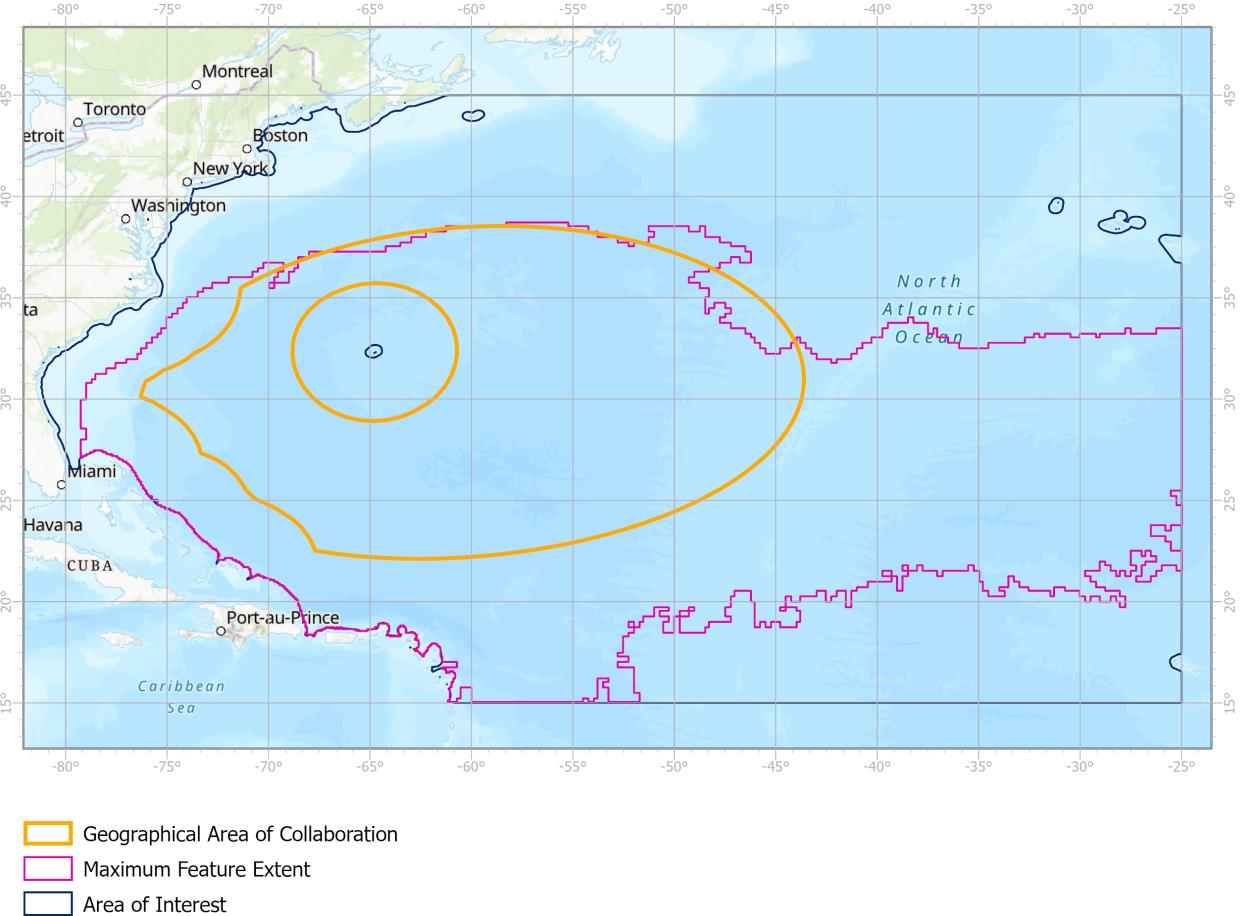
The Sargasso Sea is a pelagic ecosystem bounded by the currents of the North Atlantic Gyre. The Sargasso Sea Commission acts as steward of the ecosystem under an area of collaboration defined in the 2014 Hamilton Declaration. New work from the Duke University Marine Geospatial Ecology Laboratory emphasizes the dynamic nature of the Sargasso Sea, represented by a "maximum feature extent" with shared biogeographical characteristics (Cleary and others, 2023) (see figure I).
Figure I Sargasso Sea maximum feature extent
Ocean time-series
Continued monitoring of the Sargasso Sea from Hydrostation S and the Bermuda Atlantic Time-series Study (which are long-standing ocean quality monitoring sites) has shown that the last 40 years have seen significant surface ocean warming of approximately 1.2℃, lengthening of summertime conditions and shortening of wintertime conditions, slow-down of subtropical mode water formation, salinification due to reorganization of the global water cycle and uptake of anthropogenic carbon dioxide (CO2) such that ocean acidification in the 2020s of the Sargasso Sea are outside the range observed in the 1980s and before Ref 3 Ref 32. Marine photosynthesis has also changed with knock-on effects for the higher trophic level ecology of the Sargasso Sea Ref 19 and the marine ecosystem may have also changed in concert with these physical changes Ref 4.
In terms of chemical oceanography, since the late 1980s, waters in this subtropical region of the North Atlantic Ocean have lost oxygen at a rate of approximately 2% per decade (approximately 8% over the past 40 years) Ref 3. From the early 2000s to the present, rates of primary production have decreased by more than 25% Ref 19. Notably, over the past several decades, carbon export to the deep ocean has remained steady while primary production has decreased Ref 19 with significant changes in ecosystem community structure Ref 4.
Sargassum
Increased sea surface temperature has implications for the Sargassum ecosystem (for additional information on algae, see sect. 4 subchap. 4I). Graba-Landry and others (2020) showed that elevated temperature impacts the survival of a Sargassum algae (S. swartsii) and while it remains to be seen specifically how temperature impacts the two dominant Sargassum species of the Sargasso Sea, warming patterns revealed in the analyses suggest broader implications for the integrity of Sargassum mats Ref 14.
Although Sargassum supports a thriving ecosystem in the Sargasso Sea, it has economic and ecological impacts when it inundates beaches, as discussed in the chapters on this topic in the first and second World Ocean Assessment. Blooms of Sargassum in the North Equatorial Recirculation Region are hypothesized to be linked to anthropogenic nutrient inputs into the ocean through the Orinoco and Amazon Rivers, and anthropogenic climate change Ref 22.
Sargassum in the North Equatorial Recirculation Region is morphologically different from the Sargassum in the Sargasso Sea Ref 1. S. natans I and S. fluitans III are the most predominant variations in the Sargasso Sea, while S. natans VIII is the most predominant in the North Equatorial Recirculation Region and this morphological type has also been found to support a less diverse rafting community Ref 29, which could threaten the Sargasso Sea if S. natans VIII eventually invades a more northern area.
Fisheries
The first direct evidence of European eel migration to the Sargasso Sea using satellite tags was published in 2022 (Wright and others). Interest in the conservation and sustainable management of the species continues to grow due to its economic importance for human consumption (for broad information on medium and large-scale fisheries, see subsect. 1A, subchap. 1A).
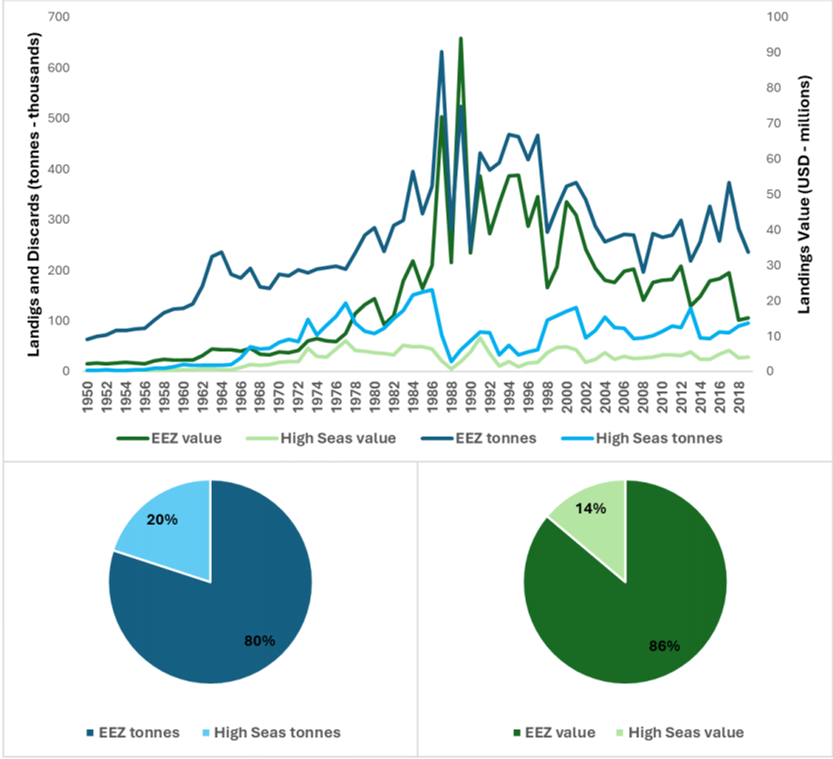
The Western Central Atlantic Ocean is among the least fished Food and Agriculture Organization of the United Nations major marine fishing areas in the world (see figure II). The landing volume and value in this portion of the high seas since 2010 has remained relatively low and stable, where catches consist of large pelagic species, primarily albacore tuna, swordfish and blue sharks. The Sargasso Sea only represents 0.47% of the volume of fisheries catches across the International Convention for the Conservation of Atlantic Tuna convention area (Vousden and others, forthcoming).
Figure II Fisheries landings volume and value in FAO fishing area 31 across the high seas and the exclusive economic zones (1950-2019)
The United States Atlantic pelagic longline fleet generated around US$ 10 million in profit without subsidies. However, without subsidies, the Spanish pelagic longline fleet would have lost between USD 1.5 and USD 2.78m, without subsidies, the other fleets would have lost between USD 4.49 and USD 7.25 million a year.
The majority of fishing in Sargasso Sea seems to be unprofitable without subsidies. The Subtropical Convergence Zone where warm and cold water masses meet, occurs between 22° and 30°N in the southern sector of the Sargasso Sea and has been shown to be a significant seasonal spawning area for three species (albacore tuna, swordfish and white marlin) managed by the International Commission for the Conservation of Atlantic Tunas (Luckhurst and Arocha, 2015), and important areas for the reproductive cycle of the blue marlin and porbeagle shark Ref 21 Ref 8. The first record of eggs and juveniles of the rare roundscale spearfish in the Sargasso Sea was reported by Freese and others in January 2025.
Deep sea
Pioneering scientific studies in the northwestern margins of the Sargasso Sea have been pivotal in understanding patterns of abundance, biomass and diversity in deep-sea ecosystems. Below the epipelagic zone sampling of mesopelagic and bathypelagic communities of fish suggests they may form a single Central North Atlantic province spanning the entire Sargasso Sea Ref 2. Benthic communities show a decline in abundance and biomass with depth Ref 33. Falling Sargassum affects the deep-sea ecosystem and some organisms are specially adapted to feed on this macroalgae Ref 26. Coral and sponge habitats on seamounts are associated with distinct communities of fish and other associated organisms.
France, Poland and the Russian Federation have mining exploration contracts awarded by the International Seabed Authority (ISA) for seabed massive sulphides on the Mid-Atlantic Ridge. Active vents in this region are often associated with vent-endemic fauna. The Lost City hydrothermal field is a unique hydrothermal vent system and may be of high scientific importance as the physio-chemical conditions may resemble those of the ancient Earth when genesis of life occurred Ref 17 Ref 7. Documentation of the species and ecology of each active vent ecosystem and surrounding non-vent ecosystems which are currently unexplored, will be required before management plans can be designed for potential mining of any of these sites, in accordance with the draft ISA regional environmental management plan.
Shipping
Vessel traffic in the Sargasso Sea ranges from highly concentrated shipping routes across the middle North Atlantic to the less intensively occupied fishing grounds around the Gulf of Maine and the coast of Labrador (see figure III).
Figure III Summary of vessel traffic (vessel time in hours) in 2021
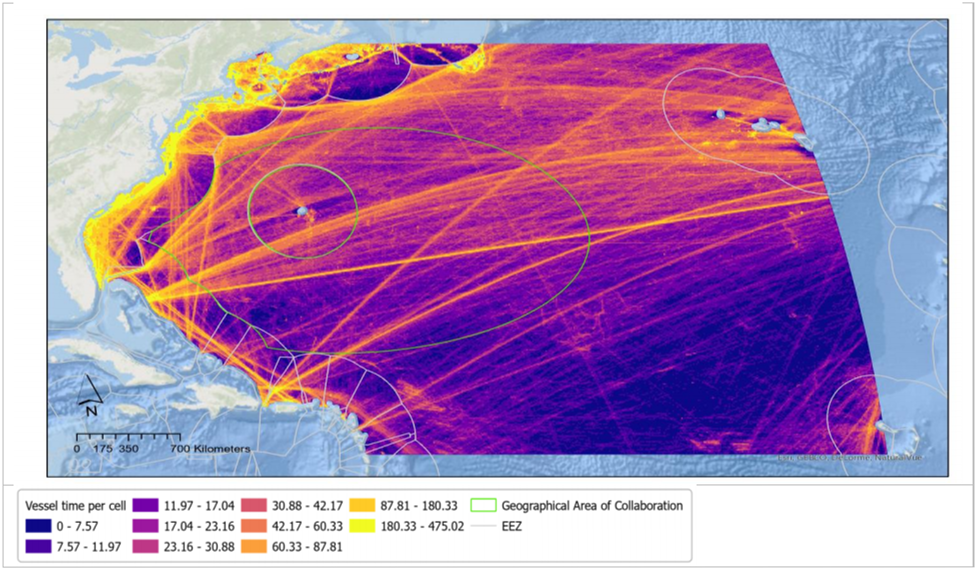
Several corridors experiencing particularly high vessel volume can be identified consistently across time Ref 31. Vessels transiting these the major routes connect ports primarily in the United States of America, the United Kingdom of Great Britain and Northern Ireland, Panama, the Kingdom of the Netherlands, Spain, Gibraltar and Egypt Ref 31.
With the presence of these prominent vessel traffic lanes through the centre of the Sargasso Sea, it is important to consider the potential environmental impacts of this traffic for cetaceans, many species of which are known to migrate through the area, especially humpback whales, including effects from noise pollution and collisions (see Smith and others, 2023, and reference to important marine mammal areas below).
3. Institutional arrangements and partnerships
As outlined in the second World Ocean Assessment, the Sargasso Sea faces a unique challenge in its conservation: it is located in an area beyond national jurisdiction. The Sargasso Sea Commission was established pursuant to the 2014 Hamilton Declaration on Collaboration for the Conservation of the Sargasso Sea to fill this lacuna in the regime. It has 10 Government signatoriesⓘ who pledged to work collaboratively to conserve the iconic ecosystem of the Sargasso Sea (for more information on high seas ocean governance, see sect. 3).
The Agreement on Marine Biological Diversity of Areas beyond National Jurisdiction represents a major change in the international legal landscape for the high seas since the inception of the Sargasso Sea project in 2010. It opens up a new pathway for area-based management tools (including marine protected areas (MPAs)) for the high seas.
The United Nations Development Programme (UNDP)- Global Environment Facility (GEF)- Intergovernmental Oceanographic Commission/ French Facility for Global Environment supported socio- ecosystem diagnostic analysis for the Sargasso Sea - the first for a high seas ecosystem - will provide the basis for a strategic action programme for the Sargasso Sea. The strategic action programme will reflect the agreement of the Sargasso Sea stakeholders on a mechanism for more effective stewardship and conservation of this unique ecosystem.
The 2011 description of the Sargasso Sea as an ecologically or biologically significant area is a scientific determination, but hopes that States and competent international organizations would utilize it to deliver conservation benefits have not materialized Ref 27. Nevertheless, the Sargasso Sea Commission's achievements are still considerable Ref 12. In 2023, the Commission cohosted with the International Maritime Organization a workshop on particularly sensitive sea areas on the high seas, an International Maritime Organization tool designed to reduce pressures from international shipping. In 2024 it supported an International Union for Conservation of Nature (IUCN) and Natural Resources/important marine mammal area workshop resulting in the designation of an important humpback whale north-south migratory corridor across the North Atlantic as an important marine mammal area in 2025. The Convention on Migratory Species is developing a single species action plan for the European eel, in consultation with Range States and relevant intergovernmental organizations and non-governmental organizations, under the mandate from the fourteenth Conference of the Parties (Decision 14.109).ⓘ Under the French Facility for Global Environment SARGADOM project, the Commission is developing tools for remote monitoring of the high seas with partners including Global Fishing Watch Ref 13.
4. Key remaining knowledge and capacity gaps and new gaps
Climate change and its accompanying effects of ocean acidification and changes to ocean circulation ( e.g. Ditlevsen and Ditlevsen, 2023) are the impacts with the furthest-reaching consequences for the Sargasso Sea, which could fundamentally change the Sargassum ecosystem and affect the distribution of larvae and the migration of fish and other species. Plastics and other pollutants are also a constant threat.
Fishing effort remains low in the Sargasso Sea, but research shows most fishing activity requires heavy subsidies to reach the area (Vousden and others, forthcoming). Anguillid eels remain economically important, but mostly encounter threats during the inshore stage of their life cycle.
Ship traffic has increased on the Sargasso Sea over time and de facto shipping routes have been established by shipping companies. With the risk of ship strikes to cetaceans, more research and discussion are needed on the effects of international shipping in the Sargasso Sea, and the need and feasibility of conservation measures related to international shipping in the area.
Gaps in knowledge for the area include bycatch, illegal, unreported and unregulated (IUU) fishing, movements of highly migratory species, plastics, impacts from deep-sea mining and deep-sea ecology. The cumulative impacts of all threats to the Sargasso Sea discussed are likely to combine to be greater than the sum of their parts, and the full effects of cumulative impacts are unknown.
The Agreement on Marine Biological Diversity of Areas beyond National Jurisdiction represents a seismic shift in the international regime for the high seas, with the potential to streamline the conservation of the Sargasso Sea. While area-based management tools do not necessarily protect against non-spatial threats, they can remove anthropogenic pressures on the ecosystem, providing greater resilience in a changing climate and increasing the potential for sustainable ecosystem benefits.
References
- Alleyne, Kristie S.T., and others (2023). Seasonal variation in morphotype composition of pelagic Sargassum influx events is linked to oceanic origin. Scientific Reports, vol. 13, art. 3753.
- Backus, R.H., and others (1977). Atlantic mesopelagic zoogeography. Pt. 7. Order Iniomi (Myctophiformis)., Fishes of the Western North Atlantic. R. H. Gibbs, ed-in-chief. Mem. Sears Fdn. Mar. Res., 1:266-287.
- Bates, Nicholas R., and Johnson, Rodney J. (2020). Acceleration of ocean warming, salinification, deoxygenation and acidification in the surface subtropical North Atlantic Ocean. Nature Communications in Earth and Environment, vol. 1, No. 33.
- Bates, Nicholas R., and Johnson, Rodney J. (2023). Forty years of ocean acidification observations (1983- 2023) in the Sargasso Sea at the Bermuda Atlantic Time-series Study (BATS) site. Frontiers in Marine Science, vol. 10.
- Bates, Nicholas R., and others (2023). Oceanography of the Sargasso Sea: An update concerning the scientific case for protection of the Sargasso Sea.
- BBNJ Agreement (2023). Agreement under the United Nations Convention on the Law of the Sea on the Conservation and Sustainable Use of Marine Biological Diversity of Areas beyond National Jurisdiction (New York, 17 June 2023, not yet in force) UN Doc A/CONF.232/2023/4*, 19 June 2023.
- Brazelton, William J., and others (2022). Metabolic Strategies Shared by Basement Residents of the Lost City Hydrothermal Field. Applied Environmental Microbiology. vol. 13, iss. 88.
- Campana, Steven E., and others (2010). Subtropical pupping ground for a cold-water shark. Journal of Fisheries and Aquatic Sciences, vol 67, pp. 769-773.
- Cleary, Jesse, and others (2020). Preparatory Data Discovery and Analysis to Support Enhanced Management and Governance of the Sargasso Sea: A Description of the Feature in Space and Time. A Report Submitted to Sargasso Sea Commission. Duke Marine Geospatial Ecology Lab, 2023. D'Alelio, Domenico and others. Machine learning identifies a strong association between warming and reduced primary productivity in an oligotrophic ocean gyre. Scientific reports, vol. 10, art. 3287.
- Ditlevsen, P., and Ditlevsen, S. (2023). Warning of a forthcoming collapse of the Atlantic meridional overturning circulation. Nature Communications, vol. 14, art. 4254.
- Freese, Marko, and others (2025). Genetically confirmed first records of an egg and a juvenile roundscale spearfish, Tetrapturus georgii. Journal of Fish Biology.
- Freestone, David (2021). The Sargasso Sea Commission: An Evolving New Paradigm for High Seas Ecosystem Governance? Frontiers in Marine Science, 8:668253. doi: 10.3389/fmars, 668253, 1-10.
- Freestone, David, and others (2024). High Seas in the Cloud: The Role of Big Data and Artificial Intelligence in supporting High Seas Governance - The Sargasso Sea Pilot Project. Frontiers of Marine Science: Policy and Practice Reviews, 1-13.
- Graba-Landry, Alexia, and others (2020). Impaired growth and survival of tropical macroalgae (Sargassum spp.) at elevated temperatures. Coral Reefs, vol. 39, pp. 475-486.
- IUCN (2008). High Seas Gems: Hidden Treasures of Our Blue Earth.
- https://iucn.org/sites/default/files/import/downloads/high_seas_gems_booklet_finaloct08.pdf.
- Johnson, David E. (2019). Protecting the lost city hydrothermal vent system: All is not lost, or is it? Marine Policy, 103593.
- Laffoley, Dan, and others (2011). The protection and management of the Sargasso Sea: The golden floating rainforest of the Atlantic.
- Lomas, Michael W., and others (2022). Adaptive carbon export response to warming in the Sargasso Sea. Nature Communications, vol. 13, art. 1211.
- Luckhurst, Brian E., and Arocha, Freddy (2016). Evidence of spawning in the southern Sargasso Sea of fish species managed by ICCAT - albacore tuna, swordfish and white marlin. Collection Volume of Scientific Papers ICCAT, vol. 72, No. 8, pp. 1949 - 1969.
- Luckhurst, Brian, E., and others (2006). Evidence of blue marlin (Makaira nigricans) spawning in Bermuda waters and elevated mercury levels in large specimens. Bulletin of Marine Science, vol. 79, pp. 691-704.
- McGillicuddy, Dennis J., and others (2023). Nutrient and arsenic biogeochemistry of Sargassum in the western Atlantic. Nature Communications, vol. 14, art. 6250.
- NAFO (2021). NAFO Agrees to Further Measures to Protect Vulnerable Marine Ecosystems (VMEs) at its 43rd Annual Meeting.
- https://www.nafo.int/Portals/0/PDFs/press/pressrelease_AM2021.pdf?fbclid=IWAR090SGcDp1B6jeXJb8 CZlZ4qEgujuuofqdm2zRZsvcjyAFHSqo2wG4U-dk.
- Pendleton, Linwood, and others (2014). Assessing the value of marine and coastal ecosystem services in the Sargasso Sea.
- Peoples, Logan M., and others (2024). A deep-sea isopod that consumes Sargassum sinking from the ocean's surface. Royal Society, vol. 291, iss. 2030.
- Roe, Howard S., and others (2022). The Sargasso Sea High Seas EBSA After Ten Years: Is It Still Relevant and How Has It Helped Conservation Efforts? Frontiers in Marine Science, vol. 9.
- Sala, Enric, and others (2018). The economics of fishing the high seas. Science advances, vol. 4, issue 6. Sargasso Sea Commission (2014). The Hamilton Declaration. https://www.sargassoseacommission.org/meet-the-commission/hamilton-declaration.
- Schell, Jeffrey M., and others (2015). Recent Sargassum Inundation Events in the Caribbean: Shipboard Observations Reveal Dominance of a Previously Rare Form. Oceanography, vol. 28, No. 3.
- SeaAroundUs (2024). We present fisheries and fisheries-related data at spatial scales that have ecological and policy relevance, such as by Exclusive Economic Zones, High Seas, or Large Marine Ecosystems. https://www.seaaroundus.org/.
- Smith, Beatrice, and others (2023). Preparatory Data Discovery and Analysis to Support Enhanced Management and Governance of the Sargasso Sea: A Technical Report on the State of the Ecosystem and Human Use Pressures. Duke Marine Geospatial Ecology Lab.
- Stevens, Samuel W., and others (2020). A recent decline in North Atlantic subtropical mode water formation. Nature Climate Change, vol. 10, art. 4, pp. 335-341.
- Sutton, Tracey T., and others (2010). Diversity and community structure of pelagic fishes to 5000 m depth in the Sargasso Sea. Deep Sea Research Part II: Topical Studies in Oceanography, vol. 57, iss. 24-26.
- UNESCO (2016). World Heritage in the High Seas: An Idea Whose Time Has Come. World Heritage Report 44.
- Vousden, David, and others (forthcoming). Socio-ecosystem diagnostic analysis for the Sargasso Sea.
- Wright Rosalind M, and others (2022). First direct evidence of adult European eels migrating to their breeding place in the Sargasso Sea. Sci Rep, vol. 12, art. 15362.
- Western Central Atlantic Fishery Commission (2016). Recommendation WECAFC/16/2016/4. Report of the Sixteenth session of the Commission Guadeloupe, 20-24 June 2016. Food and Agriculture Organization of the United Nations Subregional Office for the Caribbean. FAO Fisheries and Aquaculture Report Nº 1162. Bridgetown, Barbados, FAO. 137 pp.