
Marine mammals
Writing team: Ellen Hines (coordinating author), André Silva Barreto, Daniel Costa, Luciano Dalla Rosa, Caterina Fortuna, Frances Gulland, Kit Kovacs, Songhai Li, Helene Marsh, Carmen Mifsud (co-lead member), Shambhu Paudel and Katarina Viik (lead member).
Key points
- Major threats to marine mammals include by-catch, chemical pollution, vessel strikes and climate change.
- Anthropogenic noise, plastics and other emerging threats require investigation.
- Quantitative research on the cumulative effects of threats is limited.
1. Introduction
Marine mammals are top predators and good indicators of environmental change. They face direct, indirect and cumulative anthropogenic threats. Data on their distribution, abundance and trends are incomplete and should be considered top priorities for management and conservation.
Changes in taxonomy since 2018 are related to the definition of subspecies, although some new species have been identified (see https://marinemammalscience.org/science-and-publications/list-marine-mammal-species-subspecies/).
Few threats have been alleviated since the publication of the second World Ocean Assessment despite some advancements in threat abatement in a very small number of regional populations. Global climate change poses a significant threat, although its effects are clearest in polar regions Ref 46 Ref 87. Although climate change and overfishing are serious ecosystem-level threats, species are also challenged by by-catch, pollution, emerging diseases, vessel strikes and disturbances to animal culture and communities.
2. Environmental changes since the publication of the second World Ocean Assessment
Changes in overall status: updates by taxon
Pinnipeds (36 species, including 2 extinct)
Pinnipeds are susceptible to climate change-induced shifts and fisheries interactions (affecting mortality and prey availability). Mid-latitude species are affected by marine heat waves Ref 39 Ref 5 Ref 60. The International Union for Conservation of Nature (IUCN) has updated its information on some pinnipeds since the publication of the second World Ocean Assessment: ice-dependent species assessed are in decline. Intensive conservation efforts have improved the status of Mediterranean monk seals Ref 61 and, through national legislation and marine protection frameworks Ref 91, the status of Hawaiian monk seals Ref 6 and Saimaa seals Ref 4 has improved.
Cetaceans
Mysticetes (15 species)
Changing oceanographic processes in the north-west Atlantic due to climate change have altered the range and foraging behaviour of critically endangered North Atlantic right whales, reducing calving rates and increasing the risks of vessel strikes and fishing gear entanglement Ref 88. Since 2011, the population has declined to fewer than 400 individuals Ref 37.
Rice's whale Ref 110 Ref 111, which occurs in the north-eastern Gulf of Mexico and numbers approximately 33 individuals, is listed as Endangered under the United States Endangered Species Act and as Critically Endangered on the IUCN Red List of Threatened Species.
Odontocetes (79 species, 1 possibly extinct)
Coastal and estuarine dolphins and porpoises
By-catch continues to be the primary threat Ref 18, with habitat loss and degradation from coastal development and pollution negatively affecting feeding and breeding grounds Ref 9 Ref 71. The Critically Endangered Atlantic humpback dolphin Ref 15, found along West Africa, faces threats from artisanal fisheries and rapid coastal development Ref 42. To assist with their conservation, the Conference of the Parties to the Convention on the Conservation of Migratory Species of Wild Animals adopted resolution 14.10 on the single species action plan for the Atlantic humpback dolphin (Sousa teuszii). In 2023, gillnet blocking devices created a sanctuary for vaquitas in Baja California. Rojas-Bracho and others (2024) recommend further development of vaquita-safe fishing gear to allow artisanal fishing. In 2023, the International Whaling Commission (IWC) issued its first-ever extinction alert for the vaquita Ref 59.
Pelagic toothed whales, dolphins and porpoises
Beaked whales (n=24) lack data on population structure and abundance Ref 33. Threats to these deep-diving species include military sonar, climate change, entanglement, plastic pollution, vessel strikes and oil spills.
Freshwater dolphins
Due to their limited ranges, freshwater dolphins in Asia and South America are endangered by anthropogenic threats Ref 19. In 2023, unprecedented droughts in the Amazon Basin led to extreme water heating and increased dolphin mortality Ref 45 Ref 35. Irrawaddy dolphins in the Mekong River are likely extirpated due to population fragmentation as a result of dams, high fishing mortality, vessel strikes, pollutants, genetic outbreeding depression and low recruitment Ref 67 Ref 27.
Sirenians (5 species, including 1 extinct)
Dugong populations are mostly declining outside Australia Ref 100 Ref 84 and are listed as Vulnerable globally Ref 82. Three subpopulations have recently been listed by IUCN: New Caledonia (Endangered) Ref 48; Japan (Endangered) Ref 18 and coastal East Africa (Critically Endangered) Ref 118. Research on the three manatee species has progressed in the Amazon Ref 2, Caribbean Ref 38, Africa Ref 64 Ref 31 and Florida Ref 14.
Other carnivores
Polar bears (1 species)
Trend assessments for all polar bear populations indicate that five are stable, three are increasing and two are declining Ref 69 Ref 104. Improved harvest management and transient improvement in habitat conditions have resulted in improved status for some populations Ref 29 Ref 70, while longer ice-free seasons and reductions in ice-seal prey have reduced body condition, productivity and survivorship in others Ref 30 Ref 17 Ref 3. Given the rate of climate change Ref 90 Ref 117, few polar bear populations are expected to exist beyond 2100.
Mustelids (3 species)
Southern sea otters in western North America have not recovered from hunting, although protection began in 1911 with the North Pacific Fur Seal Convention. The population is estimated at 3,000 Ref 50. Reintroductions of otters to parts of their historical range are under consideration Ref 55 Ref 112. There is little information on the marine otter, or chungungo, along the western coast of South America; it is considered Endangered on the IUCN Red List.
Area-based protection
Since 2018, 234 important marine mammal areas for 110 species have been identified by IUCN. Such areas can inform the implementation of area-based management measures, e.g. the north-west Mediterranean Particularly Sensitive Sea Areas of the International Maritime Organization (see https://www.marinemammalhabitat.org/immas/immas-searchable-database/).
Changes in overall status
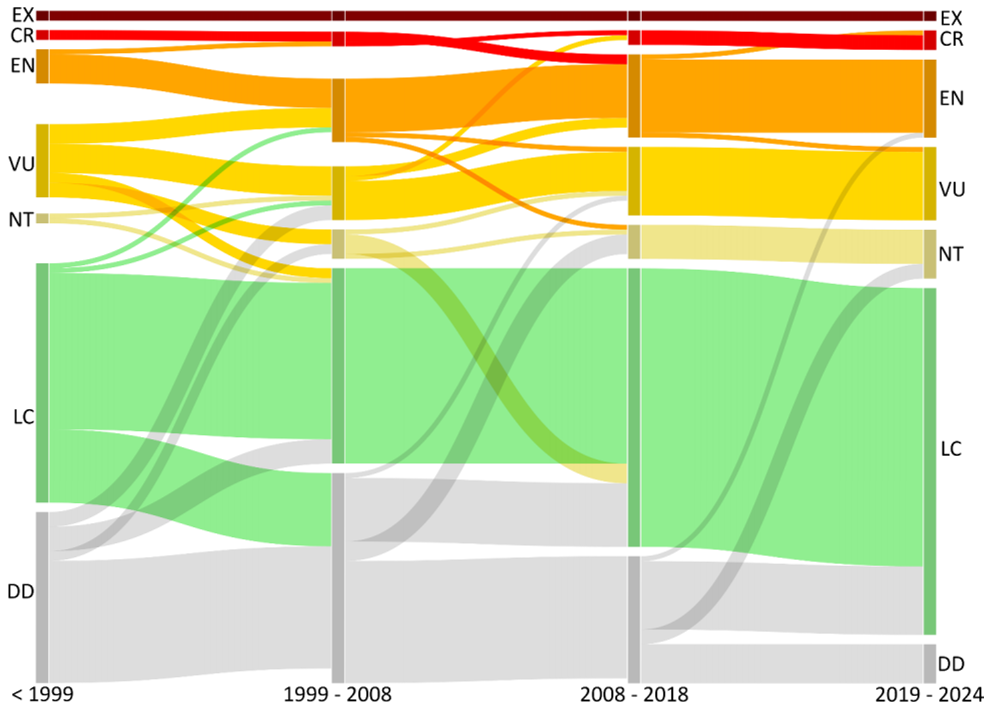
Overall, 26.9% of all marine mammal species (including freshwater species) are under threat (table 1). One third of the 30 species not assessed in the second World Ocean Assessment are still classified as Data Deficient. Only two have changed in status (table 2 and figure I): the Mediterranean monk seal, now classified as Vulnerable, and the North Atlantic right whale, now classified as Critically Endangered.
Table 1
Marine mammal species in each category of the International Union for Conservation of Nature Red List of Threatened Species in 2024
| Group | Extinct | Critically Endangered | Endangered | Vulnerable | Near Threatened | Least Concern | Data Deficient | Total |
|---|---|---|---|---|---|---|---|---|
| Freshwater dolphins | 1 | 4 | 5 | |||||
| Mysticetes | 2 | 3 | 1 | 1 | 7 | 1 | 15 | |
| Odontocetes | 2 | 5 | 6 | 9 | 42 | 9 | 73 | |
| Pinnipeds | 2 | 6 | 4 | 1 | 23 | 36 | ||
| Polar bear | 1 | 1 | ||||||
| Sea otters | 2 | 2 | ||||||
| Sirenians | 4 | 4 | ||||||
| Total | 2 | 5 | 20 | 16 | 11 | 72 | 10 | 136 |
Source: Prepared by the writing team.
Note: Regional, subspecies or subpopulation assessments are excluded.
Table 2
Changes in the status of marine mammals in the International Union for Conservation of Nature Red List of Threatened Species since the publication of the second World Ocean Assessment
| Group | New | Uplisted | Unchanged | Downlisted | Data Deficient | Total |
|---|---|---|---|---|---|---|
| Freshwater dolphins | 1 | 4 | 5 | |||
| Mysticetes | 1 | 13 | 1 | 15 | ||
| Odontocetes | 20 | 44 | 9 | 73 | ||
| Pinnipeds | 35 | 1 | 36 | |||
| Polar bears | 1 | 1 | ||||
| Sea otters | 2 | 2 | ||||
| Sirenia | 4 | 4 | ||||
| Total | 21 | 1 | 103 | 1 | 10 | 136 |
Source: Prepared by the writing team.
Note: "New" refers to species evaluated after the publication of the second World Ocean Assessment or previously Data Deficient; "Uplisted": worsened conservation status; "Downlisted": improved conservation status.
Figure I
Status changes over time
Region-specific changes
Arctic Ocean
Since the publication of the second World Ocean Assessment, Arctic marine ecosystems have changed dramatically due to global warming, with temperature increases four times the global average Ref 87 Ref 108. Arctic sea ice has drastically declined in extent and thickness. An ice-free Arctic is predicted for mid-century Ref 65, representing virtually total habitat loss for 11 endemic Arctic marine mammal species. Transformed food webs, altered predator-prey relationships, changing distribution and migration patterns, local overharvesting, increasing disease risks and human encroachment are threats Ref 52 Ref 66 Ref 68.
North Atlantic Ocean, Baltic Sea, Black Sea, Mediterranean Sea and North Sea
Regional downlisting of Mediterranean monk seals, common bottlenose dolphins and striped dolphins and the establishment of the north-western Mediterranean Particularly Sensitive Sea Areas are examples of positive developments. For example, Greece has designated two new national marine parks, one in the Ionian Sea and one in the Aegean Sea, and is endorsing concrete management actions to ensure high protection and improve species' conservation status. Türkiye has committed to designating new marine protected areas (MPAs) and management actions in the Mediterranean Sea. However, mass strandings of beaked whales and by-catch still raise serious concerns. The Critically Endangered Baltic harbour porpoise Ref 21 and the Endangered Black Sea endemic harbour porpoise are threatened by by-catch in gillnets Ref 56 and in turbot gillnets Ref 106.
South Atlantic Ocean and wider Caribbean
Entanglement in fishing gear remains the main threat to coastal marine mammals regionally Ref 26 Ref 114 Ref 25. Although legally protected in most countries, direct take and consumption occur in some countries Ref 57 Ref 95.ⓘ Environmental degradation is considered the leading cause of some population declines Ref 71 Ref 97. In 2023-2024 the H5N1 avian influenza severely affected South American pinnipeds Ref 105 Ref 119.
Indian Ocean, Arabian Sea, Bay of Bengal, Red Sea, Gulf of Aden and Persian Gulf
Since the publication of the second World Ocean Assessment, freshwater and oceanic mammals in the Bay of Bengal and its tributaries have been increasingly exposed to human-induced threats, including fisheries, habitat degradation and pollution Ref 102 Ref 103 Ref 19. A lack of monitoring and research in some countries limits the availability of information for 23 cetacean species and the dugong.
North Pacific Ocean
Knowledge of cetaceans in the East and South China Seas has increased since the publication of the second World Ocean Assessment, with at least 25 cetacean species confirmed in the South China Sea Ref 78 Ref 79 Ref 80 Ref 73. Dugongs may be functionally extinct in China Ref 74. Several populations of Indo-Pacific humpback dolphin have rapidly declined in recent decades, with at least one group facing extirpation Ref 75 Ref 76 Ref 77. As of 2022, the Yangtze finless porpoise is increasing in numbers after the implementation of a 10-year fishing ban Ref 49.
South Pacific Ocean
In Chile, South American sea lions are depredating fish catches, resulting in fishermen illegally killing them (approximately three per boat per month) Ref 115. In the South-West Pacific, data on strandings around New Caledonia could be used to determine species distributions and provide samples for genetic, ageing, diet and pollutant analysis Ref 41.
Southern Ocean
In the Southern Ocean, habitats are shifting poleward, increasing habitat for sub-Antarctic species and reducing habitat for ice-dependent species Ref 53 Ref 86. Antarctic krill distribution has drifted south, with declining sea ice Ref 62 raising concerns because they are the primary prey for blue, fin, humpback, Antarctic and minke whales and crabeater seals. There is also concern about increased vessel traffic associated with ecotourism Ref 98.
Changes in key threatening processes since the publication of the second World Ocean Assessment
Fisheries by-catch
Research on by-catch has increased in some countries since the publication of the second World Ocean Assessment because of export regulations (e.g. National Oceanic and Atmospheric Administration (NOAA), Office of International Affairs and Commerce, 2023).
Good governance and the involvement of local communities are key to addressing artisanal gillnet fisheries threats to small cetaceans globally Ref 18. The Bycatch Risk Assessment toolkit is available for addressing data-poor cases Ref 54. In some areas, animals are increasingly using fishing activities as a foraging strategy (e.g. Papageorgiou and others, 2024).
Vessel strikes
A global analysis of the risk of global shipping vessel strikes to four large whale species found that less than 10% of populations had protective measures Ref 94. The International Whaling Commission (IWC) leads global efforts on risk assessment and the identification of mitigation options, advising countries and intergovernmental organizations such as the International Maritime Organization. The Commission hosts a global vessel strike database Ref 124. Reducing the risks of vessel strikes for marine megafauna has been addressed by the Conference of the Parties to the Convention on Migratory Species in its resolution 14.5.
Climate change
Climate change impacts are recognized as a global threat to marine biodiversity, creating both direct and indirect negative effects on marine mammals Ref 83 Ref 24. Since the publication of the second World Ocean Assessment, this threat has escalated. Oceans have become warmer, fresher, increasingly stratified and less oxygenated Ref 58. Sea levels have risen, storm activity has intensified and sea ice has declined. These changes affect marine mammals directly, through physical habitat changes, and indirectly, through altered ecosystems. Other climate-related concerns related to marine mammals include increased harmful algal blooms and infectious disease exposure Ref 63 Ref 8 and the impacts of warmer water on sound propagation and exposure to contaminants Ref 1 Ref 13.
Contaminants
Legacy compounds identified in the second World Ocean Assessment have declined in many species but continue to accumulate in animal tissues in some regions despite being banned under the Stockholm Convention on Persistent Organic Pollutants (2004). Novel contaminants, especially perfluoralkyl compounds and microplastics (Schaap and others, 2023), now add to threats.
Diseases
Harmful algal blooms
Since the publication of the second World Ocean Assessment, climate change has increased the spatiotemporal distribution of harmful algal blooms globally Ref 47, which can cause marine mammal death and disease. Saxitoxin, a neurotoxin found in shellfish contaminated by harmful algal blooms, has recently been detected north of the Bering Strait for the first time Ref 72. Harmful algal blooms have been responsible for the deaths of sirenians, dolphins and baleen whales Ref 51 Ref 116 Ref 16.
Infectious diseases
Multiple viral epizootics have caused severe die-offs of marine mammals since the publication of the second World Ocean Assessment. Morbilliviruses have killed thousands of cetaceans and pinnipeds Ref 28 Ref 121 Ref 44. Die-offs of pinnipeds in South America in 2022 and 2023 were caused by the avian influenza virus H5N1 Ref 120 Ref 119.
The spread of terrestrial pathogens to marine mammals has been facilitated by coastal development and increases in coastal run-off. Toxoplasmosis causes mortality globally, killing critically endangered Māui dolphins in New Zealand, monk seals in Hawaii and sea otters in the United States of America Ref 7. Ref 89.
Offshore wind energy production
Worldwide production of offshore wind energy has expanded rapidly. Both exploration and implementation pose risks to marine mammals Ref 81. Passive acoustic monitoring can be used to define critical habitats and reduce the risk of vessel strikes, as studies in New England, for example, have shown Ref 122.
Tourism
Wildlife tourism is growing in scale and revenue Ref 96. Recent research enables the quantification of disturbance of unmanaged tourism at population levels Ref 10. Possible physiological and behavioural consequences can lead to decreased health and survival Ref 12. The Secretariat of the Convention on Migratory Species has developed a publication, International Guidelines for Sustainable Marine Wildlife Interactions: Boat-Based and In-Water Activities (CMS Technical Series Publication No. 49).
3. Key remaining knowledge and capacity gaps
| Knowledge and capacity-building gaps | Steps taken to address gaps since the publication of the second World Ocean Assessment |
|---|---|
| Global distribution, abundance and population structure | Advances in satellite imagery and artificial intelligence (Cubaynes and others, 2023) Regional and international large-scale surveys (e.g. Gilles and others, 2023; Panigada and others, 2023) Marine acoustics (Ferguson and others, 2023; Cominelli and others, 2024) Advances in genetics (McGowen and others, 2024; Morin and others, 2024) |
| Species-specific distribution modelling | Advances in habitat use modelling (Bedrinana-Romano and others, 2022; Cañadas and others, 2023; Fiedler et al 2023; Frantz et al 2024) |
| Spatiotemporal identification of climatic refugia for marine mammals | Creation of climate refugia (Gulland and others, 2022; Garcia-Reyes and others, 2023; Zelli et al 2025) |
| Plastics and microplastics | Research on the effects of microplastics on marine mammals (Zantis and others, 2021) |
Source: Prepared by the writing team.
References
- Affatati, A., Scaini, C., and Salon, S. (2022). Ocean Sound Propagation in a Changing Climate: Global Sound Speed Changes and Identification of Acoustic Hotspots. Earths Future, 10(3): e2021EF002099. Doi.org.10.1029/2021EF002099.
- Amaral, R., Marmontel, M., and others (2023). Advances in the knowledge of the biology and conservation of the Amazonian manatee (Trichechus inunguis). Latin American Journal of Aquatic Mammals. https://doi.org/10.5597/lajam00296.
- Atkinson, S.N., Boulanger, J., Campbell, M., Trim, V. Ware, J., and Roberto-Charron, A. (2022). 2021 Aerial survey of the Western Hudson Bay polar bear subpopulation. Final report to the Government of Nunavut, 16 November.
- Auttila, M., and Alakoski, R. (2025). Pusa hispida ssp. saimensis, Saimaa Ringed Seal. IUCN Red List of Threatened Species, in press.
- Backe, K, Hines, E., Nielsen, K., George, D., Twohy, E., and M. Lowry (2021). Effects of sea-level rise and storm enhanced flooding on Pacific harbor seal habitat: a comparison of haul-out changes at the Russian and Eel River Estuaries. Aquatic Conservation. https://doi.org/10.1002/aqc.3574.
- Baker, J., Robinson, S., Harting, A., Barbieri, M., and Littnan, C. (2025). Neomonachus schauinslandi Hawaiian Monk Seal. IUCN Red List of Threatened Species, in press.
- Barbieri M.M., and others (2016). Protozoal-related mortalities in endangered Hawaiian monk seals Neomonachus schauinslandi. Dis Aquat Organ, 121: 85-95.
- Barratclough, A., Ferguson, S.H., Lydersen, C., Thomas, P.O., and Kovacs, K.M. (2023). A review of circumpolar Arctic marine mammal heath - a call to action in a time of rapid environmental change. Pathogens, 12: 937. doi.org/10.3390/pathogens12070937.
- Bartalini, A., Muñoz-Arnanz, J., García-Álvarez, N., Fernández, A., Jiménez, B. (2022). Global PBDE contamination in cetaceans. A critical review. Environmental Pollution, 308, 119670. https://doi.org/10.1016/j.envpol.2022.119670.
- Bejder, L., Higham, J.E.S., and D. Lusseau (2022). Tourism and research impacts on marine mammals: A bold future informed by research and technology. In Marine Mammals: the Evolving Human Factor, Notarbartolo di Sciara, G., and B. Wursig, eds. Springer Nature, Switzerland, 255-276.
- Bedrinana-Romano, L., Zarate, P.M., and others (2022). Abundance and distribution patterns of cetaceans and their overlap with vessel traffic in the Humboldt Current Ecosystem, Chile. Scientific Reports. https://doi.org/10.1038/s41598-022-14465-7.
- Booth, H., Mourato, S. and E.J. Milner-Gulland (2022). Investigating acceptance of marine tourism levies, to cover the opportunity costs of conservation for coastal communities. Ecological Economics. https://doi.org/10.1016/j.ecolecon.2022.107578.
- Borgå, K., Mckinney, M.A., Routti, H., Fernie, K.J., Giebichenstein, J., Hallanger, I., and Muir, D.C.G. (2022). The influence of global climate change on accumulation and toxicity of persistent organic pollutants and chemicals of emerging concern in Arctic food webs. Environmental Science - Processes Impacts, 24: 1544-1576. Doi.org.10.1038/D1EM00469G.
- Brady, B., Moore, J., and K. Love (2022). Behavior related vocalizations of the Florida manatee (Trichechus manatus latirostris). Marine Mammal Science. https://doi.org/10.1111/mms.12904.
- Braulik, G.T., Taylor, B.L., and others (2023). Red-list status and extinction risk of the world's whales, dolphins and porpoises. Conservation Biology. https://doi.org/10.1111/cobi.14090.
- Broadwater, M.H., Van Dolah, F.M., Fire, S.E. (2018). Vulnerabilities of marine mammals to harmful algal blooms. In Shumway, S.E., Burkholder, J.M., Morton, S.L., eds. Harmful Algal Blooms. John Wiley & Sons, Ltd, Chichester, UK, pp. 191-222.
- Bromaghin, J.F., Mcdonald, T.L., Stirling, I., Derocher, A.E., Richardson, E.S., Regehr, E.V., Douglas, Durner, G.M., Atwood, T., and Amstrup, S.C. (2015). Polar bear population dynamics in the southern Beaufort Sea during a period of sea ice decline. Ecological Applications, 25: 634-651.
- Brownell, Jr., R.L., Reeves, R.R., and others (2019). Bycatch in gillnet fisheries threatens Critically Endangered small cetaceans and other aquatic megafauna. Endangered Species Research, 40, 285-296. https://doi.org/10.3354/esr00994.
- Campbell, E., Alfaro-Shigueto, J., Aliaga-Rossel, E., Beasley, I., Briceño, Y., Caballero, S., da Silva, V.M., Gilleman, C., Gravena, W., Hines, E. Khan, MS and others (2022). Challenges and priorities for river cetacean conservation. Endangered Species Research, 49, pp. 13-42. https://doi.org/10.3354/esr01201.
- Cañadas A., Pierantonio N., Araújo H., David L., Di-Méglio N., Ghislain D., and others (2023). Distribution patterns of marine megafauna density in the Mediterranean Sea assessed through the ACCOBAMS Survey Initiative. Front. Mar. Sci. Sec. Mar. Megafauna, 10. doi: 10.3389/fmars.2023.1270917.
- Celemin, E., Autenrieth, M., and others (2023). Evolutionary history and seascape genomics of Harbour porpoise (Phocoena phocoena) across environmental gradients in the North Atlantic and adjacent waters. Molecular Ecology Resources. https://doi.org/10.1111/1755-0998.13860.
- Cubaynes, H.C., Clarke, P.J., Goetz, K.T., Aldrich, T., and others (2023). Annotating very high-resolution satellite imagery: A whale case study. MethodsX. https://doi.org/10.1016/j.mex.2023.102040.
- Cominelli, S., Bellin, N., and others (2024). Acoustic features as a tool to visualize and explore soundscapes: Applications illustrated using marine mammal passive acoustic monitoring datasets. Ecology and Evolution. https://doi.org/10.1002/ece3.10951.
- D'Amen, M., Fortuna, C.M., and others (2024). Climate change and cetacean habitat suitability in the Mediterranean Sea: a challenge for Marine Strategy Framework Directive D1C4, D1C5 criteria. Animal Conservation. https://doi.org/10.1111/acv.13002.
- Da Silva, A.Z., Bornatowski, H., Domit, C. (2023). Small-scale fisheries and their interactions with marine megafauna: implications for the conservation of threatened species. Desenvolv. E Meio Ambiente, 61, 213-241. https://doi.org/10.5380/dma.v61i0.80221.
- Domit, C., Caballero, S., Miranda, A., Fruet, P.F., Torres-Florez, J.P., Cunha, H.A., Farro, A.P.C., Azevedo, A.F., Bisi, T.L., Briceño, Y., Cremer, M.J., Tardin, R.H., Barreto, A.S., Bertozzi, C.P., Brito, J.L., Barrios-Garrido, H., Belleghem, T.V., May-Collado, L.J., Di Tullio, J.C., Bracarense, A.P.F.R., Cantor, M., Andriolo, A. (2021). Report of the Sotalia guianensis Pre-Assessment Workshop (São Paulo, Brazil, 26-28 November 2019). J Cetacean Res Manage, 22, 335-378. https://doi.org/10.47536/jcrm.v22i1.1007.
- Dove, V. (2022). The impact of health and environmental factors on a population of Mekong River Irrawaddy dolphins (Orcaella brevirostris) in Cambodia. Doctoral dissertation, Murdoch University, Australia.
- Duignan P.J., Van Bressem M., Baker J.D., and others (2014). Phocine distemper virus: Current knowledge and future directions. Viruses, 6: 5093-5134.
- Dyck, M., Lukacs, P., and Ware, J.V. (2020). Re-estimating the abundance of a recovering polar bear subpopulation by genetic mark-recapture in M'Clintock Channel, Nunavut, Canada. Final Report, Government of Nunavut, Department of Environment, Iglulik. 29 July.
- Dyck, M., Dunham, K.D., Ware, J.V., Koons, D.N., Regehr, E.V., Hosmer, D.W., Derocher, A.E., Dale, A., Pisapio, J., and Szor, G. (2022). Re-estimating the abundance of the Davis Strait polar bear subpopulation by genetic mark-recapture. Final Report, Government of Nunavut, Department of Environment, Iglulik.
- Factheu, C., Rycyk, A.M., and others (2023). Acoustic methods improve the detection of the endangered African manatee. Frontiers in Marine Science. https://doi.org/10.3389/fmars.2022.1032464.
- Ferguson, E.L., Clayton, H.M., and Sakai, T. (2023). Acoustic indices respond to specific marine mammal vocalizations and sources of anthropogenic noise. Frontiers in Marine Science. https://doi.org/10.3389/fmars.2023.1025464.
- Feyrer, L.J., Stanistreet, J.E., and H.B. Moors-Murphy (2024). Navigating the unknown: assessing anthropogenic threats to beaked whales, family Ziphiidae. Royal Society Open Science. https://doi.org/10.1098/rsos.240058.
- Fiedler, P.C., Becker, E.A., Forney, K.A., Barlow, J., and J.E. Moore (2023). Species distribution modeling of deep diving cetaceans. Marine Mammal Science. https://doi.org/10.1111/mms.13057.
- Fleischmann, A., Papa, F., and others (2024). In Press. Extreme warming of Amazon waters in a changing climate. EarthArXiv. https://eartharxiv.org/repository/view/7437/.
- Frantz, B.H., Sepulveda, M., Garcia-Reyes, M., Vega, R., Palacios, D., Bedrinana-Romano, L., Huckstadt, L., Santos-Carvallo, M., and E. Hines (2024). Combining potential and realized distribution modeling for a bycatch risk assessment using telemetry data. Ecology and Evolution. https://doi.org/10.1002/ece3.11541.
- Frasier, T.R., Hamilton, P.K., and R.M. Pace III (2024). How compromised is reproductive performance in the endangered North Atlantic right whale? Endangered Species Research. https://doi.org/10.3354/esr01378.
- Galves, J., Galves, C.G., Gomez, N.A., and others (2022). Analysis of a long-term dataset of Antillean manatee strandings in Belize: implications for conservation. Oryx. https://doi.org/10.1017/S0030605321000983.
- Garcia-Aguilar, M., Turrent, C., Elorriaga-Verplanken, F.R., Arias-Del-Razo, A., and Schramm, Y. (2018). Climate change and the northern elephant seal (Mirounga angustirostris) population in Baja California, Mexico. PLoS One, 13(2): e0193211. Doi.org.10.1371/journal.pone.0193211.
- Garcia-Reyes, M, Sydeman, W., Koval, G., Palacios, D., Bedriñana-Romano, L., Sepulveda, M., DeForest, K., and E. Hines (2023). Most eastern boundary upwelling regions represent thermal refugia in the age of climate change. Frontiers in Marine Science. https://doi.org/10.3389/fmars.2023.1158472.
- Garrigue, C., Derville, S., and others (2024). Marine mammal strandings recorded in New Caledonia, South West Pacific Ocean, 1877-2022. Pacific Conservation Biology. https://doi.org/10.1071/PC23016.
- Genov, T., Malapert, A. and others (2024). Atlantic humpback dolphin (Sousa teuszii) in Guinea, West Africa. IWC SC69B/SM/15. https://www.sousateuszii.org/wp- content/uploads/2020/11/SC_69B_SM_15_Genov-et-al-Guinea-report.pdf.
- Gilles, A., Authier, M., Ramirez-Martinez, N.C., Araújo, H., Blanchard, A., Carlström, J., Eira, C., Dorémus, G., Fernández-Maldonado, C., Geelhoed, S.C.V., Kyhn, L., Laran, S., Nachtsheim, D., Panigada, S., Pigeault, R., Sequeira, M., Sveegaard, S., Taylor, N.L., Owen, K., Saavedra, C., Vázquez- Bonales, J.A., Unger, B., Hammond, P.S. (2023). Estimates of cetacean abundance in European Atlantic waters in summer 2022 from the SCANS-IV aerial and shipboard surveys. Final report published 29 September 2023. 64 pp. https://tinyurl.com/3ynt6swa.
- Groch, K.R., Santos-Neto, E.B., Díaz-Delgado, J., Ikeda, J.M.P., Carvalho, R.R., Oliveira, R.B., Guari, E.B., Bisi, T.L., Azevedo, A.F., Lailson-Brito, J., Catão-Dias, J.L. (2018). Guiana Dolphin Unusual Mortality Event and Link to Cetacean Morbillivirus, Brazil. Emerging Infectious Diseases journal - CDC, 24(7): 1349-1354. DOI: 10.3201/eid2407.180139.
- Grossman, D. (2024). A river in flux. Science, vol 383, Issue 6684: 692-697.
- Gulland, F.M.D., Baker, J.D., Howe, M., and others (2022). A review of climate change effects on marine mammals in United States waters: Past predictions, observed impacts, current research and conservation imperatives. Climate Change Ecology. https://doi.org/10.1016/j.ecochg.2022.100054.
- Hallegraeff, G.M., A. Zingone, Enevoldsen, H., eds. (2021). Global Harmful Algal Bloom Status Reporting. HARALG. 100.
- Hamel, M.A., Marsh, H., Cleguer, C., Garrigue, C., and Oremus, M. (2022). Dugong dugon (New Caledonia subpopulation). The IUCN Red List of Threatened Species 2022: e.T218582754A218589361. https://dx.doi.org/10.2305/IUCN.UK.2022-2.RLTS.T218582754A218589361.en.
- Hao, Y., Bin Tang, Zhigang Mei, Jinsong Zheng, Kexiong Wang, Ding Wang. (2024). Further suggestions on conservation of the Yangtze finless porpoise based on retrospective analysis of the current progress. Acta Hydrobiologica Sinica, 2024, 48(6): 1065-1072. DOI: 10.7541/2024.2024.0020.
- Hatfield, B.B., Yee, J.L., Kenner, M.C., and Tomoleoni, J.A. (2019). California sea otter (Enhydra lutris nereis) census results, spring 2019: U.S. Geological Survey Data Series 1118, 12 p., https://doi.org/10.3133/ds1118.
- Haussermann and others (2017). Largest baleen whale mass mortality during strong El Niño event is likely related to harmful toxic algal bloom. PeerJ, 5:e3123; DOI 10.7717/peerj.3123.
- Heide-Jørgensen, M-P., Garde, E., Hansen, R.G., Tervo, O.M., Sinding, M.H.S., Witting, L., Marcoux, M., Watt, C., Reeves, R.R., and Kovacs, K.M. (2020). Narwhals require targeted conservation. Science, 370: 416. Doi.10.1126/science.abe7105.
- Hindell, M.A., R.R. Reisinger, Y., and others (2020). Tracking of marine predators to protect Southern Ocean ecosystems. Nature, 580:87-92.
- Hines, EM, Johnson, A., Ponnampalam, L., Peter, C., Junchompoo, C., Vu, L., Thien, H., Caillat, M., and Verutes, G. (2020). Getting to the Bottom of Bycatch: A GIS-based toolbox to assess the risk of marine mammal bycatch. Endangered Species Research. https://doi.org/10.3354/esr01037.
- Hughes, B.B., Wasson, K., Tinker, T.M., Williams, S.L., Carswell, L.P., and others including Hines, E. and Rudebusch, J. (2019). Sea otters in estuaries: opportunities for recovery and restoration: Recovering sea otters reveal their true fundamental niche. PeerJ. http://dx.doi.org/10.7717/peerj.8100.
- ICES (2024). Workshop on Supporting the EU Action Plan to restore marine ecosystems (WKSUP). ICES Scientific Reports. 6:102. 57 pp. https://doi.org/10.17895/ices.pub.27918315.
- Ingram, D.J., Prideaux, M., Hodgins, N.K., Frisch-Nwakanma, H., Avila, I.C., Collins, T., Cosentino, M., Keith-Diagne, L.W., Marsh, H., Shirley, M.H., Van Waerebeek, K., Djondo, M.K., Fukuda, Y., Glaus, K.B.J., Jabado, R.W., Lang, J.W., Lüber, S., Manolis, C., Webb, G.J.W., Porter, L., (2022). Widespread Use of Migratory Megafauna for Aquatic Wild Meat in the Tropics and Subtropics. Front. Mar. Sci., 9.
- IPCC (2022). IPCC Special Report on the Ocean and Cryosphere in a Changing Climate, H .- O. Pörtner, D.C. Roberts, V. Masson-Delmotte, P. Zhai, M. Tignor, E. Poloczanska, K. Mintenbeck, A. Alegría, M. Nicolai, A. Okem, J. Petzold, B. Rama, N.M. Weyer, eds. Cambridge University Press, Cambridge, UK and New York, NY, USA, 755 pp. https://doi.org/10.1017/9781009157964.
- International Whaling Commission (IWC) (2023). First ever extinction alert from the IWC: the vaquita porpoise. https://iwc.int/resources/media-resources/news/first-ever-extinction-alert-from-the-iwc.
- Jog, K., Sutaria, D., Diedrich, A., and Grech, A. (2022). Marine mammal interactions with fisheries: review of research and management trends across commercial and small-scale fisheries. Frontiers in Marine Science, 9: 758013. Doi.org.10.3389/fmars.2022.758013.
- Karamanlidis, A.A., Dendrinos, P., Fernandez de Larrinoa, P., Kıraç, C.O., Nicolaou, H., and Pires, R. (2023). Monachus monachus. The IUCN Red List of Threatened Species 2023: e.T13653A238637039. https://dx.doi.org/10.2305/IUCN.UK.2023-1.RLTS.T13653A238637039.en.
- Kawaguchi, S., A. Atkinson, D. Bahlburg, K.S. Bernard, E.L. Cavan, M.J. Cox, S.L. Hill, B. Meyer, and D. Veytia (2024). Climate change impacts on Antarctic krill behaviour and population dynamics. Nature Reviews Earth & Environment, 5:43-58.
- Kebke, A., Samarra, F., and Derous, D. (2022). Climate change and cetacean health: impacts and future directions. Philosophical Transactions of the Royal Society of London, B Biological Sciences, 4: 377(1854): 20210249. Doi.org 10.1098/rstb.2021.0249.
- Keith-Diagne, L.W., Fernandez de Larrinoa, P., Diagne, T., and L.M. Gonzalez (2021). First satellite tracking of the African manatee (Trichechus senegalensis) and movement patterns in the Senegal River. Aquatic Mammals. DOI 10.1578/AM.47.1.2021.21.
- Kim, Y-H., Min, S-K., Gillett, N.P., Notz, D., and Malinina, E. (2023). Observationally-constrained projections of an ice-free Arctic even under a low emission scenario. Nature Communications.
- Kovacs, K.M., Belikov, S., Boveng, P., Desportes, G., Ferguson, S., Hansen, R., Laidre, K., Stenson, G., Thomas, P., Ugarte, F., and Vongraven, D. (2021). 2021 State of the Arctic Marine Biodiversity Report (SAMBR) - Update for Marine Mammals. Technical Report. Conservation of Arctic Flora and Fauna International Secretariat: Akureyri, Iceland.
- Krutzen, M., Beasley, I., and others (2018). Demographic collapse and low genetic diversity of the Irrrawaddy dolphin population inhabiting the Mekong River. PLOS One.https://doi.org/10.1371/journal.pone.0189200.
- Kuletz, K.J., Ferguson, S.H., Frederiksen, M., Gallagher, C.P., Hauser, D.W., Hop, H., Kovacs, K.M., Lydersen, C., Mosbech, A., and Seitz, A.C. (2024). A review of climate change impacts on migration patterns of marine vertebrates in Arctic and Subarctic ecosystems. Frontiers in Environmental Science, 12:1434549. Doi. 10.3389/fenvs.2024.1434549.
- Laidre, K.L., Regehr, E.V., Wiig, Ø., Ugarte, F., Aars, J., Dietz, R., Sonne, C., Hegelund, P., Isaksen, C., Aske, G.B., Cohen, B., Stern, H.L., Moon, T., Vollmers, C., Corbett-Detig, R., Paetkau, D., and Shaprio, B. (2022). Glacial ice supports a distinct and undocumented polar bear subpopulation persisting in late 21st-century sea-ice conditions. Science, 376(6599): 13331338. Doi.10.1126/science.abk2793.
- Laidre, K.L., Arnold, T.W., Regehr, E.V., Atkinson, S.N., and others (2023). Demographic response of a high-Arctic polar bear (Ursus maritimus) subpopulation to changes in sea ice and subsistence harvest. Endang Species Res, 51:73-87. https://doi.org/10.3354/esr01239.
- Lailson-Brito Jr., J., Oliveira-Ferreira, N., Manhães, B.M.R., Bisi, T.L., Santos-Neto, E. (2022). Chapter 11 - Chemical pollution and franciscana - a review, in: Simões-Lopes, P.C., Cremer, M.J., eds., The Franciscana Dolphin. Academic Press, pp. 235-264. https://doi.org/10.1016/B978-0-323-90974-7.00017- 3.
- Lefebvre, Kathi A., Evangeline Fachon, Emily K. Bowers, David G. Kimmel, Jonathan A. Snyder, Raphaela Stimmelmayr, Jacqueline M. Grebmeier, and others (2022). Paralytic shellfish toxins in Alaskan Arctic food webs during the anomalously warm ocean conditions of 2019 and estimated toxin doses to Pacific walruses and bowhead whales. Harmful Algae, 114 (2022): 102205.
- Li, S., Mingming Liu, Wenzhi Lin, Lijun Dong, Mingli Lin, Hui Kang, Inge Seim (2024). Identification of the enigmatic Deraniyagala's beaked whale. iScience, 27, 111465. https://doi.org/10.1016/j.isci.2024.111465.
- Lin, M., Samuel T. Turvey, Chouting Han, Xiaoyu Huang, Antonios D. Mazaris, Mingming Liu, Heidi Ma, Zixin Yang, Xiaoming Tang, and Songhai Li (2022a). Functional extinction of dugongs in China. Royal Society Open Science. 9: 211994. https://doi.org/10.1098/rsos.211994.
- Lin, W., Ruiqiang Zheng, Binshuai Liu, Shenglan Chen, Mingli Lin, Mingming Liu, Wenhua Liu, and Songhai Li (2022b). Low survival and rapid demographic decline of a threatened estuarine delphinid. Frontiers in Marine Science, 9: 782680. doi: 10.3389/fmars.2022.782680.
- Lin, W., Ruiqiang Zheng, Shiyao Xu, Songhai Li (2024a). Indo-Pacific humpback dolphins face extirpation in Shantou waters. Regional Studies in Marine Science, 77: 103641. https://doi.org/10.1016/j.rsma.2024.103641.
- Lin, W., Shenglan Chen, Binshuai Liu, Ruiqiang Zheng, Agathe Serres, Mingli Lin, Mingming Liu, Songhai Li (2024b). Survival and population size of the Indo-Pacific humpback dolphins off the eastern Leizhou Peninsula. Marine Mammal Science, e13156. https://doi.org/10.1111/mms.13156.
- Liu, M., Mingli Lin, and Songhai Li (2023). Sperm whales (Physeter macrocephalus) in the waters off China: A glimpse of the past and present. Water Biology and Security, 2: 100133. doi.org/10.1016/j.watbs.2022.100133.
- Liu, M., Wenzhi Lin, Mingli Lin, Lijun Dong, Binshuai Liu, Shenglan Chen, Mingyue Ouyang, Peijun Zhang, Zixin Yang, Hui Kang, and Songhai Li (2024a). Species diversity and critical habitats of offshore and deep-diving cetaceans in the South China Sea. Biological Conservation, 299, 110808. https://doi.org/10.1016/j.biocon.2024.110808.
- Liu, M., Wenzhi Lin, Mingli Lin, Lijun Dong, Songhai Li (2024b). Short-finned pilot whales in the South China Sea: Insights into regional distribution, movement pattern, and habitat characteristics. Marine Mammal Science, 40, 89-107. https://doi.org/10.1111/mms.13052.
- Macrander, AM, Brzyzy, L, and others (2022). Convergence of emerging technologies: Development of a risk-based paradigm for marine mammal monitoring for offshore wind energy operations. Integrated Environmental Assessment and Management. https://doi.org/10.1002/ieam.4532.
- Marsh, H., and Sobtzick, S. (2019). Dugong dugon (amended version of 2015 assessment). The IUCN Red List of Threatened Species 2019: e.T6909A160756767. https://doi.org/10.2305/IUCN.UK.2015- 4.RLTS.T6909A160756767.en.
- Marsh, H., Albouy, C., and others (2022). How might climate change affect the ethology and behavioral ecology of dugongs and manatees? In Ethology and Behavioral Ecology of Sirenia, Helene Marsh, ed. Springer Nature, Switzerland. 351-406.
- Marsh, H., Loates, P.J., and Schramm, L., eds. (2025). A global assessment of dugong status and conservation needs. Bonn: United Nations Environment Programme.
- McGowen, Michael, and others (2024). Rangewide phylogeographic structure of the endangered Irrawaddy dolphin (Orcaella brevirostris) using expanded sampling from contemporary and historical specimens. Marine Mammal Science. DOI: 10.1111/mms.13159.
- Melbourne-Thomas, J. (2020). Climate shifts for krill predators. Nature Climate Change. https://doi.org/10.1038/s41558-020-0756-6.
- Meredith, M., Sommerkorn, M., Cassotta, S., Derksen, C., Ekaykin, A., Hollowed, A., Kofinas, G., Mackintosh, A., Melbourne-Thomas, J., Muelbert, M.M.C., Ottersen, G., Pritchard, H., and Schuur, E.A.G. (2019). Polar Regions. In Pörtner, H-O., Roberts, D.C., Masson-Delmotte, V., Zhai, P., Tignor, M., Poloczanska, E., Mintenbeck, K., Alegría, A., Nicolai, M., Okem, A., Petzold, J., Rama, B., and Weyer, N.M., eds. IPCC Special Report on the Ocean and Cryosphere in a Changing Climate. IPCC,Gland Switzerland, pp 203-320.
- Meyer-Gutbrod, E.L., Davies, T.A., and others (2022). Redefining North Atlantic right whale habitat-use patterns under climate change. Limnology and Oceanography. https://doi.org/10.1002/lno.12242.
- Miller M., and others (2018). Protozoan parasites of marine mammals. In CRC Handbook of Marine Mammal Medicine. Gulland F, Dierauf L, Whitman K., eds. CRC Press, Boca Raton 414-45.
- Molnár, P.K., Bitz, C.M., Holland, M.M., Kay, J.E., Penk, S.R. and Amstrup, S.C. (2020). Fasting season length sets temporal limits for global polar bear persistence. Nature Climate Change. https://doi.org/10.1038/s41558-020-0818-9.
- Monk Seal Alliance (2024). Greece's Ministerial Decree paves the way for stronger conservation efforts, 9 September. Available at https://www.monksealalliance.org. Accessed on 5 August 2025.
- Morin, P.A., McCarthy, M.L. (2024). Revised taxonomy of eastern North Pacific killer (Orcinus orca): Bigg's and resident ecotypes deserve species status. Royal Society Open Science. https://doi.org/10.1098/rsos.231368.
- National Oceanic and Atmospheric Administration, Office of International Affairs and Commerce (2023). Modification of deadlines under the fish and fish product import provisions of the Marine Mammal Protection Act. https://www.federalregister.gov/documents/2023/11/17/2023-25399/modification-of- deadlines-under-the-fish-and-fish-product-import-provisions-of-the-marine-mammal.
- Nisi, A.C., Welch, H., and others (2024). Ship collision risk threatens whales across the world's oceans. Science. https://doi.org/10.1126/science.adp1950.
- Nuno, A., Fernandes, C., Guedes, M., Loloum, B., Matos, L., Nazaré, L., Carvalho, I. (2022). Aquatic wild meat consumption of cetaceans in São Tomé and Príncipe (Gulf of Guinea). Anim. Biodivers. Conserv, 25-33. https://doi.org/10.32800/abc.2023.46.0025.
- O'Connor, S., Campbell, R., Cortez, H., and Knowles, T. (2009). Whale Watching Worldwide: tourism numbers, expenditures and expanding economic benefits, a special report from the International Fund for Animal Welfare, Yarmouth MA, USA, prepared by Economists at Large.
- Oliveira-Ferreira, N., Manhães, B.M.R., Santos-Neto, E., Carvalho, R.R., Cunha, H.A., Azevedo, A.F., bisi, T.L., Lailson-Brito, J. (2024). Organohalogen compounds in a hotspot for chemical pollution: Assessment in free-ranging Atlantic spotted dolphins (Stenella frontalis). Sci. Total Environ., 926, 171912. https://doi.org/10.1016/j.scitotenv.2024.171912.
- Pallin, L.J., Botero-Acosta, N., Steel, D., and others (2022). Variation in blubber cortisol levels in a recovering humpback whale population inhabiting a rapidly changing environment. Sci Rep, 12, 20250. https://doi.org/10.1038/s41598-022-24704-6.
- Panigada S., Pierantonio N., Araújo H., David L., Di Meglio N., Dorémus G., and others (2023). The ACCOBAMS Survey Initiative: the first synoptic assessment of cetacean abundance in the Mediterranean Sea through aerial surveys. Front. Mar. Sci.Sec. Mar. Megafauna, 10. doi: 10.3389/fmars.2023.1270513.
- Panyawai, J., and Prathep, A. (2022). A Systematic Review of the Status, Knowledge, and Research Gaps of Dugong in Southeast Asia. Aquatic Mammals, 48(3), 203-222. https://doi.org/10.1578/AM.48.3.2022.203.
- Papageorgiou, M., Hadjieftychiou, S-I., Chistodoulou, C., Petrou, A., and Mouttopoulos, D.K. (2024). Describing dolphin interactions with Cypriot fisheries using fishers' knowledge. Journal of Marine Science and Engineering, 12(12). https://doi.org/10.3390/jmse12122240.
- Paudel, S., Koprowski, J.L. and Cove, M.V. (2020a). Seasonal flow dynamics exacerbate overlap between artisanal fisheries and imperiled Ganges River dolphins. Scientific Reports, 10(1), p.18798.
- Paudel, S. and Koprowski, J.L. (2020b). Factors affecting the persistence of endangered Ganges River dolphins (Platanista gangetica gangetica). Ecology and Evolution, 10(6), pp. 3138-3148.
- Polar Bear Specialist Group (PBSG-IUCN) (2023). Polar bear - global - population status https://www.iucn-pbsg.org/2024/12/05/pbsg-status-table-updated-2/.
- Plaza, P.I., Gamarra-Toledo, V., Rodríguez Euguí, J., Rosciano, N., Lambertucci, S.A. (2024). Pacific and Atlantic sea lion mortality caused by highly pathogenic Avian Influenza A(H5N1) in South America. Travel Med. Infect. Dis., 59, 102712. https://doi.org/10.1016/j.tmaid.2024.102712.
- Popov D., Meshkova G., Vishnyakova K., Ivanchikova J., Paiu M., Timofte C., Amaha Öztürk A., Tonay A.M., Dede A., Panayotova M., Düzgünes, E. and Gol'din P. (2023). Assessment of the bycatch level for the Black Sea harbour porpoise in the light of new data on population abundance. Front. Mar. Sci., 10:1119983. https://doi.org/10.3389/fmars.2023.1119983.
- Popov, D., Meshkova, G. (2024). Cetacean Strandings along the Bulgarian Coast of the Black Sea in 2010-2022. Oceans, 5, 429-441. https://doi.org/10.3390/oceans5030025.
- Rantanen, M., Karpechko, A. Y., Lipponen, A., Nordling, K., Hyvärinen, O., Ruosteenoja, K., Vihma, T., and Laaksonen, A. (2022). The Arctic has warmed nearly four times faster than the globe since 1979. Communications Earth & Environment, 3:168. Doi.org/10.1038/s43247-022-00498-3.
- Rojas-Bracho, L., Taylor, B.L., and others (2024). Mexico must save the vaquita from gill nets. Science, vol. 285, Issue 6708: 504.
- Rosel P.E., Wilcox L.A. (2014). Genetic evidence reveals a unique lineage of Bryde's whales in the northern Gulf of Mexico. Endang Species Res, 25: 19-34. https://doi.org/10.3354/esr00606.
- Rosel, P.E., Wilcox, L.A., Yamada, T.K., and K.D. Mullin (2021). A new species of baleen whale (Balaenoptera) from the Gulf of Mexico, with a review of its geographic distribution. Marine Mammal Science. https://doi.org/10.1111/mms.12776.
- Rudebusch J., Hughes B.B., Boyer K.E., Hines E. (2020). Assessing anthropogenic risk to sea otters (Enhydra lutris nereis) for reintroduction into San Francisco Bay. PeerJ, 8: e10241. https://doi.org/10.7717/peerj.10241.
- Schaap I., Buedenbender, L, Johann, S. Hollert,H., Dogruer G. (2023). Impact of chemical pollution on threatened marine mammals: A systematic review. Journal of Hazardous Materials, 459. doi.org/10.1016/j.jhazmat.2023.132203.
- Secchi, E.R., Cremer, M.J., Danilewicz, D., Lailson-Brito, J. (2021). A Synthesis of the Ecology, Human- Related Threats and Conservation Perspectives for the Endangered Franciscana Dolphin. Front. Mar. Sci., 8, 617956. https://doi.org/10.3389/fmars.2021.617956.
- Sepulveda, M., Martinez, T., and others (2018). Factors affecting the operational interaction between the South American sea lions and artisan gillnet fishery in Chile. Fisheries Research. https://doi.org/10.1016/j.fishres.2018.01.014.
- Starr M., Lair S., Michaud S., Scarratt M., Quilliam M., Lefaivre D., and others (2017). Multispecies mass mortality of marine fauna linked to a toxic dinoflagellate bloom. PLoS ONE, 12(5): e0176299. https://doi.org/10.1371/journal.pone.0176299.
- Stroeve, J., Crawford, A., Ferguson, S., Stirling, I., Archer, L., York, G., Babb, D., and Mallett, R. (2024). Ice-free period is too long for Southern and Western Hudson Bay polar bear populations if global warming exceeds 1.6 to 2.6 ℃. Communications Earth & Environment, 5: 296.
- Trotzuk, E., Allen, K., Cockcroft, V., Findlay, K., Gaylard, A., Marsh, H. Matos, L., West, L. and Guissamulo, A. (2022). Dugong dugon (Eastern Africa subpopulation). The IUCN Red List of Threatened Species. https://www.iucnredlist.org/species/218582764/218589142.
- Uhart, M.M., Vanstreels, R.E.T., Nelson, M.I. and others (2024). Epidemiological data of an influenza A/H5N1 outbreak in elephant seals in Argentina indicates mammal-to-mammal transmission. Nat Commun, 15, 9516. https://doi.org/10.1038/s41467-024-53766-5.
- Ulloa, M. and others (2023). Mass mortality event in South American sea lions correlated to highly pathogenic avian influenza (HPAI) H5N1 outbreak in Chile. 43, 8-18.
- Van Bressem, M., Duignan, P.J., Banyard, and others (2014). Cetacean morbillivirus: Current knowledge and future directions. Viruses, 6: 5145-5181.
- Van Parijs, S.M., DeAngelis, A.I., and others (2023). Establishing baselines for predicting change in ambient sound metrics, marine mammal, and vessel occurrence within a US offshore wind energy area. ICES Journal of Marine Science. https://doi.org/10.1093/icesjms/fsad148.
- Węgrzyn, E., Rusev, I., Tańska, N., Miedviedieva, I., Kagalo, A.A., Leniowski, K., (2023). The use of social media in assessing the impact of war on cetaceans. Biology Letters, 19, 20220562. https://doi.org/10.1098/rsbl.2022.0562.
- Winkler, C., Panigada, S., Murphy, S., and F. Ritter (2020). Global numbers of ship strikes: An assessment of collisions between vessels and cetaceans using available data in the IWC ship strike database. https://archive.iwc.int/pages/download.php?direct=1&noattach=true&ref=17562&ext-pdf&k=c9f67e8c1
- Zantis, L.J., Carroll, E.L., Nelms, S.E., and T. Bosker (2021). Marine mammals and microplastics: A systematic review and call for standarization. Environmental Pollution. https://doi.org/10.1016/j.envpol.2020.116142.
- Zelli, E., Ellis, J., and others (2025). Identifying climate refugia for vulnerable marine ecosystem indicator taxa under future climate change scenarios. Journal of Environmental Management. https://doi.org/10.1016/j.jenvman.2024.122635.