Indigenous, traditional owner and local community knowledge
Writing team: Paul Tuda (coordinating author), Ian Butler (co-lead member), Shelley Denny, Winifereti Nainoca, Sherry Pictou and Jörn Schmidt (co-lead member).
Key points
- Indigenous, traditional owner and local community knowledge is increasingly being recognized as a valuable complement to knowledge systems and ocean governance models.
- Indigenous, traditional owner and local community knowledge has frequently been conceptualized by scientific and governance systems as only land-based, and there has been an assumption that it must be "integrated" or validated by non-Indigenous methodologies, which can lead to power imbalances and a loss of the cultural integrity of such knowledge.
- The effectiveness of knowledge systems can be constrained when they fail to recognize or engage with diverse world views, including Indigenous ways of knowing.
- Ocean governance models that incorporate Indigenous, traditional owner and local community knowledge are more likely to achieve comprehensive well-being outcomes, including by maintaining cultural and/or natural heritage, fostering community resilience and offering generational insight into marine ecosystems and their sustainable use.
- In order to achieve a sustainable future, it is necessary to take specific actions such as prioritizing Indigenous, traditional owner and local community knowledge leadership in decision-making, ensuring inclusive and equitable participation, aligning objectives, and legally recognizing and empowering such communities as equal stakeholders.
- Examples of mutually respectful and effective collaboration have been documented, where Indigenous, traditional owner and local community knowledge and scientific knowledge have been woven together to generate context-specific insights and more inclusive outcomes.
- In future World Ocean Assessments, the authors should aim to improve the inclusion of Indigenous, traditional owner and local community knowledge alongside conventional scientific knowledge and should seek to protect Indigenous, traditional and local values and rights.
1. Introduction
Indigenous Peoples and traditional and local communities possess knowledge systems developed through generations of intimate interaction with their surrounding environment, often referred to as traditional ecological knowledge Ref 54. These knowledge systems are based on lived experiences, cultural practices and long-term observations, and are transmitted across generations by means of oral traditions and cultural practices Ref 40 Ref 47. The methods of transmission, which involve stories, ceremonies and customary practices, are as important as the knowledge itself Ref 40 Ref 45. These knowledge systems are highly place-based and context- specific, and capture the complex relationships among people, species and ecosystems Ref 33 Ref 54.
In the present chapter, the terms "Indigenous Peoples" and "local communities", which are recognized by the United Nations, have been used, although it should be noted that other terms may be used in national contexts. In Australia, for instance, the term "traditional owner" specifically refers to Aboriginal and Torres Strait Islander peoples with cultural, spiritual or historical ties to particular areas of the land and sea Ref 17.
It is important to emphasize that Indigenous, traditional owner and local community knowledge is a dynamic and evolving knowledge system that weaves Indigenous expertise with contemporary observations and lived experiences Ref 9 Ref 25. It is deeply rooted in the relationship between Indigenous Peoples and traditional and local communities and their environments, and is a reflection of how communities engage with, manage and sustain natural resources while adapting in response to emerging challenges Ref 51 Ref 60. The adaptability of such knowledge makes it an essential tool for biodiversity conservation, environmental sustainability and marine resource management Ref 2 Ref 37 Ref 45.
Recent publications by Strand and others (2024), and Allison and others (2023), highlight the growing and critical recognition of the role of Indigenous, traditional owner and local community knowledge in sustainable ocean management. Its role is being recognized in relation to several key areas, such as more inclusive and equitable ocean plans, the protection of marine biodiversity, ecosystem resilience and more holistic approaches to ocean governance that reflect the importance of socioecological systems Ref 7 Ref 24 Ref 45. This recognition is reflected in a recent publication by the Food and Agriculture Organization of the United Nations (FAO) on the governance of small-scale fisheries, which highlights how Indigenous knowledge systems contribute not only to environmental sustainability, but also to inclusive management and knowledge-sharing within socioecological systems Ref 10. This holistic approach often incorporates spiritual and cultural values and has an emphasis on the interconnectedness of people and the sea Ref 51 Ref 60. Governance structures that include Indigenous, traditional owner and local community knowledge are more likely to result in multifaceted well-being Ref 2 Ref 40, because they are based on the interconnectedness of social, economic, environmental and cultural aspects of life, prioritize community interests, promote sustainable practices, preserve cultural identity, and demonstrate adaptability in the face of changing circumstances.
As the world faces multiple environmental crises, there is growing recognition that Indigenous, traditional owner and local community knowledge can provide insights for sustainable resource management and biodiversity conservation. This has led to the incorporation of such knowledge into global processes and assessments, such as the Global Assessment Report on Biodiversity and Ecosystem Services (Balvanera and others, 2022; Intergovernmental Science-Policy Platform on Biodiversity and Ecosystem Services (IPBES), 2019), reports by the Intergovernmental Panel on Climate Change (IPCC) Ref 23 and contributions to the Convention on Biological Diversity Ref 46. Similarly, there has been recognition of the need to meaningfully include and engage with Indigenous, traditional owner and local community knowledge throughout the World Ocean Assessment process, which was established by the General Assembly in 2004 and is currently in its third cycle, in order to capture a more holistic understanding of the state of the marine environment and inform sustainable ocean governance. Moreover, recent global initiatives, such as the United Nations Decade of Ocean Science for Sustainable Development (2021-2030) and the Agreement under the United Nations Convention on the Law of the Sea on the Conservation and Sustainable Use of Marine Biological Diversity of Areas beyond National Jurisdiction, explicitly recognize the importance of Indigenous, traditional owner and local community knowledge in promoting ocean sustainability (Intergovernmental Oceanic Commission of the United Nations Educational, Scientific and Cultural Oganization (UNESCO-IOC), 2021; United Nations, 2023). These frameworks contain an emphasis the need for knowledge-sharing and culturally appropriate, equal participation, principles that are aligned with the United Nations Declaration on the Rights of Indigenous Peoples.
The first World Ocean Assessment cycle, conducted over the period 2010-2014, was focused on producing the first global integrative marine assessment (Division for Ocean Affairs and the Law of the Sea (UNDOALOS), 2017). However, the Assessment did not explicitly incorporate Indigenous, traditional owner and local community knowledge. In the lead-up to the second cycle, which began in 2016, an assessment was carried out to identify gaps in the first cycle of the World Ocean Assessment, which included the lack of representation of diverse knowledge systems, such as Indigenous, traditional owner and local community knowledge. Based on this, technical abstracts were produced for the second cycle that could better summarize information for policymakers. However, the inclusion of Indigenous, traditional owner and local community knowledge in the second World Ocean Assessment was still limited. It was only in the scoping and planning for the third cycle, starting in 2021, that the explicit recognition of such knowledge emerged as a priority. The shift towards greater inclusion was driven by feedback from regional workshops on the Assessment, in which participants flagged the lack of inclusion of Indigenous, traditional owner and local community knowledge as a major gap and highlighted the need to acknowledge and incorporate it in the assessment process.
As a result, a dedicated chapter on Indigenous, traditional owner and local community knowledge was included in the outline for the third World Ocean Assessment. Focused regional workshops were held and case studies were solicited from stakeholders with the goal of documenting diverse experiences and insights in the present chapter. While this represents progress, more work is needed to ensure that such knowledge is more fully included in future World Ocean Assessments and in related global and regional ocean assessment processes. The participants in regional workshops, including the representatives of Indigenous, traditional owner and local community knowledge, see the present chapter as an important first step towards establishing a stronger partnership between such knowledge holders and the conventional scientific community in assessing the state of the world's oceans. They emphasized the need to go beyond tokenistic inclusion and truly weave their knowledge into the World Ocean Assessment process and outputs as an equal and essential contribution.
2. Acknowledging the value and application of Indigenous knowledge
Many ancient Indigenous creation or origin stories from around the world centre on life beginning with or in relation to the ocean, the sea or water more generally. Centuries-old archaeological shell midden sites Ref 50 and petroglyphs, including of whales or whale hunting, exist across the globe, revealing Indigenous knowledge, knowledge transformations and human relationships with both land and water Ref 15. According to the Ocean and Human Rights Platform, there are 27 million Indigenous people, in nearly 2,000 communities across 87 countries, living in coastal areas Ref 21. There are also sea-nomadic or mobile Indigenous societies, such as the Bajau and Moken peoples of South-East Asia, whose deep maritime knowledge and mobility are central to their identities and ways of life. These communities, often referred to as "sea peoples", maintain rich traditions of marine stewardship, including sustainable fishing, freediving and ocean navigation Ref 13. However, countless Indigenous Peoples are increasingly being displaced, and torn from their ancestral oceanic sources of food and livelihood Ref 16. Knowing that their "lives, food, and livelihoods depend on the health of ocean resources, Indigenous Peoples have, through millennia, developed socioecological systems of marine resources management that rely on cultural traditions as well as an intimate, dynamic and long-term knowledge of the environment" Ref 65.
The importance of Indigenous, traditional owner and local community knowledge for protecting and conserving biodiversity and addressing climate change is increasingly being recognized by international forums such as the Conference of the Parties to the Convention on Biological Diversity, the International Union for Conservation of Nature (IUCN), the Permanent Forum on Indigenous Issues and IPBES. Recently, the importance of Indigenous knowledge for ocean sustainability was highlighted in a series of "blue papers" commissioned by the High-level Panel for a Sustainable Ocean Economy, which call for the "co-production" of ocean plans with Indigenous Peoples Ref 54. Many challenges remain. In practice, in international decision-making spheres, it is difficult to apply the United Nations Declaration on the Rights of Indigenous Peoples and the new Agreement on Marine Biological Diversity of Areas beyond National Jurisdiction, and to ensure respect for fundamental human rights. This is partly because ocean governance is spread across multiple overlapping legal frameworks and institutions Ref 12 Ref 65, which makes it hard to consistently recognize and uphold Indigenous, traditional owner and local community knowledge and rights in processes related to deep-sea mining Ref 44 and with a view to achieving Sustainable Development Goal 14 on life below water Ref 28.
A major barrier lies in the facts that, under non-Indigenous knowledge-based, conventional scientific and governance systems: the ocean is often treated as being separate from the land; Indigenous Peoples are conceived of as being only land-based; and there is an assumption that Indigenous knowledge needs to be "integrated" or validated by non-Indigenous knowledge or conventional scientific methodologies. Ref 16 Ref 35 Ref 54. As stated by Enyew and others (2021):
This land-sea dichotomy contravenes the holistic vision of Indigenous peoples, and ignores the fact that activities conducted on land may affect the rights of local communities and Indigenous [P]eoples related to their traditional use of marine spaces and resources. [ ... ] The law of the sea also principally follows a zonal division of the ocean space, where each maritime zone is subject to different levels of State sovereignty and jurisdiction, and governed by distinct regulatory mechanisms. This zonal approach and the associated logic of State sovereignty has various consequences on Indigenous peoples.
For some Indigenous Peoples, it is not only land and water that are connected, but all life forms. This interconnectedness is reflected in principles of mutual reciprocity that guide relationships between people, land, water and other beings, shaping practices related to food and livelihoods. These principles aim to sustain both ecosystem and human communities across generations Ref 16 Ref 19 Ref 47 Ref 53 Ref 66. Many Indigenous Peoples assert that the concepts of life, energy and spirituality are synonymous. All are intertwined and embedded in the territory and, therefore, cannot be addressed separately. At the core of existence, there is no division between water, plants, animals and even human beings. For that reason, life, spirituality, water and territory cannot be discussed in isolation Ref 42.
It is also important to note that Indigenous relational worldviews and practices derive from a vast array of diverse global contexts and are not static or frozen in time nor space. Indigenous Peoples can also be mobile and transitionary between and across various scales of diverse lands and waters formulating local, national and international diplomacies and protocols Ref 3 Ref 14 Ref 16.
These concepts of harmonization and fluid internationalism are synonymous with "Two-Eyed Seeing", which applies the strengths of both Indigenous and non-Indigenous worldviews Ref 41 or embraces multiple knowledge systems and "diverse ways of knowing" Ref 54, without discrediting the diversity of approaches.
3. Approaches and guiding principles for applying Indigenous, traditional owner and local community knowledge
Approaches and guiding principles for working with Indigenous, traditional owner and local community knowledge are less well documented than the challenges of working with it. However, there is increasing recognition of the value and role of Indigenous Peoples and local knowledge, and of the need for knowledge co-creation to enhance ocean governance Ref 55. Emerging frameworks include co-production approaches grounded in Indigenous research protocols and priorities, such as those developed in Arctic research Ref 69 and in diverse community contexts Ref 48. It is also important to note that many Indigenous Nations have local protocols and knowledge-sharing principles that may not be publicly available. This growing field is reflected in partnership models that bring together disparate worldviews (Indigenous and non-Indigenous) in cross- cultural collaboration to challenge the status quo, such as ethical space of engagement Ref 20 and knowledge co-creation as Two-Eyed Seeing Ref 8 Ref 41 Ref 49.
Understanding Indigenous, traditional owner and local community involves understanding that Indigenous Peoples do not all share the same worldviews. However, their worldviews do share common values inherent to Indigenous Peoples. Key values include relatedness, respect and reciprocity as a "package" that underpins the Indigenous way of life. Relatedness, a connection to the physical and spiritual realms, also referred to as kinship, is maintained through respectful relationships with other people and species that are reinforced by cultural practices. Reciprocity is required to maintain respectful relationships. As stewards, people have a responsibility to maintain balance and harmony with the natural and spiritual realms Ref 4 Ref 43 Ref 67.
Even when differences between Indigenous and non-Indigenous knowledge systems are recognized, working within the context of Indigenous, traditional owner and local community knowledge poses several challenges, especially when knowledge holders and those engaging with such knowledge lack awareness of these distinctions or lack training in inter- and transdisciplinary approaches to working across knowledge systems Ref 18. Some scholars have even cautioned against "integrating" such knowledge because it implies the prioritization of non-Indigenous ways of knowing, a failure to consider Indigenous values and worldviews, and the lack of a shared understanding of such knowledge as well as of the benefit of knowledge pluralism, which is valued and used by Indigenous Peoples Ref 11 Ref 39.
Despite these barriers, Indigenous and non-Indigenous knowledge and understanding have been successfully bridged Ref 1. For example, the integration of qualitative data derived from social science methods in quantitative models Ref 6 Ref 38, as well as the use of Bayesian Belief Networks, in which qualitative and quantitative indicators developed through participatory workshops are incorporated into a structured modelling framework to bridge Indigenous and scientific knowledge, such as in Slave River Delta, Canada Ref 38. In this regard, in "The assessment report on the diverse values and valuation of nature" (Termansen and others, 2022), IPBES draws attention to practices that are consistent with the values of Indigenous and local communities. It stresses the importance of recognizing plural values of nature - relational, spiritual and cultural - and expresses support for valuation processes that are co-developed, context-specific and respectful of knowledge sovereignty.
Similarly, qualitative data derived from interviews with Indigenous fishers who estimated catch rates for a culturally important species based on past experiences were used to parameterize simulations to assess declines in catch rates Ref 6. Another recent study by Gryba and others (2025) demonstrates the use of Indigenous, traditional owner and local community knowledge as a sole data source in the development of habitat selection models, thus reinforcing the value of such knowledge in quantitative ecological research. These examples show that it is possible to use Indigenous knowledge acquired through social science methods in quantitative-based modelling.
4. Scoping work for the third World Ocean Assessment: regional workshops and case study
The Division for Ocean Affairs and the Law of the Sea of the United Nations Secretariat held a series of regional workshops and examined one case study in an effort to understand the scope of Indigenous, traditional owner and local community knowledge and the global range of issues related to it, with a view to better incorporating such knowledge into the third World Ocean Assessment.
Regional workshops
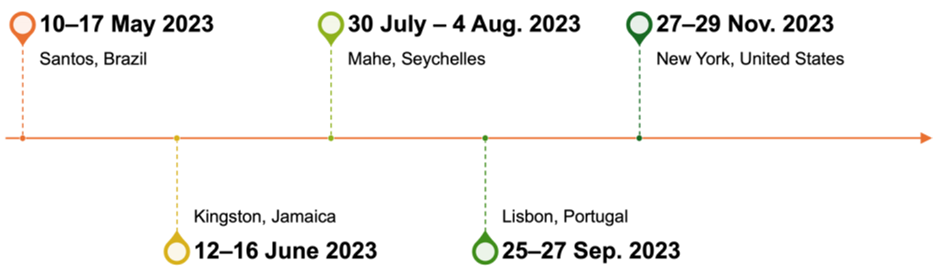
Regional workshops were held in Brazil, Jamaica, Portugal, Seychelles and the United States of America. Each workshop brought together representatives of Indigenous Peoples, traditional owners, and local communities, as well as experts and practitioners from ocean-related institutions (see figure I). The scoping process was focused on identifying regional needs, reviewing existing information and considering what should be included in the assessment to make it as useful as possible for policymakers.
Figure I Timeline of regional workshops
To allow for comparison across regions, workshop deliberations were centred on five key questions:
How might Indigenous, traditional owner and local community knowledge assist in gaining an understanding of the economic and social drivers that are producing the changes observed in the ocean?
What are the current consequences of ongoing changes in the ocean for Indigenous, traditional owner and local community social systems and cultural security?
What do future projections and outlooks for the ocean look like across societal and cultural groups and Indigenous Peoples?
How can a sustainable future be achieved in a way that will give all components of society, including Indigenous Peoples, traditional owners and local communities, an equal role?
Which socioeconomic factors will have the greatest influence on the contributions that societal and cultural groups, including Indigenous Peoples, traditional owners and local communities, can make to achieving a sustainable future?
In order to help to summarize the regional contributions, workshop notes were analysed using a grounded theory approach. The participants' responses were coded across the five main questions and common themes and keywords were identified. The terms that appeared most frequently in all workshop texts were used to generate a word cloud (see figure II). The figure highlights the most common concepts that arose in the discussions of Indigenous, traditional owner and local community knowledge in relation to ocean governance, cultural heritage and community resilience.
Figure II Word cloud highlighting the most frequently mentioned concepts in response to questions posed at regional workshops
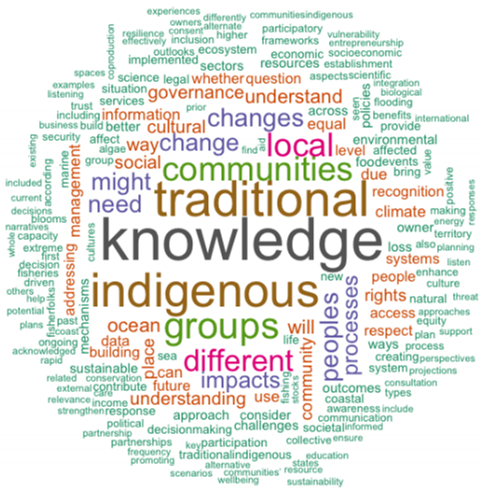
The word cloud (figure II) is not intended to be conclusive or to capture the full diversity of Indigenous, traditional owner and local community knowledge, but rather to summarize key views and ideas that were raised in the regional workshops - especially those of traditional and local communities and ocean-related experts. As such, it provides a broad overview of the views shared by the participants in the regional workshops. The most common terms - "knowledge", "traditional", "Indigenous", "local", "communities", "groups" and "impacts" - reflect the central role of culturally rooted, place-based knowledge systems in interpreting ocean change and contributing to equitable governance.
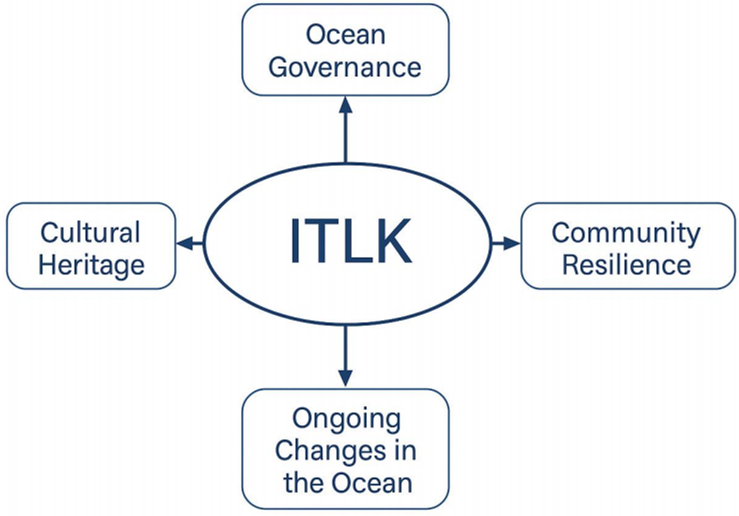
The repeated occurrence of terms such as "understanding", "change", "social", "process" and "sustainable" underlines the dynamic and interdisciplinary nature of Indigenous, traditional owner and local community in relation to both environmental and social change. Words like "recognition", "culture", "rights", "governance", "access" and "inclusion" all speak to participants' calls for greater respect for the holders of that knowledge as equal partners in ocean governance processes. Insights from regional workshops reveal the vital role that such knowledge plays in supporting ocean governance, maintaining cultural heritage and fostering community resilience, particularly in light of the ongoing changes in the ocean (see figure III).
Figure III Conceptual diagram illustrating key relationships, derived from regional workshop responses, showing how Indigenous, traditional owner and local community knowledge contributes to ocean governance, cultural heritage and community resilience in the context of ongoing ocean change
Given its long-standing historical use and the years invested in protecting and passing it down from one generation to the next, Indigenous, traditional owner and local community knowledge provides valuable, culturally authoritative and context-specific insights for managing coastal and marine resources. It offers a lens for understanding the economic and social drivers behind current changes in the ocean. In addition, Indigenous communities have a wealth of knowledge about ocean-related changes that can be used to calibrate scientific forecasts Ref 36. Indigenous Peoples are aware of how to define, understand and use natural resources in a sustainable manner. They are also key players, and their different perspective can help to better understand the crises and challenges and how to overcome them.
Many Indigenous Peoples possess valuable knowledge that contributes to the management of coastal resources and to the systems and practices through which those resources are accessed, harvested and governed. Therefore, the effects of ongoing ocean change on those communities cannot be fully understood without incorporating an Indigenous, traditional owner and local community knowledge perspective. This is because the impacts of ocean changes extend beyond the biological realm - they disrupt Indigenous Peoples' ways of life, including their social systems, erode their cultural identity and exacerbate their vulnerability to environmental and economic pressures. For instance, the loss of a biological species is not only a significant ecological loss: it can also contribute to the loss of cultural identity.
This loss of cultural identity is exemplified by the experiences of Indigenous and local communities. As one participant noted, "climate change impacts fish stocks, affecting local activities and cultural heritage". The decline of key species not only disrupts livelihoods, but also causes the loss of traditional knowledge and cultural identity. In addition, "threats to sacred sites and cultural traditions", which was mentioned by a participant, reflects the fact that environmental degradation can lead to a loss of species and spaces that are critical to communities' identities. Despite those impacts, the loss of traditional knowledge and cultural identity is often overlooked in scientific assessments. There is a need for more comprehensive scientific frameworks that address not only ecological changes, but also their cultural and spiritual impacts.
The cultural assets of most Indigenous Peoples, traditional owners and local communities are closely tied to the natural environment. Therefore, significant changes in the environment can undermine the cultural security of the holders of Indigenous, traditional owner and local community knowledge. This close connection makes them especially vulnerable to both environmental and economic changes. Climate change-induced displacement, loss of livelihoods and food and water scarcity were among the most prevalent issues that emerged from the discussions. Economic changes, such as a growth in blue economies, increase the probability of climate injustice, exacerbating marginalization and further weakening societal coping mechanisms. Adaptive strategies, informed planning and inclusivity in governance and decision-making processes are required to address these vulnerabilities. As one participant noted, "inclusive and equitable participation in decision-making processes" is essential for ensuring that the voices of Indigenous and local communities are heard. Examples include co- management frameworks and community-based fisheries management, which provide platforms for equitable participation.
Future projections and outlooks are different across societal and cultural groups, and are very different for Indigenous and non-Indigenous communities due to their different worldviews, ways of knowing and knowledge systems. There will be regional variations in the effects of climate change, such as temperature changes and sea level rise, so communities and groups with different socioeconomic status will be affected differently. Unfortunately, if the world continues with "business as usual", the outlook will only become bleaker and inequality will inevitably increase, with varying effects for different groups depending on the state of the economy and groups' access to the ocean and its resources.
The cost of living will be higher in the future for Indigenous Peoples, who have limited access to alternative sources of income and to technology, and they will be forced to transform their lives (e.g. move to higher ground or find new, less ocean-dependent livelihoods). Therefore, assessments of climate change impacts and adaptation strategies should take into account diverse perspectives in order to truly reflect realities on the ground.
In order to ensure that assessments are balanced, it is necessary to take targeted actions that position all components of society, including Indigenous Peoples, traditional owners and local communities, as equal stakeholders. Such actions include promoting Indigenous leadership in decision-making roles and embedding inclusive and equitable participation in decision-making processes. It is essential to align government objectives with Indigenous communities' goals, while enforcing policies that protect their rights. It is vital to strengthen partnerships, including for capacity-building, and to develop bottom-up governance approaches that prioritize local agency. In addition, incorporating traditional knowledge into formal systems through transdisciplinary approaches and integrating it into environmental impact assessments ensures that these communities' contributions are recognized and valued. Ultimately, Indigenous Peoples, traditional owners and local communities are the ones with the best interests of their localities at heart, whether developmental or otherwise, and therefore what they think and say about their local areas matters. Indigenous peoples hold internationally recognized cultural and legal rights, which are not always fully respected in practice.
The socioeconomic factors that will have the greatest impact on social and cultural groups' chances of achieving a sustainable future include recognition, empowerment and inclusive governance. Legal recognition that empowers these communities is a starting point, as it will ensure that their rights and territories are respected and included in broader governance frameworks. Embedding inclusive, deliberative advisory processes in marine resource management systems promotes equal participation and collaboration. In addition, promoting Indigenous Peoples, traditional owners and local communities in leadership positions improves their ability to influence decision-making processes. Aligning government objectives with those of these communities, such as by balancing Governments' need to create employment with ecosystem capacity, ensures that policies are both sustainable and equitable. Ensuring that these groups participate in rules- and decision-making processes at multiple levels and securing communities' tenure rights strengthens their capacity to contribute effectively. Lastly, advancing social justice, equality and equity across groups is essential to addressing historical inequalities and building a future where all communities can thrive and where no one is left behind.
Case study: Indigenous methodologies and frameworks of Fiji - mana (mud lobster)
Indigenous society in Fiji, and its kinship system, uses sayings and idioms for teaching and instructions. There is deep sense of interconnectedness in the Indigenous world, and in Fiji, every Indigenous person has a totemic plant and animal (a fish, bird or terrestrial animal). Garibaldi and Turner (2004) define "cultural keystone species", or totems, as "the culturally salient species that shape in a major way the cultural identity of a people, as reflected in the fundamental roles these species have in diet, materials, medicine, and/or spiritual practices". Interconnectedness in the Fijian world is represented by totemism. As expressed by Tuwere (2002), " the totems represent among other things the interdependence of land, sea or river, and sky in the world of Fijians. They are usually a trilogy of linked ika (fish); kau (trees); and manumanu (bird, animal or insect)". These totems (such as the mud lobster, or mana in Fijian) can be used metaphorically to represent a framework for community planning or even academic writing, such as a thesis or a methodology. The Kakala research framework by Professor Konai Thaman Ref 34 Ref 59 is an example of a Pacific method of teaching and learning. It was intended to encourage Pacific students to articulate theories from their perspectives and to recognize Pacific worldviews in their thinking and learning Ref 59.
When collaborating with Indigenous Peoples and local communities, it is good practice to communicate in the local language and translate any printed material into the local language.
In the Rewa Strategic Development Plan of Fiji, the mud lobster (Thalassina anomala) is used as a metaphor for the Plan's framework - in terms of the physiology and essence of the mana (see figure IV). For instance, in terms of physiology, the eight legs (pereiopods) of the mud lobster represent the eight priority areas of the Plan, while, in terms of "essence", mud lobsters are recognized for their ecological role as "friends of the mangroves", as their burrowing is important for the recycling of nutrients in the mangrove ecosystem. This resonates with the Indigenous People of Rewa, who live in the Rewa Delta, surrounded by mangroves. This metaphor illustrates how the Plan integrates cultural values and ecological understanding to promote sustainable development. The use of the mana also contextualizes the Plan, increases its relevance and a sense of ownership by Indigenous users and audiences, and helps to minimize ideas getting "lost in translation" as a result of the imposition of foreign or "outside" concepts and values. It also helps to rekindle a sense of identity and to revive Indigenous, traditional owner and local community knowledge.
Figure IV Framework of the Rewa Strategic Development Plan, employing the mana (mud lobster)
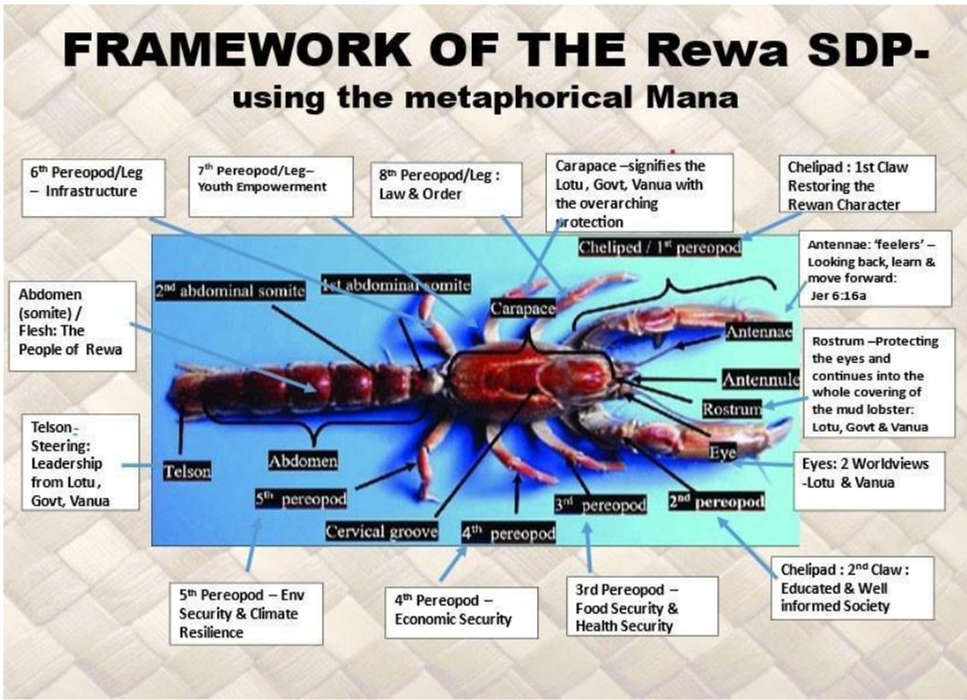
Note: This framework is illustrative of Indigenous methodologies and frameworks that weave cultural values and ecological understanding into sustainable development strategies.
5. Conclusion and outlook
Indigenous, traditional owner and local community knowledge systems represent unique worldviews, epistemologies and ways of understanding the environment. Although such knowledge is increasingly recognized globally, many attempts to integrate it into non-Indigenous or scientific frameworks often result in power imbalances because the knowledge is treated as data to be integrated into existing management structures, rather than as a knowledge system in its own right. This approach can undermine the integrity and autonomy of these knowledge systems to the point where Indigenous, traditional owner and local community loses its cultural context and becomes oversimplified to fit existing narratives Ref 52.
In the context of the World Ocean Assessment, it is suggested that, in the current process and in future assessments, Indigenous, traditional owner and local community knowledge should be better incorporated and respected, alongside non-traditional knowledge. This follows the global trend of growing recognition of and engagement with such knowledge to support better environmental and social management outcomes. The World Ocean Assessment should cover diverse issues faced by Indigenous Peoples in different regions.
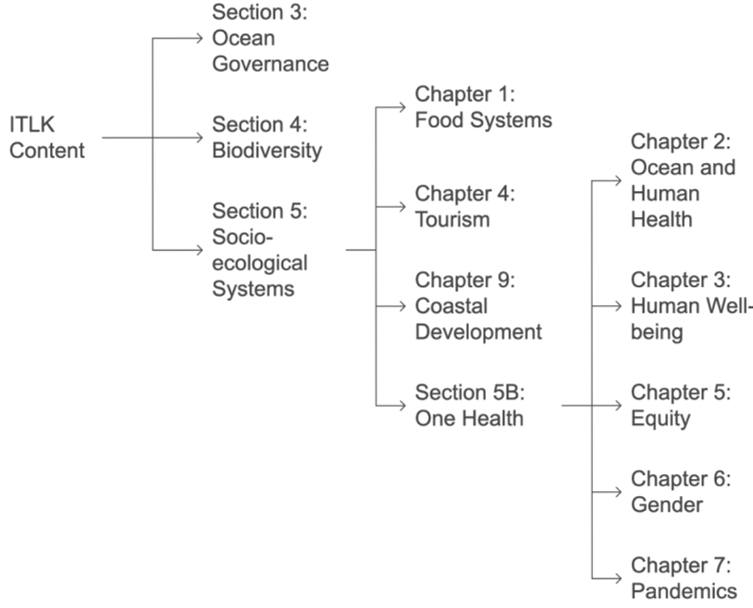
There are many sections and chapters of the World Ocean Assessment in which Indigenous, traditional owner and local community knowledge overlaps with current content and/or where such content may be included in future World Ocean Assessment cycles, as reflected in figure V. Incorporating it in these sections would help to ensure that future World Ocean Assessments truly champion Indigenous, traditional owner and local community as an essential contributor to sustainable ocean management, thereby fostering more inclusive and effective environmental stewardship.
Figure V Sections and chapters of the World Ocean Assessment where Indigenous, traditional owner and local community knowledge overlaps with current content or may be included in future cycles
Acknowledgements
The writers would like to acknowledge that some artificial intelligence-assisted software (Connected paper, Elicit) were used to assist with literature searches. Text support software (Grammarly, Paperpal and Co-pilot) were used to help with editing.
References
- Alexander, Steven M., and others (2019). Bridging Indigenous and science-based knowledge in coastal and marine research, monitoring, and management in Canada. Environmental Evidence, vol. 8, art. 36. https://doi.org/10.1186/s13750-019-0181-3.
- Allison, Edward H., and others (2023). The human relationship with our ocean planet. In The Blue Compendium, Jane Lubchenco, and Peter M. Haugan, eds. Cham: Springer.
- Ambers, A. (2024). Fluid internationalisms: the ocean as a source and forum of Indigenous international law. Borders in Globalization Review, vol. 5, No. 1, pp. 21-25.
- Artelle, Kyle A., and others (2018). Values-led management: the guidance of place-based values in environmental relationships of the past, present, and future. Ecology and Society, vol. 23, No. 3.
- Balvanera, Patricia, and others (2022). Methodological Assessment Report on the Diverse Values and Valuation of Nature of the Intergovernmental Science-Policy Platform on Biodiversity and Ecosystem Services. Bonn: IPBES
- Ban, Natalie C., and others (2017). Indigenous knowledge as data for modern fishery management: a case study of Dungeness crab in Pacific Canada. Ecosystem Health and Sustainability, vol. 3, No. 8.
- Barianaki, Eleni, and others (2024). How to incorporate cultural values and heritage in maritime spatial planning: a systematic review. Heritage, vol. 7, No. 1, pp. 380-411.
- Bartlett, Cheryl, and others (2012). Two-Eyed Seeing and other lessons learned within a co-learning journey of bringing together Indigenous and mainstream knowledges and ways of knowing. Journal of Environmental Studies and Sciences, vol. 4, pp. 331-340.
- Bay, Line K., and others (2023). Management approaches to conserve Australia's marine ecosystem under climate change. Science, vol. 381, No. 6658, pp. 631-636.
- Berkes, Fikret, and Nicole Franz (2025). Governing for Transformation Towards Sustainable Small-Scale Fisheries. Rome: FAO.
- Bingham, Jacob A., and others (2021). Knowledge pluralism in First Nations' salmon management. Frontiers in Marine Science, vol. 8.
- Bodansky, Daniel (2024). Four treaties in one: the Biodiversity Beyond National Jurisdiction Agreement. American Journal of International Law, vol. 118, No. 2, pp. 299-323.
- Boni, Yosua, and others (2024). Preserving coastal and marine resources: the existence of local wisdom among the Bajau Tribe. Journal of Global Innovations in Agricultural Sciences, pp. 663-671.
- Borrows, John (2016). Freedom and Indigenous Constitutionalism. Toronto: University of Toronto Press.
- Charette, Christian, Georges Nash, and Alain Mazel, eds. (2021). Indigenous Heritage and Rock Art: Worldwide Research in Memory of Daniel Arsenault. Oxford: Archaeopress.
- Crosman, Kristen M., and others (2022). Social equity is key to sustainable ocean governance. npj Ocean Sustainability, vol. 1, No. 1, art. 4.
- Davies, Hayley N., and others (2020). Mapping the marine environment through a cross-cultural collaboration. Frontiers in Marine Science, vol. 7, art. 716.
- Ens, Elizabeth J., and others. Australian approaches for managing 'country' using Indigenous and non- Indigenous knowledge. Ecological Management & Restoration, vol. 13, No. 1, pp. 100-107, 2012.
- Enyew, Elias N., and others (2021). Beyond borders and states: modelling ocean connectivity according to Indigenous cosmovisions. Arctic Review on Law and Politics, vol. 12, pp. 207-221.
- Ermine, Willie (2007). The ethical space of engagement. Indigenous Law Journal, vol. 6, pp. 193-210.
- Fears, Darryl (2016). Indigenous peoples of the world's coastlines are losing their fisheries - and their way of life. The Washington Post, 2 December. www.washingtonpost.com/news/energy- environment/wp/2016/12/02/coastal-native-people-who-need-fish-the-most-are-losing-them/.
- Fernández-Llamazares, Álvaro, and others (2023). Scientists' warning to humanity on threats to Indigenous and local knowledge systems. Journal of Ethnobiology, vol. 41, No. 2, pp. 144-169.
- Ford, James D., and others (2016). Including Indigenous knowledge and experience in IPCC assessment reports. Nature Climate Change, vol. 6, No. 4, pp. 349-353.
- Frid, Alejandro, and others (2023). Re-imagining the precautionary approach to make collaborative fisheries management inclusive of Indigenous Knowledge Systems. Fish and Fisheries, vol. 24, No. 6, pp. 940-958.
- Friedlander, Alan M., and Carlos F. Gaymer (2021). Progress, opportunities and challenges for marine conservation in the Pacific Islands. Aquatic Conservation: Marine and Freshwater Ecosystems, vol. 31, No. 2, pp. 221-231.
- Garibaldi, Ann, and Nancy Turner (2004). Cultural keystone species. Ecology and Society, vol. 9, No. 3.
- Gryba, R., Von Duyke, A., Huntington, H.P., Adams, B., Frantz, B., Gatten, J., Harcharek, Q., Sarren, R., Henry, G. and Auger-Méthé, M. (2025). Indigenous Knowledge as a sole data source in habitat selection functions. Proceedings of the National Academy of Sciences, U.S.A., vol. 122 (15) e2411946122. Available at https://doi.org/10.1073/pnas.2411946122.
- Haas, Benjamin (2023). Achieving SDG 14 in an equitable and just way. International Environmental Agreements: Politics, Law and Economics, vol. 23, No. 2, pp. 199-205.
- IPBES (2022). Methodological Assessment Report on the Diverse Values and Valuation of Nature of the Intergovernmental Science-Policy Platform on Biodiversity and Ecosystem Services.
- Balvanera, P., Pascual, U., Christie, M., Baptiste, B., and González-Jiménez, D., eds. IPBES Secretariat, Bonn, Germany. https://doi.org/10.5281/zenodo.6522522.
- IPBES (2019). Global Assessment Report on Biodiversity and Ecosystem Services of the
- Intergovernmental Science-Policy Platform on Biodiversity and Ecosystem Services. E. S. Brondizio, J. Settele, S. Díaz, and H. T. Ngo, eds. IPBES Secretariat, Bonn, Germany. https://doi.org/10.5281/zenodo.3831673 Version 1. Bonn: IPBES.
- Jessen, Tyler D., and others (2022). Contributions of Indigenous knowledge to ecological and evolutionary understanding. Frontiers in Ecology and the Environment, vol. 20, No. 2, pp. 93-101.
- Johansson-Fua, Seu'ula (2023). Kakala research framework. In Varieties of Qualitative Research Methods: Selected Contextual Perspectives, J.M. Okoko, S. Tunison, and K. D. Walker, eds. Cham: Springer International Publishing, pp. 275-280.
- Jones, Bethany L.H., and others (2024). New directions for Indigenous and local knowledge research and application in fisheries science: lessons from a systematic review. Fish and Fisheries, vol. 25, No. 4, pp. 647-671.
- Kaiser, Brooks A., and others (2019). The importance of connected ocean monitoring knowledge systems and communities. Frontiers in Marine Science, vol. 6, art. 309.
- Kitolelei, Seini, and others (2022). Fisherwomen's Indigenous and local knowledge - the hidden gems for the management of marine and freshwater resources in Fiji. Frontiers in Marine Science, vol. 9, art. 991253.
- Lam, Mimi E., and others (2019). Value- and ecosystem-based management approach - and Pacific herring fishery conflict. Marine Ecology Progress Series, vols. 617-618, pp. 341-364.
- Latulippe, Nicole (2015). Situating the work. AlterNative: An International Journal of Indigenous Peoples, vol. 11, No. 2, pp. 117-121.
- Magni, Giorgia (2017). Indigenous knowledge and implications for the sustainable development agenda. European Journal of Education, vol. 52, No. 4, pp. 437-447.
- Marshall, Albert, and others (2021). Awakening the sleeping giant: Re-Indigenization principles for transforming biodiversity conservation in Canada and beyond. FACETS, vol. 6, pp. 839-869.
- Martinez-Cruz, Teresa E., and others (2024). Water is more than a resource: Indigenous Peoples and the right to water. Social Sciences & Humanities Open, vol. 10, art. 100978.
- McMillan, Lorna J., and Karlee Prosper (2016). Remobilizing netukulimk: Indigenous cultural and spiritual connections with resource stewardship and fisheries management in Atlantic Canada. Reviews in Fish Biology and Fisheries, vol. 26, No. 4, pp. 629-647.
- Morgera, Elisa (2024). Participation of Indigenous Peoples in decision making over deep-seabed mining. AJIL Unbound, vol. 118, pp. 93-97.
- Ogar, Esther, and others (2020). Science must embrace Traditional and Indigenous knowledge to solve our biodiversity crisis. One Earth, vol. 3, No. 2, pp. 162-165.
- Parks, Louisa, and Elsa Tsioumani (2023). Transforming biodiversity governance? Indigenous Peoples' contributions to the Convention on Biological Diversity. Biological Conservation, vol. 280, art. 109933.
- Pictou, Sherry (2023). Reconciliation or Apiksitaultimik? Indigenous relationality for conservation.
- Rathwell, Kaitlyn J., and others (2025). A Growing Tree metaphor: identifying and reflecting on 26 Action Items for ethical bridging of Indigenous and Western knowledge systems in biodiversity research and monitoring. Ecology and Society, vol. 30, art. 30. https://doi.org/10.5751/ES-15946-300230.
- Reid, Andrea Amanda J., and others (2021). Two-Eyed Seeing: an Indigenous framework to transform fisheries research and management. Fish and Fisheries, vol. 22, No. 2, pp. 243-261.
- Rick, Torben C. (2024). Shell midden archaeology: current trends and future directions. Journal of Archaeological Research, vol. 32, No. 3, pp. 309-366.
- Rist, Phil, and others (2019). Indigenous protected areas in Sea Country: Indigenous-driven collaborative marine protected areas in Australia. Aquatic Conservation: Marine and Freshwater Ecosystems, vol. 29, Suppl. 2, pp. 138-151.
- Shackeroff, Jenna M., and Lisa M. Campbell (2007). Traditional ecological knowledge in conservation research. Conservation and Society, vol. 5, No. 3, pp. 343-360.
- Somiah, Vanessa (2022). The sea is Indigenous "land" too. Sojourn: Journal of Social Issues in Southeast Asia, vol. 37, No. 1, pp. 85-112.
- Strand, Meryl, and others (2024). Co-producing sustainable ocean plans with Indigenous and traditional knowledge holders. Washington, D.C .: World Resources Institute.
- Strand, Meryl, and others (2022). Reimagining ocean stewardship: arts-based methods to 'hear' and 'see' Indigenous and local knowledge in ocean management. Frontiers in Marine Science, vol. 9.
- Termansen, M., Jacobs, S., Mwampamba, T.H., Ahn, S., Castro, A., Dendoncker, N., Ghazi, H., Gundimeda, H., Huambachano, M., Lee, H., Mukherjee, N., Nemogá, G.R., Palomo, I., Pandit, R.,
- Schaafsma, M., Ngouhouo, J., Choi, A., Filyushkina, A., Hernández-Blanco, M., Contreras, V., and González-Jiménez, D. (2022). Chapter 3: The potential of valuation. In P. Balvanera, U. Pascual, M.
- Christie, B. Baptiste, and D. González-Jiménez, eds. Methodological Assessment Report on the Diverse Values and Valuation of Nature.
- Thaman, Konai Helu (1997). Kakala: a Pacific concept of teaching and learning. Paper presented at the Australian College of Education National Conference, Cairns.
- Tilot, Virginie, and others (2021). Traditional dimensions of seabed resource management in the context of deep sea mining in the Pacific: learning from the socio-ecological interconnectivity between island communities and the ocean realm. Frontiers in Marine Science, vol. 8, art. 637938, 2021.
- Tuwere, Ilaitia S. (2002). Vanua: Towards a Fijian Theology of Place. Suva: Institute of Pacific Studies, University of the South Pacific.
- UNESCO Intergovernmental Oceanographic Commission (IOC) (2021). The United Nations Decade of Ocean Science for Sustainable Development (2021-2030) Implementation Plan. Ocean Decade Series, No. 20(64). Paris: UNESCO.
- United Nations Division for Ocean Affairs and the Law of the Sea (UNDOALOS) (2017). The First Global Integrated Marine Assessment: World Ocean Assessment I, 1st ed. Cambridge: Cambridge University Press.
- United Nations (2023). Agreement under the United Nations Convention on the Law of the Sea on the Conservation and Sustainable Use of Marine Biological Diversity of Areas Beyond National Jurisdiction (BBNJ Agreement). New York.
- Vierros, Marjo K., and others (2020). Considering Indigenous Peoples and local communities in governance of the global ocean commons. Marine Policy, vol. 119, art. 104039.
- Von der Porten, Suzanne, and others (2019). The role of Indigenous resurgence in marine conservation. Coastal Management, vol. 47, No. 6, pp. 527-547.
- Whyte, Kyle Powys (2013). On the role of traditional ecological knowledge as a collaborative concept: a philosophical study. Ecological Processes, vol. 2, No. 1, pp. 1-12.
- Wong, Carmen Connie, and others (2020). Towards reconciliation: 10 Calls to Action to natural scientists working in Canada. FACETS, vol. 5, No. 1, pp. 769-783.
- Yua, Eva, and others (2022). A framework for co-production of knowledge in the context of Arctic research. Ecology and Society, vol. 27, art. 34.