
Ocean hazards of natural origin
Writing team: Achilleas G. Samaras (coordinating author), Davide Bonaldo, Piyali Chowdhury, Roshanka Ranasinghe, Johan Reyns, Karina von Schuckmann and Ioanna Triantafyllou.
Key points
- A methodological approach that integrates ocean hazards of natural origin into the One Health concept is proposed (see figure I).
- Identifying pathways is essential for assessing the impact of ocean hazards of natural origin on natural and human environments across oceanic scales and for enhancing ocean and coastal resilience.
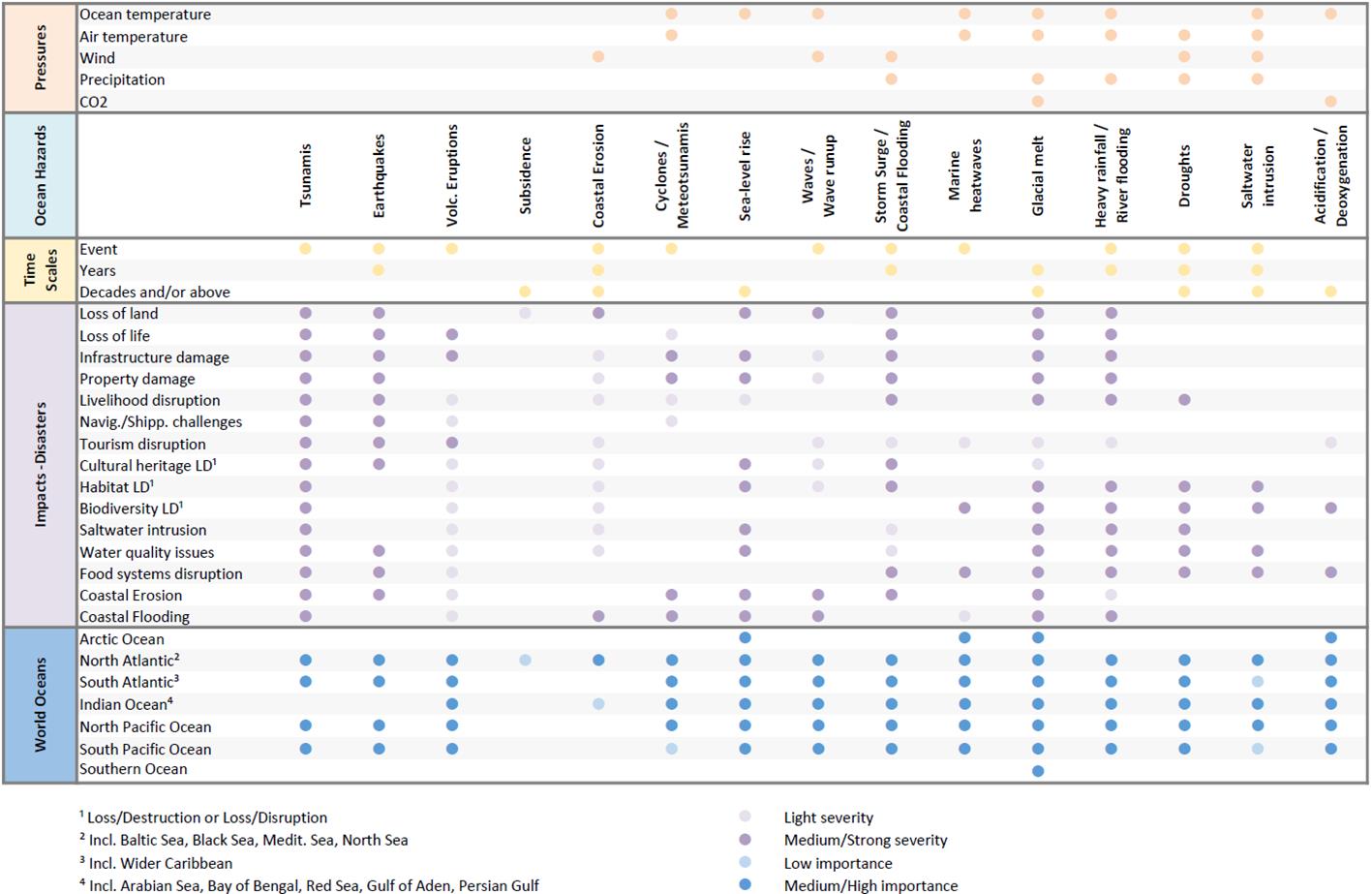
- Pathways linking "pressures", "ocean hazards" and "impacts-disasters" serve to illustrate the distinctions within ocean hazards of natural origin (see figure XVI).
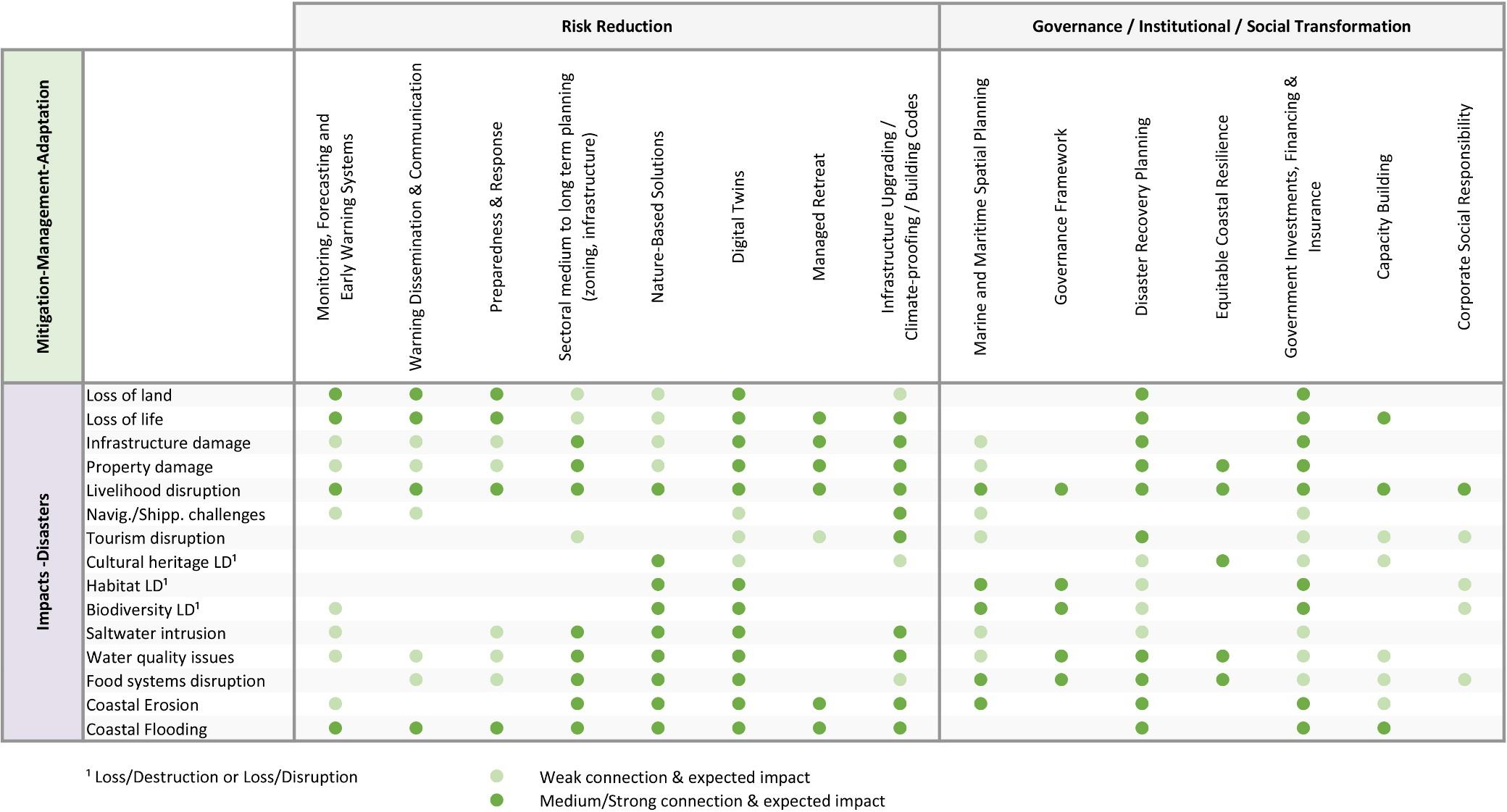
- Pathways connecting "impacts-disasters" and "mitigation-management-adaptation" serve to highlight available strategies in a multi-hazard context (see figure XVII).
1. Introduction
Ocean hazards of natural origin can be classified into four categories: (a) geophysical or geological; (b) ocean weather, hydrology and climate; (c) ecological; and (d) biological Ref 227. The present chapter is focused on categories (a), (b) and, partly, (c) (for acidification and deoxygenation, since those hazards largely affect those under categories (c) and (d). Aspects regarding (c) and (d) are also addressed in other chapters (see sect. 4, chaps. 4-6; and subsect. 5B, chaps. 1 and 2; see also table 2).
The present chapter is a new addition to the World Ocean Assessment. In the first and second Assessments, elements that were relevant to ocean hazards or integrated them within broader environmental and ecological frameworks were addressed; however, in the third Assessment, the topic has been elevated to a focused chapter. Accordingly, the approach presented below is intended to serve as a blueprint for future versions of the Assessment.
The approach taken is graphically represented by the flow chart contained in figure I. Its aim is to highlight "pathways" that connect the four core components, with the goal of facilitating a structured overall assessment of ocean hazards of natural origin within the framework of the third World Ocean Assessment. The approach is aligned with the nationally determined contributions and dialogues under the United Nations Framework Convention on Climate Change (UNFCCC) in relation to the role of ocean hazards of natural origin in the above context and to the road map towards ocean/coastal resilience Ref 289.
Figure I Flow chart of the approach to the present chapter, including its four core components
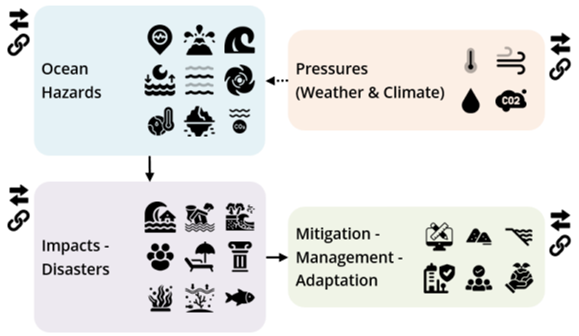
Note: Arrows denote the pathways between core components; "pressures" make part of the pathways only for hazards affected by weather and climate, hence the dotted line; double arrows denote information exchanges and link icons refer to other chapters of the third World Ocean Assessment as presented in 0).
2. Ocean hazard analysis
The present part of the chapter contains an analysis of ocean hazards of natural origin within the context of identifying pathways that connect the "pressures", "ocean hazards" and "impacts-disasters" components (see figure I). It is divided into 17 sub-parts, each containing a description of a distinct hazard. An analysis is presented in figure XVI. Information in figure XVI reflects the assimilation of available knowledge regarding the examined hazards in the relevant literature (see 0 1). Figure XVI should not be interpreted beyond its intended use, considering the uncertainties arising from such large- scale assessments when studying phenomena with significant local and regional variations. In that light, the present chapter is fundamentally linked to section 4, chapters 1 to 3, of the third World Ocean Assessment, with detailed links identified in table 2.
Tsunamis
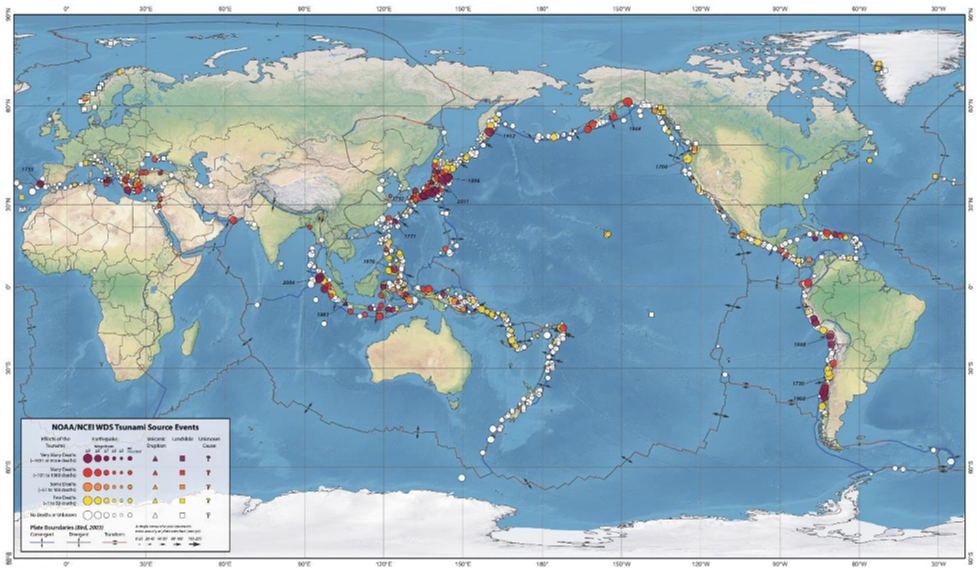
Geohazards can have major impacts on the human and natural environment, ranging from direct impacts (loss of life and damage to infrastructure and property), to indirect impacts (economic loss, social disruption and environmental degradation). Tsunamis are long sea waves with wave periods typically within the minutes to hour range. Their wavelengths are in the order of tens to hundreds of km depending on the dimensions of their causes Ref 168. Although tsunamis can be produced by several mechanisms Ref 26, submarine geological processes produce the majority of these waves. Shallow submarine earthquakes with moment magnitude greater than 6.5 produce 79% of the global number of tsunamis, while submarine volcanic eruptions or landslides produce 18%. Most tsunamis, including the largest, are generated along subduction zones (see figure II). Tsunamis caused an estimated 250,000 deaths and $280 billion in economic losses between 1998 and 2017 (United Nations Office for Disaster Risk Reduction (UNDRR), 2018).
Figure II Known tsunami sources from 1610 B.C.E. to 2023 C.E.
Earthquakes
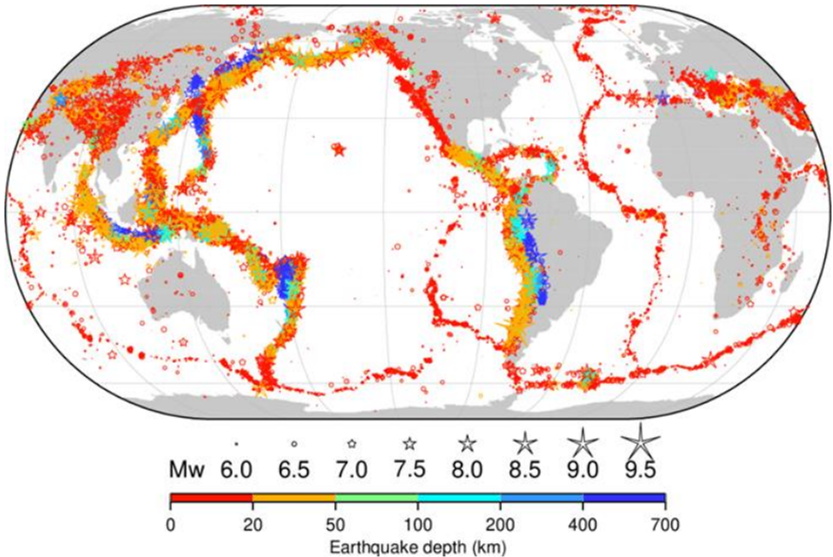
Global seismic activity is concentrated mainly along the boundaries of moving lithospheric plates (Lay and Wallace, 1995; see figure III). The sudden rupture of rocks releases stored dynamic energy in the form of seismic waves. Every year, on average, about 15 to 18 earthquakes of magnitude 7 or greater occur globally, and there are hundreds that exceed magnitude 6 (United States Geological Survey (USGS), 2024). Although most tectonic earthquakes occur at shallow depths (focal depth of less than 80 km), seismic activity has been observed at depths of up to about 720 km (the maximum depth of lithospheric subduction). Seismic waves travel from the seismic source in all directions within the Earth's interior, reaching the surface and causing the ground to shake. Earthquakes that occur in association with volcanic activity represent less than 10% of the total number of earthquakes. Earthquakes caused an estimated 500,000 deaths and $380 billion in economic losses between 1998 and 2017 Ref 286 Ref 309.
Figure III Epicentres of earthquakes
Volcanic eruptions
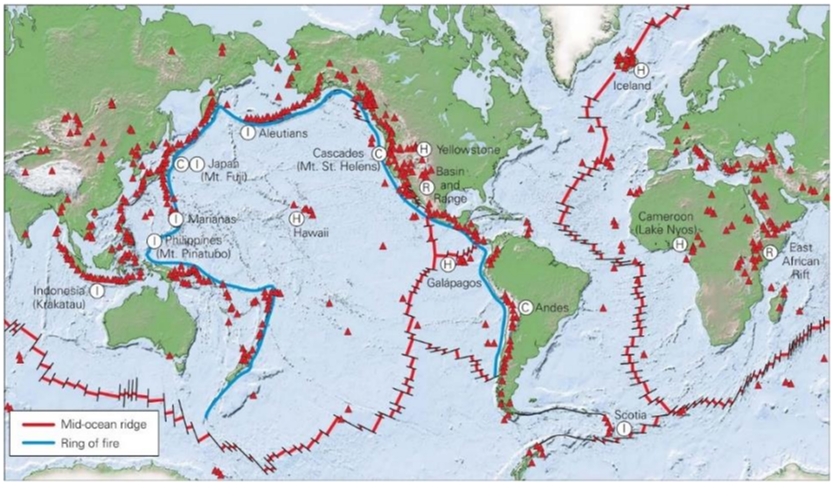
The geographical distribution of active volcanoes worldwide is similar to that of earthquake sources (Loughlin and others, 2017; see figure IV). More than 75% of all active volcanoes are located along submarine and coastal volcanic belts, such as the Ring of Fire in the Pacific Ocean. Strong volcanic eruptions that occur near populated areas become dangerous or even destructive. Over the past 500 years, volcanic eruptions are estimated to have caused more than 200,000 deaths Ref 209, with roughly half of those occurring during the period from 1900 to 2009 Ref 71.
Figure IV Main lithospheric plates and distribution of volcanoes
Tectonic subsidence
In regions characterized by subduction zones, the overriding lithospheric plate may experience subsidence. As the subducting plate pulls down the Earth's crust, large areas can gradually sink. This is a large-scale geodynamic process that is driven by plate tectonics mechanisms Ref 284. Tectonic subsidence may also occur suddenly in the overriding plate during a large subduction zone earthquake. Therefore, during large earthquakes, fault rupture can cause abrupt subsidence, thereby triggering tsunamis or permanently lowering parts of the coastline. Furthermore, in regions near convergent boundaries, heavy sediment deposition from rivers or glaciers can cause the crust to bend and subside due to weight (often seen in coastal or delta regions). Tectonic subsidence in coastal regions lowers the land relative to sea level, making those areas more vulnerable to flooding, storm surges and sea level rise. Gradual subsidence over time can cause damage to infrastructure, especially in areas where the land is subsiding unevenly. The opposite process, tectonic uplift, can also cause similar damage to infrastructure and lead to changes or disruptions in navigable waterways.
Coastal erosion
Through a global assessment of shoreline typology using satellite imagery (Hulskamp and others, 2023), 26%, 12%, 27% and 33% of ice-free shorelines were classified as sandy, muddy, rocky and vegetated, respectively, using automated image detection validated at over 50 sites. Luijendijk and others (2018) provide historical sandy shoreline position change rates during the period from 1984 to 2016, showing that 24% of sandy coasts had eroded, 28% had accreted and 48% had remained stable.
It has been stated with high confidence (Intergovernmental Panel on Climate Change (IPCC), 2021) that sandy shorelines will retreat in most regions of the world in the absence of additional sediment sources or physical barriers to shoreline retreat (for erosion trends for high-latitude permafrost-built shorelines, see sect. 4, subchap. 5K). The total length of sandy shorelines around the world projected to retreat by more than 100 m by the end of the century is about 35% greater under Representative Concentration Pathway (RCP) 8.5 (about 130,000 km) compared with that under RCP 4.5 (about 95,000 km). Vousdoukas and others (2020) find that 13.6-15.2% (36,097 km-40,511 km) of the world's sandy coastline could face shoreline retreat of more than 100 m by 2050, increasing to 35.7-49.5% (95,061 km-131,745 km) by the end of the century. Concentrating on the densely populated low-elevation coastal zone of the world, comprising 31% of the world's sandy coastline, Vousdoukas and others (2020) show that about one third of the global low-elevation coastal zone will experience shoreline retreat of more than 100 m by 2050, an estimate that reaches 52% and 63% by the end of the century, under RCP 4.5 and RCP 8.5, respectively (see figure V).
Figure V Projected retreat of sandy shorelines
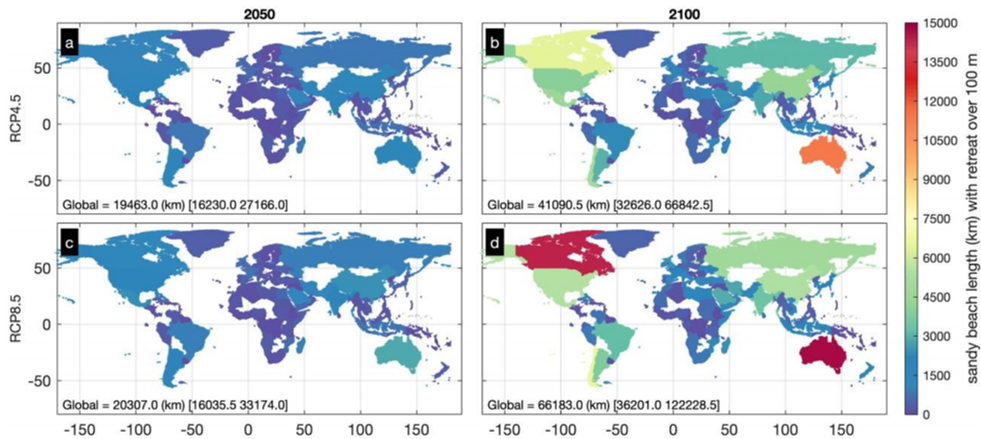
Note: Length of sandy beach coastline projected to retreat by more than 100 m by 2050 (a, c) and 2100 (b, d), under RCP 4.5 (a, b) and RCP 8.5 (c, d), by country.
Tropical and extratropical cyclones Cyclogenesis occurs through different mechanisms at varying latitudes Ref 83 and plays a crucial role in global circulation by transporting heat and moisture. Cyclogenesis is a significant hazard for coastal areas and maritime activities, especially in the form of tropical cyclones, which are warm-core, axisymmetric vortices with radii of between 100 km and 1,000 km, fuelled by thermodynamic disequilibrium between the atmosphere and ocean surface. Tropical cyclones are known as hurricanes or typhoons, depending on the region. These terms also refer to specific classifications of tropical cyclones that exceed certain wind speed thresholds in different regions. Annually, around 90 tropical cyclones occur globally Ref 82 and cause severe impacts in coastal regions through strong winds, intense rainfall and storm surge effects. Extreme events can lead to hundreds of thousands of casualties Ref 37. Since the 1970s, increased coastal exposure and climate change have exacerbated damage and the number of affected individuals Ref 154. At higher latitudes, Extratropical cyclones, such as polar lows and Mediterranean hurricanes (Medicanes or tropical-like cyclones) (see Miglietta and Rotunno, 2019), which are smaller and shorter-lived than tropical cyclones, are influenced by sea-surface heat fluxes and baroclinic instability and significantly affect annual precipitation in coastal areas Ref 248.CAccurate tracking and property assessment of cyclones is vital for disaster management and long- term preparedness. However, challenges remain in identifying long-term trends due to limited observational records and inter-annual variability. Although studies indicate potential increases in tropical and tropical-like cyclone intensity due to warming, projections regarding frequency changes and poleward migration of maximum intensity remain uncertain Ref 151. In addition, sea level rise may heighten storm impacts even if storminess decreases Ref 175.
Figure VI Wintertime extratropical storm eddy kinetic energy and track density
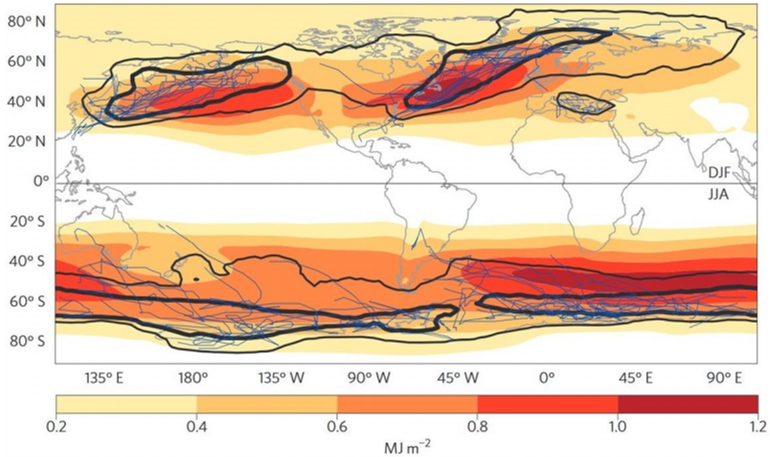
Note: Wintertime (adapted for northern and southern hemispheres) extratropical storm eddy kinetic energy (colour) and track density (contours). Thick/thin contours: 20/10 tracks (106km-2) per season; blue lines: individual tracks for the top 0.5% most intense cyclones.
Meteotsunamis
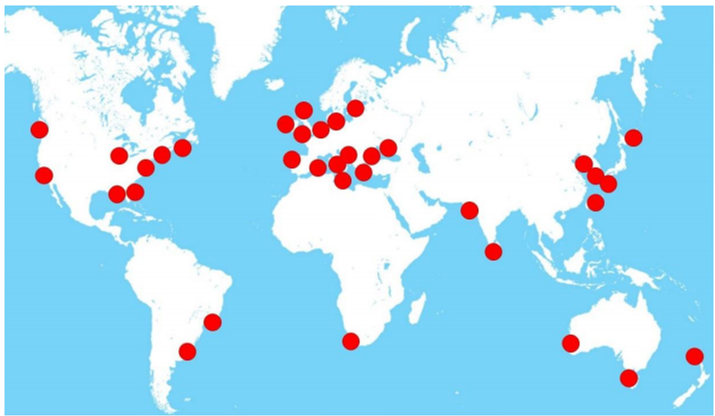
Meteotsunamis are long barotropic ocean waves generated by the resonance between atmospheric perturbations and sea surface oscillations. This resonance can occur when the propagation velocities of these atmospheric disturbances and sea waves align, in the ocean (Proudman resonance) or along coastlines (Greenspan resonance), or through interactions between incoming waves and the oscillation characteristics of a harbour or bay. Nearshore processes, such as topographic amplification or focusing, can further enhance such waves (Ličer and others, 2017). Depending on the mechanisms involved, meteotsunamis may manifest as solitary waves that impact coastlines or as seiches that oscillate in bays, with amplification reaching up to 100 times the "inverse barometer" response to the atmospheric disturbance Ref 223.
While the triggering conditions for meteotsunamis occur at large scales, significant events arise only when multiple conditions coincide Ref 202. Consequently, meteotsunamis often exhibit local characteristics, with hotspots where such events frequently occur Ref 229. Severe meteotsunami events can cause considerable economic losses and affect local economies (see, for example, Šepic and others, 2016), and possibly lead to fatalities.
Characterizing meteotsunami hazards is challenging in terms of both short-term early warning planning and long-term climate-proof coastal planning. Early warning systems use approaches such as synoptic indices that correlate atmospheric patterns with meteotsunamis, high-resolution numerical modelling of relevant physical processes and probabilistic methods Ref 62. Global adjustments in sea level monitoring protocols to one-minute intervals, which were initiated following the Indian Ocean tsunami that occurred in 2004, have improved meteotsunami detection and long-term climatological trend reconstruction. Advances in technologies, such as high-frequency radars and global navigation satellite system sensors, have also enhanced tsunami monitoring in the ionosphere Ref 6.
Figure VII Locations of meteotsunami occurrences
Sea level rise
It is well established that the ice loss from the Greenland and Antarctic ice sheets, glacier mass loss and the expansion of ocean volume from ocean warming Ref 35 cause global sea level to rise, and human influence has very likely been the main driver of such increases since at least 1971 Ref 137. It is also well established that the rate of global sea level rise is increasing (von Schuckmann and others, 2024; World Meteorological Organization (WMO), 2024), with a very likely acceleration rate of 0.094 mm/yr2 (0.082-0.115) for the period from 1993 to 2018 Ref 137. At the regional scale, sea level rise is not uniform. While most areas show a positive trend, localized regions with negative trends can also be observed Ref 90. It is well established that, in the past 30 years, nearly 50% of the ocean has experienced sea level rise at rates exceeding the global average, particularly in regions influenced by major western boundary currents, as well as parts of the western Pacific, the Indian Ocean and some areas of the Atlantic Ocean Ref 301. Although at the regional scale sea level trends are still dominated by steric changes Ref 269, studies show that accelerated land ice melt will lead to associated fingerprints becoming detectable Ref 273 Ref 53 Ref 136. Sea level rise has increased the adverse effects of coastal floods (well established), storms and tropical cyclones (established but incomplete), and hence the consequent losses and damages, the increasing vulnerability of inhabitants and infrastructure and food security risk, in particular in low-lying areas and island States Ref 138. Adaptation and mitigation measures, such as the restoration of mangroves and coastal wetlands, reduce the risks from sea level rise Ref 138.
Figure VIII Global mean sea level rise
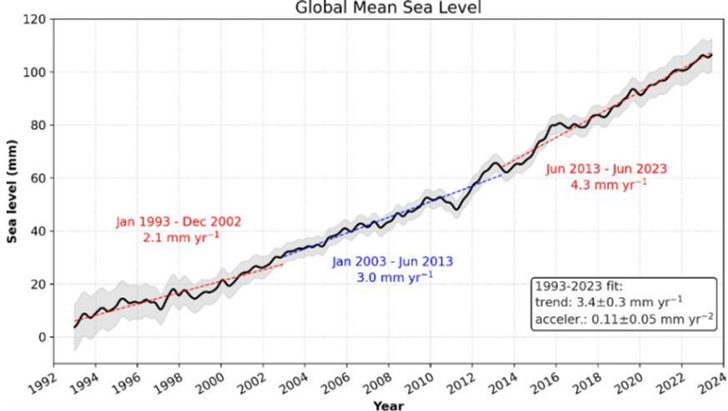
Note: Global mean sea level time series from January 1993 to June 2023 (curve) and its uncertainty envelope (shaded).
Waves and wave run-up
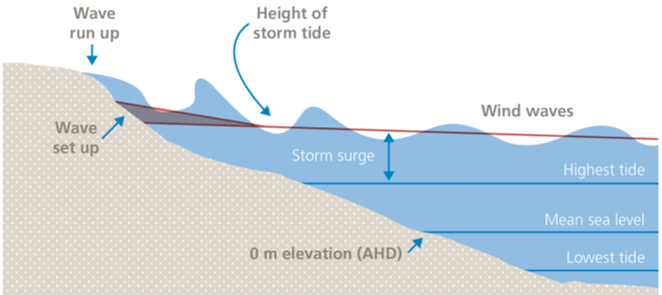
Wave run-up is a combination of wave set-up and shoreline oscillation (swash) from each incoming wave (see figure IX). It includes contributions from sea, swell and infragravity waves, varying over seconds to minutes. On gently sloping beaches, infragravity wave run-up can dominate. During storms, wave run-up on open coast beaches may reach 3 to 6 m above other components Ref 128. Run-up characteristics change depending on beach and offshore wave properties Ref 122 and is the main driver of beach-face hydrodynamics and morphodynamics Ref 81. Run-up also plays a critical role in dune erosion during storm conditions Ref 242 and structure overtopping (van der Meer and Stam, 1992). Run-up is therefore key to successful coastal planning and management and a critical parameter in assessing the effect of sea level rise on coastal inundation.
Wave run-up is closely related to many of the hazards presented in the present part of the chapter (tsunamis, tropical and extratropical cyclones, meteotsunamis, sea level rise, and storm surge and coastal flooding). Accordingly, it is difficult to disengage its assessment from a multi-hazard approach when it comes to the flow chart contained in figure I, especially considering that, with the exception of tsunamis, all other related hazards will be exacerbated by climate change. There are several studies highlighting regional variability in wave climate under present and future conditions. Nevertheless, regardless of regional variability, there appears to be consensus that major impacts will derive from significant increases in wave heights, changes in the frequency of occurrence and magnitude of extremes, and changes in wave directionality Ref 177.
Figure IX Schematic representation of the surf zone
Storm surge and coastal flooding
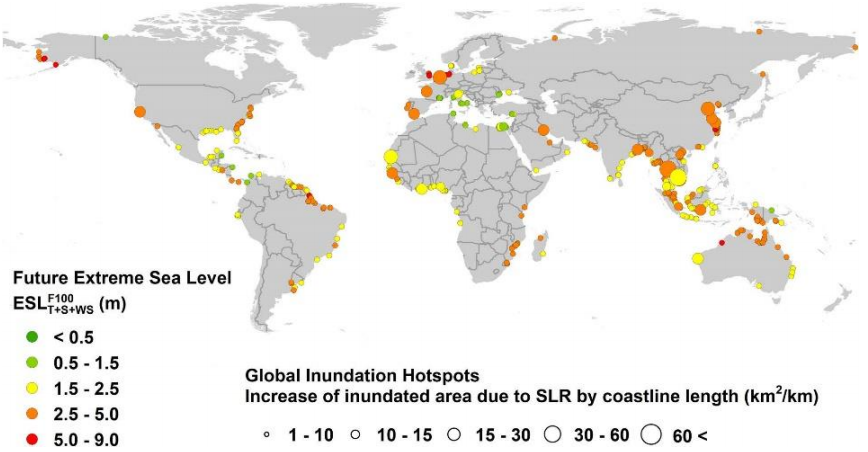
Coastal flooding is the episodic or permanent flooding of low-elevation coastal zone due to extreme total water levels. Extreme total water levels are composed of relative sea level rise, which combines sea level rise and local subsidence, storm (wind and pressure-driven) surge, tides and wave set-up Ref 241. In many cases, storm surge is the dominant contributor to extreme total water level. Hazards associated with coastal flooding are highly likely to increase in the coming decades for the majority of the world's coastlines Ref 137. Vousdoukas and others (2018) project a global increase by 2100 of 34 to 76 cm of the 100-year return period extreme total water level under the RCP 4.5 scenario, and an increase of 58 to 172cm under the RCP 8.5 scenario. Moreover, after 2050, the present- day high return period extreme total water levels is expected to become much more frequent in the majority of the world's coastal areas, especially in the tropics Ref 300, even under the most optimistic 1.5℃ warming scenarios Ref 276.
Looking at coastal flooding impacts on a global scale, without taking coastal protection and adaptation into account, an estimated area of 533*103km2 (512-603), a total of 148*106 (128*106-171*106) people and assets valued at 7,761*109$ (6,466-9,135) would be at risk under a present day 100-year return period extreme total water level event, increasing by 2100 by 33%, 36% and 32% under the RCP 4.5 scenario, respectively, and by 48%, 52% and 46% under the RCP 8.5 scenario, respectively Ref 149. Within the above context, impacts on food systems (especially fisheries and aquaculture) should not be overlooked Ref 271. Looking at risk, Tiggeloven and others (2020) found a 150-fold increase in expected annual damage by 2100 under the RCP 4.5-Shared Socioeconomic Pathway 2 scenario if no adaptation to coastal flooding occurs. When applying different adaptation scenarios, the increase reduces to 11- to 39-fold, depending on the adaptation pathway selected.
Figure X Global hotspot regions of changes in episodic coastal flooding in 2100 under Representative Concentration Pathway 8.5 (difference between projected episodic flooding in 2100 minus present- day episodic flooding)
Marine heatwaves
A marine heatwave is a period of at least five consecutive days of sea surface temperatures above the ninetieth climatological percentile Ref 119. Marine heatwave result from air-sea interactions, shifts in ocean currents and climate variability such as El Niño Ref 136. It is well established that, since the 1980s, marine heatwave frequency has doubled, with further increases expected, especially in tropical and Arctic waters, and human influence has very likely contributed to most of them since at least 2006 (IPCC, 2019 and 2021). With further increases in intensity and frequency observed, and projected in the coming decades, marine heatwaves are emerging as pervasive stressors for marine ecosystems globally (Smith and others, 2023; see figure XI), thereby exposing species and ecosystems to environmental conditions beyond their tolerance and acclimation limits Ref 138.
Adverse impacts already reported include the reduction of primary production, the migration or reduction of endemic species, the emergence of species from other regions and mass mortality of organisms Ref 263 Ref 218 Ref 99. Those changes can, in turn, have adverse impacts on human systems, including on fisheries and aquaculture Ref 41 Ref 138 Ref 308.
Figure XI Global and regional changes in the probability ratio of marine heatwaves
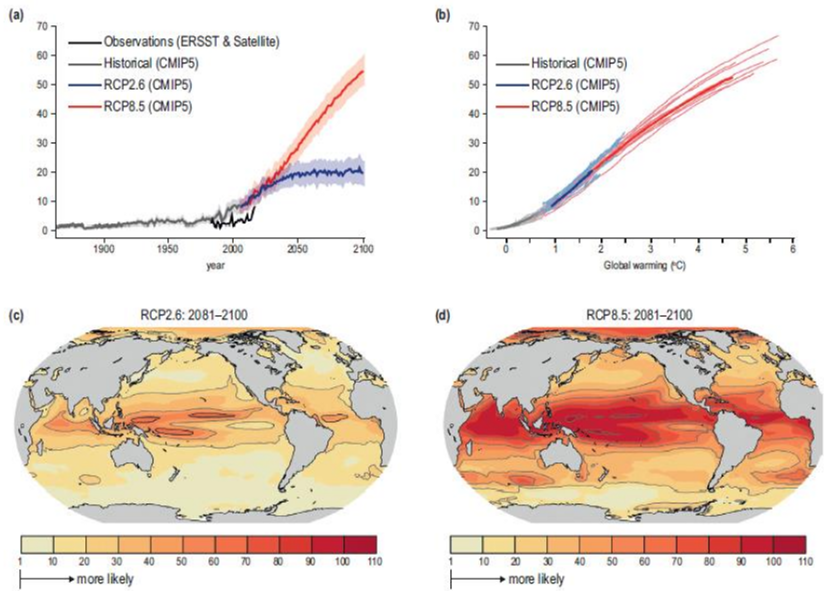
Note: The probability ratio is the fraction by which the number of marine heatwave days per year has changed since 1850-1900. (a): changes in the annual mean probability ratio of marine heatwaves exceeding the ninety-ninth percentile of pre-industrial local daily sea surface temperature averaged over the ocean. (b): same as (a), but the probability ratio is plotted for different levels of global surface atmospheric warming and for the individual models. The simulated time series in (b) are smoothed with a 10-year running mean. (c) and (d): simulated regional changes in the multi-model mean probability ratio of marine heatwaves exceeding the preindustrial ninety-ninth percentile in 2081-2100 for the RCP 2.6 scenario (c) and the RCP 8.5 scenario (d).
Glacial melt
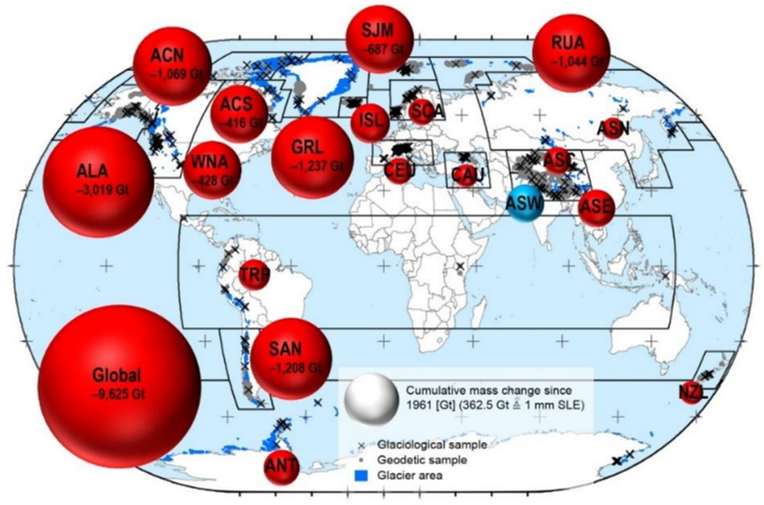
Glacial melt refers to the large-scale melting of glaciers and ice sheets, which releases vast amounts of freshwater into the world's oceans. Glacial melt contributes to sea level rise, while the influx of freshwater disrupts ocean salinity and density, thereby also modifying habitat conditions, nutrient availability and the biological productivity of affected regions Ref 136. Ice loss from glaciers and ice caps accounts for about 60% of the ice loss that contributes to sea level rise, with the remaining attributed to the melting of the Antarctic and Greenland ice sheets (Meier and others, 2007; see figure XII). As a result, sea level rise has reached approximately 1.48+0.26 mm per year from all ice-covered regions Ref 142. According to projections, glacier melt could contribute an additional 10 to 25 mm to sea level rise by 2100 Ref 189, while the Greenland ice sheet alone could contribute between 75 and 140 mm to sea level rise over the same period Ref 103. Freshwater input from glacial melt affects regional dynamics and global overturning circulation Ref 36, while also affecting nutrient and carbon cycling, thereby influencing primary and secondary productivity in marine ecosystems Ref 219. This affects not only coastal areas, but also the freshwater discharged downstream through glacial-fed rivers Ref 120.
Figure XII Regional share of glaciers in sea level rise from 1961/62 to 2015/16
Heavy rainfall and river flooding
Heavy rainfall in watersheds and associated river flooding can pose significant threats for downstream coasts, through compound flooding, degraded water quality, saltwater intrusion and threats to marine ecosystems. Compound flooding is the simultaneous occurrence of multiple flood drivers, including storm surges, river overflow and torrential rain. Such flooding is particularly severe and can exacerbate the impacts on coastal areas by increasing flooding extents and flow depths Ref 253. Effects typically extend to saltwater intrusion, which contaminates drinking water supplies and affects water quality for years Ref 186, leading to direct or indirect health risks for coastal communities. River and compound flooding also affect coastal ecosystems and habitats, through nutrient or sediment transport, physical or biogeochemical changes and habitat disruption Ref 101 Ref 95. Climate change is expected to modify the spatial and temporal modulation of rainfall regimes, leading to increased frequency of intense precipitation events and higher flood risks in many regions Ref 137. This is particularly evident in tropical and subtropical areas, where more intense rainfall is projected to increase flood frequency and magnitude Ref 320. Assessing the impacts of climate change on compound flooding involves significant uncertainties due to the complex interplay of various factors. For example, in Europe, the Mediterranean coasts might currently experience the highest probability of compound flooding; however, according to future projections, there are emerging high probabilities along parts of the northern European coast Ref 15.
Drought
Although drought is typically considered to be a terrestrial hazard, it can have significant impacts on coastal regions, affecting various aspects of the natural and human environment Ref 197. Drought can have an impact on water resources (reduced freshwater availability and salinization of coastal aquifers) Ref 332, on ecosystems and biodiversity Ref 182 and on human activities (agriculture, industry, energy production, tourism and human health) Ref 198 Ref 197. Droughts occur in both developed and developing countries, with significant impacts on the global ecosystem, varying from region to region. South and South-East Asian countries have been experiencing increasing droughts due to changing precipitation patterns Ref 198, while the Mediterranean, Amazon, southern Africa and Central America are projected to be the most affected regions by extreme multivariate drought in the future (Tabari and Willems, 2023; Dai, 2011 and 2013). Climate change is expected to exacerbate drought conditions, leading to more frequent and severe droughts Ref 137, while the combined effects of sea level rise and coastal flooding and drought will place further stress on coastal regions, leading to increased salinization and reduced groundwater quality Ref 256.
Saltwater intrusion
Saltwater intrusion, or the migration of saltwater into freshwater coastal aquifers, has significant environmental impacts on coastal regions Ref 317. The increase in water salinity has an immediate impact on drinking water quality and supplies Ref 203. It also affects crop yields and soil health through biochemical changes in aquifers, which has a detrimental impact on food security in vulnerable regions Ref 126 Ref 283. Saltwater intrusion alters coastal ecosystems, which affects vegetation and wildlife that are dependent on freshwater Ref 299.
Figure XIII Global hotspots of groundwater vulnerability to saltwater intrusion and sea level rise
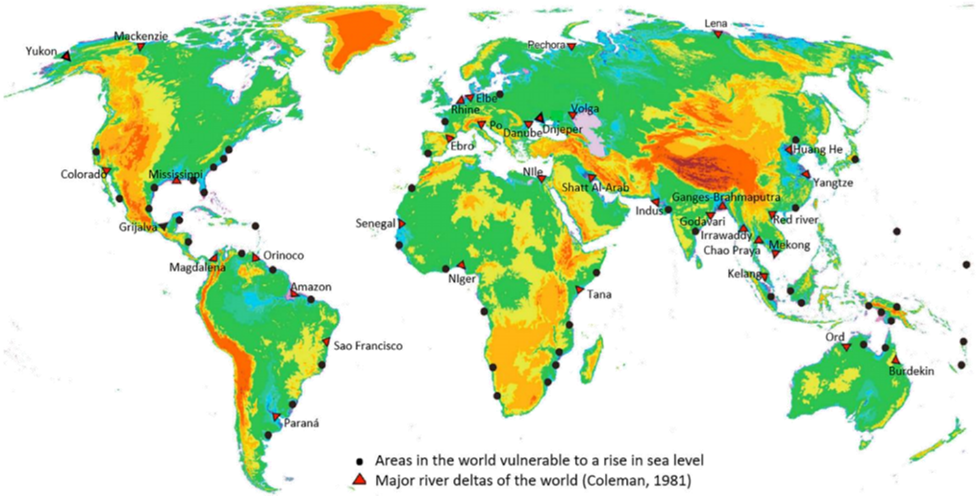
Saltwater intrusion is a global issue, affecting most coastal aquifers to varying degrees. Areas in China, India and Viet Nam are particularly vulnerable due to their low elevation and high population density, and are thus among the most studied in relevant research. Climate change is expected to enhance saltwater intrusion impacts through increased sea levels, extremes in waves and coastal flooding Ref 118 Ref 318, while the interplay between multiple hazards (primarily identified at the terrestrial level (e.g. heavy rainfall, river flooding and droughts)) along with human activities (e.g. freshwater pumping) will probably result in unprecedented effects in already problematic coastal areas and elsewhere Ref 243.
Ocean acidification
The ocean is a major player in the global carbon cycle and an important sink for anthropogenic carbon dioxide (CO2), helping to moderate climate change (Gruber and others, 2019). It is highly likely that the ocean has absorbed between 20 and 30% of total anthropogenic CO2 emissions since the 1980s Ref 136. The decrease of ocean pH is referred to as ocean acidification Ref 137. Addressing ocean acidification is among the targets of Sustainable Development Goal 14 of the 2030 Agenda for Sustainable Development.
Figure XIV Global ocean surface pH trends
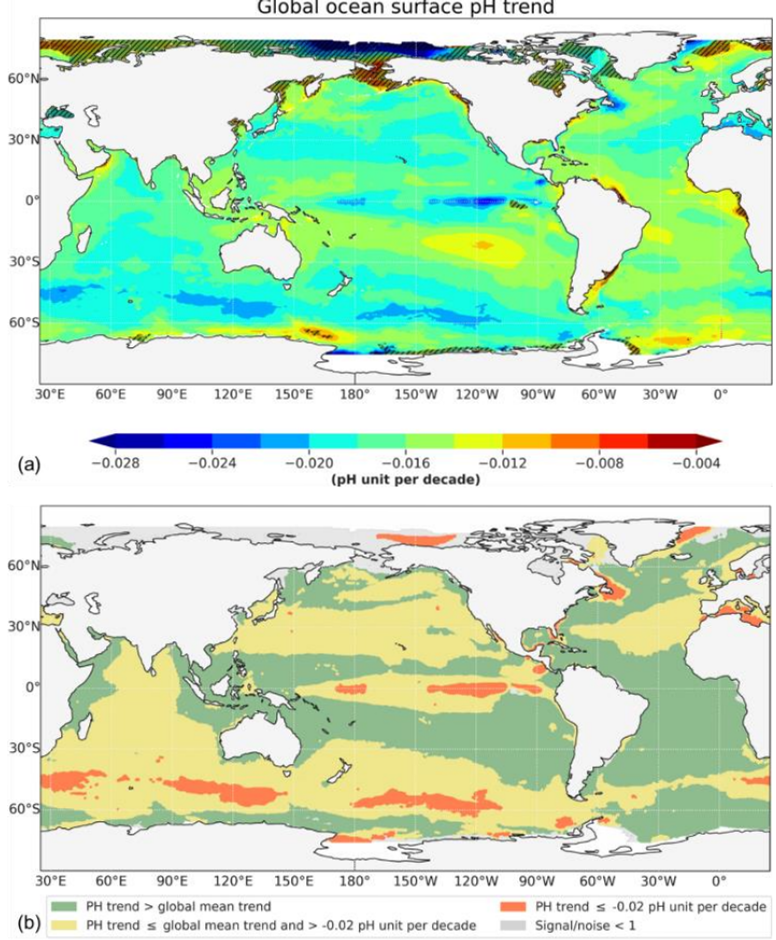
Note: (a): global ocean surface pH trend computed over the period 1985-2022; (b): magnitude of the pH decrease rates.
Open ocean surface pH has declined by a very likely range of 0.017-0.027 pH units per decade since the late 1980s, with the decline in surface ocean pH very likely to have already emerged from background natural variability for more than 95% of the ocean surface area Ref 136. Ocean acidification has spread deeper in the ocean Ref 89, surpassing 2,000 m in depth in the northern North Atlantic and in the Southern Ocean Ref 137. Acidification, in conjunction with other climate change-related environmental stresses, puts at risk many valuable ecosystem services, such as fisheries, aquaculture and shoreline protection Ref 69 Ref 138. In addition, together with ocean warming, ocean acidification threatens the future growth of coral reefs Ref 51 and has diverse adverse impacts on marine biodiversity Ref 136 Ref 277.
Ocean deoxygenation
It is well established that oxygen loss in the ocean, known as deoxygenation, is a significant consequence of climate change and has been further intensified by other global changes. Over the past 50 to 100 years, deoxygenation has already emerged in most of the global open ocean, which has experienced an average oxygen decline of 2% or more, with even more pronounced losses in intermediate waters (100-600 m) of the North Pacific, East Pacific, tropical regions and the Southern Ocean Ref 170 Ref 221 Ref 25. Natural oxygen variability has made it difficult to detect the emergence of a climate-forced signal of oxygen loss; the observed open-ocean deoxygenation and the expansion of oxygen minimum zones are attributed only in part to human influence Ref 137.
Figure XV Representative long-term records of open ocean deoxygenation in intermediate waters superimposed on full ocean percentage change in dissolved oxygen per decade since 1960
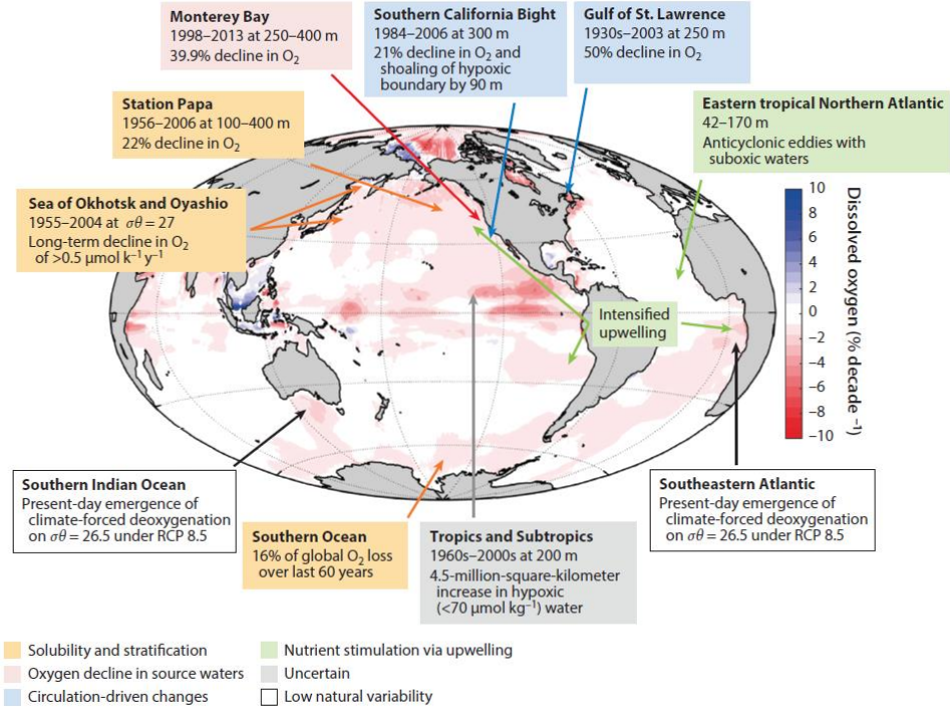
Note: 00: density surface.
Continued global ocean deoxygenation is projected to persist under most emissions scenarios, but with regional heterogeneity Ref 137. Notably, even small changes in oxygenation can have significant biological and biogeochemical effects, including for ocean productivity, nutrient cycling, carbon cycling and marine habitat Ref 136. Together with warming and acidification, deoxygenation alters ecological communities by increasing the spread of physiologically suboptimal conditions for many marine fish and invertebrates. It is well established that these and other responses have subsequently driven habitat loss, population decline, increased risks of species extirpation, and extinction and rearrangement of marine food webs Ref 138.
Figure XVI Pathways connecting the "pressures", "ocean hazards" and "impacts-disasters" components contained in figure I
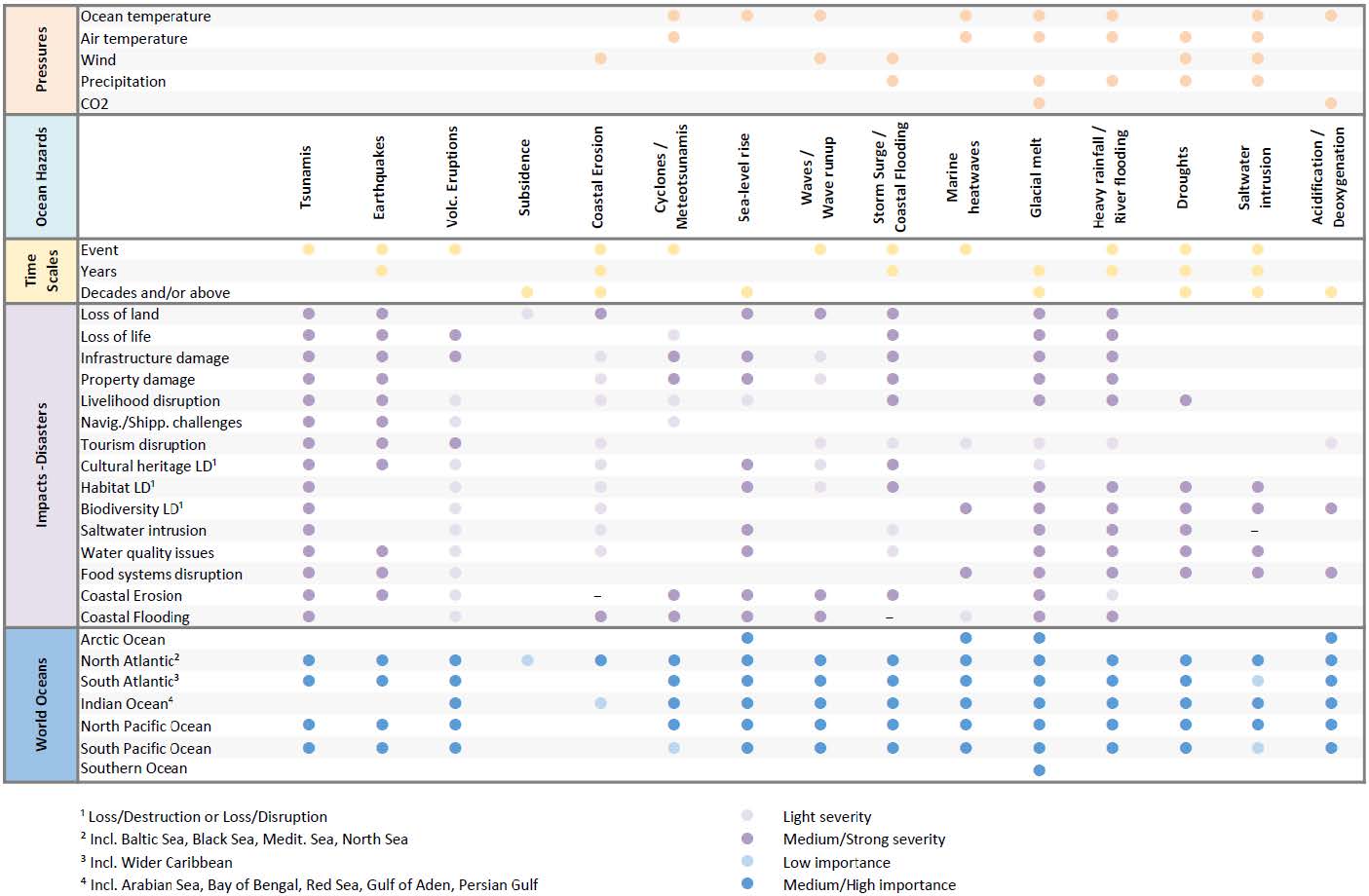
Source: Prepared by the writing team.
Note: Includes connections with "time scales" and geographical distribution ("word oceans" are listed in accordance with the division under the third World Ocean Assessment).
3. Towards ocean and coastal resilience
This part of the chapter analyses strategies towards ocean and coastal resilience that serve this chapter's context of identifying pathways that connect the components "impacts-disasters" and "mitigation-management-adaptation" (see subsect. 5B, chap. 4, including figure I), referring to single- and multi-hazard assessment. It is divided into nine sub- parts. Some of the hazards presented below are grouped, as relevant strategies typically address multiple hazards. In the 58 national adaptation plans submitted, the most commonly identified climate hazard was sea level rise, along with ocean acidification, saltwater intrusion and increased sea surface temperatures Ref 292. Furthermore, of the Parties that included an ocean-based measure in their national adaptation plans, 12% included reference to human- and climate-induced ocean changes, such as acidification, extreme weather events, sea level rise, storms and drought Ref 290.
The "mitigation-management-adaptation" strategies presented in this part of the chapter are closely aligned with evolving international climate policy frameworks on ocean resilience Ref 289. Ecosystem-based adaptation, enhanced early warning systems and risk-informed planning are prioritized as integral parts of the national adaptation plans that have been developed or are under development (UNFCCC, 2024a and 2024c). Likewise, focus on community engagement and robust governance relates to calls under the United Nations Framework Convention on Climate Change for inclusive, "whole-of-society" approaches to climate resilience.
An analysis of the efforts undertaken under the present partis presented in figure XVII. Information in figure XVII reflects the assimilation of available knowledge regarding the examined strategies in the relevant literature (see also 0table 1). It is noted that the figure is not focused on specific technical or managerial solutions, but rather serves to divide strategies into the categories "risk reduction" and "governance/institutional/social transformation", in accordance with Pinardi and others (2024). Figure XVII should not be interpreted beyond its intended use, considering the uncertainties arising from such large-scale multi-hazard assessments when studying phenomena with significant local and regional variations, as well as existing knowledge gaps in relevant research. Given the above, this part of the chapter is fundamentally linked to section 4, chapter 2, and to subsections 5A and 5B of third World Ocean Assessment, with detailed links identified in 0table 2.
Geophysical and geological hazards
Understanding the impacts of geohazards highlights the need for effective mitigation and adaptation strategies, including preparedness actions, improvement of building codes, development of early warning systems and land-use planning. For instance, after the Tohoku earthquake and tsunami in Japan in 2011, the Government invested heavily in building higher sea walls along the coastline to protect communities and in developing high-tech early warning systems in the country (National Research Institute for Earth Science and Disaster Resilience (NIED), 2024). On a global scale, warning services are provided by regional systems operating in different ocean basins (IOC, 2023). These systems focus on end- to-end tsunami warning and mitigation, and are coordinated by IOC of the United Nations Educational, Scientific and Cultural Organization (UNESCO) as a global "system of systems". Communities must be aware and prepared to respond quickly to these extremely short-notice and fast-onset events Ref 287. Earthquakes can cause extensive damage on land but also liquefaction in coastal zones and partial collapse of structures (e.g. the Loma Prieta earthquake in 1989 and its impact on the San Francisco-Oakland Bay Bridge). Following that earthquake, the public and private sectors made substantial investments in redevelopment and seismic retrofitting programmes to reduce the impact of future earthquakes and enhance earthquake resilience Ref 338.
Cyclones and meteotsunamis
When meteotsunami risk is recognized and protection is economically justified, for example for strategic infrastructure, design criteria for coastal structures and flood protection systems can be adapted to account for those events Ref 59. Nevertheless, in most cases, early warning remains the backbone of meteotsunami risk reduction, although key obstacles include observational challenges (limited spatial and temporal data) and modelling difficulties (accurate location and timing predictions, considering local geomorphology). Relevant benefits can be derived from relatively small investments in existing multi-hazard coastal warning systems and emerging technologies (Vilibic and others, 2016).
Cyclone impacts are typically mitigated through different management approaches comprising risk reduction strategies and post-event response and recovery Ref 123. Risk reduction in particular has traditionally mostly involved tackling vulnerability and exposure of coastal assets, infrastructures and communities by means of technological instruments, such as early warning systems, and changes in urban planning and building practices. As these approaches struggle to keep pace with the increasing pressures on coastal areas, new techniques based on geoengineering principles are emerging as potential lines of development for risk reduction to address the characteristics of cyclones as a hazard factor Ref 194. In both cases, addressing education, training, involvement of coastal communities and issues related to social acceptance and trust is key to risk reduction.
Sea level rise and glacial melt
Addressing current coastal impacts, managing future risks and preventing accelerated sea level rise after 2050 all require immediate mitigation and adaptation Ref 214. The most urgent adaptation challenge is chronic flooding at high tide Ref 138. Adaptation planning and implementation needs up to 2050 are projected to increase significantly in most inhabited coastal regions (IPCC, 2019 and 2021). Risks can be anticipated and adaptation measures can be planned and implemented over the coming decades, given that adaptation capacity and governance frameworks to manage the risks of projected sea level rise typically require decades to become effective Ref 109. Without timely action, vulnerable communities will face a reduction in adaptation options and bear disproportionate impacts Ref 138. Effective responses include decision analysis, land-use planning, public participation and conflict resolution, with the aim of charting adaptive pathways and managing governance challenges posed by sea level rise Ref 136. Furthermore, evidence-informed risk management, strengthened stakeholder dialogue and coordination, and enhanced action and support for finance, technology and capacity-building has been prioritized internationally Ref 285. It is well established that available near-term adaptation options include engineered, sediment- or ecosystem-based protection; land-use planning to reduce vulnerability; and advance (land reclamation) or retreat strategies (relocation) Ref 138 Ref 136. Only avoidance and relocation can remove coastal risks for the coming decades, while other measures only delay impacts temporarily, have increasing residual risk or perpetuate risk and create ongoing legacy effects and virtually certain property and ecosystem losses Ref 258. Large-scale relocation has immense cultural, political, social and economic costs and equity implications, which can be reduced by fast implementation of climate mitigation and adaptation policies Ref 137 Ref 109. Ecosystem-based adaptation, such as planting and conserving vegetation, landward migration and sediment supply, can reduce impacts on human settlements and generate substantial co-benefits across various socioeconomic dimensions, but they require space for sediment and ecosystems and have site-specific physical limits Ref 138 Ref 213 Ref 289.
Since the main direct impact of glacial melt is its contribution to sea level rise, strategies are largely covered by the previous paragraph). Beyond that, hazard-specific measures include using geotextiles to cover glaciers Ref 250, creating submerged barriers or dams in front of ice sheets and glaciers Ref 129 and a wide range of other geoengineering approaches Ref 178.
Coastal erosion, waves and wave run-up, and storm surge and coastal flooding
Mitigating coastal erosion and flooding involves strategies aimed at protecting shorelines, preserving natural landscapes, minimizing the impacts of shoreline retreat on coastal infrastructure and reducing the hazards posed by rising sea levels, storm surges and high tides on coastal communities Ref 138. Risk mitigation and adaptation strategies should ideally operate across multiple timescales to be effective. In the short term, this includes implementing early warning systems and emergency response protocols and maintaining existing protective infrastructure Ref 261 Ref 322. In the medium term, the focus could be shifted to the upgrading of infrastructure, the consideration of nature-based solutions, such as mangrove restoration, and the development of comprehensive coastal zone management plans Ref 3. Long-term strategies may require transformative approaches, such as relocation from high-risk areas Ref 235, major infrastructure redesign and strategic rethinking of land-use planning, that account for projected sea level rise and increased storm intensity and frequency Ref 138. Successful implementation requires careful alignment of these temporal scales along adaptation pathways Ref 108 with an appropriate multilevel governance framework that spans from emergency response to long-term socioeconomic planning, while ensuring continuity across political cycles Ref 236 Ref 19. Successful risk reduction strategies depend heavily on community buy-in, local knowledge integration and social justice considerations. Vulnerable coastal communities, particularly those with limited resources, often face disproportionate risks while being the least resilient to coastal flooding and erosion Ref 138.
Marine heatwaves
Well-established impacts of marine heatwaves have been reported for different types of ecosystem, particularly warm- water coral reefs, rocky shores, kelp systems, estuaries, lagoons, mangroves, seagrasses, sandy beaches, semi-enclosed seas, shelf seas and the Arctic region Ref 138. Socioeconomic systems (including those of Indigenous Peoples and local communities) that rely on these ecosystems are threatened by marine heatwave impacts on incomes, on economic sectors, such as fisheries and tourism, and, in the case of coral reefs, on shoreline protection from waves Ref 138. Management and adaptation strategies include the use of high-resolution data, forecasts and early warning systems to better prepare for marine heatwave and collect data on their effects Ref 121 Ref 187. These data can be used to guide economic sectors, such as aquaculture, in selecting new sites in order to reduce the likelihood of exposure to marine heatwaves Ref 244 Ref 176, and can support active restoration efforts Ref 94 Ref 7. Early management intervention and shifts in management approaches (e.g. quotas or stock assessments and flexible harvesting strategies) can also help to limit the impacts of marine heatwaves Ref 162 Ref 226 Ref 121. Furthermore, marine protected areas (MPAs) and no-take zones, in addition to terrestrial protection surrounding vulnerable coastal ecosystems, cannot prevent marine heatwaves from occurring. Nevertheless, depending on the location and adherence by people to restrictions on certain activities, the cumulative effect of other stressors on vulnerable ecosystems can be reduced, thereby potentially helping to enhance the rate of recovery of marine life Ref 138 Ref 8. Moreover, MPAs are more likely to buffer the impacts of marine heatwaves if climate change responses are considered in their design Ref 264.
Heavy rainfall and river flooding
Mitigation-management-adaptation strategies against heavy rainfall and river flooding extend beyond coastal zones. Regarding "traditional" defence infrastructure, reinforcing levees, dykes and barriers would protect low-lying coastal areas against coastal, river or compound flooding Ref 52 Ref 199, while retention basins and river regulation works would contribute to reducing downstream flooding risks Ref 320. Nature-based solutions (wetlands, mangroves, salt marshes and coastal dunes) can also significantly improve flood resilience, while at the same time enhancing water quality and supporting estuarine biodiversity Ref 15 Ref 183. Furthermore, adopting integrated watershed management approaches can prove highly beneficial by controlling erosion, run-off and pollutant loads travelling downstream Ref 101, while climate-adaptive infrastructure and planning in coastal cities can enhance the resilience of coastal communities Ref 311. Improvements in monitoring, forecasting and early warning system development, along with strategic investment in community preparedness and response, will always be integral to coastal resilience Ref 92 Ref 253.
Droughts and saltwater intrusion
Droughts and saltwater intrusion are closely associated in terms of their impacts and therefore call for aligned strategies to strengthen ocean and coastal resilience. In general, aligning water management, land use policies and coastal zone management should be a key requirement for effective water resources management from catchment to coast. Water conservation measures and efficient crop selection and irrigation practices can alleviate stress on water resources during drought periods Ref 50 Ref 272, while sustainable groundwater management and coastal infrastructure, such as barriers and subsurface dams, can mitigate saltwater intrusion Ref 317 Ref 91. Coastal land use zoning in vulnerable areas and managed aquifer recharge can also be reliable management strategies Ref 44, as can the controlled release of freshwater from upstream reservoirs Ref 203. Furthermore, ecosystem-based adaptation (restoring and conserving coastal ecosystems), a shift towards drought- and salinity-tolerant crops in agriculture, and community engagement and education on sustainable water use and irrigation practices can all contribute to resilient coastal ecosystems and communities Ref 299 Ref 182.
Ocean acidification and ocean deoxygenation
Ocean acidification and ocean deoxygenation generate extensive impacts across ocean-related sectors, including coastal communities, fisheries, mariculture and tourism, and adversely affect all categories of marine ecosystem services - regulating, provisioning and supporting Ref 138. Adapting to ocean acidification requires enhancing the resilience of marine ecosystems, supporting affected industries and developing adaptive management practices Ref 224 Ref 282 Ref 326. With regard to marine heatwaves , the protection and restoration of resilient ecosystems, such as seagrass, , mangroves, kelp forests, and other benthic habitats can help to buffer the effects of acidification by absorbing CO2 and creating more stable local conditions Ref 302. Evidence-based support for marine species adaptation, such as selective breeding and diversification of the major aquaculture species, also plays an increasing role Ref 24 Ref 274. Ocean acidification also affects human health and well-being in the context of malnutrition and poisoning, respiratory issues, mental health impacts and the development of medical resources Ref 87. Adapting to ocean changes will require efforts to manage socioecological systems adaptively Ref 46, including for fisheries and aquaculture, by iteratively changing management practices through biodiversity conservation and local management Ref 72 Ref 9 Ref 17.
Figure XVII Pathways connecting the "impacts-disasters" and "mitigation-management-adaptation" components contained in figure I
Source: Prepared by the writing team.
Note: Division by "risk reduction" and governance/institutional/social transformation" adopted from Pinardi and others, 2024.
Table 1 Extended literature by chapter part
| Sub-Section | Extended Literature |
|---|---|
| 5B4.3.1 | Doocy and others (2013), Espinosa and others (2017) |
| 5B4.3.2 | Daniel (2014), Jaiswal and Wald (2013), Skufina and others (2019) |
| 5B4.3.3 | - |
| 5B4.3.4 | - |
| 5B4.3.5 | Nawarat and others (2024) |
| 5B4.3.6 | Wang and Lin (2020), Earl-Spurr and others (2023), Lamers and others (2023), Heidarzadeh and Rabinovich (2021), Kim and Omira (2024), Raible and others (2021), Gaertner and others (2018), Hoque and others (2017), Catto (2016), Leroux and others (2018), Heming and others (2019), Wang and others (2016), Catto and others (2019), Knutson and others (2019), Hart (2003) |
| 5B4.3.7 | Dusek and others (2019), Vilibic and others (2016), Huang and others (2022), Angove and others (2021) |
| 5B4.3.8 | - |
| 5B4.3.9 | Xu and Perrie (2012), Wong and others (2019), Dissanayake and others (2021), Hemer and others (2010, 2013), Meucci and others (2023), Shimura and other (2015), Young and others (2011), Hsu and others (2023), Lee and others (2022) |
| 5B4.3.10 | - |
| 5B4.3.11 | Harris and others (2018) |
| 5B4.3.12 | Zemp and others (2020), Sraneo and Heimbach (2023), Khan and others (2022), Zhou and others (2021), Cape and others (2019), Sejr and others (2022) |
| 5B4.3.13 | Wood and others (2024), Yuan and others (2024), Couasnon and others (2020), Wang and others (2021), Howley and others (2018), Cardoso and others (2008), Shore and others (2021), Draut and others (2009), Milner and others (2018), Dankers and others (2014), Eccles and others (2019) |
| 5B4.3.14 | Fakhruddin and Eslamian (2017), Thomsen and Green (2019), Lake (2011), Ravindra and others (2010), Oh and others (2023), Dai (2011, 2013) |
| 5B4.3.15 | Chong and others (2014), Hu and others (2024), Bui and others (2024), Vu and others (2024), Datta and others (2009), Ferguson and Gleeson (2012) |
| 5B4.3.16 | - |
| 5B4.3.17 | Levin (2003), Sperling and others (2016), Orio and others (2021) |
| 5B4.4.1 | - |
| 5B4.4.2 | Lewis and others (2023), Angove and others (2021), Lamers and others (2023) |
| 5B4.4.3 | Huss and others (2021), Xie and others (2023) |
| 5B4.4.4 | Vousdoukas and others (2018, 2020), Dedekorkut-Howes and others (2020), Casella and others (2014), Polk and Eulie (2018) |
| 5B4.4.5 | |
| 5B4.4.6 | Dankers and others (2014), Barbier and others (2011), Howley and others (2018), Mansour Abdelkareem (2024), Ward and others (2018), Wahl and others (2015) |
| 5B4.4.7 | Hingst and others (2024), Bhattachan and others (2018), Chang and others (2019), Hu and others (2024), Murgulet and Tick (2008), Miyan (2015), Ravindra and others (2010), Osemwegie and Boko-Koiadia (2019) |
| 5B4.4.8 | - |
Source: Prepared by the writing team.
Table 2 Links to other sections and chapters of the third World Ocean Assessment
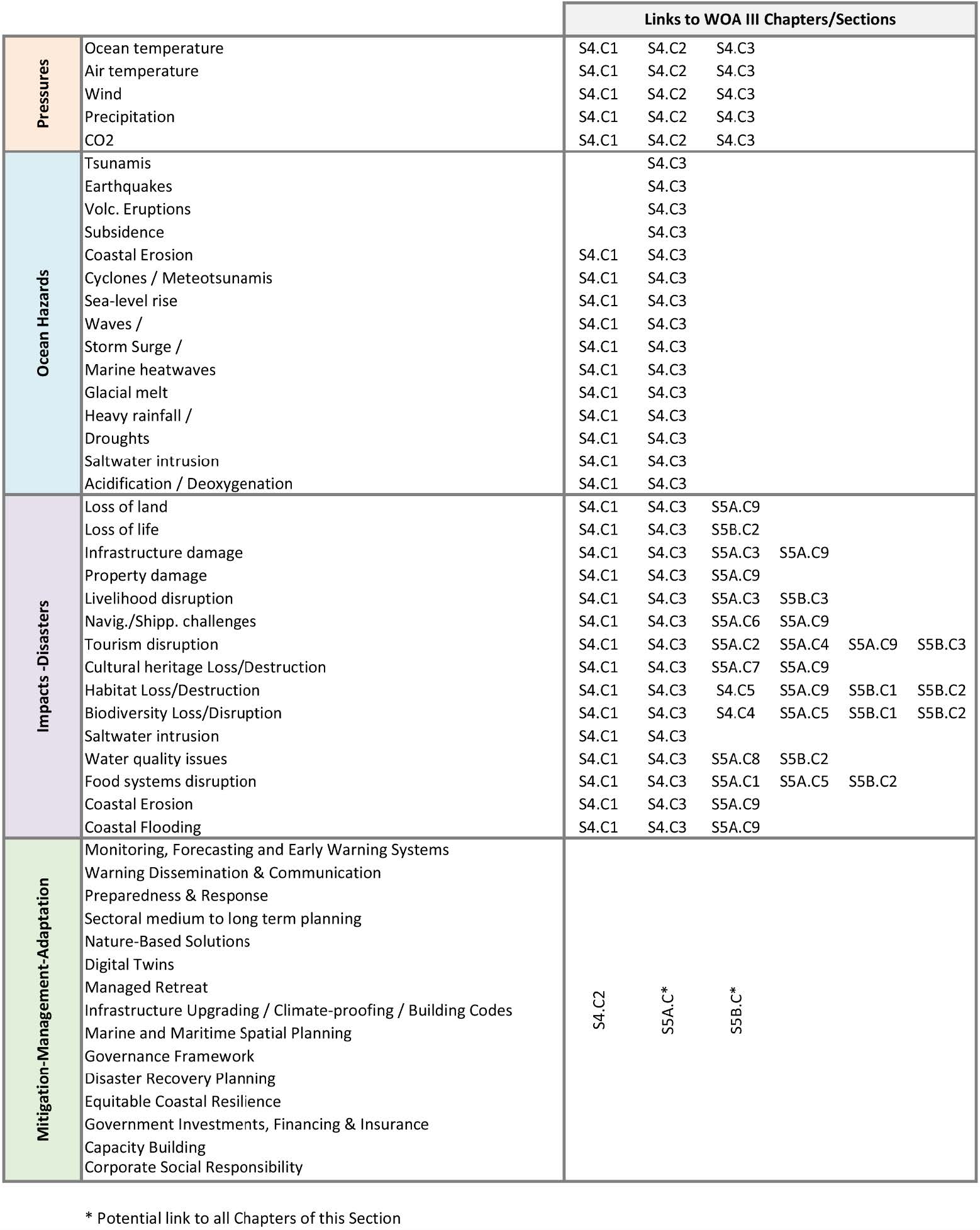
* Potential link to all Chapters of this Section
Source: Prepared by the writing team.
References
- Allan, Jonathan C., and Komar, Paul D. (2002). Wave Climate Change and Coastal Erosion in the US Pacific Northwest. In Proceedings of the Ocean Wave Measurement and Analysis, Reston, VA, pp. 680- 689.
- Alves, P.B.R., and others (2021). An integrated socio-environmental framework for mapping hazard- specific vulnerability and exposure in urban areas. Urban Water Journal, vol. 18, No. 7, pp. 530-543.
- Andersson, Erik, and others (2022). Urban climate resilience through hybrid infrastructure. Current Opinion in Environmental Sustainability, vol. 55, pp. 101158-101158.
- Andreeva, N., and others (2023). Identification of Coastal Flooding Hotspots in a Large Bay Using an Index-Based Risk Assessment Approach. In Proceedings of the Lecture Notes in Networks and Systems, pp. 51-65.
- Andreeva, N., and others (2016). Assessment of coastal receptors' exposure vulnerability to flood hazard along varna regional coast. In Proceedings of the Proceedings of the Coastal Engineering Conference.
- Angove, Michael, and others (2021). Addressing the meteotsunami risk in the United States. Natural Hazards, vol. 106, No. 2, pp. 1467-1487.
- Aoki, Lillian R., and others (2020). Depth Affects Seagrass Restoration Success and Resilience to Marine Heat Wave Disturbance. Estuaries and Coasts, vol. 43, No. 2, pp. 316-328.
- Arafeh-Dalmau, Nur, and others (2023). Integrating climate adaptation and transboundary management: Guidelines for designing climate-smart marine protected areas. One Earth, vol. 6, No. 11, pp. 1523-1541.
- Arkhipkin, Alexander I., and others (2015). World Squid Fisheries. Reviews in Fisheries Science & Aquaculture, vol. 23, No. 2, pp. 92-252.
- Armstrong, S.B., and Lazarus, E.D. (2019). Reconstructing patterns of coastal risk in space and time along the US Atlantic coast, 1970-2016. Natural Hazards and Earth System Sciences, vol. 19, No. 11, pp. 2497-2511.
- Baouham, A., and others. A Review of Structural Vulnerability Assessment Methods in the Advent of a Tsunami. In Proceedings of the E3S Web of Conferences, 2024.
- Barbier, Edward B., and others (2011). The value of estuarine and coastal ecosystem services. Ecological Monographs, vol. 81, No. 2, pp. 169-193.
- Barría, P., and others (2019). From multi-risk evaluation to resilience planning: The case of central Chilean coastal cities. Water (Switzerland), vol. 11, No. 3.
- Benassai, G., and others (2015). Coastal risk assessment of a micro-tidal littoral plain in response to sea level rise. Ocean and Coastal Management, vol. 104, pp. 22-35.
- Bevacqua, E., and others (2019). Higher probability of compound flooding from precipitation and storm surge in Europe under anthropogenic climate change. Science Advances, vol. 5, No. 9.
- Bhattachan, A., and others (2018). Evaluating the effects of land-use change and future climate change on vulnerability of coastal landscapes to saltwater intrusion. Elementa, vol. 6.
- Billé, Raphaël, and others (2013). Taking Action against Ocean Acidification: A Review of Management and Policy Options. Environmental Management, vol. 52, No. 4, pp. 761-779.
- Bin, L., and others (2023). Urban flood risk assessment characterizing the relationship among hazard, exposure, and vulnerability. Environmental Science and Pollution Research, vol. 30, No. 36, pp. 86463- 86477.
- Bisaro, A., and others (2020). Multilevel governance of coastal flood risk reduction: A public finance perspective. Environmental Science and Policy, vol. 112, pp. 203-212.
- Bongarts Lebbe, T., and others (2021). Designing Coastal Adaptation Strategies to Tackle Sea Level Rise. Frontiers in Marine Science, vol. 8.
- Booij, N., and others (1999). A third-generation wave model for coastal regions 1. Model description and validation. Journal of Geophysical Research: Oceans, vol. 104, No. C4, pp. 7649-7666.
- Borges Monteiro, A.C., and others (2024). A machine learning methodology to calculate the percentage of areas affected by drought in Brazil in map images. Modern Cartography Series, vol. 12, pp. 701-718.
- Bosom, E., and Jiménez, J.A. (2010). Storm-induced coastal hazard assessment at regional scale: Application to Catalonia (NW Mediterranean). Advances in Geosciences, vol. 26, pp. 83-87.
- Boudry, Pierre, and others (2021). Current status and potential of genomic selection to improve selective breeding in the main aquaculture species of International Council for the Exploration of the Sea (ICES) member countries. Aquaculture Reports, vol. 20, pp. 100700-100700.
- Breitburg, Denise, and others (2018). Declining oxygen in the global ocean and coastal waters. Science, vol. 359, No. 6371.
- Bryant, Edward (2008). Tsunami: The Underrated Hazard. Berlin, Heidelberg: Springer Berlin Heidelberg.
- Bui, Q.D., and others (2024). A holistic approach to salinity intrusion vulnerability assessment using geospatial technologies: An application for mekong delta of vietnam. International Journal of Disaster Risk Reduction, vol. 113.
- Cape, M.R., and others (2019). Circumpolar deep water impacts glacial meltwater export and coastal biogeochemical cycling along the west Antarctic Peninsula. Frontiers in Marine Science, vol. 6, No. MAR 2019.
- Cardoso, P.G., and others (2008). The impact of extreme flooding events and anthropogenic stressors on the macrobenthic communities' dynamics. Estuarine, Coastal and Shelf Science, vol. 76, No. 3, pp. 553- 565.
- Casas-Prat, M., and others (2024). Wind-wave climate changes and their impacts. Nature Reviews Earth and Environment, vol. 5, No. 1, pp. 23-42.
- Casas-Prat, M., and Sierra, J. P. (2012). Trend analysis of wave direction and associated impacts on the Catalan coast. Climatic Change, vol. 115, Nos. 3-4, pp. 667-691.
- Casella, Elisa, and others (2014). Study of wave runup using numerical models and low-altitude aerial photogrammetry: A tool for coastal management. Estuarine, Coastal and Shelf Science, vol. 149, pp. 160- 167.
- Catto, J.L. (2016). Reviews of Geophysics Extratropical cyclone classification and its use. Reviews of Geophysics, vol. 54, pp. 486-520.
- Catto, Jennifer L., and others (2019). The Future of Midlatitude Cyclones. Current Climate Change Reports, vol. 5, No. 4, pp. 407-420.
- Cazenave, Anny, and Moreira, Lorena (2022). Contemporary sea-level changes from global to local scales: a review. Proceedings of the Royal Society A: Mathematical, Physical and Engineering Sciences, vol. 478, No. 2261.
- Cenedese, C., and Straneo, F. (2023). Icebergs Melting. Annual Review of Fluid Mechanics, vol. 55, pp. 377-402.
- Cerveny, Randall S., and others (2017). WMO assessment of weather and climate mortality extremes: Lightning, tropical cyclones, tornadoes, and hail. Weather, Climate, and Society, vol. 9, No. 3, pp. 487- 497.
- Chang, Qinpeng, and others (2019). Effect of subsurface dams on saltwater intrusion and fresh groundwater discharge. Journal of Hydrology, vol. 576, pp. 508-519.
- Chang, S.E., and others (2018). Community vulnerability to coastal hazards: Developing a typology for disaster risk reduction. Applied Geography, vol. 91, pp. 81-88.
- Chen, J. and Zhang, L. (2022). Risk Assessment and Risk-Benefit Assessment. In Nutritional Toxicology.
- Cheung, William W.L., and Frölicher, Thomas L. (2020). Marine heatwaves exacerbate climate change impacts for fisheries in the northeast Pacific. Scientific Reports, vol. 10, No. 1, pp. 6678-6678.
- Chinchiolo, J. (2012). Landslide repair and severe erosion mitigation case studies in sensitive coastal areas. In Proceedings of the Landslides and Engineered Slopes: Protecting Society through Improved Understanding - Proceedings of the 11th International and 2nd North American Symposium on Landslides and Engineered Slopes, pp. 1581-1585.
- Chinchiolo, J., and Barrett, C. (2011). Landslide repair and severe erosion mitigation case studies in sensitive coastal areas. In Proceedings of the Coastal Engineering Practice - Proceedings of the 2011 Conference on Coastal Engineering Practice, pp. 605-615.
- Chong, Y. J., and others (2014). Climate change and salinity in drinking water as a global problem: using remote-sensing methods to monitor surface water salinity. International Journal of Remote Sensing, vol. 35, No. 4, pp. 1585-1599.
- Christie, E.K., and others (2018). Regional coastal flood risk assessment for a tidally dominant, natural coastal setting: North Norfolk, southern North Sea. Coastal Engineering, vol. 134, pp. 177-190.
- Cinner, J.E., and others (2019). Sixteen years of social and ecological dynamics reveal challenges and opportunities for adaptive management in sustaining the commons. Proceedings of the National Academy of Sciences, vol. 116, No. 52, pp. 26474-26483.
- Coleman, J.M. (1981). Deltas: Processes of Deposition and Models for Exploration. Boston, MA: Burgess Publishing Company.
- Conley, D.C. (2015). Drivers: Waves and Tides. In Coastal Environments and Global Change.
- Conrad, Patricia A., and others (2013). Operationalizing a One Health approach to global health challenges. Comparative Immunology, Microbiology and Infectious Diseases, vol. 36, No. 3, pp. 211- 216.
- Cook, B.I., and others (2018). Revisiting the leading drivers of Pacific coastal drought variability in the contiguous United States. Journal of Climate, vol. 31, No. 1, pp. 25-43.
- Cornwall, Christopher E., and others (2021). Global declines in coral reef calcium carbonate production under ocean acidification and warming. Proceedings of the National Academy of Sciences, vol. 118, No. 21.
- Couasnon, A., and others (2020). Measuring compound flood potential from river discharge and storm surge extremes at the global scale. Natural Hazards and Earth System Sciences, vol. 20, No. 2, pp. 489- 504.
- Coulson, Sophie, and others (2022). A detection of the sea level fingerprint of Greenland Ice Sheet melt. Science, vol. 377, No. 6614, pp. 1550-1554.
- Dai, A. (2011). Drought under global warming: A review. Wiley Interdisciplinary Reviews: Climate Change, vol. 2, No. 1, pp. 45-65, 2011.
- Dai, A. (2013). Increasing drought under global warming in observations and models. Nature Climate Change, vol. 3, No. 1, pp. 52-58.
- Daniell, J.E. (2014). The Socioeconomic Impact of Earthquake Disasters. In Earthquake Hazard, Risk and Disasters.
- Dankers, R., and others (2014). First look at changes in flood hazard in the Inter-Sectoral Impact Model Intercomparison Project ensemble. Proceedings of the National Academy of Sciences of the United States of America, vol. 111, No. 9, pp. 3257-3261.
- Datta, Bithin, and others (2009). Modeling and control of saltwater intrusion in a coastal aquifer of Andhra Pradesh, India. Journal of Hydro-environment Research, vol. 3, No. 3, pp. 148-159.
- De Jong, M.P.C., and others (2021). Meteorologically generated long-period waves and their impact on the Dutch primary national flooding protection system. Natural Hazards, vol. 106, No. 2, pp. 1421-1443.
- De Risi, R., and others (2018). A way forward to resilient infrastructures against earthquake-tsunami multi-hazard. In Routledge Handbook of Sustainable and Resilient Infrastructure.
- Dedekorkut-Howes, Ayşın, and others (2020). When the tide gets high: a review of adaptive responses to sea level rise and coastal flooding. Journal of Environmental Planning and Management, vol. 63, No. 12, pp. 2102-2143.
- Denamiel, Cléa, and others (2023). Climate projections of meteotsunami hazards. Frontiers in Marine Science, vol. 10.
- Denamiel, Cléa, and others (2023). Destructive Potential of Planetary Meteotsunami Waves beyond the Hunga Tonga-Hunga Ha'apai Volcano Eruption. Bulletin of the American Meteorological Society, vol. 104, No. 1, pp. E178-E191.
- Di Luccio, Diana, and others (2018). Monitoring and Modelling Coastal Vulnerability and Mitigation Proposal for an Archaeological Site (Kaulonia, Southern Italy). Sustainability, vol. 10, No. 6, pp. 2017- 2017.
- Dietz, S., and Koninx, F. (2022). Economic impacts of melting of the Antarctic Ice Sheet. Nature Communications, vol. 13, No. 1.
- DiGiacomo, P.M., and others (2004). Coastal pollution hazards in southern California observed by SAR imagery: Stormwater plumes, wastewater plumes, and natural hydrocarbon seeps. Marine Pollution Bulletin, vol. 49, Nos. 11-12, pp. 1013-1024.
- Dissanayake, P., and others (2021). Climate change impacts on coastal wave dynamics at Vougot beach, France. Journal of Marine Science and Engineering, vol. 9, No. 9.
- Doalos, United Nations (2021). The Second World Ocean Assessment. New York.
- Doney, Scott C., and others (2020). The Impacts of Ocean Acidification on Marine Ecosystems and Reliant Human Communities. Annual Review of Environment and Resources, vol. 45, No. 1, pp. 83-112.
- Doocy, S., and others (2013a). The Human Impact of Tsunamis: A Historical Review of Events 1900- 2009 and Systematic Literature Review. PLoS Currents, No. APR 2013.
- Doocy, S., and others (2013b). The Human Impact of Volcanoes: A Historical Review of Events 1900- 2009 and Systematic Literature Review. PLoS Currents, No. APR 2013.
- Doubleday, Zoë A., and Connell, Sean D. (2018). Weedy futures: can we benefit from the species that thrive in the marine Anthropocene? Frontiers in Ecology and the Environment, vol. 16, No. 10, pp. 599- 604.
- Draut, A.E., and others (2009). Supply and dispersal of flood sediment from a steep, tropical watershed: Hanalei Bay, Kaua'i, Hawai'i, USA. Bulletin of the Geological Society of America, vol. 121, Nos. 3-4, pp. 574-585.
- DSE (2012). Victorian Coastal Hazard Guide. Melbourne: Victorian Government Department of Sustainability and Environment.
- Duc Tran, D., and others (2024). Extent of saltwater intrusion and freshwater exploitability in the coastal Vietnamese Mekong Delta assessed by gauging records and numerical simulations. Journal of Hydrology, vol. 630.
- Dupouy, G., and others (2017). Propagating spatial and thematic uncertainties in mountain natural hazard assessment process. In Proceedings of the Risk, Reliability and Safety: Innovating Theory and Practice - Proceedings of the 26th European Safety and Reliability Conference, ESREL 2016, pp. 44-44.
- Durand, G., and others (2022). Sea-Level Rise: From Global Perspectives to Local Services. Frontiers in Marine Science, vol. 8.
- Dusek, Gregory, and others (2019). A meteotsunami climatology along the U.S. East Coast. Bulletin of the American Meteorological Society, vol. 100, No. 7, pp. 1329-1345.
- Earl-Spurr, Craig, and others (2023). Forecasting tropical cyclone wind hazards and impacts: Summary from the Tenth International Workshop on Tropical Cyclones (IWTC-10). In Proceedings of the Tropical Cyclone Research and Review, pp. 113-122.
- Eccles, R., and others (2019). A review of the effects of climate change on riverine flooding in subtropical and tropical regions. Journal of Water and Climate Change, vol. 10, No. 4, pp. 687-707.
- Elfrink, Berry, and Baldock, Tom (2002). Hydrodynamics and sediment transport in the swash zone: a review and perspectives. Coastal Engineering, vol. 45, Nos. 3-4, pp. 149-167.
- Emanuel, Kerry, and others (2023). The Surprising Roles of Turbulence in Tropical Cyclone Physics. Atmosphere, vol. 14.
- Emanuel, K.A. (1991). The theory of hurricanes. Annual Review of Fluid Mechanics, vol. 23, pp. 179- 196.
- Espinosa, F.R., and others (2017). Economic evaluation of recovering natural protection with concurrent relocation of the population threatened by Tsumani hazards in central coastal Ecuador. Science of Tsunami Hazards, vol. 36, No. 4, pp. 293-306.
- Europe, WHO (1984). Health promotion: a discussion document on the concept and principles: summary report of the Working Group on Concept and Principles of Health Promotion. Copenhagen.
- Fakhruddin, B.S.H.M., and Eslamian, S. (2017). Analysis of drought factors affecting the economy. In Handbook of Drought and Water Scarcity: Principles of Drought and Water Scarcity (2017).
- Falkenberg, Laura J., and others (2020). Ocean Acidification and Human Health. International Journal of Environmental Research and Public Health, vol. 17, No. 12, pp. 4563-4563.
- Falkenberg, Laura J., and others (2021). Biotic habitats as refugia under ocean acidification. Conservation Physiology, vol. 9, No. 1.
- Fassbender, Andrea J., and others (2023). Amplified Subsurface Signals of Ocean Acidification. Global Biogeochemical Cycles, vol. 37, No. 12.
- Fasullo, J.T., and Nerem, R.S. (2018). Altimeter-era emergence of the patterns of forced sea-level rise in climate models and implications for the future. Proceedings of the National Academy of Sciences, vol. 115, No. 51, pp. 12944-12949.
- Ferguson, G. and Gleeson, T. (2012). Vulnerability of coastal aquifers to groundwater use and climate change. Nature Climate Change, vol. 2, No. 5, pp. 342-345.
- Figlus, Jens. (2022). Chapter 4 - Modeling the movement of water and sediment in coastal environments. In Coastal Flood Risk Reduction, Samuel Brody Yoonjeong Lee and Baukje Bee Kothuis, eds. Elsevier.
- Fleming, C.S., and others (2023). Indicators and participatory processes: a framework for assessing integrated climate vulnerability and risk as applied in Los Angeles County, California. Natural Hazards, vol. 115, No. 3, pp. 2069-2095.
- Fox, Michael D., and others (2021). Increasing Coral Reef Resilience through Successive Marine Heatwaves. Geophysical Research Letters, vol. 48, No. 17.
- Furnas, M.J. (2011). River plumes and coral reefs. In Proceedings of the Encyclopedia of Earth Sciences Series, pp. 934-938.
- Gaertner, Miguel Ángel, and others (2018). Simulation of Medicanes over the Mediterranean Sea in a regional climate model ensemble: impact of ocean-atmosphere coupling and increased resolution. Climate Dynamics, vol. 51, No. 3, pp. 1041-1057.
- Gallina, V., and others (2020). A multi-risk methodology for the assessment of climate change impacts in coastal zones. Sustainability (Switzerland), vol. 12, No. 9.
- Garmestani, A., and others (2019). The Role of Social-Ecological Resilience in Coastal Zone Management: A Comparative Law Approach to Three Coastal Nations. Frontiers in Ecology and Evolution, vol. 7.
- Garrabou, Joaquim, and others (2022). Marine heatwaves drive recurrent mass mortalities in the Mediterranean Sea. Global Change Biology, vol. 28, No. 19, pp. 5708-5725.
- Gasparotti, C. (2010). Risk assessment of marine oil spills. Environmental Engineering and Management Journal, vol. 9, No. 4, pp. 527-534.
- Ge, J., and others (2021). Impacts of fluvial flood on physical and biogeochemical environments in estuary-shelf continuum in the East China Sea. Journal of Hydrology, vol. 598.
- Ghosh, A. (2017). Quantitative approach on erosion hazard, vulnerability and risk assessment: case study of Muriganga-Saptamukhi interfluve, Sundarban, India. Natural Hazards, vol. 87, No. 3, pp. 1709-1729.
- Gillet-Chaulet, F., and others (2012). Greenland ice sheet contribution to sea-level rise from a new- generation ice-sheet model. Cryosphere, vol. 6, No. 6, pp. 1561-1576.
- Grabemann, I., and Weisse, R. (2008). Climate change impact on extreme wave conditions in the North Sea: An ensemble study. Ocean Dynamics, vol. 58, Nos. 3-4, pp. 199-212.
- Gruber, N., and others (2018). The oceanic sink for anthropogenic CO2 from 1994 to 2007. Science, vol. 363, No. 6432, pp. 1193-1199.
- Gulev, S.K., and Grigorieva, V. (2004). Last century changes in ocean wind wave height from global visual wave data. Geophysical Research Letters, vol. 31, No. 24, pp. 1-4.
- Guo, L., and others (2015). The Impacts of Climate Change on the Autumn North Atlantic Wave Climate. Atmosphere - Ocean, vol. 53, No. 5, pp. 491-509.
- Haasnoot, Marjolijn, and others (2013). Dynamic adaptive policy pathways: A method for crafting robust decisions for a deeply uncertain world. Global Environmental Change, vol. 23, No. 2, pp. 485-498.
- Haasnoot, Marjolijn, and others (2021). Pathways to coastal retreat. Science, vol. 372, No. 6548, pp. 1287-1290.
- Haque, M.M., and others (2017). Drought losses to local economy. In Handbook of Drought and Water Scarcity: Principles of Drought and Water Scarcity.
- Harris, R.M.B., and others (2018). Biological responses to the press and pulse of climate trends and extreme events. Nature Climate Change, vol. 8, No. 7, pp. 579-587.
- Hart, Robert E. (2003). A cyclone phase space derived from thermal wind and thermal asymmetry. Monthly Weather Review, vol. 131, No. 4, pp. 585-616.
- He, Ming-Xia, and others (2014). Harbour dredging and fish mortality in an aquaculture zone: assessment of changes in suspended particulate matter using multi-sensor remote-sensing data. International Journal of Remote Sensing, vol. 35, Nos. 11-12, pp. 4383-4398.
- Heidarzadeh, Mohammad, and Rabinovich, Alexander B. (2021). Combined hazard of typhoon-generated meteorological tsunamis and storm surges along the coast of Japan. Springer Netherlands.
- Hemer, M.A., and others (2010). Variability and trends in the directional wave climate of the Southern Hemisphere. International Journal of Climatology, vol. 30, No. 4, pp. 475-491.
- Hemer, M.A., and others (2013). Projected changes in wave climate from a multi-model ensemble. Nature Climate Change, vol. 3, No. 5, pp. 471-476.
- Heming, Julian T., and others (2019). Review of Recent Progress in Tropical Cyclone Track Forecasting and Expression of Uncertainties. Tropical Cyclone Research and Review, vol. 8, No. 4, pp. 181-218.
- Hingst, M.C., and others (2024). Beyond the Wedge: Impact of Tidal Streams on Salinization of Groundwater in a Coastal Aquifer Stressed by Pumping and Sea-Level Rise. Water Resources Research, vol. 60, No. 10.
- Hobday, Alistair J., and others (2016). A hierarchical approach to defining marine heatwaves. Progress in Oceanography, vol. 141, pp. 227-238.
- Hock, R. (2014). Glaciers and Climate Change, in Global Environmental Change, Bill Freedman, eds. (Dordrecht, Springer Netherlands).
- Holbrook, Neil J., and others (2020). Keeping pace with marine heatwaves. Nature Reviews Earth & Environment, vol. 1, No. 9, pp. 482-493.
- Holman, R.A. (1986). Extreme value statistics for wave run-up on a natural beach. Coastal Engineering, vol. 9, No. 6, pp. 527-544.
- Hoque, Muhammad Al Amin, and others (2017). Tropical cyclone disaster management using remote sensing and spatial analysis: A review. International Journal of Disaster Risk Reduction, vol. 22, No. September 2016, pp. 345-354.
- Howley, C., and others (2018). Assessment of water quality from the Normanby River catchment to coastal flood plumes on the northern Great Barrier Reef, Australia. Marine and Freshwater Research, vol. 69, No. 6, pp. 859-873.
- Hsu, Chu-En, and others (2023). Total water levels along the South Atlantic Bight during three along- shelf propagating tropical cyclones: relative contributions of storm surge and wave runup. Natural Hazards and Earth System Sciences, vol. 23, No. 12, pp. 3895-3912.
- Hu, H., and others (2024). An observation study of the combined river discharge and sea level impact on the duration of saltwater intrusion in Pearl River estuary-Modaomen waterway. Natural Hazards, vol. 120, No. 1, pp. 409-428.
- Huang, Chenfu, and others (2022). Evaluating essential processes and forecast requirements for meteotsunami-induced coastal flooding. Natural Hazards, vol. 110, No. 3, pp. 1693-1718.
- Hughes, M. (2016). Coastal waves, water levels, beach dynamics and climate change. Gold Coast. Hulskamp, R., and others (2034). Global distribution and dynamics of muddy coasts. Nature Communications, vol. 14, No. 1, p. 8259.
- Hunt, Julian David, and Byers, Edward (2019). Reducing sea level rise with submerged barriers and dams in Greenland. Mitigation and Adaptation Strategies for Global Change, vol. 24, No. 5, pp. 779-794.
- Huss, Matthias, and others (2021). Quantifying the overall effect of artificial glacier melt reduction in Switzerland, 2005-2019. Cold Regions Science and Technology, vol. 184, pp. 103237.
- Hyndman, R.D., and Wang, K. (1995). The rupture zone of Cascadia great earthquakes from current deformation and the thermal regime. Journal of Geophysical Research: Solid Earth, vol. 100, No. B11, pp. 22133-22154.
- Intergovernmental Oceanographic Commission (IOC) (2019). Tsunami Glossary. Paris: United Nations Educational, Scientific, and Cultural Organization (UNESCO).
- Intergovernmental Oceanographic Commission (IOC) (2022). Standard Guidelines for the Tsunami Ready Recognition Programme. Paris: United Nations Educational, Scientific, and Cultural Organization (UNESCO).
- Intergovernmental Oceanographic Commission (IOC) (2023). Research, Development and
- Implementation Plan for the Ocean Decade Tsunami Programme. Paris: United Nations Educational, Scientific, and Cultural Organization (UNESCO).
- IPCC (2019). The Ocean and Cryosphere in a Changing Climate. Cambridge, UK and New York, NY, USA: Cambridge University Press.
- IPCC (2021). Climate Change 2021: The Physical Science Basis. Contribution of Working Group I to the Sixth Assessment Report of the Intergovernmental Panel on Climate Change. Cambridge, United Kingdom and New York, NY, USA: Cambridge University Press.
- IPCC (2022). Climate Change 2022: Impacts, Adaptation and Vulnerability. Contribution of Working Group II to the Sixth Assessment Report of the Intergovernmental Panel on Climate Change. Cambridge, UK and New York, NY, USA: Cambridge University Press.
- IPCC (2023). Climate Change 2023: Synthesis Report. Contribution of Working Groups I, II and III to the Sixth Assessment Report of the Intergovernmental Panel on Climate Change. Cambridge, UK and New York, NY, USA: Cambridge University Press.
- ISC (2024). ISC-GEM Catalogue. 2024. https://www.isc.ac.uk/iscgem/overview.php, 2024
- Islek, F., and others (2022). Evaluation of regional climate models and future wave characteristics in an enclosed sea: A case study of the Black Sea. Ocean Engineering, vol. 262.
- Jacob, T., and others (2012). Recent contributions of glaciers and ice caps to sea level rise. Nature, vol. 482, No. 7386, pp. 514-518.
- Jaiswal, K., and Wald, D.J. (2013). Estimating economic losses from earthquakes using an empirical approach. Earthquake Spectra, vol. 29, No. 1, pp. 309-324.
- Johnson, T., and others (2019). Bridging the broadsound: A case study in assessing coastal hazards in dynamic but data poor areas. In Proceedings of the Australasian Coasts and Ports 2019 Conference, pp. 1287-1293.
- Kamranzad, B. and Mori, N. (2019). Future wind and wave climate projections in the Indian Ocean based on a super-high-resolution MRI-AGCM3.2S model projection. Climate Dynamics, vol. 53, Nos. 3-4, pp. 2391-2410.
- Kappes, M.S., and others (2012). Assessing physical vulnerability for multi-hazards using an indicator- based methodology. Applied Geography, vol. 32, No. 2, pp. 577-590.
- Khan, S.A., and others (2022). Accelerating Ice Loss from Peripheral Glaciers in North Greenland. Geophysical Research Letters, vol. 49, No. 12.
- Kim, Jihwan, and Omira, Rachid (2024). Combined surge-meteotsunami dynamics: A numerical model for hurricane Leslie on the coast of Portugal. Ocean Modelling, vol. 189, 2024.
- Kirezci, Ebru, and others (2020). Projections of global-scale extreme sea levels and resulting episodic coastal flooding over the 21st Century. Scientific Reports, vol. 10, No. 1, pp. 11629.
- Knutson, Thomas, and others (2019). Tropical cyclones and climate change assessment: Part I: Detection and Attribution. Bulletin of the American Meteorological Society, vol. 100, No. 10, pp. 1987-2007.
- Knutson, Thomas, and others (2020). Tropical cyclones and climate change assessment: Part II: Projected Response to Anthropogenic Warming. Bulletin of the American Meteorological Society, vol. 101, No. 3, pp. E303-E322.
- Koks, E.E., and others (2015). Combining hazard, exposure and social vulnerability to provide lessons for flood risk management. Environmental Science and Policy, vol. 47, pp. 42-52.
- Komar, P.D., and others (2009). Ocean wave climates: Trends and variations due to earth's changing climate. In Handbook of Coastal and Ocean Engineering. (2009).
- Kunze, Sven (2021). Unraveling the Effects of Tropical Cyclones on Economic Sectors Worldwide: Direct and Indirect Impacts. Environmental and Resource Economics, vol. 78, No. 4, pp. 545-569.
- Laino, E., and Iglesias, G. (2024). Beyond coastal hazards: A comprehensive methodology for the assessment of climate-related hazards in European coastal cities. Ocean and Coastal Management, vol. 257.
- Laino, E., and Iglesias, G. (2024). Multi-hazard assessment of climate-related hazards for European coastal cities. Journal of Environmental Management, vol. 357.
- Lake, S.P. (2011). Drought and Aquatic Ecosystems: Effects and Responses.
- Lamers, Alex, and others (2023). Forecasting tropical cyclone rainfall and flooding hazards and impacts. Tropical Cyclone Research and Review, vol. 12, No. 2, pp. 100-112.
- Lamont-Doherty Earth Observatory (LDEO) (2024). Subduction zones and earthquakes.
- https://www.ldeo.columbia.edu/~djs/aleut/info_for_public.html.
- Lay, Thorne, and Wallace, Terry C. (1995). Modern Global Seismology. Academic Press.
- Le Bris, Arnault, and others (2018). Climate vulnerability and resilience in the most valuable North American fishery. Proceedings of the National Academy of Sciences, vol. 115, No. 8, pp. 1831-1836.
- Leake, J., and others (2008). Predicted wave climate for the UK: Towards an integrated model of coastal impacts of climate change. In Proceedings of the Proceedings of the International Conference on Estuarine and Coastal Modeling, pp. 393-406.
- Learning Geology (2024). Relation of Volcanism to Plate Tectonics. https://geologylearn.blogspot.com/2016/03/relation-of-volcanism-to-plate-tectonics.html.
- Lee, Woo-Dong, and others (2022). Runup characteristics of a tsunami-like wave on a slope beach. Ocean Engineering, vol. 259, pp. 111897-111897.
- Leroux, M.D., and others (2018). Recent Advances in Research and Forecasting of Tropical Cyclone Track, Intensity, and Structure at Landfall. Tropical Cyclone Research and Review, vol. 7, No. 2, pp. 85- 105.
- Lesani, S., and Niksokhan, M.H. (2019). Climate change impact on Caspian Sea wave conditions in the Noshahr Port. Ocean Dynamics, vol. 69, Nos. 11-12, pp. 1287-1310.
- Levin, Boris W., and Nosov, Mikhail (2016). Physics of Tsunamis. Springer International Publishing.
- Levin, Lisa A. (2003). Oxygen minimum zone benthos: adaptation and community response to hypoxia. In Oceanography and Marine Biology, An Annual Review, Volume 41. CRC Press.
- Levin, Lisa A. (2018). Manifestation, Drivers, and Emergence of Open Ocean Deoxygenation. Annual Review of Marine Science, vol. 10, No. 1, pp. 229-260.
- Lewis, Clare, and others. Meteotsunami in the United Kingdom: the hidden hazard. Natural Hazards and Earth System Sciences, vol. 23, No. 7, pp. 2531-2546, 2023.
- Li, J., and others (2022). Establishing a Risk Assessment Framework for Marine Assets and Assessing Typhoon Lekima Storm Surge for the Laizhou Bay Coastal Area of the Bohai Sea, China. Journal of Marine Science and Engineering, vol. 10, No. 2.
- Ličer, Matjaž, and others (2017). Numerical study of Balearic meteotsunami generation and propagation under synthetic gravity wave forcing. Ocean Modelling, vol. 111, pp. 38-45.
- Linham, M.M., and Nicholls, R.J. (2012). Adaptation technologies for coastal erosion and flooding: A review. Proceedings of the Institution of Civil Engineers: Maritime Engineering, vol. 165, No. 3, pp. 95- 111.
- Lionello, Piero, and others (2017). The contrasting effect of increasing mean sea level and decreasing storminess on the maximum water level during storms along the coast of the Mediterranean Sea in the mid-21st century. Global and Planetary Change, vol. 151, pp. 80-91.
- Liu, Yang, and others (2014). The regional impacts of climate change on coastal environments and the aquaculture of Japanese scallops in northeast Asia: case studies from Dalian, China, and Funka Bay, Japan. International Journal of Remote Sensing, vol. 35, Nos. 11-12, pp. 4422-4440.
- Lobeto, H., and others (2021). Future behavior of wind wave extremes due to climate change. Scientific Reports, vol. 11, No. 1.
- Lockley, A., and others (2020). Glacier geoengineering to address sea-level rise: A geotechnical approach. Advances in Climate Change Research, vol. 11, No. 4, pp. 401-414.
- Loughlin, S., and others (2017). Geophysical Risk - volcanic activity. In Science for disaster risk management 2017: knowing better and losing less, K. Poljanšek, M. Marin Ferrer, T. De Groeve, and I. Clark, eds. Luxembourg, Publication Office of EU.
- Luijendijk, A., and others (2018). The State of the World's Beaches. Scientific Reports, vol. 8, No. 1, p. 6641.
- Mack, E.A., and others (2020). Coastal typology: An analysis of the spatiotemporal relationship between socioeconomic development and shoreline change. Land, vol. 9, No. 7.
- Mafi-Gholami, D., and others (2020). Mangrove regional feedback to sea level rise and drought intensity at the end of the 21st century. Ecological Indicators, vol. 110.
- Maiolo, Mario, and others (2020). A Stepwise Approach to Beach Restoration at Calabaia Beach. Water, vol. 12, No. 10, pp. 2677.
- Majidi, A.G., and others (2023). The impact of climate change on the wave energy resource potential of the Atlantic Coast of Iberian Peninsula. Ocean Engineering, vol. 284.
- Mansour, Abbas M., and Abdelkareem, Mohamed (2024). Climate change and risk assessment of the Red Sea region, Egypt. In Oceanographic and Marine Environmental Studies around the Arabian Peninsula, Najeeb M.A. Rasul, and Ian C.F. Stewart, eds. London, CRC Press.
- Marques, C.A., and others (2020). Aquifer contamination by coastal floods in the plain of costa da caparica, almada (portugal). In Advances in Science, Technology and Innovation.
- McAdam, Ronan, and others (2023). Seasonal forecasting of subsurface marine heatwaves.
- Communications Earth & Environment, vol. 4, No. 1, pp. 225-225.
- Meier, M.F., and others (2007). Glaciers dominate eustatic sea-level rise in the 21st century. Science, vol. 317, No. 5841, pp. 1064-1067.
- Merlotto, A., and others (2016). Hazard, vulnerability and coastal erosion risk assessment in Necochea Municipality, Buenos Aires Province, Argentina. Journal of Coastal Conservation, vol. 20, No. 5, pp. 351-362.
- Meucci, A., and others (2023). 140 Years of Global Ocean Wind-Wave Climate Derived from CMIP6 ACCESS-CM2 and EC-Earth3 GCMs: Global Trends, Regional Changes, and Future Projections. Journal of Climate, vol. 36, No. 6, pp. 1605-1631.
- Miglietta, Mario Marcello, and Rotunno, Richard (2019). Development mechanisms for Mediterranean tropical-like cyclones (Medicanes). Quarterly Journal of the Royal Meteorological Society, vol. 145, No. 721, pp. 1444-1460.
- Mignan, A., and others (2017). Multi-Risk Assessment and Governance. In Handbook of Disaster Risk Reduction & Management: Climate Change and Natural Disasters.
- Miller, Jack, and others (2023). The Feasibility and Governance of Cyclone Interventions. Climate Risk Management, vol. 41, pp. 100535-100535.
- Milner, A.M., and others (2018). River ecosystem resilience to extreme flood events. International Journal of Business Innovation and Research, vol. 17, No. 3, pp. 8354-8363.
- Mishra, A.K., and others (2015). Anatomy of a local-scale drought: Application of assimilated remote sensing products, crop model, and statistical methods to an agricultural drought study. Journal of Hydrology, vol. 526, pp. 15-29.
- Mishra, A.K., and Singh, V.P. (2010). A review of drought concepts. Journal of Hydrology, vol. 391, Nos. 1-2, pp. 202-216.
- Miyan, M.A. (2015). Droughts in Asian least developed countries: Vulnerability and sustainability. Weather and Climate Extremes, vol. 7, pp. 8-23.
- Moftakhari, Hamed R., and others (2017). Compounding effects of sea level rise and fluvial flooding. Proceedings of the National Academy of Sciences, vol. 114, No. 37, pp. 9785-9790.
- Mondal, P., and others (2023). The spread and cost of saltwater intrusion in the US Mid-Atlantic. Nature Sustainability, vol. 6, No. 11, pp. 1352-1362.
- Monismith, S.G., and others (2002). Structure and flow-induced variability of the subtidal salinity field in northern San Francisco Bay. Journal of Physical Oceanography, vol. 32, No. 11, pp. 3003-3019.
- Monserrat, S., and others (2006). Meteotsunamis: Atmospherically induced destructive ocean waves in the tsunami frequency band. Natural Hazards and Earth System Science, vol. 6, No. 6, pp. 1035-1051.
- Moore, W.S., and Joye, S.B. (2021). Saltwater Intrusion and Submarine Groundwater Discharge: Acceleration of Biogeochemical Reactions in Changing Coastal Aquifers. Frontiers in Earth Science, vol. 9.
- Mori, N., and others (2011). Extreme wave climate change projection at the end of 21st century. In Proceedings of the Asian and Pacific Coasts, 2011 - Proceedings of the 6th International Conference, pp. 341-348.
- Morris, Bradley D., and others (2016). Evaluation of Runup Characteristics on the NSW Coast. Journal of Coastal Research, vol. 75, No. sp1, pp. 1187-1191.
- Moss, R.H., and others (2010). The next generation of scenarios for climate change research and assessment. Nature, vol. 463, No. 7282, pp. 747-756.
- Moulin, A., and others (2024). Projections of the Adriatic wave conditions under climate changes. Frontiers in Climate, vol. 6.
- Murgulet, D., and Tick, G. (2008). The extent of saltwater intrusion in southern Baldwin County, Alabama. Environmental Geology, vol. 55, No. 6, pp. 1235-1245.
- Muzeau, J.P., and others (2010). Actions due to volcanic eruptions. In Urban Habitat Constructions under Catastrophic Events: COST C26 Action Final Report. (2010).
- Narayan, Siddharth, and others (2016). The Effectiveness, Costs and Coastal Protection Benefits of Natural and Nature-Based Defences. PLOS ONE, vol. 11, No. 5, pp. e0154735-e0154735.
- Nastos, P.T., and others (2021). Risk management framework of environmental hazards and extremes in Mediterranean ecosystems. Natural Hazards and Earth System Sciences, vol. 21, No. 6, pp. 1935-1954.
- Nawarat, Khin, and others (2024). Coastal hardening and what it means for the world's sandy beaches. Nature Communications, vol. 15, No. 1, pp. 10626.
- Neijnens, Floris K., and others (2021). Early Warning Signals for Rate-induced Critical Transitions in Salt Marsh Ecosystems. Ecosystems, vol. 24, No. 8, pp. 1825-1836.
- Nicholls, Robert J., and others (2018). Stabilization of global temperature at 1.5℃ and 2.0°C: implications for coastal areas. Philosophical Transactions of the Royal Society A: Mathematical, Physical and Engineering Sciences, vol. 376, No. 2119, pp. 20160448-20160448.
- NIED (2024). Network Center for Earthquake, Tsunami and Volcano.
- https://www.bosai.go.jp/e/research/center/network.html.
- Oh, H., and others (2023). Sources and uncertainties of future global drought risk with ISIMIP2b climate scenarios and socioeconomic indicators. Science of the Total Environment, vol. 859.
- Oliver, Eric C.J., and others (2019). Projected Marine Heatwaves in the 21st Century and the Potential for Ecological Impact. Frontiers in Marine Science, vol. 6.
- Oliver, H., and others (2020). Meltwater-Enhanced Nutrient Export from Greenland's Glacial Fjords: A Sensitivity Analysis. Journal of Geophysical Research: Oceans, vol. 125, No. 7.
- Orio, Alessandro, and others (2022). Deoxygenation impacts on Baltic Sea cod: Dramatic declines in ecosystem services of an iconic keystone predator. Ambio, vol. 51, No. 3, pp. 626-637.
- Oschlies, Andreas, and others (2018). Drivers and mechanisms of ocean deoxygenation. Nature Geoscience, vol. 11, No. 7, pp. 467-473.
- Osemwegie, I., and Boko-Koiadia, A.N. (2019). Climate Variability and Water Availability in Riparian Rural Communities of the Ebrié Lagoon in Côte d'Ivoire. In Handbook of Climate Change Resilience, Volume 1-4.
- Pattiaratchi, Charitha B., and Wijeratne, E.M.S. (2015). Are meteotsunamis an underrated hazard? Philosophical Transactions of the Royal Society A: Mathematical, Physical and Engineering Sciences, vol. 373, No. 2053, pp. 20140377-20140377.
- Pelletier, Marguerite C., and others (2020). Resilience of aquatic systems: Review and management implications. Aquatic Sciences, vol. 82, No. 2, p. 4.
- Perry, D.C., and others (2020). Implementing adaptive management into a climate change adaptation strategy for a drowning New England salt marsh. Journal of Environmental Management, vol. 270.
- Pershing, Andrew, and others (2018). Evidence for Adaptation from the 2016 Marine Heatwave in the Northwest Atlantic Ocean. Oceanography, vol. 31, No. 2.
- Pinardi, N., and others (2024). Ocean Decade Vision 2030 White Papers - Challenge 6: Increase Community Resilience to Ocean Hazards. Paris: UNESCO-IOC.
- Polk, Mariko A., and Eulie, Devon O. (2018). Effectiveness of Living Shorelines as an Erosion Control Method in North Carolina. Estuaries and Coasts, vol. 41, No. 8, pp. 2212-2222.
- Rabinovich, Alexander B. (2020). Twenty-Seven Years of Progress in the Science of Meteorological Tsunamis Following the 1992 Daytona Beach Event. Pure and Applied Geophysics, vol. 177, No. 3, pp. 1193-1230.
- Raible, Christoph C., and others (2021). A review of past changes in extratropical cyclones in the northern hemisphere and what can be learned for the future. Wiley Interdisciplinary Reviews: Climate Change, vol. 12, No. 1, pp. 1-21.
- Raksmey, M., and Hamid, S.A.S. (2021). Physical modelling approach for assessing the effect of climate change on groundwater at coastal area. Malaysian Construction Research Journal, vol. 33, No. 1, pp. 83- 92.
- Ramakrishnan, Ratheesh, and others. Wave induced coastal flooding along the southwest coast of India during tropical cyclone Tauktae. Scientific Reports, vol. 12, No. 1, pp. 19966-19966.
- Ravindra Chary, G., and others (2010). Drought hazards and mitigation measures. In Natural and Anthropogenic Disasters: Vulnerability, Preparedness and Mitigation.
- Reguero, B.G., and others (2019). A recent increase in global wave power as a consequence of oceanic warming. Nature Communications, vol. 10, No. 1.
- Revell, David, and others (2021). A Holistic Framework for Evaluating Adaptation Approaches to Coastal Hazards and Sea Level Rise: A Case Study from Imperial Beach, California. Water, vol. 13, No. 9, pp. 1324-1324.
- Rocle, Nicolas, and others (2021). Moving towards multi-level governance of coastal managed retreat: Insights and prospects from France. Ocean & Coastal Management, vol. 213, pp. 105892-105892.
- Romero-Martín, R., and others (2024). Mapping cumulative compound hydrometeorological and marine- induced risks on the NW Mediterranean coast. Scientific Reports, vol. 14, No. 1.
- Rosendahl Appelquist, L. (2013). Generic framework for meso-scale assessment of climate change hazards in coastal environments. Journal of Coastal Conservation, vol. 17, No. 1, pp. 59-74.
- Rosendahl Appelquist, L., and Balstrøm, T. (2014). Application of the Coastal Hazard Wheel methodology for coastal multi-hazard assessment and management in the state of Djibouti. Climate Risk Management, vol. 3, pp. 79-95.
- Rosendahl Appelquist, L., and Halsnæs, K. (2015). The Coastal Hazard Wheel system for coastal multi- hazard assessment & management in a changing climate. Journal of Coastal Conservation, vol. 19, No. 2, pp. 157-179.
- Rueda, A., and others (2017). A global classification of coastal flood hazard climates associated with large-scale oceanographic forcing. Scientific Reports, vol. 7, No. 1, p. 5038.
- Ruggiero, P., and others (2001). Wave Runup, Extreme Water Levels and the Erosion of Properties Backing Beaches. Journal of Coastal Research, vol. 17, No. 2.
- Safi, A., and others (2018). Synergy of climate change and local pressures on saltwater intrusion in coastal urban areas: effective adaptation for policy planning. Water International, vol. 43, No. 2, pp. 145- 164.
- Sandersen, Håkan T., and others (2020). Climate Change and Norwegian Arctic Aquaculture: Perception, Relevance, and Adaptation. In Arctic Yearbook 2020.
- Sanuy, M., and others (2018). Linking source with consequences of coastal storm impacts for climate change and risk reduction scenarios for Mediterranean sandy beaches. Natural Hazards and Earth System Sciences, vol. 18, No. 7, pp. 1825-1847.
- Sanuy, M., and others (2020). A Bayesian Network methodology for coastal hazard assessments on a regional scale: The BN-CRAF. Coastal Engineering, vol. 157.
- Saviz Naeini, Saeed, and Snaiki, Reda (2024). A physics-informed machine learning model for time- dependent wave runup prediction. Ocean Engineering, vol. 295, pp. 116986-116986.
- Schultz, David M., and others (2019). Extratropical Cyclones: A Century of Research on Meteorology's Centerpiece. Meteorological Monographs, vol. 59, pp. 16.11-16.56.
- Sejr, M.K., and others (2022). Glacial meltwater determines the balance between autotrophic and heterotrophic processes in a Greenland fjord. Proceedings of the National Academy of Sciences of the United States of America, vol. 119, No. 52.
- Senese, Antonella, and others (2020). The non-woven geotextiles as strategies for mitigating the impacts of climate change on glaciers. Cold Regions Science and Technology, vol. 173, pp. 103007.
- Šepić, Jadranka, and others (2016). Multi-Meteotsunami Event in the Adriatic Sea Generated by Atmospheric Disturbances of 25-26 June 2014. Pure and Applied Geophysics, vol. 173, No. 12, pp. 4117-4138.
- Shaw, T.A., and others (2016). Storm track processes and the opposing influences of climate change. Nature Geoscience, vol. 9, No. 9, pp. 656-664.
- Shen, Y., and others (2019). Flood risk assessment and increased resilience for coastal urban watersheds under the combined impact of storm tide and heavy rainfall. Journal of Hydrology, vol. 579, 2019.
- Shimura, T., and others (2015). Future projection of ocean wave climate: Analysis of SST impacts on wave climate changes in the Western North Pacific. Journal of Climate, vol. 28, No. 8, pp. 3171-3190.
- Shimura, T., and others (2014). Future projection of ocean wave climate change using multi-SST ensemble experiments. In Proceedings of the Proceedings of the Coastal Engineering Conference.
- Shishaye, H.A. (2021). Fate of Coastal Aquifers under the Changing Climate and Hydrologic Extremes: Review and Modeling Scenarios. In Handbook of Climate Change Management: Research, Leadership, Transformation.
- Shore, A., and others (2021). On a Reef Far, Far Away: Anthropogenic Impacts Following Extreme Storms Affect Sponge Health and Bacterial Communities. Frontiers in Marine Science, vol. 8.
- Siders, A.R., and others (2019). The case for strategic and managed climate retreat. Science, vol. 365, No. 6455, pp. 761-763.
- Sina, B., and others (2024). Integrating Sea Level Considerations into Civil Engineering Practice. In Proceedings of the Proceedings of the World Congress on New Technologies.
- Singh, N.P., and others (2014). Vulnerability and policy relevance to drought in the semi-arid tropics of Asia - A retrospective analysis. Weather and Climate Extremes, vol. 3, pp. 54-61.
- Singhvi, Ankita, and others (2022). The grey - green spectrum: A review of coastal protection interventions. Journal of Environmental Management, vol. 311, pp. 114824-114824.
- Skufina, T.P., and others (2019). Actual and forecast impact assessment of earthquakes on the global economic system. Journal of Mining Institute, vol. 238, pp. 465-473.
- Smith, Kathryn E., and others (2023). Biological Impacts of Marine Heatwaves. Annual Review of Marine Science, vol. 15, No. 1, pp. 119-145.
- Smith, Kathryn E., and others (2021). Socioeconomic impacts of marine heatwaves: Global issues and opportunities. Science, vol. 374, No. 6566.
- Snyder, Brian F., and Ruyle, Leslie E. (2020). A just compensation for leaving it in the ground: Climate easements and oil development. Environmental Science & Policy, vol. 112, pp. 181-188.
- Sperling, Erik A., and others (2016). Biodiversity response to natural gradients of multiple stressors on continental margins. Proceedings of the Royal Society B: Biological Sciences, vol. 283, No. 1829, pp. 20160637-20160637.
- Squire, V.A. (2020). Ocean Wave Interactions with Sea Ice: A Reappraisal. Annual Review of Fluid Mechanics, vol. 52, pp. 37-60s.
- Stahl, K., and others (2016). Impacts of European drought events: Insights from an international database of text-based reports. Natural Hazards and Earth System Sciences, vol. 16, No. 3, pp. 801-819.
- Stammer, Detlef, and others (2013). Causes for Contemporary Regional Sea Level Changes. Annual Review of Marine Science, vol. 5, No. 1, pp. 21-46.
- Straneo, F., and Heimbach, P. (2013). North Atlantic warming and the retreat of Greenland's outlet glaciers. Nature, vol. 504, No. 7478, pp. 36-43.
- Sühring, Nicole, and others (2023). Effects of storms on fisheries and aquaculture: An Icelandic case study on climate change adaptation. Arctic, Antarctic, and Alpine Research, vol. 55, No. 1, 2269689.
- Tabari, H., and Willems, P. (2023). Sustainable development substantially reduces the risk of future drought impacts. Communications Earth and Environment, vol. 4, No. 1.
- Tamisiea, Mark E. (2011). Ongoing glacial isostatic contributions to observations of sea level change. Geophysical Journal International, vol. 186, No. 3, pp. 1036-1044.
- Tan, Karsoon, and others (2020). Selective breeding of edible bivalves and its implication of global climate change. Reviews in Aquaculture, vol. 12, No. 4, pp. 2559-2572.
- Tanim, A.H., and others (2022). Integrated socio-environmental vulnerability assessment of coastal hazards using data-driven and multi-criteria analysis approaches. Scientific Reports, vol. 12, No. 1.
- Tebaldi, Claudia, and others (2021). Extreme sea levels at different global warming levels. Nature Climate Change, vol. 11, No. 9, pp. 746-751.
- Teixidó, Núria, and others (2024). Functional changes across marine habitats due to ocean acidification. Global Change Biology, vol. 30, No. 1.
- Terra, C., and others (2022). Using Hydrologic Model Data to Inform Time-Lapse ERT Investigations of Coastal Processes. In Proceedings of the SEG Technical Program Expanded Abstracts, pp. 2110-2112.
- Thomsen, S.K., and Green, D.J. (2019). Predator-mediated effects of severe drought associated with poor reproductive success of a seabird in a cross-ecosystem cascade. Global Change Biology, vol. 25, No. 5, pp. 1642-1652.
- Thrusfield, M., and Kelly, L. (2017). Risk analysis. In Veterinary Epidemiology: Fourth Edition.
- Tiggeloven, Timothy, and others (2020). Global-scale benefit-cost analysis of coastal flood adaptation to different flood risk drivers using structural measures. Natural Hazards and Earth System Sciences, vol. 20, No. 4, pp. 1025-1044.
- Trebilco, R., and others (2022). Warming world, changing ocean: mitigation and adaptation to support resilient marine systems. Reviews in Fish Biology and Fisheries, vol. 32, No. 1, pp. 39-63.
- Tully, K., and others (2019). The invisible flood: The chemistry, ecology, and social implications of coastal saltwater intrusion. BioScience, vol. 69, No. 5, pp. 368-378.
- Turcotte, Donald, and Schubert, Gerald (2002). Geodynamics- Applications of continuum physics to geological problems. Cambridge University Press.
- UNCC (2025). Technical guide on sea level rise. United Nations Climate Change.
- UNDRR (2018). Tsunamis account for $280 billion in economic losses over last twenty years. 2018. https://www.undrr.org/news/tsunamis-account-280-billion-economic-losses-over-last-twenty-years.
- UNDRR (2024). World Tsunami Awareness Day. https://tsunamiday.undrr.org.
- UNESCO, I.O.C. (2021). MSP Global Policy Brief: Climate Change and Marine Spatial Planning (IOC Policy Brief No. 3). Paris.
- UNFCCC (2023). Ocean and climate change dialogue 2023: Informal summary report by the co- facilitators of the Ocean and Climate Change Dialogue 2023-2024. United Nations Framework Convention on Climate Change.
- UNFCCC (2024a). Nationally determined contributions under the Paris Agreement: Synthesis report by the secretariat. United Nations Framework Convention on Climate Change.
- UNFCCC (2024b). Ocean and climate change dialogue 2024: Informal summary report by the co- facilitators of the Ocean and Climate Change Dialogue 2023-2024. United Nations Framework Convention on Climate Change.
- UNFCCC (2024c). Progress in the process to formulate and implement national adaptation plans: Note by the secretariat. United Nations Framework Convention on Climate Change.
- USGS (2024). The Science of Earthquakes. https://www.usgs.gov/programs/earthquake-hazards/science- earthquakes.
- Van der Gun, Jac (2021). Chapter 24 - Groundwater resources sustainability. In Global Groundwater, Abhijit Mukherjee, Bridget R. Scanlon, Alice Aureli, Simon Langan, Huaming Guo, and Andrew A. Mckenzie, eds. Elsevier.
- Van der Meer, Jentsje W., and Stam, Cor-Jan M. (1992). Wave Runup on Smooth and Rock Slopes of Coastal Structures. Journal of Waterway, Port, Coastal, and Ocean Engineering, vol. 118, No. 5, pp. 534 550.
- Van Vuuren, D.P., and others (2011). The representative concentration pathways: An overview. Climatic Change, vol. 109, No. 1, pp. 5-31.
- Vicente-Serrano, S.M., and others (2010). A multiscalar drought index sensitive to global warming: The standardized precipitation evapotranspiration index. Journal of Climate, vol. 23, No. 7, pp. 1696-1718.
- Vilibić, Ivica, and others (2016). Modern Approaches in Meteotsunami Research and Early Warning. Frontiers in Marine Science, vol. 3.
- Visschers, L.L.B., and others (2022). Accelerated migration of mangroves indicate large-scale saltwater intrusion in Amazon coastal wetlands. Science of the Total Environment, vol. 836.
- Vitousek, Sean, and others (2017). Doubling of coastal flooding frequency within decades due to sea- level rise. Scientific Reports, vol. 7, No. 1, pp. 1399-1399.
- Von Schuckmann, K., and others (2024). The state of the global ocean. In 8th edition of the Copernicus Ocean State Report (OSR8).
- Voolstra, Christian R., and others (2023). Mitigating the ecological collapse of coral reef ecosystems. EMBO reports, vol. 24, No. 4.
- Vousdoukas, Michalis I., and others (2018). Global probabilistic projections of extreme sea levels show intensification of coastal flood hazard. Nature Communications, vol. 9, No. 1, pp. 2360-2360.
- Vousdoukas, Michalis I., and others (2020). Sandy coastlines under threat of erosion. Nature Climate Change, vol. 10, No. 3, pp. 260-263.
- Vu, M.T., and others (2024). Simulation of hydrodynamic changes and salinity intrusion in the lower Vietnamese Mekong Delta under climate change-induced sea level rise and upstream river discharge. Regional Studies in Marine Science, vol. 78.
- Wahl, Thomas, and others (2015). Increasing risk of compound flooding from storm surge and rainfall for major US cities. Nature Climate Change, vol. 5, No. 12, pp. 1093-1097.
- Wainwright, D.J., and others (2014). An argument for probabilistic coastal hazard assessment: Retrospective examination of practice in New South Wales, Australia. Ocean and Coastal Management, vol. 95, pp. 147-155.
- Wakelin, S., and others (2021). Marine heatwaves and cold-spells, and their impact on fisheries in the southern North Sea. In Copernicus Marine Service Ocean State Report, Issue 5, K. von Schuckmann, Pierre-Yves Le Traon, and Neville Smith, eds.
- Wallemacq, P., and Rowena, H. (2018). Economic Losses, Poverty and Disasters 1998-2017. Centre for Research on the Epidemiology of Disasters (CRED) and UN Office for Disaster Risk Reduction (UNISDR).
- Wang, Danyang, and Lin, Yanluan (2020). Size and structure of dry and moist reversible tropical cyclones. Journal of the Atmospheric Sciences, vol. 77, No. 6, pp. 2091-2114.
- Wang, S., and others (2021). Uncertainties in riverine and coastal flood impacts under climate change. Water (Switzerland), vol. 13, No. 13.
- Wang, Xiaolan L., and others (2016). Inter-comparison of extra-tropical cyclone activity in nine reanalysis datasets. Atmospheric Research, vol. 181, pp. 133-153.
- Wang, X.L., and Swail, V.R. (2001). Changes of extreme Wave Heights in northern Hemisphere Oceans and related atmospheric circulation regimes. Journal of Climate, vol. 14, No. 10, pp. 2204-2221.
- Wang, X.L., and Swail, V.R. (2006). Climate change signal and uncertainty in projections of ocean wave heights. Climate Dynamics, vol. 26, Nos. 2-3, pp. 109-126.
- Ward, Philip J., and others (2018). Dependence between high sea-level and high river discharge increases flood hazard in global deltas and estuaries. Environmental Research Letters, vol. 13, No. 8, pp. 084012.
- Wardlow, B.D., and others (2017). Advancements in satellite remote sensing for drought monitoring. In Drought and Water Crises: Integrating Science, Management, and Policy, Second Edition.
- Werner, A.D., and others (2013). Seawater intrusion processes, investigation and management: Recent advances and future challenges. Advances in Water Resources, vol. 51, pp. 3-26.
- Werner, A.D., and Simmons, C.T. (2009). Impact of sea-level rise on sea water intrusion in coastal aquifers. Ground Water, vol. 47, No. 2, pp. 197-204.
- Wilhite, D.A., and Glantz, M.H. (1985). Understanding: The drought phenomenon: The role of definitions. Water International, vol. 10, No. 3, pp. 111-120.
- Winarta, B., and others (2019). Flood Inundation Assessment under Climate Change Scenarios in Kuantan River Basin, Malaysia. In Proceedings of the IOP Conference Series: Earth and Environmental Science.
- Winarta, B., and others (2019). Flood Inundation Assessment under Climate Change Scenarios in Kuantan River Basin, Malaysia. IOP Conference Series: Earth and Environmental Science, vol. 328, No. 1, pp. 012013.
- Winter, Gundula, and others (2020). Steps to Develop Early Warning Systems and Future Scenarios of Storm Wave-Driven Flooding Along Coral Reef-Lined Coasts. Frontiers in Marine Science, vol. 7.
- WMO (2015). WMO Guidelines on Multi-hazard Impact-based Forecast and Warning Services. Geneva, Switzerland.
- WMO (2024). State of the global climate in 2023. Geneva, Switzerland.
- Wood, M., and others (2024). Risk of compound flooding substantially increases in the future Mekong River delta. Natural Hazards and Earth System Sciences, vol. 24, No. 10, pp. 3627-3649.
- Woods, P.J., and others (2022). A review of adaptation options in fisheries management to support resilience and transition under socio-ecological change. ICES Journal of Marine Science, vol. 79, No. 2, pp. 463-479.
- World Glacier Monitoring Service (WGMS) (2024). Contribution to sea level rise. https://wgms.ch/sea- level-rise/.
- Wright, L.D., and others (2019). Impacts of coastal waters and flooding on human health. In Coastal Research Library.
- Xie, Yida, and others (2023). Applying Artificial Cover to Reduce Melting in Dagu Glacier in the Eastern Qinghai-Tibetan Plateau. Remote Sensing, vol. 15, No. 7, pp. 1755.
- Xing, G., and others (2023). Wave and Meso-Scale Eddy Climate in the Arctic Ocean. Atmosphere, vol. 14, No. 6.
- Xu, Fumin, and Perrie, William (2012). Extreme Waves and Wave Run-up in Halifax Harbour under Climate Change Scenarios. Atmosphere-Ocean, vol. 50, No. 4, pp. 407-420.
- Yihdego, Y. (2017). Drought and groundwater quality in coastal areas. In Handbook of Drought and Water Scarcity: Environmental Impacts and Analysis of Drought and Water Scarcity.
- Young, I.R., and others (2011). Global trends in wind speed and wave height. Science, vol. 332, No. 6028, pp. 451-455.
- Yuan, J., and others (2024). Numerical modelling and quantification of coastal urban compound flooding. Journal of Hydrology, vol. 630.
- Zemp, Michael, and others (2020). Brief communication: Ad hoc estimation of glacier contributions to sea-level rise from the latest glaciological observations. The Cryosphere, vol. 14, No. 3, pp. 1043-1050.
- Zemp, M., and others (2019). Global glacier mass changes and their contributions to sea-level rise from 1961 to 2016. Nature, vol. 568, No. 7752, pp. 382-386.
- Zhou, M., and others (2021). Surveying a Floating Iceberg With the USV SEADRAGON. Frontiers in Marine Science, vol. 8.
- Zoback, Mary Lou (2014). Epicenters of resilience. Science, vol. 346, No. 6207, p. 283.