
Erosion and sedimentation
Writing team: Luciana S. Esteves (coordinating author), Mabel Anim, Jarbas Bonetti, Trang Duong, Matthew Eliot, Niki Evelpidou, Bronwyn Goble, Eric Okuku (co-lead member) and Juying Wang (lead member).
Key points
- Global and regional coastal erosion and sedimentation assessments based on satellite data have proliferated since the mid-2010s, offering insights into trends and patterns of change. However, uncertainties and limitations of satellite-derived methods must be carefully considered.
- People, property and economic activities are increasingly exposed to coastal flooding and erosion across all latitudes, which is often associated with climate change impacts.
- The literature has been focused more on coastal erosion than on sedimentation changes.
- Growing evidence suggests that coastal erosion in the Arctic is intensifying due to permafrost thaw and increased wave action. This accelerated erosion is releasing large amounts of nutrients into the Arctic Ocean, with potential implications for carbon sequestration and marine ecosystems.
- Nature-based solutions, such as the renaturalization of floodplains and intertidal areas, are increasingly being applied to catchments and coastal regions in the northern hemisphere. While such measures can improve long-term resilience, they may lead to rapid short-term changes.
1. Introduction
The present subchapter contains a summary of key findings published from 2018 to 2023 concerning trends and changes in erosion and sedimentation processes that might affect the world's oceans, highlighting major changes from previous World Ocean Assessments. In the first Assessment, key processes related to erosion and sedimentation are discussed in chapter 26. In the second Assessment, the topic is featured more prominently in chapter 13, which contains summaries of key findings concerning each ocean region in dedicated subsections.
Previous World Ocean Assessments have been focused mostly on coastal areas rather than erosion and sedimentation changes at sea, with a greater emphasis on erosion due to a bias in the literature. The first Assessment contains a detailed discussion of anthropogenic pressures, particularly the extent and impacts of land reclamation and catchment disturbances. In the second Assessment, emphasis is placed on global assessments of shoreline change using satellite-derived data Ref 35.
During the period covered by the third World Ocean Assessment, there was an increase in satellite-derived shoreline change assessments at the global, regional and local Ref 31 Ref 78 Ref 4 Ref 37 Ref 30 Ref 38. Satellites can be used to bridge gaps in data availability in difficult-to- reach areas and cover large areas. However, the methods and algorithms used to extract shoreline positions vary and have intrinsic limitations Ref 82 that must be fully appreciated before results are used to inform policy or decision-making, particularly at the local level. It is also important to understand that magnitudes and rates of change are specific to time intervals and geographical locations, varying greatly in space and time and according to averaging and aggregation methods.
2. Environmental change since the second World Ocean Assessment
Pressures due to human interventions and climate change impacts continue to influence coastal erosion and sedimentation patterns Ref 7. Global warming is projected to exacerbate conditions along coasts due to sea level rise and more extreme weather conditions, strengthening storm surges, winds and waves Ref 18 Ref 40. Such changes are discussed in detail in section 4, chapter 3 and in subsection 5B, chapter 4. Polar regions, particularly the Arctic, are fast-changing. Sea ice protects high-latitude shorelines and sediment deposited on continental shelves from wave action. In polar regions, coastal erosion results from increased wave exposure caused by reduced sea-ice cover, prolonged ice-free seasons or permafrost thaw. These effects have been linked to global warming Ref 10 Ref 28.
Changes in wind direction and speed influence cross- and long-shore currents and, by extension, sediment transport, affecting coastal erosion and sedimentation Ref 26. Coastal erosion is projected to increase in many areas due to sea level rise and increased wave activity Ref 34 Ref 53 Ref 15. Potential impacts of coastal erosion include habitat, property and land loss, destruction of cultural and natural heritage, migration and other economic losses Ref 47 Ref 65 Ref 68, as detailed in section 4, chapter 5. On some coasts, sedimentation may increase Ref 1 due sediment supplied by rivers Ref 85.
Coastal development disrupts or alters local sediment budget, often triggering or worsening coastal erosion (Wang and others, 2022; Saengsupavanich and others, 2024; see also subsect. 5A, chap. 9). Nature-based solutions, including restoration of mangroves Ref 71 and coastal marshes Ref 19, have been a preferred approach Ref 73 to mitigating coastal erosion and promoting shoreline accretion.
Changes in the overall status
Research continues to unveil the magnitude of anthropogenic disturbances on the sediment cycle and fluxes. Between 1950 and 2010, soil erosion caused by human activities more than quadrupled the mobilization of fluvial sediment, while supply from land to the coast reduced by 23%, mostly due to retention in dams Ref 66. Natural variability contributes to a very small proportion of these changes.
Shoreline changes are determined by regional drivers and site-specific factors, including geomorphological settings and human activities Ref 44. Human activities areas are a main cause of the largest shoreline changes observed worldwide Ref 35 Ref 38, while natural cycles, such as El Niño/Southern Oscillation Ref 79 and major hazards, such as cyclones and tsunamis Ref 6 can have important effects at the regional and local scales. Although global and regional assessments of shoreline change have been published, the methods used in those assessments differ, preventing comparative analysis of results.
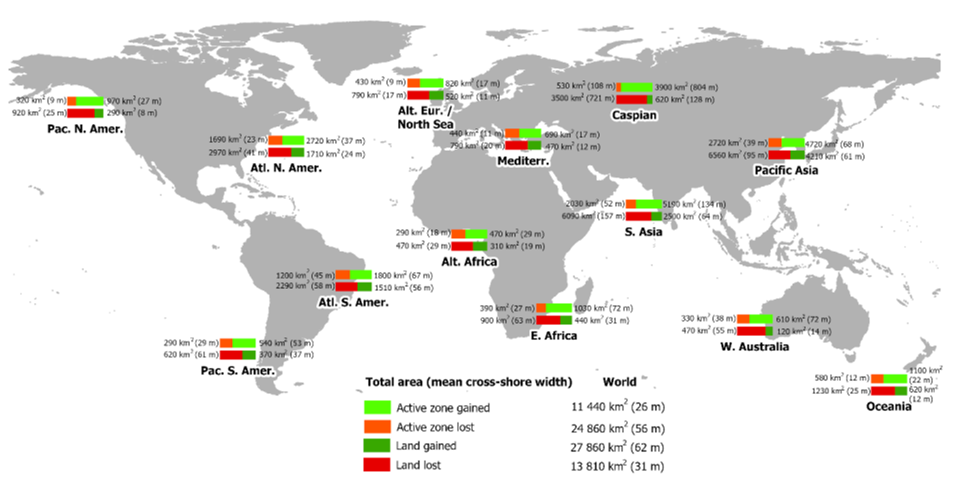
Using satellite data but different methods, Luijendijk and others (2018) assessed sandy beaches worldwide, while Mentaschi and others (2018) covered all coastal typologies (although parts of the South-West Pacific and polar regions were excluded). The aggregated results of the former identified overall erosion for Australasia and Africa and mean accretion for other continents, while the latter reported net land loss in all continents and regions (net global loss of 14,050 km2, see the figure below). Based on field data from 315 sandy beaches, Bozzeda and others (2023) indicated that 21% were intensely eroding, similar to the findings by Luijendijk and others (2018), but they diverge on the proportion of stable and accreted beaches.
Figure Mean regional losses and gains of coastal (dry) land and active (intermittently wet, including intertidal) areas and mean cross-shore width change, 1984-2015
Globally, there has been a transition from hard engineering solutions towards integrated, sustainable approaches that merge natural, technological and community-driven inputs. Combined with ecosystem- based management, these approaches are considered to enhance resilience to climate change impacts Ref 22 Ref 74. Arguably, this is one of the most crucial changes in recent years due to the effects on both short and long-term local coastal responses. Growing interest in nature-based solutions stems from a better understanding of the undesired consequences of coastal engineering on natural coastal dynamics.
3. Region-specific changes
Arctic Ocean
The Arctic has warmed faster than other regions since the mid-1960s Ref 17, almost four times faster than the global average over the period 1979-2021 Ref 55. Sea-ice cover has been declining for the past 46 years Ref 28. It is well-established that Arctic coastlines are eroding, with growing evidence suggesting acceleration. These rapid changes in the Arctic threaten settlements, infrastructure, traditional lifestyles and archaeological sites Ref 28.
Nutrient and sediment fluxes are changing due to release from melting ice, eroding permafrost and increased wave interactions with the seabed. Predicting the rates and magnitudes of change is difficult Ref 28 due to complex air-ice-sea interactions and the increased supply from river discharge due to land ice melt. Emerging research suggests positive feedback between carbon release from melting permafrost and global warming, as higher input of carbon into coastal waters reduces their potential to absorb atmospheric carbon Ref 36 Ref 41.
North Atlantic Ocean, Baltic Sea, Black Sea, Mediterranean Sea and North Sea
Erosion and sedimentation rates on the Baltic coast vary due to isostatic uplifting in the north and subsiding in the south, which contributed to accretion and erosion, respectively, at rates higher than 1 m/year over the period 2007-2017 Ref 83. Based on satellite data validated with field measurements, Castelle and others (2024) estimated that sandy European shores on the Atlantic accreted at a mean rate of 0.21 m/year over the period 1984-2021, although coasts exposed to high wave energy (such as those in northwest France and in Portugal) are prone to long-term erosion. The Mediterranean coast experiences moderate erosion rates of 0.4-1.0 m/year due to sea level rise and human activity, particularly along coasts undergoing subsidence Ref 75. Using satellite data from 1984 to 2017, Tătui and others (2019) reported that 68% of the Black Sea coast was stable, with erosion exceeding 1 m/year along 19% of the coast, mostly in Georgia, Romania, Ukraine, and low-lying areas affected by severe storms.
South Atlantic Ocean and wider Caribbean
Studies on erosion and sedimentation changes in the South Atlantic are site-specific. The region's diverse coasts face challenges from catchment changes Ref 60, limited sediment input from rivers Ref 43 and beach sand extraction Ref 46. Storms threaten infrastructure and populations across the region Ref 62 Ref 50 Ref 29.
In West Africa, research highlights natural and anthropogenic factors driving coastal changes mostly in Ghana, Nigeria and Senegal Ref 2. Delta morphology, sedimentation, fisheries and habitats are affected by changes in river discharge and sediment supply, including in the Volta and the Niger Deltas Ref 27, but limited data hinder comprehensive understanding.
Caribbean small island States face coastal erosion and sedimentation issues triggered by hurricanes and sea level rise, which reduce the natural protection offered by beaches, mangroves and reefs, as observed in The Bahamas and Jamaica Ref 54. The Caribbean Disaster Emergency Management Agency is a key player in regional risk reduction measures, including nature-based solutions Ref 58.
Indian Ocean, Arabian Sea, Bay of Bengal, Red Sea, Gulf of Aden and Persian Gulf
There is limited literature in English covering erosion and sedimentation in this diverse ocean region. Available data are mostly from local or global assessments, which limits comparative analysis. Coastal variability due to changing sediment supply from rivers has been identified in Bangladesh, India, Indonesia, Malaysia and Sri Lanka, with an increasing tendency for erosion where downstream sediment transfer is disrupted Ref 66. Ecological damage to wetlands, particularly mangroves, has been linked to coastal erosion due to disruption of sediment transfers.
Impacts from human activities on erosion and sedimentation have been reported across the Indian Ocean region. Recent large-scale activities include the Mumbai Coastal Road Project in India, involving extensive land reclamation protected by a seawall (Movik and others 2023), and the Jakarta Sea Wall in Indonesia, which is an effort to protect against the combined impacts of subsidence and climate change (Purnomo and others 2024).
North Pacific Ocean
Coastal erosion is a constant threat in the North Pacific, especially on densely populated and economically significant coastlines Ref 15 Ref 64 Ref 77 Ref 87 Ref 8. According to the "State of the Global Climate 2023" report prepared by the World Meteorological Organization, the Pacific Ocean is experiencing rates of sea level rise faster than the global average. Sea level rise can trigger or increase erosion Ref 64 Ref 77, which is already a critical problem due to artificial sediment retention in many Asian rivers Ref 3, and is exacerbated by land subsidence in some locations Ref 64. Studies have shown that tropical cyclones have intensified in recent decades Ref 32 Ref 86 likely due to climate change Ref 5 Ref 84, often linked to extreme erosion events. Projections indicate that the mean wave height in the region should decrease by the end of the century Ref 9.
Sea level changes along the North Pacific coasts are highly affected by changes in oceanic circulation Ref 12 and sea temperature Ref 52. From 1960 to 2013, extreme sea level events along the North-West Pacific coasts were 1.5 to 2 times more intense and lasted longer than the ones recorded along the Eastern Pacific Ref 20.
South Pacific Ocean
Systematic assessments of the longer South Pacific coasts have been undertaken (Dickson and others, 2021) Ref 69 Ref 4 Ref 72. However, the diverse morphology across the South Pacific islands confounds the characterization of erosion patterns Ref 42, except through aggregated assessment Ref 78. There is a strong awareness of erosion and land loss related to sea level rise in the region, particularly for low-lying atolls, such as Tuvalu Ref 25.
El Niño and La Niña have regional effects across the South Pacific (Vos and others, 2023(b)), influencing prevailing winds, storm incidence, sea levels and wave conditions Ref 72. More energetic conditions occur during El Niño phases in the eastern half of the South Pacific, and during La Niña in the western half, affecting the distribution of erosion pressures across the region (Ramsay, 2011; Vos and others, 2023b). In recent decades, La Niña phases have had greater influence, and, perhaps coincidentally, there have been exceptional storm events in the western South Pacific, including tropical cyclone Gabrielle in New Zealand in 2023 and multiple storms affecting the east coast of Australia from 2016 to 2024 Ref 70.
Southern Ocean
In the Southern Ocean, ice-cover changes show high temporal and spatial variability within an overall trend of net increase over the period 1979-2020 Ref 56, except on the Amundsen- Bellingshausen Seas (West Antarctica), despite an emerging positive trend since 2007 Ref 45. Based on sea-ice extent, the maximum length of coastal exposure in Antarctica decreased 30 km per year over the period 1979-2020 Ref 56. However, sea-ice cover reached record minima in February 2022, 2023 and 2024 Ref 59, remaining persistently low in recent years. It is too soon to know whether this is a temporary fluctuation Ref 59 or the inception of a new state in the Southern Ocean triggered by long-term global warming Ref 48 Ref 16.
4. Key remaining knowledge and capacity gaps and new gaps
The bias in research coverage and volume persists, with large gaps in the global South, where insufficient generation, transmission and use of reliable in situ data are pervasive, despite emerging or growing research in parts of South America, Africa and South-East Asia. As nature-based risk reduction approaches become increasingly popular, a deeper understanding of the applicability of and uncertainties surrounding ecosystem-based management in different geographical contexts is required Ref 23 Ref 14. Post-erosion recovery efforts often lack sufficient research, leading to vulnerability to future events Ref 21. The practice of integrating Indigenous knowledge and scientific data must be expanded to improve the understanding of site-specific socioenvironmental systems and promote cooperation among stakeholders Ref 33.
References
- Anderson, John B., and others (2022). Holocene Evolution of the Western Louisiana-Texas Coast, USA: Response to Sea-Level Rise and Climate Change. Memoir 221. Boulder: Geological Society of America.
- Ankrah, Johnson and others (2023). Shoreline Change and Coastal Erosion in West Africa: A Systematic Review of Research Progress and Policy Recommendation. Geosciences, vol. 13, No. 59, art. 13020059.
- Binh, Doan V., and others (2020). Changes to long-term discharge and sediment loads in the Vietnamese Mekong Delta caused by upstream dams. Geomorphology, vol. 353, art. 107011.
- Bishop-Taylor, Robbi, and others (2021). Mapping Australia's dynamic coastline at mean sea level using three decades of Landsat imagery. Remote Sensing of Environment, vol. 267, art. 112734.
- Bloemendaal, Nadia, and others (2022). A globally consistent local-scale assessment of future tropical cyclone risk. Science Advances, vol. 8, No. 17, art. eabm8438.
- Bozzeda, Fabio, and others (2023). Global patterns in sandy beach erosion: unraveling the roles of anthropogenic, climatic and morphodynamic factors. Frontiers of Marine Science, vol. 10, art. 1270490.
- Cabana, David, and others (2023). Enabling Climate Change Adaptation in Coastal Systems: A Systematic Literature Review. Earth's Future, vol. 11, No. 8, art. e2023EF003713.
- Cai, Feng, and others (2022). Rapid migration of mainland China's coastal erosion vulnerability due to anthropogenic changes. Journal of Environmental Management, vol. 319, art. 115632.
- Casas-Prat, Mercè and others (2024). Wind-wave climate changes and their impacts. Nature Reviews Earth & Environment, vol. 5, No. 1, pp. 23-42.
- Cassidy, Galen, and others (2024). Seasonal coastal erosion rates calculated from PlanetScope Imagery in Arctic Alaska. Remote Sensing, vol. 16, No. 13, art. 2365.
- Castelle, Bruno, and others (2024). Satellite-derived sandy shoreline trends and interannual variability along the Atlantic coast of Europe. Scientific Reports, vol. 14, art. 13002.
- Cha, Hyeonsoo, and others (2023). A process-based assessment of the sea-level rise in the northwestern Pacific marginal seas. Communications Earth & Environment, vol. 4, No. 1, art. 300.
- Dickson, Mark, and others (2022). 80 Years of Shoreline Change in Northland, New Zealand. In Proceedings of the Australasian Coasts & Ports 2021, 11-13 April 2022, Christchurch, New Zealand, Deirdre E. Hart and Tom Shand, eds. pp. 373-377.
- Doelle, Meinhard, and Tony George Puthucherril (2023). Nature-based solutions to sea level rise and other climate change impacts on oceanic and coastal environments: a law and policy perspective. Nordic Journal of Botany, vol. 2023, No. 1, e03051.
- Dong, Wan S., and others (2024). The impact of climate change on coastal erosion in Southeast Asia and the compelling need to establish robust adaptation strategies. Heliyon, vol. 10, No. 4, art. e25609.
- Eayrs, Clare, and others (2021). Rapid decline in Antarctic sea ice in recent years hints at future change. Nature Geoscience, vol. 14, pp. 460-464.
- England, Mark R., and others (2021). The recent emergence of Arctic Amplification. Geophysical Research Letters, vol. 48, art. e2021GL094086.
- Ewans, Kevin, and Philip Jonathan (2023). Uncertainties in estimating the effect of climate change on 100-year return value for significant wave height. Ocean Engineering, vol. 272, art. 113840.
- Fairchild, Tom P., and others (2021). Coastal wetlands mitigate storm flooding and associated costs in estuaries. Environmental Research Letters, vol. 16, art. 074034.
- Fan, Linlin and Ling Du (2023). Combined effects of climatic factors on extreme sea level changes in the Northwest Pacific Ocean, Ocean Dynamics, vol. 73.
- Garzon, Juan L., and others (2024). Development of a Bayesian network-based early warning system for storm-driven coastal erosion. Coastal Engineering, vol. 189, art. 104460.
- Gebrael, Karen, and others (2024). Overview of nature-based solutions for climate resilience in the MENA region. Nature-Based Solutions, vol. 6, art. 100159.
- Gracia, Adriana, and others (2018). Use of ecosystems in coastal erosion management. Ocean & Coastal Management, vol. 156, pp. 277-289.
- Gunnarson, Jaboc L., and others (2024). Drivers of future extratropical sea surface temperature variability changes in the North Pacific. npj Climate and Atmospheric Science, vol. 7, art. 164.
- Harun-al-rashid, Ahmed, and Chan-Su Yand (2023). A review on multidecadal coastal changes at Funafuti, Tuvalu from 1897 to 2015. Korean Journal of Remote Sensing, vol. 39, No.1, pp. 23-45.
- Ibaceta, Raimundo, and others (2023). Interannual variability in dominant shoreline behaviour at an embayed beach. Geomorphology, vol. 433, art. 108706.
- Ideki, Oye, and Osinachi Ajoku (2024). Scenario analysis of shorelines, coastal erosion, and land use/land cover changes and their implication for climate migration in East and West Africa. Journal of Marine Science and Engineering, vol. 12, No. 7, art. 1081.
- Irrgang, Anna M., and others (2022). Drivers, dynamics and impacts of changing Arctic coasts. Nature Reviews Earth & Environment, vol. 3, pp. 39-54.
- Isla, Federico I., and Luis C. Cortizo (2023). Coastal erosion in Argentina: The retreating rates of southern South America. Journal of South American Earth Sciences, vol. 126, art. 104342.
- Konlechner, Teresa M., and others (2020). Mapping spatial variability in shoreline change hotspots from satellite data; a case study in southeast Australia. Estuarine, Coastal and Shelf Science, vol. 246, art. 107018.
- Konstantinou, Aikaterini, and others (2023). Satellite-based shoreline detection along high-energy macrotidal coasts and influence of beach state. Marine Geology, vol. 462, art. 107082.
- Li, and others (2023). Recent increase in the potential threat of western North Pacific tropical cyclones. npj Clim Atmos Sci 6, 53. https://doi.org/10.1038/s41612-023-00379-2.
- Loch, Theresa K., and Maraja Riechers (2021). Integrating indigenous and local knowledge in management and research on coastal ecosystems in the Global South: A literature review. Ocean & Coastal Management, vol. 212, art. 105821.
- López-Olmedilla, Laura, and others (2022). Effect of alongshore sediment supply gradients on projected shoreline position under sea-level rise (northwestern Portuguese coast). Estuarine, Coastal and Shelf Science, vol. 271, art. 107876.
- Luijendijk, Arjen, and others (2018). The state of the world's beaches. Scientific Reports, vol. 8, art. 6641.
- Manizza, Manfredi (2024). Climate feedbacks from coastal erosion, Nature Climate Change, vol. 14, pp. 899-900.
- Mao, Yongjing, and others (2021). Efficient measurement of large-scale decadal shoreline change with increased accuracy in tide-dominated coastal environments with Google Earth Engine. ISPRS Journal of Photogrammetry and Remote Sensing, vol. 181, pp. 385-399.
- Mentaschi, Lorenzo, and others (2018). Global long-term observations of coastal erosion and accretion. Scientific Reports, vol. 8, art. 12876.
- Movik, Synne, and others (2023). Claiming space: Contested coastal commons in Mumbai. Geoforum, vol. 144, art. 103805.
- Narita, Y., Honda, K., Okamoto, K., Doukai, F. (2024). The Impacts of Future Climate Change on Storm Surges and Wave Heights in Three Major Bays of Japan. In Proceedings of the 34th International Ocean and Polar Engineering Conference, 16-21 June 2024, Rhodes, Greece, p. 2864.
- Nielsen, David M., and others (2022). Increase in Arctic coastal erosion and its sensitivity to warming in the twenty-first century. Nature Climate Change, vol. 12, pp. 263-270.
- Nunn, Patrick D., and others (2020). Islands in the Pacific: settings, distribution and classification. In Climate Change and Impacts in the Pacific, pp. 33-170, Lalit Kumar, ed. Springer.
- Oliveira, Emiliano C., and others (2023). Erosion of four Brazilian coastal deltas: how dam construction is changing the natural pattern of coastal sedimentary systems. Anais da Academia Brasileira de Ciências, vol. 95, No. 1, art. e20220576.
- Pang, Tianze, and others (2023). Coastal erosion and climate change: A review on coastal-change process and modelling, Ambio, 52, pp. 2034-2052.
- Parkinson, Claire L. (2019). A 40-y record reveals gradual Antarctic sea ice increases followed by decreases at rates far exceeding the rates seen in the Arctic. PNAS, vol. 116, No. 29, pp. 14414-14423.
- Pilkey, Orrin H., and others (2022). Vanishing Sands: Losing Beaches to Mining. Durham, London: Duke University Press.
- Pouye, Ibrahima, and others (2024). Evaluation of the Economic Impact of Coastal Erosion in Dakar Region. Journal of Coastal Research, vol. 40, No. 1, pp. 193-209.
- Purich, Ariaan, and Edward W. Doddridge (2023). Record low Antarctic sea ice coverage indicates a new sea ice state. Communications Earth & Environment, vol. 4, art. 314.
- Purnomo, Agus H., and others (2024). Revisiting the climate change adaptation strategy of Jakarta's coastal communities. Ocean & Coastal Management, vol. 253, art. 107112.
- Queiroz, Heithor A.A., and others (2022). Characterising global satellite-based indicators for coastal vulnerability to erosion management as exemplified by a regional level analysis from Northeast Brazil. Science of The Total Environment, vol. 817, art. 152849.
- Ramsay, Doug (2011). Coastal erosion and inundation due to climate change in the Pacific and East Timor. NIWA Technical Report HAM2011-097.
- Ran, Junlin, and others (2023). Quantifying the contribution of temperature, salinity, and climate change to sea level rise in the Pacific Ocean: 2005-2019. Frontiers in Marine Science, vol. 10, art. 1200883.
- Ranasinghe, Roshanka, and others (2023). Assessing coastline recession for adaptation planning: sea level rise versus storm erosion. Scientific Reports, vol. 13, No. 1, art. 8286.
- Rangel-Buitrago, Nelson, and others (2018). Hard protection structures as a principal coastal erosion management strategy along the Caribbean coast of Colombia. A chronicle of pitfalls. Ocean & Coastal Management, vol. 156, pp. 58-75.
- Rantanen, Mika, and others (2022). The Arctic has warmed nearly four times faster than the globe since 1979. Communications Earth & Environment, vol. 3, art. 168.
- Reid, Paul. A., and Massom, R.A. (2022). Change and variability in Antarctic coastal exposure, 1979- 2020. Nature Communications, vol. 13, art. 1164.
- Reyna, Julián, and others (2016). Chapter 26: Land-Sea Physical Interaction. In The First World Ocean Assessment, Part V. New York, United Nations.
- Rhiney, Kevon, and Baptiste, April K. (2019) Adapting to Climate Change in the Caribbean: Existential Threat or Development Crossroads? Caribbean Studies, vol. 47, No. 2, pp. 59-80.
- Riordon, James (2024). Antarctic sea ice near historic lows: Arctic ice continues decline. NASA. https://phys.org/news/2024-03-antarctic-sea-ice-historic-lows.html.
- Riquetti, Nelva B., and others (2022). Assessment of the soil-erosion-sediment for sustainable development of South America. Journal of Environmental Management, vol. 321, art. 115933.
- Saengsupavanich, Cherdvong, and others (2024). A systematic review of jetty-induced downdrift coastal erosion management. Regional Studies in Marine Science, vol. 74, No. 4, art. 103523.
- Serafim, Mirela B., and others (2019). Coastal vulnerability to wave impacts using a multi-criteria index: Santa Catarina (Brazil). Journal of Environmental Management, vol. 230, pp. 21-32.
- Simões, Rodrigo S., and others (2022). Coastline dynamics in the extreme south of Brazil and their socio- environmental impacts. Ocean & Coastal Management, vol. 230, art. 106373.
- Siringan, and others (2024). Sea Level Rise and Coastal Erosion in the Philippines: Impacts and Adaptation Strategies for Coastal Communities. In Climate Emergency in the Philippines, Kristoffer B. Berse, and others, eds. Singapore, Springer.
- Solihuddin, Tubagus, and others (2024). The impact of coastal erosion on land cover changes in Muaragembong, Bekasi, Indonesia: a spatial approach to support coastal conservation. Journal of Coastal Conservation, vol. 28, No. 2, art. 43.
- Syvitski, Jaia, and others (2022). Earth's sediment cycle during the Anthropocene. Nature Reviews Earth & Environment, vol. 3, pp. 179-196.
- Tătui, Florin, and others (2019). The Black Sea coastline erosion: Index-based sensitivity assessment and management-related issues. Ocean and Coastal Management, vol. 182, art. 104949.
- Thepsiriamnuay, Hiripong, and Nathsuda Pumijumnong (2024). Sandy beach erosion: impacts and adaptation strategies in Thailand. Environment, Development and Sustainability, 1-24.
- Thom, Bruce G., and others (2018). National sediment compartment framework for Australian coastal management. Ocean & Coastal Management, vol. 154, pp. 103-120.
- Turner, Ian L., and others (2024). A framework for national-scale coastal storm hazards early warning. Coastal Engineering, vol. 192, No.11, art. 104571.
- Uddin, Mohammad M., and others (2022). Ecological development of mangrove plantations in the Bangladesh Delta. Forest Ecology and Management, vol. 517, art. 120269.
- Vallarino-Castillo, Ruby, and others (2024). A Systematic Review of Oceanic-Atmospheric Variations and Coastal Erosion in Continental Latin America: Historical Trends, Future Projections, and Management Challenges. Journal of Marine Science and Engineering, vol. 12, No. 7, art. 1077.
- Van der Meulen, Frank, and others (2023). Nature-based solutions for coastal adaptation management, concepts and scope, an overview. Nordic Journal of Botany, vol. 2023, No. 1, art. e03290.
- Van Westen, Bart, and others (2024). Predicting marine and aeolian contributions to the Sand Engine's evolution using coupled modelling. Coastal Engineering, vol. 188, art. 104444.
- Vecchio, Antonio, and others (2024). Sea level rise projections up to 2150 in the northern Mediterranean coasts. Environmental Research Letters, vol. 19, art. 014050.
- Villarroel-Lamb, Deborah (2020). Quantitative risk assessment of coastal erosion in the Caribbean region. Natural Hazards Review, vol. 21, No. 3, art. 04020021.
- Vitousek, Sean, and others (2023). A model integrating satellite-derived shoreline observations for predicting fine-scale shoreline response to waves and sea-level rise across large coastal regions. Journal of Geophysical Research: Earth Surface, vol. 128, No. 7, art. e2022JF006936.
- Vos, Kilian, and others (2023a). Benchmarking satellite-derived shoreline mapping algorithms. Communications Earth & Environment, vol. 4, art. 345.
- Vos, Kilian, and others (2023b). Pacific shoreline erosion and accretion patterns controlled by El Niño/Southern Oscillation. Nature Geoscience, vol. 16, No. 2, pp. 140-146.
- Vu, Ca Thanh, and others (2021). Chapter 13: Changes in erosion and sedimentation. In The Second World Ocean Assessment, vol. II, pp. 185-200. New York, United Nations.
- Wang, Yu-Hai, and others (2022). Emerging downdrift erosion by twin long-range jetties on an open mesotidal muddy coast, China. Journal of Marine Science and Engineering, vol. 10, No. 5, art. 570.
- Warrick, Jonathan A., and others (2024). Coastal shoreline change assessments at global scales. Nature Communications, vol. 15, art. 2316.
- Weisse, Ralf, and others (2021). Sea level dynamics and coastal erosion in the Baltic Sea region. Earth System Dynamics, vol. 12, No. 3, pp. 871-898.
- Wood, Melissa, and others (2023). Climate-induced storminess forces major increases in future storm surge hazard in the South China Sea region, Natural Hazards and Earth System Sciences, vol. 23, No. 7, pp. 2475-2504.
- Yoon, H.H., Lee, J.Y., Kim, J.C., Jun, C.P., Choi, H.W. (2023). Incised-valley filling sedimentation in a small river valley of a wave-dominated, embayed coast in response to Holocene sea level rise, Yeongil Bay, Southeastern Korea. Marine Geology, 464, 107127.
- Xu, Jing, and others (2024). Increasing tropical cyclone intensity in the western North Pacific partly driven by warming Tibetan Plateau. Nature Communications, vol. 15, art. 310.
- Yum, Sang-Guk and others (2023). A quantitative analysis of multi-decadal shoreline changes along the East Coast of South Korea. Science of The Total Environment, vol. 876, art. 162756.