
Ridges, plateaus and trenches
Writing team: Ana Colaço (coordinating author), Angelika Brandt, Malcolm R. Clark, Ana Hilário, Baban Shravan Ingole, Anna Metaxas, Yutaka Michida (co-lead member), Jose Angel Alvarez Perez, Roberto de Pinho (lead member), Imants George Priede and Hiromi Kayama Watanabe.
Key points
- Greatest advances have been in studies of hadal trench systems facilitated by newly available technologies.
- Progress on exploration of ridge systems has slowed and immense gaps remain despite new discoveries in the Indian Ocean.
- Most plateaus are important fishery areas and are studied in that context.
- Changes owing to human pressures have been observed, leading to protection measures for bottom habitats (applied or are under discussion).
1. Introduction and context
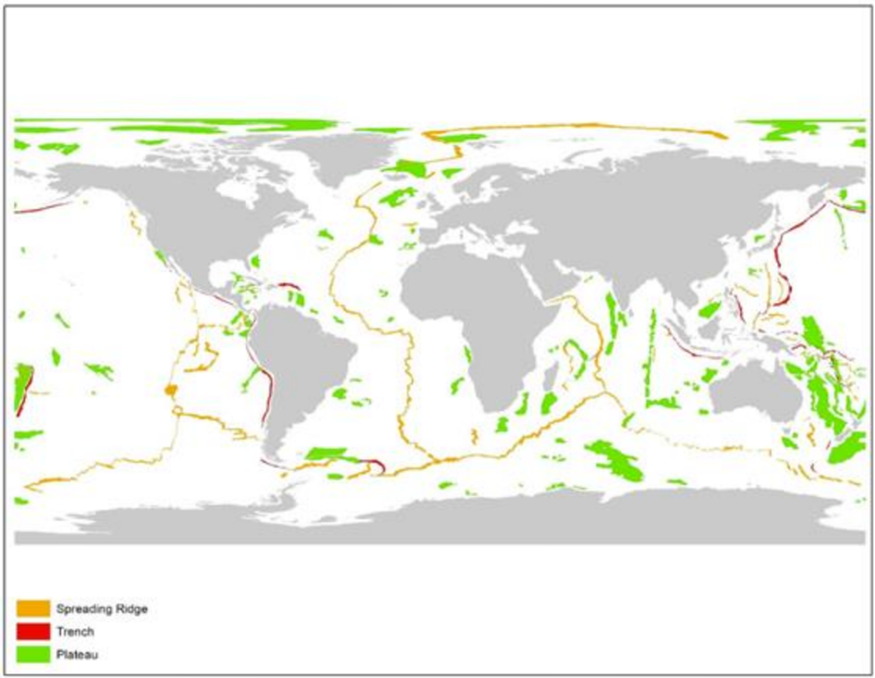
Ridges, plateaus and hadal trenches are distinctive offshore habitats, identified in the first World Ocean Assessment (2017) as potentially threatened by human disturbances such as fisheries, pollution and mining. In the second World Ocean Assessment (2021) it was reported that despite this vulnerability and added climate change pressures, they remained poorly known. The present subchapter assesses the extensive slopes of mid-ocean spreading ridges that divide ocean basins (see figure I); ; hadal trenches at depths greater than 6000 m (see figure I); plateaus, either continent-derived fragments or other origins (see figure I); seamounts and ridge-associated hydrothermal vents Ref 6 are considered in sect. 4, subchaps. 5L and 5P, respectively)
Figure I
World map, hadal trenches in red; mid ocean spreading ridges in orange and plateaus in green
2. Description of environmental changes between 2020 and 2024
New knowledge acquired since 2020 and how it can be used to evaluate changes
Ridges
The bathyal (200 to 3,000 m depth) slopes of the mid-ocean ridge system, dominated by soft sediments interspersed with rocky outcrops at summits and fracture zones remain poorly surveyed. The Mid-Atlantic Ridge provides about half the living space for bathyal species in the North Atlantic. North of the Azores, surface productivity is high, supporting diverse demersal fish Ref 61 and benthic invertebrates Ref 3 with overlying waters exploited by migratory seabirds Ref 21. Predicted seafloor biomass is lower between the Azores and the Equator and the benthic fauna is almost unknown even in proposed deep-sea mining contract areas (26- 32ºN), Ref 64.
The Arctic Mid-Ocean Ridge hosts many geological features and habitat types. Although some research was done on impacts of fishing (e.g. Morrison and others, 2020), biodiversity (e.g. Ramirez-Llodra and others, 2020), mineral resources (e.g. Juliani and Ellefmo, 2018) and bioprospecting (e.g. Royseth and others, 2023), additional studies are needed on the "typical" soft sedimentary slopes Ref 66. On the Central Indian Ridge and the Southwest Indian Ridge, new species or range extensions for polychaetes, corals sponges and crustaceans were discovered Ref 54 Ref 55 Ref 56 Ref 57 Ref 58 Ref 59. The Southeast Indian Ridge remains one of the least studied regions on the Indian Ocean.
No new information was published on the Pacific Oceanic Ridges.
The mid-ocean ridge system extends over 65,000 km around the globe but only in small areas around islands, sea-mount summits and sites of special interest such as hydrothermal vents is anything known about species, abundance, biomass and ecosystems. The Mid-Atlantic Ridge between Iceland and the Azores has been explored (Priede and others, 2022), but this represents only 5% of the global ridge system; the South Atlantic and other ocean ridges remain largely unknown.
Hadal trenches
Globally, all major hadal trenches have been surveyed with new technologies revealing a rich diversity of habitats Ref 78 Ref 29. Abyssal taxa have extended into hadal depths Ref 29 and new trench-endemic species and ecological relationships revealed Ref 41 Ref 40 Ref 68 Ref 52 with a rich hadal microbial flora including viruses Ref 81, bacteria Ref 67 and fungi Ref 51 that contribute to biochemical processes.
In the Indian Ocean, various habitats were observed, including soft and hard substrates in Sunda Trench Ref 29. In the South Pacific, the Kermadec Trench was revisited in 2022 Ref 50 revealing, habitats driven by flow and substrate characteristics. Across the Pacific Trenches, seafloor biological oxygen consumption varies greatly but is always greater than on adjacent abyssal plains, reflecting increased fertilization from the rain of particles funnelled into the trenches Ref 68.
Human impacts include accumulation of pollutants such as plastics Ref 1, mercury Ref 70, halogenated organics Ref 20 and black carbon Ref 79. Trench habitats are vulnerable to disturbances with estimated recovery times of over 100 years Ref 29. Renewed proposals for permanent sequestration of captured liquid CO2 into hadal trenches, that would eliminate all resident biota are a matter for concern Ref 24 Ref 42.
Plateaus
The two largest plateaus in the North Atlantic Ref 26 are the Hatton-Rockall and Azores plateaus, both highly biodiverse and important fishery areas. The Azores plateau has interconnected assemblages of cold-water corals that differ according to the temperature and properties of surrounding waters and regional productivity Ref 76. It is a hotspot for large migratory marine mammals, turtles, sharks and tunas Ref 2, but knowledge gaps remain Ref 77.
In the Southeast Atlantic, mapping of vulnerable marine ecosystems of the Walvis Ridge/plateau Ref 12 Ref 8 shows patchy cold-water coral communities among relict coral rubble on flat-topped seamounts. In the Southwest Atlantic, exploration of the summit of the Rio Grande Rise Ref 39 indicated distinctive communities of corals and sponges associated with ferromanganese cobalt crusts, depth and slope Ref 18 Ref 55, along with hexactinellid "sponge gardens" of Sarostegia oculata, Ref 25.
The São Paulo Plateau extends southeast from the Brazilian Continental Margin (2000 to 4500 m depths) encompassing over 80% of Brazilian oil and gas production Ref 53. In the north, asphalt seeps harbour mainly hexactinellid sponges and typical deep-sea isidid octocorals, brisingid starfishes and galatheid crabs Ref 23. Along the escarpment to the south, Perez and others (2020b) described benthic habitats and communities at 4,219 to 2,644 m depths associated with topography and deep-water mass distribution.
High productivity over the plateau surrounding the Falkland Islands (Malvinas)1 is driven by an influx of sub-Antarctic waters. Deep benthic biomass is dominated by Stylasteridae (lace corals), sponges, Pennatulacea (sea pens) and cup corals Ref 48.
In the southern Indian Ocean, the Kerguelen Plateau (45-65°S) traverses the Polar Front (e.g. Bestley and others, 2020), resulting in major differences in phytoplankton, zooplankton and mesopelagic fish productivity Ref 43 with different trophic dynamics between the western and eastern parts of the Plateau Ref 27 Ref 17
In the western Indian Ocean, the Mascarene Plateau supports the largest seagrass beds in the world that, along with rhodolith beds, provide key shallow-water biogenic habitats for various taxa, including new species. Dominant mega-epifauna taxa were cnidarians, fish, echinoids and shrimps/prawns (Bhagooli, 2021).
Around New Zealand, benthic species distributions of the Chatham Rise and Campbell plateau have been studied in support of habitat suitability modelling to enhance effectiveness in data-poor areas (Stephenson and others, 2021),
Unique faunal assemblages have been found on Arctic Ocean plateaus that are vulnerable to both fisheries and global warming Ref 33. In the Pacific-Arctic region, epifaunal communities of the Chukchi plateau are proposed as long-term observatories of responses to climate changes Ref 82
3. Description of economic and social changes between 2020 and 2024 and the relevant governance
Fisheries (subsect. 5A, subchap. 1A)
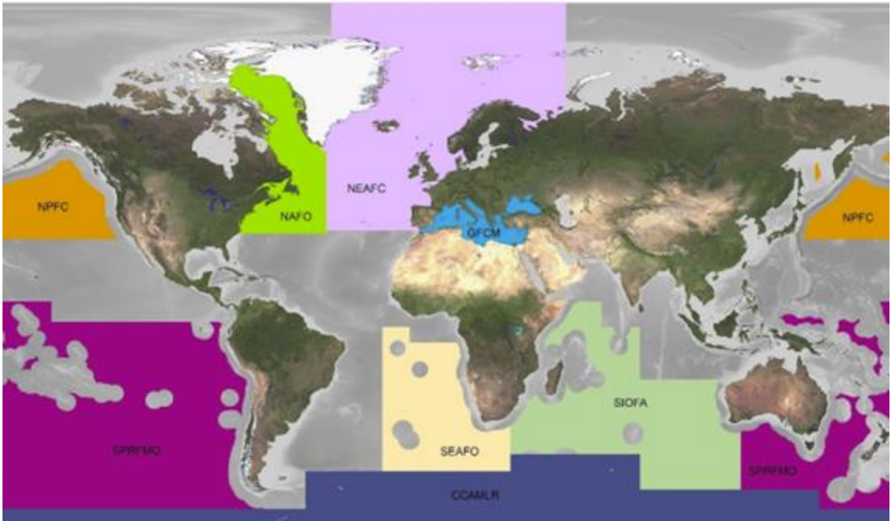
Deep-sea fisheries extend across slopes, seamounts, ridges and plateaus in all the world's oceans. United Nations resolutions require States to safeguard these environments either through national measures or through regional fisheries management organizations (RFMOs) Ref 35 (see figure II). Fisheries stocks and vulnerable marine ecosystems are increasingly being protected by multiple regulations and spatial protection measures, including closed areas.
Figure II Map of regional fisheries management organizations
In the North Atlantic, Hatton-Rockall plateau extends across exclusive economic zones (EEZ) and areas beyond national jurisdiction and presents spatial management challenges in the face of international bottom trawling fleets Ref 32 whereas the Azores plateau is mainly exploited by locally based vessels managed by national measures Ref 45. In the southwest Pacific, bottom trawl fisheries on the Challenger Plateau are managed by New Zealand within the EEZ and by the South Pacific Regional Fisheries Management Organization in the area beyond national jurisdiction further offshore. Fisheries for hoki, ling and blue whiting on the Campbell Plateau are within the EEZ (Fisheries New Zealand, 2024).
Major trawl and bottom-set longline fisheries for Patagonian toothfish and mackerel icefish occur on some southern plateaus of the Indian Ocean, especially the Kerguelen Plateau. This has been the focus of extensive food web modelling (Subramaniam and others, 2020, 2021, Hindell and others, 2022, McCormack and others, 2021).
Globally, ridge and plateau habitats are affected by marine litter largely originating from lost fishing gear Ref 15 Ref 22.
Mining (subsect. 5A, chap. 7)
Deep-sea mining on ridges and plateaus remains in the exploration phase under contracts issued by the International Seabed Authority (ISA) that proposes regional environmental management plans for mining areas. Ref 11. Please refer also to part 4 (Region-specific changes) below, and to subsection 5A, chapter 7 on mineral resources.
Climate change
The deep ocean is warming more slowly than surface waters, but analysis of shifts in expected species' range (climate velocity), indicates that deep-ocean biodiversity is highly sensitive to projected climate changes (Brito Morales and others, 2020). Direct evidence has been recorded in the South Pacific Ocean off New Zealand where warming over the Chatham Rise is five times faster than the global rate with implications for local sustainability of fish stocks Ref 36.
4. Region-specific changes
Since 2020, several regions across the world's oceans have experienced significant environmental and human pressures, including fisheries, mineral resource exploration, climate change and pollution. In the Arctic Ocean, for example, the Chukchi Borderland plateau has been impacted by both fisheries and climate change. Protection measures such as the Agreement to Prevent Unregulated High Seas Fisheries in the Central Arctic Ocean, effective since June 2021, and Norwegian regulations in the Yermak Plateau, have been put in place. Similarly, in the North Atlantic Ocean, areas like the Hatton-Rockall Bank and Azores Plateau have faced fisheries pressure, with the closure of multiple regions to bottom fishing gears and the development of draft regional environmental management plans for the area. These protective actions aim to mitigate the effects of human activity, while pollution remains a significant concern.
In the South Atlantic and Indian Oceans, fisheries, mineral exploration and pollution continue to affect marine ecosystems. The South Atlantic, with regions like the Rio Grande Rise and Walvis Ridge, has seen significant protective measures, including fully protected MPAs such as Ascension Island and Tristan da Cunha, and various fishing closures across important areas like the Southern Mid-Atlantic Ridge. Brazil has also terminated cobalt crust exploration contracts in the Rio Grande Rise, claiming it as part of its extended EEZ. The Indian Ocean has seen similar pressures, with areas like the Sunda Trench and Amirante to Fortuna Banks being fully protected. Fishing closures have been enforced in regions like the Atlantis Bank and Walter's Shoal, while developments like the Central Indian Basin regional environmental management plan are being implemented to safeguard these fragile ecosystems.
In the Pacific and Southern Oceans, the situation mirrors that of the other regions, with key areas facing both human-induced and natural challenges. The North Pacific, for instance, has seen the development of a draft regional environmental management plan for the Northwest Pacific, and the establishment of protected areas such as the Hawaiian Papahanaumokuākea National Monument. Meanwhile, in the South Pacific, countries like New Zealand and Australia have implemented strict protections, such as prohibiting bottom trawling along the Kermadec Ridge and creating networks of MPAs. In the Southern Ocean, the Ross Sea and South Orkney Islands are subject to comprehensive protection, with commercial fishing prohibited in specific areas. These ongoing efforts across diverse oceans emphasize the importance of international collaboration and proactive conservation strategies to address the growing pressures on marine ecosystems.
5. Key advances in knowledge and understanding
New knowledge based on advances in technology: exploration, artificial intelligence tools and the resulting implications
Knowledge of hadal trenches is being revolutionized by the advent of human occupied vehicles capable of repeated dives to maximum ocean depth (11 km) (e.g. the United States' Deep Submergence Vehicle Limiting Factor and the Chinese Human Occupied Vehicle Fendouzhe) (Zhou and Peng, 2023). Together with autonomous landers, these have enabled global sampling programmes, the Five Deeps Expedition Ref 30 and the Global Trench Exploration and Diving Programme to all the major trenches with detailed mapping, discovery of new species and studies of biogeological processes.
Increasing use of sea-floor imagery enabled by advances in digital camera technology is providing non- destructive means of surveying the sea floor Ref 7. Beyond the area surveyed by cameras, habitat suitability modelling can extrapolate the predicted distribution of faunal communities to data-poor areas. Off New Zealand, for example, habitat suitability maps for deep-sea corals have been developed based on seafloor imagery Ref 4 and modelled coral densities were used to identify areas for conservation efforts. The South Pacific Regional Fisheries Management Organization has used zonation decision-support software to help define management areas that can protect predicted vulnerable marine ecosystems habitat while permitting deep-sea commercial fishing. This analysis identified priority areas for conservation where the impact on fisheries is small Ref 5 within the Lord Howe Rise, South Tasman Rise, Challenger Plateau and West Norfolk Ridge. Mapping at an unprecedented scale, coupled with rapidly evolving artificial intelligence is rapidly increasing habitat suitability modelling capability. Deep learning, specifically, can both accelerate and standardize the interpretation of biological imagery data Ref 16.
6. Key remaining knowledge and capacity gaps and new gaps
Despite progress since the publication of the first World Ocean Assessment, gaps remain and research on ridges continues to be focussed on chemosynthetic environments, seamounts and deep-sea mining, neglecting the wider ridge environment so that most of the global ridge system remains poorly known, in particular in the Arctic which is inaccessible for most of the year. Plateaus in active fishing areas are well surveyed, but no new research has been done on plateaus in the Arctic. Deep-sea ecosystems include slow-growing, long-lived and late reproducing species, making them particularly vulnerable to anthropogenic impacts yet individual and cumulative effects remain poorly known.
Management of ridges, plateaus and trenches in areas beyond national jurisdiction exists for fisheries and mining under RFMOs and the International Seabed Authority (ISA). The new Agreement under the United Nations Convention on the Law of the Sea on the Conservation and Sustainable Use of Marine Biological Diversity of Areas beyond National Jurisdiction may provide additional biodiversity protection and potential solutions for conflicts.
Sampling the deep-sea requires access to large ships and advanced technologies available only in a few institutions in a few nations. This creates a lack of equitability in access and the problem of parachute, colonial or parasitic science whereby highly resourced agencies extract samples and data from poorer regions with no reference to local populations or their expertise Ref 75 which needs to be addressed urgently. Collaborative networks developing low-cost deep-sea imaging systems that can be used from small indigenous fishing vessels may overcome some of these problems (Bell and others, 2022)
Human pressures on these high-seas ecosystems continue. Calls for capacity-development and knowledge transfer get louder (including in international agreements such as the Kunming-Montreal Global Biodiversity Framework and the Agreement on Marine Biological Diversity of Areas beyond National Jurisdiction) but their targets are still far from being achieved.
References
- Abel, S.M., Primpke, S., Int-Veen, I., Brandt, A., and Gerdts, G. (2021) Systematic identification of microplastics in abyssal and hadal sediments of the Kuril Kamchatka trench. Environmental Pollution, 269, 116095.
- Afonso, P., Fontes, J., Giacomello, E., Magalhães, M.C., Martins, H.R., Morato, T., and Vandeperre, F. (2020). The Azores: a mid-Atlantic hotspot for marine megafauna research and conservation. Frontiers in Marine Science, 6, 826.
- Alt, C.H.S., Kremenetskaia (Rogacheva), A., Gebruk, A.V., Gooday, A.J., Jones, D.O.B. (2019). Bathyal benthic megafauna from the Mid-Atlantic Ridge in the region of the Charlie-Gibbs fracture zone based on remotely operated vehicle observations. Deep Sea Research Part I: Oceanographic Research Papers, 145: 1-12. https://doi.org/10.1016/j.dsr.2018.12.006
- Anderson, O.F., Schnabel, K.E., Bowden, D., Davey, N., Hart, A. (2023). Identification of protected coral hotspots using species distribution modelling. NIWA, Wellington, New Zealand. https://dxcprod.doc.govt.nz/our-work/conservation-services-programme/csp-reports/202223-csp- reports/identification-of-protected-coral-hotspots-using-species-distribution-modelling/.2
- Australia-New Zealand (2023). Cumulative bottom fishery impact assessment for Australian and New Zealand bottom fisheries. SPRFMO Scientific Committee document SC11-DW01_rev1. 222p.
- Beaulieu, S.E., Baker, E.T., German, C.R. and Maffei, A. (2013). An authoritative global database for active submarine hydrothermal vent fields. Geochemistry, Geophysics, Geosystems, 14(11), pp. 4892- 4905.
- Bell, K.L.C., Chow, J.S., Hope, A., Quinzin, M.C., Cantner, K.A., Amon, D.J., Cramp, J.E., Rotjan, R.D., Kamalu, L., de Vos, A., Talma, S., Buglass, S., Wade, V., Filander, Z., Noyes, K., Lynch, M., Knight, A., Lourenço, N., Girguis, P.R., de Sousa, J.B., Blake, C., Kennedy, B.R.C., Noyes, T.J., and McClain, C.R. (2022). Low-Cost, Deep-Sea Imaging and Analysis Tools for Deep-Sea Exploration: A Collaborative Design Study. Front. Mar. Sci.,z 9:873700. https://doi.org/10.3389/fmars.2022.873700.
- Bergstad, O.A., Gil, M., Hoines, A.S., Serralde, R., Maletzky, E., Mostarda, E., Singh, L., Antonio, M.A., Ramil, F., Clerkin, P., Campanis, G., (2019a). Megabenthos and benthopelagic fishes on Southeast Atlantic seamounts. Afr. J. Mar. Sci., 41, 29-50. https://doi.org/10.2989/1814232X.2019.1571439.
- Bergstad, O.A., Hoines, A.S., Serralde, R., Campanis, G., Gil, M., Ramil, F., Maletzky, E., Mostarda, E., Singh, L., Antonio, M.A. (2019b). Bathymetry, substrate and fishing areas of Southeast Atlantic high- seas seamounts. Afr. J. Mar. Sci., 41, 11-28. https://doi.org/10.2989/1814232X.2019.1569160.
- Bestley, S., van Wijk, E., Rosenberg, M., Eriksen, R., Corney, S., Tattersall, K., and others (2020). Ocean circulation and frontal structure near the southern Kerguelen Plateau: The physical context for the Kerguelen Axis ecosystem study. Deep Sea Res. Part II: Topical Stud. Oceanography, 174. doi: 10.1016/j.dsr2.2018.07.013.
- Blanchard, C., Harrould-Kolieb, E., Jones, E., Taylor, M.L. (2023). The current status of deep-sea mining governance at the International Seabed Authority. Marine Policy, 147: 105396.
- Bridges, A.H., Howell, K.L., Amaro, T., Atkinson, L., Barnes, D.K., and others (2023). Review of the Central and South Atlantic Shelf and Deep Sea Benthos: Science, Policy, and Management. Oceanography and Marine Biology: An Annual Review, 61, 127-218. DOI: 10.1201/9781003363873-5.
- CCAMLR (2023). Schedule of Conservation Measures in Force 2023/24. Commission for the Conservation of Antarctic Marine Living Resources, Hobart, Tasmania, Australia. https://www.ccamlr.org/en/document/conservation-and-management/schedule-conservation-measures- force-2023/24. Accessed on 18 October 2024.
- Canals, M., Pham, C.K., Bergmann, M., Gutow, L., Hanke, G., Van Sebille, E., Angiolillo, M., Buhl- Mortensen, L., Cau, A., Ioakeimidis, C., and Kammann, U. (2021). The quest for seafloor macrolitter: a critical review of background knowledge, current methods and future prospects. Environmental Research Letters, 16(2), p. 023001
- Clark, H.P., Smith, A.G., Mckay, F.D., Larsson, A.I., Jaspars, M., and De Clippele L.H. (2024). New interactive machine learning tool for marine image analysis. R. Soc. Open Sci.11231678. http://doi.org/10.1098/rsos.231678.
- Constable, A.J., and Swadling, K.M. (2020). Ecosystem drivers of food webs on the Kerguelen Axis of the Southern Ocean. Deep Sea Research Part II: Topical Studies in Oceanography, 174, 104790.
- Corrêa, P.V.F., Jovane, L., Murton, B.J, Sumida, P.Y.G. (2022). Benthic megafauna habitats, community structure and environmental drivers at Rio Grande Rise (SW Atlantic). Deep-Sea Research Part I, 186, 103811.
- Cotté, C., Ariza, A., Berne, A., Habasque, J., Lebourges-Dhaussy, A., Roudaut, G., and Cherel, Y. (2022). Macrozooplankton and micronekton diversity and associated carbon vertical patterns and fluxes under distinct productive conditions around the Kerguelen Islands. Journal of Marine Systems, 226, 103650.
- Cui, J., Yu, Z., Mi, M., He, L, Sha, Z., Yao, P., Fang, J., and Sun, W.(2020). Occurrence of Halogenated Organic Pollutants in Hadal Trenches of the Western Pacific Ocean. Environmental Science & Technology, 54 (24), 15821-15828. DOI: 10.1021/acs.est.0c04995.
- Davies, T.E., Carneiro, A.P.B., Tarzia, M. and others (2021). Multispecies tracking reveals a major seabird hotspot in the North Atlantic. Conservation Letters, 14:e12824. https://doi.org/10.1111/conl.12824.
- Duncan, E.M., Vieira, N., González-Irusta, J.M., Dominguez-Carrió, C., Morato, T., Carreiro-Silva, M., Jakobsen, J., Jakobsen, K., Porteiro, F., Schläpfer, N. and Herrera, L. (2023). Predicting the distribution and abundance of abandoned, lost or discarded fishing gear (ALDFG) in the deep sea of the Azores (North Atlantic). Science of the Total Environment, 900, p. 166579.
- Fujikura, K., Yamanaka, T., Sumida, P.Y., Bernardino, A.F., Pereira, O.S., Kanehara, T., Nagano, Y., Nakayama, C.R., Nobrega II, M., Pellizari, V.H., and Shigeno, S. (2017). Discovery of asphalt seeps in the deep Southwest Atlantic off Brazil. Deep Sea Research Part II: Topical Studies in Oceanography, 146, doi:10.1016/j. dsr2.2017.04.002.
- Goldthorpe, S. (2017). Potential for Very Deep Ocean Storage of CO2 Without Ocean Acidification: A Discussion Paper. Energy Procedia, 114: 5417-5429, https://doi.org/10.1016/j.egypro.2017.03.1686.
- Hajdu, E., Castello-Branco, C., Lopes, D.A., Sumida, P.Y.G., Perez, J.A.A., (2017). Deep-sea dives reveal an unexpected hexactinellid sponge garden on the Rio Grande Rise (SW Atlantic). A mimicking habitat? Deep Sea Res. Part II Top. Stud. Oceanogr., 146, 93-100. https://doi.org/10.1016/j.dsr2.2017.11.009.
- Harris, P.T., Macmillan-Lawler, M., Rupp, J., and Baker, E.K. (2014). Geomorphology of the oceans. Marine Geology, 352:4-24. http://dx.doi.org/10.1016/j.margeo.2014.01.011.
- Hunt, B.P.V., and Swadling, K.M. (2021). Macrozooplankton and micronekton community structure and diel vertical migration in the Heard Island Region, Central Kerguelen Plateau. Journal of Marine Systems, 221, 103575.
- Hunt, B.P., Espinasse, B., Pakhomov, E.A., Cherel, Y., Cotté, C., Delegrange, A., and Henschke, N. (2021). Pelagic food web structure in high nutrient low chlorophyll (HNLC) and naturally iron fertilized waters in the Kerguelen Islands region, Southern Ocean. Journal of Marine Systems, 224, 103625.
- Jamieson, A.J., and Vecchione, M. (2022). Hadal cephalopods: first squid observation (Oegopsida, Magnapinnidae, Magnapinna sp.) and new records of finned octopods (Cirrata) at depths > 6000 m in the Philippine Trench. Marine Biology, 169, 1, 11.
- Jamieson, A.J. (2020). The Five Deeps Expedition and an Update of Full Ocean Depth Exploration and Explorers. Marine Technology Society Journal, 54(1): 6-12. https://doi.org/10.4031/MTSJ.54.1.1.
- Jamieson, A.J., Stewart, H.A., Weston, J.N.J., Lahey, P., and Vescovo, V.L. (2022). Hadal Biodiversity, Habitats and Potential Chemosynthesis in the Java Trench, Eastern Indian Ocean. Frontiers in Marine Science, 9, 856992.
- Johnson, D.E., Barrio Froján, C., Neat, F., Van Oevelen, D., Stirling, D., Gubbins, M.J., and Roberts, J.M. (2019). Rockall and Hatton: Resolving a Super Wicked Marine Governance Problem in the High Seas of the Northeast Atlantic Ocean. Front. Mar. Sci., 6: 69. doi: 10.3389/fmars.2019.00069.
- Jørgensen, L.L., Pecuchet, L., Ingvaldsen, R.B., and Primicerio, R. (2022). Benthic transition zones in the Atlantic gateway to a changing Arctic ocean. Progress in Oceanography, 204, p. 102792.
- Jørgensen, L.L., Bakke, G. and Hoel, A.H. (2020). Responding to global warming: New fisheries management measures in the Arctic. Progress in Oceanography, 188, p. 102423.
- Juliani, C. and Ellefmo, S.L. (2018)1. Resource assessment of undiscovered seafloor massive sulfide deposits on an Arctic mid-ocean ridge: Application of grade and tonnage models. Ore geology reviews, 102, pp. 818-828.
- Kaikkonen, L., Teresa Amaro, Peter J. Auster, David M. Bailey, James B. Bell, Angelika Brandt, Malcolm R. Clark, Jeffrey C. Drazen, Cherisse Du Preez, Elva Escobar-Briones, Eva Giacomello, Matthew Gianni,
- Andrew F. Johnson, Lisa A. Levin, Rosanna J. Milligan, Stephen Oduware, Tabitha R.R. Pearman, Christopher K. Pham, Sofia P. Ramalho, Ashley A. Rowden, Tracey T. Sutton, Michelle L. Taylor, Les Watling, Lissette Victorero (2024). Improving impact assessments to reduce impacts of deep-sea fisheries on vulnerable marine ecosystems. Marine Policy, 167, 106281. https://doi.org/10.1016/j.marpol.2024.106281.
- Kiko, R., Biastoch, A., Brandt, P., Cravatte, S., Hauss, H., Hummels, R., Kriest, I., Marin, F., McDonnell, A.M.P., Oschlies, A., Picheral,M., Schwarzkopf, F.U., Thurnherr,A.M., Stemmann, L. (2017). Biological and physical influences on marine snowfall at the equator. Nature Geosciences, 10. DOI: 10.1038/NGEO3042.
- Kitazato, H., Fujikura, K., Pellizari, V., Perez, J.A.A., and Sumida, P. (2017). Editorial: Rich geo- and bio- diversities exist in the South West Atlantic deep-sea: the first human-occupied submersible Shinkai 6500 dive cruise (Iatá-piúna). Deep Sea Res. II, 146, 1-3. doi: 10.1016/j.dsr2.2017.11.007.
- Kniesz, K., Brandt, A., and Riehl, T. (2018). Peritrich epibionts on the hadal isopod species Macrostylis marionae n. sp. from the Puerto Rico Trench used as indicator for sex-specific behaviour. Deep Sea Research Part II: Topical Studies in Oceanography, 148, 105-129. https://doi.org/10.1016/j.dsr2.2017.10.007.
- Lörz, A., Jażdżewska, A.M., and Brandt, A. (2018) A new predator connecting the abyssal with the hadal in the Kuril-Kamchatka Trench, NW Pacific. PeerJ, 6, e4887. https://doi.org/10.7717/peerj.4887.
- Luo, J., Xie, Y., Hou, M.Z., Xiong, Y, Wu, X., Lüddeke, C.T., and Huang, L. (2023). Advances in subsea carbon dioxide utilization and storage. Energy Reviews, 2: 100016. https://doi.org/10.1016/j.enrev.2023.100016.
- Matsuno, K., Wallis, J.R., Kawaguchi, S., Bestley, S., and Swadling, K.M. (2020). Zooplankton community structure and dominant copepod population structure on the southern Kerguelen Plateau during summer 2016. Deep Sea Research Part II: Topical Studies in Oceanography, 174, 104788.
- Montserrat, F., Guilhon, M., Corrêa, P.V.F., Bergo, N.M., Signori, C.N., Tura, P.M., de los Santos, M., Moura, D., Jovane, L., Pellizari, V., Sumida, P.Y.G., Brandini, F.P., Turra, A., (2019). Deep-sea mining on the Rio Grande Rise (Southwestern Atlantic): a review on environmental baseline, ecosystem services and potential impacts. Deep-Sea Res. Part A Oceanogr. Res. Pap., 145, 31-58. https://doi.org/10.1016/j.dsr.2018.12.007.
- Morato, T., Afonso, P., Menezes, G.M., Santos, R.S., and Silva, M.A. (2020). Editorial: The Azores Marine Ecosystem: An Open Window into North Atlantic Open Ocean and Deep-Sea Environments. Front. Mar. Sci., 7: 601798. doi: 10.3389/fmars.2020.601798.
- Morrison, K.M., Meyer, H.K., Roberts, E.M., Rapp, H.T., Colaço, A., and Pham, C.K. (2020). The first cut is the deepest: trawl effects on a deep-sea sponge ground are pronounced four years on. Frontiers in Marine Science, 7, p. 605281.
- NEAFC (2024). VMEs and Closures Maps and Coordinates. North-East Atlantic Fisheries Commission. London, United Kingdom, https://www.neafc.org/managing_fisheries/vmec. Accessed on 18 October 2024.
- Pearman, T.R.R., Brewin, P.E., Baylis, A.M.M., Brickle, P. (2022). Deep-Sea Epibenthic Megafaunal Assemblages of the Falkland Islands, Southwest Atlantic. Diversity, 14, 637. https://doi.org/10.3390/d14080637.
- Peng, D., and Liu, L. (2022). Quantifying slab sinking rates using global geodynamic models with data- assimilation. Earth-Science Reviews, 230, 104039.
- Peng, Q., Li, Y., Deng, L. and others High hydrostatic pressure shapes the development and production of secondary metabolites of Mariana Trench sediment fungi. Sci Rep 11, 11436 (2021). https://doi.org/10.1038/s41598-021-90920-1.
- Peoples, Logan M., Gerringer, Mackenzie E., Weston, Johanna N. J., León-Zayas, Rosa, Sekarore, Abisage, Sheehan, Grace, Church, Matthew J., Michel, Anna P. M., Soule, S. Adam, and Shank, Timothy M. (2024). A deep-sea isopod that consumes Sargassum sinking from the ocean's surfaceProc. R. Soc. B., 291, 20240823. http://doi.org/10.1098/rspb.2024.0823.
- Perez, J.A.A., Abreu, J.G.N., Lima, A.O.S., Silva, M.A.C., Souza, L.H.P., and Bernardino, A.F. (2020a). Living and non-living resources in Brazilian deep-waters. In Brazilian Deep-Sea Biodiversity 2020, P.Y.G. Sumida and others, eds .. Switzerland: Springer, 217-254.
- Perez, J.A.A., Gavazzoni, L., De Souza, L.H.P., Sumida, P.Y.G., and Kitazato, H. (2020b). Deep-sea habitats and megafauna on the slopes of the São Paulo Ridge, SW Atlantic. Frontiers in Marine Science, doi:10.3389/fmars.2020.572166.
- Perez, J.A.A., Kitazato, H., Sumida, P.Y.G., Sant'Ana, R., Mastella, A.M. (2018). Benthopelagic megafauna assemblages of the Rio Grande rise (SW atlantic). Deep-Sea Res. Part A Oceanogr. Res. Pap., 134, 1-11. https://doi.org/10.1016/j.dsr.2018.03.001.
- Periasamy R., and Ingole B., (2022). Three New Carnivorous sponge species (Demospongiae: Cladorhizidae) from the Seamounts of the Central Indian Ridge. Zootaxa, 5162 (5), 451-486.
- Periasamy, R., Palayil, J.K., and Ingole, B. (2022). A new report on the deep-sea sponge-associated Spongicoloides weijiaensis Xu, Zhou & Wang, 2017 (Decapoda: Spongicolidae) from the Southwest Indian Ocean Ridge. Zootaxa, 5195 (3), 267-277.
- Periasamy, R., Kurian, P.J., and Ingole, B. (2023a). A new deep-water coral species Telestula ridgensis sp. nov (Scleralcyonacea: Sarcodictyonidae) from the seamount of the Central Indian Ridge. Zootaxa, 5254 (2), 231-244.
- Periasamy, R., Kurian, P.J., and Ingole, B., (2023b). Two new deep-water species of squat lobsters (Crustacea: Anomura: Galatheoidea) from the Central and Southwest Indian Ridge. Zootaxa, 5231 (2), 165-178.
- Periasamy, R., Palayil, J.K., and Ingole, B. (2023c). First record of sponge-associated deep-sea polychaete (Polynoidae: Bathymoorea) on the ultraslow-spreading Southwest Indian Ridge. Deep Sea Research Part I: Oceanographic Research Papers, 191, 103923.
- Periasamy R., Kurian, P.J., and Ingole, B. (2023d). Two new bamboo corals species (Octocorallia: Keratoisididae) from the seamounts of slow-spreading Central Indian Ridge. Deep Sea Research Part I: Oceanographic Research Papers, 201, 104158.
- Pörtner, H.O., Roberts, D.C., Masson-Delmotte, V., Zhai, P., Tignor, M., Poloczanska, E. and Weyer, N. (2019). The ocean and cryosphere in a changing climate. IPCC special report on the ocean and cryosphere in a changing climate, 1155, pp. 10-1017.
- Priede I.G., Muller-Karger F. E., Niedzielski T., Gebruk A.V., Jones D.O.B., and Colaço A. (2022). Drivers of Biomass and Biodiversity of Non-Chemosynthetic Benthic Fauna of the Mid-Atlantic Ridge in the North Atlantic. Frontiers in Marine Science, 9: 10.3389/fmars.2022.866654.
- Radziejewska, T., Błażewicz, M., Włodarska-Kowalczuk, M., Jóźwiak, P., Pabis, K., and Węsławski, J.M. (2022). Benthic biology in the Polish exploration contract area of the Mid-Atlantic Ridge: The knowns and the unknowns. A review. Front. Mar. Sci., 9: 898828. doi: 10.3389/fmars.2022.898828.
- Ramirez-Llodra, E., Hilario, A., Paulsen, E., Costa, C.V., Bakken, T., Johnsen, G. and Rapp, H.T. (2020). Benthic communities on the Mohn's treasure mound: implications for management of seabed mining in the Arctic mid-ocean ridge. Frontiers in Marine Science, 7, p. 490.
- Ramirez-Llodra, E., Meyer, H.K., Bluhm, B.A., Brix, S., Brandt, A., Dannheim, J., Downey, R.V., Egilsdóttir, H., Eilertsen, M.H., Gaudron, S.M., and Gebruk, A. (2024). The emerging picture of a diverse deep Arctic Ocean seafloor: From habitats to ecosystems. Elementa: Science of the Anthropocene, 12(1).
- Rastelli, E., Cinzia Corinaldesi, Antonio Dell'Anno, Michael Tangherlini, Marco Lo Martire, Manabu Nishizawa, Hidetaka Nomaki, Takuro Nunoura, Roberto Danovaro (2019). Drivers of Bacterial a- and ß- Diversity Patterns and Functioning in Subsurface Hadal Sediments, Frontiers in Microbiology, 10.3389/fmicb.2019.02609, 10.
- Riehl, T., Lins, L., Brandt, A. (2018). The effects of depth, distance, and the Mid-Atlantic Ridge on genetic differentiation of abyssal and hadal isopods (Macrostylidae). Deep Sea Research Part II: Topical Studies in Oceanography, 148, 74-90. https://doi.org/10.1016/j.dsr2.2017.10.005.
- Røyseth, V., Hurysz, B.M., Kaczorowska, A.K., Dorawa, S., Fedøy, A.E., Arsın, H., Serafim, M.S.M., Myers, S.A., Werbowy, O., Kaczorowski, T., and Stokke, R. (2023). Activation mechanism and activity of globupain, a thermostable C11 protease from the Arctic Mid-Ocean Ridge hydrothermal system. Frontiers in Microbiology, 14, p. 1199085.
- Sanei, H., Outridge, P.M., Oguri, K., Stern, G.A., Thamdrup, B., Wenzhöfer, F., Wang, F., and Glud, R.N. (2021). High mercury accumulation in deep-ocean hadal sediments. Scientific Reports, 11, 1, 8 p. 10970.
- SEAFO (2015). Conservation Measure 30/15 on Bottom Fishing Activities and Vulnerable Marine Ecosystems in the SEAFO Convention Area. CM30-15, South East Atlantic Fisheries Organisation. Sakopmund, Namibia. http://www.seafo.org/Documents. Accessed on 18 October 2024.
- SIOFA (2024). Conservation and Management Measure for the Interim Management of Bottom Fishing in the Agreement Area (Interim Management of Bottom Fishing). CM 01 (2024). Southern Indian Ocean Fisheries Agreement, Le Port, La Reunion. https://siofa.org/management/CMM/01(2024). Accessed on 18 October 2024.
- Southeast Atlantic Fisheries Organization (2016). Conservation Measure 30/15 on Bottom Fishing Activities and Vulnerable Marine Ecosystems in the SEAFO Convention Area.
- SPRFMO (2023). Conservation and Management Measure for the Management of Bottom Fishing in the SPRFMO Convention Area. CMM 03-2023. South Pacific Regional Fisheries Management Organisation, Wellington, New Zealand. https://www.sprfmo.int/fisheries/conservation-and-management-measures/. Accessed on 18 October 2024.
- Stefanoudis, P.V., Licuanan, W.Y., Morrison, T.H., Talma, S., Veitayaki, J., Woodall, L.C. (2021). Turning the tide of parachute science. Current Biology, 31 (4), R184-R185. https://doi.org/10.1016/j.cub.2021.01.029.
- Taranto, G.H., González-Irusta, J.M., Dominguez-Carrió, C., Pham, C.K., Tempera, F., Ramos, M., Gonçalves, G., Carreiro-Silva, M., and Morato, T. (2023). Spatial distributions, environmental drivers and co-existence patterns of key cold-water corals in the deep sea of the Azores (NE Atlantic). Deep Sea Research Part I: Oceanographic Research Papers, 197, p. 104028.
- Vecchione, M., and Bergstad, O.A. (2022). Numerous Sublinear Sets of Holes in Sediment on the Northern Mid-Atlantic Ridge Point to Knowledge Gaps in Understanding Mid-Ocean Ridge Ecosystems. Front. Mar. Sci., 9: 812915. doi: 10.3389/fmars.2022.812915.
- Weston, J.N.J., and Jamieson, A.J. (2022). Exponential growth of hadal science: perspectives and future directions identified using topic modelling. ICES Journal of Marine Science. 79, 4, p. 1048-1062, 15 p.
- Zhang, X., Xu, Y., Xiap, W., Zhao, M., Wang, Z., Wang, X., Xu, L., Luo, M., Li, X., Fang, J., Fang, Y., Wang, Y., Oguri, K., Wenzhöfer, F., Rowden, A. A., Mitra, S., and Glud, R.N. (2022). The hadal zone is an important and heterogeneous sink of black carbon in the ocean. Communications Earth & Environment, 3, 25. https://doi.org/10.1038/s43247-022-00351-7.
- Zhou P., and Peng X. (2023). Delving into the deep: China launches global collaboration program for advancing hadal science. The Innovation Geoscience, 1(2), 100028. https://doi.org/10.59717/j.xinn- geo.2023.100028.
- Zhou, Y .- L., Paraskevi Mara, Dean Vik, Virginia P. Edgcomb, Matthew B. Sullivan, Yong Wang (2022). Ecogenomics reveals viral communities across the Challenger Deep oceanic trench, Communications Biology, 10.1038/s42003-022-04027-y, 5, 1.
Zhulay, I., Iken, K., Renaud, P.E. and Bluhm, B.A. (2019). Epifaunal communities across marine landscapes of the deep Chukchi Borderland (Pacific Arctic). Deep Sea Research Part I: Oceanographic Research Papers, 151, p. 103065.
Peng, D., & Liu, L. (2022). Quantifying slab sinking rates using global geodynamic models with data-assimilation. Earth-Science Reviews, 230, 104039.
Glud, R. N., Berg, P., Thamdrup, B., Larsen, M., Stewart, H. A., Jamieson, A. J., ... & Wenzhöfer, F. (2021). Hadal trenches are dynamic hotspots for early diagenesis in the deep sea. Communications Earth & Environment, 2(1), 21.
Bhagooli, R., Ramah, S., Kaullysing, D., Gopeechund, A., & Bergstad, O. A. (2021). First field observations of Halimeda beds at depths of 37-62 m at Saya de Malha and Nazareth banks, Mascarene Plateau. Western Indian Ocean Journal of Marine Science, (2/2021), 183-187.
Stephenson, F., Bowden, D. A., Finucci, B., Anderson, O. F., & Rowden, A. A. (2021). Developing updated predictive models for benthic taxa and communities across Chatham Rise and Campbell Plateau using photographic survey data. Ministry for Primary Industries.
Fisheries New Zealand 2024. Fisheries Assessment Plenary: stock assessments and stock status. May 2024. 3 volumes. [https://fs.fish.govt.nz].
Subramaniam, R. C., Corney, S. P., Swadling, K. M., & Melbourne-Thomas, J. (2020). Exploring ecosystem structure and function of the northern Kerguelen Plateau using a mass-balanced food web model. Deep Sea Research Part II: Topical Studies in Oceanography, 174, 104787.
Subramaniam, R. C. A. (2021). Modelling energy pathways and spatio-temporal drivers of change for the Kerguelen Plateau food web (Doctoral dissertation, University of Tasmania).
Hindell, M. A., McMahon, C. R., Guinet, C., Harcourt, R., Jonsen, I. D., Raymond, B., & Maschette, D. (2022). Assessing the potential for resource competition between the Kerguelen Plateau fisheries and southern elephant seals. Frontiers in Marine Science, 9, 1006120.
McCormack, S. A., Melbourne?Thomas, J., Trebilco, R., Blanchard, J. L., Raymond, B.,&Constable,A.(2021).Decades of dietary data demonstrate regional food web structures in the Southern Ocean. Ecology and Evolution, 11(1), 227-241.
Brito-Morales, I., Schoeman, D.S., Molinos, J.G., Burrows, M.T., Klein, C.J., Arafeh-Dalmau, N., Kaschner, K., Garilao, C., Kesner-Reyes, K. and Richardson, A.J., 2020. Climate velocity reveals increasing exposure of deep-ocean biodiversity to future warming. Nature Climate Change, 10(6), pp.576-581.
Sutton, P.J.H., Rickard, G.J. and Roemmich, D.H., 2024. Southwest Pacific Ocean warming driven by circulation changes. Geophysical Research Letters, 51(13), p.e2024GL109174.
ISA 2022. Report of the Chair of the Legal and Technical Commission on the work of the Commission during the twenty-seventh session Regional environmental management plan for the Area of the northern Mid-Atlantic Ridge with a focus on polymetallic sulphide deposits International Seabed Authority ISBA/27/C/38.
ISA 2023. Workshop on the development of a REMP for the Area of the Indian Ocean, with a focus on the mid-ocean ridges and central Indian Ocean basin. Available online at: https://www.isa.org.jm/events/workshop-on-the-development-of-a-remp-for-the-area-of-the-indian-ocean-with-a-focus-on-the-mid-ocean-ridges-and-central-indian-ocean-basin/.
ISA 2024. Workshop on the development of a regional environmental management plan for the Area of the Indian Ocean, with a focus on the Mid-Ocean Ridges and Central Indian Ocean Basin. https://www.isa.org.jm/wp-content/uploads/2024/08/Advanced_copy_Indian_Ocean_REMP_workshop.pdf.
Bell, K. L., Chow, J. S., Hope, A., Quinzin, M. C., Cantner, K. A., Amon, D. J., ... & McClain, C. R. (2022). Low-cost, deep-sea imaging and analysis tools for deep-sea exploration: a collaborative design study. Frontiers in Marine Science, 9, 873700.
Table
| Region | New data | Human pressures | Protection measures |
|---|---|---|---|
| Arctic Ocean | Chukchi Borderland plateau | Fisheries Exploration for mineral resources (chap. 7) Climate change | Agreement to Prevent Unregulated High Seas Fisheries in the Central Arctic Ocean entered into force on 25 June 2021 |
| The Government of Norway to regulate fisheries in the Yermak plateau, northwest of Spitsbergen/Svalbard | |||
| North Atlantic Ocean | Puerto Rico Trench Vema Fracture zone (11ºN) survey Hatton- Rockall Bank Azores plateau | Fisheries Exploration for mineral resources (chap. 7) Climate change Pollution | -Nine areas on the Hatton-Rockall Bank are closed to all bottom fishing gears (NEAFC, 2024) |
| -Three areas between the Azores and Iceland including the Charlie-Gibbs Fracture Zone are closed to bottom fishing until 2027 (NEAFC, 2024) when they will be reviewed. | |||
| -Development of Northern Mid- Atlantic Ridge draft regional environmental management plan (International Seabed Authority (ISA) document, 2022). | |||
| South Atlantic Ocean | Rio Grande Rise, São Paulo Plateau Walvis Ridge | Fisheries Exploration for mineral resources (chap. 7) Climate change Offshore hydrocarbons (chap. 19) | Ascension Island and Tristan da Cunha marine protected area (MPA) - Fully protected against fishing and mining |
| -Fishing closure areas in the Walvis Ridge (South East Atlantic Fisheries Organization) | |||
| Pollution | -Valdivia Bank closed to bottom trawling (SEAFO, 2015). | ||
| - Six areas on the Southern Mid- Atlantic Ridge and the Wüst seamount segment of the Walvis Ridge (SEAFO, 2015) |
| - Brazil's sponsored cobalt crust exploration contract with International Seabed Authority in the Rio Grande Rise terminated. The region claimed as extended Brazilian EEZ. | |||
|---|---|---|---|
| Indian Ocean | Sunda trench | Fisheries Exploration for mineral resources (chap. 7) Climate change Pollution | -Amirante to Fortuna Banks; fully protected Fishing closure at the Atlantis Bank of the Broken Ridge Plateau in the east and Walter's Shoal on the Madagascar Plateau in the west (SIOFA, 2024). Development of the Central Indian Basin and western Indian Ocean ridge systems regional environmental management plan (ISA, 2023) |
| North Pacific Ocean | Northwest Hawaiian Ridge Mariana Trench Emperor Though | Fisheries Exploration for mineral resources (chap. 7) Climate change Pollution Concentrations of discarded cables from scientific expeditions to the Mariana Trench | Development of North West Pacific Ocean draft regional environmental management plans (ISA, 2024) Northwest Hawaiian Ridge protected as part of the United States of America exclusive economic zone, Hawaiian Papahānaumokuākea National Monument Fishery targetting North Pacific armorhead_Pentaceros wheeleri_and splendid alfonsino_Beryx splendens is managed by North Pacific Fishery Commission (NPFC) |
| South Pacific Ocean | East and West Pacific Trenches. | Fisheries Exploration for mineral resources (chap. 7) Climate change Pollution | -Palau MPA. - fully protected Coco Islands and Christmas Islands MPA. - fully protected -Cook Islands Marae Moana management zones, 50km exclusion zones around the islands for deep-sea mineral exploration |
| -New Zealand, no bottom trawling allowed along the Kermadec Ridge and complete protection 12 miles around each island on the ridge. -Australia, A network of Marine Parks offshore where uses are managed, including areas closed to fishing. - South Pacific Regional Fisheries Management Organization spatial management planning includes the Challenger Plateau, Lord Howe Rise and West Norfolk Ridge. -Bottom trawling prohibited in areas of the Tasman Rise, Lord Howe Rise, Challenger Plateau and Norfolk Ridge (SPRFMO, 2023). | |||
| -Bottom trawling prohibited on part of the Three Kings Ridge. (SPRFMO, 2023) | |||
| Southern Ocean | East Scotia Ridge | Fisheries Climate change | Ross Sea MPA. General protection zones where no fishing is allowed. |
| South Sandwich Trench | Pollution | -The Ross Sea region MPA. prohibits all commercial fishing on the Antarctic Continental shelf and slope and on a segment of the Pacific Antarctic Ridge. (CCAMLR, 2023) | |
| In the Southern Ocean, all commercial fishing prohibited in the South Orkney Islands Southern Shelf MPA. (CCAMLR, 2023) |
Source: Prepared by the writing team.