
Salt marshes
Writing team: Judith Weis (coordinating author), Mehdi Ghodrati Shojaei (co-lead member), Yuan Li, Luis Pinheiro, Katherine Segarra and Karenne Tun (lead member).
Key points
- Salt marshes are extremely valuable ecosystems that continue to be lost worldwide, due primarily to sea level rise and development.
- Techniques are being developed to restore and rehabilitate marshes; some have shown encouraging results.
- Salt marshes are also damaged by pollution and invasive species.
1. Introduction
Salt marshes are among the most valuable ecosystems on Earth Ref 10, providing ecosystem services, including habitat for many species, protection from storms and flooding, "blue carbon" and nitrogen storage. They face many stressors, including sea level rise and development, and are in global decline. Currently, only 21.8% of global salt marshes are inside marine protected areas (MPAs) (see figure I) Ref 33, where human activities are restricted, with about 7.5% included in the marine World Heritage sites of the United Nations Educational, Scientific and Cultural Organization (UNESCO) Ref 18. Worthington and others (2024) estimated their global extent in 2020 to be 52,880 km2, distributed across 120 countries and territories, with 45% in the temperate Northern Atlantic region. There have been recent reviews of their status Ref 4 Ref 41 Ref 22.
Figure I Global distribution of salt marsh ecosystems, including those in marine protected areas Global saltmarsh habitats

Climate change
Climate change poses the most severe threat to salt marshes worldwide. Either marsh elevation must increase at a greater rate than sea level rise or marshes must move inland, which is possible only when there is open land behind them. In developed areas with roads and buildings, marshes cannot move inland and are subject to "coastal squeeze", eventually being submerged. Nicholls and others (1999) estimated that 1 m of sea level rise would eliminate 46% of the world's coastal wetlands.
Rates of sea level rise are exacerbated in regions with considerable subsidence Ref 38, increasing relative sea level rise and reducing marshes' ability to elevate fast enough. Some marshes have inadequate sediment supply Ref 16 or limited potential for landward migration because of steep slopes Ref 51. Landward migration is further hindered by infrastructure, such as sea walls and groins.
It has been recently realized that historical farming practices cause problems, especially when associated with sea level rise. Straight lines of flood-tolerant Spartina alterniflora have appeared in the high marsh. These lines may criss-cross each other, forming a network, inside which are "waffle pools" in which water does not drain. Adamowicz and others (2020) realized that past agricultural practices of ditching and berms, combined with sea level rise, were responsible; tidal water now floods the high marsh plants, which die and are replaced with shallow pools that expand into "megapools".
Development
Tidal wetlands have been filled for agriculture and urban development without regard for their ecological value. "Reclamation" involves dyke installation, blocking the entry of tidal water and allowing land to dry out and be developed. Stricter reclamation policies adopted in China in 2018 resulted in an increase in coastal salt marsh area of 18.7% between 2010 and 2019, and have begun to reverse a long-term net loss of 23.7% from 1985 to 2019 Ref 9. These reductions were attributed to sea level rise, pollution, conversion to agriculture, aquaculture, salt pans and urban development Ref 21 Ref 9 Ref 18. Similar losses to development are seen in Europe and America.
Bioturbation
The purple marsh crab (Sesarma reticulatum) causes extensive marsh damage by herbivory and bioturbation, resulting in the loss of carbon stocks in marshes along the east coast of the United States of America (Wittyngham and others, 2024). Sesarma "fronts" reduce elevation, causing a transition from high to low marsh Ref 55. Martinez-Soto and Johnson (2023) found that, in the northern part of the range into which fiddler crabs expanded, Spartina biomass was reduced when they were present. Studies in the native range also find negative effects: Smith and Green (2015) found that fiddler crab bioturbation caused sediment loss, as excavated sediments on the surface wash away with outgoing tides. Raposa and others (2018) found negative effects of burrows near creekbanks, where erosion increased.
Protecting and rehabilitating marshes
Efforts to protect and restore salt marshes are effective in reducing decline or even increasing areal extent. Billah and others (2022) reviewed publications issued between 1990 and 2021 on restoration techniques and success indicators in North America, Europe, China and Oceania. They found that the most common techniques are recovery of tidal exchange, managed realignment, creation of marshland with dredged material and control of invasive grasses. Indicators of success included structural diversity, ecosystem functions, physical condition and species composition. They stressed that soil and plant succession functions may recover in weeks to years, while carbon storage capacity may take up to a century to recover. Raposa and others (2024) investigated whether removing upland vegetation behind marshes facilitates marsh migration. One-time removal provided little benefit; they suggested that repeated removals might be required.
Applications of thin layers of sediment over marsh Ref 52 can improve plant health and recruitment. As canopy density grows, sediment trapping increases and might become self- maintaining. Adequate sediment supply is essential for sustaining habitats and may promote accumulation of mineral-associated carbon Ref 19 Ref 27. In Poplar Island, Chesapeake Bay, United States, where sediments had been added, Staver and others (2024) used over 10 years of data and found that elevation change in the low marsh was double the high marsh rate and exceeded the natural reference marsh and relative sea level rise. The increase was due mostly to belowground biomass, which contributed more than surface sediment. By stimulating organic matter production and elevation change, the substrate apparently offset the low supply of sediment. Adding sediments to increase elevation is essential to long-term sustainability.
It is possible to create marshes where they previously did not exist. Stewart and others (2024) observed recession in about half of the marsh creation projects in British Columbia, Canada, representing 9.3% of the created marsh surveyed. They attributed losses to boat wake erosion and goose herbivory. Greater recession was found upriver, as was reduced dominance of native species. These remedies are much less effective than creating policies to prevent marshes being filled in for development.
Invasive species (see sect. 4, subchap. 6A)
The common reed, Phragmites australis Ref 46, arrived on the east coast of North America over a century ago and invaded many brackish and freshwater marshes. It has become a dominant species in North America, reducing plant diversity, altering patterns of water flow and causing sediment accumulation Ref 59. It is also beneficial in sequestering contaminants Ref 63 and enabling marshes to increase their elevation. It is more likely to become established at low salinity and sites where rhizomes are buried in well-drained marsh areas Ref 5. Millions of dollars are spent annually to remove it, but it inevitably returns.
Since its introduction to coastal China in the 1960s, Spartina alterniflora has thrived remarkably, covering a latitudinal span of about 21 degrees from 40°47'N to 19º46'N along the coastline. By 2020, it had expanded across 519.70 km2 Ref 25, reducing biodiversity and posing threats to artisanal fisheries and tourism Ref 43. By 2023, China had initiated nearly 200 projects to manage S. alterniflora, utilizing such technologies as "mowing and flooding", "mowing and ploughing" and "mowing and shading."
Salt marshes may also be damaged by non-native animals. Hogs in the marshes of the south-eastern United States reduce soil carbon storage and alter community structure Ref 40 Ref 23 Ref 17. In addition to disturbing cordgrass by severing roots, creating wallows and overturning grass and soil clumps, hogs consume mussels Ref 23. In Ireland, the cessation of cattle grazing was associated with an increase in salt marsh invertebrate biodiversity Ref 29.
Pollution (see sect. 4, subchap. 6E)
Marsh plants take up high concentrations of toxic metals from contaminated sediments. Metals of concern include mercury, cadmium, lead and copper, which can bioaccumulate and cause toxicity. Metals in marsh sediments are affected by the presence of different plant species. Their concentrations in bare sediments were lower than vegetated "rhizosediment" in the Swartkops Estuary, South Africa Ref 36.
Oil can have long-term effects on salt marshes once it sinks down below the surface and cannot "weather". Effects can persist decades after a spill Ref 11.
Large amounts of debris accumulate in tidal wetlands and along other shorelines from both the water (such as fishing gear and abandoned boats) and the land (in the form of litter). In Brazilian marshes, Pinheiro and others (2021) found more litter in the high marsh, where the water rarely reaches, than in the middle and low marsh. Most items were plastic, from food packaging, fishery and shipping activities, and personal use. Plastics in coastal wetland sediments reach 156.7 items per kg, 200 times higher than in the water column Ref 39. Variation depends on climatic and geographical zones, season, population density and waste management. Tidal wetlands contain very high concentrations of microplastics, with greater amounts in urbanized areas Ref 28.
2. Environmental changes since the second World Ocean Assessment
Changes in overall status
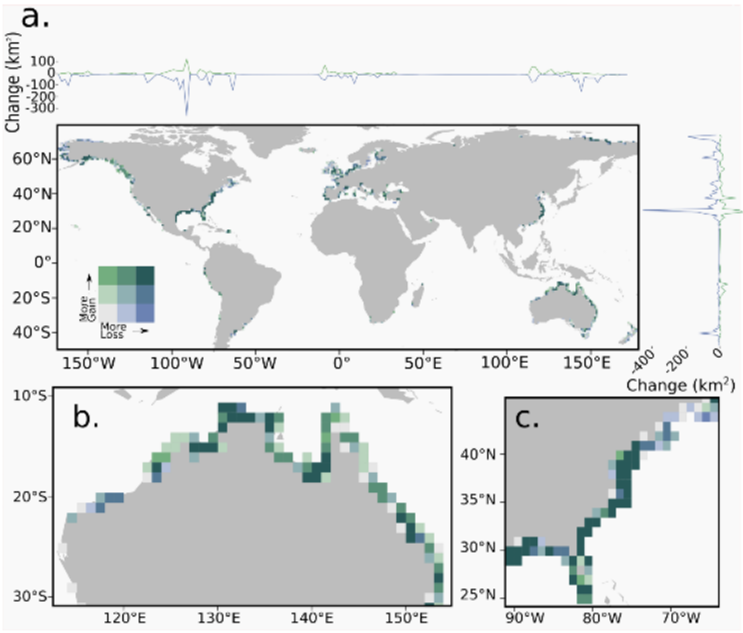
Since the second World Ocean Assessment, marshes have continued to lose ground, though reported rates vary. In a study using satellite data conducted by the National Aeronautics and Space Administration, Campbell and others (2022) found overall global loss equivalent to two soccer (football) fields (14,280 m2) per hour or 0.28% per year (see figure II). By contrast, a study of tidal wetlands (salt marshes, tidal flats and mangroves) found a net loss of only 4,000 km2 over two decades Ref 35. Coastal erosion and hurricanes accelerate marsh loss. Observed substantial reductions were primarily attributed to sea level rise, pollution, conversion to agriculture, aquaculture, salt pans and urban development Ref 21 Ref 9.
Figure II Map of global salt marsh loss and gain, 2000-2019
3. Region-specific changes
Arctic Ocean
Arctic salt marshes occur west of the Alaska Peninsula along the Bering Sea coastline and extend across the Alaskan coastal plain and the Arctic coastline of Canada. They are under pressure from climate change, coastal erosion, severe storms, changes in sea ice and increased industrial activities offshore, including oil drilling. From 2015 to 2019, there was 279.4 ± 35.9 km2 and 5.6 ± 1.0 km2 of salt marsh loss and gain in the Russian Federation, respectively Ref 8. Lack of knowledge and mapping prevents accurate quantification and leads to the underestimation of global soil organic carbon stocks, estimated at 1.44 Pg C in the top metre of tidal marsh soils globally. Ward (2020) found low carbon stocks in salt marshes in Norway, likely due to historical isostatic uplift and sediment accretion outpacing sea level rise.
Baltic Sea, North-East Atlantic Ocean, Mediterranean and Black Sea
Salt marsh loss is attributed mostly to reclamation. The area lost, primarily in the European region, between 2015 and 2019 was 103.2 ± 13.3 km2, which was offset by 64.2 ± 11.3 km2 of gain Ref 8.
South Atlantic Ocean and wider Caribbean
Salt marshes in South America are mostly located on the Atlantic coast, with over 95% of them in Argentina Ref 30. These authors also found that these marshes store about 42.43 mg of organic carbon per ha (40.74 below ground) and bury about 47.62 g of organic carbon per m2 per year. In South Africa, approximately 43% of salt marsh was lost to development and agriculture between 1930 and 2018 Ref 2. At their equatorial end, salt marshes are losing ground to mangroves (see sect. 4, subchap. 5H), which are moving north due to climate change (Santilan and others, 2013). Mangroves may provide increased storm protection and carbon storage Ref 14 Ref 13 but may also cause a decline in habitat for some animals.
Indian Ocean, Arabian Sea, Bay of Bengal, Red Sea, Gulf of Aden and Persian Gulf, Strait of Malacca and South China Sea
Salt marsh extent in India is estimated at 290 km2 Ref 54; salt marshes are classed as ecologically sensitive areas within the Coastal Regulation Zone, with some designated as Ramsar Sites. Although salt marshes are present in the Arabian Sea Ref 3, there are currently no area estimates for the region.
North Pacific Ocean
Chen and others (2022) found that salt marshes in China declined from 151,324 ha in 1985 to 115,397 ha in 2019, representing a drop of 23.7%. Over the past decade, Chinese socioeconomic reforms and stricter environmental regulations have significantly decreased the contributions of anthropogenic metals in salt marshes Ref 20. Black carbon can contribute up to 20% of the total organic carbon in salt marsh soils and, on average, 80% of this black carbon is derived from fossil fuel combustion Ref 26.
South Pacific Ocean
Salt marshes in Oceania showed a net loss of 32.1 km2 from 2015 to 2019, primarily due to reclamation for agriculture and urban development in Australia.
Southern Ocean
Salt marshes are not found in Antarctica.
4. Key remaining knowledge and capacity gaps and new gaps
Salt marshes are being lost worldwide due to sea level rise and continued development. There are ways to adapt to rising sea levels and preserve marshes through engineering practices (such as living shorelines and thin-layer deposition) and ways to restore or create new marshes, but legal and policy changes are needed to curtail development Ref 58.
Roads or houses immediately upland of a marsh prevent migration and cause "coastal squeeze". Such houses are likely to be frequently flooded; some homeowners will therefore be willing to move. In such situations, marsh migration pathways could be created, opening space for the marsh. This can be facilitated by offering incentives for residents to move away, through easements, land acquisition, buyouts and other means, whereby people would receive compensation. Such agreements could be concluded with whole neighbourhoods; success will require efforts by planners and social workers, since people may be on low incomes, feel attached to their neighbourhoods, and want to stay despite the risks Ref 53.
As marsh edges erode, losses can be reduced by placing hard structures, such as oyster reefs or rocks, near the eroding edge, making a "living shoreline." Challenges include site-specific factors (marshes are not all the same), weather Ref 12, performance standards Ref 50 and regional norms Ref 64 Ref 34. Living shorelines generally succeed if they can persist past their initial stages. Thin channels ("runnels") can be dug to connect pools to tidal creeks in order to drain them, provided that the creek has a lower elevation than the pool Ref 57.
More work is needed to understand the effects of increased temperature on marsh structure and function Ref 15. While oil and chemical contaminants are decreasing due to environmental policies, plastic pollution continues unabated. If marshes are to continue to exist throughout this century, nations should take proactive steps to preserve and protect them. To reduce plastic waste, nations should ban single-use plastics, restrict plastic uses and ensure that the burden of disposal and recycling is borne by the plastic industry, not by Governments or individuals Ref 7.
References
- Adamowicz, S., Wilson, G., Burdick, D, Ferguson, W., Hopping, R. (2020). Farmers on the Marsh: Lessons from History and Case Studies for the Future. Wetland Science and Practice, 37, 183-195, ISSN 19436254. https://issuu.com/societyofwetlandscientists/docs/july_2020_wsp.
- Adams, J. (2020). Salt marsh at the tip of Africa: Patterns, processes and changes in response to climate change. Estuarine, Coastal and Shelf Science, V. 237, 106650. https://doi.org/10.1016/j.ecss.2020.106650.
- Almahasheer, H. (2021). Assessment of coastal salt marsh plants on the Arabian Gulf region. Saudi Journal of Biological Sciences 28, 5640-5646. https://doi.org/10.1016/j.sjbs.2021.06.002.
- Armitage, A.R. (2021). Perspectives on Maximizing Coastal Wetland Restoration Outcomes in Anthropogenically Altered Ecosystems. Estuaries and Coasts 44, 1699-1709. https://doi.org/10.1007/s12237-021-00907-4.
- Bart, D., Burdick, D., Chambers, R., Hartman, J.M. (2006). Human facilitation of invasions in tidal marshes: A review and synthesis. Wetlands Ecology and Management, 14, 53-65. https://doi.org/10.1007/s11273-005-2566-z.
- Billah, M.M., Bhuiyan, M.K.A., Islam, M.A., Das, J., Hoque, A.R. (2022). Salt marsh restoration: an overview of techniques and success indicators. Environmental Science and Pollution Research, 29, 15347-15363. https://doi.org/10.1007/s11356-021-18305-5.
- Brander, S.M., Senathirajah, K., Fernandez, M.O., Weis, J.S., and others (2024). The time for ambitious action is now: Science-based recommendations for plastic chemicals to inform an effective global plastics treaty. Science of The Total Environment, 949, 174881. https://doi.org/10.1016/j.scitotenv.2024.174881.
- Campbell, A., Fatoyimbo, L., Goldberg, L., Lagomasino D. (2022). Global hotspots of salt marsh loss and carbon emissions. Nature, 612, 701-706. https://doi.org/10.1038/s41586-022-05355-z.
- Chen, G., Jin, R., Ye, Z., Li, Q., Gu, J., Luo, M., Luo, Y., Christakos, G., Morris, J., He, J., Li, D., Wang, H., Song, L., Wang, Q., Wu, J. (2022). Spatiotemporal mapping of salt marshes in the intertidal zone of China during 1985-2019. Journal of Remote Sensing, 2022, 9793626. https://doi.org/10.34133/2022/9793626.
- Costanza, R., d'Arge, R., de Groot, R., Farber, S., and others (1997). The value of the world's ecosystem services and natural capital. Nature, 387, 253-260. https://doi.org/10.1038/387253a0.
- Culbertson, J., Valiela, I., Peacock, E., Reddy, C and others (2007). Long-term biological effects of petroleum residues on fiddler crabs in salt marshes. Mar poll Bull, 54: 955-962. https://doi.org/10.1016/j.marpolbul.2007.02.015.
- Currin, C., Davis, J., Malhotra, A. (2017). Response of salt marshes to wave energy provides guidance for successful living shoreline implementation. In Living Shorelines: The Science and Management of Nature-Based Coastal Protection, Bilkovic D., Mitchell, M., La Peyre, M., Toft, J., eds. CRC Press Boca Raton FL. https://doi.org/10.1201/9781315151465.
- Dontis, E. E., Radabaugh, K. R., Chappel, A. R., Russo, C. E., and Moyer, R. P. (2020). Carbon storage increases with site age as created salt marshes transition to mangrove forests in Tampa Bay, Florida (USA). Estuaries and Coasts, 43(6), 1470-1488.
- Doughty, C. L., Langley, J. A., Walker, W. S., Feller, I.C., Schaub, R., and Chapman, S. K. (2016). Mangrove range expansion rapidly increases coastal wetland carbon storage. Estuaries and Coasts, 39(2), 385-396.
- Duarte, B., Carreiras, J., Caçador, I. (2021). Climate change impacts on salt marsh blue carbon, nitrogen and phosphorous stocks and ecosystem Services. Appl. Sci., 11. https://doi.org/10.3390/app11041969.
- Ensign, S.H., Halls, J.N., Peck, E.K. (2023). Watershed sediment cannot offset sea level rise in most US tidal wetlands. Science, 382, 1191-1195. https://doi.org/10.1126/science.adj0513.
- Fischman, H.S., Smyth, A.R., and Angelini, C. (2024). Invasive consumers provoke ecosystem-wide disruption of salt marsh functions by dismantling a keystone mutualism. Biol Invasions, 26, 169-185. https://doi.org/10.1007/s10530-023-03167-4.
- Fu, C., Steckbauer, A., Mann, H., Duarte, C.M. (2024a). Achieving the Kunming-Montreal global biodiversity targets for blue carbon ecosystems. Nature Reviews Earth & Environment, 5, 538-552. https://doi.org/10.1038/s43017-024-00566-6.
- Fu, C., Li, Y., Zeng, L., Tu, C., Wang, X., Ma, H., Xiao, L., Luo, Y. (2024b). Climate and mineral accretion as drivers of mineral-associated and particulate organic matter accumulation in tidal wetland soils. Global Change Biology, 30, e17070. https://doi.org/10.1111/gcb.17070.
- Fu, C., Li, Y., Tu, C., Hu, J., Zeng, L., Qian, L., Christie, P., Luo, Y. (2023). Dynamics of trace element enrichment in blue carbon ecosystems in relation to anthropogenic activities. Environment International, 180, 108232. https://doi.org/10.1016/j.envint.2023.108232.
- Gu, J., Luo, M., Zhang, X., Christakos, G., Agusti, S., Duarte, C.M., Wu, J. (2018). Losses of salt marsh in China: Trends, threats and management. Estuarine, Coastal and Shelf Science, 214, 98-109. https://doi.org/10.1016/j.ecss.2018.09.015.
- He, Q., Li, Z., Daleo, P., and others (2025). Coastal wetland resilience through local, regional and global conservation. Nature Reviews Biodiversity 1, 50-67. https://doi.org/10.1038/s44358-024-00004-x.
- Hensel, M.J.S., Silliman, B.R., Hensel, E., Byrnes, J.E.K. (2021). Feral hogs control brackish marsh plant communities over time. Ecology. https://doi.org/10.1002/ecy.3572.
- Lang, M., Ingebritsen, J., Griffin, R. (2024). Status and trends of wetlands in the coterminous United States 2009-2029. U.S. Dept. of the Interior, Fish and Wildlife Service, Washington D.C., pp. 43.
- Li, H., Mao, D., Wang, Z., Huang, X., Li, L., Jia, M. (2022). Invasion of Spartina alterniflora in the coastal zone of mainland China: Control achievements from 2015 to 2020 towards the Sustainable Development Goals. Journal of Environmental Management, 323, 116242. https://doi.org/10.1016/j.jenvman.2022.116242.
- Li, Y., Fu, C., Zeng, L., Zhou, Q., Zhang, H., Tu, C., Li, L., Luo, Y.(2021). Black Carbon Contributes Substantially to Allochthonous Carbon Storage in Deltaic Vegetated Coastal Habitats. Environmental Science & Technology, 55, 6495-6504. https://doi.org/10.1021/acs.est.1c00636.
- Li, Y., Fu, C., Hu, J., Zeng, L., Tu, C., Luo, Y. (2023). Soil Carbon, Nitrogen, and Phosphorus Stoichiometry and Fractions in Blue Carbon Ecosystems: Implications for Carbon Accumulation in Allochthonous-Dominated Habitats. Environmental Science & Technology, 57, 5913-5923. https://doi.org/10.1021/acs.est.3c00012.
- Lloret, J., Pedroso-Pamies, R., Vandal, N. Rorty, R., Ritchie, M., McGuire, C., Chenoweth, K., Valiela, I. (2021). Salt marsh sediments act as sinks for microplastics and reveal effects of current and historical land use changes. Environmental Advances, 4, 10060. https://doi.org/10.1016/j.envadv.2021.100060.
- Lynch, K.E., Penk, M.R., Perrin, P.M., and others (2022). Cattle Grazing of a Celtic Sea Saltmarsh Affects Invertebrate Community Composition and Biomass, but not Diversity. Wetlands 42, 125. https://doi.org/10.1007/s13157-022-01643-6.
- Martinetto, P., Alberti, J., Becherucci, M., and others (2023). Nature Communications, 14, 8500. https://doi.org/10.1038/s41467-023-44196-w.
- Martinez-Soto K., Johnson, D. (2023). A fiddler crab reduces plant growth in its expanded range. Ecology, 105, e4203. https://doi.org/10.1002/ecy.4203.
- Maxwell, T.L., Spalding, M.D., Friess, D.A., and others (2024). Soil carbon in the world's tidal marshes. Nature Communications 15, 10265. https://doi.org/10.1038/s41467-024-54572-9
- Mcowen, C., Weatherdon, L.V., Bochove, J., Sullivan, E., Blyth, S., Zockler, C., Stanwell-Smith, D., Kingston, N., Martin, C.S., Spalding, M., Fletcher, S. (2017). A global map of saltmarshes (v6.1). Biodiversity Data Journal, 5, e11764. Paper DOI: https://doi.org/10.3897/BDJ.5.e11764; Data DOI: https://doi.org/10.34892/07vk-ws51.
- Morris, R., Bilkovic, D., Boswell, M., Bushek, D., and others (2019). The application of oyster reefs in shoreline protection: Are we over-engineering for an ecosystem engineer? Journal of Applied Ecology, 56, 1703-1711. https://doi.org/10.1111/1365-2664.13390.
- Murray, N., Worthington, T., Bunting, P., Duce, S., and others (2022). High resolution mapping of losses and gains of Earth's tidal wetlands. Science, 376, 744-749. https://doi.org/10.1126/science.abm9583.
- Nel, M., Rubidge, G., Adams, J., Human, L. (2022). Contributions of wetland plants on metal accumulation in sediment. Sustainability, 14, 3679. https://doi.org/10.3390/su14063679.
- Nicholls, R. J., Hoozemans, F. M., and Marchand, M. (1999). Increasing flood risk and wetland losses due to global sea-level rise: regional and global analyses. Global Environmental Change, 9, S69-S87.
- Ohenhen, L., Shirzaei, M., Barnard, P. (2024). Slowly but surely: Exposures of communities and infrastructure to subsidence on the US East Coast. PNAS Nexus, 3, pgad426. https://doi.org/10.1093/pnasnexus/pgad426.
- Ouyang, X., Duarte, C., Cheung, S.G., Tam, N.F.Y., Cannicci, S., Martin, C., Lo, H.S., Lee, S.Y. (2022). Fate and effects of macro- and microplastics in coastal wetlands. Environmental Science & Technology, 56, 4, 2386-2397. https://doi.org/10.1021/acs.est.1c06732.
- Persico, E., Sharp, S., Angelini, C. (2017). Feral hog disturbance alters carbon dynamics in southeastern US salt marshes. Mar Ecol Prog Ser, 580: 57-68. https://doi.org/10.3354/meps12282.
- Petillon, J., McKinley, E., Alexander, M., and others (2023). Top ten priorities for global saltmarsh research, conservation, and ecosystem service research. Science of the Total Environment 898, 165444. https://doi.org/10.1007/s12237-021-00907-4.
- Pinheiro, L., Carvalho, I.V., Agostini, V.O., Martinez-Souza, G., Galloway, T.S., Pinho, G.L. (2021). Litter contamination at a salt marsh: An ecological niche for biofouling in South Brazil. Environmental Pollution, 285, 117647. https://doi.org/10.1016/j.envpol.2021.117647.
- Qi, X., Chmura, G.L. (2023). Invasive Spartina alterniflora marshes in China: a blue carbon sink at the expense of other ecosystem services. Frontiers in Ecology and the Environment, 21, 182-190. https://doi.org/10.1002/fee.2611.
- Raposa, K.B., Mckinney, R.A., Wigand, C., Hollister, J.W., and others (2018). Top-down and bottom-up controls on southern New England salt marsh crab populations. Peer J, 6, e4876. https://doi.org/10.7717/peerj.4876.
- Raposa, K.B., Weber, R., Durant D. Mitchell, J.C., Rasmussen, S., Mckinney, R.A., Wigand, C. (2024). Upland vegetation removal as a potential tool for facilitating landward salt marsh migration. Restoration Ecology, e14242. https://doi.org/10.1111/rec.14242.
- Saltonstall, K. (2002). Cryptic invasion by a non-native genotype of the common reed, Phragmites australis, into North America. Proceedings of the National Academy of Science, 99, 2445-2449. https://doi.org/10.1073/pnas.032477999.
- Smith, S.M., Green, C.W. (2015). Sediment suspension and elevation loss triggered by Atlantic Mud Fiddler Crab (Uca pugnax) bioturbation in salt marsh dieback areas of Southern New England. Journal of Coastal Research, 31, 88-94. https://doi.org/10.2112/JCOASTRES-D-12-00260.1.
- Staver, L.W., Morris, J.T., Cornwell, J.C., Stevenson, J.C., Nardin, W., Hensel, P., Owens, M.S., Schwark, A. (2024). Elevation changes in restored marshes at Poplar Island, Chesapeake Bay, MD: 1. Trends and drivers of spatial variabiity. Estuaries and Coasts, 47, 1784-1798. https://doi.org/10.1007/s12237-023- 01319-2.
- Stewart, D., Lievesley, M., Paterson, J. E., Hennigar, D., Ingham, R., Knight, R., and Balke, E. (2024). Factors Influencing the Resilience of Created Tidal Marshes in the Fraser River Estuary, British Columbia. Wetlands, 44(5), 53.
- Sutton-Grier, A., Wowk, K., Bomford, H. (2015). Future of our coasts: The potential for natural and hybrid infrastructure to enhance the resilience of our coastal communities, economies and ecosystems. Environmental Science & Policy, 51, 137-148. https://doi.org/10.1016/j.envsci.2015.04.006.
- Thorne, K., MacDonald, G., Guntenspergen, G., Ambrose, R., Buffington, K., Dugger, B., Freeman, C., Janousek, C., Brown, L., Rosencranz, J., Holmquist, J. (2018). US Pacific coastal wetland resilience and vulnerability to sea-level rise. Science Advances, 2018, 4, eaao3270. https://doi.org/10.1126/sciadv.aao3270.
- Thorne, K.M., Freeman, C.M., Rosenkranz J.A., Ganju, N.K., Guntenspergen, G.R. (2019). Thin-layer sediment addition to an existing salt marsh to combat sea-level rise and improve endangered species habitat in California USA. Ecological Engineering, 136, 197-208. https://doi.org/10.1016/j.ecoleng.2019.05.011.
- Van Dolah, E.R., Miller Hesed, C.D., Paolisso, M.J. (2020). Marsh migration, climate change, and coastal resilience: human dimensions considerations for a fair path forward. Wetlands, 40, 1751-1764. https://doi.org/10.1007/s13157-020-01388-0.
- Viswanathan, C., Purvaja, R., Joyson Joe Jeevamani, J. and others (2020). Salt marsh vegetation in India: Species composition, distribution, zonation pattern and conservation implications. Estuarine, Coastal and Shelf Science, V. 242, 106792. https://doi.org/10.1016/j.ecss.2020.106792
- Vu, H.D., Więski, K., Pennings, S.C. (2017). Ecosystem engineers drive creek formation in salt marshes. Ecology, 98, 162-174. https://doi.org/10.1002/ecy.1628.
- Ward, R.D. (2020). Carbon sequestration and storage in Norwegian Arctic coastal wetlands: Impacts of climate change. Science of the Total Environment, 748, 141343. https://doi.org/10.1016/j.scitotenv.2020.141343.
- Watson, E.B., Ferguson, W., Champlin L.K., White, J. D., Ernst, N., Sylla, H. A., Wilburn, B.P., Wigand, C. (2022). Runnels mitigate marsh drowning in microtidal salt marshes. Frontiers in Environmental Science: Section on Conservation and Restoration Ecology, 10, 987246. https://doi.org/10.3389/fenvs.2022.987246.
- Weis, J.S., Watson E.B., Ravit, B., Harman, C., Yepsen, M. (2021). The status and future of tidal marshes in New Jersey faced with sea level rise. Anthropocene Coasts, 4, 168-192. https://doi.org/10.1139/anc- 2020-0020.
- Windham, L., Lathrop, R.G. (1999). Effects of Phragmites australis (common reed) invasion on aboveground biomass and soil properties in brackish tidal marsh of the Mullica River, New Jersey. Estuaries, 22, 927-935. https://doi.org/10.2307/1353072.
- Wittyngham S., Johnson D., Chen, Y., Kirwan, M. (2024). A grazing crab drives saltmarsh carbon storage and recovery. Ecology, 105, e4385. https://doi.org/10.1002/ecy.4385.
- Worthington, T., Spalding, M., Landis, E, Maxwell, T.L., Navarro, A., Smart, L.S., Murray, N.J. (2024). The distribution of global tidal marshes from earth observation data. Global Ecology and Biogeography, 33, e13852. https://doi.org/10.1101/2023.05.26.542433.
- Xie, B., Han, G. (2023). Control of invasive plant Spartina alterniflora: Concept, technology and practice. Bulletin of Chinese Academy of Sciences, 38, 1924-1938. https://doi.org/10.16418/j.issn.1000- 3045.20230921001 (in Chinese).
- Zhang, Ni-chen, and others (2023). Mechanism of polycyclic aromatic hydrocarbons degradation in the rhizosphere of Phragmites australis: Organic acid co-metabolism, iron-driven, and microbial response. Environmental Pollution, 327 (2023): 121608.
- Zhu, L., Chen, Q., Wang, H., Capurso, W., Niemoczynski, L., Hu, K., Snedden, G. (2020). Field Observations of Wind Waves in Upper Delaware Bay with Living Shorelines. Estuaries and Coasts, 43, 739-755. https://doi.org/10.1007/s12237-019-00670-7.