
Geoengineering
Writing team: Jerry Blackford (coordinating author), Jahson Berhane Alemu, Yekaterina Astafyeva, Chelsey Baker, Ian Butler (lead member), Navraj Sing Ghaleigh, Jonne Kotta, Dahai Liu, Aline Sbizera Martinez, Precious Mongwe, Christopher Pearce, Mariana Mayer Pinto, Mariamalia Rodríguez (co-lead member), Richard Sanders and Romany Webb.
Key points
- The scientific consensus remains that proposed novel geoengineering approaches are unproven in practice, and there is significant uncertainty about the impacts of pilot studies and upscaled experiments, especially where these experiments are planned over large ocean areas.
- Paris Agreement-compliant Intergovernmental Panel on Climate Change (IPCC) scenarios indicate that 7 gigatons of CO2 (GtCO2) to 9 GtCO2 CO2 removal (CDR) would be needed per year by 2050, in addition to reductions in greenhouse gas emissions. Currently only 2 GtCO2 p.a. of conventional, low-durability terrestrial CDR has materialized.
- Monitoring, reporting and verification (MRV) protocols will be key to determining whether marine carbon dioxide (CO2) removal (mCDR) approaches are effective.
- mCDR research studies may advance the state of key knowledge in the coming decade.
- Governance frameworks are limited and fragmented. Efforts to develop an international legally binding governance framework under the Convention on the Prevention of Marine Pollution by Dumping of Wastes and Other Matter (London Convention) and its 1996 Protocol (London Protocol) are progressing.
1. Introduction
This new chapter in the World Ocean Assessment outlines current understanding of and road maps for marine-based geoengineering. This is defined under the London Convention and Protocol as "a deliberate intervention in the marine environment to manipulate natural processes, including to counteract anthropogenic climate change and/or its impacts, and that has the potential to result in deleterious effects, especially where those effects may be widespread, long-lasting or severe".
This chapter takes a broad remit, including marine-based: CO2 removal (CDR): "human activity that captures CO2 from the atmosphere and stores it for decades to millennia" Ref 118, solar radiation modification (SRM) and structural engineering. Some countries are of the view that a cautious approach to SRM technologies is needed, as they carry numerous risks, not only for the environment but also with regard to geopolitical and security concerns.
Further reading on this subject can be found in the following documents:
- "The state of the science for marine carbon dioxide removal (mCDR) - a scientific summary for policymakers" (Ref 51)
- A Research Strategy for Ocean-based Carbon Dioxide Removal and Sequestration (Ref 94)
- Principles for Responsible and Effective Marine Carbon Dioxide Removal Development and Governance Ref 35
- Ocean Visions high-level road map Ref 99
- Strategy for NOAA Carbon Dioxide Removal Research (Ref 30)
- Guide to Best Practices in Ocean Alkalinity Enhancement Research (Oschlies and others (eds), 2023b)
- A code of conduct for marine carbon dioxide removal research Program (Ref 9)
- The State of Carbon Dioxide Removal Ref 118
The Paris Agreement (2015) sets a goal of limiting temperature increases to "well below 2° C above pre-industrial levels and pursuing efforts to limit the temperature increase to 1.5° C above pre-industrial levels", which will require rapid, deep and sustained greenhouse gas reductions and ultimately the attainment of net zero CO2 emissions by mid-century Ref 59 Ref 129. A significant gap remains between international targets and the actions required to limit the extent of warming to 1.5° C (IPCC, 2023). All scenarios and action pathways that lead to achievement of the Paris goal require global net negative emissions, whereby the greenhouse gases taken up by land and ocean exceed the amount released to the atmosphere Ref 113. One proposed pathway for achieving this is the implementation of geoengineering approaches to counterbalance residual or harder-to-abate emissions (IPCC, 2022) Ref 106 and their impact on global warming. That said, methodologies remain unproven in practice, requiring significant research abiding by the precautionary approach Ref 25. Furthermore, there is considerable debate around the definition and quantification of residual emissions Ref 17.
The range of biological, chemical and physical processes that influence air-sea CO2 exchange (see subsect. 5B, chap. 1) suggest that it may be possible to enhance the rate and capacity for ocean carbon storage through methods such as the implementation of mCDR techniques (Ref 95) (see figure I). Some mCDR methods seek to enhance the diffusion of atmospheric CO2 into seawater by increasing the production and/or storage of organic carbon or by altering the inorganic pool of dissolved carbon. Biological mCDR techniques, including direct nutrient addition or upwelling of nutrient rich waters to encourage primary production and the restoration of coastal vegetated ecosystems, potentially stimulate the conversion of dissolved CO2 into plant matter through photosynthesis. Permanent or long-term removal requires the export or burial of the carbon such that its release back into the atmosphere following degradation is prevented. Deposition of terrestrial and marine biomass into the deep ocean for long-term storage is also proposed. Chemical mCDR approaches propose enhancing the capacity of the ocean to absorb atmospheric CO2 either by increasing alkalinity, which forces the conversion of dissolved CO2 into the more stable compounds (carbonate and bicarbonate ions), or by electrochemically removing the dissolved CO2 for geological storage. In both cases the perturbations in seawater chemistry are designed to create an air-to-sea gradient that drives the absorption of more atmospheric CO2 into the ocean. Physical mCDR approaches, including the downwelling of carbon-enriched surface waters, have also been suggested Ref 51.
Ultimately, the successful long-term storage of CO2 sequestered by CDR depends on either its incorporation into stable biogeochemical compounds in the ocean and ultimate burial in deep sediments (e.g. Ref 14) or CO2 capture and geological storage, which offers the most certainty for permanent CO2 removal (IPCC, 2022). The placement of CO2 saturated fluids on the deep seabed for long-term storage has also been considered Ref 60, as has the deposition of terrestrial biomass (Levin and others, 2023). All of the techniques have uncertain ecological impacts, long-term stability and legality.
Structural geoengineering techniques include the adoption of low-carbon manufactured building products and the design of marine structures to enhance biodiversity (Ref 126, Ref 43, Ref 32, Ref 45). Such approaches may be relevant as coastal development (including for mCDR) progresses (see subsect. 5A, chap. 9).
Marine SRM approaches seek to explore increasing the albedo of the atmosphere or the ocean's surface, enabling more energy to be reflected away. Techniques include seawater sprays to stimulate cloud formation, sea ice enhancement, microbubbles and reflective foams (e.g. GESAMP, 2019); figure I). Ocean heat displacement and the use of more sustainable or biobased materials in ocean engineering have also been proposed as mechanisms for supporting decarbonization through the production of renewable electricity and CO2 emission reduction during construction Ref 49 Ref 98.
Figure I Solar radiation modification and mCDR approaches
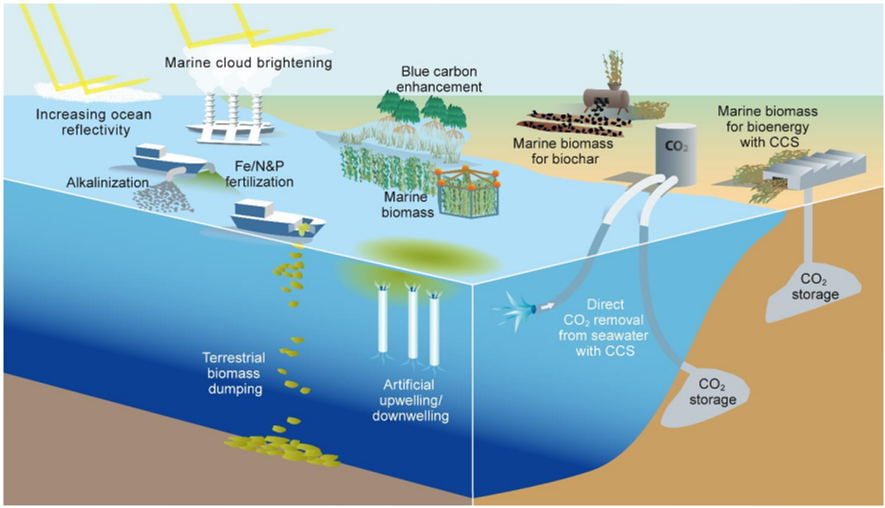
Although the fundamental scientific principles of geoengineering approaches are well known, their technological maturity, environmental impact and potential for wide-scale implementation vary significantly (see figure II). Several recent synthesis reports outline the challenges and research gaps (see above), and while there is debate, the current consensus is that most of the techniques are not yet proven effective, safe or technologically mature enough to scale. Correspondingly, the level of investment in marine-based techniques remain considerably lower than terrestrial alternatives such as direct capture, bioenergy with CCS (BECCS) and biochar Ref 118. Notwithstanding the London Protocol (see below), there are no binding international agreements that comprehensively and specifically address mCDR Ref 135. Controlled pilot studies are starting to address some of the critical knowledge gaps in these approaches. GESAMP (2024) currently identify more than 39 mCDR initiatives aimed at sequestering carbon in the marine environment. Of these, the most numerous are macroalgae farming, ocean alkalinity enhancement, biomass sinking and ocean fertilization (28%, 20%, 18% and 15%, respectively). Crop wastes feature strongly in the biomass disposal category, alongside sargassum, accounting for a further four of the macroalgae farming initiatives. The development of monitoring, reporting and verification (MRV) protocols that assess carbon storage while accounting for local to global-scale marine processes, is another recognized research priority. Additional uncertainties regarding inter alia environmental impacts, resource use, societal acceptability and economic viability of marine geoengineering and mCDR approaches will need to be adequately addressed, with effective governance frameworks implemented, before considering deployment at climatically relevant scales. This chapter outlines the current challenges and priorities for marine geoengineering, including mitigation potential, environmental effects, impacts on communities, economic feasibility, governance and pathways for ensuring sustainable development.
Figure II Status of mCDR and other marine geoengineering approaches and the potential changes

Source: Based on Smith and others (2024) and Cooley and others (2023).
Note: Blank spaces indicate a lack of data.
2. Pressures and impacts
Chemical mCDR approaches
It is contended that chemical mCDR methods that increase the pH and/or alkalinity of seawater (either through mineral addition or electrochemical methods) have significant long-term carbon sequestration potential (Ref 94; Ref 76; Oschlies and others, 2023; Ref 104; see also subsect. 5B, chap. 3). However, complex multi-scale ocean mixing processes, and the long timescales required for CO2 diffusion into seawater Ref 66, create significant uncertainty for their potential efficacy. Oceanic uptake of CO2 might decrease in the future as a consequence of progressing ocean warming (enhancing outgassing), continuing ocean acidification (decreasing oceans' storage capacity) as well as potentially reduced CO2 emissions due to successful climate policy (Gruber and others, 2023). Furthermore, any alteration to marine chemistry resulting in increased carbon storage will impose chemical gradients that exceed normal variability. Reducing these gradients by spreading operations over larger areas will have implications for both cost and monitoring and for the social acceptability of mCDR projects Ref 112. Increasing seawater pH and alkalinity may not linearly enhance carbon storage. At a higher pH, bicarbonate saturation can reach a tipping point, reducing the efficiency of further CO2 uptake and potentially leading to diminished or even negative effects on carbon drawdown Ref 122.
A large body of research describes ecosystem impacts arising from increasing levels of CO2 leading to ocean acidification Ref 36. Conversely, little work to date has looked at the ecological effects of increased alkalinity. Subhas and others (2022) and Ferderer and others (2022) both noted limited impacts on plankton communities during small-scale microcosm experiments but highlight the need for further research Ref 2.
Estimates of chemical mCDR potential have been reported in the range of 3 GtCO2 yr-1-30 FtCO2 yr-1 Ref 70 Ref 108 Ref 41, but current pilots operate at the scale of tons. CDR activities would need to increase in both number and capacity by orders of magnitude, accompanied by increased environmental impacts and process uncertainties, within a relatively short timescale Ref 99 Ref 14.
Apart from sequestration and impact potential, the scalability of chemical mCDR approaches will depend on the deployment location (open ocean or coastal), deployment strategy (e.g. choice of alkalinity source), delivery mechanism, infrastructure needs (e.g. ships, systems for electrochemical stripping) and feasibility, energy requirements, raw materials and contamination, collectively making a full life-cycle analysis imperative Ref 39.
Biological mCDR approaches
The conservation and expansion of macroalgal coastal ecosystems such as salt marshes (sect. 4, subchap. 5I), mangroves (sect. 4, subchap. 5H), seagrass meadows (sect. 4, subchap. 5G) and kelp forests (sect. 4, subchap. 4I) protects biodiversity, stabilizes coastal habitats and act as carbon sinks, with an estimated storage potential of less than 3 GtCO2 yr-1 Ref 130 Ref 21 Ref 40 Ref 74 Ref 34 Ref 141.
Macroalgae aquaculture can potentially contribute to mCDR if it leads to long-term carbon storage but will compete with phytoplankton for nutrients Ref 6. Alternatively, such aquaculture can contribute indirectly to reducing climate pressures through food and product provision, improving water quality Ref 73 Ref 37 and mitigating local ocean acidification and deoxygenation Ref 52 Ref 140 Ref 33. Deposition on deep ocean sediments of harvested macroalgae, or terrestrial biomass, may significantly increase carbon sequestration and its climatic benefits (e.g. Ref 139), although the potential scalability and durability remains uncertain Ref 6. Other post-harvest uses of macroalgae (feed additives to reduce ruminant methane emissions, biofuels and plastic substitutes) have additional climatic benefits Ref 69, while the removal and use of beach wrack for agricultural soil improvement can have a positive impact on carbon sink efficiency if done sustainably Ref 77. Crucially, impacts on habitats and populations stemming from the alteration of the ecosystem must be considered Ref 111 Ref 24 Ref 56. Deposition of shells from shellfish aquaculture has also been proposed as a mCDR technique by restoring alkalinity, although the efficiency of the process has been questioned, and full life cycle assessments are yet to be conducted (e.g. Ref 14).
Microalgal mCDR methods are aimed at increasing primary productivity through fertilization using micronutrients, such as iron fertilization, or macronutrients (e.g. nitrogen, phosphorous) through the upwelling of deep nutrient rich waters. Iron fertilization has been shown to promote the local growth of phytoplankton, particularly diatoms, but an increase in the amount of carbon that reaches the deep ocean is not generally observed Ref 14 Ref 91 Ref 62. Iron fertilization may also lead to widescale changes in nutrient distribution, reduced interior oxygen concentrations and decreases in ecosystem biomass in the tropics with implications for fisheries Ref 124. Concerns such as these led Parties to the London Convention and London Protocol to issue a statement of concern in 2007 (Ref 58), leading to the adoption of a resolution in the following year that introduced the first international controls on ocean fertilization activities (IMO, 2008). Further research is needed, following the London Protocol 2013 guidelines for scientific research to better assess the efficacy, impacts and feasibility of this approach Ref 18. Fertilization through the upwelling of nutrient-rich waters has been shown have scalability constraints, with the CDR potential of the approach thought to be limited to 0.1 GtCO2 y-1 Ref 72 Ref 143.
Physical mCDR approaches
Artificial downwelling has been proposed as a method to accelerate the sinking of carbon carrying biomass to the deep ocean, driven by pumps or increased salinity gradients (Ref 94), with only regional tests conducted Ref 119. Primarily proposed as a method by which to counter deep ocean hypoxia, impacts and efficacy in sequestering carbon are unknown. Impacts on local temperature, salinity and plankton communities can be envisaged, and model studies have suggested that downwelling is highly unlikely to be competitive Ref 147.
Structural geoengineering
Traditionally, coastal and marine developments involve the construction of rigid infrastructures such as seawalls, piers, ports as well as wind farms and oil platforms. These constructions, although needed for a wide range of societal demands, have considerable environmental impacts, including habitat loss. The production of building materials also generates carbon emissions (Ref 43).
Geoengineering approaches can be applied in this context to promote low-carbon sustainable development practices aimed at mitigating environmental impacts from both existing and new marine infrastructure. Biobased materials are emerging as a solution for decarbonization through the responsible management of carbon cycles, with the potential for reducing construction-related emissions by up to 40% by 2060 (Ref 126; Ref 43). This approach involves using alternative raw materials, cement chemistries and fuels in the production process. Other approaches, such as eco-engineering, may also be viable alternatives, through the design of structures to promote the colonization of carbon-capturing organisms (Ref 32; Ref 45).
Implementing a large-scale transition to circular and biobased materials in the built environment involves significant risks. Without careful planning, decarbonization can lead to unintended ecological impacts, if biobased materials are not sourced sustainably (Ref 126). In addition, it can worsen unfair labour practices and result in uneven economic shifts during industry transitions Ref 80.
Solar radiation modification in marine environments
Unlike CDR approaches which reduce atmospheric CO2, the root cause of warming, SRM works by reflecting incoming solar radiation, purporting to cause a cooling effect Ref 87. While theoretically effective, there is potential to generate adverse impacts on climate, weather, ecosystems and air quality with geopolitical implications Ref 65 Ref 64 Ref 92. From an ocean perspective, changing the heat and light reaching the surface ocean may alter ecosystems by changing hydrodynamics, nutrient supply to the photic zone and photosynthetically available radiation. The effect on carbon cycles is highly uncertain Ref 22 Ref 144. Consequently, at present, SRM is a controversial approach, with no international consensus on research pathways (Ref 126) or successful calls to establish international scientific review and governance processes to ensure an equitable, transparent and rigorous body of knowledge (Ref 126).
Monitoring, reporting and verification
An acute challenge for geoengineering is establishing protocols that deliver sufficient knowledge into the efficacy and impact potential of each method and generate trust in regulators, publics and markets Ref 12. The time and spatial scales over which geoengineering interventions may be realized complicates such protocols, and the potential lag between mCDR implementation and carbon drawdown presents a challenge for financing.
Joint model and observation approaches to MRV for mCDR are recommended Ref 42, so that predictive models can establish the likelihood of success of a given intervention, while being appraised by observations. However, models have inherent uncertainties, which cannot be completely resolved by cost-limited observations, suggesting that complete certainty will be elusive Ref 3 and the risks must be carefully considered in advance of any trials.
From an observational perspective, environmental sensors and their deployment options (e.g. autonomous platforms such as Biogeochemical-Argo floats, gliders and drones) are generally well established (e.g. Ref 142; Ref 82). However, their capability for measuring key parameters for conducting market- and regulatory-acceptable MRV at and beyond initial deployment locations is yet to be proven. Similarly, the financial costs and carbon emissions of at-sea monitoring are currently considered to be prohibitive for at-scale implementation and remain a focus of ongoing research activities.
Modelling capability among scientists is relatively well established, falling into two broad categories.
- High-resolution local and regional scale models, that address single or clusters of geoengineering/mCDR operations, assessing dispersal, ecosystem impact, local sequestration efficacy and advection to deep water Ref 68.
- Global ocean or Earth system models that assess the long-term effectiveness of upscaled geoengineering /mCDR approaches, which consider the biotic and abiotic carbon cycles and macroscale hydrodynamics and operate on decadal to millennial scales Ref 103 Ref 3.
Lack of fully comprehensive biodiversity in standard marine models may restrict the ability to accurately simulate biological mCDR or specific impacts. While the marine carbonate system is well understood, care must be taken that the chemical parameterizations still hold for mCDR interventions and are applied in both observational and modelling studies Ref 38 Ref 115.
MRV for mCDR is a rapidly growing area of research drawing on natural analogues Ref 121 and small-scale field trials Ref 31. Decision-support tools Ref 23 also provide high-level frameworks with which to indicate confidence levels for various approaches, although the status of current certification practices remains complex, diverse and inconsistent Ref 1. By contrast, protocol development for SRM is in its infancy.
3. Socioeconomic considerations
Societal perceptions
Public attitudes towards mCDR and geoengineering are divergent (Ref 61). On the one hand, there is theoretical support for strategies to reduce CO2. On the other, opposition emerges when specific projects are proposed, owing to uncertainties about their risks and reversibility, as well as governance shortcomings Ref 28. This tension is further compounded by the divide between "natural" and "engineered" solutions, as public perceptions are heavily influenced by how technologies are framed Ref 7.
Conditional supporters favour mCDR technologies, but their acceptance is typically contingent on the perception of co-benefits, controllability and alignment with conservation efforts Ref 7. For example, in countries such as the United States, Canada and the United Kingdom, where prior knowledge of CDR remains very low, public support can waver depending on actual or perceived risks and benefits (Ref 27). This type of support is particularly evident in responses to different approaches: ecosystem-based solutions, such as blue carbon management, tend to receive more public support, while engineered methods such as ocean fertilization face significant resistance Ref 63.
Less controversial approaches which align with traditional conservation methods, such as wetland restoration and algal farming, tend to receive general (or unconditional) support. Acceptability follows from perceived co-benefits, e.g. food security and enhanced biodiversity Ref 137. These nature-based solutions are preferred globally, especially where local livelihoods are intertwined with ecosystems Ref 7. However, even supporters of climate mitigation express concerns about the potential social, economic or environmental impacts. These concerns grow when interventions appear intrusive or large scale, particularly with engineered solutions such as ocean alkalinity enhancement Ref 7.
In the global North, concerns are often centred around environmental risk and governance, with public preference leaning towards small, localized projects Ref 7 Ref 4.
In the global South, large-scale projects intended to offset emissions in the global North often raise ethical issues regarding land use and sovereignty Ref 145 Ref 54. Concerns about exploitation and inequity in the global South are further fuelled by fears of wealthier nations' reliance on technological fixes rather than reducing their emissions at the source Ref 63. This amplifies opposition in areas where the risks associated with new technologies are perceived as disproportionately impacting poorer nations Ref 112. This resistance to mCDR projects is not confined to one region but is observed globally, reflecting a scepticism towards interventions considered disruptive or overly risky.
Also significantly influencing public acceptance of mCDR is the perceived urgency of climate change Ref 5. Openness towards mCDR does not equate to uncritical acceptance. Comfort with specific technologies varies depending on perceived risks and uncertainties. While solutions such as coastal restoration and direct air capture tend to be more favoured, experimental technologies such as ocean fertilization and ocean alkalinity enhancement face greater scepticism, largely owing to concerns about environmental impacts and the permanence of carbon storage Ref 29 Ref 97. Generally public support for geoengineering techniques such as SRM are lower than those for mCDR, with concerns about controllability, reversibility and a preference for mitigation techniques over temperature management (Ref 95). These disparities reflect how risks and uncertainties associated with those technologies, as well as climate vulnerability, inequity and development priorities, shape regional attitudes towards climate intervention technologies.
Economic potential and sustainability
The economic potential of geoengineering depends on integration into carbon markets, providing financial incentives and fostering new industries. The co-benefits from certain mCDR techniques could include supporting sectors such as tourism and fisheries, contributing to a "blue growth" strategy. This is the case notably for ecosystems restoration.
However, integrating CDR into markets entails significant risks. A primary concern is mitigation deterrence, where reliance on credits substitutes for, rather than complements, emission reductions Ref 125. Neglecting the mitigation hierarchy - whereby emission avoidance and reduction should precede reliance on removals - risks fostering overreliance on market mechanisms and delaying decarbonization Ref 19.
Further risks concern the environmental and social integrity of carbon markets, including challenges such as the risk of low-quality credits misrepresenting actual emission reductions Ref 125. On the supply side, challenges include ensuring additionality, permanence, accurate monitoring, avoidance of double counting and independent verification Ref 75. On the demand side, credible claims and protections against greenwashing are essential Ref 125. Without double-claiming prevention, the voluntary carbon market (VCM) may struggle to encourage genuine mitigation efforts. Accurate MRV is essential for maintaining market credibility, as inadequate MRV creates uncertainties about the actual carbon removal achieved. As environmental conditions change, it becomes challenging to assess the true impact of CDR projects, leading to credits that may not accurately reflect real carbon removal. Issues of additionality also arise when projects receive credits for carbon removal that would have happened without market incentives (Betz and others, 2023).
VCM, provided that solid guardrails are established, such as those established in the standards and methodologies of the Paris Agreement Crediting Mechanism, could provide a valuable means for financing climate action and sustainable development, especially for projects in vulnerable areas. Smaller-scale projects such as the Mikoko Pamoja (mangrove restoration) project in Kenya, funded through the VCM, offer a promising opportunity for small island developing States Ref 67, although VCM for projects in developing States is more suited to ecosystem restoration, as opposed to other geoengineering approaches such as ocean alkalinity enhancement or ocean fertilization. This approach can be especially effective when combined with organic certification in areas with existing aquaculture, generating revenue through carbon credits, supporting local livelihoods and community development.
To tackle challenges of accurately measuring carbon sequestration within restoration Ref 88, regional and international networks such as the Blue Forests Project, the Blue Planet fund and the Blue Carbon Initiative, are developing best practices to effectively utilize international carbon finance Ref 101, although this currently applies to habitat restoration rather than geoengineering.
Overall (i.e. not mCDR specific), carbon credit issuances are currently increasing exponentially (37 million tons CO2 by July 2025 - CDR.fyi), while retirements of carbon credits have plateaued Ref 123. The economic feasibility of the carbon market hinges on developing MRV capacity and a combination of technical readiness, storage verification, supportive policies and strategies to mitigate carbon leakage (emissions reductions in one region that lead to increased emissions elsewhere Ref 114), while maintaining industry competitiveness Ref 57.
Generally, the global carbon market is bolstered by policies and mechanisms facilitating emissions reductions and promoting sustainable investment Ref 57. Carbon pricing mechanisms, such as carbon taxes and cap-and-trade systems such as the European Union Emissions Trading System, incentivize companies to reduce emissions. The idea of integrating carbon removals into the European Union ETS is gaining traction Ref 93.
Supportive policies are applied to encourage market participation. On 10 April 2024, the European Parliament approved the Carbon Removals and Carbon Farming (CRCF) Regulation, creating the first European Union-wide framework for certifying carbon removals, carbon farming and carbon storage. It sets quality standards, tackles greenwashing and promotes investment in carbon removal technologies and sustainable farming to support the European Union's climate goals.
Various levels of implementation for sustainable ocean-based economy programmes, including established official development assistance, involve key mechanisms such as conservation trust funds, blue carbon payments and private sector concessions. Improving practices that facilitate carbon sequestration by ocean ecosystems offers economic opportunities through emerging blue carbon markets. These activities require a robust framework for successful carbon investing, including precise measurement and verification Ref 138.
4. Sector-relevant governance
Governance of marine geoengineering and CDR spans international, regional and domestic frameworks. Currently, there are no binding international laws specifically governing marine geoengineering or CDR, but various general international agreements and rules of customary international law may apply (e.g. United Nations Convention on the Law of the Sea; International Tribunal for the Law of the Sea, advisory opinion on climate change and international law, 2024; International Court of Justice, advisory opinion on the obligations of States in respect of climate change, 2025) (see also sect. 3). Non-binding instruments, including a 2010 resolution of the Parties to the Convention on Biological Diversity, which applies to geoengineering broadly (e.g. decision X/33 (2010)) and widely agreed conventions have bridged regions (e.g. International Law Commission, Prevention of Transboundary Harm from Hazardous Activities; Oxford Principles on Geoengineering).
Marine geoengineering could implicate various provisions of the United Nations Convention on the Law of the Sea, including those governing marine scientific research and protection of the marine environment, particularly as marine scientific research has been interpreted as encompassing marine geoengineering research Ref 16 Ref 135. Under articles 192 and 194 (1), the Convention includes an obligation to protect the marine environment by taking all measures "necessary to prevent, reduce and control" marine pollution. Other provisions include the obligation not to transform one type of pollution into another (United Nations Convention on the Law of the Sea, art 195; International Tribunal for the Law of the Sea, advisory opinion, 2024). This has some implications for geoengineering both directly in association with the introduction of substances or energy into the ocean (Ghaleigh and Boyle, 2016) Ref 109 Ref 135 and also indirectly through its application to reduce greenhouse gas emissions. In its advisory opinion, the International Tribunal on the Law of the Sea determined that greenhouse gas emissions into the atmosphere constitute marine pollution and thus States have an obligation to reduce emissions under the Convention.
The modernizing London Protocol, an extension to the London Convention (1972), entered into force in 2006 but has not been ratified by all Convention Parties, and thus the two instruments continue to operate jointly. While the Convention is generally more permissive of dumping of wastes, the Protocol takes a more precautionary approach, prohibiting the dumping of all wastes and other matter, except those on the "reverse list" in annex 1. In 2006, CO2 was added to annex 1 to the Protocol, thereby enabling sub-seabed carbon storage, subject to purity standards and risk assessment procedures, amended in 2009 to allow export of CO2 to other countries for storage. The amendment is yet to enter into force but has been provisionally applied since 2019. Furthermore, in 2012, the governing bodies for the Convention and Protocol adopted specific guidelines for the assessment of Carbon Dioxide for disposal into sub-seabed geological formations (LC 34/15, annex 8) to guide its implementation. These instruments have implications for some forms of mCDR.
In 2008, the Parties to the London Convention and Protocol adopted a non-binding resolution on ocean fertilization, declaring that "ocean fertilization activities other than legitimate scientific research should not be allowed" (resolution LC-LP.1, adopted on 31 October 2008). In 2010, the Parties adopted an assessment framework for evaluating proposed scientific research projects, requiring (among other things) ex ante environmental review and ongoing monitoring and management of risks (resolution LC-LP.2, adopted on 14 October 2010). This approach to ocean fertilization of permitting some legitimate scientific research but restricting commercial deployment was codified in a formal amendment to the London Protocol in 2013 (resolution LP 4(8), adopted on 18 October 2013). The amendment is yet to enter into force but is intended to establish a governance framework for certain marine geoengineering and CDR activities listed in a new annex 4 (Ref 110). Currently, only ocean fertilization is listed.
In 2022, Parties to both the London Convention and the London Protocol committed to evaluate four marine geoengineering techniques - ocean alkalinity enhancement, biomass cultivation for carbon removal, marine cloud brightening and surface albedo enhancement - for potential listing under the 2013 amendment Ref 84. While that process remains ongoing, in 2025, the Parties issued a statement on marine geoengineering.
The United Nations Framework Convention on Climate Change Ref 127 does not contain explicit references to geoengineering. It contains references to "removal by sinks", language repeated in the Paris Agreement Ref 128. The Convention defines "sink" as "any process, activity or mechanism which removes a greenhouse gas ... from the atmosphere" Ref 127. The recognition of the ocean's critical role in climate action under Convention has evolved significantly over time.
While yet to enter into force, the 2023 Agreement under the United Nations Convention on the Law of the Sea on the Conservation and Sustainable Use of Marine Biological Diversity of Areas Beyond National Jurisdiction may have implications for marine geoengineering and CDR activities. For example, Part III outlines a framework for establishing area-based management tools, and Part IV outlines detailed nenvironmental assessment requirements, which could be used to control where and how marine activities are conducted Ref 136.
In addition, potentially relevant to marine geoengineering and CDR are international agreements governing shipping, such as the International Convention for the Prevention of Pollution from Ships Convention), global human rights conventions and regional seas conventions including the Convention for the Protection of the Marine Environment of the North-East Atlantic (OSPAR Convention) and the Convention on the Protection of the Marine Environment of the Baltic Sea Area (Helsinki Convention), the Convention for the Protection of the Marine Environment and the Coastal Region of the Mediterranean (Barcelona Convention) and the Convention on the Protection of the Black Sea Against Pollution (Bucharest Convention).
Emerging domestic governance frameworks
To date, decisions relating to CDR and other marine geoengineering activities have often been regulated under domestic environmental laws, including (although not restricted to) laws enacted to implement the London Convention and Protocol and other international agreements; however, regulation varies significantly between countries Ref 117. For example, in the United States, the federal Marine Protection, Research, and Sanctuaries Act - i.e. the domestic law implementing the Convention - governs many marine activities. Other federal, state, tribal and local laws may also apply to some projects. The laws of a few countries allow research for marine geoengineering or CDR, subject to permitting and other requirements Ref 117. At least one other country, Australia, has taken steps to implement the 2013 London Protocol Amendment revising its Environment Protection (Sea Dumping) Act 1981, but the revisions will not take effect until the London Protocol Amendment enters into force.
By contrast, other countries have implemented regulation that is more restrictive than the 2013 London Protocol amendment. For example, in Germany, the High Seas Dumping Act prohibits any addition of substances to the ocean in connection with marine geoengineering and/or CDR, with only a limited exception for certain ocean fertilization research Ref 107.
See also section 3 of the present Assessment.
5. Sustainability pathways
The ability of mCDR to make a meaningful contribution towards global targets is theoretically plausible but not yet established. Nevertheless, interest and efforts on the research and development of various techniques has accelerated significantly since the publication of the World Ocean Assessment II, delivering a rapidly evolving knowledge base. Generically, motivations and challenges identified are diverse and sometimes opposing, but may be broadly summarized as environmental, social, economic, regulatory and technical.
There can be potential co-benefits of certain macroalgal mCDR approaches, for example in protecting biodiversity, creating gender positive roles and providing food and other resources Ref 78 Ref 146. Development of macroalgae approaches for mCDR will require a sustainability framework that emphasizes the critical importance of environmental limits and constraints imposed by nature and ecological impacts Ref 12 and incorporates performance indicators, ensures societal acceptance and enables policymaking that takes into consideration marine space allocation and reduces regulatory barriers Ref 26 Ref 74 Ref 53. Conversely, biological mCDR methods based on the stimulation of phytoplankton productivity are thought to offer fewer direct co-benefits and have greater potential for disruptive ecosystem feedbacks, by altering the magnitude and geography of marine primary production Ref 124.
Concentrating mCDR deployments in designated offshore marine areas could provide infrastructural, economic and environmental benefits through a multi-use approach Ref 116 reducing user conflicts. Seaweed farming, for instance, adapted to local conservation targets can contribute to the goals of marine protected areas (MPAs), all while providing jobs and revenue to local communities Ref 79.
Motivations and challenges derived from the United Nations regional workshops
| Motivations | Challenges | |
|---|---|---|
| Environmental | • Addressing climate change and the Paris Agreement goals • Reducing ocean acidification, greenhouse gas levels and emissions • Preserving marine ecosystems, biodiversity and ecosystem services • Sea level change management • Understanding impacts of geoengineering on ecosystems • Nature-based solutions | • Life-cycle assessment, including lack of feasibility studies and post implementation impact understanding • Potential for and lack of assessment of significant negative impacts, including technological limitations |
| Social | • Quality of life for future generations • Sustainable communities • Application of traditional knowledge | • Social licence to operate, awareness and education • Ethical and moral challenges – managing finite resources, who benefits and who pays, transnational impacts |
| Economic | • Limiting economic threats of climate change • Lowering cost of geoengineering/CDR and capacity-building | • Lack of incentive, financing and funding for capacity-building, especially in the least developed countries and small island developing States |
| Governance | • Development of regulations, legislation and policies • International cooperation and dissemination | • Lack of consistent policy, regulations, monitoring and standards • Interactions between landlocked and coastal States |
| Technical | • Technology development, innovation and excellence in research and development • Technology for exploration and sustainable exploitation of natural resources • Digital toolboxes to evaluate solutions | • Deep ocean exploration and monitoring |
Source: Prepared by the writing team.
Several small-scale pilot studies assessing potential chemical mCDR approaches are currently in progress (Ocean Visions 2024) Ref 50. Independent scientific oversight of these, in conjunction with the application of the London Protocol requirements, including the research assessment framework, as well as the proposed approaches to upscaling, will be crucial to maximize learnings in the next few years. Any move to upscale from pilot studies will require a full life-cycle assessment such that carbon emissions from energy, transport and installation are offset against carbon sequestered. As upscaled trials will span local and national jurisdictions to the open ocean, international coordination will be necessary to ensure that those experiments do not harm the environment and human societies.
There remains little consensus on testing, development, monitoring or regulation of SRM, with this controversial approach not considered as mitigation when the terminology of the Intergovernmental Panel on Climate Change (IPCC) is applied. Nevertheless, funding and research and development is likely to increase in this sector over the coming years.
In summary, a number of uncertainties remain with regard to marine CDR and geoengineering techniques, including:
- Their impacts on marine ecosystems and coastal areas.
- Their effectiveness in the long-term removal and storage of CO2, including ensuring that they do not reduce the ocean's natural CO2 storage capacity.
- The energy and resources needed for deployment at scale and the effects on terrestrial ecosystems, including conflicts over, for example, minerals use and mining.
- There are currently no reliable technical means to monitor, report or verify (MRV) the CO2 that would be absorbed and sequestrated, especially considering the complexity and existing knowledge gaps about the ocean carbon cycle.
The key enablers for sustainable research progress are:
- Scientifically endorsed, standardized and accessible MRV approaches.
- Responsive and transparent funding mechanisms, ensuring that commercial interests do not influence the design, conduct and outcomes of the research activities.
- Collaboration and transparency for research will be required for geoengineering approaches to demonstrate feasibility (or lack thereof) and upscale effectively and safely if they are proven safe, effective and realistic.
- Global policy that prioritizes addressing knowledge gaps, equity concerns, risk perception and precautionary governance to strengthen understanding and control for mCDR and geoengineering research.
References
- Arcusa, S., and Sprenkle-Hyppolite, S. (2022). Snapshot of the Carbon Dioxide Removal certification and standards ecosystem (2021-2022). Climate Policy, vol. 22(9-10), pp. 1319-1332. https://doi.org/10.1080/14693062.2022.2094308.
- Bach, Lennart. T., and others (2024). Technical note: Ocean Alkalinity Enhancement Pelagic Impact Intercomparison Project (OAEPIIP), Biogeosciences, vol. 21, pp. 3665-3676. https://doi.org/10.5194/bg-21-3665-2024.
- Bach, Lennart T., and others (2023). Toward a consensus framework to evaluate air-sea CO2 equilibration for marine CO2 removal, Limnology and Oceanography Letters, vol. 8, pp. 685-691. https://doi.org/10.1002/lol2.10330.
- Baum, C.M., and others (20240. Public perceptions and support of climate intervention technologies across the Global North and Global South. Nature Communications, vol. 15(1), art. 2060.
- Bellamy, R. (2022). Mapping public appraisals of carbon dioxide removal. Global Environmental Change, vol. 76, art. 102593.
- Berger, Manon, and others (2023). Ocean dynamics and biological feedbacks limit the potential of macroalgae carbon dioxide removal. Environmental Research Letters vol. 18, art. 0240392023. https://doi.org/10.1088/1748-9326/acb06e.
- Bertram, Christine, and Christine Merk (2020). Public perceptions of ocean-based carbon dioxide removal: the nature-engineering divide? Frontiers in Climate, vol. 2, art. 594194. https://doi.org/10.3389/fclim.2020.594194.
- Betz, R., Michaelowa, A., Castro, P., Kotsch, R., Mehling, M., Michaelowa, K., and Baranzini, A. (2022). The Carbon Market Challenge: Preventing Abuse Through Effective Governance. Cambridge: Cambridge University Press. https://doi.org/10.1017/9781009216500.
- Miranda Boettcher and others (2023), "A code of conduct for marine carbon dioxide removal research", Aspen Institute, Energy and Environment Program.
- Boettcher Miranda, and Kerryn Brent (2024). The potential of the BBNJ clearing house mechanism to enhance knowledge pluralism in marine carbon dioxide removal assessment, Frontiers in Climate, vol. 6. https://www.frontiersin.org/journals/climate/articles/10.3389/fclim.2024.1497476/full.
- Boyd Philip. W., and others (2007). Mesoscale Iron Enrichment Experiments 1993-2005: Synthesis and Future Directions. Science, vol. 315, pp. 612-617. https://doi.org/10.1126/science.1131669.
- Boyd, Philip W., and others (2023). Operational Monitoring of Open-Ocean Carbon Dioxide Removal Deployments. Oceanography vol. 36.1, pp. 2-10 (2023). https://www.jstor.org/stable/27217363.
- Boyd, Philip W., and others (2022). Potential negative effects of ocean afforestation on offshore ecosystems. Nature Ecology and Evolution vol. 6, pp. 675-683. https://doi.org/10.1038/s41559-022-01722-1.
- Boyd Philip W., and others (2024). Limited understanding of basic ocean processes is hindering progress in marine carbon dioxide removal. Environmental Research Letters, vol. 19 (6), art. 061002. https://doi.org/10.1088/1748-9326/ad502f.
- Boyle, Alan, and Navraj Singh Ghaleigh (2016). Climate Change and International Law beyond the UNFCCC. In Gray, Kevin R. and others, eds. The Oxford Handbook of International Climate Change Law. https://doi.org/10.1093/law/9780199684601.003.0002
- Brent Kerryn, and others (2019). Governance of Marine Geoengineering, Centre for International Governance Innovation Special Report. https://www.cigionline.org/publications/governance-marine-geoengineering/.
- Buck, Holly J., and others (2023). Why residual emissions matter right now. Nat. Clim. Chang., 13, 351- 358. https://doi.org/10.1038/s41558-022-01592-2.
- Buesseler, K.O., and others (2024). Next steps for assessing ocean iron fertilization for marine carbon dioxide removal. Frontiers in Climate, vol. 6, art. 1430957. https://doi.org/10.3389/fclim.2024.1430957.
- Caldecott, B., and Johnstone, I. (2024). The Carbon Removal Budget: theory and practice. Carbon Management, 15(1). https://doi.org/10.1080/17583004.2024.2374515.
- Campbell, T.H., and Kay, A.C. (2014). Solution aversion: on the relation between ideology and motivated disbelief. Journal of Personality and Social Psychology, vol. 107 pp. 809-824. https://doi.org/10.1037/a0037963.
- Canadell, J.G., and others (2021). Global Carbon and other Biogeochemical Cycles and Feedbacks. In Climate Change 2021: The Physical Science Basis. Contribution of Working Group I to the Sixth Assessment Report of the Intergovernmental Panel on Climate Change, Masson-Delmotte, V., and others, eds. Cambridge University Press, Cambridge, United Kingdom and New York, NY, USA, pp. 673-816. https://doi.org/10.1017/9781009157896.007.
- Cao, L. (2018). The Effects of Solar Radiation Management on the Carbon Cycle. Current Climate Change Reports, vol. 4, pp. 41-50. https://doi.org/10.1007/s40641-018-0088-z.
- Chay, F., and others (2022). Verification Confidence Levels for carbon dioxide removal, CarbonPlan. https://carbonplan.org/research/cdr-verification-explainer.
- Chopin, Thierry, and others (2024). Deep-ocean seaweed dumping for carbon sequestration: Questionable, risky, and not the best use of valuable biomass, One Earth, vol. 7, Issue 3, pp. 359-364.
- Cooley, Sarah R., and others (2023). Sociotechnical considerations about ocean carbon dioxide removal. Annual Review of Marine Science. vol. 15.1, pp. 41-66. https://doi.org/10.1146/annurev-marine-032122-113850.
- Cordell, Dana, and others (2009). The story of phosphorus: Global food security and food for thought, Global Environmental Change, vol. 19 (2), pp. 292-305. https://doi.org/10.1016/j.gloenvcha.2008.10.009.
- Cox E, and others (2020). Public perceptions of carbon dioxide removal in the United States and the United Kingdom. Nature Climate Change, vol. 10, pp.744-49.
- Cox, E., and others (2022). But they told us it was safe! Carbon dioxide removal, fracking, and ripple effects in risk perceptions. Risk Analysis, vol. 42(7), pp. 1472-1487. https://doi.org/10.1111/risa.13717.
- Cox, E., and others (2024). Public attitudes and emotions toward novel carbon removal methods in alternative sociotechnical scenarios. Environmental Research Letters, vol. 19(8), art. 084026.
- Jessica Cross and others (2023), Strategy for NOAA Carbon Dioxide Removal Research: A White Paper Documenting a Potential NOAA CDR Science Strategy as an Element of NOAA's Climate Interventions Portfolio DOI: 10.25923/gzke-8730.
- Cyronak, T., and others (2023). Field experiments in ocean alkalinity enhancement research. In Guide to Best Practices in Ocean Alkalinity Enhancement Research, Oschlies, A., and others, eds. Copernicus Publications, State of the Planet, vol. 2-oae2023, 3. https://doi.org/10.5194/sp-2-oae2023-7-2023.
- Dafforn K.A., and others (2015). Marine urbanization: an ecological framework for designing multifunctional artificial structures. Frontiers in Ecology and the Environment, vol. 13, pp. 82-90.
- Dinghui Zou (2005). Effects of elevated atmospheric CO2 on growth, photosynthesis and nitrogen metabolism in the economic brown seaweed, Hizikia fusiforme (Sargassaceae, Phaeophyta), Aquaculture, vol. 250, pp. 726-735. https://doi.org/10.1016/j.aquaculture.2005.05.014.
- Do Amaral Camara Lima, Mariana, and others (2023). A review of seagrass ecosystem services: providing nature-based solutions for a changing world. Hydrobiologia, vol. 850, pp. 2655-2670. https://doi.org/10.1007/s10750-023-05244-0.
- Doney, S., K. Lebling, O.S. Ashford, C.R. Pearce, W. Burns, S. Nawaz, T. Satterfield, H.S. Findlay, N.D. Gallo, J.- P. Gattuso, P. Halloran, D.T. Ho, L.A. Levin, C. Savoldelli, P.A. Singh, and R. Webb (2025). Principles for Responsible and Effective Marine Carbon Dioxide Removal Development and Governance. Washington, DC: World Resources Institute. https://oceanpanel.org/publication/marine-carbon-dioxide-removal/ DOI: https://doi.org/10.69902/84b3a9a8.
- Doney, Scott, and others (2020). The Impacts of Ocean Acidification on Marine Ecosystems and Reliant Human Communities. Annual Review of Environment and Resources, vol. 45 pp. 83-112. https://doi.org/10.1146/annurev-environ-012320-083019.
- Duarte, C.M., and others (2022). A seaweed aquaculture imperative to meet global sustainability targets. Nature Sustainability, vol. 5, pp. 185-193. https://doi.org/10.1038/s41893-021-00773-9.
- Dupont, S., and Metian, M. (2023). General considerations for experimental research on ocean alkalinity enhancement. In Guide to Best Practices in Ocean Alkalinity Enhancement Research, Oschlies, A., and others, eds. Copernicus Publications, State of the Planet, vol. 2-oae2023, 3. https://doi.org/10.5194/sp-2-oae2023-4-2023.
- Eisaman, M.D., and others (2023). Assessing the technical aspects of ocean-alkalinity-enhancement approaches, in: Guide to Best Practices in Ocean Alkalinity Enhancement Research, Oschlies, A., and others, eds. Copernicus Publications, State of the Planet, vol. 2-oae2023, 3. https://doi.org/10.5194/sp-2-oae2023-3-2023.
- Erlania, and others (2023). Patterns and drivers of macroalgal 'blue carbon' transport and deposition in near-shore coastal environments, Science of The Total Environment, vol. 890, art. 164430. https://doi.org/10.1016/j.scitotenv.2023.164430.
- Feng, E., Y., and others (2017). Model-based assessment of the CO2 sequestration potential of coastal ocean alkalinization, Earth's Future, vol. 5, pp. 1252-1266. https://doi.org/10.1002/2017EF000659.
- Fennel, K., and others (2023). Modelling considerations for research on ocean alkalinity enhancement (OAE). In Guide to Best Practices in Ocean Alkalinity Enhancement Research, Oschlies, A., and others, eds. Copernicus Publications, State of the Planet, vol. 2-oae2023, 3. https://doi.org/10.5194/sp-2-oae2023-9-2023.
- Fennell P.S., and others (2021). Decarbonizing cement production. Joule, vol. 5, pp. 1305-1311.
- Ferderer, A., and others (2022). Assessing the influence of ocean alkalinity enhancement on a coastal phytoplankton community, Biogeosciences, vol.19, pp. 5375-5399. https://doi.org/10.5194/bg-19-5375-2022.
- Firth Louise B., and others (2024). Coastal greening of grey infrastructure: an update on the state-of-the-art. Proceedings of the Institution of Civil Engineers, vol. 177(2), pp. 35-67. https://doi.org/10.1680/jmaen.2023.003.
- Fridahl, M., and others (2023). Novel carbon dioxide removals techniques must be integrated into the European Union's climate policies. Communication Earth and Environment vol. 4, art. 459. https://doi.org/10.1038/s43247-023-01121-9.
- Friedlingstein, P., and others (2023). Global Carbon Budget 2023. Earth Syst. Sci. Data, 15, 5301-5369. https://doi.org/10.5194/essd-15-5301-2023.
- Gagern, Antonius, and others (2022). Ocean-Based Carbon Dioxide Removal: A New Frontier in the Blue Economy. Marine Technology Society Journal, vol. 1, pp. 40-48. https://doi.org/10.4031/MTSJ.56.1.15.
- GESAMP (2019). High level review of a wide range of proposed marine geoengineering techniques, Boyd, P.W., and Vivian, C.M.G., eds. (IMO/FAO/UNESCO-IOC/UNIDO/WMO/IAEA/UN/UN Environment/UNDP/ISA Joint Group of Experts on the Scientific Aspects of Marine Environmental Protection). Rep. Stud. GESAMP No. 98, 144 p.
- GESAMP (2024). Ocean Interventions for Climate Change Mitigation.
- GESAMP (2025). The State of the Science for Marine Carbon Dioxide Removal (mCDR) - A Scientific Summary for Policy-Makers. Paris, UNESCO-IOC. (IOC Technical Series, 209) downloaded from https://unesdoc.unesco.org/ark:/48223/pf0000393817.
- Guang Gao, and others (2022). The potential of seaweed cultivation to achieve carbon neutrality and mitigate deoxygenation and eutrophication. Environmental Research. Letters, vol. 17, art. 014018. https://doi.org/10.1088/1748-9326/ac3fd9.
- Herrero, Mario, and others (2021). Articulating the effect of food systems innovation on the Sustainable Development Goals, The Lancet Planetary Health, vol. 5 (1), pp. e50-e62. https://doi.org/10.1016/S2542-5196(20)30277-1.
- Hickel, J., and Slamersak, A. (2022). Existing climate mitigation scenarios perpetuate colonial inequalities. The Lancet Planetary Health, vol. 6 (7), pp. e628-e631.
- Ho, D.T., and others (2023). Monitoring, reporting, and verification for ocean alkalinity enhancement. In Guide to Best Practices in Ocean Alkalinity Enhancement Research, Oschlies, A., and others, eds. Copernicus Publications, State of the Planet, vol. 2-oae2023, 3. https://doi.org/10.5194/sp-2-oae2023-12-2023
- Hyndes, G.A., and others (2022). The role of inputs of marine wrack and carrion in sandy-beach ecosystems: a global review. Biological Reviews, vol. 97, pp. 2127-2161. https://doi.org/10.1111/brv.12886.
- IFC (2023) Deep Blue: Opportunities for Blue Carbon Finance in Coastal Ecosystems, International Finance Corporation. https://www.ifc.org/en/insights-reports/2023/blue-carbon-finance-in-coastal-ecosystems.
- International Maritime Organization (IMO) (2007) Statement of concern regarding iron fertilization of the oceans to sequester CO2. Report of the Joint Meeting of the Scientific Groups of the Convention on the Prevention of Maine Pollution by Dumping of Wastes and Other Matter, 1972 and its 1996 Protocol, IMO Doc LC-LP.1/Circ.14, 13 July 2007. https://www.whoi.edu/cms/files/London_Convention_statement_24743_29324.pdf.
- IPCC (2018). Global Warming of 1.5℃. An IPCC Special Report on the impacts of global warming of 1.5°℃ above pre-industrial levels and related global greenhouse gas emission pathways, in the context of strengthening the global response to the threat of climate change, sustainable development, and efforts to eradicate poverty. Cambridge University Press, Cambridge, UK and New York, NY, USA, 616 pp. https://doi.org/10.1017/9781009157940.
- IPCC (2005). IPCC Special Report on Carbon Dioxide Capture and Storage. Prepared by Working Group III of the Intergovernmental Panel on Climate Change, Metz, B., and others, eds. Cambridge University Press, Cambridge, United Kingdom and New York, NY, USA, 442 pp.
- Jebari J., and others (2021). From moral hazard to risk-response feedback. Climate Risk Management, vol. 33, art. 100324.
- Jiang, Hai-Bo, and others (2024). Complexities of regulating climate by promoting marine primary production with ocean iron fertilization, Earth-Science Reviews, vol. 249, art. 104675. https://doi.org/10.1016/j.earscirev.2024.104675.
- Jinnah, S., and others (2021). Splitting climate engineering governance: how problem structure shapes institutional design. Global Policy, vol. 12, pp. 8-19. https://doi.org/10.1111/1758-5899.12900.
- Jones, A. C., and others (2018). Regional Climate Impacts of Stabilizing Global Warming at 1.5 K Using Solar Geoengineering, Earth's Future, vol. 6, pp. 230-251. https://doi.org/10.1002/2017EF000720.
- Jones, A., and others (2013). The impact of abrupt suspension of solar radiation management (termination effect) in experiment G2 of the Geoengineering Model Intercomparison Project (GeoMIP). Journal of Geophysical Research: Atmospheres, vol. 118, pp. 9743-9752.
- Jones, D.C., and others (2014). Spatial and seasonal variability of the air-sea equilibration timescale of carbon dioxide, Global Biogeochemical Cycles, vol. 28, pp. 1163-1178. doi:10.1002/2014GB004813.
- Kairo, James G., and others (2018). Mikoko Pamoja, A Demonstrably Effective Community-Based Blue Carbon Project in Kenya. In Windham-Myers, Lisamarie, and others, eds. A Blue Carbon Primer: The State of Coastal Wetland Carbon Science, Practice and Policy, CRC Press, Boca Raton, ISBN9780429435362. https://doi.org/10.1201/9780429435362.
- Khangaonkar, Carter, and others (2024). Mixing and dilution controls on marine CO2 removal using alkalinity enhancement. Environmental Research Letters, vol. 19 (10), art. 104039. https://doi.org/10.1088/1748-9326/ad7521.
- Kinley, Robert D., and others (2020). Mitigating the carbon footprint and improving productivity of ruminant livestock agriculture using a red seaweed, Journal of Cleaner Production, vol. 259, art. 120836. https://doi.org/10.1016/j.jclepro.2020.120836.
- Köhler, P., and others (2013). Geoengineering impact of open ocean dissolution of olivine on atmospheric CO2, surface ocean pH and marine biology, Environmental Research Letters, vol. 8, art. 014009. https://doi.org/10.1088/1748-9326/8/1/014009.
- Konar, Manaswita, and Helen Ding (2020). Ocean Panel report: A Sustainable Ocean Economy for 2050: Approximating Its Benefits and Costs. https://oceanpanel.org/wp-content/uploads/2022/05/Ocean-Panel_Economic-Analysis_FINAL.pdf.
- Koweek, D.A. (2022). Expected Limits on the Potential for Carbon Dioxide Removal From Artificial Upwelling. Frontiers in Marine. Science, vol. 9, art. 841894. https://doi.org/10.3389/fmars.2022.841894.
- Krause, G., and others (2022). Prospects of Low Trophic Marine Aquaculture Contributing to Food Security in a Net Zero-Carbon World. Frontiers in Sustainable Food Systems, vol. 6, art. 875509. https://doi.org/10.3389/fsufs.2022.875509.
- Krause-Jensen, D., and Duarte, C. (2016). Substantial role of macroalgae in marine carbon sequestration. Nature Geosciences vol. 9, pp. 737-742. https://doi.org/10.1038/ngeo2790.
- Kreibich, N., and Hermwille, L. (2021). Caught in between: credibility and feasibility of the voluntary carbon market post-2020. Climate Policy, 21(7), 939-957. https://doi.org/10.1080/14693062.2021.1948384.
- Kwiatkowski, Lester, and others (2023). Contrasting carbon dioxide removal potential and nutrient feedbacks of simulated ocean alkalinity enhancement and macroalgae afforestation. Environmental Research Letters, vol. 18, art. 124036. https://doi.org/10.1088/1748-9326/ad08f9.
- Lanari, Marianna, and others (2024). From sink to source: Dynamic of greenhouse gases emissions from beach wrack accumulations in a temperate coastal bay, Science of The Total Environment, vol. 925, art. 171783. https://doi.org/10.1016/j.scitotenv.2024.171783.
- Larson, Silva, and others (2021). Women's well-being and household benefits from seaweed farming in Indonesia, Aquaculture, vol. 530, art. 735711. https://doi.org/10.1016/j.aquaculture.2020.735711.
- Le Gouvello R., and others. Aquaculture and marine protected areas: Potential opportunities and synergies. Aquatic Conservation: Marine and Freshwater Ecosystems, vol 27(S1), pp 138-150, 2017. https://doi.org/10.1002/aqc.2821
- Lehne, J., and Preston F. (2018). Making Concrete Change: Innovation in Low-carbon Cement and Concrete. Chatham House: The Royal Institute of International Affairs. Energy, Environment and Resources Department, 138 pp.
- Li, Z., and others (2023). Recent acceleration in global ocean heat accumulation by mode and intermediate waters. Nature Communication vol 14, art. 6888. https://doi.org/10.1038/s41467-023-42468-Z.
- Lichtschlag, Anna, and others (2021). Suitability analysis and revised strategies for marine environmental carbon capture and storage (CCS) monitoring, International Journal of Greenhouse Gas Control, vol. 112, art. 103510. https://doi.org/10.1016/j.ijggc.2021.103510.
- London Convention (1972). Convention on the Prevention of Marine Pollution by Dumping of Wastes and Other Matter. https://www.imo.org/en/OurWork/Environment/Pages/London-Convention-Protocol.aspx.
- London Convention (2022). Marine geoengineering techniques - potential impacts.
- Lovelock C.E., and Duarte C.M. (2019). Dimensions of Blue Carbon and emerging perspectives. Biology Letters, vol. 15, art. 20180781. http://dx.doi.org/10.1098/rsbl.2018.0781.
- Maar, Marie, and others (2023). Multi-use of offshore wind farms with low-trophic aquaculture can help achieve global sustainability goals. Communications Earth and Environment, vol. 4, art. 447. https://doi.org/10.1038/s43247-023-01116-6.
- MacMartin, Douglas G., and others (2018). Solar geoengineering as part of an overall strategy for meeting the 1.5℃ Paris target. Philosophical Transactions of the Royal Society A., vol. 376, art. 20160454. http://doi.org/10.1098/rsta.2016.0454.
- Macreadie, P.I., and others (2019). The future of Blue Carbon science. Nature Communications, vol. 10, art. 3998. https://doi.org/10.1038/s41467-019-11693-w.
- Markusson, N., and others (2013). In case of emergency press here: framing geoengineering as a response to dangerous climate change. Wiley Interdisciplinary Reviews 5: Climate Change, 281-290. https://doi.org/10.1002/wcc.263.
- Markusson N., and others (2018). Towards a cultural political economy of mitigation deterrence by negative emissions technologies (NETs). Global Sustainability, 1: e10. https://doi.org/10.1017/sus.2018.10.
- Martin, P., and others (2013). Iron fertilization enhanced net community production but not downward particle flux during the Southern Ocean iron fertilization experiment LOHAFEX, Global Biogeochemical Cycles, vol. 27, pp. 871-881. https://doi.org/10.1002/gbc.20077.
- Mengis, N., and others (2016). Assessing climate impacts and risks of ocean albedo modification in the Arctic, Journal of Geophysical Research, Oceans, vol. 121, pp. 3044-3057. https://doi.org/10.1002/2015JC011433.
- Meyer-Ohlendorf, Nils (2023). Making Carbon Removals a Real Climate Solution. How to integrate carbon removals into EU Climate Policies. Berlin: Ecologic Institute. https://www.ecologic.eu/19290.
- NASEM: National Academies of Sciences, Engineering, and Medicine (2022). A Research Strategy for Ocean-based Carbon Dioxide Removal and Sequestration. Washington, D.C.: The National Academies Press. https://doi.org/10.17226/26278.
- NASEM: National Academies of Sciences, Engineering, and Medicine (2021). Reflecting Sunlight: Recommendations for Solar Geoengineering Research and Research Governance. Washington, D.C.: The National Academies Press. https://doi.org/10.17226/25762.
- National Research Council of the National Academies of Sciences, Engineering, and Medicine, Geological and Geotechnical Engineering in the New Millennium: Opportunities for Research and Technological Innovation (Washington, DC: The National Academies Press, 2006). https://doi.org/10.17226/10324.
- Nawaz, Sara, and others (2023). Public evaluations of four approaches to ocean-based carbon dioxide removal, Climate Policy, vol. 23: 3, pp. 379-394. https://doi.org/10.1080/14693062.2023.2179589.
- NRC, National Research Council (2006). Geological and Geotechnical Engineering in the New Millennium: Opportunities for Research and Technological Innovation. Washington, D.C.: The National Academies Press. https://doi.org/10.17226/11558.
- Ocean Visions (2023). A Comprehensive Program to Prove or Disprove Marine Carbon Dioxide Removal Technologies by 2030. https://oceanvisions.org/wp-content/uploads/2023/10/A-Comprehensive-Program-to-Prove-or-Disprove-Marine-Carbon-Dioxide-Removal-Technologies-by-2030_FINAL.pdf.
- Ocean Visions (2024). mCDR Field Trial Database.
- OECD (2020), Sustainable Ocean for All: Harnessing the Benefits of Sustainable Ocean Economies for Developing Countries, The Development Dimension. OECD Publishing, Paris. https://doi.org/10.1787/bede6513-en.
- Oschlies, A., and others (2023a). Climate targets, carbon dioxide removal, and the potential role of ocean alkalinity enhancement. In Guide to Best Practices in Ocean Alkalinity Enhancement Research, Oschlies, A., and others, eds. Copernicus Publications, State of the Planet, vol. 2-oae2023, 3. https://doi.org/10.5194/sp-2-oae2023-1-2023.
- Oschlies, A. and others (eds.) (2023b) Guide to Best Practices in Ocean Alkalinity Enhancement Research, Copernicus Publications, State Planet, 2-oae2023, https://doi.org/10.5194/sp-2-oae2023.
- Palmiéri, J., and Yool, A. (2024). Global-scale evaluation of coastal ocean alkalinity enhancement in a fully coupled Earth system model. Earth's Future, vol. 12, art. e2023EF004018. https://doi.org/10.1029/2023EF004018.
- Paris Agreement's trading mechanism (A6.4-SB009-A02), Recommendation: Activities involving removals under the Article 6.4 mechanism, 2023. https://unfccc.int/sites/default/files/resource/a64-sb009-a02.pdf.
- Pathak, M., and others (2022). Technical Summary. In: Shukla, P.R. and others, (eds.) Climate Change 2022: Mitigation of Climate Change. Contribution of Working Group III to the Sixth Assessment Report of the Intergovernmental Panel on Climate Change. Cambridge University Press, Cambridge, UK and New York, NY, USA. https://doi.org/10.1017/9781009157926.002.
- Proelss, Alexander, and Robert Steenkamp (2023), Germany in Ocean Carbon Dioxide Removal for Climate Mitigation. Edward Elgar Publishing, Cheltenham, UK and Northhampton, MA, USA.
- Renforth, Phil, and Henderson, Gideon (2017). Assessing ocean alkalinity for carbon sequestration, Reviews of Geophysics, vol. 55, pp. 636-674. https://doi.org/10.1002/2016RG000533.
- Reynolds, Jesse, and Gernot Wagner (2018). Governance of highly decentralized nonstate actors: the case of solar geoengineering. Belfer Center for Science and International Affairs Discussion Paper, Harvard Kennedy School, Harvard. https://www.belfercenter.org/publication/governance-highly-decentralized-nonstate-actors-case-solar-geoengineering
- Röschel, Lina, and Babara Neumann (2023). Ocean-based negative emissions technologies: a governance framework review. Frontiers in Marine Science, vol. 10. https://www.frontiersin.org/journals/marine-science/articles/10.3389/fmars.2023.995130/full.
- Ross, Finnley W.R., and others (2023). Potential role of seaweeds in climate change mitigation, Science of The Total Environment, vol. 885, art. 163699. https://doi.org/10.1016/j.scitotenv.2023.163699.
- Satterfield, T., and others (2023). Exploring public acceptability of direct air carbon capture with storage: climate urgency, moral hazards and perceptions of the 'whole versus the parts'. Climatic Change, vol. 176(2), p. 14.
- Schipper, E.L.F., and others (2022). Climate Resilient Development Pathways. In: Climate Change 2022: Impacts, Adaptation and Vulnerability. Contribution of Working Group II to the Sixth Assessment Report of the Intergovernmental Panel on Climate Change. Pörtner, Hans Otto, and others, eds. Cambridge University Press, Cambridge, UK and New York, NY, USA, pp. 2655-2807. doi:10.1017/9781009325844.027.
- Schroeder, C., and Stracca, L. (2023). Pollution Havens? Carbon taxes, globalization, and the geography of emissions, ECB Working Paper No. 2862. http://dx.doi.org/10.2139/ssrn.4623033.
- Schulz, K.G., and others (2023). Seawater carbonate chemistry considerations for ocean alkalinity enhancement research: theory, measurements, and calculations. In Guide to Best Practices in Ocean Alkalinity Enhancement Research, Oschlies, A., and others, eds. Copernicus Publications, State of the Planet, vol. 2-oae2023, 3. https://doi.org/10.5194/sp-2-oae2023-2-2023.
- Schupp, M.F., and others (2019). Toward a Common Understanding of Ocean Multi-Use. Frontiers in Marine Science, vol. 6, art. 165. https://doi.org/10.3389/fmars.2019.00165.
- Silverman-Roati, K., and Webb, R.M. (2023). Conclusion, in Webb, Romany M., and others, eds. Ocean Carbon Dioxide Removal for Climate Mitigation: The Legal Framework, Edward Elgar Publishing. http://dx.doi.org/10.4337/9781802208856.
- Smith, S.M., and others, eds. (2024). The State of Carbon Dioxide Removal 2024 - 2nd Edition. https://www.stateofcdr.org.
- Stigebrandt, A., and others (2015). An experiment with forced oxygenation of the deepwater of the anoxic By Fjord, western Sweden. Ambio, vol. 44(1), pp.42-54. https://doi.org/10.1007/s13280-014-0524-9.
- Subhas, A.V., and others (2022). Microbial ecosystem responses to alkalinity enhancement in the North Atlantic Subtropical Gyre. Frontiers in Climate, vol. 4, art. 784997. https://doi.org/10.3389/fclim.2022.784997.
- Subhas, A.V., and others (2023). Natural analogues to ocean alkalinity enhancement, in: Guide to Best Practices in Ocean Alkalinity Enhancement Research, Oschlies, A., and others, eds. Copernicus Publications, State of the Planet, vol. 2-oae2023, 3. https://doi.org/10.5194/sp-2-oae2023-8-2023.
- Suitner, N., and others (2024). Ocean alkalinity enhancement approaches and the predictability of runaway precipitation processes: results of an experimental study to determine critical alkalinity ranges for safe and sustainable application scenarios, Biogeosciences, 21, 4587-4604. https://doi.org/10.5194/bg-21-4587-2024.
- Sylvera (2024). The State of Carbon Credits 2024.
- Tagliabue, A., and others (2023). Ocean iron fertilization may amplify climate change pressures on marine animal biomass for limited climate benefit. Global Change Biology, vol. 29, pp. 5250-5260. https://doi.org/10.1111/gcb.16854.
- Trencher, G., Nick, S., Carlson, J., and Johnson, M. (2024). Demand for low-quality offsets by major companies undermines climate integrity of the voluntary carbon market. Nature communications, 15(1), 6863.
- UNEP: United Nations Environment Programme, and Yale Center for Ecosystems and Architecture (2023). Building Materials and the Climate: Constructing a New Future. https://wedocs.unep.org/handle/20.500.11822/43293.
- UNFCCC (1992). United Nations Framework Convention on Climate Change. https://unfccc.int/resource/docs/convkp/conveng.pdf.
- UNFCCC (2015). Paris Agreement. https://unfccc.int/sites/default/files/resource/parisagreement_publication.pdf.
- UNFCCC (2023). Technical dialogue of the first global stocktake FCCC/SB/2023/9.
- UNFCCC (2023). Ocean dialogue. Informal summary report of the ocean and climate change dialogue 2023.
- UNFCCC (2020). UNFCCC, Decision 1/CP.25: Chile Madrid Time for Action, FCCC/CP/2019/13/Add.1.
- UNFCCC (2023). UNFCCC, Decision 1/CMA5: Outcome of the First Global Stocktake, Report of the Conference of the Parties serving as the meeting of the Parties to the Paris Agreement on its fifth session, held in the United Arab Emirates from 30 November to 13 December 2023. Addendum. Part two: Action taken by the Conference of the Parties serving as the meeting of the Parties to the Paris Agreement at its fifth session | UNFCCC.
- UNEP: United Nations Environment Programme (2023). Emissions Gap Report 2023: Broken Record - Temperatures hit new highs, yet world fails to cut emissions (again). Nairobi. https://doi.org/10.59117/20.500.11822/43922.
- Vierros, Marjo K. (2021). Promotion and Strengthening of Sustainable Ocean-based Economies. https://sdgs.un.org/sites/default/files/2022-01/2014248-DESA-Oceans_Sustainable_final-WEB.pdf.
- Webb, Romany M., and others (2023). International Laws Governing Ocean CDR. In Webb, Romany M., and others, eds. Ocean Carbon Dioxide Removal for Climate Mitigation: The Legal Framework, Edward Elgar Publishing, ISBN: 978 1 80220 884 9 2023.
- Webb, Romany M. (2024). International Governance of Ocean-Based Carbon Dioxide Removal: Recent Developments and Future Directions, Sabin Center for Climate Change Law, Columbia Law School. https://scholarship.law.columbia.edu/sabin_climate_change/216.
- Were, D., and others (2019). Carbon sequestration by wetlands: a critical review of enhancement measures for climate change mitigation. Earth Systems and Environment, vol. 3, pp. 327-340.
- World Bank (2023). Unlocking Blue Carbon Development: Investment Readiness Framework for Governments. Washington, D.C.: World Bank. http://hdl.handle.net/10986/40334.
- Wu, J., and others (2023). Carbon dioxide removal via macroalgae open-ocean mariculture and sinking: an Earth system modeling study, Earth Systems Dynamics, vol. 14, pp.185-221. https://doi.org/10.5194/esd-14-185-2023.
- Xi Xiao, and others (2021). Seaweed farms provide refugia from ocean acidification, Science of The Total Environment, vol. 776, art. 145192. https://doi.org/10.1016/j.scitotenv.2021.145192.
- Yau, Y.Y.Y., and others (2023). Methane emissions in seagrass meadows as a small offset to carbon sequestration. Journal of Geophysical Research: Biogeosciences, vol. 128, art. e2022JG007295. https://doi.org/10.1029/2022JG007295.
- Yin, Tianya, and others (2021). A Novel Lab-on-Chip Spectrophotometric pH Sensor for Autonomous In Situ Seawater Measurements to 6000 m Depth on Stationary and Moving Observing Platforms. Environmental Science & Technology, vol. 55 (21), pp. 14968-14978. https://doi.org/10.1021/acs.est.1c03517.
- Yool, A., and others (2009). Low efficiency of nutrient translocation for enhancing oceanic uptake of carbon dioxide, Journal of Geophysical. Research, vol. 114, art. C08009. https://doi.org/10.1029/2008JC004792.
- Zarnetske, Phoebe L., and others (2021). Potential ecological impacts of climate intervention by reflecting sunlight to cool Earth. Proceedings of the National Academy of Sciences, vol. 118, art. e1921854118. https://doi.org/10.1073/pnas.1921854118.
- Zeng, Y., and others (2021). Global potential and limits of mangrove blue carbon for climate change mitigation. Current Biology, vol. 31(8), pp. 1737-1743. https://doi.org/10.1016/j.cub.2021.01.070.
- Zhang, Xueqian, and others (2022). Blue growth and bioextraction potentials of Danish Saccharina latissima aquaculture - A model of eco-industrial production systems mitigating marine eutrophication and climate change, Algal Research, vol. 64, art. 102686. https://doi.org/10.1016/j.algal.2022.102686.
- Zhou, S., and P.C. Flynn (2005). Geoengineering downwelling ocean currents: A cost assessment. Climatic Change, vol. 71(1-2) pp. 203-220. https://doi.org/10.1007/s10584-005-5933-0.