
Tourism
Writing team: Peter Schuhmann (coordinating author), Donovan Campbell (lead member), Sergio Alvarez, Antonia Correia, Alan Fyall, Rafael González-Quirós (co-lead member), Eliza Northrop and Adriana Ressurreição.
Key points
- Coastal and ocean tourism can support all pillars of sustainable development.
- Coastal and ocean tourism relies heavily on ocean and marine ecosystem health while also contributing to various negative impacts on natural and cultural resources. Sustainable tourism remains difficult to achieve due to data gaps concerning the hidden costs of tourism and the value of natural and cultural capital.
- Visitor arrivals create opportunities for data collection, dissemination of information regarding sustainability, and the harnessing of tourists' willingness to contribute to sustainable outcomes.
- Transitioning the tourism sector towards a more sustainable paradigm will require significant political will and leadership to shift away from the prioritization of low-cost mass tourism and towards the adoption of a more holistic view of tourism success that promotes reinvestment into the local community, culture and environment.
1. Introduction
The purpose of the present chapter is to provide an overview of the scope and extent of coastal and ocean tourism, highlight the pressures and impacts of tourism on ecosystems and human well-being and provide alternative pathways for improved governance and more sustainable outcomes. Travel and tourism comprise one of the largest economic sectors in the world. Despite the severe impacts of the coronavirus disease (COVID-19) pandemic on the sector (see subsect. 5B, chap. 7) from 2020 to 2022, travel and tourism contributed $10.15 trillion to global gross domestic product (GDP) (9.2%) and accounted for approximately 330 million jobs (10% of the global workforce) in 2023. Supported by strong tourism demand across regions, the global economic contribution of travel and tourism is estimated to have reached an all-time high of $11.1 trillion (10% of global GDP), supporting 348 million jobs in 2024 Ref 170. In the future, the travel and tourism sector is expected to grow faster than other sectors of the global economy, contributing $16 trillion to global GDP (11.4%) and accounting for 450 million jobs (12.2% of the global workforce) by 2034.
As made clear in prior World Ocean Assessments, identifying the contribution of coastal and ocean tourism to the overall size of global tourism is challenging. Recent estimates by Northrop and others (2022) suggest that coastal and ocean tourism comprises at least 50% of all tourism spending, thereby accounting for more than $5.5 trillion (5%of global GDP) and employing roughly 174 million people. Importantly, coastal and ocean tourism is growing at a faster rate than international tourism as a whole and is expected to surpass offshore oil and gas as the largest sector of the ocean economy by 2030 (Organisation for Economic Co-operation and Development (OECD), 2016). In small island, archipelagic and coastal States, coastal tourism is often the predominant form of tourism and has a pronounced impact on economic activity (Pratt, 2015; Mcelroy, 2003).
As shown in the figure below, the Caribbean remains the most tourism-dependent region in the world. In 2019, tourism accounted for approximately 14% of the region's GDP, 16% of employment and more than 20% of export earnings Ref 170. Tourism's share of employment in the Caribbean is forecast to increase over the next decade to 18%, supporting nearly 1 in 5 jobs in the region. The Asia-Pacific region is also heavily dependent on tourism; the industry accounted for 11.2% of GDP and 12.5% of employment in the region in 2024.
Figure Total contribution of travel and tourism to GDP
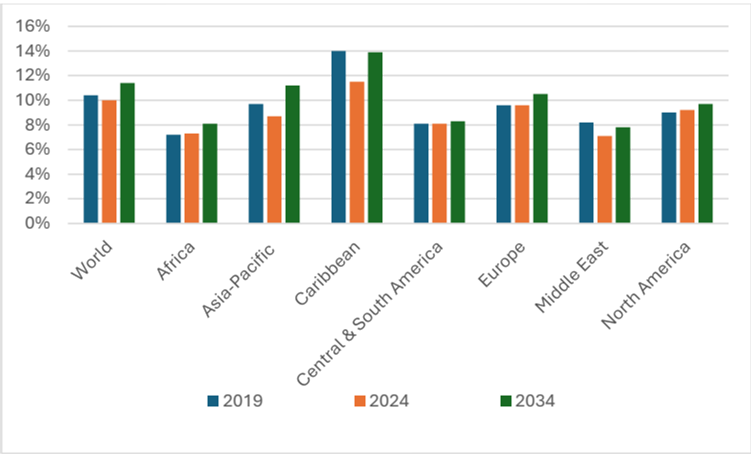
The World Travel and Tourism Council forecasts that, by 2034, the travel and tourism sector will have grown by 3.7% per year, outpacing the expected 2.4% annual growth in the broader global economy, and contributing $16 trillion (11.4%) to global GDP, 101 million new jobs and employment for 449 million people (roughly 12.2% of the global workforce). Between 2024 and 2034, the Asia-Pacific region is expected to experience the fastest growth in travel and tourism (6.1%), with China projected to surpass the United States of America with the largest absolute contribution of tourism to GDP Ref 170. Significant gains are also expected in India and Saudi Arabia.
Given its cross-cutting nature, importance to economic activity and human well-being, and critical dependence on environmental and cultural assets, tourism is uniquely positioned to contribute to all sustainable development pillars. However, when not properly managed, tourism can damage and degrade natural systems, deplete local resources and dilute culture, potentially diminishing destination appeal and offsetting economic gains from visitor spending. Strains on natural and cultural capital imposed by tourism can exacerbate vulnerability to climate change and economic shocks, leaving coastal communities increasingly at risk.
To balance the often competing needs of economic, environmental and community health and well-being (see subsect. 5B, chap. 3), it is necessary not only to make investments that target market-based economic returns from tourism, but also to invest in the protection of natural and cultural amenities and heritage and equitable outcomes for local people. Contrary to the current trend towards mass tourism, evidence suggests that marine ecotourists spend more time and money at destinations than traditional tourists Ref 127 Ref 151.
Justifying public investment in natural and cultural capital is inherently challenging. While the economic value of tourism is relatively easy for policymakers to observe and appreciate in terms of arrivals and employment, the value to tourism of healthy coastal and marine environments and culture, and the economic costs that tourism creates remain largely hidden and underappreciated due to their indirect, non-market nature. The future sustainability of coastal and marine tourism will depend on closing the gap between science and policy through targeted use of data and analytics to understand the links between tourism, the environment and human well-being and communicating those connections to decision makers, investors, travellers and coastal communities. The links between tourism, coastal and ocean resources and socioeconomic outcomes are outlined below and information is provided about alternative avenues for targeted investments to promote a more sustainable tourism sector.
2. Pressures and impacts
Coastal and ocean tourism is highly dependent on the health of natural resources, including beaches (see sect. 4, subchap. 5A), reefs (see sect. 4, subchap. 5D), mangroves (see sect. 4, subchap. 5H), marshes (see sect. 4, subchap. 5I), seagrasses (see sect. 4, subchap. 5G), seawater and numerous forms of wildlife, including birds (see sect. 4, subchap. 4G), fish (see sect. 4, subchap. 4D), sea turtles, pinnipeds and cetaceans. The health of these assets and their ability to attract visitors and contribute to economic activity and human well-being (see subsect. 5B, chap. 3) are under threat from an array of local and global pressures and impacts Ref 92 Ref 93 Ref 94.
Coastal tourism infrastructure, shoreline maintenance and protection
As pointed out in the first and second World Ocean Assessments, the increasing use of the coastal zone for leisure has transformed many of the world's coastlines (see subsect. 5A, chap. 9), making them more accessible for tourism and recreation, but also reducing their aesthetic appeal and the quantity and quality of ecosystem services that are vital to economic value and human well-being (see subsect. 5B, chap. 3). Compounded by sea level rise (see sect. 4, chap. 3), many coastlines are receding (see sect. 4, chap. 6, and subsect. 5B, chap. 4) Ref 35. To counter the loss of beaches and protect coastal real estate, many destinations have engaged in active shoreline maintenance and protection, including beach nourishment through sand replacement or the installation of shoreline armouring structures (see sect. 4, chap. 6) such as jetties, seawalls and groynes Ref 59 Ref 66 Ref 35. These changes can affect water flow, diminish water quality and cause the loss of valuable ecosystem services Ref 64 Ref 90. In addition, coastal tourism development can create issues of environmental justice when privatization of coastal lands, crowding and physical impediments imposed by built structures inhibit residents' access to and enjoyment of the coastline.
Solid waste
Tourism can generate large volumes of solid waste from lodging and leisure activities Ref 174. Coastal tourism is the main source of plastic litter (see sect. 4, chap. 6) on beaches Ref 52 Ref 73, the most common being food packages from beachgoers Ref 81. Solid waste management poses a challenge to small island destinations with tourism-based economies that have poorly developed waste infrastructure, have limited land area and are geographically isolated Ref 5. Islands are heavily dependent on imported goods but have little control over imported waste by-products. In addition, many must accept solid waste from cruise ships. This can lead to waste production exceeding management capacity, leaving few options other than landfills and incineration Ref 160. Poor solid waste management can have a negative effect on destination image and tourists' choices Ref 25 Ref 77.
Sewage and water pollution
Urbanization caused by tourism leads to water pollution (see sect. 4, chap. 6) through sewage or septic effluent and nonpoint source pollution from rain, storm water or snowmelt run-off. Polluted water that enters the ocean adds nutrients and induces excessive plant and algae growth, which can lead to hypoxia or "dead zones" in the water. Some algae are known to produce harmful toxins, which can create negative impacts on tourism visitation in coastal destinations Ref 12 Ref 172 Ref 105. In Florida, United States, for example, a bloom of the dinoflagellate Karenia brevis in 2018 caused $2.7 billion in economic losses to tourism-related businesses Ref 6. Discharge of sewage and run-off also reduces seawater quality, leaving local and visitor populations vulnerable to illness Ref 125.
Greenhouse gas emissions
The energy produced to meet the demands of coastal and ocean tourism generated an estimated 1.57 billion tons of carbon dioxide equivalent (CO2 e) emissions in 2023, representing 3% of global greenhouse gas emissions. Of these estimated 1.57 billion tons, 50% stems from supply chain sources (referred to as scope 3 emissions), 25% from direct emissions from sources owned or controlled by an organization, such as domestic transport (referred to as scope 1 emissions), 7% from indirect emissions from purchased energy (scope 2 emissions) and 19% from international transport Ref 171. In many industrialized nations, the climate impact from long-distance travel (one-way trips exceeding 100 km) is greater than that from short-distance travel. Aviation is the major emitter in this sector, generating 2.4% of global anthropogenic CO2 emissions in 2017 Ref 3. Cruises are a particularly carbon-intense type of travel. While two of the major cruise liners report 2% annual improvements in carbon intensity in recent years and aim to continue improving at that rate (Royal Caribbean Group, 2021; Carnival Corporation & PLC, 2022), these figures refer to scope 1 and 2 emissions only, and a 2% reduction in carbon intensity is likely to be cancelled out by the expected 6-7% passenger growth Ref 114.
Interactions with wildlife
Opportunities for wildlife-based recreation can yield significant benefits to tourists and local communities. For example, ecotourism based on marine megafauna is one of the fastest growing sectors of ecotourism Ref 62. In Semporna, Malaysia, shark-diving tourism provided more than $9.8 million in direct expenditures per year Ref 154. Shark and ray tourism in Indonesia produces an estimated $22 million in direct expenditures annually, equivalent to at least 7% of the $1 billion in revenue from marine tourism in the country Ref 99. Recent evidence suggests that the popularity of shark diving could double in the next 20 years Ref 29. However, interactions between tourists and wildlife, including noise and physical disturbance caused by human visitors, can affect the behaviour and fitness of animals by causing changes in foraging, migration and aggregation patterns, and displacement from preferred habitat, negatively affecting wildlife populations Ref 104 Ref 23 Ref 140 Ref 119. Populations that are spatially constrained or food-limited are most sensitive to tourism pressures and impacts Ref 103. Beyond recreation, tourism can be an important driver of food systems and can lead to an increased demand for seafood (see subsect. 5A, subchaps. 1E and 1F), which has been associated with increases in fishing effort and unsustainable harvest practices Ref 97. Touristic vessels are also a known pathway for the introduction of non-native species (see sect. 4, chap. 6) into marine environments and may have a disproportionate effect on the risk of introduction into marine protected areas (MPAs) Ref 118 (Slišković and others, 2021). As highlighted in the second World Ocean Assessment, Antarctic and Arctic tourism have been growing rapidly in recent years. Coupled with heightened pressures on native biodiversity caused by the increasing pace of environmental change in polar regions, the seasonal timing of human presence in these regions increases the chances of direct human-wildlife conflicts, adverse impacts on endemic fauna and flora and the establishment of non-native species (see sect. 4, chap. 6) Ref 149.
Mass tourism
The arrival of large amounts of visitors, although a means of economic activity and diversification, can negatively reshape local economies by increasing the cost of property and the overall cost of living Ref 53, potentially leading to crowding out of locals Ref 176. Such trends can also hasten change in the skills necessary to prosper, which can be to the detriment of the resident workforce and may impact equitable access to essential services Ref 4 Ref 95. Tourism's rapid recovery from the COVID-19 pandemic (see subsect. 5B, chap. 7) exacerbated problems associated with tourist volume and overtourism. Following the pandemic, there was a marked increase in tensions between tourists and residents and in pushback by locals on the impacts of overtourism on housing prices and availability, public services and degradation of natural areas and cultural sites Ref 7 Ref 56 (Ref 96; Stojčić, Vizek and Galurdić, 2024). Protests calling for limits on tourism were held in popular coastal destinations in Greece, Italy and Spain and several locations in the United States, including New York, San Francisco, Los Angeles and Oahu. Several coastal destinations in Europe and Asia have imposed bans or restrictions on short-term rental platforms to mitigate tourism impacts on housing prices and availability Ref 163. Destinations in China, France, Italy, Spain and the United States have implemented economic incentive policies such as tourist fees to quell crowds Ref 28. More radical proposals include complete or partial bans on cruise ships in port destinations such as Amsterdam in the Kingdom of the Netherlands, Barcelona in Spain, Dubrovnik in Croatia, Mykonos and Santorini in Greece, and Venice in Italy to offset the negative impacts of tourist crowding Ref 102.
As the top destination for coastal and ocean tourism for millions of tourists, islands are particularly vulnerable to the impacts of mass tourism but are also dependent on visitor spending Ref 18. However, the cost of managing tourism frequently outpaces the revenue generated and retained. Small islands often accumulate public debt as tourist arrivals rise Ref 122 Ref 123. In Maldives, for example, tourism grew to represent 80% of the economy, while public account balances fell, leaving the nation in debt. Such "operational externalities" generated by costs on public infrastructure can leave nations with insufficient financing to manage tourism impacts Ref 43. An example of the scale of tourism that many small island developing States face is the Caribbean island of Aruba, which has a population of 105,000 and a land area of around 178 square km, yet hosted over 1 million tourists in 2017 Ref 63.
Cruise tourism
Despite comprising less than 3% of all travel, the cruise industry is one of the fastest-growing sectors of tourism, with approximately 40 million passengers expected by 2027, supported by a fleet of over 330 cruise ships (Cruise Lines International Association (CLIA), 2024). It is one of the most common forms of mass tourism and is the dominant form of tourism in many coastal and ocean destinations Ref 15. North America and Europe remain the largest source markets for cruises, accounting for 57% and 26% of passenger volume, respectively, with the Caribbean and Mediterranean the most popular cruise destinations, receiving roughly 44% and 19% of travellers, respectively. For some island destinations in the Caribbean, the annual number of cruise passengers far exceeds the local population Ref 168. Although the impacts of cruise passenger spending are the subject of debate due to the short length of stay, limited spatial movement of passengers on shore Ref 145 and availability of onboard services and amenities Ref 58, cruise ship arrivals can generate positive economic impacts for coastal communities Ref 27. Large volumes of temporary visitors also create pressures on local water, food and waste disposal resources and produce large volumes of emissions, solid waste, sewage, greywater and oily bilge water Ref 91. The cruise industry releases 300,000 gallons of sewage, 8 tons of solid waste and 25,000 gallons of bilge water weekly, along with other by-products, at destinations and into national waters, causing a multitude of stress on marine ecosystems Ref 42 Ref 91. Despite comprising less than 1% of the merchant fleet Ref 34, cruise ships release up to 25% of all fleet waste Ref 19. Other impacts from cruise tourism include modification of nearshore ecosystems to accommodate cruise ships Ref 86, damage from anchoring Ref 50 Ref 132 Ref 142 and breakdown of the sociocultural make-up of destinations Ref 67.
Recent estimates of carbon intensity based on annual reports from the three largest cruise lines (Carnival, Royal Caribbean and Norwegian) Ref 114 suggest that the global cruise sector emitted approximately 60 Mt CO2e in 2018, which is comparable to the annual emissions of many countries. With expected growth of 6% per year, emissions of 40 Mt CO2e (scope 1 and 2 emissions) or 80 Mt CO2e (scope 1, 2 and 3 emissions) are expected by 2030, trends that stand in stark contrast to global ambitions to halve emissions by 2030 (Hoegh-Guldberg and others, 2023).
3. Social components
The social and cultural sustainability of coastal and ocean tourism is also of considerable importance Ref 85. Opportunities for recreation and access to blue spaces drive travel to coastal and ocean locations and contribute to visitors' mental health, physical activity, enhanced psychological connection to the natural world (see subsect. 5B, chap. 2) and pro-environmental behaviours Ref 54 Ref 164. Evidence suggests that sustainable tourism initiatives can also generate significant social capital for coastal populations through economic diversification, cultural and natural heritage preservation and educational infrastructure development Ref 115. Tourism revenues can be harnessed as a means of boosting employment and addressing core issues relating to poverty Ref 177. Marine ecotourism can also empower community members to serve as environmental stewards, finance and expand MPAs and promote ocean literacy and citizen science Ref 17 Ref 128. It can also facilitate the transmission of traditional ecological knowledge, thereby reinforcing place-based cultural identities (Pomeroy and others, 2007).
However, there are sociocultural challenges associated with ocean tourism development, particularly regarding power asymmetries between external stakeholders and local populations, and adverse effects on residents' well-being from the pressures and impacts outlined in part 3 above. The phenomenon of cultural commodification is a documented concern, wherein culturally significant marine practices undergo transformation into commercialized experiences for tourist consumption (Mostafanezhad and Norum, 2019). Other adverse socioeconomic impacts from tourism such as congestion, higher prices, seasonal unemployment, economic leakage, distributional inequality and dilution of culture can induce negative host attitudes toward tourism and restrain the sustainable development of the sector Ref 21 Ref 49. Dissimilarities between the social and cultural norms of visitors and host communities can also create tensions, resentment, irritation and conflict Ref 83. This will be evidenced in the coming years with the entry into coastal tourism development of countries like Saudi Arabia. Returns from their recent and significant investments in tourism may hinge on accommodating visitors in a culturally sensitive manner and blending tourism development with the sociocultural norms that reflect the country's religious heritage Ref 55 Ref 175.
4. Sector-relevant governance
The tourism industry is highly fragmented, comprising a variety of product and service markets, including transportation, accommodation, attractions, nightlife, recreation and food and beverages, and is intrinsically connected to other economic sectors and the broader macroeconomy. Coastal and ocean tourism involves public and private goods, asymmetric power across stakeholder groups and a coupling of dependence and impact between the economy and the natural environment.
Owing to these challenges and complexities in governance, progress towards sustainable coastal and ocean tourism requires policy coherence across numerous private and civil society stakeholders operating at the local, national, regional and international levels, and clear and accurate understanding of the magnitude and direction of change Ref 84 Ref 39. Increased interest in new forms of governance for sustainable tourism has been driven in recent years by heightened sustainability awareness, smarter tourism development and management for both tourists and residents, a rising call for social inclusion, new technologies, a growing need for resilience and increasing governmental interest in destination governance and stewardship Ref 71 Ref 126. Prerequisites include a unified vision and organization at the destination, national and regional levels, the effective use of data and information, and clear communication and cooperation across a range of stakeholder groups Ref 139.
Current research advocates for governance frameworks characterized by collaborative decision-making mechanisms that allocate substantive authority to local actors regarding marine tourism development trajectories (Milne and Ateljevic, 2001; Ref 81). Such community-forward frameworks necessarily encompass equitable labour standards, support for local enterprise development, and protocols for cultural exchange predicated on community-determined parameters (Asker and others, 2010; Jackson, 2025). There is also an imperative to integrate Indigenous knowledge systems as foundational elements within sustainable tourism paradigms rather than as peripheral considerations (Nursey-Bray and Rist, 2009). Engaging local communities in the visioning, planning and co-management of sustainable tourism initiatives can generate and renew knowledge, awareness and pride in local ecosystems, history and traditions, foster local ownership, stimulate interest and investment in preservation and ensure that tourism practices align with ecological and cultural values (Ref 13; Ref 79; Ref 152).
The integration of environmental, social and governance principles into tourism business models has increased in recent years in response to consumer and investor pressure to engage in responsible practices and to build organizational resilience against environmental and social risks in an increasingly volatile global context Ref 57. Environmental, social and governance practices can improve operational efficiency related to environmental impacts associated with agriculture, water and waste management systems, while enhancing community engagement and advancing the fair treatment of employees Ref 10. While research into the impact of corporate environmental, social and governance strategies on financial returns is limited, preliminary evidence suggests that engaging in corporate social responsibility activities can yield positive returns for tourism and hospitality firms in terms of performance and market value and that factors related to governance and stakeholder engagement are critical components of success Ref 72.
At the destination level, the creation of a central tourism management organization taking into consideration private and public sector tourism interests and involving community leaders can be effective in coordinating goals across the complex and multi-stakeholder nature of the sector and ensuring open and inclusive participation Ref 14. To assist destinations in advancing inclusive destination governance, the World Travel and Tourism Council has not only a destination stewardship governance diagnostic framework that provides alternative destination stewardship scenarios, but also a diagnostic tool to identify triggers and barriers to effective destination stewardship, assess different aspects of destination governance and identify priority areas for improvement Ref 169.
Modes of regional governance can provide many benefits to coastal and ocean tourism destinations, including opportunities for capacity-building, improved access to data and resources, risk-sharing and efficiency gains from economies of scale Ref 148. Establishing regional coordination through governance mechanisms can also help to minimize price competition between locations, which can induce a "race to the bottom" in terms of sustainability Ref 39 Ref 61. International cooperation and collaboration can be enhanced through the formation of regional clubs designed to promote shared values and understanding across diverse tourism actors and unite economic and social interests. Coordination of environmental policies between countries (e.g. standards for cruise ships, tourist fees earmarked for conservation, environmental tax rates) can address the concerns of domestic industries that may be vulnerable to international competition Ref 33.
5. Sustainable pathways
The future of coastal and ocean tourism will be shaped by global economic conditions such as the availability of disposable income and leisure time, the costs of energy and travel, information technology, demographics and global environmental change. Ocean acidification and rising sea temperatures (see sect. 4, chap. 3) are expected to have continued detrimental impacts on nearshore ecosystems (Guild and others, 2024; Ref 157), affecting destination appeal and leaving coastal destinations increasingly vulnerable to the effects of a changing climate Ref 68 Ref 161. Despite commitments by Member States at the twenty-eighth session of the Conference of the Parties to the United Nations Framework Convention on Climate Change and noticeable progress since the adoption of the Paris Agreement, a large climate action gap remains and appears unlikely to close soon Ref 167, suggesting that coastal and ocean destinations should anticipate continued impacts from changes in temperature and rainfall, warmer seas, rising sea levels Ref 24 and hazardous weather events Ref 22.
Younger and wealthier travellers, a larger middle class, low transportation costs and increasing demand for experiential travel suggest that tourism volume will continue to grow and "overtourism" will continue, bringing continued pressures and tensions between visitors and local populations. As with all economic sectors, the tourism sector will be characterized by increasing access to richer and more comprehensive data, indicators and processing power, including machine learning and artificial intelligence tools, providing unprecedented opportunities for visitor engagement and improved understanding of tourist preferences, behaviours and impacts Ref 145.
Transitioning towards a more sustainable future will involve investments to mitigate dependence on tourism and build resilience to the pressures and impacts outlined above, while safeguarding the economic viability of the sector by restoring and regenerating the natural and cultural capital that attracts visitors and supports local communities Ref 60 Ref 106 Ref 129. Given the diverse array of coastal and ocean destinations across the globe and the complex and highly contextual relationships between tourism and economic, environmental, social and cultural outcomes, there is not a one-size-fits-all prescription for the future of the sector Ref 109.
Four complementary pathways for reorienting coastal and ocean tourism towards more sustainable outcomes are set out below. These pathways assume that other ocean sectors (e.g. capture fisheries (see subsect. 5A, subchaps. 1A and 1B), shipping (see subsect. 5A, chap. 6) and extraction of energy resources (see subsect. 5A, subchap. 3B)) will continue and that unfettered market forces will not provide efficient investment in protection and regeneration of ecosystems and cultural resources Ref 137.
Each pathway addresses the array of environmental and social impacts created by tourism outlined above and relies on purposeful planning and investment. A key challenge in achieving investments in environmental and social capital is that the associated returns are often not observable in terms of traditional economic indicators and may only be apparent over a time frame that is longer than election cycles. Most nations have limited fiscal space for long-term investments with unclear returns. Key elements of sustainable pathways across destinations therefore include improved access to financial resources to support investment in natural and social capital, enhanced data collection and analysis to illustrate economic returns from that investment and the creation of inclusive governance frameworks to support policy and legislation that incentivize information-sharing and private sector investment in sustainable outcomes Ref 167.
Investment in data collection, publication and analysis to understand linkages between tourism and natural and cultural resources and the full costs and benefits of tourism
Many of the amenities that attract visitors to coastal and marine destinations are open-access public goods, generating no direct economic impacts, but serving as key drivers for market-based activities that generate income and employment Ref 100. A deep body of research illustrates that maintaining or enhancing the quality of coastal and ocean ecosystems allows for significant contributions to economic growth, employment and poverty reduction while enhancing resilience to climate change, natural disasters and economic shocks (Patil and others, 2016). Damage to coastal and ocean systems entails real economic costs. Eroded or littered beaches (see sect. 4, subchap. 5A and chap. 6), degraded reefs (see sect. 4, subchap. 5D) and polluted seawater (see sect. 4, chap. 6) are known to be less attractive to tourists Ref 136 and loss of coastal ecosystems puts tourism assets at risk Ref 11 Ref 143.
Despite these well-known findings, coastal and marine ecosystems continue to be modified, damaged and degraded by human activities associated with market-based returns Ref 9 Ref 130. Part of this dichotomy lies in the fact that market-based metrics such as arrivals, spending, jobs and revenues are widely publicized and easily understood, while measures of ecosystem health and function lack clear and appropriate monetary signals, creating a situation where private and public interests are naturally inclined to prioritize market values. This information gap inhibits sustainable management, as policymakers must operate with incomplete understanding of connections between traditional economic activity and natural and cultural capital Ref 150.
Measuring the impacts of tourism on natural and cultural resources is an integral part of monitoring and controlling those impacts Ref 116. Investments in the comprehensive collection and analysis of economic, social and environmental data can facilitate empirical assessments of the relationships between market activity and environmental and cultural sources of human well-being (see subsect. 5B, chap. 3), such as ecosystem health and extent, maintenance of local knowledge and traditions, and equitable distribution of the economic benefits from tourism. Avenues for data collection to support the enhanced monitoring, assessment and prediction of ecosystem health include advanced mooring systems that facilitate the collection of real-time data on seawater quality, biodiversity, climate variability and ocean hazards. Smart tourism apps can help to measure and manage ecological footprints and carrying capacities, assess visitor satisfaction, enhance operational efficiency and reduce waste Ref 120 Ref 159. Smart technology can also facilitate the bidirectional exchange of information with visitors, further engaging them in destination sustainability by guiding and informing decisions regarding purchases, experiences and movement. An example of the power of digital tools and improved access to data is the use of mandatory global navigation satellite system trackers to monitor local seafood in the tourism sector in Jamaica, where consumers are increasingly demanding supply chain transparency and traceability Ref 107. Digital data-gathering mechanisms like apps empower local fishers (see subsect. 5A, subchap. 1B) while giving consumers confidence in premium-priced, sustainably labelled seafood (see subsect. 5A, subchap. 1E).
Coupling traditional measures of economic impacts from tourism with measures of non-market impacts, such as waste generation, water and energy use, crowding, ecosystem health and qualitative forms of information such as visitor and resident satisfaction, can form the foundation for education and capacity-building programmes designed to help policymakers, tourism operators and civil society to understand the real economic value of natural and cultural resources and redefine the notion of tourism success Ref 48 Ref 137. Beyond the provision of a clearer view of tourism's impacts on ecosystems and communities, the measurement and mapping of ecosystem service stocks, flows and values can support evidence-based decision-making Ref 138 for investment planning and for designing policies that direct resources towards their highest and best use Ref 115 Ref 137. Empirical evidence regarding the economic losses created by tourism can also help destinations to negotiate and implement tourist fees (e.g. cruise passenger fees) commensurate with costs imposed on local resources and infrastructure.
Echoing the recommendations of the Ocean Decade Vision 2030 Ref 20 and the Intergovernmental Oceanographic Commission (IOC-UNESCO) State of the Ocean Report 2024 Ref 110, this pathway may require increased investment in data literacy, information technology readiness, the updating and modernization of national statistical offices and systems, data collection and data-sharing, and analysis efforts that span disciplinary and geographical boundaries. Natural capital accounting methods such as the System of Environmental-Economic Accounting and ocean accountsⓘ provide structure for such data using a framework that is compatible with traditional national income accounts used by statistical offices and finance ministries. Creating and maintaining such accounts can foster and improve collaboration and coordination across government entities, help to identify gaps and deficiencies in data and statistics related to national priority issues (e.g. energy efficiency, water use, emissions and protected area management), help to measure and manage risks and opportunities related to nature, and improve stakeholder engagement Ref 45 Ref 70 Ref 74 Ref 121. By mapping tourism's linkages with coastal and marine ecosystems, ocean accounts also demonstrate the sector's vested interest in supporting ocean conservation, safeguarding its own future prosperity, and can be used to identify sustainable scenarios and pathways Ref 51.
High-quality, immersive nature-positive and authentic community-based tourism
A broad body of empirical evidence shows that immersion in nature and culture can stimulate place attachment, sustainable behaviours and willingness to return Ref 26 Ref 76 Ref 165 Ref 177 and that tourists are willing and able to give back Ref 1 Ref 162. Developing and promoting opportunities for high-quality, immersive nature-positive and authentic community-based tourism experiences can foster connections between visitors and marine environments, attract longer-staying visitors who spend within the local economy, strengthen visitor awareness of local conservation issues and enhance resiliency by counteracting tourism seasonality, while creating opportunities for employment, entrepreneurship and economic empowerment Ref 84 Ref 88 Ref 153. Well-designed experiences can cultivate visitors' ocean literacy and environmental consciousness that extend beyond the travel period (Ballantyne and others, 2018), generating ripple effects as tourists return home with new perspectives on ocean conservation, potentially influencing consumption patterns and political support for marine protection (Zeppel and Muloin, 2008; Walker and Moscardo, 2014). For coastal communities facing climate threats, sustainable tourism initiatives can serve as a vehicle for climate adaptation education, helping both residents and visitors to understand changing ocean conditions while building collective resilience against environmental uncertainties (Sheller, 2021; Cinner and others, 2018).
Examples of nature-positive community-based opportunities include the sustainable community tourism initiative in the Dominican Republic, which links communities with tourists emphasizing proper management of natural resources, appreciation of cultural heritage, equitable distribution of benefits from tourism and local community development through empowerment, entrepreneurship and self-management. Tourist scuba divers in Fiji can join with local non-profit organizations and engage in citizen science or participate in more active pursuits such as coral restoration, creating a triple win: improved data and knowledge, action that advances conservation, and enhanced tourist satisfaction and willingness to return. Blue Safari Seychelles is a company that allows visitors to help to protect marine ecosystems through data collection of encounters with species, tree planting, beach clean-ups and underwater debris collection. Travelers pay a daily conservation charge of $25, earmarked for ecological programmes and initiatives Ref 150. Other examples are shown in the table below.
Opportunities to inform visitors regarding the importance of environmental and cultural assets and the purpose of sustainability initiatives can further engage visitors and stimulate responsible behaviour Ref 2 Ref 84. Codes of conduct, such as the Palau Pledge, incentivize tourists to interact with the local community and culture and participate in regeneration projects Ref 65 Ref 87. The Palau Pledge is stamped in all tourists' passports, which they must sign before passing through customs Ref 87. An emerging area is improving access to information regarding the environmental impacts of trip decisions and enabling tourists to make carbon-offset contributions to blue carbon investments such as mangrove restoration or choose lower-emitting flights and accommodation using carbon calculators and carbon data transparency initiatives, such as Skyscanner and Google.
Challenges to implementing nature-positive and community-based tourism include: scaling due to reliance on small enterprises and carrying capacities of sensitive cultural sites and ecosystems; maintenance of natural and cultural integrity; and avoiding the commodification of culture and heritage. To ensure long-term success and community buy-in, it is essential for residents to be fully engaged in the co-development of such initiatives. Inclusive capacity-building and training in sustainable practices targeting local management and/or ownership of commercial tourist enterprises can further empower residents.
Table Nature-positive and community-based tourism initiatives
| Active | |
| Preservation | Shoreline and marine clean-up efforts; invasive species removal |
| Regeneration | Mangrove planting; seagrass propagation; coral restoration; tree planting; dune restoration; marsh restoration; restoration of tidal flows and natural hydrology |
| Citizen science | Encounters with species; species counts; water quality or clarity assessments; litter counts |
| Nature- and culture-based adventures | Wildlife and habitat viewing; fishing; diving and snorkelling; cooking and cuisine |
| Passive | |
| Tours and visits | Museums; coastal ecosystems; historic and heritage sites; visual and performing arts |
| Local goods and services | Markets for local arts and crafts, products and services; health and wellness |
| Non-intrusive access to nature | Boardwalks, bridges, wildlife viewing structures; species identification and other interpretive signage |
| Immersive learning experiences | Cultural interpretation of natural environments and species, storytelling, history and heritage; importance of ecosystems; endemic biodiversity |
Source: Adapted from Thorburn, Milne and Deuchar, (2021) and Leotaud and others (2024).
Multi-use planning and diversification for infrastructure, services and operators
This can provide backstop income and employment opportunities during periods of tourism disruption and enhance destination resilience to natural hazards and economic shocks. Public investments in infrastructure improvements targeting energy efficiency, maintenance of water and waste management infrastructure, and protection of ecosystems and biodiversity have been shown to provide positive economic and environmental returns Ref 117. Opportunities for tourism diversification include niche markets such as ecotourism, cultural and heritage tourism and community-based tourism Ref 84. Increasing focus on service quality for business travellers and providing incentives to extend visits beyond the work period can offset losses from the decline in demand for business travel, generate additional economic impacts and create new opportunities for return visitation. Examples include remote work visa programmes that target digital nomads Ref 133. Investments in local capacity-building, such as training marine tourism operators to monitor protected sites and collect data regarding ecosystem health and function, can also enhance economic resilience to tourism downturns and empower tourism stakeholders as stewards of the natural environment Ref 36. A key challenge is that diversifying tourism value chains and decreasing economic dependence on tourism requires structural reform.
Enhanced use of economic instruments to incentivize the transition towards sustainable outcomes and create fiscal space for investments in natural and cultural capital
Coastal and ocean tourist destinations can use an array of fiscal policy tools to harness the power of monetary incentives and direct financial resources towards activities that generate long-term economic returns through regeneration and resilience, pollution reduction and the increased sustainability of tourist attractions. Taxes, fees, subsidies and payments for environmental services have been shown to be effective in funding protected area management, green energy, nature-based solutions, the decarbonization of supply chains, waste and emissions reductions and water use efficiency without constraining economic and social development or deterring visitation Ref 112 Ref 147 Ref 156.
Tourist fees can serve the dual purpose of revenue generation and visitor management. A large body of empirical evidence suggests that visitors are willing to pay fees that improve resource quality or offset management costs when the purpose is clearly communicated Ref 41 Ref 131 Ref 47. In addition, collection points for visitor fees create a conduit for bidirectional exchange of information, enabling enhanced visitor management and the education of tourists on codes of conduct, the importance of natural systems, history, culture and traditions, and environmentally and culturally responsible behaviours, and facilitating the collection of information related to tourist activities, spending, preferences and satisfaction.
In addition, Governments can incentivize private sector sustainability initiatives through monetary and operational subsidies such as favourable tax treatment and fast-tracked permits for tourism projects that promote renewable energy, green products and services, locally sourced inputs, high-quality and low-volume experiences and community benefits Ref 84 Ref 167. Special events, visitor concessions for off-season trips and visits to less popular sites and attractions can also be used for visitor management and for the reduction of the impacts of seasonality Ref 31. Quota or reservation systems can also be used for high-demand or sensitive sites. Destinations must first measure and understand capacity limits in terms of adverse impacts on ecosystems, cultural integrity, water and energy resources, infrastructure, community well-being, safety and visitor satisfaction.
6. Conclusion
The review of the nature and extent of coastal and ocean tourism and its impacts on human and environmental well-being set out above highlights a coupling of dependence and impact. Economic and social gains from coastal and ocean tourism rely on the ability of coastal and marine ecosystems to provide benefits to visitors and local communities. However, mounting evidence suggests that continued growth of the sector poses threats to the natural and cultural resources upon which tourism depends.
Transitioning coastal and ocean tourism towards more sustainable outcomes will require a shift among tourism stakeholders to view the value and success of tourism more holistically, complementing traditional market-based measures of economic activity with measures of environmental, cultural and community costs and benefits. This shift will require purposeful public and private sector investments. Investments in data collection and analysis can close information gaps, allowing for a more comprehensive view of tourism's value and impacts, facilitating evidence-based planning and decision-making and providing the foundation for education and capacity-building programmes. Support for nature-positive and community-based tourism opportunities can create economic gains and empower both visitors and local communities to be agents of change. Multipurpose infrastructure and diversification of product and service offerings can improve economic efficiency and enhance destination resilience to natural hazards and economic shocks. Enhanced use of economic instruments can incentivize sustainable behaviours and create revenue streams to support investments in natural and cultural capital.
References
- Adam, I. (2021). Tourists' perception of beach litter and willingness to participate in beach clean-up. Marine Pollution Bulletin, 170, p.112591.
- Aini, W., and Syuraini, S. (2023). The Implementation of Community Participation Guidebook Development as an Effort in Environmental Preservation of Air Manis Beach in Padang City. Journal of Nonformal Education, 9(1), pp. 77-86.
- Åkerman, J., Kamb, A., Larsson, J., and Nässén, J. (2021). Low-carbon scenarios for long-distance travel 2060. Transportation Research Part D: Transport and Environment, 99, p. 103010.
- Albalate, D., and Bel, G. (2010). Tourism and urban public transport: Holding demand pressure under supply constraints. Tourism management, 31(3), pp. 425-433.
- Almroth, B.C., and Kershaw, P. (2024). Status and trends of plastic pollution, including strategies on how to reduce them. State of the Ocean Report, p. 18.
- Alvarez, S., Brown, C.E., Diaz, M.G., O'Leary, H., and Solís, D. (2024). Non-linear impacts of harmful algae blooms on the coastal tourism economy. Journal of Environmental Management, 351, 119811.
- Amrhein, S., and Langer, M. (2025). Resistance and power dynamics in tourist destinations: a study of Mallorca's anti-touristification protests through Bourdieu's theory of practice. Journal of Sustainable Tourism, 1-18.
- Artal-Tur, A., Navarro-Azorín, J.M., and Ramos-Parreño, J.M. (2021). Estimating the impact of cruise tourism through regional input-output tables. In Tourism Research in Ibero-America (pp. 70-80). Routledge.
- Atwood, T.B., Connolly, R.M., Almahasheer, H., Carnell, P.E., Duarte, C.M., Ewers Lewis, C.J., Irigoien, X., Kelleway, J.J., Lavery, P.S., Macreadie, P.I. and Serrano, O. (2017). Global patterns in mangrove soil carbon stocks and losses. Nature Climate Change, 7(7), pp. 523-528.
- Back, K.J. (2024). ESG for the hospitality and tourism research: Essential demanded research area for all. Tourism Management, 105, p. 104954.
- Barbier, E.B. (2015). Valuing the storm protection service of estuarine and coastal ecosystems. Ecosystem Services, 11, pp. 32-38.
- Berdalet, E., Pavaux, A.S., Abós-Herràndiz, R., Travers, M., Appéré, G., Vila, M., and Lemee, R. (2022). Environmental, human health and socioeconomic impacts of Ostreopsis spp. Blooms in the NW Mediterranean. Harmful Algae, 119, 102320.
- Bichler, B.F. (2021). Designing tourism governance: The role of local residents. Journal of Destination Marketing & Management, 19, p. 100389.
- Bichler, B.F., and Lösch, M. (2019). Collaborative governance in tourism: Empirical insights into a community-oriented destination. Sustainability, 11(23), 6673.
- Bresson, G., and Logossah, K. (2011). Crowding-out effects of cruise tourism on stay-over tourism in the Caribbean: Non-parametric panel data evidence. Tourism Economics, 17(1), pp. 127-158.
- Brida, J.G., Gómez, D.M., and Segarra, V. (2020). On the empirical relationship between tourism and economic growth. Tourism Management, 81, p. 104131.
- Bushell, R., and Bricker, K. (2017). Tourism in protected areas: Developing meaningful standards. Tourism and Hospitality Research, 17(1), pp. 106-120.
- Butler, R.W., and Dodds, R. (2022). Island tourism: Vulnerable or resistant to overtourism. Highlights of Sustainability, 1(2), 54-64.
- Butt, N. (2007). The impact of cruise ship generated waste on home ports and ports of call: A study of Southampton. Marine Policy, 31(5), pp. 591-598.
- Calewaert, J.- B., Sierra-Correa, P.C.,de Boer, G., Crosman, K., Kågesten, G., Taconet, M., Busumprah, P.T., Alvarez-Fanjul, E., Shepherd, I., Schaap, D., Hall, S., Zinkann, A.- C., Haddad, T., Jegat, V., Smit, M., Sun, M., Suzuki, T., Visbeck, M., Xingyuan, R., and McMeel, O. (2024). Ocean Decade Vision 2030 White Papers - Challenge 8: Create a Digital Representation of the Ocean. Paris, UNESCO-IOC. (The Ocean Decade Series, 51.8.). https://doi.org/10.25607/bxhy-ra59.
- Canavan, B. (2016). Tourism culture: Nexus, characteristics, context and sustainability. Tourism management, 53, pp. 229-243.
- Catalano, M., Forni, L., and Pezzolla, E. (2020). Climate-change adaptation: The role of fiscal policy. Resource and Energy Economics, 59, p. 101111.
- Cattano, C., Turco, G., Di Lorenzo, M., Gristina, M., Visconti, G., and Milazzo, M. (2021). Sandbar shark aggregation in the central Mediterranean Sea and potential effects of tourism. Aquatic Conservation: Marine and Freshwater Ecosystems, 31(6), 1420-1428.
- Cazenave, A., and Mitchum, G. (2024). Sea level rise State of the Ocean Report, p. 52.
- Chaudhry, A.K., Sachdeva P. (2021). Microplastics' origin, distribution, and rising hazard to aquatic organisms and human health: Socio-economic insinuations and management solutions. Regional Studies in Marine Science, 48, 102018.
- Chen, H., and Rahman, I. (2018). Cultural tourism: An analysis of engagement, cultural contact, memorable tourism experience and destination loyalty. Tourism management perspectives, 26, pp. 153-163.
- Chen, J.M., Petrick, J.F., Papathanassis, A., and Li, X. (2019). A meta-analysis of the direct economic impacts of cruise tourism on port communities. Tourism Management Perspectives, 31, pp. 209-218.
- Choi, J., Jeon, H., and Asperin, A. (2024). Popularity Paradox in Venice, Italy: A Battle of Priorities. Journal of Hospitality & Tourism Cases, 21649987241281375.
- Cisneros-Montemayor, A.M., Townsel, A., Gonzales, C.M., Haas, A.R., Navarro-Holm, E. E., Salorio-Zuniga, T., Johnson, A.F. (2020). Nature-based marine tourism in the Gulf of California and Baja California Peninsula: economic benefits and key specie Nat. Resour. Forum, 44 (2), 111-128. https://doi.org/10.1111/1477-8947.12193.
- Coldwell, W. (2017). First Venice and Barcelona: now anti-tourism marches spread across Europe. The Guardian, 10.
- Connell, J., Page, S.J., and Meyer, D. (2015). Visitor attractions and events: Responding to seasonality. Tourism management, 46, pp. 283-298.
- Cooper, J.A.G., O'Connor, M.C., and McIvor, S. (2020). Coastal defences versus coastal ecosystems: a regional appraisal. Marine Policy, 111, 102332.
- Coste, A., M. Cali, N. Cantore, and D. Heine (2018). Staying Competitive: Productivity Effects of Environmental Taxes. In Fiscal Policies for Development and Climate Action, M.A. Pigato, ed. 65. Washington, D.C.: World Bank. https://elibrary.worldbank.org/doi/epdf/10.1596/978-1-4648-1358-0_ch2.
- CLIA (2024). State of the Cruise Industry Report, Cruise Lines International Association, May. https://cruising.org/-/media/clia-media/research/2024/2024-state-of-the-cruise-industry-report_updated-050824_web.ashx.
- De Schipper, M.A., Ludka, B.C., Raubenheimer, B., Luijendijk, A.P., and Schlacher, T.A. (2021). Beach nourishment has complex implications for the future of sandy shores. Nature Reviews Earth & Environment, 2(1), 70-84.
- Day, J. (2008). The need and practice of monitoring, evaluating and adapting marine planning and management - lessons from the Great Barrier Reef. Marine policy, 32(5), 823-831.
- Domènech, A., Gutiérrez, A., and Anton Clavé, S. (2020). Cruise passengers' spatial behaviour and expenditure levels at destination. Tourism Planning & Development, 17(1), pp. 17-36.
- Downs, C.A., Cruz, O.T., and Remengesau J.r., T.E. (2022). Sunscreen pollution and tourism governance: Science and innovation are necessary for biodiversity conservation and sustainable tourism. Aquatic Conservation: Marine and Freshwater Ecosystems, 32(5), pp. 896-906.
- Dwyer, L. (2003). Trends underpinning tourism to 2015: An analysis of key drivers for change. International Journal of Tourism Sciences, 3(2), pp. 61-77.
- Dwyer, L., and Kim, C. (2003). Destination competitiveness: Determinants and indicators. Current Issues in Tourism, 6(5), 369-414.
- Edwards, P.E. (2009). Sustainable financing for ocean and coastal management in Jamaica: The potential for revenues from tourist user fees. Marine Policy, 33(2): 376-385.
- Epler Wood, M. (2017). Sustainable Tourism on a Finite Planet: Environmental, Business and Policy Solutions. London: Routledge. https://doi.org/10.4324/9781315439808.
- Epler Wood, M., M. Milstein, and K. Ahamed-Broadhurst (2019). Destinations at Risk: The Invisible Burden of Tourism. Bristol, UK: Epler Wood International and Travel Foundation; New York: Cornell University, Centre for Sustainable Global Enterprise. https://www.thetravelfoundation.org.uk/invisible-burden/.
- Fan, D.X., Liu, A., and Qiu, R.T. (2019). Revisiting the relationship between host attitudes and tourism development: A utility maximization approach. Tourism Economics, 25(2), pp. 171-188.
- Fenichel, E.P., Milligan, B., Porras, I., Addicott, E.T., Árnasson, R., Bordt, M., Djavidnia, S., Dvarskas, A., Goldman, E., Grimsrud, K., and Lange, G.M. (2023). National accounting for the ocean and ocean economy. In The Blue Compendium: From Knowledge to Action for a Sustainable Ocean Economy (pp. 279-307). Cham: Springer International Publishing.
- Fisher, D., and Stewart, E.J. (2017). Tourism, time, and the last chance. Tourism Analysis, 22(4), 511-521.
- Font, X., Cochrane, J., and Tapper, R. (2004). Pay per nature view: understanding tourism revenues for effective management plans. Report for WWF, Leeds Metropolitan University, Leeds, UK.
- Frantzeskaki, N., McPhearson, T., Collier, M.J., Kendal, D., Bulkeley, H., Dumitru, A., Walsh, C., Noble, K., Van Wyk, E., Ordóñez, C., and Oke, C. (2019). Nature-based solutions for urban climate change adaptation: linking science, policy, and practice communities for evidence-based decision-making. BioScience, 69(6), pp. 455-466.
- Frent, C. (2016). An overview on the negative impacts of tourism. Revista de turism-studii si cercetari in turism, (22).
- Forrester, G.E., Flynn, R.L., Forrester, L.M., and Jarecki, L.L. (2015). Episodic disturbance from boat anchoring is a major contributor to, but does not alter the trajectory of, long-term coral reef decline. PloS one, 10(12), p. e0144498.
- Gacutan, J., Galparsoro, I., Pınarbaşı, K., Murillas, A., Adewumi, I.J., Praphotjanaporn, T., Johnston, E.L., Findlay, K.P., and Milligan, B.M. (2022). Marine spatial planning and ocean accounting: Synergistic tools enhancing integration in ocean governance. Marine Policy, 136, p. 104936.
- Garcés-Ordóñez, O., Díaz, L.F.E., Cardoso, R.P., and Muniz, M.C. (2020). The impact of tourism on marine litter pollution on Santa Marta beaches, Colombian Caribbean. Marine pollution bulletin, 160, 111558.
- Garza, N., and Ovalle, M.C. (2019). Tourism and housing prices in Santa Marta, Colombia: Spatial determinants and interactions. Habitat International, 87, pp. 36-43.
- Gascon, M., Zijlema, W., Vert, C., White, M.P., and Nieuwenhuijsen, M.J. (2017). Outdoor blue spaces, human health and well-being: A systematic review of quantitative studies. International journal of hygiene and environmental health, 220(8), pp. 1207-1221.
- Ghaderi, Z., Tavakoli, R., Yarahmadi, F., Bagheri, F., and Almuhrzi, H.M. (2024). Islamic views on local tourism engagement in conservative societies: an insight from Oman. Current Issues in Tourism, pp. 1-17.
- González-Reverté, F., and Guix, A.S. (2024). The social construction of anti-tourism protest in tourist cities: a case study of Barcelona. International Journal of Tourism Cities, (ahead-of-print).
- Gössling, S., Scott, D., and Hall, C.M. (2020). Pandemics, tourism and global change: a rapid assessment of COVID-19. Journal of Sustainable Tourism, 29(1), 1-20.
- Gouveia, A.X., and Eusébio, C. (2019). Assessing the direct economic value of cruise tourism in a port of call: The case of Funchal on the island of Madeira. Tourism and Hospitality Research, 19(4), pp. 422-438.
- Griggs, G. (2024). Beach Nourishment: A Critical Look. Journal of Coastal Research.
- Gounder, A., and Cox, C. (2022). Exploring the role of tourism dependency on COVID-19 induced economic shock in the Small Island Developing States. Current Issues in Tourism, 25(7), pp. 1151-1168.
- Grydehøj, A., and Kelman, I. (2017). The eco-island trap: Climate change mitigation and conspicuous sustainability. Area, 49(1), 106-113.
- Guidino, C., Campbell, E., Alcorta, B., Gonzalez, V., Mangel, J.C., Pacheco, A.S., Silva, S., Alfaro-Shigueto, J. (2020). Whale watching in northern Peru: an economic boom? Tourism Mar. Environ., 15 (1), 1-10. https://doi.org/10.3727/154427320X15819596320544.
- Hampton, M.P., and J. Jeyacheya (2020). Tourism-Dependent Small Islands, Inclusive Growth, and the Blue Economy. One Earth, 2 (1): 8-10. https://www.sciencedirect.com/science/article/pii/S2590332219302763.
- Henderson, C.J., Gilby, B.L., Schlacher, T.A., Connolly, R.M., Sheaves, M., Maxwell, P.S., and Olds, A.D. (2020). Landscape transformation alters functional diversity in coastal seascapes. Ecography, 43(1), 138-148.
- Herrmann, M. (2022). This Tourism App Unlocks Unique Experiences in Palau through Completing Eco-Friendly Tasks. Forbes, 17 May. https://www.forbes.com/sites/micheleherrmann/2022/05/17/this-tourism- app-for-palau-unlocks-unique-experiences-through-completingeco-friendly-tasks/?sh=c81 ac2057020.
- Hill, K. (2015). Coastal infrastructure: a typology for the next century of adaptation to sea-level rise. Frontiers in Ecology and the Environment, 13(9), 468-476.
- Hoarau-Heemstra, H., Wigger, K., Olsen, J., and James, L. (2023). Cruise tourism destinations: Practices, consequences and the road to sustainability. Journal of Destination Marketing & Management, 30, p. 100820.
- Hoegh-Guldberg, O., Mumby, P.J., Hooten, A.J., Steneck, R.S., Greenfield, P., Gomez, E., Harvell, C.D., Sale, P.F., Edwards, A.J., Caldeira, K., and Knowlton, N. (2007). Coral reefs under rapid climate change and ocean acidification. Science, 318(5857), pp. 1737-1742.
- Hughes, N. (2018). Tourists go home: anti-tourism industry protest in Barcelona. Social movement studies, 17(4), 471-477.
- Ingram, J.C., Mckenzie, E.J., Bagstad, K.J., Finisdore, J., van den Berg, R., Fenichel, E., Vardon, M., Posner, S., Santamaria, M., Mandle, L., and Barker, R. (2024). Leveraging natural capital accounting to support businesses with nature-related risk assessments and disclosures. Philosophical Transactions of the Royal Society B, 379(1903), p. 20220328.
- Imbsen, C., S. Hartman, P. Bernadett, and B. Lynam (2021). Towards Destination Stewardship: Achieving Destination Stewardship through Scenarios and a Governance Diagnostics Framework. London: World Travel and Tourism Council. https://wttc.org/Portals/0/Documents/Reports/2021/Destination-Stewardship-Framework.pdf?ver=2021-07-22-091804-637.
- Ionescu, G.H., Firoiu, D., Pirvu, R., and Vilag, R.D. (2019). The impact of ESG factors on market value of companies from travel and tourism industry. Technological and Economic Development of Economy, 25(5), pp. 820-849.
- Khadanga M.K., Behera A.K., Swain G.K., Dora D.P., Padhi C.P., Mishra R.K., Pradhan S., Barik S., Mohanty P.K., Mishra P., Patro S. (2022). Evaluation of the status of marine plastic pollution along a tourist beach of Bay of Bengal during lockdown and post lockdown. Marine Pollution Bulletin, 182, 113970.
- King, S., Agra, R., Zolyomi, A., Keith, H., Nicholson, E., De Lamo, X., Portela, R., Obst, C., Alam, M., Honzák, M., and Valbuena, R. (2024). Using the system of environmental-economic accounting ecosystem accounting for policy: A case study on forest ecosystems. Environmental Science & Policy, 152, p. 103653.
- Kittinger, J.N., Rotjan, R.D., Hanich, Q., Pasisi, B. and Rambourg, C. (2024). Balancing protection and production in ocean conservation. npj Ocean Sustainability, 3(1), p. 24. https://doi.org/10.1038/s44183-024-00062-w.
- Kil, N., Holland, S.M., Stein, T.V., and Ko, Y.J. (2012). Place attachment as a mediator of the relationship between nature-based recreation benefits and future visit intentions. Journal of Sustainable Tourism, 20(4), pp. 603-626.
- Koliotasi, A.S., Abeliotis, K., and Tsartas, P.G. (2023). Understanding the Impact of Waste Management on a Destination' s Image: A Stakeholders' Perspective. Tourism and Hospitality, 4(1), 38-50.
- Kotrikla, A.M., Zavantias, A., and Kaloupi, M. (2021). Waste generation and management onboard a cruise ship: A case study. Ocean & Coastal Management, 212, p. 105850.
- Kuba, D., Kuba, M.Z.D., and Sani, K. (2024). Community-Based Management: Marine Tourism Development for Ecological and Economic Sustainability. Journal of Economic Education and Entrepreneurship Studies, 5(3), 467-479.
- Lagarias, A., Stratigea, A., and Theodora, Y. (2023). Overtourism as an emerging threat for sustainable island communities - Exploring indicative examples from the South Aegean Region, Greece. In International Conference on Computational Science and Its Applications (pp. 404 421). Cham: Springer Nature Switzerland.
- Lamb J., Willis B., Fiorenza E., Couch C., Howard R., Rader D., True J., Kelly L. A., Ahmad A., Jompa J., Harvell C.D. (2018). Plastic waste associated with disease on coral reefs. Science, 359, 460-462.
- Legendre, T.S., Ding, A., and Back, K.J. (2024). A bibliometric analysis of the hospitality and tourism environmental, social, and governance (ESG) literature. Journal of Hospitality and Tourism Management, 58, pp. 309-321.
- Lehto, X., Davari, D., and Park, S. (2020). Transforming the guest-host relationship: a convivial tourism approach. International Journal of Tourism Cities, 6(4), pp. 1069-1088.
- Leotaud, N., Laidlow-Ferdinand, A., Clauzel, S., Vaughan, N. (2024). Towards sustainable blue tourism in the Caribbean: Policy pathways to support community-based coastal and ocean tourism. Blue Tourism Initiative Diagnostic Study. CANARI: Port of Spain.
- Leposa, N. (2020). Problematic blue growth: A thematic synthesis of social sustainability problems related to growth in the marine and coastal tourism. Sustainability Science, 15, pp. 1233-1244.
- Lester, S.E., White, C., Mayall, K., and Walter, R.K. (2016). Environmental and economic implications of alternative cruise ship pathways in Bermuda. Ocean & Coastal Management, 132, pp. 70-79.
- Levitan-Haffar, M.M. (2022). Can Nature Tourists Police Themselves? Comparing Eco-Pledges in the United States and Palau. U. Colo. L. Rev., 93, p. 801. https://lawreview.colorado.edu/wp-content/uploads/2023/02/11.-Levitan-Haffar.pdf.
- Lewis-Cameron, A., and Brown-Williams, T. (2022). Rethinking destination success: An island perspective. Island Studies Journal, 17(1), pp. 141-156.
- Li, C., and Huang, X. (2022). How does COVID-19 risk perception affect wellness tourist intention: findings on Chinese generation z. Sustainability, 15(1), 141. https://doi.org/10.3390/su15010141.
- Liu, J., Yi, C., Tang, S., Zhang, W., Wen, K., Qin, C., and Jiang, A. (2023). Impact of coastal island restoration engineering and subsequent tourism on migratory waterbirds: a 3-year case from Southern China. Restoration Ecology, 31(8), e13974.
- Lloret, J., Carreño, A., Carić, H., San, J., and Fleming, L.E. (2021). Environmental and human health impacts of cruise tourism: A review. Marine pollution bulletin, 173, p. 112979.
- Mafruhah, M., Supriyadi, S., and Rahman, A. (2020). Causality between tourism industry development and the ecological sustainability in the marine environment: A convergence and divergence among stakeholders with MACTOR analysis. International Journal of Energy Economics and Policy, 10(6), 7989. https://doi.org/10.32479/ijeep.7989.
- Mehvar, N., Khosravi, M., and Zare, M. (2018). Quantifying the economic value of coastal ecosystem services: A review. Journal of Marine Science and Engineering, 6(1), 5. https://doi.org/10.3390/jmse6010005.
- Mejjad, N., Rossi, A., and Pavel, A.B. (2022). The coastal tourism industry in the Mediterranean: A critical review of the socio-economic and environmental pressures & impacts. Tourism Management Perspectives, 44, 101007.
- Milano, C., Novelli, M., and Cheer, J.M. (2019). Overtourism and tourismphobia: A journey through four decades of tourism development, planning and local concerns. Tourism Planning & Development, 16(4), pp. 353-357.
- Milano, C., Novelli, M., and Russo, A.P. (2024). Anti-tourism activism and the inconvenient truths about mass tourism, touristification and overtourism. Tourism Geographies, 26(8), 1313-1337.
- Miller, K.M. (2022). Disentangling tourism impacts on small-scale fishing pressure. Marine Policy, 137, p. 104960.
- Morse M., McCauley D., Orofino S., Stears K., Mladjov S., Caselle J., Clavelle T., Freeman R. (2024). Preferential selection of marine protected areas by the recreational scuba diving industry. Marine Policy, 159, 105908.
- Mustika, P.L.K., Ichsan, M., and Booth, H. (2020). The economic value of shark and ray tourism in Indonesia and its role in delivering conservation outcomes. Frontiers in Marine Science, 7, 261.
- National Oceanic and Atmospheric Administration (NOAA), Office for Coastal Management (2023). NOAA Report on the U.S. Marine Economy. Charleston, SC: NOAA Office for Coastal Management. Available at http://coast.noaa.gov/digitalcoast/training/econreport.html.
- National Oceanic and Atmospheric Association (2024). Fast Facts, Tourism and Recreation, NOAA Office of Coastal Management. https://coast.noaa.gov/states/fast-facts/tourism-and-recreation.html#.
- Nepal, R., and Nepal, S.K. (2021). Managing overtourism through economic taxation: Policy lessons from five countries. Tourism Geographies, 23(5-6), 1094-1115.
- New, L., Lusseau, D., and Harcourt, R. (2020). Dolphins and boats: when is a disturbance, disturbing? Frontiers in Marine Science, 7, 353.
- Niella, Y., Udyawer, V., Drew, M., Simes, B., Pederson, H., and Huveneers, C. (2023). Multi-year effects of wildlife tourism on shark residency and implications for management. Marine Policy, 147, 105362.
- Nilsson, J.H., and Gössling, S. (2013). Tourist responses to extreme environmental events: The case of Baltic Sea algal blooms. Tourism Planning & Development, 10(1), 32-44.
- Northrop, E., Schuhmann, P., Burke, L., Fyall, A., Alvarez, S., Spenceley, A., Becken, S., Kato, K., Roy, J., Some, S., and Veitayaki, J. (2022). Opportunities for transforming coastal and ocean tourism: towards sustainability, regeneration and resilience. Commissioned by the high-level panel for a sustainable ocean economy (ocean panel). Washington, DC: World Resources Institute.
- Northrop, E., Konar, M., Frost, N., Hollaway, E. (2023). A Sustainable and Equitable Blue Recovery to the COVID-19 Crisis. In Lubchenco, J., Haugan, P.M., eds. The Blue Compendium. Springer, Cham. https://doi.org/10.1007/978-3-031-16277-0_19.
- Novy, J., and Colomb, C. (2021). Urban tourism as a source of contention and social mobilisations: A critical review. Travel and tourism in the age of overtourism, 6-23.
- Nunkoo, R., Seetanah, B., Jaffur, Z.R.K., Moraghen, P.G.W., and Sannassee, R.V. (2020). Tourism and economic growth: A meta-regression analysis. Journal of Travel Research, 59(3), pp. 404-423.
- O'Brien, K., Belbéoch, M., Appeltans, W., and Heslo, E. (2024). Open access to ocean data from global to local scales. State of the Ocean Report, p. 71.
- OECD (2016). The Ocean Economy in 2030. OECD Publishing, Paris.https://www.oecd.org/en/publications/the-ocean-economy-in-2030_9789264251724-en.html.
- Olmstead, S.M., and Stavins, R.N. (2009). Comparing price and nonprice approaches to urban water conservation. Water Resources Research, 45(4).
- One Planet Network (2021). The Glasgow Declaration: A Commitment to a Decade of Tourism Climate Action. Nairobi: One Planet Network Secretariat, United Nations Environment Programme. https://www.oneplanetnetwork.org/sites/default/files/2021-11/GlasgowDeclaration_EN_0.pdf.
- Ove Hoegh-Guldberg, Eliza Northrop, Oliver S. Ashford, Thierry Chopin, Jessica Cross, Carlos Duarte, Steve Gaines, Tess Geers, Stefan Gössling, Peter Haugan, Mark Hemer, Jennifer Howard, Claire Huang, Andreas Humpe, Gabriella Kitch, David Koweek, Dorte Krause-Jensen, Catherine E. Lovelock, Kathryn Matthews, Patrick Mustain, Finn Gunnar Nielsen, Robert Parker, Joyashree Roy, Tristan Smith, Shreya Some, Ya-Yen Sun, Torsten Thiele, and Peter Tyedmers (2023). The Ocean as a Solution to Climate Change: Updated Opportunities for Action. Special Report. Washington, D.C.: World Resources Institute. https://oceanpanel.org/publication/ocean-solutions-to-climate-change.
- Papageorgiou, M. (2016). Coastal and ocean tourism: A challenging factor in Marine Spatial Planning. Ocean & coastal management, 129, pp. 44-48.
- Papathanassis, A. (2023). A decade of 'blue tourism' sustainability research: Exploring the impact of cruise tourism on coastal areas. Cambridge Prisms: Coastal Futures, 1, p. e12.
- Paramati, S.R., Alam, M.S., and Lau, C.K.M. (2018). The effect of tourism investment on tourism development and CO2 emissions: empirical evidence from the EU nations. Journal of Sustainable Tourism, 26(9), pp. 1587-1607.
- Parretti, P., Canning-Clode, J., Ferrario, J., Marchini, A., Botelho, A.Z., Ramalhosa, P. and Costa, A.C. (2020). Free rides to diving sites: The risk of marine non-indigenous species dispersal. Ocean & coastal management, 190, p. 105158.
- Pavez, G., Munoz, L.I.L.Y., Barilari, F., and Sepúlveda, M. (2015). Variation in behavioral responses of the South American sea lion to tourism disturbance: Implications for tourism management. Marine Mammal Science, 31(2), 427-439.
- Pencarelli, T. (2020). The digital revolution in the travel and tourism industry. Information Technology & Tourism, 22(3), pp. 455-476.
- Perkiss, S., McIlgorm, A., Nichols, R., Lewis, A.R., Lal, K.K., and Voyer, M. (2022). Can critical accounting perspectives contribute to the development of ocean accounting and ocean governance? Marine Policy, 136, p. 104901.
- Peterson, R.R. (2023). Over the Caribbean top: community well-being and over-tourism in small island tourism economies. International Journal of Community Well-Being, 6(2), 89-126.
- Peterson, R., and DiPietro, R.B. (2021). Is Caribbean tourism in overdrive? Investigating the antecedents and effects of overtourism in sovereign and nonsovereign small island tourism economies (SITEs). International Hospitality Review, 35(1), 19-40.
- Qiang, M., Shen, M., and Xie, H. (2020). Loss of tourism revenue induced by coastal environmental pollution: a length-of-stay perspective. Journal of Sustainable Tourism, 28(4), pp. 550-567.
- Rangel-Buitrago, N., Galgani, F., and Neal, W.J. (2024). Addressing the global challenge of coastal sewage pollution. Marine Pollution Bulletin, 201, p. 116232.
- Reinhold, S., Beritelli, P., Fyall, A., Choi, H.S.C., Laesser, C., and Joppe, M. (2023). State-of-the-art review on destination marketing and destination management. Tourism and Hospitality, 4(4), pp. 584-603.
- Ressurreição, A., Cardigos, F., Giacomello, E., Leite, N., Oliveira, F., Kaiser, M.J., Gonçalves, J., and Santos, R.S. (2022). The value of marine ecotourism for an European outermost region. Ocean & Coastal Management, 222, p. 106129.
- Ressurreição, A., and Giacomello, E. (2013), Quantifying the direct use value of the Condor Seamount. Deep-Sea Research II, 98: 209-217.
- Richardson, R.B., and Witkowski, K. (2010). Economic vulnerability to climate change for tourism-dependent nations. Tourism Analysis, 15(3), pp. 315-330.
- Riegl, B., Bruckner, A., Coles, S.L., Renaud, P., and Dodge, R.E. (2009). Coral reefs: threats and conservation in an era of global change. Annals of the New York Academy of Sciences, 1162(1), pp. 136-186.
- Rivera-Planter, M., and Muñoz-Piña, C. (2005). Fees for reefs: Economic instruments to protect Mexico's marine natural areas. Current Issues in Tourism, 8 (2-3): 195-213.
- Rogers, C.S., and Garrison, V.H. (2001). Ten years after the crime: lasting effects of damage from a cruise ship anchor on a coral reef in St. John, US Virgin Islands. Bulletin of Marine Science, 69(2), pp. 793-803.
- Sánchez-Vergara, J.I., Orel, M., and Capdevila, I. (2023). Home office is the here and now. Digital nomad visa systems and remote work-focused leisure policies. World Leisure Journal, 65(2), 236-255.
- Satnarine-Singh, N., Hosein, R., and Saridakis, G. (2024). Structural change and export diversification: A comparison of CARICOM's position. The Journal of International Trade & Economic Development, 33(6), pp. 1163-1189.
- Schoo, K.L., Newton, J.A., Widdicombe, S., and Isensee, K. (2024). Status and trends of ocean acidification. State of the Ocean Report, p. 21.
- Schuhmann, P.W., Bass, B.E., Casey, J.F., and Gill, D.A. (2016). Visitor preferences and willingness to pay for coastal attributes in Barbados. Ocean & Coastal Management, 134, pp. 240-250.
- Schuhmann, P.W. (2020). Valuation of ecosystem services as a basis for investment in Blue Economies. In The Caribbean blue economy (pp. 78-91). Routledge.
- Schumacher, J., Bergqvist, L., Van Beest, F.M., Carstensen, J., Gustafsson, B., Hasler, B., Fleming, V., Nygård, H., Pakalniete, K., Sokolov, A., and Zandersen, M. (2020). Bridging the science-policy gap-toward better integration of decision support tools in coastal and marine policy implementation. Frontiers in Marine Science, 7, p. 587500.
- Scott, N. (2013). Tourism is a fragmented industry and policy area: Myth or reality? In Conference Proceedings of the Myths of Tourism Conference.
- Shamir, Z.Z., Shamir, S.Z., Becker, N., Scheinin, A., and Tchernov, D. (2019). Evidence of the impacts of emerging shark tourism in the Mediterranean. Ocean & Coastal Management, 178, 104847.
- Slišković, M., Piria, M., Nerlović, V., Ivelja, K.P., Gavrilović, A., and Mrčelić, G.J. (2021). Non-indigenous species likely introduced by shipping into the Adriatic Sea. Marine Policy, 129, p. 104516.
- Small, M., and Oxenford, H.A. (2022). Impacts of cruise ship anchoring during COVID-19: Management failures and lessons learnt. Ocean & Coastal Management, 229, p. 106332.
- Spalding, M.D., McIvor, A.L., Beck, M.W., Koch, E.W., Möller, I., Reed, D.J., Rubinoff, P., Spencer, T., Tolhurst, T.J., Wamsley, T.V., and Van Wesenbeeck, B.K. (2014). Coastal ecosystems: a critical element of risk reduction. Conservation Letters, 7(3), pp. 293-301.
- Spalding, M., Burke, L., and Fyall, A. (2021). Covid-19: Implications for nature and tourism. Anatolia, 32(1), 126-127.
- Spalding, M.D., Longley-Wood, K., McNulty, V.P., Constantine, S., Acosta-Morel, M., Anthony, V., Cole, A.D., Hall, G., Nickel, B.A., Schill, S.R., and Schuhmann, P.W. (2023). Nature dependent tourism - Combining big data and local knowledge. Journal of Environmental Management, 337, p. 117696.
- Stojčić, N., Vizek, M., and Glaurdić, J. (2024). Short-term rental expansion and residential displacement in tourism communities: evidence from Croatia. Regional Studies, 58(11), 2115-2128.
- Sun, L., and Feng, N. (2023). Research on fiscal policies supporting green and low-carbon transition to promote energy conservation and emission reduction in cities: empirical evidence from China. Journal of Cleaner Production, 430, p. 139688.
- Tausch, A. (2016). Social cohesion, sustainable development and tourism in small island developing states (SIDS): Alternative models towards sustainability. Sustainability, 8(11), 1151.
- Tejedo, P., Benayas, J., Cajiao, D., Leung, Y.F., De Filippo, D., and Liggett, D. (2022). What are the real environmental impacts of Antarctic tourism? Unveiling their importance through a comprehensive meta-analysis. Journal of Environmental Management, 308, p. 114634.
- Thorburn, E., Milne, S., and Deuchar, C. (2021). Developing marine ecotourism for a sustainable blue economy: a literature review.
- Topelko, K.N., and Dearden, P. (2005). The shark watching industry and its potential contribution to shark conservation. Journal of Ecotourism, 4(2), pp. 108-128.
- UNESCO (2021). Cutting Edge: Bringing cultural tourism back in the game. United Nations Educational, Scientific and Cultural Organization, March. Available at https://www.unesco.org/en/articles/cutting-edge-bringing-cultural-tourism-back-game.
- Vergori, A.S., and Arima, S. (2020). Cultural and non-cultural tourism: Evidence from Italian experience. Tourism Management, 78, p. 104058.
- Vianna, G.M., Meekan, M.G., Rogers, A.A., Kragt, M.E., Alin, J.M., and Zimmerhackel, J.S. (2018). Shark-diving tourism as a financing mechanism for shark conservation strategies in Malaysia. Marine Policy, 94, 220-226.
- Vianello, M. (2016). The No Grandi Navi campaign: protests against cruise tourism in Venice. In Protest and resistance in the tourist city (pp. 185-204). Routledge.
- Von Saltza, E., and Kittinger, J.N. (2022). Financing conservation at scale via visitor green fees. Frontiers in Ecology and Evolution, 10, p. 1036132.
- Von Schuckmann, K., Minière, A., and Cheng, L. (2024). Ocean warming. State of the Ocean Report, p. 24.
- Waligo, V.M., Clarke, J., and Hawkins, R. (2013). Implementing sustainable tourism: A multi-stakeholder involvement management framework. Tourism Management, 36, 342-353.
- Wang, X., Li, X.R., Zhen, F., and Zhang, J. (2016). How smart is your tourist attraction? Measuring tourist preferences of smart tourism attractions via a FCEM-AHP and IPA approach. Tourism management, 54, pp. 309-320.
- Wang, K.C.M., Lee, K.E., and Mokhtar, M. (2021). Solid waste management in small tourism islands: An evolutionary governance approach. Sustainability, 13(11), 5896.
- Ward, R.D., Friess, D.A., Day, R.H., and Mackenzie, R.A. (2016). Impacts of climate change on mangrove ecosystems: a region by region overview. Ecosystem Health and sustainability, 2(4), p. e01211.
- Wearing, S., and McGehee, N.G. (2013). Volunteer tourism: A review. Tourism management, 38, pp. 120-130.
- Wessel, M., Schmidt-Kessen, M.J., and Hukal, P. (2024). Regulating short-term rental platforms: the effects of local regulatory responses on Airbnb's operations in Europe. Industrial and Corporate Change, 33(5), 1158-1179.
- White, M.P., Elliott, L.R., Gascon, M., Roberts, B., and Fleming, L.E. (2020). Blue space, health and well-being: A narrative overview and synthesis of potential benefits. Environmental research, 191, p. 110169.
- Wilkins, E.J., and de Urioste-Stone, S. (2018). Place attachment, recreational activities, and travel intent under changing climate conditions. Journal of Sustainable Tourism, 26(5), pp. 798-811.
- Wong, C.M., Conti-Jerpe, I., Raymundo, L.J., Dingle, C., Araujo, G., Ponzo, A., and Baker, D.M. (2019). Whale shark tourism: impacts on coral reefs in the Philippines. Environmental management, 63, 282-291.
- World Economic Forum (2024). Bold Measures to Close the Climate Action Gap: A Call for Systemic Change by Governments and Corporations, World Economic Forum, Geneva, Switzerland.
- World Tourism Organization (2023). UNWTO Tourism Statistics Database, Madrid. https://www.unwto.org/tourism-statistics/tourism-statistics-database.
- WTTC (2021). Towards Destination Stewardship Achieving Destination Stewardship through Scenarios & a Governance Diagnostics Framework.
- WTTC (2024a). World Travel & Tourism Council: Travel & Tourism Economic Impact 2024. https://wttc.org/Portals/0/Documents/Reports/2021/Destination-Stewardship-Framework.pdf?ver=2021-07-22-091804-637.
- WTTC (2024b). World Travel & Tourism Council. Climate and Ocean: Quantifying coastal and marine tourism and protecting destinations (A Summary of Key Findings). https://researchhub.wttc.org/product/climate-and-ocean-quantifying-coastal-and-marine-tourism-protecting-destinations.
- Yan, T., Li, X.D., Tan, Z.J., Yu, R.C., and Zou, J.Z. (2022). Toxic effects, mechanisms, and ecological impacts of harmful algal blooms in China. Harmful Algae, 111, 102148.
- Yu, Y., Zhang, Y., and Wang, Y. (2018). Effects on willingness to pay for marine conservation: Evidence from Zhejiang Province, China. Sustainability, 10(7), 2298. https://doi.org/10.3390/su10072298.
- Yusoff, M.S., Kamaruddin, M.A., Hanif, M.H.M., Norashiddin, F.A., Shadi, A.M.H., Wang, L.K., and Wang, M.H.S. (2022). Solid Waste Management in the Tourism Industry. In Solid Waste Engineering and Management: volume 3 (pp. 1-54). Cham: Springer International Publishing.
- Zamani-Farahani, H., and Henderson, J.C. (2010). Islamic tourism and managing tourism development in Islamic societies: the cases of Iran and Saudi Arabia. International journal of tourism research, 12(1), pp. 79-89.
- Zanini, S. (2017). Tourism pressures and depopulation in Cannaregio: Effects of mass tourism on Venetian cultural heritage. Journal of Cultural Heritage Management and Sustainable Development, 7(2), pp. 164-178.
- Zhang, D., Wang, Q., and Yang, Y. (2023). Cure-all or curse? A meta-regression on the effect of tourism development on poverty alleviation. Tourism Management, 94, p. 104650.
Zhang, H., Cai, L., Bai, B., Yang, Y., and Zhang, J. (2023). National forest park visitors' connectedness to nature and pro-environmental behavior: The effects of cultural ecosystem service, place and event attachment. Journal of Outdoor Recreation and Tourism, 42, p. 100621.
Hoegh-Guldberg, O., Caldeira, K., Chopin, T., Gaines, S., Haugan, P., Hemer, M., Howard, J., Konar, M., Krause-Jensen, D., Lovelock, C.E. and Lindstad, E., 2023. The ocean as a solution to climate change: five opportunities for action. In The blue compendium: from knowledge to action for a sustainable ocean economy (pp. 619-680). Cham: Springer International Publishing.
Pomeroy, R.S., Mascia, M.B. and Pollnac, R.B., 2007, June. Marine protected areas: the social dimension. In FAO expert workshop on marine protected areas and fisheries management: review of issues and considerations (pp. 149-275). FAO Rome.
Asker, S.A., Boronyak, L.J., Carrard, N.R. and Paddon, M., 2010. Effective community based tourism: A best practice manual.
Ballantyne, R., Hughes, K., Lee, J., Packer, J. and Sneddon, J., 2018. Visitors' values and environmental learning outcomes at wildlife attractions: Implications for interpretive practice. Tourism Management, 64, pp.190-201.
Bennett, N.J., Roth, R., Klain, S.C., Chan, K., Christie, P., Clark, D.A., Cullman, G., Curran, D., Durbin, T.J., Epstein, G. and Greenberg, A., 2017. Conservation social science: Understanding and integrating human dimensions to improve conservation. Biological conservation, 205, pp.93-108.
Carnival PLC Annual Report, Year Ended November 30 2022. Available at: https://www.carnivalcorp.com/wp-content/uploads/2024/08/Carnival-plc-2022-Annual-Report-1.pdf
Cusack, C., Sethi, S.A., Rice, A.N., Warren, J.D., Fujita, R., Ingles, J., Flores, J., Garchitorena, E. and Mesa, S.V., 2021. Marine ecotourism for small pelagics as a source of alternative income generating activities to fisheries in a tropical community. Biological Conservation, 261, p.109242.
Guild, R., Wang, X. and Quijón, P.A., 2024. Climate change impacts on coastal ecosystems. Environmental Research: Climate, 3(4), p.042006.
Jackson, L.A., 2025. Community-based tourism: A catalyst for achieving the United Nations sustainable development goals one and eight. Tourism and Hospitality, 6(1), p.29.
Kelly, C., Ellis, G. and Flannery, W., 2018. Conceptualising change in marine governance: learning from transition management. Marine Policy, 95, pp.24-35.
McElroy, J.L., 2003. Tourism development in small islands across the world. Geografiska Annaler: Series B, Human Geography, 85(4), pp.231-242.
Milne, S. and Ateljevic, I., 2001. Tourism, economic development and the global-local nexus: Theory embracing complexity. Tourism geographies, 3(4), pp.369-393.
Mostafanezhad, M. and Norum, R., 2019. The anthropocenic imaginary: Political ecologies of tourism in a geological epoch. Journal of Sustainable Tourism, 27(4), pp.421-435.
Nursey-Bray, M. and Rist, P., 2009. Co-management and protected area management: Achieving effective management of a contested site, lessons from the Great Barrier Reef World Heritage Area (GBRWHA). Marine Policy, 33(1), pp.118-127.
Patil, P.G., Virdin, J., Diez, S.M., Roberts, J. and Singh, A., 2016. Toward a blue economy: a promise for sustainable growth in the Caribbean. World Bank.
Pratt, S., 2015. The economic impact of tourism in SIDS. Annals of tourism research, 52, pp.148-160.
Royal Caribbean Group, 2021 Seastainability: Environmental, Social and Governance Report. Available at: https://www.royalcaribbeangroup.com/corporateresponsibility/reporting
Sheller, M., 2021. Reconstructing tourism in the Caribbean: connecting pandemic recovery, climate resilience and sustainable tourism through mobility justice. Journal of sustainable tourism, 29(9), pp.1436-1449.
Cinner, J.E., Adger, W.N., Allison, E.H., Barnes, M.L., Brown, K., Cohen, P.J., Gelcich, S., Hicks, C.C., Hughes, T.P., Lau, J. and Marshall, N.A., 2018. Building adaptive capacity to climate change in tropical coastal communities. Nature Climate Change, 8(2), pp.117-123.
Zeppel, H. and Muloin, S., 2008. Conservation benefits of interpretation on marine wildlife tours. Human dimensions of wildlife, 13(4), pp.280-294.
Walker, K. and Moscardo, G., 2014. Encouraging sustainability beyond the tourist experience: ecotourism, interpretation and values. Journal of sustainable tourism, 22(8), pp.1175-1196.