
Gender
Writing team: Leandra R. Gonçalves (coordinating author), Luceni Hellebrandt, Ellen Johannesen, Momoko Kitada, Slimane Maliki (co-lead member), Elena Mengo, Mina Ogbanga, Renis Auma Ojwala, Mariamalia Rodríguez (lead member) and Luciana Yokoyama Xavier.
Key points
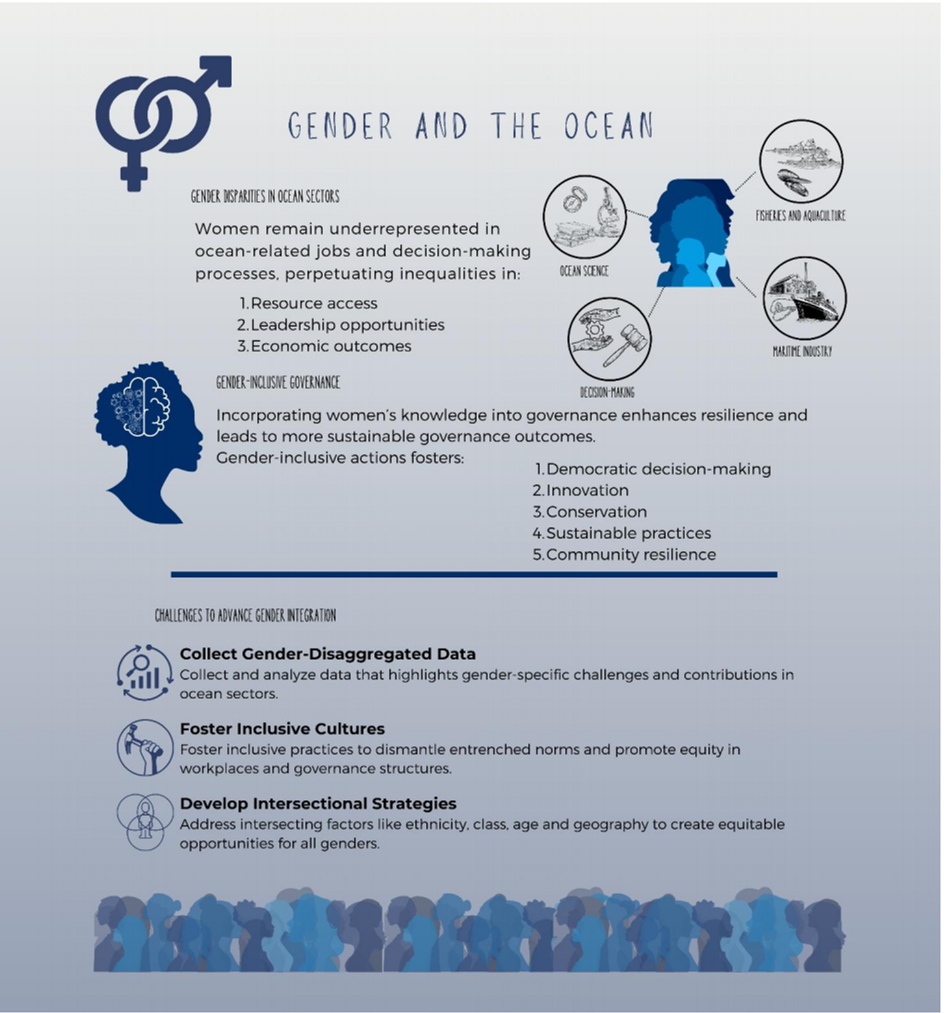
- Persistent gender disparities across ocean sectors: women remain underrepresented in ocean-related employment and decision-making processes. Traditional roles often restrict their participation in fisheries, aquaculture, maritime industry and marine sciences, perpetuating inequalities in resource access, leadership opportunities and economic outcomes Ref 33 Ref 69.
- Importance of gender-transformative governance: integrating gender perspectives into ocean governance enhances the resilience and effectiveness of conservation and management initiatives. Women's knowledge, particularly in small-scale fisheries and coastal communities, is an underutilized resource that can enrich governance frameworks and promote sustainable outcomes Ref 7 Ref 36 (see also subsect. 5A, subchap. 1B).
- Advances and gaps in gender integration: milestones such as the Agreement under the United Nations Convention on the Law of the Sea on the Conservation and Sustainable Use of Marine Biological Diversity of Areas beyond National Jurisdiction of 2023 demonstrate progress in recognizing gender in international frameworks. However, systemic challenges, including a lack of gender-disaggregated data and entrenched masculinized cultures, limit the implementation of gender-responsive policies Ref 74 Ref 58.
- Need for intersectional approaches: addressing gender issues in ocean governance requires intersectional strategies that take into account the ways in which factors such as ethnicity, class and geography intersect with gender. These approaches are vital to tackling systemic barriers and fostering equitable participation in ocean-related activities Ref 8.
- Benefits of gender-transformative conservation: case studies show that gender-transformative approaches in marine conservation lead to more gender-equitable decision-making and innovative strategies. Promoting women's leadership in ocean science and governance is aligned with sustainable practices and strengthens community resilience Ref 50 Ref 111.
Figure I
Gender and the ocean: overview of gender disparities in ocean-related sectors and the role of gender-inclusive governance in promoting sustainability, equity and resilience
1. Introduction
Gender plays a critical role in shaping ocean-related employment, activities and governance. However, systemic disparities continue to limit equitable access and representation in these sectors. Women are often underrepresented in leadership positions and decision-making processes, while traditional gender roles restrict their participation in fisheries, aquaculture and marine sciences Ref 33 Ref 69. Addressing these inequities is essential to fostering sustainable and inclusive ocean governance Ref 16.
Achieving the Sustainable Development Goals, particularly Goal 5, on gender equality, requires the integration of gender considerations into ocean policies and frameworks. A gender-responsive approach not only supports social justice, but also enhances the effectiveness of conservation and management initiatives by drawing on women's extensive, yet often underutilized, knowledge of marine ecosystems. This is especially relevant in small-scale fisheries and coastal communities Ref 7 Ref 36. Such an approach enriches governance systems, ensuring resilience and sustainability in the face of global challenges.
Despite this recognition, progress remains limited. Differences in systematically collected, gender-disaggregated data represent a critical gap that hampers the design of targeted interventions aimed at achieving equitable access and participation in ocean sectors Ref 73. Research on the gender-ocean nexus has predominantly been focused on women's roles and has often overlooked the impacts of masculinities and the entrenched masculinized cultures that exclude women and other marginalized people Ref 58. Addressing these dimensions is key to dismantling structural barriers and fostering inclusive policies.
Recently, there have been significant milestones in international ocean governance, such as the inclusion of gender-responsive language in the Agreement on Marine Biological Diversity of Areas beyond National Jurisdiction. This Agreement, the first law of the sea instrument in which gender is explicitly addressed, reflects the cross-cutting importance of gender in sustainable ocean management Ref 74. Such progress is aligned with a growing recognition that gender perspectives must be integrated into global frameworks aimed at promoting equity and inclusivity across sectors (the dimensions of equity are further explored in subsect. 5B, chap. 5).
The intersection of gender and social, economic and environmental dimensions further underscores the need for a comprehensive approach. Traditional gender roles have historically influenced activities in marine environments, ranging from fishing Ref 84 and aquaculture (Kruijissen and others, 2018) to governance and research Ref 33 Ref 69. Through international initiatives, organizations such as the United Nations Educational, Scientific and Cultural Organization (UNESCO) are emphasizing the need for structural changes aimed at promoting gender diversity in marine science and technology in light of its importance for fostering innovation and addressing global challenges Ref 64.
The present chapter is focused on the role of women in the context of ocean employment and activities, and provides an in-depth examination of gender-responsive approaches to ocean governance. Including these discussions in the World Ocean Assessment makes it possible to highlight the importance of gender awareness and inclusive policies. The chapter also provides actionable insights for embedding gender equality within global ocean governance frameworks, drawn from case studies.
Three case studies were deliberately selected because each project was supported by a prominent international organization that coordinates activities in its sphere of work, exemplifying how structured global collaboration can drive gender-responsive practices. While other sectors - such as offshore oil, gas, renewable energy, tourism, recreation, environmental protection and coastal management - also play critical roles in the ocean economy, focusing on these three cases facilitates an in-depth exploration of coordinated international efforts in promoting gender equality.
2. Gender and the Sustainable Development Goals
The Sustainable Development Goals of the 2030 Agenda for Sustainable Development build on the foundation of the Millennium Development Goals, which provided a framework for development and resulted in significant progress in several areas. However, the Millennium Development Goals had a limited scope and relatively few indicators, leading to uneven progress on some Goals; the Sustainable Development Goals were designed to complete what remained unachieved (see General Assembly resolution 70/1). The Sustainable Development Goals are grounded in frameworks such as the Beijing Declaration and Platform for Action and the Programme of Action of the International Conference on Population and Development, and contain an emphasis on the causal role of discriminatory laws, beliefs and practices in relation to ocean and gender disparities Ref 96. The focus on gender is evident in Goal 5, "Achieve gender equality and empower all women and girls", and in the cross-cutting consideration of gender issues in other Goals Ref 48 Ref 80. Gender equality is thus recognized as critical for economic, social and environmental sustainability (United Nations, 2024), with direct impacts on the implementation of the 2030 Agenda.
Although Sustainable Development Goal 14 does not explicitly address gender, the interdependence of the Goals demands that gender considerations shape the conservation and sustainable use of ocean resources (Breuer and others, 2019; International Council for Science, 2017). Achievement of the targets under Goal 14 is significantly affected by gender disparities Ref 80. The intersection between Goals 5 and 14 illuminates the importance of integrated approaches that enhance gender equality and advance sustainable ocean management Ref 116.
The targets under Goal 5 address key barriers to gender equality such as discrimination (5.1), violence (5.2) and harmful practices (5.3), while promoting access to sexual and reproductive health (5.6), equal decision-making (5.5) and economic rights (5.a). In contrast, the focus of Goal 14 is on conserving marine ecosystems and resources, including by reducing pollution (14.1), mitigating ocean acidification (14.3) and restoring fish stocks (14.4). Fisheries are essential to ocean economies and community resilience. Notably, target 14.7 is focused on economic benefits from marine resources for small-scale fishers, which should explicitly support equitable access for women and other people in marginalized situations in the ocean economy Ref 115.
Women's involvement in ocean conservation is often underrecognized, despite their unique perspectives and roles in sustainable marine practices Ref 52 Ref 112. However, limited representation of women in decision-making jeopardizes progress towards goals on sustainable ocean practices by reinforcing inequalities in resource access and policy influence (Baker-Médard, 2017). For instance, promoting sustainable fisheries requires gender-safe environments both on land and at sea, as well as policies that address the economic barriers faced by women and ensure equal access to markets and marine resources Ref 15.
Empowering women in ocean-related sectors also requires investment in capacity-building, technological access and research opportunities Ref 46 Ref 82. Engaging women in ocean science bolsters innovation for sustainable marine resource management, especially as women play key roles in community-based conservation and climate resilience initiatives Ref 81 Ref 51. Women working in grass-roots organizations, for instance, often lead efforts to reduce marine pollution and educate communities, thereby transforming gender norms and improving urban coastal conditions Ref 56.
Lastly, increasing women's representation in international ocean conservation agreements is essential to fostering gender-responsive policies. Historically, ocean affairs have been male-dominated Ref 75, with slow but growing acknowledgment of women's roles. Expanding women's participation in ocean conservation and management, research, and policy development will not only advance Goal 5 but will also accelerate progress towards Goal 14, which is one of the Sustainable Development Goals with the lowest rates of implementation (Sachs and others, 2024; United Nations Department of Economic and Social Affairs (UNDESA), 2024). Gender-responsive ocean policies and inclusive decision-making processes will be key in moving towards a more equitable and sustainable ocean future.
3. Gender issues in ocean science
Overview of gender disparities in ocean science and governance
Gender equity in ocean science is not only an ethical imperative but also a means to improve the quality, relevance and impact of the science itself Ref 95. As ocean sciences tackle increasingly urgent global challenges, the full participation of diverse talent is required for producing the best possible research and policy advice. While evidence of gender disparities in science have diminished considerably over time, women still have to contend with discrimination, unequal pay and difficulty accessing funding (Shen, 2013).
Gender disparities in representation across career stages reflect the persistent gender bias and multiple barriers that women face in ocean science Ref 50 Ref 20. In many areas, while gender balance has been achieved at the PhD student and recent graduate levels, women remain significantly underrepresented in higher-level academic and leadership positions. This pattern reflects the well-documented "leaky pipeline", a metaphor used to describe the underrepresentation of women at leadership levels of science and academia Ref 127.
Women face a range of gendered challenges in marine science workplaces, including harassment, stereotyping and unequal distribution of power, that require systemic, institutional and network changes in order to create conditions that allow a greater variety of leaders to advance to leadership roles Ref 111. Family-friendly institutional arrangements and gender-neutral parental leave can prevent mothers and fathers from being penalized in their science careers Ref 104.
According to the best available data, women account for 38% of ocean researchers worldwide, with significant regional variations - from 4% in Mauritania to 62% in Croatia (Intergovernmental Oceanographic Commission (IOC-UNESCO), 2020). While the Global Ocean Science Report provides critical insights, data quality and reliability remain a challenge Ref 73 Ref 98. Johannesen (2024) highlights the lack of standardized, gender-disaggregated data, which makes global claims about gender representation difficult to validate.
Although women have substantial roles in marine conservation and governance, they are often excluded from decision-making Ref 97. For instance, data from Kenyan ocean science institutions reveal that women hold just 25% of leadership roles in public universities, 17% in non-governmental organizations and 13% in government agencies Ref 98. Gender equality is crucial to achieving the objectives of the United Nations Decade of Ocean Science for Sustainable Development (2021-2030), including through the integration of gender perspectives into ocean policies Ref 120.
Figure II
Gender issues in ocean science and governance

Challenges faced by women in fieldwork
Fieldwork in ocean science often demands extended periods in remote environments, posing unique challenges for women. Traditional male-biased workplace norms, caregiving obligations, safety concerns and physical demands related to ship design exacerbate these challenges Ref 69. Sexual harassment remains pervasive, impacting women's professional and personal lives Ref 117. Creating pathways to safe working environments is necessary to allow for greater inclusion of a broader range of social identities in ocean science Ref 6.
Implicit biases also perpetuate inequalities, influencing hiring, funding and publication decisions Ref 25. For example, such biases create divides between knowledge systems, impeding collaborative efforts for ocean sustainability (Hägele and Hornidge, 2024). Addressing these biases is critical to fostering equity and inclusivity in the field (see subsect. 5B, chap. 5).
Initiatives and policies that promote gender equality in ocean science
Gender equality plans offer actionable steps for fostering inclusivity. In 2022, the European Union linked Horizon Europe research funding to gender equality plans, highlighting the importance of diversity in scientific teams. Similarly, through the "Empowering Women for the United Nations Decade of Ocean Science" programme, a high-level gender equality plan to guide organizations was produced Ref 119 Ref 107. However, evidence from Kenyan ocean science institutions suggests that plans alone are insufficient: they must be systemically implemented Ref 97 Ref 67.
Programmes such as Baltic Gender; Women in Ocean Science; "Empowering Women for the United Nations Decade of Ocean Science"; "Empowering Women in Hydrography," of the International Hydrographic Organization; and the International Seabed Authority (ISA) "S.H.E. See Her Exceed" mentoring programme are examples of regional and international efforts to enhance gender inclusivity. Mentorship programmes, representation in outreach initiatives and policies, such as conference quotas and leadership targets, contribute to fostering a more balanced ocean science community.
Gender-transformative policies not only promote equal rights for women and men in terms of employment, professional development and working conditions, but also ensure equal representation in leadership, decision-making and research teams. This, in turn, improves resilience and sustainability in ocean governance Ref 97. In contrast, gender-neutral policies - often termed "gender-blind" - fail to advance true gender equality, as they are based on the assumption that women and men face the same challenges, and do not address the unique barriers that hinder inclusivity and equity.
Integration of gender considerations into ocean science
Gender issues have increasingly been addressed in marine social science, highlighting power dynamics in sea-related practices. However, the focus has largely been on gender roles rather than on how dominant systems in science, policy and society are gendered Ref 103. A systematic literature review reveals that marine social science largely treats gender as an object of study, with limited focus on researcher positionality and knowledge production. Expanding to gender-as-subject and gender-as-epistemology fosters intersectional, reflexive approaches. A gender-as-political-project perspective strengthens ocean equity by addressing structural inequalities, power dynamics and epistemological biases in marine research Ref 103. Gender significantly influences access to and interaction with marine resources. In many regions of the global South, gender-specific restrictions, such as taboos and traditional practices, affect resource use and management Ref 71 Ref 100. Gender analysis is needed to improve coastal management and inform marine spatial planning Ref 36. Inclusive management strategies enhance socioecological outcomes, uphold human rights and foster equitable governance systems (Bennet and others, 2021).
Challenges and opportunities in promoting gender equality
Promoting gender equity in traditionally male-dominated ocean science is essential for fostering diversity, innovation and human rights Ref 111. Despite their contributions, women in these fields continue to face systemic barriers, including underrepresentation, isolation, stereotyping and unsafe working environments Ref 111 Ref 67. For Black women and other women from minority groups, these challenges are further compounded by financial and structural obstacles that hinder their progress in ocean science programmes, from education to career advancement Ref 65 Ref 99. High tuition costs, limited funding opportunities, limited access to career opportunities and wage disparities create significant roadblocks. A study by Isma and others (2023) revealed that over 60% of Black women in ocean science in the United States of America identified funding as a critical barrier to achieving their career goals. In addition, more than 40% of surveyed individuals had to take unpaid internships, while over 90% worked multiple jobs to support themselves due to lower wages for women. These financial constraints, combined with systemic discrimination and limited access to resources, create an uneven playing field that prevents talented individuals from fully participating in and contributing to ocean science.
Women also hold a mere 13-24% of senior leadership positions in European Union research institutions, with very few leading them. In publication, women account for only 18-22% of authors in top journals, with a significant gap in senior authorship. Funding data show a larger success rate for women in early grants, but their representation drops significantly in advanced funding stages Ref 50.
International actions, such as expanding funding opportunities, creating inclusive mentorship programmes and dismantling structural biases, are required to address these disparities and challenges. By breaking down these barriers, the ocean science community can harness the full potential of diverse perspectives, ultimately leading to more equitable and innovative solutions to marine challenges.
The absence of comprehensive gender-disaggregated data hampers efforts to assess and address disparities in ocean science education, employment and leadership Ref 98 Ref 68. Such data are essential to understanding participation and contributions across genders, and provide insights into gaps in access to resources and career progression Ref 97. Policymakers can use these insights to promote inclusivity and equitable governance, ensuring that ocean science efforts align with sustainability goals Ref 52. Addressing data gaps will enable more inclusive decision-making and support global progress in women's representation in ocean science and governance frameworks.
As the Ocean Decade neared its halfway mark, the Intergovernmental Oceanographic Commission of UNESCO initiated a process called Vision 2030 to refine the direction of future action under the Ocean Decade and further strengthen engagement and impact in the period up to 2030 and beyond. This process led to the identification of the need to "continue to enhance diversity, inclusivity, and equity in the Ocean Decade, and systematically identify and remove barriers to generational, geographic, and gender diversity" Ref 126. An Ocean Decade gender working group has been established to oversee development of a road map and action plan for enhancing gender equality in the Ocean Decade.
4. Incorporating a gender lens in fisheries and aquaculture
Overview of gender dynamics in fisheries and aquaculture
In 2022, approximately 62 million people were employed in the primary sectors of commercial fisheries and aquaculture, with women playing key roles across these "blue" food sectors by participating in organizations, administration, consulting and research (Food and Agriculture Organization of the United Nations (FAO), 2024; Frangoudes and others, 2020). These sectors are essential for nutrition, livelihoods and food security in rural coastal communities (Quimby and others, 2023; Thomas and others, 2021; Weeratunge and others, 2010). Women are active throughout fisheries and aquaculture value chains, particularly in processing, trading and marketing Ref 38 Ref 53. However, entrenched beliefs, norms and regulatory practices often define which activities are "feminized" or "masculinized", reinforcing a rigid gender division of labour Ref 78 Ref 130. These dynamics highlight the fact that power, equity and equality within fisheries cannot be fully understood through a gender lens alone: intersecting social dimensions, such as age, class, ethnicity, ability and marital status, also shape women's roles and access to opportunities Ref 89.
Gender equality is imperative for diversifying seafood value chains and achieving "blue justice" within the sector Ref 88. However, women's contributions are often underrepresented in data, with limited gender-disaggregated information restricting understanding of their participation (Merayo, Vakhitova and Carlson, 2024). This lack of documentation marginalizes women and slows the development of gender-sensitive policies in fisheries and aquaculture, perpetuating inequality Ref 122 Ref 78.
Representation and contributions of women in fisheries and aquaculture
Gender roles in fisheries and aquaculture differ globally, influenced by cultural, economic, political and ecological factors Ref 1. Globally, women accounted for 24% of the primary fisheries and aquaculture workforce in 2022, with about 60% employed in fish processing Ref 44. Women's roles are especially prominent in small-scale fisheries, where they participate in approximately 50% of value chain activities, often in roles related to processing, trading and marketing Ref 130. In aquaculture, women's involvement in production, processing and marketing may surpass their involvement in that work in fisheries, contributing significantly to coastal community resilience Ref 78 Ref 121 (see also subsect. 5A, subchap. 1B).
Figure III
Gender roles in fisheries
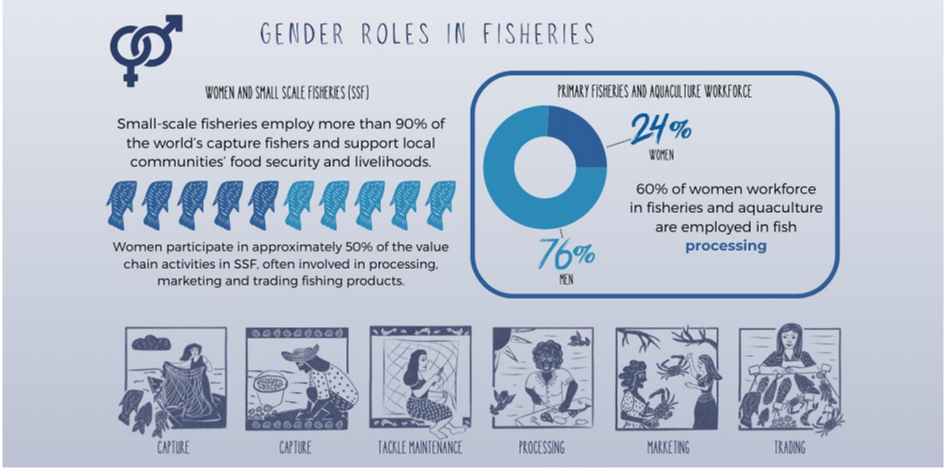
Note: This overview of gendered participation in fisheries highlights women's central roles in small-scale fisheries and along the value chain, particularly in processing, marketing and trading, alongside disparities in the primary fisheries and aquaculture workforce.
Despite women's contributions in activities such as net-making, gear repair and bait acquisition, traditional definitions of "fishing" typically exclude these pre-harvest roles, meaning that women's labour and contributions are undervalued (FAO, Duke University and WorldFish, 2023). Men are more visible in data due to their engagement in offshore, boat-based fishing, while women's inshore activities, like gleaning for shellfish in intertidal zones, are less documented Ref 123 Ref 130. This exclusion leads to an underestimation of fishing effort and catch volumes, affecting fisheries management decisions on local, national and international levels Ref 76.
Challenges faced by women in fisheries and aquaculture
Women in fisheries face challenges that vary across sectors and regions but often include limited recognition, lower wages and unpaid labour Ref 38. Women involved in processing in small-scale fisheries frequently receive lower or no pay, as their work is perceived as an extension of household duties, such as cooking and cleaning (Merayo, Vakhitova and Carlson, 2024). Meanwhile, men dominate more lucrative fishing sectors, resulting in stark income disparities Ref 28. In aquaculture, women are often relegated to less profitable tasks and receive lower pay for the same work, hindered by traditional gender norms that limit their economic roles Ref 78.
Access to resources remains a significant barrier, with women facing challenges in securing financial support, owning property and participating in decision-making (Merayo, Vakhitova and Carlson, 2024). Limited access to financial instruments like loans prevents women from investing in essential equipment and land resources, further marginalizing them in fisheries and aquaculture (St. Louis and Oliveira, 2022). Traditional norms, such as those restricting asset inheritance or property ownership, also limit women's involvement and autonomy in these industries Ref 78 (see also subsect. 5A, subchap. 1C).
Gender-specific impacts of overfishing and environmental changes
Climate-driven changes to marine ecosystems pose severe challenges for aquatic food systems, especially in low- and middle-income coastal areas Ref 30 Ref 92. Climate change affects fish availability and trade, disrupts local food security and heightens coastal communities' vulnerability to extreme weather events, with women often disproportionately impacted Ref 94 Ref 12. As fishing becomes increasingly dangerous, female fishers and processors, whose livelihoods depend heavily on fish harvests, are bearing the brunt of the economic consequences Ref 114 Ref 106.
Gendered divisions of labour mean that men and women are exposed to different risks and stressors associated with climate change and overfishing. For example, when extreme weather prevents men from fishing, women who process and sell fish products may lose income sources, destabilizing entire households and communities Ref 110. Similarly, overexploitation of fish resources, particularly in shallow coastal waters Ref 37, affects female workers primarily engaged in processing and trading (FAO, Duke University and WorldFish, 2023) for low-profit fisheries Ref 87, resulting in livelihood losses and an increase in gendered food insecurity. Beyond economic hardship, unsustainable fisheries practices, such as overfishing, may also amplify the risk of sexual violence for female processors and traders Ref 94.
Policies and initiatives promoting gender equality
Over the past decade, global fisheries policies have demonstrated increasing recognition of the role of women and contained a greater emphasis on gender equality Ref 85. In its Voluntary Guidelines for Securing Sustainable Small-Scale Fisheries in the Context of Food Security and Poverty Eradication (2015), FAO formally acknowledges the importance of gender mainstreaming for small-scale fisheries' development strategies. The Illuminating Hidden Harvests initiative (FAO, Duke University and WorldFish, 2023) supports the implementation of the Guidelines, and aims to close the gender data gap by highlighting both men's and women's contributions (see also subsect. 5A, subchap. 1B).
Despite these advances, fisheries policies often remain gender-blind in practice, with many practitioners lacking the training and knowledge necessary to implement gender-sensitive strategies Ref 84. Even in contexts with advanced fisheries policies, like Norway, the male-dominated ownership of fishing quotas underscores the need for additional gender-aware policies Ref 49. Misunderstandings around gender equality also hinder implementation, as seen in Pacific tuna fisheries where perceived progress has not matched on-the-ground realities Ref 13.
In this context, mechanisms for scaling up successful gender-transformative initiatives and ensuring their integration into local governance frameworks would strengthen the link between policy and practice. Connecting female leadership to generational transition in this sector is essential.
Successful examples of integrating a gender lens in fisheries management
In many countries, women play a vital role in shellfish industries. For instance, in West Africa, women are integral to the harvesting, processing and marketing of shellfish in estuarine and mangrove ecosystems Ref 29. The oyster fishery in the Densu delta in Ghana has seen declining populations due to overfishing and habitat loss. In response, the United States Agency for International Development, through its Sustainable Fisheries Management Project, partnered with the Development Action Association and the Ghana Fisheries Commission to address the issue by establishing the Densu Estuary Women's Oyster Pickers Association Ref 2 Ref 124.
The approximately 200 members of the Association work to restore oyster habitats and implement sustainable management practices. These women have increased their skills with training in leadership, oyster ecology and water quality monitoring, meaning that they are able to contribute to a more sustainable fishery Ref 29. The project's peer-to-peer learning programmes have fostered greater confidence among participants, allowing the Association's model to serve as a scalable example of community-driven, women-led fisheries co-management Ref 2.
The Association demonstrates how women's contributions to resource management can be harnessed for effective fisheries governance. By empowering fisherwomen in Ghana, the programme has strengthened their roles as stewards of local biodiversity while promoting sustainable livelihoods. Initiatives like this one underscore the potential for similar models in other regions, where empowering women through training, leadership development and community-based management can enhance the sustainability of fisheries and aquaculture Ref 124 Ref 32.
5. Incorporating a gender lens in the maritime industry
The maritime industry is a capital-intensive business that serves as an economic backbone for many countries. The industry involves heavy ship and port infrastructure, where women are underrepresented. Of 1.9 million seafarers worldwide, women seafarers are estimated to account for only 1.28% (Baltic and International Maritime Council (BIMCO) and International Chamber of Shipping (ICS), 2021). In ports, women occupy management or administrative positions, but they comprise only 17% of the overall port workforce, according to the United Nations Conference on Trade and Development (UNCTAD) (2022), which investigated 58 port entities in 2021. In the same year, a survey conducted by the International Maritime Organization (IMO) and the Women's International Shipping and Trading Association revealed that 39% of women who worked in companies were in mid-management, 28% were in technical roles and 48% were in administrative and support roles. Women made up around 20% of the workforce in maritime authorities (IMO and Women's International Shipping and Trading Association, 2021) (see also subsect. 5A, chap. 6).
Generally, the maritime industry is characterized by both horizontal and vertical gender segregation, which makes it hard to attract and retain women Ref 72. Traditionally masculine attributes, such as physical strength, technical and engineering experience, and certain leadership styles are also valued in the work culture. That culture is also seen in maritime education, and fewer women take maritime-related courses, especially technical and engineering subjects. In Europe, approximately 13.5% of students enrolled in nautical courses are women, and an average of 6.3% of marine engineering students are women Ref 11. While women seafarers have historically been disadvantaged in terms of finding employment and accessing on-board practical training, recent initiatives have the potential to address these inequalities, leading to a gradual increase in their participation in the sector (World Maritime University (WMU), 2023).
Recently, there has been awareness-raising in the maritime industry, which has made it possible to discuss gender and diversity in relation to well-being and occupational safety and health. Inspired by the World Maritime Day theme for 2019, "Empowering women in the maritime community", the States members of IMO adopted resolution A.1147, entitled "Preserving the legacy of the world maritime theme for 2019 and achieving a barrier-free working environment for women in the maritime sector", in December 2019 Ref 59. In response to a number of reported and unreported cases of sexual harassment and bullying of female crew members (Carballo Piñeiro and Kitada, 2020), in February 2024 the International Labour Organization (ILO) and IMO convened the Joint ILO/IMO Tripartite Working Group to identify and address seafarers' issues, with a focus on violence and harassment, including sexual harassment, bullying and sexual assault Ref 61. There is an urgent need for the maritime industry to ensure a safe working environment. One of the solutions under discussion at IMO is to make training on violence and harassment, as well as psychological safety, mandatory under the International Convention on Standards of Training, Certification and Watchkeeping for Seafarers. Several States members of IMO have also stressed the importance of incorporating the perspectives of other gender minorities, such as lesbian, gay, bisexual, transgender, intersex and queer persons, into the design of a safe working environment at sea Ref 60 (see also subsect, 5A, chap. 6).
In addition to the human dimension of gender equality, the concept of gender equality has recently become a factor in a just and equitable transition in the maritime industry. In 2022, the Maritime Just Transition Task Force was established by United Nations agencies and industry stakeholders with the aim of promoting smarter and greener shipping in a just and equitable manner Ref 86. Today, gender equality is recognized as the top priority in the industry, although there is still a long way to go to remove all the barriers to women and people with diverse gender identities in order to achieve diversity and inclusion in the industry (see also subsect. 5A, chaps. 6 and 7).
6. Strengthening science-based approaches
Integrating gender perspectives into science-based marine solutions makes practices more equitable and enhances innovation, participation and sustainability (Alexander and others, 2021). Several successful initiatives demonstrate how gender-transformative approaches lead to improved research outcomes, reduce inequalities and strengthen community resilience.
For instance, the Gendered Innovations project of Stanford University highlights case studies that showcase how gender perspectives have contributed to improved outcomes in marine research. Studies included designing gender-sensitive equipment that enables both men and women to participate effectively in marine fieldwork and developing policies that address gender disparities in research funding and opportunities (Johannesen and others, 2022). Such examples illustrate that when technology and innovation are designed to be inclusive, they not only accommodate a broader range of users, but also enhance research quality and engagement.
In the Baltic region, Baltic Gender has pioneered the Gender Wave tool, which supports the incorporation of gender perspectives into marine research and innovation. This tool supports research institutions in analysing and addressing gender imbalances across scientific disciplines and organizational structures (Baltic Gender, 2020). By fostering gender-aware practices in research, the Gender Wave tool promotes a more equitable research environment and sets a model for other regions seeking to balance gender representation in science.
Collaboration between researchers, policymakers and local communities is essential to addressing gender disparities in ocean-related activities. Effective partnerships amplify marginalized voices, especially those of women in the fishing and extractive industries, thereby ensuring that policies reflect the diverse experiences and needs of those communities.
A notable example is the network of women from extractive and fishing communities in southern Bahia, Brazil. In a region heavily impacted by environmental degradation, predatory fishing and real estate pressures, local communities mobilized to protect their livelihoods through the Canavieiras Extractive Reserve, established in 2006 Ref 27. Recognizing the male dominance in the management of the Reserve, women fishers and shellfish gatherers formed the network of women from extractive and fishing communities in southern Bahia in 2009 Ref 40 Ref 45.
The network aims to empower women, promote gender equity and advocate policies that address women's unique challenges in extractive activities. Through it, women have gained the skills and confidence to participate actively in management discussions, advocate for their rights and take on leadership roles within their communities Ref 39. Training sessions and forums organized by the network cover a range of topics, from technical skills to economic autonomy and legal rights, allowing women to build capacities that extend beyond their work in extractive industries Ref 40 Ref 27.
The network's impact is multifaceted: not only has it enhanced women's economic empowerment, but it has also fostered a sustainable management approach that aligns local traditions with environmental preservation. By engaging in sustainable fishing practices and educating communities on ecosystem protection, the network has contributed to safeguarding biodiversity and promoting long-term food security Ref 45. This community-driven model exemplifies how collective action rooted in gender equality can drive social, economic and environmental change.
In fisheries and aquaculture, access to gender-transformative technology has empowered women to participate in new ways. A powerful example of this is in the seaweed farming sector in Zanzibar, United Republic of Tanzania. Initially introduced as a means of economic empowerment for women, seaweed farming in Zanzibar has faced challenges, including declining productivity due to climate change and insufficient access to appropriate technology. In response, through the SeaPoWer project, tubular net technology for seaweed farming has been introduced, enabling women to shift their operations to deeper waters. This helps to mitigate climate-related declines in coastal yields, enabling more sustainable cultivation Ref 23. This initiative has not only provided women with essential skills in boat handling and environmental monitoring, but has also created pathways for women's leadership in aquaculture innovation Ref 21 Ref 53. Gender-sensitive technological interventions like these transform blue economy sectors by enhancing productivity, expanding livelihood opportunities and creating a more inclusive industry (see also subsect. 5A, chap. 6).
Gender-transformative technology is essential to advancing ocean science by ensuring that innovations are accessible, equitable and beneficial to people of all genders involved in marine research, management and conservation. Integrating gender perspectives into technology development entails consideration of the specific needs, experiences and constraints of women and other marginalized people, and thus promotes greater inclusivity, participation and innovation. For instance, area-based management tools like the Western Indian Ocean Symphony support ecosystem-based marine spatial planning, providing data-driven solutions that respond to diverse stakeholder needs (Nairobi Convention and Swedish Agency for Marine and Water Management (SwAM), 2021). Such gender-responsive technologies are needed to empower a wider range of users and to enhance the contributions of women to ocean scientific research and governance.
Incorporating gender perspectives into science-based approaches for ocean-related sectors like fisheries, aquaculture and marine conservation leads to more inclusive, sustainable and effective outcomes (see also subsect. 5A, subchap. 1C). Success stories from projects like SeaPoWer in Zanzibar and the women's network in southern Bahia demonstrate how gender-sensitive initiatives empower women, enhance resource sustainability and promote community resilience. Collaborative efforts between researchers, policymakers and communities are essential to addressing gender disparities in ocean sectors and implementing meaningful change. The integration of gender into ocean science makes it possible to adopt a more inclusive and resilient approach to marine conservation that is capable of addressing the diverse challenges of a rapidly changing world.
Ultimately, gender-transformative strategies in science-based solutions pave the way for sustainable development in marine and coastal environments. Gender equity must be central to our efforts, in the light of the invaluable roles that women play in marine stewardship and community resilience. By fostering innovation, collaboration and gender-sensitive policies, we can work towards a future where marine resources are managed sustainably and equitably for the benefit of all (see also subsect. 5B, chap. 5).
7. Conclusion
In the present chapter, the role of gender equality in ocean science and governance has been explored, and the ways in which a gender perspective can enhance the effectiveness, inclusivity and sustainability of ocean-related activities have been highlighted. Important strides in addressing gender disparities, including the Sustainable Development Goals and recent international agreements, such as the Agreement on Marine Biological Diversity of Areas beyond National Jurisdiction, were emphasized. A gender lens allows for a more holistic view of marine sectors and the acknowledgment of the unique contributions of women, especially in fisheries, aquaculture, climate adaptation and marine conservation.
Gender disparities remain significant in these fields, with barriers for women ranging from limited access to leadership positions to systemic biases that result in the undervaluation of their roles and contributions. Women's roles in marine and coastal communities, often in areas like processing, trading and local conservation, underscore women's importance in the socioecological resilience of those communities. However, persistent structural challenges limit their involvement in decision-making and leadership. Studies reveal that gender-diverse teams and inclusive governance structures bring a broader range of perspectives and more innovative solutions to marine conservation and governance challenges.
Initiatives like the Gendered Innovations project and the Baltic Gender project, and local efforts, including the SeaPoWer project in Zanzibar and the network of women from extractive and fishing communities in southern Bahia, illustrate how gender-transformative approaches can lead to more sustainable and impactful marine management and conservation practices.
Promoting gender equality in ocean science and governance is not merely an ethical imperative: it is essential for effective and adaptive marine resource management. As has been demonstrated in the present chapter, fostering inclusivity through gender-sensitive policies, training and research contributes to healthier marine ecosystems and more resilient coastal communities. Integrating women's knowledge and leadership into ocean science makes it possible to address pressing environmental issues with greater nuance and cultural awareness.
A call to action, aimed at expanding and deepening gender equality efforts across ocean-related sectors, is therefore warranted. First, governments and international organizations must prioritize gender equality in policy frameworks and integrate gender-focused objectives into marine conservation and resource management initiatives. Also, funding bodies should provide targeted resources to support gender-sensitive research and training, particularly in regions where gender disparities are most pronounced.
Ocean governance institutions can play a pivotal role by establishing leadership programmes and mentorship opportunities for women, particularly those from underrepresented backgrounds, including women of colour, Indigenous women and lesbian, gay, bisexual, transgender, intersex and queer individuals. Gender-disaggregated data collection must also be prioritized, as data gaps remain a major barrier to the visibility of gender inequalities in these fields, and to accurate assessments and responses. Increasing awareness through gender training, as seen in projects like the "Empowering Women" initiative, under the United Nations Ocean Decade, can help to dismantle biases and foster a culture of inclusion and respect in ocean science.
As the field of ocean science and governance continues to evolve, future research must focus on several key areas to ensure that gender equality is fully integrated into marine resource management. One potential area is the intersectionality of gender and other social factors, such as ethnicity, class and geography. Future studies can investigate how these intersections affect women's access to resources, decision-making power and roles in marine sectors, allowing for a more nuanced understanding of the barriers and opportunities within these industries.
Another critical direction is the development and assessment of gender-sensitive technology in marine science. Technological innovations, particularly in remote sensing, marine biology and climate monitoring, can benefit from inclusive design principles that make them accessible and relevant to diverse user groups. Researchers can explore how such technology may empower women in ocean-related fields, particularly by reducing physical barriers in activities like data collection and fieldwork.
The impacts of climate change on gender disparities in ocean science and coastal management are also worthy of further study. As climate-induced shifts affect fishery resources, coastal habitats and marine biodiversity, an understanding of the gender-specific impacts on livelihoods and resilience can guide the formulation of adaptive policies that support both ecological and social resilience. In addition, future research could be focused on how women in local communities are adapting to climate pressures through community-led conservation initiatives and sustainable resource management, which could provide valuable insights for scaling these practices globally.
Lastly, expanding research into the economic contributions of women in fisheries, aquaculture and conservation can bring visibility to their roles and contributions. Quantifying these economic impacts would help to correct the long-standing undervaluation of women's labour and encourage policymakers to allocate resources to and support programmes that enhance women's economic empowerment in marine sectors (see also subsect. 5A, subchap. 1C).
Promoting gender equality in ocean science and governance is integral to creating more sustainable, resilient and equitable marine ecosystems. Acknowledging and addressing gender disparities enables more effective and inclusive stewardship of marine resources. As the present chapter has shown, diverse voices and perspectives enrich conservation and governance practices, making them more adaptable and better suited to meet the challenges of a changing world.
Acknowledgments
We acknowledge the use of OpenAI's ChatGPT to assist in improving the readability and language of this text.
References
- Adam, R., and others (2024). Using a sustainable food systems framework to examine gender equality and women's empowerment in aquatic food systems. Frontiers in Sustainable Food Systems, 8. Available at https://doi.org/10.3389/fsufs.2024.1327798.
- Agbekpornu, H., Ennin, E.J., Issah, F., Pappoe, A. and Yeboah, R. (2021). Women in West African Mangrove Oyster (Crassostrea Tulipa) Harvesting, Contribution to Food Security and Nutrition in Ghana. Oceanogr Fish Open Access J, 14(1).
- Ahmadia, G.N., Cheng, S.H., Andradi-Brown, D.A., Baez, S.K., Barnes, M.D., Bennett, N.J., and Wosu, A. (2021). Limited progress in improving gender and geographic representation in coral reef science. Frontiers in Marine Science, 8, 731037.
- Alexander, K. A., Fleming, A., Bax, N., Garcia, C., Jansen, J., Maxwell, K. H., Melbourne-Thomas, J., Mustonen, T., Pecl, G. T., Shaw, J., Syme, G., & Ogier, E. (2022). Equity of our future oceans: practices and outcomes in marine science research. Reviews in Fish Biology and Fisheries, vol. 32 (1), pp. 297- 311. Available at https://doi.org/10.1007/s11160-021-09661-z.
- Alongi, D.M. (2008). Mangrove forests: resilience, protection from tsunamis, and responses to global climate change. Estuarine, Coastal and Shelf Science, 76(1), 1-13.
- Amon, D. J., Filander, Z., Harris, L., & Harden-Davies, H. (2022). Safe working environments are key to improving inclusion in open-ocean, deep-ocean, and high-seas science. Marine Policy, vol. 137, 104947. Available at https://doi.org/10.1016/j.marpol.2021.104947.
- Andrade, M.M.D., Xavier, L.Y., Grilli, N.D.M., Oliveira, C.C.D., Andrade, D.A.D., Barreto, G.C., and Gonçalves, L.R. (2021). Gender and small-scale fisheries in Brazil: Insights for a sustainable development agenda. Ocean and Coastal Research, 69(suppl 1), e21033.
- Axelrod, M., Vona, M., Novak Colwell, J., Fakoya, K., Salim, S.S., Webster, D.G., and de la Torre-Castro, M. (2022). Understanding gender intersectionality for more robust ocean science. Earth System Governance, 13, 100148. https://doi.org/10.1016/j.esg.2022.100148.
- Baker-Médard, M. (2017) Gendering Marine Conservation: The Politics of Marine Protected Areas and Fisheries Access, Society & Natural Resources, vol. 30, pp. 723-737. Available at https://doi.org/10.1080/08941920.2016.1257078.
- Baltic Gender. (n.d.). Outcomes. Retrieved 2 February 2025, from https://www.baltic- gender.eu/outcomes.html.
- Barahona-Fuentes, C., Castells-Sanabra, M., Ordás, S., and Torralbo, J. (2020). Female figures in maritime education and training institutions between 2009 and 2018: Analysing possible impacts of gender policies. WMU Journal of Maritime Affairs, 19(1), 143-158. https://doi.org/10.1007/S13437-019- 00190-Y.
- Barange, M., and others (2018). Impacts of Climate Change on Fisheries and Aquaculture. Synthesis of Current Knowledge, Adaptation, and Mitigation Options.
- Barclay, K., and others (2021). Pacific Gender Equity and Social Inclusion in Coastal Fisheries and Aquaculture. The Pacific Community. Available at https://www.spc.int/resource-centre/publications/pacific-gender-equity-and-social-inclusion-in-coastal-fisheries-and. Accessed on 4 November 2024.
- Becker-Weinberg, V. (2019) The protection of women in illegal, unregulated and unreported fishing. WMU Journal of Maritime Affairs, vol. 18, pp. 531-535. Available at https://doi.org/10.1007/s13437-019- 00189-5.
- Bennett, N.J. (2022). Mainstreaming equity and justice in the ocean. Frontiers in Marine Science, 9, 873572.
- Bennett, N.J., Katz, L., Yadao-Evans, W., Ahmadia, G.N., Atkinson, S., Ban, N.C., and Wilhelm, A. (2021). Advancing social equity in and through marine conservation. Frontiers in Marine Science, 8, 711538.
- Berryman, Sue E., and Rockefeller Foundation, New York, NY (1983). Who Will Do Science? Trends, and Their Causes in Minority and Female Representation among Holders of Advanced Degrees in Science and Mathematics. A Special Report. Distributed by ERIC Clearinghouse, Washington, D.C. https://eric.ed.gov/?id=ED245052.
- BIMCO, and ICS (2021). Seafarer Workforce Report: The global supply and demand of seafarers in 2021. Witherby Publishing Group Ltd.
- Brooks, L.A., and Déniz-González, I. (2021). An apercu of the current status of women in ocean science. Pure and Applied Chemistry, 93(8), 869-884.
- Brugere, C., Msuya, F.E., Jiddawi, N., Nyonje, B. and Maly, R. (2019). The introduction of an improved seaweed farming technology for women's empowerment, livelihoods and environmental protection. Institute of Marine Sciences, Zanzibar.
- Brugere, C., and Munoz, P. (2019). Women's participation in the seaweed industry in Zanzibar: Opportunities for empowerment and prosperity. World Bank.
- Brugere, C., Munoz, P., and Pike, K. (2020). Gender-sensitive innovation in seaweed farming: A sustainable solution for climate resilience. World Development Perspectives, 19, 100210. https://doi.org/10.1016/j.wdp.2020.100210.
- Burdett, H.L., Kelling, I., and Carrigan, M. (2022). #TimesUp: tackling gender inequities in marine and fisheries science. Journal of Fish Biology, 100(1), 4-9.
- Calaza, K. C., Erthal, F. C. S., Pereira, M. G., Macario, K. C. D., Daflon, V. T., David, I. P. A., Castro, H. C., Vargas, M. D., Martins, L. B., Stariolo, J. B., Volchan, E., and de Oliveira, L. (2021). Facing Racism and Sexism in Science by Fighting Against Social Implicit Bias: A Latina and Black Woman's Perspective. Frontiers in Psychology, vol. 12. Available at https://doi.org/10.3389/fpsyg.2021.671481.
- Carballo Piñeiro, L., and Kitada, M. (2020). Sexual harassment and women seafarers: The role of laws and policies to ensure occupational safety & health. Marine Policy, 117, 103938. https://doi.org/10.1016/j.marpol.2020.103938.
- Carmo, J.C. do, Pires, M. de M., Jesus Júnior, G. de, Cavalcante, A.L., and Trevizan, S.D.P. (2016). Voice of nature and women in the Canavieiras Extractive Reserve, Bahia, Brazil: Environmental and gender sustainability from an ecofeminist perspective. Revista Estudos Feministas, 24(1), 155-180. https://doi.org/10.1590/1805-9584-2016v24n1p155.
- Cho, M. (2024). Gender equity in small-scale fisheries: Challenges and pathways. Marine Policy, 145, 105410.
- Chuku, E.O. and others (2022) 'Spotlighting Women-Led Fisheries Livelihoods Toward Sustainable Coastal Governance: The Estuarine and Mangrove Ecosystem Shellfisheries of West Africa', Frontiers in Marine Science, 9. Available at https://doi.org/10.3389/fmars.2022.884715.
- Cochrane, K.L., Bahri, T., Dabbadie, L., Fernandez-Reguera, D., Kalikoski, D.C., Ma, X., and Vannuccini, S. (2023). The impact of climate change on coastal fisheries and aquaculture.
- Commonwealth Secretariat. (2024). Turning the Tides of Inclusion: A toolkit for gender equality in ocean sectors (Commonwealth Blue Charter Programme). The Commonwealth. Available at https://thecommonwealth.org/publications/turning-tides-inclusion-toolkit-gender-equality-ocean-sectors.
- Crawford, B. and others (2022) The Women Shellfishers and Food Security Project: Multivariate analysis of the theory of change model.
- Crosman, K.M., Allison, E.H., Ota, Y., Cisneros-Montemayor, A.M., Singh, G.G., Swartz, W., and Spalding, A.K. (2022). Social equity is key to sustainable ocean governance. npj Ocean Sustainability, 1(1), 4.
- De Carvalho, D.A., Amaral, S., and Alves, L.M. (2023). Climate change adaptation frameworks in fishing communities: A systematic review. Ocean & Coastal Management, 243, p. 106754. Available at https://doi.org/10.1016/j.ocecoaman.2023.106754.
- De la Torre-Castro, M. (2019). Inclusive management through gender consideration in small-scale fisheries: the why and the how. Frontiers in Marine Science, 6, 156.
- De la Torre-Castro, M., Fröcklin, S., Börjesson, S., Okupnik, J., and Jiddawi, N.S. (2017). Gender analysis for better coastal management-Increasing our understanding of social-ecological seascapes. Marine Policy, 83, 62-74.
- Ding, Q., Chen, X., Chen, Y., Tian, S. (2017). Estimation of catch losses resulting from overexploitation in the global marine fisheries. Acta Oceanol. Sin., 36, 37-44. https://doi.org/10.1007/s13131-017-1096-x.
- Elias, M., and others (2024). Towards gender equality in forestry, livestock, fisheries and aquaculture. Global Food Security, 41, p. 100761. Available at https://doi.org/10.1016/j.gfs.2024.100761.
- Ettinger, V.M.T. de M., Jesus Junior, G., Setenta, A.M., and Cavalcante, A.L. (2016). Culture, identity, and gender: Weaving the network of women from extractive and fishing communities in Southern Bahia. Revista Interdisciplinar De Gestão Social, 4(3). Retrieved from UFBA.
- Ettinger, V.M.T. (2013). Weaving the Network of Women from Extractive and Fishing Communities in Southern Bahia: Recognizing and affirming "being" a woman. Dissertation presented to the Development and Social Management Program, School of Administration, Federal University of Bahia, 138 pp.
- FAO (2015). SSF Guidelines, Voluntary Guidelines for Securing Sustainable Small-Scale Fisheries. Available at https://www.fao.org/voluntary-guidelines-small-scale-fisheries/en. Accessed on 4 November 2024.
- FAO (2017). Towards gender-equitable small-scale fisheries governance and development: A handbook, Biswas, N., ed. Rome: Food and Agriculture Organization of the United Nations.
- FAO, Duke University, and WorldFish (2023). Illuminating Hidden Harvests (IHH), Voluntary Guidelines. Available at https://www.fao.org/voluntary-guidelines-small-scale-fisheries/ihh/en. Accessed on 4 November 2024.
- FAO (2024). The State of World Fisheries and Aquaculture 2024 - Blue Transformation in action. Rome. https://doi.org/10.4060/cd0683en.
- Figueiredo, M.A. (2015). Gender and political participation: The experience of the Network of Women Fishers in Southern Bahia. Revista Artemis, 20(2), 171-179. https://doi.org/10.15668/1807- 8214/artemis.v20n2p171-179.
- Fitrianggraeni, S. (2019). Building business, enriching lives: an Indonesian initiative to empower women in the fishing communities. WMU Journal of Maritime Affairs, vol. 18, pp. 595-616. Available at https://doi.org/10.1007/s13437-019-00181-z.
- Frangoudes, K., Gerrard, S., and Said, A. (2020). Commentary 6 to the Manifesto for the marine social sciences: gender and the role of women. Maritime Studies, 19(2), pp. 137-138. Available at https://doi.org/10.1007/s40152-020-00186-y.
- Fukuda-Parr, S. (2016). From the Millennium Development Goals to the Sustainable Development Goals: Shifts in purpose, concept, and politics of global goal setting for development. Gender and Development, 24(1), 43-52. https://doi.org/10.1080/13552074.2016.1145895.
- Gerrard, S., and Kleiber, D. (2019). Women fishers in Norway: few, but significant. Maritime Studies, 18(3), pp. 259-274. Available at https://doi.org/10.1007/s40152-019-00151-4.
- Giakoumi, S., Pita, C., Coll, M., Fraschetti, S., Gissi, E., Katara, I., and Micheli, F. (2021). Persistent gender bias in marine science and conservation calls for action to achieve equity. Biological Conservation, 257, 109134.
- Gicheru, M.N., Mwenda, M. J., Omwami, D.O. (2024). Gender and Climate Change: The Role of Women in Climate Change Processes. Asian Journal of Geographical Research, vol. 7, pp. 13-23. Available at https://doi.org/10.9734/AJGR/2024/V7I1210.
- Gissi, E., Portman, M.E., and Hornidge, A.K. (2018). Un-gendering the ocean: Why women matter in ocean governance for sustainability. Marine Policy, 94, 215-219.
- Gopal, N., and others (2020). Expanding the horizons for women in fisheries and aquaculture. Gender, Technology and Development, 24(1), pp. 1-9. Available at https://doi.org/10.1080/09718524.2020.1736353.
- Hägele, R., and Hornidge, A .- K. (2025). Transnational Intersectionality at Sea: Gender, Appearance, Ethnicity, Age, and Marine Knowledge Production. Ocean and Society, vol. 2. Available at https://doi.org/10.17645/oas.8737.
- Hanson, A. M. (2017). Women's environmental health activism around waste and plastic pollution in the coastal wetlands of Yucatán, Gender & Development, vol. 25, pp. 221-234. Available at https://doi.org/10.1080/13552074.2017.1335450.
- Harper, S.J., Gurney, G.G., Darling, E., Mangubhai, S., Jupiter, S., Lestari, W.P., and Ban, N.C. (2024). Gender differences in the perceived impacts of coastal management and conservation. npj Ocean Sustainability, 3(1), 34.
- Hornidge, A .- K., Partelow, S., and Knopf, K. (2023). Knowing the Ocean: Epistemic Inequalities in Patterns of Science Collaboration. In S. Partelow, M. Hadjimichael, and A .- K. Hornidge (Eds.), Ocean Governance: Knowledge Systems, Policy Foundations and Thematic Analyses (pp. 25-45). Springer International Publishing. Available at https://doi.org/10.1007/978-3-031-20740-2_2.
- IMO (2019). Preserving the Legacy of the World Maritime Theme for 2019 and Achieving a Barrier-Free Working Environment for Women in the Maritime Sector, Resolution A.1147(31), 31st session of the IMO Assembly.
- IMO (2023). Diversity and inclusivity in the maritime sector. (Submitted by Belgium, Canada, Luxembourg, Denmark, Malta, Netherlands (Kingdom of the), South Africa, and International Transport Workers' Federation (ITF)), TC 73/INF.15.
- IMO, and ILO (2024). Report to the IMO Maritime Safety Committee and the ILO Governing Body, The 2nd meeting of the Joint ILO/IMO Tripartite Working Group to Identify and Address Seafarers' Issues and the Human Element, JTWG-SIHE 2/6
- IMO and WISTA. (2021). Women in Maritime Survey 2021: A study of maritime companies and IMO Member States' maritime authorities. Available at https://www.imo.org/en/ourwork/technicalcooperation/pages/imo-wista-women-in-maritime-survey- 2021.aspx.
- IOC-UNESCO (2020). Global Ocean Science Report 2020-Charting Capacity for Ocean Sustainability. K. Isensee, ed., Paris, UNESCO Publishing.
- Isma, L.M., Bernard, M.L., Layton, J., Santana, R., Wilkins, K.W., and Nembhard, D. (2023). Black Women in Ocean Science. Oceanography, 36(4), 56-59.
- Johannesen, E. (2024). Gender inequality in the practice of international marine science: case study on the International Council for the Exploration of the Sea. WMU Publications: Malmö, Sweden. Available at http://dx.doi.org/10.21677/phd240430.
- Johannesen, E. (2025). Advancing gender equality in international ocean science: Participatory approaches for institutional actions. Marine Policy, vol. 171, 106421. Available at https://doi.org/10.1016/j.marpol.2024.106421.
- Johannesen, E., Barz, F., Dankel, D.J., and Kraak, S.B.M. (2023). Gender and early career status: Variables of participation at an international marine science conference. ICES Journal of Marine Science, 80(4), 1016-1027.
- Johannesen, E., Ojwala, R. A., Rodriguez, M. C., Neat, F., Kitada, M., Buckingham, S., Schofield, C., Long, R., Jarnsäter, J., and Sun, Z. (2022). The Sea Change Needed for Gender Equality in Ocean-Going Research. Marine Technology Society Journal, 56(3), pp. 18-24. Available at https://doi.org/10.4031/MTSJ.56.3.6.
- Johri, S., Carnevale, M., Porter, L., Zivian, A., Kourantidou, M., Meyer, E.L., and Skubel, R.A. (2021). Pathways to justice, equity, diversity, and inclusion in marine science and conservation. Frontiers in Marine Science, 8, 696180.
- Jones, J.P., Andriamarovololona, M.M., and Hockley, N. (2008). The importance of taboos and social norms to conservation in Madagascar. Conservation Biology, 22(4), 976-986.
- Kitada, M. (2022). Gender and work within the maritime sector. In Wright, T., Budd, L. and Ison, S. (eds.) Women, Work and Transport (Transport and Sustainability, vol. 16), Bingley: Emerald, pp. 229-248. Available at https://doi.org/10.1108/S2044-994120220000016015.
- Kitada, M., Johannesen, E., Ojwala, R.A., Buckingham, S., Sun, Z., Rodríguez-Chaves, M., and Schofield, C. (2023). Barriers to the collection of gender-disaggregated data in ocean science. Human Factors in Management and Leadership, 71.
- Kitada, M., and Rodríguez-Chaves, M. (2024). Advancing Gender Equality in Contemporary Ocean Affairs. The International Journal of Marine and Coastal Law, Available at https://doi.org/10.1163/15718085-bja10199.
- Kitada, M., Williams, E., and Froholdt, L. L. (Eds.). (2015). Maritime Women: Global Leadership. Springer. Available at https://doi.org/https://doi.org/10.1007/978-3-662-45385-8.
- Kleiber, D., Harris, L.M. and Vincent, A.C.J. (2015). Gender and small-scale fisheries: a case for counting women and beyond, Fish and Fisheries, 16(4), pp. 547-562. Available at https://doi.org/10.1111/faf.12075.
- Koehler, G. (2016). Tapping the Sustainable Development Goals for progressive gender equity and equality policy? Gender & Development, 24(1), 53-68.
- Kruijssen, F., McDougall, C.L., and Van Asseldonk, I.J. (2018). Gender and aquaculture value chains: A review of key issues and implications for research. Aquaculture, 493, 328-337.
- Lawless, S., Cohen, P.J., Mangubhai, S., Kleiber, D., and Morrison, T.H. (2021). Gender equality is diluted in commitments made to small-scale fisheries. World Development, 140, 105348.
- Leal Filho, W., Kovaleva, M., Tsani, S., Țîrcă, D.M., Shiel, C., Dinis, M.A.P., Nicolau, M., Sima, M., Fritzen, B., Lange Salvia, A., Minhas, A., Kozlova, V., Doni, F., Spiteri, J., Gupta, T., Wakunuma, K., Sharma, M., Barbir, J., Shulla, K., Bhandari, M.P. and Tripathi, S. (2023) Promoting gender equality across the sustainable development goals. Environment, Development and Sustainability, vol. 25, pp. 14177-14198. Available at https://doi.org/10.1007/s10668-022-02656-1.
- Loarne-Lemaire, S., Martineau, C., and Peters, K. (2021). Female innovators in ocean science: Uncovering gender-specific contributions to technology. Innovation Management Review, 18(2), 37-51.
- Mahabir-Lee, S., and Rambarath-Parasram, S. (2019). Women's economic empowerment in marine science and coastal management. Women's Studies International Forum, 76, 102277.
- Maneschy, M.C. (2000). Da Casa ao Mar: papéis das mulheres na construção da Pesca. Proprosta, março/agos (84/85), 82-91.
- Mangubhai, S., Lawless, S., Cowley, A., Mangubhai, J.P., and Williams, M.J. (2022). Progressing gender equality in fisheries by building strategic partnerships with development organisations. World Development, 158, 105975.
- Mangubhai, S., and Lawless, S. (2021). Exploring gender inclusion in small-scale fisheries management and development in Melanesia, Marine Policy, 123, p. 104287. Available at https://doi.org/10.1016/j.marpol.2020.104287.
- Maritime Just Transition Task Force (2022). Mapping a Maritime Just Transition for Seafarers: Position paper.
- McClanahan, T.R., Abunge, C. (2017). Fish trader's gender and niches in a declining coral reef fishery: implications for sustainability. Ecosyst. Health Sustain. 3, 1353288. https://doi.org/10.1080/20964129.2017.1353288.
- McClenachan, L., and Moulton, A. (2022). Transitions from wild-caught fisheries to shellfish and seaweed aquaculture increase gender equity in Maine, Marine Policy, 146, p. 105312. Available at https://doi.org/10.1016/j.marpol.2022.105312.
- McDougall, C., and others (2022). Gender integration and intersectionality in food systems research for development: A guidance note. Available at https://hdl.handle.net/20.500.12348/5286. Accessed on 4 November 2024.
- Merayo, E., Vakhitova, V., and Carlson, A. (2024). Women in fisheries in the Mediterranean and Black Sea region: roles, challenges and opportunities. Available at https://openknowledge.fao.org/items/5672080f-e93e-436f-9968-b43dd8d6c910. Accessed on 4 November 2024.
- Mitra, A., and Barua, P. (2023). Coping Practices of Women Fisherfolk in Responses to Climate Change at UNESCO Declared World Heritage Site of Sundarbans, springerprofessional.de. Available at https://www.springerprofessional.de/en/ecological-footprints-of-climate-change/23879964.
- Nairobi Convention, and SwAM (Swedish Agency Marine and Water Management) (2021). Western Indian Ocean Symphony- a tool for ecosystem-based marine spatial planning. Available at https://www.nairobiconvention.org/wio-symphony/. Accessed on 7 March 2025.
- Nyasimi, M., and Jakarasi, V.N. (2024). Persisting Inequalities: An Intersectional View of Climate Change, Gender and Violence. In The Palgrave Handbook of Violence in Africa (pp. 879-892). Cham: Springer Nature Switzerland.
- Nielsen, M.W., Alegria, S., Börjeson, L., Etzkowitz, H., Falk-Krzesinski, H.J., Joshi, A., Leahey, E., Smith-Doerr, L., Woolley, A.W., and Schiebinger, L. (2017). Gender diversity leads to better science. Proceedings of the National Academy of Sciences, 114(8), 1740-1742. https://doi.org/10.1073/pnas.1700616114.
- Odera, J.A., and Mulusa, J. (2020). SDGs, Gender Equality and Women's Empowerment: What Prospects for Delivery? 95-118. https://doi.org/10.1007/978-3-030-30469-0_6.
- Ojwala, R.A., Kitada, M., Neat, F., and Buckingham, S. (2022). Effectiveness of gender policies in achieving gender equality in ocean science programmes in public universities in Kenya. Marine Policy, 144, 105237. https://doi.org/10.1016/j.marpol.2022.105237.
- Ojwala, R.A. (2023). Gender equality in ocean science for sustainable development: Analysis of ocean science institutions in Kenya. WMU Publications: Malmö, Sweden.
- Ojwala, R.A. (2024). Unravelling gender and ethnic bias in higher education: students' experiences in access to ocean science education and career opportunities in Kenya. Higher Education, 1-22.
- Oloko, A., Harper, S., Fakoya, K., and Sumaila, U.R. (2024). The multi-dimensional perspectives of taboos on gender roles of fisherfolk in the Global South. Maritime Studies, 23(1), 1.
- Österblom, H., Wabnitz, C.C., Tladi, D., Allison, E.H., Arnaud-Haond, S., Bebbington, J., and Selim, S.A. (2023). Towards ocean equity. In The Blue Compendium: From Knowledge to Action for a Sustainable Ocean Economy (pp. 485-521). Cham: Springer International Publishing.
- Partelow, S., Schlüter, A., Ban, N.C., Batterbury, S., Bavinck, M., Bennett, N.J., and Villasante, S. (2023). Five social science intervention areas for ocean sustainability initiatives. npj Ocean Sustainability, 2(1), 24.
- Pauwelussen, Annet, and Lau, Sallie. (2023). A Review of Gender Studies and Feminist Theory in and for Marine Social Science (Ocean Nexus Special Report). https://oceannexus.org/specialreports/a-review-of- gender-studies-and-feminist-theory-in-and-for-marine-social-science/.
- Powell, K. (2021). The parenting penalties faced by scientist mothers. Nature, 595(7868), 611-613. https://doi.org/10.1038/d41586-021-01993-x.
- Quimby, B., and others (2023). Blue Food Sovereignty Benefits Social-Ecological Resilience: A Case Study of Small-Scale Fisheries Co-Management and Mariculture in Samoa, Human Ecology, 51(2), pp. 279-289. Available at https://doi.org/10.1007/s10745-023-00401-4.
- Riviwanto, M., and Basuki, A. (2019). The role of gender as a model of climate change adaptation in fisherman settlement communities - IOPscience. Available at https://iopscience.iop.org/article/10.1088/1755-1315/314/1/012086. Accessed on 4 November 2024.
- Rodríguez-Chaves, M., Sun, Z., Kitada, M., Buckingham, S., Johannesen, E., Ojwala, R. A., Long, R., and Neat, F. (2024). Towards gender equality in ocean science and ocean governance: Gender equality strategy and action plan for ocean-related institutions. World Maritime University.
- Sachs, J.D., Lafortune, G., and Fuller, G. (2024). The SDGs and the UN Summit of the Future. Sustainable Development Report 2024. Dublin: Dublin University Press. https://doi.org/10.25546/108572.
- Shaffril, H.A.M., Samah, A.A., and Mazuki, R. (2024). A systematic literature review on the adaptation of women in fisheries-based families on climate change impacts, Journal of Environmental Studies and Sciences [Preprint]. Available at https://doi.org/10.1007/s13412-024-00963-9.
- Shellock, R.J., Cvitanovic, C., Mackay, M., Mckinnon, M.C., Blythe, J., Kelly, R., and Wisz, M.S. (2022). Breaking down barriers: The identification of actions to promote gender equality in interdisciplinary marine research institutions. One Earth, 5(6), 687-708.
- Shellock, R.J., Cvitanovic, C., Mckinnon, M.C., Mackay, M., van Putten, I.E., Blythe, J., and Wisz, M.S. (2023). Building leaders for the UN Ocean Science Decade: A guide to supporting early career women researchers within academic marine research institutions. ICES Journal of Marine Science, 80(1), 56-75.
- Shellock, R. J. and Maltby, K. (2023). Women Leaders Are Essential for Tackling Ocean Sustainability Challenges. Fisheries. Available at https://doi.org/10.1002/fsh.10919.
- Siles, J., and others (2019). Advancing Gender in The Environment: Gender in Fisheries-A Sea of Opportunities, IUCN. Available at https://genderandenvironment.org/advancing-gender-in-the- environment-gender-in-fisheries-a-sea-of-opportunities/.
- Silva, S.T., Andrade, D.A., and Mont'Alverne, T.C.F. (2020). A Invisibilidade Das Mulheres Pescadoras No Brasil: Uma Discussão a Partir Dos Objetivos De Desenvolvimento. Revista Do Programa de Pós- Graduação Em Direito Da UFC, 40(1), 143-159.
- Singh, G. G., Cisneros-Montemayor, A. M., Swartz, W., Cheung, W., Guy, J. A., Kenny, T .- A., McOwen, C. J., Asch, R., Geffert, J. L., Wabnitz, C. C. C., Sumaila, R., Hanich, Q., and Ota, Y. (2018). A rapid assessment of co-benefits and trade-offs among Sustainable Development Goals. Marine Policy, vol. 93, pp. 223-231. Available at https://doi.org/10.1016/j.marpol.2017.05.030.
- St Clair, M. (2021). Sexual Harassment in Marine Science. Women in Ocean Science. Available at https://www.womeninoceanscience.com/sexual-harassment.
- St. Louis, T.J., and Oliveira, N.M. (2022). Women's contribution to aquaculture's regional development: a literature review. Journal of Applied Aquaculture, 34(2), pp. 294-313.
- Sun, Z., Kitada, M., Buckingham, S., Chavez-Rodriguez, M., Jarnsäter, M., Johannesen, E., Long, R., Neat, F., Ojwala, R.A., Schofield, C. (2022). Empowering Women for the United Nations Decade of Ocean Science for Sustainable Development. Marine Technology Society Journal, 56 (3), pp. 108-109. Available at https://www.ingentaconnect.com/content/mts/mtsj/2022/00000056/00000003/art00019;jsessionid=2tmgu ka9s9nv2.x-ic-live-02.
- Sun, Z., Kitada, M., and Rodriguez-Chaves, M. (2021). Empowering women in marine science: Lessons from the UN Ocean Decade. Marine Policy, 130, 104591.
- Szaboova, L., Gustavsson, M., and Turner, R. (2022). Recognizing Women's Wellbeing and Contribution to Social Resilience in Fisheries, Society & Natural Resources, 35(1), pp. 59-74. Available at https://doi.org/10.1080/08941920.2021.2022259.
- Szymkowiak, M. and Rhodes-Reese, M. (2020). Addressing the Gender Gap: Using Quantitative and Qualitative Methods to Illuminate Women's Fisheries Participation. Frontiers in Marine Science, vol. 7, p. 299.
- Thomas, A., and others (2021). Why they must be counted: Significant contributions of Fijian women fishers to food security and livelihoods', Ocean & Coastal Management, 205, p. 105571. Available at https://doi.org/10.1016/j.ocecoaman.2021.105571.
- Torell, E., and others (2019). Assessing the Impacts of Gender Integration in Ghana's Fisheries Sector', Coastal Management, 47, pp. 1-20. Available at https://doi.org/10.1080/08920753.2019.1669098.
- UNCTAD (2022). Review of maritime transport 2022: Navigating stormy waters. UN Publication. United Nations (2024). Pact For The Future, Global Digital Compact And Declaration On Future Generations.
- UNESCO-IOC (2024). Ambition, Action, Impact: The Ocean Decade Pathway to 2030. Consolidated Outcomes of the Vision 2030 Process. UNESCO, Paris. (The Ocean Decade Series, 50).
- UNESCO (2015). UNESCO Science Report: towards 2030. https://unesdoc.unesco.org/ark:/48223/pf0000235406.
- UNDESA (2024). Sustainable Development Goals Report 2024. United Nations Department of Economic and Social Affairs.
- Weeratunge, N., Snyder, K., and Choo, P .- S. (2010). Gleaner, fisher, trader, processor: Understanding gendered employment in fisheries and aquaculture, Fish and Fisheries, 11, pp. 405-420. Available at https://doi.org/10.1111/j.1467-2979.2010.00368.x.
- Williams, M.J. (2016). How are Fisheries and Aquaculture Institutions Considering Gender Issues? Asian Fisheries Science, 29, January, 21-48.
WMU (2023). Transport 2040: Impact of Technology on Seafarers - The Future of Work. World Maritime University. https://doi.org/10.21677/230613.
Johannesen, E., Ojwala, R. A., Chavez-Rodriguez, M., Neat, F., Kitada, M., Buckingham, S., Schofield, C., Long, R., Jarnsäter, J., & Sun, Z. (2022). The sea change needed for gender equality in ocean-going research. Marine Technology Society Journal, 56(3), 18-24. https://doi.org/10.4031/MTSJ.56.3.6.
Almeida de Carvalho, D., Amaral, S., & Alves, L. M. (2023). Climate change adaptation frameworks in fishing communities: A systematic review. Ocean & Coastal Management, 243, 106754. https://doi.org/10.1016/j.ocecoaman.2023.106754.
Breuer, A., Janetschek, H., & Malerba, D. (2019). Translating Sustainable Development Goal (SDG) interdependencies into policy advice. Sustainability, 11(7), 2092. https://doi.org/10.3390/su11072092.
International Council for Science (ICSU). (2017). A guide to SDG interactions: From science to implementation (D. J. Griggs, M. Nilsson, A. Stevance, & D. McCollum, Eds.). International Council for Science. https://doi.org/10.24948/2017.01.
IOC-UNESCO. (2020). Global Ocean Science Report 2020: Charting Capacity for Ocean Sustainability (K. Isensee, Ed.). UNESCO Publishing.
Shen, H. (2013). Inequality quantified: Mind the gender gap. Nature, 495, 22-24. https://doi.org/10.1038/495022a.