
Human well-being
Writing team: Phoebe Koundouri (coordinating author), Donovan Campbell (lead member), Alana Malinde S.N. Lancaster, Conrad Landis, Anastasia Litina, Slimane Maliki (co-lead member), Ali Mashayek, Jiang Nanqih and Laura Onofri.
Key points
- The intrinsic value of oceans extends beyond economic benefits, as oceans enrich human life through cultural, recreational and ecological contributions.
- Oceans have many non-economic benefits, including cultural and ecological value.
- Non-market valuation methods are used to quantify the intangible benefit of oceans, including clean air, biodiversity and recreational spaces.
- Marine environments can boost subjective well-being and provide mental health benefits, such as stress relief and emotional resilience, which are central to the blue health concept.
- Oceans support cultural practices, spiritual connections and knowledge-sharing across generations, which can strengthen identities and resilience within communities.
- Ocean-based recreational activities benefit physical and mental health, and foster social bonds, community cohesion and an appreciation for the environment.
- Climate change, pollution and resource depletion are potential risks to marine ecosystems and human well-being.
- By sustaining fisheries, livelihoods, cultural heritage, social cohesion and intergenerational well-being are preserved.
1. Introduction
The present chapter contains an overview of the various ways that oceans contribute to human well-being and an exploration of the interplay between ocean ecosystem health and aspects of human prosperity. Although the economic advantages offered by oceans to global and local communities are substantial, the present chapter is focused on the non-economic benefits that contribute to well-being beyond measurable financial value Ref 36. An assessment of economic benefits is covered elsewhere in the third World Ocean Assessment (see, for example, subsect. 5A, chaps. 4, 6, 7 and 9), thereby enabling the present chapter to be focused on the intrinsic value of oceans, including its cultural, mental health, recreational and community-supporting roles.ⓘ.
Through welfare economics and non-market valuation, such as the contingent valuation and travel cost methods, the present chapter serves to illustrate how quantifying non-economic benefits informs sustainable policymaking. Various aspects, such as the concept of blue health, are explored, and the mental and physical health advantages that arise from proximity to marine environments are highlighted (see also subsect. 5A, chap. 2). Community-focused case studies show the essential role played by oceans in supporting cultural identity, heritage and social cohesion, thereby underscoring the need for inclusive, sustainable ocean management Ref 3 Ref 11. Confronting threats such as climate change and pollution is crucial to maintaining non-economic benefits, and a wide-ranging governance approach would help to sustain the critical connections between ocean health and human well-being for future generations.
2. Welfare economics of non-market valuation
Welfare economics can be used to examine the value provided by oceans beyond monetary metrics and can reveal critical aspects of non-market valuation. Several non-market goods and services, such as clean air, biodiversity and recreational spaces, play an important role in human well-being Ref 47. Nevertheless, they are difficult to measure in traditional economic terms, as they are not traded in markets. It is thus necessary to find ways to capture the wide range of non-market benefits, which contribute not only to global ecological balance, but also to quality of life, cultural heritage and community cohesion.
Several methods, such as the contingent valuation method (a survey-based willingness to pay approach; see, for example, Ref 14), the travel cost method (value from travel expenses; see, for example, Ref 72), choice experiments (hypothetical choice modelling; see, for example, Ref 46), hedonic pricing (property price analysis; see, for example, Ref 58) and the replacement/restoration cost method (cost to restore ecosystems; see, for example, Ref 22), can be used to capture various environmental aspects.
Among those methods, the focus in the present chapter is on the contingent valuation and travel cost methods, as they are well suited for capturing the intangible benefits of ocean ecosystems.
Contingent valuation method. Contingent valuation is a survey-based technique that serves to assess people's willingness to pay for preserving or restoring environmental goods. The approach is instrumental in gauging public support for conservation frameworks, particularly for intangible goods, such as ocean habitats or biodiversity, where direct market prices are absent. As outlined by Carson (2012) and Hanemann (1994), contingent valuation is useful when assessing non-market assets, such as ocean ecosystems. Examples include survey respondents indicating their willingness to pay to protect marine biodiversity and to evaluate the value of experience of ocean education (Lee and Kim, 2023). The approach provides a monetary estimate of the perceived worth of ecosystems.
Travel cost method. Through the travel cost method, economic values associated with recreational sites are estimated by analysing the expenses incurred by visitors to access such sites Ref 51 Ref 52 Ref 72. When applying the method to marine parks or coastal areas, travel costs can be used as a proxy for the value that visitors attach to the recreational usage of ocean spaces. Visitor costs, such as access fees for marine reserves, represent the recreational value of those sites, contributing to the understanding of how recreational goods contribute to the overall valuation of ocean ecosystems Ref 72.
Market valuation contributes to environmental cost-benefit analysis by measuring the benefits of ecological services against their potential costs Ref 7. Non-market environmental values can be incorporated into cost-benefit analysis to inform environmental decision-making (Pearce and Turner, 1990).
The valuation of sustainable fisheries and ocean-based livelihoods is an important dimension that relates to these approaches. For many coastal communities, oceans are not only ecosystems to be conserved, but also vital sources of income, nutrition and cultural identity. It is thus important to acknowledge the role of fisheries in supporting well-being, which is particularly true in low-income or food-insecure regions, as doing so ensures that valuation frameworks reflect the full spectrum of ocean-related benefits. Moreover, in terms of policy, acknowledging the role of fisheries in supporting well-being is particularly relevant for designing inclusive policies aimed at balancing conservation goals and coupling them with the needs of those who directly depend on marine resources for their living.
Using these methods, policymakers can assess non-market values and thus recognize ocean benefits, such as climate regulation, biodiversity conservation and public health and nutrition, which might otherwise be underestimated or overlooked.
Case studies further demonstrate how non-market valuation affects marine policy Ref 40 Ref 41, and discuss how valuations influenced the establishment of marine protected areas (MPAs) and guided decisions on resource allocation and conservation Ref 64 Ref 19. By quantifying the benefits derived from oceans, valuation methods can inform policies aimed at sustaining marine ecosystems, thereby ensuring that oceans continue to support human welfare.
Another important consideration regarding the intrinsic nature of ocean resources is their public good characteristics. As in the case of every public good, oceans are non-excludable and non-rivalrous, meaning that access cannot easily be restricted and that one person's enjoyment does not diminish that of another. It is also essential to highlight that oceans often exhibit traits of common-pool resources, rather than purely public goods, making them vulnerable to overuse or congestion if not carefully managed. All these complexities are explored in Ostrom (1990) and Samuelson (1954), who argue that such goods complicate valuation efforts, especially when trying to establish boundaries for willingness to pay or equitable resource allocation.
To complicate matters further, policymakers must also consider intergenerational equity (see subsect. 5B, chap. 5), which involves ensuring that ocean resources benefit both present and future generations and that their intergenerational nature is taken into account when using them. It is important to preserve the ocean in order to allow future generations to enjoy their substantial non-use values. These values are particularly challenging to measure, as they reflect primarily intangible and non-measurable benefits, such as cultural heritage and intergenerational welfare. Survey techniques can be used to estimate the individual value of the existence or preservation of ocean ecosystems Ref 43 Ref 45 Ref 25. By developing methods to capture the intangible worth of oceans, from recreational and health benefits to climate regulation and cultural significance, policies can honour the essential enduring role of the ocean in a world facing challenges.
3. Subjective well-being
Drawing on the insights from welfare economics and non-market valuation, the focus below is on subjective well-being in order to explain how ocean environments can be a source of well-being for individuals and support for community sustainability.
Welfare economics as a field is focused on two aspects: efficiency (maximizing total benefits) and equity (ensuring distributional fairness) Ref 56. A key concept in this context is subjective well-being, which measures self-reported life quality, including factors such as life satisfaction, happiness and mental health. Studies by Kahneman and Krueger (2006) underscore how important environmental conditions are in shaping subjective well-being, illustrating how positive physical spaces can foster happiness and alleviate negative emotions.
The natural characteristics of marine environments create unique psychological and emotional experiences that contribute to people's well-being. Moreover, oceans often carry important spiritual and cultural value, adding another layer to their contribution to subjective well-being. Taken together, these considerations highlight the critical role that ocean environments play in improving mental health and overall happiness, positioning them as key contributors to both individual welfare and broader community resilience.
The wide range of health benefits associated with spending time in or near water bodies, especially marine environments, is captured by the concept of blue health. Researchers have found that proximity to blue spaces can significantly affect mental and physical health and thus offer opportunities for both active and passive engagement with nature. For example, Gascon and others (2017) argue that time spent near blue spaces is associated with stress reduction, enhanced mood and increased opportunities for physical activity. All these benefits are most noticeable in coastal communities, where activities such as swimming, walking on the beach and being near water can reduce anxiety, promote cardiovascular health and help to boost emotional resilience Ref 42.
Marine environments are especially restorative because their sensory qualities, such as natural sounds, open horizons and a calming atmosphere, help to direct and refocus attention. Owing at least in part to the natural sound, vastness of open water and the impression of a relaxing atmosphere associated with these bodies of water Ref 71, researchers have highlighted that blue spaces, such as oceans and rivers, may offer health benefits beyond those provided by green spaces, including by triggering nurturing physiological responses, such as decreased blood pressure and cortisol levels, which promote the reduction of stress Ref 23. For that reason, oceans can serve as natural refuges for people and communities alike by providing respite from the pressures of modernity and urban living.
Long-term well-being may also be supported by the physical activity benefits associated with blue health environments Ref 74. Individuals living in coastal areas tend to engage more frequently in outdoor activities such as walking, swimming and recreational sports, behaviours that are linked to improved physical health outcomes. In that context, variation in access to coastal environments can act as a catalyst for blue health by highlighting how proximity to water facilitates active lifestyles and by revealing potential inequalities in opportunities for such engagement across communities. Such dynamics are particularly relevant for community well-being, as regular interaction with coastal spaces can contribute to healthier behavioural patterns, strengthen local identity and support place-based social cohesion. Moreover, public visibility of everyday coastal practices, such as walking along the shoreline, can reinforce awareness of the physical and psychological benefits associated with blue spaces. At the household level, shared ocean-related activities may further promote intergenerational interaction, foster stronger family bonds and cultivate respect for coastal cultural traditions.
The influence of marine environments on mental health is an important factor that goes beyond the physical benefits of being close to the ocean. Proximity to water and other natural settings is consistently linked to lower stress levels, improved moods and better cognitive performance. Living near green and blue spaces is associated with lower psychological distress and higher life satisfaction, according to a number of researchers Ref 73. Oceans often provide a peaceful setting that evokes feelings of calm, which can reduce anxiety and depression. Ocean environments also provide relief from the noise and cognitive demands of cities, thereby promoting mental renewal.
Furthermore, Pearson and Craig (2014) highlight the specific mental health benefits that can be derived from outdoor environments, including oceans. They argue that natural spaces encourage mindfulness, which can, in turn, help individuals to focus on the present moment and temporarily distance themselves from stressors. That shift of attention is crucial for mood regulation and helps to build resilience against mental fatigue.
In the light of the substantial benefits that oceans provide for subjective well-being and blue health, there are strong policy arguments for ensuring equitable access to coastal areas. Local governments and urban planners can advance that aim by prioritizing the development of accessible blue spaces, especially in areas where communities face socioeconomic barriers to such environments.
At the same time, it is important to acknowledge that expanding access to blue spaces for recreational purposes, such as tourism and leisure, may conflict with the livelihood activities of local coastal communities. For example, increased beach access or tourism infrastructure can disrupt traditional fishing zones or compromise ecosystem health. Such disruptions can affect the well-being of those who rely on the ocean for their livelihood, income and cultural practices. That is a critical concern that policymakers must factor into their decision-making processes. They must carefully balance the recreational and economic uses of marine spaces and ultimately ensure, on the one hand, that blue health benefits are equitably distributed, and, on the other hand, that local fishing communities are not marginalized in the pursuit of tourism-driven well-being.
Co-management approaches and stakeholder engagement can help to mitigate such conflicts by integrating both local needs and environmental sustainability into planning. In addition, measures aimed at facilitating access to coastal areas or maintaining affordable public beach access can help to strengthen mental and physical health across populations, while at the same time protecting local production.
In conclusion, there is a need to preserve the health of ocean ecosystems in order to sustain their therapeutic benefits. Enhancing the protection of coastal and marine ecosystems against pollution, habitat degradation and climate impacts will be crucial to maintaining their natural contributions to mental health and well-being. Doing so will involve limiting coastal development, ensuring financial support for MPAs and developing long-term solutions aimed at reconciling climate change responses with the preservation of ocean landscapes.
Figure I Conceptual framework for the relationship between oceans and human well-being
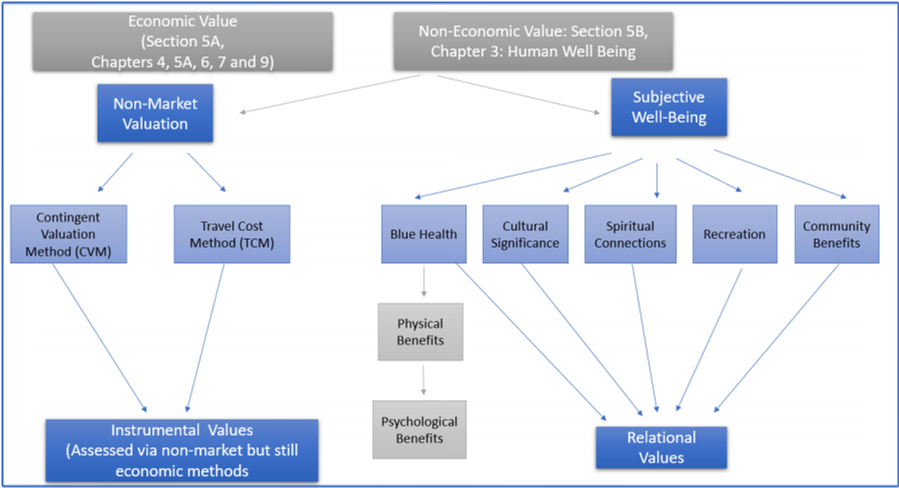
Note: To illustrate the relationship between oceans and human well-being, two main pathways are highlighted: non-market valuation and subjective well-being. The graphic is aligned with the values assessment of the Intergovernmental Science-Policy Platform on Biodiversity and Ecosystem Services (IPBES).
4. Societal dimensions of ocean-human interactions
Cultural significance
For millenniums, oceans have been a source of cultural meaning, an important part of the stories, identities and traditions that have shaped countless societies throughout human history. Their role is multifaceted; they are not only intertwined with livelihoods in coastal communities, but also contribute to cultural expressions and help to maintain intangible heritage. There are several aspects to consider that are linked to maritime heritage, such as various practices, beliefs and customs that have evolved around the sea, from fishing traditions to artistic expressions (see also subsect. 5A, subchaps. 1A and 1B), all of which are living proof of how oceans shape the lives and identities of those who live near them. The vital role played by oceans in supporting cultural practices, the preservation of intangible heritage and intergenerational knowledge transfer is presented below.
Maritime heritage encompasses a vast array of cultural expressions, such as traditional fishing techniques, navigational knowledge, storytelling and festivals that celebrate the connection between communities and the sea. For several coastal societies, oceans have been central to cultural identity, offering material and symbolic resources. Prominent examples include traditional maritime songs, dances and rituals that are expressions of local identity and reinforce the importance of ocean conservation. Coastal communities often incorporate such expressions into local festivals and ceremonies, celebrating the ocean as a life-giving force Ref 6.
Food culture is another important aspect, as oceans provide culturally significant food sources that are integral to culinary traditions (see also subsect. 5A, chap. 1). Traditional seafood dishes, for example, can reinforce community bonds and strengthen the connection between people and the ocean. Access to culturally relevant food resources therefore helps to sustain dietary customs and preserve the cultural heritage of coastal societies. Beyond their cultural significance, such foods offer nutritional value and are essential for the overall health and well-being of coastal communities (see also subsect. 5B, chap. 2).
In addition, small-scale fisheries are a principal vehicle for nutrition, livelihoods and cultural identity for coastal communities, which highlights the deep social and economic connection of those communities with the ocean. Aside from their economic contribution, such fisheries support biodiversity preservation, reinforce community identity and sustain intangible cultural practices that have been passed down for centuries (see also subsect. 5A, subchaps. 1A-1D).
The transfer of traditional knowledge is essential in preserving cultural practices associated with the ocean. Cultural knowledge includes ecological wisdom and spiritual beliefs tied to the sea and is often passed down through generations. Intergenerational equity is therefore a vital aspect of such transfer; each generation inherits both the responsibility and privilege of caring for the ocean Ref 55. For example, knowledge about marine ecosystems, seasonal fish patterns and sustainable harvesting techniques supports both ecological health and cultural continuity Ref 6.
The considerations presented above highlight the importance of intergenerational equity as at a time when ocean ecosystems are facing increasing environmental threats. Ensuring that future generations have access to healthy oceans is not only an ecological responsibility, but also a cultural one. When knowledge transfer is disrupted, whether through environmental degradation, restricted access to coastal areas or the loss of language and practices, the cultural connections between communities and the ocean risk being lost. Policies aimed at supporting traditional knowledge transmission and promoting sustainable ocean management are therefore crucial for preserving cultural heritage Ref 38.
Spiritual connections
Ecosystem services are increasingly recognized as an essential aspect of human well-being. The concept of ecosystem services refers to the broad range of benefits provided by natural systems Ref 47. Cooper and others (2016) report that the Millennium Ecosystem Assessment contains 335 instances of the word "spiritual". According to Koundouri and others (2025), spiritual ecosystem services can be defined as a subset of cultural ecosystem services that provide intangible benefits to human well-being, including inspiration, connection to nature and a sense of place.
Cultural, religious and individual beliefs are often intertwined with the services provided by the spiritual ecosystem, from individual experiences and feelings connected to nature to subjective beliefs and a sense of sacredness. Spiritual ecosystem services offer numerous benefits, including the beauty and wonder of natural landscapes and the symbolic and religious significance of ecosystems.
Associated literature
The reviewed literature on the economics of the spiritual values of ecosystem services emphasizes that conventional economic frameworks must be rethought in order to fully capture the variety of benefits offered by ecosystems.
Although challenges remain, advancements in methodologies and a growing recognition of the importance of spiritual values offer opportunities for more comprehensive and inclusive assessments of ecosystem services. By understanding and valuing spiritual values, ecosystem services can be better protected and managed. Ecosystem services are often difficult to quantify and measure, making their assessment challenging. The economic measurement of spiritual ecosystem services remains open to debate. While traditional economic valuations are often focused on tangible, market-based benefits (e.g. food, water and timber), the intangible, non-market benefits, including spiritual and cultural aspects, are becoming more widely recognized. These values, which are frequently rooted in cultural, religious and personal beliefs, as well as in human-nature ties, are essential for understanding how ecosystems contribute to overall societal well-being, but they are frequently disregarded in decision-making processes Ref 8 Ref 20.
The need for a thorough grasp of spiritual ecosystem services has increased, as nature-based solutions for addressing social issues gain broader recognition. The significance of integrating spiritual values into decision-making processes is becoming more widely acknowledged by Governments and enterprises. By including those values in conservation planning, ecosystems can be safeguarded and managed in a way that reflects cultural and spiritual requirements. Economic assessments can support informed decisions regarding resource allocation, development and land use. Recognizing the significance of spiritual values can also foster increased public involvement in environmental issues. A more thorough evaluation of the advantages and disadvantages of development projects can be obtained by including spiritual values in policy. Promoting community participation in conservation initiatives can be greatly aided by spiritual principles.
Most existing studies draw on qualitative valuation methods. In fact, although traditional economic valuation methods, such as contingent valuation and hedonic pricing, are often used to assess tangible benefits, such methods may not fully capture the spiritual values of ecosystem services. Assigning monetary values to these services is a complex and often controversial task. Economic valuation is fundamental to decision-making and policies related to resource allocation; however, the process of attaching monetary value to intangible and subjective benefits can be very complex. Spiritual ecosystem services are inherently subjective and often difficult to express in quantitative terms, which makes it challenging to develop standardized assessment methods. The value and significance of spiritual ecosystem services vary across cultures, religions and individual experiences. As a result, valuation methods must be flexible and adaptable to diverse contexts.ⓘ
It is important to note that the majority of ecosystem services linked to spirituality are located in coastal and marine settings or places that are connected to water Ref 48. In any case, spiritual ecosystems are unquestionably regarded (and quantified) as valuable because they consistently convey well-being, welfare and benefits, even when they are declining and even though they are defined in multiple ways. Their benefits include inspiration, freedom, a sense of transcendence and a connection to nature (such as oceans or forests). They may also carry a sense of sacredness, either because they are located in nature or because, in urban settings, they are symbolically connected to ideas of creation or humanity's origins, often through myths and shared traditions. In this way, places acquire meaning not only through their physical characteristics, but also through the cultural and spiritual interpretations attached to them. More broadly, values represent individual or collective evaluations of benefits, whether these are linked to specific locations or to the environment as a whole.
Recent studies have begun to integrate both quantitative and qualitative data-gathering techniques, such as interview surveys and case study analyses, in order to identify and measure the spiritual importance ascribed to the attributes of specific ecosystems. Those evidence-based approaches complement the reflective views contained in the present chapter while offering certain metrics or narratives that clearly depict how spiritual value converges with ecosystem services. A notable example is the study by Cooper and others (2016), which combined both survey data and in-depth interviews to explore how individuals perceive and value the spiritual and aesthetic qualities of ecosystems. This mixed-methods approach provided quantitative indicators, such as the reported frequency and degree of spiritual significance, and qualitative insights into participants' personal and cultural connections with natural landscapes.
Quantifying spiritual values, however, presents unique challenges. Spiritual values are highly subjective and vary across individuals and cultures. They are not traded in markets, making it difficult to assign monetary value. Moreover, survey-based methods may be subject to biases, such as hypothetical bias or anchoring effects. The monetization of spiritual values can raise ethical concerns with regard to commodifying intangible aspects of the human experience. Nevertheless, understanding the economic value of spiritual values can inform policy decisions and resource management. By understanding the challenges and opportunities associated with assessing spiritual ecosystem services, researchers can develop more effective methods for assigning value and protecting important ecosystem benefits Ref 16.
Methodological approaches to assessing spiritual ecosystem services
In order to assess spiritual ecosystem services, researchers often rely on qualitative and participatory approaches, reflecting the intangible nature of spiritual values. A notable example is the study by Sangha and others (2018), which utilized a value transfer approach in northern Australia, where Indigenous communities derive spiritual and well-being benefits from coastal and marine resources. According to the study, spiritual ecosystem services can be captured by understanding the cultural narratives and symbolic meanings attached to natural resources, a perspective that is especially relevant for Indigenous communities. Similarly, Klain and Chan (2012) interviewed marine resource users in British Columbia, Canada, and found that the ocean holds strong spiritual significance and plays a central role in shaping both personal identity and the shared sense of belonging within the community.
A shared feature of those studies is their participatory orientation, consistent with the methods used by Bryce and others (2016), who assessed spiritual ecosystem services at broad scales using hedonic measures of subjective well-being. They measured values, including sense of place, belonging and intergenerational continuity, through surveys and interviews. Such approaches shed light as to how spiritual ecosystem services contribute to subjective well-being, as participants also emphasize their relationships with particular natural places that evoke feelings of reverence and respect for nature (Keniger and others. 2013).
Challenges in quantifying spiritual ecosystem services
The quantification of spiritual values presents a unique set of challenges due to the subjective and culturally dependent nature of those values. Unlike market-based ecosystem services, spiritual values are often not traded in markets, making them difficult to measure through traditional economic methods Ref 18. Studies, including those by Sangha and others (2019) and Brown and Hausner (2017), therefore rely on qualitative data to gauge the importance of spiritual ecosystem services, using participatory mapping and interviews to capture non-material benefits. The application of monetary valuation can lead to ethical concerns about the commodification of spiritual experiences. For example, applying the contingent valuation method to willingness to pay assessments may not fully capture the intrinsic value of spiritual landscapes, as motivations for conservation can be driven by cultural, existence or bequest values rather than economic incentives Ref 35.
Another significant challenge lies in the lack of a unified definition of spiritual ecosystem services, as there are diverse cultural interpretations of spirituality in the context of nature. Various studies highlight the variance in spiritual ecosystem services definitions and the corresponding methodologies, thereby further complicating a standardized assessment approach Ref 12. Spiritual values also extend beyond individual experiences to reflect shared, collective values, suggesting that spiritual ecosystem services assessments may need to incorporate more community-oriented perspectives in order to fully capture their importance Ref 30.
Recreation
Exercising in the ocean, including swimming, surfing and diving, is hugely beneficial to our physical and mental well-being. Such locally rooted activities not only enhance individual well-being, but also reflect sea-based cultures in which the ocean shapes everyday life. Ocean-based recreation is also recognized as a way of supporting the right to play, which is vital for natural childhood development, facilitates learning and strengthens the sense of connection with the marine environment Ref 34 (see also subsect. 5A, chap. 2).
In addition, recreation plays a cultural role, as it strengthens community bonds and serves as a source of identity. In that sense, ocean-based activities extend beyond leisure to include the right to culture and education, fostering an appreciation for marine ecosystems that lasts into adulthood.
Maintaining a healthy ocean is also integral to sustaining livelihoods that rely on recreational tourism (see also subsect. 5A, chap. 4), which is a major economic driver for many coastal areas. When marine environments are well preserved, they attract visitors seeking unique ocean experiences, thereby generating income for local communities. It should be noted that this relationship is mutual; for recreation to thrive, the health of marine ecosystems must be prioritized. For example, the experience of Miskito divers, traditional fishers who also engage in diving tourism, illustrates this mutual dependency. Any pollution or degradation of marine habitats would directly affect their livelihoods, which reinforces the need for sustainable practices that balance human activity with ecosystem conservation Ref 63.
Although public attention has generally been focused on the physical wellness benefits of oceans, their mental health benefits must be equally acknowledged. Studies show that time spent near water is associated with reduced stress and anxiety and enhanced mental clarity Ref 23. The ocean serves as a place of mindfulness and restoration for many people, helping them with stress-related ailments. Public health policies that encourage recreation in or near the ocean can contribute to both mental health and physical fitness.
Healthy ecosystems, maintained through environmentally friendly leisure activities and policies aimed at safeguarding the ocean, support communities and provide opportunities for future generations to use the ocean sustainably for health, recreation and economic opportunities without harming local production and contributing to unsustainable growth.
Community benefits
Ocean ecosystems play a vital role in promoting cooperation at the community level, shaping social identities, supporting community welfare and fostering sustainable development.
There are a variety of relevant social events in which people can participate, including beach clean-ups, fishing events and ocean-related celebrations. Through such events, individuals are made aware of the importance of caring for the ocean while also practising sustainability. In addition to their recreational and social value, such events also educate the participants on ocean conservation and promote behaviours and habits that ensure that ocean ecosystems continue to thrive for future generations Ref 30. Through hands-on engagement, community members feel a shared sense of responsibility for the ocean, thus leading to lasting support for conservation efforts.
Furthermore, there is a need to acknowledge the immeasurable value of the sea. The sea not only provides us with countless opportunities for recreation and cultural experiences, but also contributes significantly to the well-being of communities. There are also economic aspects, as many people in coastal regions depend on the sea for their sustenance, including through fishing or ocean-based tourism. Such activities generate large economic benefits and contribute to the welfare of such communities.
Eco-friendly sustainable tourism practices can help communities to strike a critical balance between financial growth and marine habitat protection. Such practices help to build resilience and offer communities an anchor to develop sustainable ways of life that support the global need to care for the health of ocean ecosystems Ref 63.
The ocean is particularly important in coastal regions and plays a key role in cultural identity and heritage. The ocean is a resource and a symbol of cultural identity for many Indigenous Peoples around the world, not only acting as an essential service but also enabling them to participate in traditions that are passed down from generation to generation. Engaging young people in local communities in ocean literacy activities helps to reinforce their sense of cultural identity while also instilling them with values associated with environmental stewardship, illustrating the need for a healthy ocean to support overall well-being and maintain cultural continuity Ref 24.
Social capital can also be viewed as a vital aspect that contributes to the resilience and sustainability of coastal communities, fostering trust, cooperation and shared responsibility towards ocean conservation. Strong community bonds stimulate cooperation in marine resource management, enabling traditional knowledge and collective action to support long-term sustainability Ref 57. Areas that are cosmopolitan and developed in terms of social capital usually have stronger local governance systems and active community participation in environmental programmes aimed at promoting the stewardship of marine ecosystems Ref 2. In addition, social networks enable communities to mobilize resources, share information and adjust to environmental changes, especially climate-related threats to fisheries and coastal livelihoods Ref 1. The strengthening of social capital through inclusive decision-making processes and participatory conservation frameworks can promote environmental conservation and community livelihood enhancement for a more integrated approach to ocean sustainability.
Developing sustainable policies is crucial to fully harnessing the social, economic and cultural benefits. Actions aimed at promoting sustainable fishing, responsible tourism and community-based conservation frameworks can help to preserve marine ecosystems and support local economies. By further integrating community perspectives into conservation and resource management policies, the needs of local populations are addressed, thereby fostering a stronger connection between community welfare and ecosystem health Ref 15.
5. Challenges and threats
In recent years natural ecosystems, such as marine environments, have been confronted with a large number of risks that compromise the health of human beings and the sea itself. A detailed discussion of the challenges is contained in Intergovernmental Oceanographic Commission-United Nations Educational, Scientific and Cultural Organization (IOC-UNESCO) (2022, 2024). Related issues and suggested actions can be found in the second World Ocean Assessment (chap. 27). The major challenges affecting the survival, development and well-being of many communities and species are driven by factors such as pollution, climate change and environmental degradation. Ensuring the sustainability of the increased exploitation of the environment and the pace of development is essential in order to better deal with and, in the long term, eliminate such concerns.
Climate change is perhaps the most severe threat to oceanic systems. Increasing temperatures are accelerating and intensifying ocean acidification, thereby damaging coral reefs and marine life Ref 27. As marine species move to colder waters, local ecosystems are weakened, which poses significant risks to coastal societies, particularly those that rely heavily on fishing.
Another major threat to the ocean is pollution. In particular, plastic waste and chemicals have a severe impact on marine life and water quality, and it is increasingly being reported that microplastics have infiltrated the food chain, affecting fish and shellfish consumed by humans, which poses health risks to people Ref 31. Similarly, agricultural run-off, laden with nutrients, causes eutrophication in coastal areas, leading to algal blooms that deplete oxygen and create dead zones. In order to mitigate pollution, strategies such as waste management reforms, stricter regulations on plastic production and public awareness campaigns are essential.
Resources are being depleted at unprecedented rates, raising serious challenges as new threats emerge (see also subsect. 5A, chap. 3). This has recurred during economic history. Recent instances of unsustainable resource extraction have put more pressure on ocean ecosystems. Fish stocks are declining as a result of rising demand for seafood, which, in turn, reduces marine biodiversity. This depletion not only affects marine life, but also poses risks to food security and the economies that rely on fishing. In that regard, adopting sustainable fishing practices, investing in aquaculture and cultivating international cooperation are necessary for healthy fisheries and sustainable fish stock control Ref 53.
To address those challenges, comprehensive strategies, including conservation efforts, policy reforms and community involvement, are needed. Global frameworks, such as the Paris Agreement, along with local efforts, including coastal restoration projects, demonstrate the need for integrated approaches to protect ocean health. The United Nations Decade of Ocean Science for Sustainable Development Vision 2030 white papers contain in-depth discussion of several challenges and suggested solutions. By tackling climate change, minimizing pollution and encouraging sustainable resource use, ocean ecosystems can be preserved and the well-being of both current and future generations can be ensured.
6. Case studies
Several case studies related to various topics addressed in the present chapter are presented below. In particular, they explore aspects such as marine resource management, fisheries management, recycling waste fishing nets, cultural ecosystems, community-based coral reef management, and sacred sea rituals and marine conservation. Figure II presents an overview of the context, challenges and action undertaken. A more detailed examination of Indigenous and local community knowledge can be found in subsection 5B, chapter 8.
Figure II Community-led ocean conservation: case studies in sustainable marine management

Source: Prepared by the writing team.
7. Conclusion
The present chapter highlights the extensive contributions of ocean ecosystems to human well-being, ranging from economic value to non-market benefits such as spiritual, cultural and recreational services. Non-market valuation, despite its challenges, remains crucial to understanding and quantifying the non-monetary value of oceans, which can enable informed policy decisions that support both human and environmental health. Subjective well-being is closely linked to the therapeutic and restorative qualities of marine environments, which reinforces the significance of accessible blue spaces for mental and physical health. Ocean ecosystems play an irreplaceable role in supporting cultural practices, traditional knowledge and intergenerational heritage. Preserving marine resources for small-scale fisheries and coastal communities is very important to safeguard their livelihoods, cultural heritage and social unity. Many of those communities actively engage in conservation efforts, as protecting their fisheries helps to secure economic stability, while also preserving their traditions, cultural identities and overall well-being across generations through community-based management and stewardship.
The case studies illustrate how different communities interact with, and depend on, ocean resources, often employing innovative strategies to balance conservation with socioeconomic needs. However, growing environmental challenges, such as climate change, pollution and resource depletion, pose severe risks to those benefits, underscoring the need for robust policy frameworks and community-driven conservation. Integrating cultural, economic and ecological perspectives into ocean management policies helps to ensure that oceans continue to support human well-being, cultural heritage and sustainable development for future generations.
References
- Adger, W.N. (2003). Social capital, collective action, and adaptation to climate change. Economic Geography, 79(4), 387-404.
- Aldrich, D.P., and Meyer, M.A. (2015). Social capital and community resilience. American Behavioral Scientist, 59 (2), 254-269.
- Anderson, C.B., Athayde, S., Raymond, C.M., Vatn, A., Arias, P., Gould, R.K., Kenter, J., Muraca, B., Sachdeva, S., Samakov, A., Zent, E., Lenzi, D., Murali, R., Amin, A., and Cantú-Fernández, M. (2022). Chapter 2: Conceptualizing the diverse values of nature and their contributions to people. In: Methodological Assessment Report on the Diverse Values and Valuation of Nature of the Intergovernmental Science-Policy Platform on Biodiversity and Ecosystem Services. Balvanera, P., Pascual, U., Christie, M., Baptiste, B., and González-Jiménez, D., eds. IPBES secretariat, Bonn, Germany. https://doi.org/10.5281/zenodo.6493134.
- Apostolaki, S., Akinsete, E., Koundouri, P., and Samartzis, P. (2018). Reference Module in Earth Systems and Environmental Sciences. https://doi.org/10.1016/B978-0-12-409548-9.12117-7.
- Bateman, I.J., and others (2011). Economic Analysis for Ecosystem Service Assessments. Environmental and Resource Economics, 48(2), 177-218.
- Berkes, F. (2012). Sacred Ecology (3rd ed.). Routledge.
- Boardman, A.E., Greenberg, D.H., Vining, A.R., and Weimer, D.L. (2017). Cost-Benefit Analysis: Concepts and Practice (4th ed.). Cambridge University Press.
- Brander, L.M., R. de Groot, J.P. Schägner, V. Guisado-Goñi, V. van 't Hoff, S. Solomonides, A. McVittie, F. Eppink, M. Sposato, L. Do, A. Ghermandi, M. Sinclair, R. Thomas (2024). Economic values for ecosystem services: A global synthesis and way forward, Ecosystem Services, volume 66. Ecosystem Services, 66, 101606. doi: 10.1016/j.ecoser.2024.101606.
- Britton, E., Kindermann, G., Domegan, C., and Carlin, C. (2020). Blue care: A systematic review of blue space interventions for health and wellbeing. Health Promotion International, 35(1), 50-69.
- Brown, G., and Hausner, V.H. (2017). An empirical analysis of cultural ecosystem values in coastal landscapes. Ocean & Coastal Management, 142, 49-60.
- Brondizio, E., Diaz, S., Settele, J., Ngo, H.T., Gueze, M., Aumeeruddy-Thomas, Y., Bai, X., Geschke, A., Molnár, Z., Niamir, A., Pascual, U., Simcock, A., and Jaureguiberry, P. (2019). Chapter 1 Assessing a planet in transformation: Rationale and approach of the IPBES Global Assessment on Biodiversity and Ecosystem Services. Zenodo.
- Bryce, R., Irvine, K.N., Church, A., Fish, R., Ranger, S., and Kenter, J.O. (2016). Subjective well-being indicators for large-scale assessment of cultural ecosystem services. Ecosystem Services, 21, 258-269.
- Carothers, C. (2015). Fisheries privatization, social transitions, and well-being in Kodiak, Alaska. Marine Policy, 61, 313-322.
- Carson, R.T. (2012). Contingent Valuation: A Practical Alternative When Prices Aren't Available. Journal of Economic Perspectives, 26(4), 27-42.
- Chan, K.M.A., Balvanera, P., Benessaiah, K., Chapman, M., Díaz, S., Gómez-Baggethun, E., Gould, R., Hannahs, N., Jax, K., Klain, S., Luck, G.W., Martín-López, B., Muraca, B., Norton, B., Ott, K., Pascual, U., Satterfield, T., Tadaki, M., Taggart, J., Turner, N. (2016). Why protect nature? Rethinking values and the environment. Proceedings of the National Academy of Sciences, 113(6), 1462-1465.
- Cheng, X., Van Damme, S., Li, L., and Uyttenhove, P. (2019). Evaluation of cultural ecosystem services: A review of methods. Ecosystem services, 37, 100925.
- Cinner, J.E., and Aswani, S. (2007). Integrating customary management into marine conservation. Biological Conservation, 140(3-4), 201-216.
- Cooper, N., Brady, E., Steen, H., and Bryce, R. (2016). Aesthetic and spiritual values of ecosystems: Recognising the ontological and axiological plurality of cultural ecosystem 'services'. Ecosystem Services, 21, 218-229.
- Costanza, R., and others (1997). The Value of the World's Ecosystem Services and Natural Capital. Nature, 387(6630), 253-260.
- Duha, S.P.I., Harefa, O.O., Lombok, J.L., and Marpaung, N.B. (2023). Tanggung Jawab Orang Percaya Atas Pengrusakan Alam: Perspektif Pendidikan Agama Kristen. REAL DIDACHE: Journal of Christian Education, 3(2), 90-105.
- Foale, S., and Macintyre, M. (2000). Dynamic and flexible aspects of customary marine tenure in Papua New Guinea. Asia Pacific Viewpoint, 41(3), 281-294.
- Freeman, A.M. (2003). The Measurement of Environmental and Resource Values: Theory and Methods. 2nd ed., Washington, D.C., RFF Press.
- Gascon, M., Zijlema, W., Vert, C., White, M.P., and Nieuwenhuijsen, M.J. (2017). Outdoor blue spaces, human health, and well-being: A systematic review of quantitative studies. International Journal of Hygiene and Environmental Health, 220(8), 1207-1221.
- Gould, R.K., Klain, S.C., Ardoin, N.M., Satterfield, T., Woodside, U., Hannahs, N., Daily, G.C., Chan, K.M.A. (2015). A protocol for eliciting nonmaterial values through a cultural ecosystem services frame. Conservation Biology, 29(2), 575-586.
- Halkos, G., Aslanidis, P.-S., Plataniotis, A., and Koundouri, P. (2024). Global insights on Sustainable Development Goal 14: Reviewing willingness-to-pay levels for marine ecosystem protection and conservation (No. 2416). DEOS Working Papers, Athens University of Economics and Business.
- Hanemann, W.M. (1994). Valuing the Environment Through Contingent Valuation. Journal of Economic Perspectives, 8(4), 19-43.
- Hoegh-Guldberg, O., Poloczanska, E.S., Skirving, W., and Dove, S. (2017). Coral reef ecosystems under climate change and ocean acidification. Frontiers in Marine Science, 4, 158. doi: 10.3389/fmars.2017.00158.
- Intergovernmental Oceanographic Commission (2024). State of the ocean report, 2024, H. Enevoldsen, K. Isensee, and Y.J. Lee, eds. IOC Technical Series, No. 190. UNESCO.
- Intergovernmental Oceanographic Commission (2022). State of the ocean report 2022: Pilot edition, H. Enevoldsen, K. Isensee, and I. Yoon, eds. IOC Technical Series, No. 173. UNESCO.
- Irvine, K.N., O'Brien, L., Ravenscroft, N., Cooper, N., Everard, M., Fazey, I., Reed, M.S., and Kenter, J.O. (2016). Ecosystem services and the idea of shared values. Ecosystem Services, 21, 184-193.
- Jambeck, J.R., Geyer, R., Wilcox, C., Siegler, T.R., Perryman, M., Andrady, A., Narayan, R., and Law, K.L. (2015). Plastic waste inputs from land into the ocean. Science, 347(6223), 768-771.
- Johannes, R.E. (2002). The renaissance of community-based marine resource management in Oceania. Annual Review of Ecology and Systematics, 33, 317-340.
- Kahneman, D., and Krueger, A.B. (2006). Developments in the measurement of subjective well-being. Journal of Economic Perspectives, 20(1), 3-24.
- Keniger, L.E., Gaston, K.J., Irvine, K.N., and Fuller, R.A. (2013). What are the benefits of interacting with nature? International Journal of Environmental Research and Public Health, 10(3), 913-935.
- Klain, S.C., and Chan, K.M.A. (2012). Navigating coastal values: participatory mapping of ecosystem services for spatial planning. Ecological Economics, 82, 104-113.
- Koundouri, P., and Giannouli, A. (2015). Blue growth and economics. Front. Mar. Sci., 2, 94. doi: 10.3389/fmars.2015.00094.
- Koundouri, P., Anquetil-Deck, C., Becchetti, L., Berthet, E., Borghesi, S., Cavalli, L., Chioatto, E., Cruickshank, E., Devves, S., Dibattista, I., Fusacchia, I., Giovannini, E., Halkos, G., Hansmeyer, C., Landis, C., Mazzarano, M., Papa, C., Patel, K., Plataniotis, A., Salustri, F., Tiwari, M.M. (2023a). Transforming Our World: Interdisciplinary Insights on the Sustainable Development Goals, SDSN European Green Deal Senior Working Group.
- Koundouri, P., Halkos, G., Landis, C., Dellis, K., Stratopoulou, A., Plataniotis, A., and Chioatto, E. (2023b). Valuation of marine ecosystems and Sustainable Development Goals. Frontiers in Environmental Economics, 2, 1160118. doi: 10.3389/frevc.2023.1160118.
- Koundouri, P., Landis, C., and Onofri, L. (2025). Exploring the Economic Nature of Spiritual Values: Results from a Qualitative Meta-analysis. Munich Personal Repec Archives Online at https://mpra.ub.uni-muenchen.de/124399/ MPRA Paper No. 124399.
- Koundouri, P., Anquetil-Deck, C., Becchetti, L., Berthet, E., Borghesi, S., Cavalli, L., Chioatto, E., Cruickshank, E., Devves, S., Dibattista, I., Fusacchia, I., Giovannini, E., Halkos, G., Hansmeyer, C., Landis, C., Mazzarano, M., Papa, C., Patel, K., Plataniotis, A., Salustri, F., Tiwari, M.M., (2023a). Transforming Our World: Interdisciplinary Insights on the Sustainable Development Goals, SDSN European Green Deal Senior Working Group.
- Koundouri, P., Halkos, G., Landis, C., Dellis, K., Stratopoulou, A., Plataniotis, A., and Chioatto, E. (2023b). Valuation of marine ecosystems and Sustainable Development Goals. Front. Environ. Econ. 2.
- Kronsted Lund, L., Gurholt, K.P., and Kaae, B.C. (2023). Whose blue healthy spaces? A scoping study on blue health promotion and recreation, planning and management. Sport, Education and Society, 28(6), 714-726.
- Krutilla, J.V. (1967). Conservation Reconsidered. American Economic Review, 57(4), 777-786.
- Lee, S., and Kim, T.-G. (2024). Economic Value of Ocean Education in Korea Using the Contingent Valuation Method (CVM). Journal of Coastal Research, 116(sp1), 304-308.
- Loomis, J.B. (2000). Environmental Valuation Techniques in Water Resource Decision Making. Journal of Water Resources Planning and Management, 126 (6), 339-344.
- Louviere, J.J., Hensher, D.A., and Swait, J.D. (2000). Stated Choice Methods: Analysis and Applications. Cambridge University Press.
- Millennium Ecosystem Assessment (2005). Ecosystems and Human Well-being: Synthesis. Island Press. Available at https://www.millenniumassessment.org/documents/document.356.aspx.pdf. Accessed on 13 March 2025.
- Nevzati, Fiona, Mart Külvik, Joanna Storie, Liisa-Maria Tiidu, and Simon Bell (2023). Assessment of Cultural Ecosystem Services and Well-Being: Testing a Method for Evaluating Natural Environment and Contact Types in the Harku Municipality, Estonia. Sustainability, 15, no. 13: 10214.
- Ocean Conservancy (2020). The impact of fishing gear as a source of marine plastic pollution: A global ghost gear initiative (GGGI) information paper to support negotiations in preparation for UNEA 5.2.
- Ostrom, E. (1990). Governing the Commons: The Evolution of Institutions for Collective Action. Cambridge University Press.
- Padilla Arya, M., and Diswandi (2024). Investigating the Economic Significance of Tourism Destinations: A Bibliometric Analysis of the Travel Cost Method. International Journal of Tourism Business Research, 3(1), 1-6. doi: 10.29303/intour.v3i1.1108.
- Parsons, G.R. (2003). The Travel Cost Model. In Champ, P.A., Boyle, K.J., and Brown, T.C., eds. A Primer on Nonmarket Valuation. Dordrecht, Kluwer Academic Publishers, pp. 269-329. doi: 10.1007/978-94-007-0826-6_9.
- Pauly, D., and Zeller, D. (2016). Catch reconstructions reveal that global marine fisheries catches are higher than reported and declining. Nature Communications, 7, 10244.
- Pearson, D.G., and Craig, T. (2014). The great outdoors? Exploring the mental health benefits of natural environments. Frontiers in Psychology, 5, 1178.
- Poe, M.R., Norman, K.C., and Levin, P.S. (2014). Cultural dimensions of socio-ecological systems: Key connections and guiding principles for conservation in coastal environments. Conservation Letters, 7(3), 166-175.
- Pigou, A.C. (1920). The Economics of Welfare. Macmillan.
- Pretty, J., and Smith, D. (2004). Social capital in biodiversity conservation and management. Conservation Biology, 18(3), 631-638.
- Rosen, S. (1974). Hedonic Prices and Implicit Markets: Product Differentiation in Pure Competition. Journal of Political Economy, 82(1), 34-55.
- Sachs, J., Koundouri, P., Becchetti, L., Brunnhuber, S., Chioatto, E., Cordella, M., and others (2022). Financing the Joint Implementation of Agenda 2030 and the European Green Deal. Report of the UN Sustainable Development Solutions Network. Available at https://resources.unsdsn.org/financing-the-joint-implementationof-agenda-2030-and-the-european-green-deal.
- Sala, A., and Richardson, K. (2023). Fishing gear recycling technologies and practices. Rome, FAO and IMO.
- Samuelson, P.A. (1954). The Pure Theory of Public Expenditure. The Review of Economics and Statistics, 36(4), 387-389.
- Sangha, K.K., Preece, L., Villarreal-Rosas, J., Kegamba, J.J., Paudyal, K., Warmenhoven, T., and Ramakrishnan, P.S. (2018). An ecosystem services framework to evaluate indigenous and local peoples' connections with nature. Ecosystem Services, 31, 111-125.
- Sangha, K.K., Stoeckl, N., Crossman, N., and Costanza, R. (2019). A state-wide economic assessment of coastal and marine ecosystem services to inform sustainable development policies in the Northern Territory, Australia. Marine Policy, 107, 103595.
- Spash, C.L. (2000). Ecosystems, Contingent Valuation and Ethics: The Case of Wetland Re-Creation. Ecological Economics, 34(2), 195-215.
- Termansen, M., Jacobs, S., Mwampamba, T.H., Ahn, S., Castro, A., Dendoncker, N., Ghazi, H., Gundimeda, H., Huambachano, M., Lee, H., Mukherjee, N., Nemogá, G.R., Palomo, I., Pandit, R., Schaafsma, M., Ngouhouo, J., Choi, A., Filyushkina, A., Hernández-Blanco, M., Contreras, V., and González-Jiménez, D. (2022). Chapter 3: The potential of valuation. In Methodological Assessment Report on the Diverse Values and Valuation of Nature of the Intergovernmental Science-Policy Platform on Biodiversity and Ecosystem Services, P. Balvanera, U. Pascual, M. Christie, B. Baptiste, and D. González-Jiménez, eds. IPBES secretariat, Bonn, Germany. https://doi.org/10.5281/zenodo.6521298.
- Turner, N.J., Gregory, R., Brooks, C., Failing, L., and Satterfield, T. (2008). From invisibility to transparency: Identifying the implications. Ecology and Society, 13(2), 1-17.
- United Nations Environment Programme (2021). Drowning in Plastics: marine litter and plastic waste vital graphics.
- Intergovernmental Oceanographic Commission of UNESCO (2024). Ocean Decade Vision 2030 White Papers. The Ocean Decade Series, 51.1-51.10. Paris, UNESCO-IOC. UN Decade of Ocean Science for Sustainable Development Vision 2030 white papers. Available at https://oceandecade.org/publications/ocean-decade-vision-2030-white-papers/.
- Vave, R., Friedlander, A.M., Kittinger, J.N., and Ticktin, T. (2024). Cultural ecosystem services and the conservation challenges for an Indigenous people's aquatic protected area practice. Conservation Biology, 38(6). e14403. doi: 10.1111/cobi.14403d.
- Vave, R. (2022). Five culturally protected water body practices in Fiji: Current status and contemporary displacement challenges. Ambio, 51(4), 1001-1013. doi: 10.1007/s13280-021-01620-z.
- Völker, S., and Kistemann, T. (2011). The impact of blue space on human health and well-being: Salutogenetic health effects of inland surface waters: A review. International Journal of Hygiene and Environmental Health, 214(6), 449-460.
- Ward, F. A., and Beal, D. (2000). Valuing Nature with Travel Cost Models: A Manual. Edward Elgar Publishing.
- White, M.P., Alcock, I., Wheeler, B.W., and Depledge, M.H. (2013). Would you be happier living in a greener urban area? A fixed-effects analysis of panel data. Psychological Science, 24(6), 920-928.
White, M.P., Elliott, L.R., Gascon, M., Roberts, B., and Fleming, L.E. (2020). Blue space, health and well-being: A narrative overview and synthesis of potential benefits. Environmental Research, 191, 110169.
Please add the following to the reference list: Pearce, D.W., and Turner, R.K. (1990). Economics of Natural Resources and the Environment. Baltimore, Johns Hopkins University Press.