
Intertidal zone
Writing team: Martin Zimmer (coordinating author), Niki Evelpidou, Pilar Lorena Muñoz Muga, Sheila Nyang'anyi Rioba, Eric Okuku (lead member) and Tymon Zielinski (co-lead member).
Key points
- The intertidal zone has undergone considerable transformations, driven primarily by climate change, pollution and coastal development. Sea level rise and coastal squeeze have led to habitat loss and reduced ecosystem services, such as the provision of natural resources and coastal protection. Rising temperatures and extreme weather events have exacerbated these effects. Efforts to integrate intertidal ecosystems into climate change mitigation initiatives and increased aquaculture activities have affected intertidal zones.
- Mangrove forests, salt marshes and seagrass beds are increasingly recognized for their role as blue carbon sinks, and there are initiatives to establish or re-establish and protect these habitats for their ecological and economic value.
- Regional differences in recent developments are becoming apparent, with each biogeographical region facing distinct challenges. Arctic areas are affected by sea ice retreat, while urbanization in such regions as the Mediterranean and the Caribbean is leading to eutrophication and habitat fragmentation. The vulnerability of intertidal ecosystems necessitates tailored conservation strategies that reflect regional socioeconomic and environmental contexts.
- Establishment and re-establishment efforts, such as introducing or restoring mangroves and seagrass and implementing green-grey infrastructure, are promising for mitigating habitat loss. The shift towards high-intervention approaches, such as ecosystem co-design, is aimed at creating resilient socioecological systems that adapt to climate change while providing essential ecosystem services.
- Rising carbon dioxide (CO2) concentrations in seawater are resulting in ocean acidification that increasingly affects inhabitants of intertidal ecosystems, in particular molluscs, corals and other calcifying organisms.
1. Introduction
The intertidal zone is a dynamic interface between marine and terrestrial environments, characterized by large environmental variability due to regionally specific tidal regimes. This boundary includes diverse habitats (see figure below), such as rocky shores (with macroalgal forests), mudflats, seagrass beds, mangrove forests, salt marshes and sandy beaches, each providing essential services, such as shoreline stabilization, carbon sequestration (see subsect. 5B, chap. 1), and the provision of habitats for numerous species Ref 64.
Figure Exemplary zonation of macrophytes in coastal and intertidal ecosystems
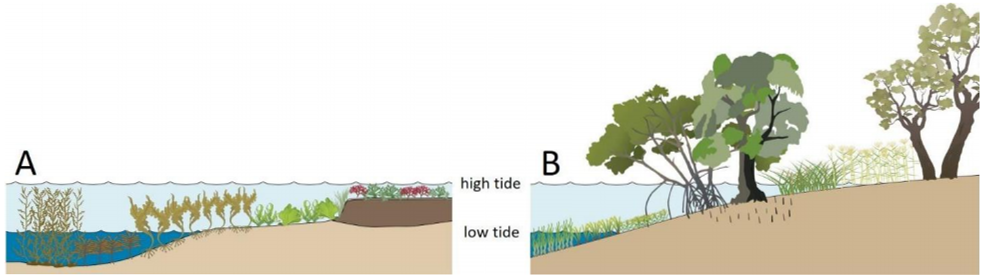
Note: (A) temperate rocky shores: subtidal (e.g. Macrocystis spp., Ecklonia spp.), low-intertidal (e.g. Laminaria spp., Lessonia spp., Ulva spp.), mid-intertidal (e.g. Chaetomorpha spp.) and high-intertidal (e.g. Chondrus spp., Codium spp.) macroalgal beds (see sect. 4, subchap. 4I); (B) tropical and subtropical soft sediment shores: subtidal and intertidal seagrass beds (e.g. Thalassia spp., Cymodocea spp., Halophila spp.) (see sect. 4, subchap. 5G), mid- to high-intertidal mangrove forests (e.g. Rhizophora spp., Avicennia spp.) (see sect. 4, subchap. 5H), high-intertidal and low-supratidal salt marshes (e.g. Spartina spp., Phragmites spp.) (see sect. 4, subchap. 5I) and supratidal coastal forests (e.g. Melaleuca spp.).
The first World Ocean Assessment Ref 83 served to highlight the ecological significance of the intertidal zone, emphasizing its role as a unique interface between land and sea.
The second World Ocean Assessment Ref 84 contained details of substantial changes in intertidal ecosystems between 2010 and 2020, driven primarily by climate change, coastal development and invasion by non-native species. Key impacts included habitat degradation and biodiversity loss, notably in vegetated areas, such as mangrove forests, seagrass beds and salt marshes. These changes have affected the provision of ecosystem services and revealed the vulnerability of intertidal zones to anthropogenic pressures.
The present subchapter provides an updated assessment of the state of intertidal ecosystems between 2018 and 2023, detailing the effects of sea level rise, pollution, habitat fragmentation and socioeconomic shifts. The importance of regional trends is discussed, as are establishment and re-establishment efforts and adaptive strategies, such as nature-based solutions and green-grey infrastructure, to address these challenges. The aim is to provide a comprehensive overview that supports policymakers in devising targeted conservation, establishment and re-establishment strategies, while promoting resilience through such approaches as ecosystem co-design Ref 96 Ref 97 and community-based management. This approach aligns with Sustainable Development Goal 14: Conserve and sustainably use the oceans, seas and marine resources for sustainable development.
2. Environmental changes since the second World Ocean Assessment
Changes in overall status
Climate change and its consequences have become increasingly prevalent, and the pace of change is faster than anticipated, posing imminent and rapidly growing threats to coastal ecosystems. In addition to warming, sea level rise has effected tangible change in intertidal habitats.
Between 2018 and 2023, sea level rise accelerated, averaging 3.2 mm per year globally Ref 62 and now exceeds 6 mm per year in regions such as South-East Asia, where land subsidence and glacial melt are exacerbating the effects Ref 42. Depending on topography, this rise either shifts intertidal habitats landward or compresses them against developed coastlines, resulting in "coastal squeeze" Ref 71. This reduces the extent of intertidal habitats along the tidal gradient, in particular in urban areas, and affects biodiversity and key ecosystem services, such as shoreline stabilization and carbon sequestration. As the sea level rises, coastal areas become ever more vulnerable to coastal erosion Ref 29; this is especially true of coastal areas undergoing additional, non-climatic rises in sea level due to tectonic subsidence or other factors Ref 15.
Among direct anthropogenic drivers, agricultural run-off and urban and industrial wastewater discharges are major contributors to eutrophication, causing harmful algal blooms and reduced oxygen levels in coastal waters Ref 82. Heavy metals and hydrocarbons (see sect. 4, subchap. 6E) from industries affect sediment characteristics and benthic species and reduce biodiversity Ref 69 Ref 57. Urban expansion has increased pollutants, such as microplastics Ref 23, which accumulate in many marine organisms Ref 89, and pharmaceuticals, potentially affecting the endocrine system of many organisms Ref 6 (see sect. 4, subchap. 6E).
Those pressures notwithstanding, there has been intertidal habitat expansion in some areas due to natural processes. Areas with minimal human interference have experienced sediment deposition, due in part to sea level rise and changed coastal hydrodynamics, leading to the formation of new mudflats and sandbanks Ref 90. These new flats provide habitats for diverse species, enhancing local biodiversity. Such expansions are limited, however, to regions where natural sediment availability and transport are unaffected by human infrastructure Ref 11.
Rising temperatures have affected, and continue to affect, the distribution of intertidal species and the species composition of intertidal communities. Warming has shifted thermally sensitive species poleward Ref 37, and invasive species are often taking advantage of these conditions, outcompeting native species Ref 61 (see sect. 4, subchap. 6A). The spread of invasive species is accelerated by global trade and travel Ref 63. Along with rising temperatures, the frequency and severity of extreme weather events, such as storms and heatwaves, has increased (see subsect. 5B, chap. 4), contributing to ecosystem instability Ref 72.
Habitat fragmentation persists, especially in urbanizing regions of Asia and the Middle East, where natural intertidal areas are being replaced with artificial structures through land reclamation Ref 21. This fragmentation reduces the ecological connectivity needed for species resilience Ref 2, leading to declining species richness, altered ecosystem processes and unequilibrated ecosystems Ref 75. There are some positive efforts to note, however. For example, green-grey hybrid infrastructure projects, in which mangroves and other natural elements are integrated into coastal defences, have mitigated erosion and created habitats that support intertidal species Ref 1.
Significant socioeconomic changes can be attributed to environmental pressures, climate change Ref 55, and conservation, establishment and re-establishment strategies Ref 46 in the intertidal zone.
In response to declining shellfish populations, aquaculture (subsect. 5A, subchaps. 1C and 1D) has been focused increasingly on regional species better adapted to local environmental conditions Ref 18. This reduces the impact of non-native species that often disrupt communities and ecosystems Ref 49. Supporting native aquaculture improves sustainability and provides a stable income, contributing to food security and economic resilience Ref 27. Integrated and multi-trophic aquaculture has gained in popularity. It involves combining different species, ideally of different trophic levels, of commercial interest in order to optimize resource use and reduce environmental impacts Ref 8. For example, farming filter-feeding molluscs improves water quality (reduced nutrient load) and light conditions for primary producers Ref 26. Including mangroves in shrimp aquaculture also enhances coastal resilience by reducing erosion and improving water quality Ref 53, thereby combining some of the many services and benefits of mangroves with food production. This approach aligns with global sustainability goals and offers new economic opportunities for coastal communities Ref 41.
The recognition of intertidal ecosystems, such as mangrove forests, salt marshes and seagrass beds, as important blue carbon sinks has led to efforts to protect, establish or re-establish these ecosystems Ref 39. Integrating blue carbon valuation into coastal management has created incentives for conservation projects, potentially generating funding through carbon credits and international programmes Ref 31, provided that proper monitoring, reporting and verification (MRV) are assured Ref 86.
The socioeconomic impacts of rising sea levels and increased storm frequency highlight the need for effective coastal resilience strategies Ref 40. Nature-based solutions, such as mangrove forest establishment and re-establishment and salt marsh conservation, have been prioritized for their role in enhancing biodiversity and providing coastal defence Ref 85 Ref 87. These approaches can be complemented by engineering solutions, including sea walls, to improve infrastructure Ref 13. Such green-grey hybrid infrastructure, combining natural elements with technical, architectural or engineering solutions, balances human needs with biodiversity conservation and the need for efficient coastal protection Ref 91 Ref 28.
Coastal tourism can have profound impacts on marine biodiversity Ref 4 and can cause the pollution of coastal sediments Ref 14. Tourist activities on sandy beaches are often facilitated through the deliberate destruction of intertidal habitats Ref 29 Ref 5 or the removal of beach wrack, gravel, boulders and beach rocks, resulting in changed coastal morphodynamics and increased erosion Ref 43 Ref 74. Coastal tourism has, in turn, faced challenges due to beach erosion, pollution and biodiversity loss, reducing the natural appeal of intertidal and coastal areas Ref 79. This can lead to a decline in tourism revenue, pushing communities to adapt by promoting conservation-focused or ecotourism initiatives Ref 52. These adaptations provide new income opportunities and raise awareness of the importance of preserving intertidal ecosystems Ref 38 for both tourists and local actors.
Community-based management of coastal resources has gained emphasis, in recognition of the fact that Indigenous, traditional owner and local community knowledge and stakeholder engagement and involvement are key to sustainability Ref 78. Empowering communities to co-design measures to manage fisheries, establish or re-establish ecosystems and participate in conservation programmes has been effective in building coastal resilience. These participatory approaches foster a sense of ownership, leading to better stewardship Ref 33.
3. Region-specific changes
Intertidal zones across biogeographical regions have experienced distinct trends driven by changing climatic conditions, socioeconomic factors and human activities. The following paragraphs provide an overview of key trends in the seven major biogeographical regions.
Arctic Ocean
In the Arctic Ocean, the rapid retreat of sea ice due to increasing temperatures has had a significant impact on intertidal habitats Ref 7. Rising sea levels and storm frequency have led to coastal erosion, altering sediment patterns and affecting species reliant on stable intertidal environments Ref 44. The northward expansion of sub-Arctic species has displaced native Arctic organisms, challenging Indigenous Peoples and communities who depend on intertidal resources Ref 76. Increased commercial shipping traffic due to receding sea ice has led to higher pollution levels, including oil spills and noise pollution, disrupting intertidal ecosystems and wildlife Ref 35.
North Atlantic Ocean, Baltic Sea, Black Sea, Mediterranean and North Sea
The North Atlantic, Baltic Sea, Black Sea, Mediterranean and North Sea regions have shown varied trends. The North Atlantic and North Sea face extreme weather events, floods of greater frequency and severity, and erosion Ref 54, while warming in the Mediterranean has facilitated invasive species, challenging native communities Ref 94. Coastal urbanization in the Baltic Ref 88 and Black Seas Ref 3 has led to eutrophication, decreasing water quality.
South Atlantic Ocean and wider Caribbean
In the South Atlantic and wider Caribbean, coastal development (subsect. 5A, chap. 9), especially in urban areas, has fragmented mangrove and seagrass habitats Ref 10. Tourism infrastructure expansion has further contributed to habitat loss Ref 81.
Indian Ocean, Arabian Sea, Bay of Bengal, Red Sea, Gulf of Aden and Persian Gulf
The Indian Ocean, Arabian Sea, Bay of Bengal, Red Sea, Gulf of Aden and Persian Gulf face intense socioeconomic and anthropogenic environmental pressures. Mangrove forests have been negatively affected by coastal squeeze Ref 56, and increased temperatures have had an impact on intertidal ecosystems Ref 70.
North Pacific Ocean
In the North Pacific, warming waters have shifted species distributions, facilitating invasive species Ref 51. Coastal urbanization Ref 58, anthropogenic activities Ref 93 and increased storm activity pose threats Ref 48, leading to habitat fragmentation and highlighting the need for resilient construction practices Ref 12.
South Pacific Ocean
The South Pacific, which includes many island nations and small island developing States, has been affected by rising sea levels, leading to the loss of critical habitats and ecosystems, such as mangrove forests Ref 95, that are vital for communities dependent on small-scale fisheries Ref 30. Pressures from urban expansion, pollution and habitat loss have caused the degradation of salt marshes and coastal wetlands, affecting both coastal biodiversity and the livelihoods of artisanal fishers Ref 32.
Southern Ocean
The Southern Ocean has seen less direct human influence Ref 59 than other regions, but climate change remains a major driver of environmental and ecological change and the degradation of intertidal habitats and ecosystems, as increased temperatures have altered species distributions in Antarctica Ref 22.
4. Key remaining knowledge and capacity gaps and new gaps
The ongoing trends in anthropogenic impacts, such as coastal development (see subsect. 5A, chap. 9), pollution (see sect. 4, subchap. 6E) and resource extraction, continue to degrade intertidal habitats Ref 77. At the same time, opportunities exist for the establishment and re-establishment of intertidal ecosystems in degraded and newly emerged habitats. Establishment and re-establishment efforts, however, must balance species richness, functional diversity and species distinctiveness in order to ensure that these ecosystems remain ecologically robust and contribute effectively to biodiversity, ecosystem processes and coastal resilience Ref 50 Ref 67 Ref 68.
Intertidal ecosystems exhibit a decline in native species richness Ref 17, and functional diversity and distinctiveness are being increasingly affected by the proliferation of invasive species Ref 66 (see sect. 4, subchap. 6A). As species composition changes, the dynamic equilibrium of these ecosystems Ref 47 is at risk, potentially undermining their ability to provide essential services, such as shoreline stabilization, nutrient cycling and carbon sequestration Ref 65. The success of measures to combat the spread of invasive species will depend on increased awareness of the threats they pose and on adequate training of staff in the authorities responsible Ref 73.
Conventional restoration methods, which focus on returning ecosystems to their original state, may be insufficient in the face of accelerating climate change and ongoing anthropogenic pressures Ref 16. High-intervention approaches, such as ecosystem co-design Ref 96 Ref 97, are gaining traction. These methods are aimed at creating resilient socioecological systems that mitigate and adapt to the effects of climate change while serving human needs. Such strategies integrate natural and artificial components in order to bolster ecosystem services Ref 92.
The outlook for intertidal ecosystems ultimately depends on policy integration and effective management practices that combine conservation, establishment, re-establishment and adaptive approaches Ref 9. Engagement with stakeholders, in particular local actors and communities, and the incorporation of Indigenous knowledge, will be crucial for developing strategies that sustain these vulnerable, yet vital, ecosystems amid ongoing environmental challenges Ref 60.
Key knowledge gaps with respect to the intertidal zone reflect the need for improved models and scenarios that can be used to project the future state of protected and established and re-established areas experiencing ongoing climate change effects Ref 34. Such models must incorporate both physical and biological variables in order to predict how establishment and re-establishment actions will fare against accelerating sea level rise and shifting climatic conditions. Reliable projections are crucial for ensuring the long-term sustainability of intertidal conservation efforts and for informing adaptive management strategies Ref 45.
A significant capacity gap is the lack of widespread, standardized monitoring of biodiversity loss and species distribution shifts. The implementation of advanced techniques, such as molecular taxonomy and environmental DNA approaches, is essential to fill this gap. These methods allow for non-invasive, accurate monitoring of species composition and help to detect changes, especially in response to climate-induced shifts in distribution, providing critical information for conservation planning Ref 80. Actions against future coastal squeeze, such as strategic spatial planning for coastal vegetated ecosystems, require further research and implementation Ref 50. Learning from such examples as New Orleans, United States of America, where proactive spatial planning has resulted in the designation of areas for future coastal vegetated ecosystems, can help to mitigate habitat compression Ref 25. Such strategies must be adapted to regional contexts in order to ensure the preservation and resilience of intertidal habitats Ref 20.
Addressing these gaps requires coordinated international and regional efforts Ref 19, increased funding for technological advances and capacity-development initiatives Ref 24 to empower local communities and stakeholders to use modern tools and approaches for effective intertidal ecosystem management Ref 36.
References
- Agardy, T., MacIntosh, K. (2023). Gray leads to green in the blue: building infrastructure to enhance coastal habitat. Coastal Engineering Proceedings, 37. https://icce-ojs-tamu.tdl.org/icce/article/view/13051.
- Aiken, C.M, Mulloy, R., Dwane, G., Jackson, E.L. (2021). Working with nature approaches for the creation of soft intertidal habitats. Front Ecol Evol, 9. https://doi.org/10.3389/fevo.2021.682349.
- Akkoyunlu, A. (2018). Land-based pollution of the Black Sea along the Turkish shoreline. J Mar Sci Res Devel, 8. https://doi.org/10.4172/2155-9910.1000248.
- Alsaleh, M., Wang, X., Nan, Z., Liu, R., Sun, Q. (2023). Impact of coastal tourism demand on fisheries industry sustainability: A suggested framework for blue growth. Natural Resources Forum, 1-27. https://doi.org/10.1111/1477-8947.12332.
- Andriolo, U., Gonçalves, G. (2023). Impacts of a massive beach music festival on a coastal ecosystem - A showcase in Portugal. Science of the Total Environment, 861: 1-8. https://doi.org/10.1016/j.scitotenv.2022.160733.
- Arguello-Pérez, M.A., Mendoza-Pérez, J.A., Tintos-Gómez, A., Ramírez-Ayala, E., Godínez-Domíngez, E., de Asis Silva Bátiz, F. (2019). Ecotoxicological analysis of emerging contaminants from wastewater discharges in the coastal zone of Cihuatlán (Jalisco, Mexico). Water, 11. https://doi.org/10.3390/w11071386.
- Assis, J., Serrão, E.A., Duarte, C.M., Fragkopoulou, E., Krause-Jensen, D. (2022). Major expansion of marine forests in a warmer Arctic. Front Mar Sci, 9. https://doi.org/10.3389/fmars.2022.850368.
- Barrington, K., Ridler, N., Chopin, T., Robinson, S., Robinson, B. (2008). Social aspects of the sustainability of integrated multi-trophic aquaculture. Aquaculture International, 18: 201-211.
- Baskent, E.Z. (2020). A framework for characterizing and regulating ecosystem services in a management planning context. Forests, 11. https://doi.org/10.3390/f11010102.
- Blanco-Libreros, J.F., Ramírez-Ruiz, K. (2021). Threatened mangroves in the Anthropocene: habitat fragmentation in urban coastalscapes of Pelliciera spp. (Tetrameristaceae) in Northern South America. Front Mar Sci, 8. https://doi.org/10.3389/fmars.2021.670354.
- Braat, L., Leuven, J.R.F.W., Lokhorst, I.R., Kleinhans, M.G. (2018). Effects of estuarine mudflat formation on tidal prism and large-scale morphology in experiments. Earth Surf Proc Landf, 44. https://doi.org/10.1002/esp.4504.
- Bulleri, F., Chapman, M.G. (2010). The introduction of coastal infrastructure as a driver of change in marine environments. J Appl Ecol, 47. https://doi.org/10.1111/j.1365-2664.2009.01751.x.
- Burcharth, H.F., Zanuttigh, B., Andersen, T.L., Lara, J.L., Steendam, G.J., Ruol, P., Sergent, P., Ostrowski, R., Silva, R., Martinelli, L., Nørgaard, J.Q.H., Mendoza, E., Simmonds, D., Ohle, N., Kappenberg, J., Pan, S., Nguyen, D.K., Toorman, E.A., Prinos Panayotis, Hoggart, S., Chen, Z., Piotrowska, D., Pruszak, Z., Schönhofer, J., Skaja, M., Stmytkiewicz, P., Smytkiewicz, M., Leont'yev, I., Angelelli, E., Formentin, S.M., Smaoui, H., Bi, Q., Sothmann, J., Schuster, D., Li, M., Ge, J., Lendzion, J., Koftis, T., Kuznetsov, S., Puente, A., Echavarri, B., Medina, R., Díaz-Simal, P., Rodriguez, I.L., Maza, M., Higuera, P. (2015). Innovative engineering solutions and best practices to mitigate coastal risk. In Coastal risk management in a changing climate, Zanuttigh, B., Nicholls, R., Vanderlinden, J.P., Burcharth, H.F., Thompson, R.C., eds., 55-170. https://doi.org/10.1016/B978-0-12-397310-8.00003-8.
- Buzzi, N.S., Menéndez, M.C., Truchet, D.M., Delgado, A.L., Severini, M.D.F. (2022). An overview on metal pollution on touristic sandy beaches: Is the COVID-19 pandemic an opportunity to improve coastal management? Marine Pollution Bulletin, 174. https://doi.org/10.1016/j.marpolbul.2021.113275.
- Cai, F., Cao, C., Qi, H., Su, X., Lei, G., Liu, J., Zhao, S., Liu, G., Zhu, K. (2022). Rapid migration of mainland China's coastal erosion vulnerability due to anthropogenic changes. Journal of Environmental Management, 319: 115632.
- Capon, S.J., Pettit, N.E. (2018). Turquoise is the new green: Restoring and enhancing riparian function in the Anthropocene. Ecol Manag Rest, 19: 44-53. https://doi.org/10.1111/emr.12326.
- Cappelatti, L., Mauffrey, A.R.L., Griffin, J.N. (2020). Functional diversity of habitat formers declines scale-dependently across an environmental stress gradient. Oecologia, 194: 135-149. https://doi.org/10.1007/s00442-020-04746-1.
- Carranza, A., zu Ermgassen, P.S.E. (2020). A Global Overview of Restorative Shellfish Mariculture. Front Mar Sci, 7. https://doi.org/10.3389/fmars.2020.00722.
- Cavallo, M., Elliott, M., Touza, J., Quintino, V. (2016). The ability of regional coordination and policy integration to produce coherent marine management: Implementing the Marine Strategy Framework Directive in the North-East Atlantic. Marine Policy, 68: 108-116. https://doi.org/10.1016/j.marpol.2016.02.013.
- Chambers, J.C., Allen, C.R., Cushman, S.A. (2019). Operationalizing Ecological Resilience Concepts for Managing Species and Ecosystems at Risk. Front Ecol Evol, 7. https://doi.org/10.3389/fevo.2019.00241.
- Chee, S.Y., Othman, A.G., Sim, Y.K., Adam, A.N.M., Firth, L.B. (2017). Land reclamation and artificial islands: Walking the tightrope between development and conservation. Glob Ecol Cons, 12: 80-95. https://doi.org/10.1016/j.gecco.2017.08.005.
- Chelchowski, M., Balazy, P., Grzelak, K., Grzelak, L., Kedra, M., Legenzynska, J., Kuklinski, P. (2021). Vertical zonation of benthic invertebrates in the intertidal zone of Antarctica (Admiralty Bay, King George Island). Antarct Sci, 34: 29-44. doi:10.1017/S095410202100047X.
- Chen, Q., Zhao, H., Liu, Y., Jin, L., Peng, R.(2023). Factors Affecting the Adsorption of Heavy Metals by Microplastics and Their Toxic Effects on Fish. Toxics, 11: 490. https://doi.org/10.3390/toxics11060490.
- Clark, R., Reed, J., Sunderland, T. (2018). Bridging funding gaps for climate and sustainable development: Pitfalls, progress and potential of private finance. Land Use Policy, 71: 335-346. https://doi.org/10.1016/j.landusepol.2017.12.013.
- De Mutsert, K., Lewis, K.A., White, E.D., Buszowski, J. (2021). End-to-End Modeling Reveals Species-Specific Effects of Large-Scale Coastal Restoration on Living Resources Facing Climate Change. Front Mar Sci, 8. https://doi.org/10.3389/fmars.2021.624532.
- Du, X., Song, D., Wang, H., Yang, J., Liu, H., Huo T. (2023). The combined effects of filter-feeding bivalves (Cristaria plicata) and submerged macrophytes (Hydrilla verticillate) on phytoplankton assemblages in nutrient-enriched freshwater mesocosms. Front Plant Sci, 14. https://doi.org/10.3389/fpls.2023.1069593.
- Engle, C.R., van Senten, J. (2022). Resilience of Communities and Sustainable Aquaculture: Governance and Regulatory Effects. Fishes, 7: 268. https://doi.org/10.3390/fishes7050268.
- Evelpidou, N., Spyrou, E. (2024). Coastal areas and wetlands: Suggestions for sustainable mitigation and management strategies. In Climate and Anthropogenic Impacts on Earth Surface Processes in the Anthropocene. Elsevier, Amsterdam, Beylich, A.A., and others, eds., pp. 313-322.
- Evelpidou, N., Tzouxaniot, M., Liaskos, A. (2022). Coastal erosion: The future of sandy beaches. Proceedings of the European Academy of Sciences & Arts, 1: 1-16. https://doi.org/10.5281/zenodo.7298431.
- Flores-Verdugo, F., Amazcua, F., Kovacs, J.M., Serrano, D., Blanco-Correa, M. (2014). Changes in the Hydrological Regime of Coastal Lagoons Affect Mangroves and Small Scale Fisheries: The Case of the Mangrove-Estuarine Complex of Marismas Nacionales (Pacific Coast of Mexico). In Fisheries Management of Mexican and Central American Estuaries. Estuaries of the World. Amezcua F., Bellgraph, B., eds., 81-91. Springer, Dordrecht. https://doi.org/10.1007/978-94-017-8917-2_6.
- Friess, D.A., Howard, J., Huxham, M., Macreadie, P.I., Ross, F. (2022). Capitalizing on the global financial interest in blue carbon. PLoS Climate, 1(8): e0000061. https://doi.org/10.1371/journal.pclm.0000061.
- Gaete, H., Álvarez, M., Lobos, G., Soto, E., Jara-Gutiérrez, C. (2017). Assessment of oxidative stress and bioaccumulation of the metals Cu, Fe, Zn, Pb, Cd in the polychaete Perinereis gualpensis from estuaries of central Chile. Ecotoxicology and Environmental Safety, 145: 653-658. https://doi.org/10.1016/j.ecoenv.2017.07.073.
- Galappaththi, E.K., Falardeau, M., Harris, L.N., Rocha, J.C., Moore, J-S., Berkes, F. (2022). Resilience-based steps for adaptive co-management of Arctic small-scale fisheries. Environ Res Lett, 17: 10.1088/1748-9326/ac7b37.
- Garner, A.J., Sosa, S.E., Tan, F., Tan, C.W.J., Garner, G.G., Horton, B.P. (2023). Evaluating Knowledge Gaps in Sea-Level Rise Assessments From the United States. Earth's Future, 11. https://doi.org/10.1029/2022EF003187.
- Ghosh, S., Rubly, C. (2015). The emergence of Arctic shipping: issues, threats, costs, and risk-mitigating strategies of the Polar Code. Australian Journal of Maritime & Ocean Affairs, 7: 171-182. http://dx.doi.org/10.1080/18366503.2015.1093695.
- Goodspeed, R., Riseng, C., Wehrly, K., Yin, W., Mason, W., Schoenfeldt, B. (2016). Applying design thinking methods to ecosystem management tools: Creating the Great Lakes Aquatic Habitat Explorer. Marine Policy, 69: 134-145. https://doi.org/10.1016/j.marpol.2016.04.017.
- Habary, A., Johansen, J.L., Nay, T.J., Steffenson, J.F., Rummer, J.L. (2017). Adapt, move or die - how will tropical coral reef fishes cope with ocean warming? Glob Change Biol, 23: 566-577. https://doi.org/10.1111/gcb.13488.
- Harahab, N., Riniwati, H., Utami, T.N., Abidin, Z., Wati, L.A. (2021). Sustainability Analysis of Marine Ecotourism Management for Preserving Natural Resources and Coastal Ecosystem Functions. Env Res Eng Manag, 77. https://doi.org/10.5755/j01.erem.77.2.28670.
- Heimhuber, V., Raoult, V., Glamore, W.C., Taylor, M.D., Gaston, T.F. (2023). Restoring blue carbon ecosystems unlocks fisheries' potential. Rest Ecol, 32: e14052. https://doi.org/10.1111/rec.14052.
- Hoggart, S.P.G., Hanley, M.E., Parker, D.J., Simmonds, D.J., Bilton, D.T., Filipova-Marinova, M., Franklin, E.L., Kotsev, I., Penning-Rowsell, E.C., Rundle, S.D., Trifonova, E., Vergiev, S., White, A.C., Thompson, R.C. (2014). The consequences of doing nothing: The effects of seawater flooding on coastal zones. Coast Eng, 87: 169-182. https://doi.org/10.1016/j.coastaleng.2013.12.001.
- Hossain, A., Senff, P., Glaser, M. (2022). Lessons for Coastal Applications of IMTA as a Way towards Sustainable Development: A Review. Appl Sci, 12: 11920. https://doi.org/10.3390/app122311920.
- Idris, N.H., Munadi, M.H.F. (2022). Recent progress on sea-level rise over the marginal seas in Southeast Asia. Proc. SPIE 12263, Remote Sensing of the Ocean, Sea Ice, Coastal Waters, and Large Water Regions 2022, 1226304. https://doi.org/10.1117/12.2639437.
- Johnston, W.G., Cooper, J.A.G., Olynik, J. (2023). Shoreline change on a tropical island beach, Seven Mile Beach, Grand Cayman: The influence of beachrock and shore protection structures. Mar Geol, 45: 107006. https://doi.org/10.1016/j.margeo.2023.107006.
- Jones, B.M., Arp, C.D., Jorgenson, M.T., Hinkel, K.M., Schmutz, J.A., Flint, P.L. (2009). Increase in the rate and uniformity of coastline erosion in Arctic Alaska. Geophys Res Lett, 36. https://doi.org/10.1029/2008GL036205.
- Judge, R., Choi, F., Helmuth, B. (2018). Recent advances in data logging for intertidal ecology. Front Ecol Evol, 6. https://doi.org/10.3389/fevo.2018.00213.
- Katsanevakis, S., Coll, M., Fraschetti, S., Giakoumi, S., Goldsborough, D., Macic, V., Mackelworth, P., Rilov, G., Stelzenmüller, V., Albano, P.G., Bates, A.E., Bevilacqua, S., Gissi, E., Hermoso, V., Mazaris, A.D., Pita, C., Rossi, V., Teff-Seker, Y., Yates, K. (2020). Twelve Recommendations for Advancing Marine Conservation in European and Contiguous Seas. Front Mar Sci, 7. https://doi.org/10.3389/fmars.2020.565968.
- Krohs, U., Zimmer, M. (2023). Do ecosystems have functions? Ecol Evol, 13. e10458. https://doi.org/10.1002/ece3.10458.
- Kuwano-Yoshida A., Okajima, S., Nakamura, H. (2022). Rapid Increase of Explosive Cyclone Activity over the Midwinter North Pacific in the Late 1980s. J Clim, 35: 1113-1133. https://doi.org/10.1175/JCLI-D-21-0287.1.
- Lima, L., Oliveira, F.J.M., Giocomini, H.C., Lima-Junior, D.P. (2018). Expansion of aquaculture parks and the increasing risk of non-native species invasions in Brazil. Rev Aquacult, 10: 111-122. https://doi.org/10.1111/raq.12150.
- Lester, S.E., Dubel, A.K., Hernán, G., McHenry, J., Rassweiler, A. (2020). Spatial planning principles for marine ecosystem restoration. Front Mar Sci, 7. https://doi.org/10.3389/fmars.2020.00328.
- Liu, Y-L., Zhong, K-L., Jueterbock, A., Satoshi, S., Choi, H-G., Weinberger, F., Assis, J., Hu, Z-M. (2022). The invasive alga Gracillaria vermiculophylla in the native Northwest Pacific under ocean warming: Southern genetic consequence and Northern range expansion. Front Mar Sci, 9. https://doi.org/10.3389/fmars.2022.983685.
- Lukoseviciute, G., Panagopoulos, T. (2021). Management priorities from tourists' perspectives and beach quality assessment as tools to support sustainable coastal tourism. Ocean & Coast Manag, 208: 105646. https://doi.org/10.1016/j.ocecoaman.2021.105646.
- Mahmudi, M., Musa, M., Bunga, A., Wati, N.A., Arsad, S., Lusiana, E.D. (2022). A Water Quality Evaluation of Integrated Mangrove Aquaculture System for Water Treatment in Super-Intensive White Leg Shrimp Pond. J Ecol Eng, 23: 287-296. https://doi.org/10.12911/22998993/146746.
- Mendez-Tejeda, R., Pérez-Valentín, K.A., Barreto-Orta, M. (2020). Impact of extreme weather events on the beaches of Puerto Rico: The case of ocean park, San Juan. American Journal of Marine Science, 8: 1-5. https://doi.org/10.12691/marine-8-1-1.
- Mieszkowska, N., Burrows, M.T., Hawkins, S.J., Sugden, H. (2021). Impacts of pervasive climate change and extreme events on rocky intertidal communities: evidence from long-term data. Front Mar Sci, 8: https://doi.org/10.3389/fmars.2021.642764.
- Milani, A.S. (2018). Mangrove forests of the Persian Gulf and the Gulf of Oman. In Threats to Mangrove Forests: Hazards, Vulnerability and Management, Makowski, C., Finkl, C.W., eds. Springer: 53-75.
- Moazampour, S.R., Nabavi, S.M.B., Roozbahani, M.M., Khodadai, M. (2021). Determination of total petroleum hydrocarbons and selected heavy metals (Pb, Co, V, Ni) concentration levels in surficial sediments of the Arvand River estuary and their impact on benthic macroinvertebrate assemblages. Intl J Env Anal Chem, 103: 2841-2857. https://doi.org/10.1080/03067319.2021.1900143.
- Momota, K., Hosokawa, S. (2021). Potential impacts of marine urbanization on benthic macrofaunal diversity. Sci Rep, 11: 4028. https://doi.org/10.1038/s41598-021-83597-z.
- Murphy, E.J., Johnston, N.M., Hofmann, E.E., Phillips, R.A., Jackson, J.A., Constable, A.J., Henley, S.F., Melbourne-Thomas, J., Trebilco, R., Cavanagh, R.D., Tarling, G.A., Saunders, R.A., Barnes, D.K.A., Costa, D.P., Corney, S.P., Fraser, C.I., Höfer, J., Hughes, K.A., Sands, C.J., Thorpe, S.E., Trathan, P.N., Xavier, J.C. (2021). Global connectivity of Southern ocean ecosystems. Front Mar Sci, 9. https://doi.org/10.3389/fevo.2021.624451.
- Ndonye, H.N., Mulwa, A., Ndunge Kyalo, D. (2021). Stakeholder engagement and performance of community based conservation projects: A case of Laikipia conservation region conservancies. J Econ Sust Devel, 21. https://doi.org/10.7176/JESD/12-4-07.
- Nguyen, H.M., Yadav, N.S., Barak, S., Lima, F.P., Sapir, Y., Winters, G. (2020). Responses of invasive and native populations of the seagrass Halophila stipulacea to simulated climate change. Front Mar Sci, 6. https://doi.org/10.3389/fmars.2019.00812.
- NOAA (2024). Is sea level rising? oceanservice.noaa.gov/facts/sealevel.html.
- O'Shaughnessy, K.A., Hawkins, S.J., Yunnie, A.L.E., Hanley, M.E., Lunt, P., Thompson, R.C., Firth, L.B. (2020). Occurrence and assemblage composition of intertidal non-native species may be influenced by shipping patterns and artificial structures. Mar Poll Bull, 154: 111082. https://doi.org/10.1016/j.marpolbul.2020.111082.
- Phang, V.X.H., Chou, L.M., Friess, D.A. (2015). Ecosystem carbon stocks across a tropical intertidal habitat mosaic of mangrove forest, seagrass meadow, mudflat and sandbar. Earth Surf Proc Landf, 40: 1387-1400. https://doi.org/10.1002/esp.3745.
- Pinto, P., de Jonge, V.N., Marques, J.C. (2014). Linking biodiversity indicators, ecosystem functioning, provision of services and human well-being in estuarine systems: Application of a conceptual framework. Ecol Ind, 36: 644-655. https://doi.org/10.1016/j.ecolind.2013.09.015.
- Pires-Teixeira, L.M., Neres-Lima, V., Creed, J.C. (2021). How Do Biological and Functional Diversity Change in Invaded Tropical Marine Rocky Reef Communities? Diversity, 13: 353. https://doi.org/10.3390/d13080353.
- Rahman, M.M., Zimmer, M., Ahmed, I., Donato, D., Kanzaki, M., Xu, M. (2021). Co-benefits of protecting mangroves for biodiversity conservation and carbon storage. Nature Comm, 12: 3875. https://doi.org/10.1038/s41467-021-24207-4.
- Rahman, M.M., Zimmer, M., Donato, D., Ahmed, I., Xu, M., Wu, J. (2024). Functional composition outweighs taxonomic and functional diversity in maintaining ecosystem properties and processes of mangrove forests. Glob Change Biol, 30. e17152 https://doi.org/10.1111/gcb.17152.
- Rahmanpour, S., Ghorghani, N.F., Lotfi Ashtiyani, S.M. (2014). Heavy metal in water and aquatic organisms from different intertidal ecosystems, Persian Gulf. Environ Monit Assess, 186: 5401-5409. https://doi.org/10.1007/s10661-014-3788-4.
- Rajalakshmi, P.R., Achyuthan, H. (2021). Climate change as observed in the Bay of Bengal. J Clim Change, 7: 69-82. https://doi.org/10.3233/JCC210020.
- Rilov, G., David, N., Guy-Haim, T., Golomb, D., Arav, R., Filin, S. (2021). Sea level rise can severely reduce biodiversity and community net production on rocky shores. Sci Total Env, 791: 148377. https://doi.org/10.1016/j.scitotenv.2021.148377.
- Román, M., Román, S., Vázquez, E., Troncoso, J., Olabarria, C. (2020). Heatwaves during low tide are critical for the physiological performance of intertidal macroalgae under global warming scenarios. Sci Rep, 10: 21408. https://doi.org/10.1038/s41598-020-78526-5.
- Roussos, O., Kapetanopoulou, C., Petza, D. (2021). ACTION PLAN 2021-2023: INVALIS - Protecting European Biodiversity from Invasive Alien Species. Natural Environment and Climate Change Agency. Athens, Greece.
- Saitis, G. (2022). Geomorphological-Geoenvironmental Investigation of Natural and Artificial Beachrocks Formation Mechanism and their potential as a soft engineering method against coastal hazards. Comparative studies from the Eastern Mediterranean and southern Japan. Ph.D. thesis, Department of Geology & Geo-Environment, National and Kapodistrian University of Athens.
- Sedano, F., Pavón-Paneque, A., Navarro-Barranco, C., Guerra-García, J.M., Digenis, M., Sempere-Valverde, J., Espinosa, F. (2021). Coastal armouring affects intertidal biodiversity across the Alboran Sea (Western Mediterranean Sea). Mar Env Res, 171: 105475. https://doi.org/10.1016/j.marenvres.2021.105475.
- Stafford, K.M., Farley, E.V., Ferguson, M., Kuletz, K.J., Levine, R. (2022). Northward range expansion of subarctic upper trophic level animals into the Pacific Arctic region. Oceanography, 35: 158-166. https://doi.org/10.5670/oceanog.2022.101.
- Stamp, T., West, E., Robbins, T., Plenty, S., Sheehan, E. (2022). Large-scale historic habitat loss in estuaries and its implications for commercial and recreational fin fisheries, ICES J Mar Sci, 79: 1981-1991. https://doi.org/10.1093/icesjms/fsac141.
- Tetelepta, J.M.S., Abrahamsz, J., Mamesah, J.A.B., Pattikawa, J.A., Wawo, M., Al Hamid, F. (2023). The local wisdom knowledge applied in the management of coastal resources at Ilili Village, Western Seram District, Indonesia. IOP Conf Ser: Earth Environ Sci, 1207: 012023. https://doi.org/10.1088/1755-1315/1207/1/012023.
- Thinh, N.A., Thanh, N.N., Tuyen, L.T., Hens, L. (2019). Tourism and beach erosion: valuing the damage of beach erosion for tourism in the Hoi An World Heritage site, Vietnam. Environ Dev Sustain, 21: 2113-2124. https://doi.org/10.1007/s10668-018-0126-y.
- Thomsen, P.F., Willerslev, E. (2015). Environmental DNA - An emerging tool in conservation for monitoring past and present biodiversity. Biol Cons, 183: 4-18. https://doi.org/10.1016/j.biocon.2014.11.019.
- Tuholske, C., Tane, Z., López-Carr, D., Roberts, D., Cassels, S. (2017). Thirty years of land use/cover change in the Caribbean: Assessing the relationship between urbanization and mangrove loss in Roatán, Honduras. Appl Geogr, 88: 84-93. https://doi.org/10.1016/j.apgeog.2017.08.018.
- Tuholske, C., Halpern, B.S., Blasco, G., Villasenor, J.C., Frazier, M., Caylor, K. (2021). Mapping global inputs and impacts from human sewage in coastal ecosystems. PLoS ONE. https://doi.org/10.1371/journal.pone.0258898.
- United Nations (2017). The First Global Integrated Marine Assessment: World Ocean Assessment I. Cambridge: Cambridge University Press.
- United Nations (2021). The Second World Ocean Assessment: World Ocean Assessment II, Volume I.
- Van Coppenolle, R., Schwarz, C., Temmerman, S. (2018). Contribution of Mangroves and Salt Marshes to Nature-Based Mitigation of Coastal Flood Risks in Major Deltas of the World. Est Coasts, 41: 1699-1711. https://link.springer.com/article/10.1007/s12237-018-0394-7.
- Van Dam, B., Helfer, V., Kaiser, D., Sinemus, E., Staneva, J., Zimmer, M. (2024). Towards a fair, reliable, and practical verification framework for Blue Carbon-based CDR. Environ Res Lett, 19: 081004. https://doi.org/10.1088/1748-9326/ad5fa3.
- Van der Meulen, F., IJff, S., van Zetten, R. (2023). Nature-based solutions for coastal adaptation management, concepts and scope, an overview. Nordic J Bot. https://doi.org/10.1111/njb.03290.
- Vigouroux, G., Kari, E., Beltrán-Abaunza, J.M., Uotila, P., Yuan, D., Destouni, G. (2021). Trend correlations for coastal eutrophication and its main local and whole-sea drivers - Application to the Baltic Sea. Sci Total Environ, 779: 146367. https://doi.org/10.1016/j.scitotenv.2021.146367.
- Von Hellfeld, R., Zarzuelo, M., Zaldibar, B., Cajaraville, M.P., Orbea, A. (2022). Accumulation, Depuration, and Biological Effects of Polystyrene Microplastic Spheres and Adsorbed Cadmium and Benzo(a)pyrene on the Mussel Mytilus galloprovincialis. Toxics, 10: 18. https://doi.org/10.3390/toxics10010018.
- Wang, Y.P., Gao, S., Jia, J., Thompson, C.E.L., Gao, J., Yang, Y. (2012). Sediment transport over an accretional intertidal flat with influences of reclamation, Jiangsu coast, China. Mar Geol, 291-294: 147-161. https://doi.org/10.1016/j.margeo.2011.01.004.
- Waryszak, P., Gavoille, A., Whitt, A.A., Kelvin, J., Macreadie, P.I. (2021). Combining gray and green infrastructure to improve coastal resilience: lessons learnt from hybrid flood defenses. Coast Eng J, 63: 335-350. https://doi.org/10.1080/21664250.2021.1920278.
- Westphal, H., Murphy, G.N., Doo, S.S., Mann, T., Petrovic, A., Schmidt, C., Stuhr, M. (2022). Ecosystem design as an avenue for improving services provided by carbonate producing marine ecosystems. PeerJ. https://doi.org/10.7717/peerj.12785.
- Yap, C.K., Leow, C.S., Peng, S.H.T., Ismail, M.S. (2020). Human interaction with the environmental ecosystem: A review, some notes and insights. J Aquat Pollut Toxicol, 4: 26. https://doi.org/10.37532/2581-804X/4.1.26.
- Yeruham, E., Shpigel, M., Abelson, A., Rilov, G. (2020). Ocean warming and tropical invaders erode the performance of a key herbivore. Ecology, 101: e02925. https://doi.org/10.1002/ecy.2925.
- Zhu, B., Bai, Y., He, X., Chen, X., Li, T., Gong, F. (2021). Long-Term Changes in the Land-Ocean Ecological Environment in Small Island Countries in the South Pacific: A Fiji Vision. Remote Sensing, 13: 3740. https://doi.org/10.3390/rs13183740.
- Zimmer, M. (2018). Ecosystem Design: when mangrove ecology meets human needs. In Makowski C., Finkl C.W., eds. Threats to Mangrove Forests: Hazards, Vulnerability and Management. Springer: 367-376.
- Zimmer, M., Ajonina, G.N., Amir, A.A., Cragg, S., Crooks, S., Dahdouh-Guebas, F., Duke, N., Fratini, S., Friess, D.A., Helfer, V., Huxham, M., Kathiresan, K., Kodikara, K.A.S., Koedam, N., Lee, S.Y., Mangora, M.M., Primavera, J., Satyanarayana, B., Yong, J.W.H., Wodehouse, D. (2022). When nature needs a helping hand: different levels of human intervention for mangrove (re-)establishment. Front Forests Glob Change, 5: 784322. https://doi.org/10.3389/ffgc.2022.784322.