
Seabirds
Writing team: Maria Dias (coordinating author), Martin Beal, Stephanie Borrelle, Tammy Davies, Esteban Frere, Carolina Hazin, Jana Jeglinski, Slimane Maliki (lead member), Patricia Serafini, Katarina Viik (co- lead member) and Ross Wanless.
Key points
- Seabirds remain one of the most threatened species groups at the global level, with 31% considered threatened with extinction.
- Invasive alien species and incidental fisheries by-catch remain among the major threats to seabird species, and the number of species affected by these threats has increased since the publication of the second World Ocean Assessment.
- Seabirds are increasingly facing the impacts of emerging processes, such as outbreaks of highly pathogenic avian influenza (HPAI), the development of offshore wind farms and the increase in plastic and light pollution.
- Research priorities include understanding the population trends and at-sea distribution of burrow nesters (such as storm petrels and other small petrels) and understanding the population-level effects of cumulative threats.
1. Introduction and context
Seabirds, which are bird species that depend on marine ecosystems for at least part of the year, are either top predators or skilled scavengers that play important roles in marine food webs Ref 7. They are found in all oceans, from coastal waters to the high seas. Although most seabirds are restricted to surface waters, they interact with other marine species living at different depth-layers, from the epipelagic to the mesopelagic and bathypelagic zones (e.g. by preying upon marine animals such as fish, squid or crustaceans, or by foraging in association with marine mammals). There are currently 366 extant seabird species recognized across nine different orders (see table 1). Many species are migratory and travel great distances from their breeding colonies to their foraging grounds. For this reason, seabirds are recognized as key biological vectors of nutrients, which they collect from large oceanic areas and concentrate at their colonies Ref 21 Ref 4.
Seabirds are relatively well-studied compared with other marine species, allowing for the compilation of extensive information on their conservation status, population trends and main threats, with global assessments led by BirdLife International Ref 13 Ref 14. These studies have revealed that seabirds are severely impacted by human activities worldwide, with 31% of species threatened with extinction and 57% with declining population trends (see table 1).
2. Changes in the status of seabirds since the second World Ocean Assessment
An overview of the conservation status of seabird species in 2024 is provided in Table 1 Ref 5. The procellariiformes (tubenoses such as albatrosses and petrels) are the largest group of seabirds and have the highest number of globally threatened (Critically Endangered, Endangered and Vulnerable) and Near Threatened species of any vertebrate group, according to the International Union for Conservation of Nature (IUCN) Red List of Threatened Species. Sphenisciformes, namely penguins, stand out as the group with the highest percentage of threatened species (50%) and the highest percentage of declining population trends (excluding the tropical birds and grebes, which have few species) (table 1).
The overall conservation status of seabirds (measured as the percentage of species classified as threatened by IUCN) has remained relatively stable since the publication of the second World Ocean Assessment (30.8%and 30.6%, respectively). However, an improving trend is reflected in the slight decrease in the percentage of threatened species in some groups (figure I) and in the decrease in the number of "uplisted" species between 2018 and 2024 (table 2). Six species were uplisted (i.e. their conservation status deteriorated) between 2021 and 2025 (an average of 1 species per year), while 28 species were uplisted between 2010 and 2018 (an average of 3.5 per year). However, these numbers should be interpreted with caution, as changes can be due to improved knowledge (e.g. taxonomy changes or new colonies found) rather than a genuine change in status. In fact, the percentage of species with declining population trends has increased since the last assessment, from 47% Ref 14 to 57% (table 1). It should be also noted that the most recent assessment of the IUCN Red List status of most seabird species was carried out before the recent outbreaks of HPAI, which caused the mortality of significant proportions of the populations in some seabird colonies Ref 16 Ref 28.
3. Changes in pressures since the second World Ocean Assessment
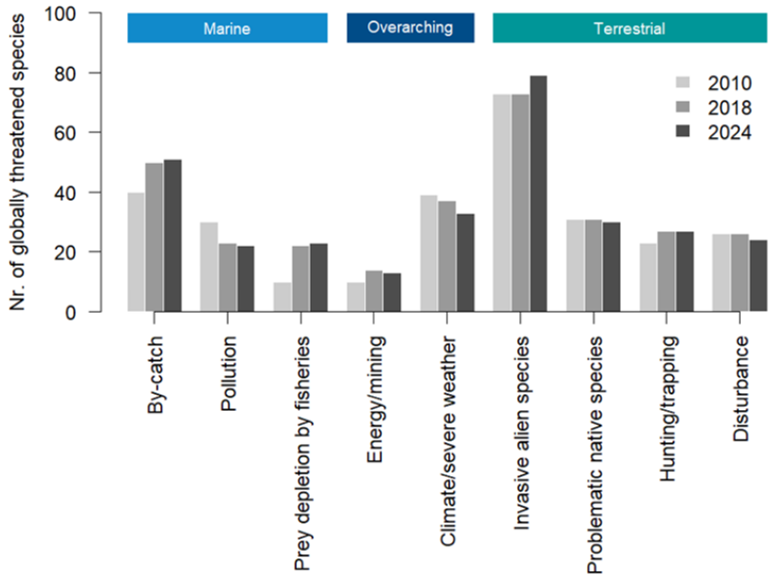
The main threats affecting seabird populations are well-known and can mostly be attributed to human activities in both marine and terrestrial habitats (Ref 14; see also sect. 4, chap. 5). At sea, the fisheries sector has been the main cause of population declines (figure II), in particular through the incidental capture of seabirds in fishing gear (incidental by-catch) and prey depletion due to overfishing (Ref 45; Ref 33; see also subsect. 5A), followed by pollution. In colonies, the introduction of invasive species (see sect. 4, chap. 6) is causing severe declines, particularly for species that breed on isolated islands (such as predation by cats and rodents, habitat degradation by introduced herbivores; see, e.g., Ref 41). Another ongoing threat in colonies is the direct harvest of eggs, chicks or adult birds for human consumption Ref 14. The number of threatened species affected by these pressures has increased since the publication of the first World Ocean Assessment (figure II).
In addition, seabirds increasingly face emerging threats, such as the development of offshore wind farms (sect. 4, chaps. 5 and 6), the increase in plastic and light pollution (ibid.) and the spread of highly lethal diseases such as avian influenza Ref 32. As numerous studies have reported the negative impacts of these emerging threats since the the publication of the second World Ocean Assessment, the following paragraphs focus on them, as well as on information updated since the publication of the second World Ocean Assessment on fisheries by-catch and prey depletion.
Pollution, with a special focus on plastics and light
Seabirds continue to be affected by pollution from marine and terrestrial sources Ref 27 Ref 34 Ref 11. While reductions in oil spills affecting seabird species have been noted Ref 14, plastic pollution remains a threat to many seabirds through ingestion and toxic chemical release Ref 35 Ref 23 Ref 30 Ref 44. Seabirds foraging in the Mediterranean and Black Seas are at particularly high risk of exposure to plastic pollution, although data is still lacking to evaluate the risk of seabirds encountering and ingesting plastic in other regions with high levels of plastic pollution, such as the coastal waters around East and South-East Asia and the South Pacific and North Atlantic gyres Ref 11.
Sub-lethal responses of seabirds to plastics have begun to be explored Ref 24 Ref 40. However, the consequences of plastic ingestion and associated chemical contamination at the population level are still poorly understood.
Light pollution poses a significant risk to some species near colonies and marine structures as a result of disorientation, collision or grounding, which can result in injury or mortality Ref 38. In contrast, the effects of light pollution at sea (e.g. from ships, offshore infrastructure or light-attracting fisheries) are poorly documented. Mitigating these effects requires the large-scale reduction and management of light pollution sources.
Offshore wind farm development
The demand for renewable sources of energy is leading to an exponential increase in the development of offshore wind farms. Seabirds are particularly vulnerable to these and can be affected directly, by collision with turbines, and indirectly, through habitat loss due to displacement effects (e.g. Ref 15). Of particular concern is the potential cumulative impact of multiple facilities, especially for migratory species that travel hundreds or thousands of kilometres per year. Recent studies have assessed this concern Ref 18, although the vast majority are limited to relatively small regions often located in northern countries (Europe and North America) and are focused on breeding species. Potential impacts of offshore wind farms on migrating seabirds (by means of the barrier effect, i.e. when wind farms cause an obstacle to the regular movement of birds) are still poorly understood.
Highly pathogenic avian influenza
HPAI has emerged as a new threat with serious implication for seabirds on a global scale. In contrast to low pathogenicity avian influenza, which circulates asymptomatically in waterbirds Ref 19, HPAI causes severe illness and high mortality. Prior to 2017, positive HPAI cases in seabirds were localized and sporadic, and the overall prevalence of active infection was considered very low Ref 26. However, in 2017, the Goose/Guangdong (Gs/GD) clade 2.3.4.4b H5N8 avian influenza virus caused mass die-offs of coastal seabird species, such as terns and African penguins (Spheniscus demersus) along the southern South African coasts Ref 31, and was confirmed in 15 seabird species by 2018. It then reappeared in 2021 Ref 37, when the clade 2.3.4.4b H5N1 avian influenza virus caused mass die-offs of great skuas (Stercorarius skua) in Scotland Ref 2, and was dwarfed by the re-emergence of H5N1 in early 2022, which spread throughout the North Atlantic, affecting at least 10 seabird species in Great Britain alone Ref 8 Ref 16. In late 2022, H5N1 spread to South America and caused unprecedented mass die-offs of seabirds in Peru Ref 28. In early 2023, HPAI spread to Chile and Uruguay and, worryingly, jumped to marine mammals, causing parallel mass die-offs Ref 43. In late 2023, positive samples were detected in several bird species in the Antarctic region Ref 3.
In addition, the impact of HPAI appears to vary among species, with some being particularly affected (i.e. experiencing higher levels of mortality or higher incidence at the colonies when compared with other species), such as the northern gannet (Morus bassanus), the common guillemot (Uria aalge) and the great skua in the North Atlantic, as well as the Peruvian pelican (Pelecanus thagus) and the Peruvian booby (Sula variegata) in the southern Pacific Ref 2 Ref 17 Ref 25 Ref 29.
Fisheries by-catch and overfishing
Severe impacts of fishing activities on seabirds (as a result of birds getting caught as by-catch or as a result of direct competition for food resources) have been highlighted since the publication of the first World Ocean Assessment. Following the publication of the second World Ocean Assessment, new studies have provided further detail on the magnitude of these impacts.
A review of the impact of fisheries on seabirds by Votier and others (2023) concluded that, although the problem of seabird by-catch was recognized in the late 1980s (Brothers and others, 1991), it continues to have significant impacts. Suggested avenues to address this threat include improved compliance monitoring of by-catch mitigation measures (including on small-scale fleets and with a special focus on less-known, poorly studied species and regions). Votier and others (2023) also highlighted the urgent need to understand the combined effects of fisheries and other threats, in particular emerging issues such as climate change and offshore wind farms. Ramírez and others (2024) provided, for the first time, estimates of the number of seabirds by-caught annually in European waters (a mean of 195,000 individual birds, with a range of 130,000 to 380,000). These authors pinpointed the North-East Atlantic as the region with the highest by-catch, and gillnet fisheries as responsible for the highest by-catch levels, while highlighting significant knowledge gaps concerning the eastern Atlantic, the Mediterranean Sea and the Black Sea.
Phillips and others (2024) reviewed the global incidental mortality of seabirds in trawl fisheries, conservatively estimating that 44,000 birds are caught every year, with albatrosses, large petrels and northern gannets being the most affected species. The authors agreed with others that the actual mortality is likely to be much higher, given the extent of cryptic mortality and poor or non-existent monitoring Ref 6.
The potential impact of mesopelagic fisheries on seabirds should also be regarded as an emerging concern Ref 14. Mesopelagic species (i.e. those inhabiting depths of 200-1,000 m) are considered one of the most promising future human food resources (e.g. Ref 48) and several countries are exploring the viability of exploiting these species. Mesopelagic species potentially have enormous importance in the global ocean through their fundamental role in marine food webs and their function as biological carbon pumps, which helps to mitigate climate change (e.g. Ref 42). Recent studies have shown that the diets of several seabird species, including members of the most threatened groups (e.g. procellariiformes and penguins; see Ref 42; Ref 47 Ref 1), is largely composed of mesopelagic species, raising concerns about the potentially devastating consequences of unregulated mesopelagic fisheries on seabirds and broader marine biodiversity.
4. Responses to pressures on seabirds
Incidental fisheries by-catch remains one of the major threats to seabird species despite decades of understanding of the nature of the problem and the mandatory use of by-catch reduction measures by all tuna regional fisheries management organizations (RFMOs). This is particularly true for longline fisheries, which pose high risks to seabirds. Parties to international multilateral instruments such as the Convention on Biological Diversity have also committed to halt adverse impacts on threatened species, including impacts attributed to fisheries by-catch. However, the global target has not yet been met Ref 39. Therefore, long-term responses to seabird conservation challenges, especially those related to cross-border and high seas threats, should be focused on improved monitoring and compliance with by-catch mitigation measures by members of RFMOs. For example, the Agreement on the Conservation of Albatrosses and Petrels has established a by-catch working group that evaluates current by-catch rates across fisheries, examines mitigation solutions, and provides best practice advice to RFMOs and others. It is recommended that those organizations update their seabird by-catch mitigation requirements to reflect the current best practice advice under the Agreement. In addition, the Commission for the Conservation of Southern Bluefin Tuna is implementing a multifaceted seabird conservation initiative funded by the Common Oceans Program Tuna Project (2023-2026) specifically targeting its members. Despite these efforts, the implementation of scientifically proven mitigation measures in regional fisheries managements organizations remains slow.
Aside from addressing fisheries, several intergovernmental organizations are funding seabird conservation projects and/or actively supporting national Governments in implementing actions tackling major threats. Examples include programmes for controlling and eradicating invasive species (particularly mammalian predators such as cats and rodents) in key seabird colonies, as well as initiatives to minimize the impacts of light pollution. Furthermore, specific guidance has been provided by the Conference of the Parties to the Convention on the Conservation of Migratory Species of Wild Animals on reducing known key pressures on seabirds such as light pollution (resolution 13.5, and the International Light Pollution Guidelines for Migratory Species), avian influenza (resolution 14.18 ), climate change (resolution 12.21 ), disturbance (especially as a result of tourism; see International Guidelines for Sustainable Marine Wildlife Interactions: Boat-Based and In-Water Activities) and harvesting in West Africa (see resolution 14.15, on the Action Plan to Address Aquatic Wild Meat Harvests in West Africa). In addition, guidance has been provided on conservation actions to reduce seabird vulnerability to climate change in the North- East Atlantic Ref 22 and on strategies to mitigate the impact of offshore wind farms on seabirds Ref 12.
5. Knowledge gaps
Although seabirds are a relatively well-studied group of birds, there are still some major knowledge gaps. Some groups are poorly known due to their small sizes, nocturnal behaviour and breeding habits (e.g. burrow nesters such as storm petrels and other small petrels), making population estimates and trends for most of these species unreliable.
Another priority is to understand the population-level effects of pollution, overfishing, offshore wind farms and climate change in addition to the cumulative effect of these threats and those causing direct mortality of seabirds (such as by-catch, predation by invasive species, diseases, hunting and egg harvesting). Regarding diseases, particular attention should be paid to managing the spread and impact of HPAI. Due to its novelty, basic understanding of transmission dynamics and basic epidemiological characteristics (such as mortality rates and levels of post-infection immunity) is lacking in most regions but is critical for predicting the recovery and long-term viability of seabird populations.
Knowledge of seabird ecology still comes mostly from temperate and polar regions, while seabirds inhabiting tropical areas have received considerably less attention, particularly with respect to their at-sea distributions, especially in the Pacific Ocean Ref 9.
Table 1 Number of seabird species in each International Union for Conservation of Nature Red List of Threatened Species category in 2024, and percentage of species with declining population trends
| Seabird order | EX | CR | EN | VU | NT | LC | DD | Percentage of species classified as threatenedª (CR+EN+VU) | Percentage of species in declineb | All species |
|---|---|---|---|---|---|---|---|---|---|---|
| Procellariiformes (tubenoses) | 2 | 17 | 20 | 29 | 20 | 57 | 3 | 46 | 59 | 148 (130) |
| Charadriiformes (gulls and auks) | 1 | 1 | 4 | 11 | 10 | 95 | 13 | 48 | 122 (103) | |
| Suliformes (gannets and boobies) | 1 | 1 | 5 | 9 | 2 | 28 | 33 | 61 | 46 (36) | |
| Anseriformes (sea ducks) | 1 | 4 | 3 | 14 | 19 | 67 | 22 (18) | |||
| Sphenisciformes | 5 | 4 | 2 | 7 | 50 | 71 | 18 (17) | |||
| (penguins) | ||||||||||
| Gaviiformes (loons) | 1 | 4 | 0 | 60 | 5 (5) | |||||
| Podicipediformes (grebes) | 1 | 3 | 25 | 100 | 4 (2) | |||||
| Phaethontiformes (tropicbirds) | 3 | 0 | 100 | 3 (3) | ||||||
| Pelecaniformes (pelicans) | 1 | 2 | 0 | 0 | 3 (2) | |||||
| All species | 5 | 19 | 34 | 58 | 39 | 213 | 3 | 31 | 57 | 371 (316) |
Source: Prepared by the writing team.
Abbreviations: EX, Extinct; CR, Critically Endangered; EN, Endangered; LC, Least Concern; NT, Near Threatened; VU, Vulnerable; DD, Data Deficient.
Note: Threatened species are those classified as CR, EN or VU. In parenthesis ("All species" column) is number of species with known population trends.
a The calculation of the percentage of threatened species excluded EX and DD species.
b Only species with known population trends were considered.
Table 2 Summary of changes in the International Union for Conservation of Nature Red List of Threatened Species status of seabirds between 2018 and 2024
| Seabird order | Uplistedª | Unchanged | Downlisted | Data Deficient | Total |
|---|---|---|---|---|---|
| Procellariiformes (tubenoses) | 3 (11) | 130 | 5 | 2 | 140 |
| Charadriiformes (gulls and auks) | 2 (8) | 115 | 3 | 120 | |
| Suliformes (gannets and boobies) | (2) | 43 | 2 | 45 | |
| Anseriformes (sea ducks) | 1 (5) | 20 | 21 | ||
| Sphenisciformes (penguins) | (1) | 15 | 3 | 18 | |
| Gaviiformes (loons) | 5 | 5 | |||
| Podicipediformes (grebes) | (1) | 4 | 4 | ||
| Phaethontiformes (tropicbirds) | 3 | 3 | |||
| Pelecaniformes (pelicans) | 3 | 3 | |||
| Total | 6 (28) | 338 | 13 | 2 | 359 |
Source: Prepared by the writing team.
Note: Includes only the 359 extant seabird species analysed in Dias and others (2019). "Uplisting" refers to a deterioration in conservation status in 2024 compared with 2018, while "downlisting" refers to an improvement in conservation status.
a In parentheses, the number of uplisted species reported in the second World Ocean Assessment.
Figure I Percentage of species categorized as globally threatened (i.e. Critically Endangered, Endangered or Vulnerable, following International Union for Conservation of Nature classification), by seabird order, in 2018 (reported in the second World Ocean Assessment) and in 2024 (the third World Ocean Assessment)
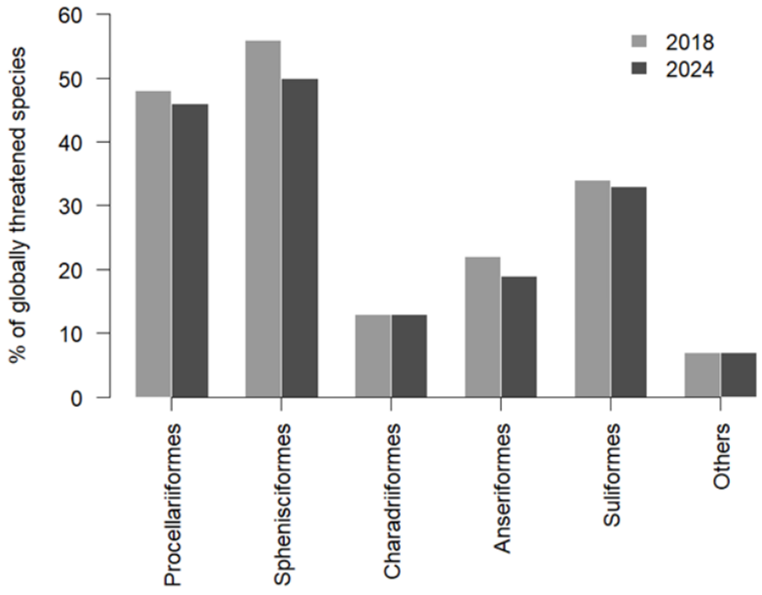
Figure II Number of globally threatened seabird species negatively affected by marine, terrestrial and overarching processes in 2010, 2018 and 2024
References
- Alho, Maria, and others (2022). Revealing the foraging movements and diet of the White-faced Storm Petrel Pelagodroma marina in the NE Atlantic. Marine Biology, vol. 169, art. 91.
- Banyard, Ashley C., and others (2022). Detection of Highly Pathogenic Avian Influenza Virus H5N1 Clade 2.3.4.4b in Great Skuas: A Species of Conservation Concern in Great Britain. Viruses, vol. 14, No. 2, art. 212.
- Banyard, Ashley C., and others (2024). Detection and spread of high pathogenicity avian influenza virus H5N1 in the Antarctic Region. Nature Communications, vol. 15, art. 7433.
- Benkwitt, Cassandra E., and others (2022). Seabird diversity and biomass enhance cross-ecosystem nutrient subsidies. Proceedings of the Royal Society B, vol. 289, art. 20220195.
- BirdLife International (2024). IUCN Red List for birds. https://datazone.birdlife.org/home.
- Brothers, Nigel, and others (2010). Seabird bycatch in pelagic longline fisheries is grossly underestimated when using only haul data. PLoS One, vol. 5, No. 8, art. e12491.
- Brooke, Michael de L. (2004). The food consumption of the world's seabirds. Proceedings of the Royal Society B, vol. 271, pp. S246-S248.
- Caliendo, Valentina, and others (2022). Transatlantic spread of highly pathogenic avian influenza H5N1 by wild birds from Europe to North America in 2021. Scientific Reports, vol. 12, art. 11729.
- Carneiro, A.P.B., and others (2024). The BirdLife Seabird Tracking Database: 20 years of collaboration for marine conservation. Biological Conservation, vol. 299, art. 110813.
- Charlton-Howard, Hayley, and others (2023). Plasticosis: characterising macro-and microplastic- associated fibrosis in seabird tissues. Journal of Hazardous Materials, vol. 450, art. 131090.
- Clark, Bethany L., and others (2023). Global assessment of marine plastic exposure risk for oceanic birds. Nature Communications, vol. 14, art. 3665.
- Croll, Donald A., and others (2022). Framework for assessing and mitigating the impacts of offshore wind energy development on marine birds. Biological Conservation, vol. 276, art. 109795.
- Croxall, John P., and others (2012). Seabird conservation status, threats and priority actions: a global assessment. Bird Conservation International, vol. 22, pp. 1-34.
- Dias, Maria P., and others (2019). Threats to seabirds: A global assessment. Biological Conservation, vol. 237, pp. 525-537.
- Dierschke, Volker (2016). Seabirds and offshore wind farms in European waters: Avoidance and attraction. Biological Conservation, vol. 202, pp. 59-68.
- Falchieri, Marco, and others (2022). Shift in HPAI infection dynamics causes significant losses in seabird populations across Great Britain. The Veterinary Record, vol. 191, pp. 294-296.
- Gamarra-Toledo, Víctor, and others (2023). Avian flu threatens Neotropical birds. Science, vol. 379, pp. 246-246.
- Garthe, Stefan, and others (2023). Large-scale effects of offshore wind farms on seabirds of high conservation concern. Scientific Reports, vol. 13, art. 4779.
- Gass, Jonathon D., and others (2023). Global dissemination of influenza A virus is driven by wild bird migration through arctic and subarctic zones. Molecular Ecology, vol. 32, pp. 198-213.
- Goodale, Michael W., and others (2019). Assessing the cumulative adverse effects of offshore wind energy development on seabird foraging guilds along the East Coast of the United States. Environmental Research Letters, vol. 14, art. 074018.
- Graham, Nicholas A. J., and others (2018). Seabirds enhance coral reef productivity and functioning in the absence of invasive rats. Nature, vol. 559, pp. 250-253.
- Häkkinen, Henry, and others (2023). Co-developing guidance for conservation: An example for seabirds in the North-East Atlantic in the face of climate change impacts. Conservation Science and Practice, vol. 5, art. e12985.
- Hamilton, Bonnie, and others (2023). Monitoring to conservation: The science-policy nexus of plastics and seabirds. Cambridge Prisms: Plastics, vol. 1, art. e3.
- Kreitsberg, Randel, and others (2023). The effect of environmental pollution on gene expression of seabirds: A review. Marine Environmental Research, vol. 189, art. 106067.
- Lane, Jude V., and others (2023). High pathogenicity avian influenza (H5N1) in Northern Gannets: Global spread, clinical signs, and demographic consequences. Ibis, vol. 166, pp. 633-650.
- Lang, Andrew S., and others (2016). Assessing the Role of Seabirds in the Ecology of Influenza A Viruses. Avian Diseases, vol. 60, pp. 378-386.
- Lavers, Jennifer L., and others (2014). Plastic ingestion by Flesh-footed Shearwaters (Puffinus carneipes): Implications for fledgling body condition and the accumulation of plastic-derived chemicals. Environmental Pollution, vol. 187, pp. 124-129.
- Leguia, Mariana, and others (2023). Highly pathogenic avian influenza A (H5N1) in marine mammals and seabirds in Peru. Nature Communications, vol. 14, art. 5489.
- McPhail, Gretchen M., and others (2024). Geographic, ecological, and temporal patterns of seabird mortality during the 2022 HPAI H5N1 outbreak on the island of Newfoundland. Canadian Journal of Zoology, in press.
- Navarro, Alberto, and others (2023). Microplastics ingestion and chemical pollutants in seabirds of Gran Canaria (Canary Islands, Spain). Marine Pollution Bulletin, vol. 186, art. 114434.
- Peyrot, Belinda M., and others (2022). Evolutionary dynamics of the clade 2.3.4.4B H5N8 high- pathogenicity avian influenza outbreaks in coastal seabirds and other species in southern Africa from 2017 to 2019. Transboundary and Emerging Diseases, vol. 69, pp. 3749-3760.
- Phillips, Richard A., and others (2023). Conservation status and overview of threats to seabirds. In Conservation of Marine Birds, Lindsay Young and Eric VanderWerf, eds. London, Academic Press, 2023.
- Phillips, Richard A., and others (2024). Incidental mortality of seabirds in trawl fisheries: A global review. Biological Conservation, vol. 296, art. 110720.
- Provencher, Jennifer F., and others (2019). Assessing plastic debris in aquatic food webs: what we know and don't know about uptake and trophic transfer. Environmental Reviews, vol. 27, pp. 304-317.
- Provencher, Jennifer F., and others (2018). Are ingested plastics a vector of PCB contamination in northern fulmars from coastal Newfoundland and Labrador? Environmental Research, vol 167, pp. 184- 190.
- Ramírez, Ivan, and others (2024). Seabird bycatch in European waters. Animal Conservation, in press.
- Roberts, Laura C. and others (2023). Descriptive Epidemiology of and Response to the High Pathogenicity Avian Influenza (H5N8) Epidemic in South African Coastal Seabirds, 2018. Transboundary and Emerging Diseases, vol. 2023, art. 708458.
- Rodríguez, Airam (2023). Mitigating light attraction. In Conservation of Marine Birds, Lindsay Young and Eric Vander Werf, eds. London, Academic Press.
- Secretariat of the Convention on Biological Diversity (2020). Global Biodiversity Outlook 5. Montreal.
- Serafini, Patrícia P., and others (2024). Biochemical and molecular biomarkers and their association with anthropogenic chemicals in wintering Manx shearwaters (Puffinus puffinus). Marine Pollution Bulletin, vol. 203, art. 116398.
- Spatz, Dena R., and others (2017). Managing Invasive Mammals to Conserve Globally Threatened Seabirds in a Changing Climate: Threatened seabird conservation on islands. Conservation Letters, vol. 10, pp. 736-747.
- St. John, Michael A., and others (2016). A dark hole in our understanding of marine ecosystems and their services: perspectives from the mesopelagic community. Frontiers in Marine Science, vol. 3, art. 31.
- Ulloa, Mauricio, and others (2023). Mass mortality event in South American sea lions (Otaria flavescens) correlated to highly pathogenic avian influenza (HPAI) H5N1 outbreak in Chile. Veterinary Quarterly, vol. 43, pp. 1-10.
- Vanstreels, Ralph E.T., and others (2023), Phthalate esters (plasticizers) in the uropygial gland and their relationship to plastics ingestion in seabirds along the coast of Espírito Santo, eastern Brazil. Journal of Zoo and Wildlife Medicine, vol. 53, pp. 733-743.
- Votier, Stephen C., and others (2023). An overview of the impacts of fishing on seabirds, including identifying future research directions. ICES Journal of Marine Science, vol. 80, pp. 2380-2392.
- Waap, Silke, and others (2017). The diet of a nocturnal pelagic predator, the Bulwer's petrel, across the lunar cycle. Scientific Reports, vol. 7, art. 1384.
- Watanuki, Yutaka and Jean-Baptiste Thiebot (2018). Factors affecting the importance of myctophids in the diet of the world's seabirds. Marine Biology, vol. 165, art. 79.
Webb, Thomas J., and others (2010). Biodiversity's big wet secret: the global distribution of marine biological records reveals chronic under-exploration of the deep pelagic ocean. PLoS One, vol. 5, art. e10223.
Brothers, N., Cooper, J.P., Løkkeborg, S., 1999. The incidental catch of seabirds by longline fisheries: worldwide review and technical guidelines for mitigation (FAO Fisheries Circular No. 937). FAO, Rome.