
Trends in the physical and chemical state of the ocean
Writing team: Penny Vlahos (coordinating author), Sam Dupont, Niki Evelpidou, Rafael González-Quirós (co-lead member), Jelena Knezevic, Vasily Smolyanitsky (lead member), David N. Thomas and Manuel Vargas-Yáñez.
Key points
- Tracking changes in the physical and chemical properties of ocean regions is critical to understanding the future of the planet, with significant geopolitical and socioeconomic consequences.
- These changes are under way, and nations will need to plan to adapt to them strategically to minimize damage to ecosystems and communities that rely upon them.
- Since the publication of the second World Ocean Assessment (see chap. 5 thereof), trends continue to reflect accelerated warming and sea level rise in the global ocean, as well as prominent regional increases in surface salinity, particularly in the Mid-Atlantic and Southern Atlantic, and decreases in annual global sea ice coverage.
- These changes are affecting global water circulation and air-sea-ice interaction processes while also leading to changes in nutrient distribution, species shifts (see sect. 4, chap. 4) and accelerating ocean hazards (see subsect. 5B, chap. 4). There will be significant changes to coastal ocean dynamics associated with sea level rise, warming and shifts in circulation, leading to significant impacts on regional communities over the next few decades. One of the most impactful changes anticipated is the frequent occurrence of an ice-free Arctic Ocean in September by the middle of the twenty-first century.
1 Physical trends
Ocean temperature (including ocean heat content)
The great capacity of the ocean to capture and store heat moderates the temperature of the planet. Over 90% of the heat absorbed by the Earth since 1955 has been accumulated in the oceans. Figure I (a) illustrates the heat increase in the upper 2,000 m of the ocean since 1955 and shows a continuous rise that peaks in 2023 Ref 48. Some 16% of this increase occurred between 2018 and 2023 even though those years represent only 7% of the time period. This heat energy accounts for 30 to 50% of sea level rise in the ocean through thermal expansion. In addition, warming contributes to changes in the migration of oceanic species, damage to coral reef systems and the accelerated melting of ice sheets (see sect. 4, subchap. 5K; and subsect. 5B, chap. 4). While the Pacific Ocean holds the largest heat reservoir due to its vast size, the greatest warming has been observed in most of the Atlantic Ocean and in the parts of the South Ocean adjacent to the Indian and Western Pacific Oceans (see figure I (b)), with notable cooling regions observed in the North Atlantic (~ 50-70º N) and in the North-West and South-West Pacific Ref 6 Ref 48. The ocean surface is where the most important heat exchange between the ocean and the atmosphere occurs. Shifts in sea surface temperature translate to important differences in water evaporation rates, atmospheric heating and cooling, marine heat waves and the thawing of sea ice, in addition to broader impacts on continental climate, as discussed in the second World Ocean Assessment.
Figure I. (a) Global mean ocean heat content (0–2,000 m); (b) Regional trends of ocean heat content (0–2,000 m)

Note: (a) Global mean ocean heat content (60° S-60º N) integrated from the surface down to a depth of 2,000 m based on different products. Shaded areas indicate the uncertainty of each method. The trend is estimated using a locally weighted scatterplot smoothing approach and amounts to 0.58 ± 0.13 W m-2 over the period 1960-2023 and 1.05 ± 0.17 W m-2 over the period 2005-2023. (b) Regional trend in the period 1960-2023 for ocean heat content in the upper 2,000 m, in W m-2
Ocean salinity
The warming climate is causing an intensification of the global water cycle due to increased rates of ocean evaporation. The impacts on ocean salinity vary based on whether a region will experience greater net evaporation (raising salinity) or greater net precipitation (reducing salinity). The long-term trends indicate that there has been relative freshening or salinity decreases over the entire Pacific, North Atlantic and Southern Oceans, but salinity increases in the Mid-Atlantic, Southern Atlantic and Indian Oceans Ref 7. These trends are expected to continue throughout the century, likely spanning the 0-1,000 m layer, with a further increase in salinity by 4 to 8% in a world warmed by +2℃ (expected in 2046).
Sea level
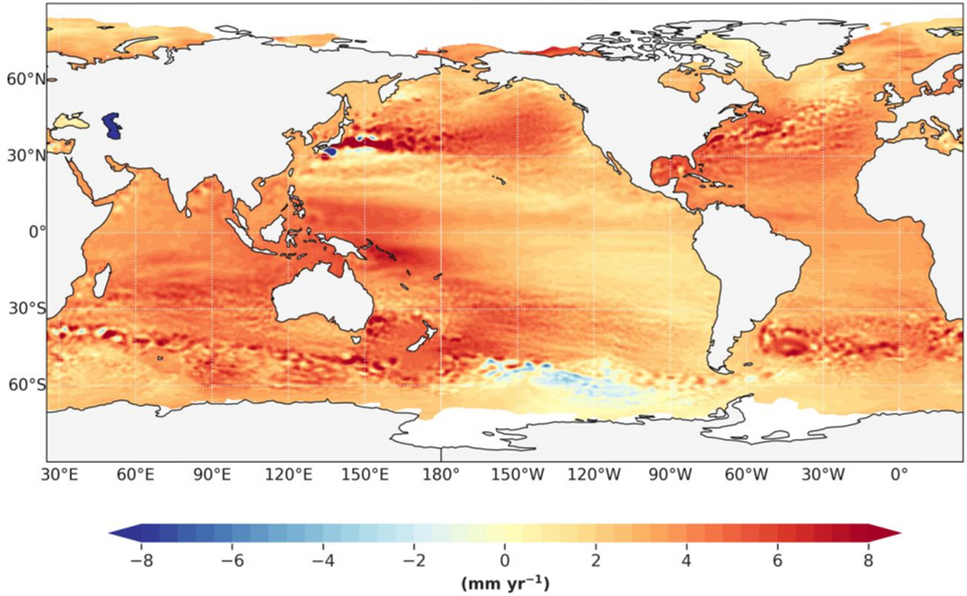
Sea level rise is driven mainly by the combination of thermal expansion and extended ice sheet melting. In some coastal zones, additional changes in storm surges and waves and local tectonic or isostatic processes may contribute to absolute sea level changes of up to a few millimetres per year. Locally, storm surges and waves may account for up to 10% of the sea level rise Ref 21. The simultaneous occurrence of storm surge and spring tides, resulting in storm tides, adds a significant threat to coastal communities Ref 29. Rates of global mean sea level rise show an increasing tendency, from 1.3 to 1.9 mm per year during the period 1901-2015 to 2.1 mm per year for the first 10 years of the altimetry era (1993-2002) and 4.3 mm per year for the past 10 years (2013-2023), with faster rates in the Indian Ocean and in some regions of the Pacific and Atlantic Oceans (see figure II). Rates are projected to reach between 5.2 mm per year (lowest carbon dioxide (CO2) scenario) and 12.1 mm per year (highest CO2 scenario) during the period 2080-2100 Ref 11. Sea level rise is not projected to be uniform up to 2100, as tropical areas seem more likely to undergo the largest changes. Extreme sea level scenarios under storm conditions (as a combination of sea surface height associated with storm surges, waves, high tides and a low-probability sea level rise scenario) may reach 4.2 m by 2100, compared with 2.6 m in the period 1980-2014 Ref 21. Overall, a significant proportion of the world's coasts will be inundated by 2100, although inundation will not be uniform, as countries with flat coasts will be more threatened Ref 47. Further sea level rise concerns are addressed in United Nations technical reports (United Nations Framework Convention on Climate Change (UNFCCC), 2024).
Figure II Regional sea level trends, January 1993 to June 2023
Sea ice
The well-documented decrease in Arctic sea-ice extent (more precisely, in Arctic Ocean and other northern hemisphere areas with seasonal ice cover) continues Ref 28 Ref 40, and in the period 2021-2025 seasonal sea ice extent remained close to the lowest in the satellite record for the period from 1979 to the present. The area of multi-year ice (>4 years old), as well as the age, thickness and volume of sea ice, have remained consistently low since the 2010s and close to minimum values for the period of observations from 1979 to 2025, with the marginal ice zone moving further north in the summer Ref 28, although significant regional and seasonal positive variations do occur. On 22 March 2025, Arctic winter ice reached a minimum extent of 14.33 million km2, below the prior low of 14.41 million km2 in 2017 (see figure III). In the most recent climate predictions based on the Climate Model Intercomparison Project 6, the earliest ice-freeⓘ conditions could occur in the 2030s under all emission trajectories and are likely to occur by 2050 Ref 20. Consistently ice-free September conditions (frequent occurrences of an ice-free Arctic) are anticipated by the middle of the twenty-first century (2035-2067), with emission trajectories determining how often and for how long the Arctic could be ice-free.
Figure III Arctic and Antarctic sea-ice average and extreme extents
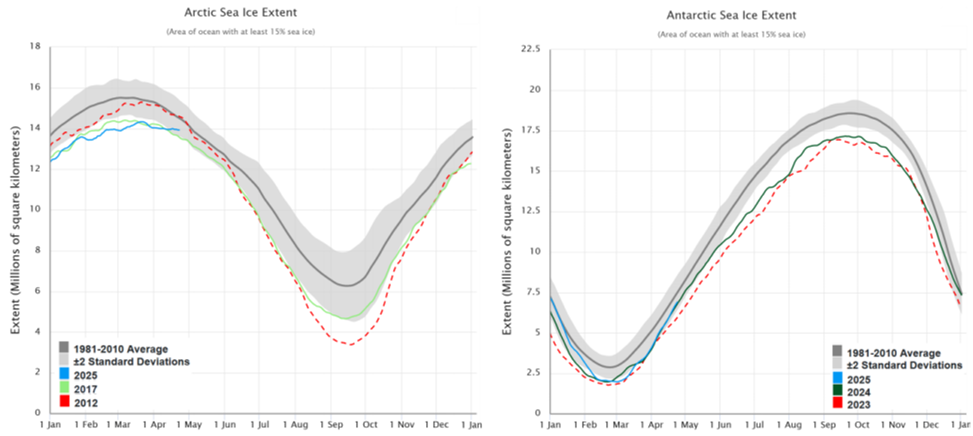
Note: The red dashed lines indicate the current record minimum extents for the summer (Arctic, 2012) and for the summer and winter (Antarctic, 2023), and the grey line and zones in the time series indicate the average for 1981-2010, with a standard deviation range of +/-2
In contrast to Arctic sea ice, the extent of sea ice in the Southern Ocean has only very recently (since 2021) shown a significant decrease, with the record minimum summer and winter sea ice observed in February and September 2023 Ref 36. Southern Ocean declines in sea ice are most pronounced in regions south and west of the Antarctic Peninsula. The impacts of such decreases are widespread, including changes in dense shelf water and associated Antarctic bottom water formation, and increased heating of surface waters with subsequent changes in stratification and mixing dynamics. On 1 March 2025, Antarctic Sea ice reached its minimum extent of 1.98 million km2, tying for the second lowest extent with 2022-2024 in the 47-year satellite record (see figure III).
Global ocean circulation patterns at all scales, including vertical and horizontal patterns such as stratification, and boundary currents
The potential decline of the Atlantic Meridional Overturning Circulation is a major concern related to ongoing changes in global circulation patterns. Previous results from Climate Model Intercomparison Project 5 had predicted the slowdown of the Atlantic Meridional Overturning Circulation, and some models predicted an abrupt collapse during the twenty-first century. However, weakening during the twenty-first century (see figure IV) has a medium to low confidence level and none of the models in Climate Model Intercomparison Project 6 predict the collapse of the Atlantic Meridional Overturning Circulation during the present century. A weakening of northward heat transport would result in a decrease in sea surface temperature and surface atmospheric temperature in the North Atlantic subpolar gyre, ultimately reducing the delivery of heat to Northern Europe. Swingedouw and others Ref 39 estimated that the probability of this cooling was 45.5% in Climate Model Intercomparison Project 5, but had decreased to 36.4% in Climate Model Intercomparison Project 6. On the other hand, Caesar and others Ref 2 Ref 3 found that the Atlantic Meridional Overturning Circulation was weakening and could reach a tipping point and abrupt collapse during the mid-twenty-first century Ref 45. This would result in significant climate shifts in the northern hemisphere, particularly in Europe, followed by significant shifts globally due to the redistribution of ocean heat energy. Changes in the Atlantic Meridional Overturning Circulation remain a research priority.
Figure IV Temporal evolution of Atlantic Meridional Overturning Circulation strength at 26.5° N

Source: Adapted from Ref 48.
Note: Temporal evolution of the Atlantic Meridional Overturning Circulation strength at 26.5° N obtained by integrating meridional transport at 26.5° N across the Atlantic basin (zonally) and then cumulatively integrating over depth. The green line and shading (twice the standard deviation) are based on modelled products. The black line shows the observational record from the RAPID array (Moat and others, 2025). Panel A shows monthly mean values, and panel B shows inter-annual variations by applying a 12-month running mean.
These changes in heat and freshwater transport in the North Atlantic are likely related to changes in the South Atlantic and Indian Oceans. According to the Intergovernmental Panel on Climate Change Ref 18, the Agulhas leakage, an inflow of anomalously warm and saline water from the Indian Ocean into the South Atlantic, has intensified since the 1960s, contributing to the warming of the upper 300 m in the South Atlantic. The Agulhas leakage is likely to continue to increase during the twenty-first century contributing to the slowdown of the Atlantic Meridional Overturning Circulation Ref 25. This intensification of the Agulhas and Benguela Currents would be produced by an intensification of westerlies in the southern hemisphere and the southward displacement of the southern currents. This result should, however, be further analysed carefully in the future. Majumder and Schmid (2018) used temperature and salinity profiles from Argo profilers and sea surface height data to calculate the transport associated with the Agulhas Current and found no significant changes since 1993.
Against a backdrop of ocean warming, freshening changes to Arctic Ocean oceanography induced by declining sea ice are certain, as reviewed by Timmermans and Marshall Ref 43. Decreased summer sea ice is resulting in reduced reflection of solar radiation back into space (reduced albedo) and an associated increase in surface ocean mixed-layer temperatures at a rate of about 0.5℃ per decade. Additional trends in increased heat advecting from the Pacific Ocean have triggered increased sea ice decline in the Chukchi Sea at the fastest rate of sea ice decline of the entire Arctic Ocean. The Atlantification of the Arctic Ocean, resulting from increased Atlantic water layer heat fluxes into the Eurasian basin, is resulting in reduced sea ice and changes in stratification Ref 33 Ref 34. The total freshwater content of the Arctic Ocean continues to increase, especially in the Beaufort gyre region (increase of liquid freshwater content from 2003 to 2018 by 40% relative to the climatology of the 1970s) as a result of persistent anticyclonic atmospheric wind forcing, sea ice melt, a wind-forced redirection of the Mackenzie River discharge and a contribution of low-salinity waters of Pacific Ocean origin through the Bering Strait Ref 35. In the Arctic shelf seas, there has been a decrease in freshwater content, combined with deeper mixed layers as winds drive surface freshwater offshore.
In general, there has been a freshening and warming of the Southern Ocean and associated increased stratification of the uppermost 200 m since the 1970s. This potentially restricts the vertical exchange of heat, salt, nutrients and gases between surface, intermediate and deep waters Ref 5. The freshening of Antarctic shelf waters in Southern Ocean surface waters has led to a freshening and contraction of Antarctic bottom water formed in the Weddell Sea, Cape Darnley, the Adélie coast and the Ross Sea. This trend is certain to have profound implications in slowing down deep ocean ventilation and global overturning circulation Ref 14 Ref 23 Ref 24 and in turn on marine productivity, with a consequent impact on fisheries. The societal implications of these changing resources are profound Ref 16 Ref 40.
2 Chemical trends ⓘ
Ocean acidification
About 20 to 30% of the CO2 released by human activity into the atmosphere has been absorbed by the ocean, leading to an increase in the average surface ocean acidity of 0.1 pH units since pre-industrial levels. The transport of CO2 to the deeper ocean via currents and mixing has meant that ocean acidification now surpasses a depth of 2,000 m in the North Atlantic and Southern Oceans (IPCC, 2022). International initiatives such as the Global Ocean Acidification Observing Network are reporting large spatial and temporal variability in carbonate chemistry in the coastal zones as consequences of biological activity, water mixing and run-off from land. There is a large body of evidence reporting the negative impact of ocean acidification on marine species, ecosystems and their associated services (see sect. 4, chaps. 4 and 5). Species adaptation to changes in carbonate chemistry has been utilized as one of the representative stressors studied to understand species and ecosystem sensitivity Ref 46 in future marine conditions Ref 49.
Changes in carbon
The ocean is the second largest carbon reservoir on Earth at 37,300 GtC (1015gC) and holds over 60 times the carbon of the atmosphere Ref 9. Ocean CO2 uptake rates have tripled over the past 60 years to 2.7 ±0.3 PgC per year (over the period 1990-2019) and are expected to continue increasing by 0.4± 0.1 PgC per decade Ref 15. These values are affected spatially and interannually by shifts in weather and climate. It is expected that eventually the average net warming of surface waters will reduce ocean uptake rates due to the reduction in CO2 solubility at higher temperatures.
Total alkalinty is a measurement of the buffering capacity of the ocean or its ability to counter changes in pH and is dominated by inorganic carbon (i.e. bicarbonate and carbonate). Total alkalinity in subtropical regions has increased due to changes in the global water cycle (increased evaporation) and is expected to continue to do so. The northern hemisphere has more spatial variability in total alkalinity and salinity than the Southern Ocean due to fewer changes in salinity and the contribution of upwelling of total alkalinity- enriched waters Ref 10.
Dissolved oxygen
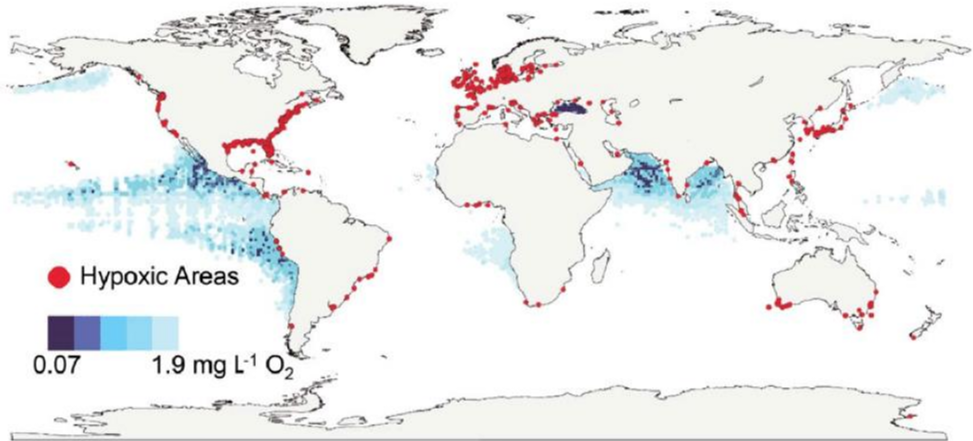
The trend of global deoxygenation in the oceans continues and is driven by a combination of lower oxygen solubility associated with increasing water temperatures, intensified stratification (particularly in the open ocean) and higher nutrient additions to primarily coastal areas that drive bacterial activity and oxygen consumption. Figure V shows the areas with increasing oxygen minimum zones (blue) and coastal areas that are experiencing primarily anthropogenically driven hypoxia (red). It should be noted that over the past 50 years the hypoxic zone area has increased by 4.5 million km2 and the world's oceans continue to lose roughly 1 GtO2 per year (Keeling and Garcia, 2002), decreasing by more than 2% (4.8 ± 2.1 petamoles) since 1960 Ref 37.
Figure V Ocean minimum zones (blue) and areas with coastal hypoxia (red) in the world's ocean
Nutrients
Nitrogen
Since 2018, changes in the climate have significantly altered oceanic nitrogen dynamics, affecting phytoplankton productivity, carbon sequestration and greenhouse gas emissions (see sect. 4, subchaps. 4A and 5N). Although ocean warming, changes in stratification and acidification are major influences on the ocean's nitrogen cycle, ocean deoxygenation is expected to have one of the largest impacts on microorganisms involved in nitrogen transformation pathways Ref 17. Adaptable anammox bacteria in oxygen-deficient zones Ref 51 reflect diverse responses, and increased nitrogen fixation rates linked to higher diazotroph richness underscore the role of biodiversity Ref 38. Comparing recent studies with historical data such as the World Ocean Atlas II reveals differing trends across regions, emphasizing the need for ongoing monitoring to capture dynamic regional responses to climate change Ref 32, such as in the Southern Ocean, where regional variability in nitrogen dynamics and phytoplankton responses reflect localized impacts Ref 1. Understanding these complexities is crucial for predicting climate feedback and guiding effective mitigation strategies.
Phosphorus
Since 2018, studies have highlighted shifting oceanic phosphorus availability and cycling driven by climate change. Changes in ocean temperature, stratification and circulation affect phosphorus availability and cycling (Gerace and others, 2025). Further studies have demonstrated the significant role that phosphorus plays in nitrogen fixation by important groups of phytoplankton, with implications for marine productivity and ecosystems Ref 30 Ref 1. These recent studies highlight deviations in contemporary phosphorus trends from historical baselines, emphasizing the need for updated monitoring to accurately predict future biogeochemical cycles.
Silica
Rising ocean acidification lowers the dissolution rate of biogenic silica and therefore increases the burial rate in sediments Ref 41. This is expected to favour diatoms that require silicic acid to grow and account for nearly 40% of marine primary productivity in the short term. Over the long term (150 years), the increased burial of silica will lead to silica limitation, which may have a negative impact on diatom productivity and shift the primary production assemblages in the global surface ocean waters. The areas most affected are expected to be those undergoing the fastest rates of acidification, particularly coastal zones where burial rates are greatest.
3 Gaps
There remain important uncertainties in mechanistic understanding of how ocean circulation will respond to warming and changes in freshwater inputs, especially at regional scales. The ocean is an important distributer of heat on the planet and any changes in circulation patterns alter how heat will be distributed. In addition to heat, circulation patterns determine where and when nutrients will be depleted and replenished, which is translated to regional ecosystem dynamics, regional fisheries and regional economies. To improve the ability to predict future conditions and plan for and achieve some degree of resilience in response to the changes, it is necessary to invest in observations (including long-term time series) and models in key regions and help communities to prepare and adapt infrastructure planning. These include the areas known to be changing most rapidly, such as the Arctic Ocean and the Southern Ocean. It is also necessary to identify ecosystem thresholds where key species are most at risk, in order to avoid fisheries collapse. These efforts are critical to inform communities and help to guide adaptive management.
References
- Boyd, P.W., Antoine, D., Baldry, K., Cornec, M., Ellwood, M., Halfter, S., Lacour, L., Latour, P., Strzepek, R.F., Trull, T.W., and Rohr, T. (2024). Controls on polar Southern Ocean deep chlorophyll maxima: Viewpoints from multiple observational platforms. Global Biogeochemical Cycles, 38(3), e2023GB008033. https://doi.org/10.1029/2023GB008033.
- Caesar, L., Rahmstorf, S., Robinson, A., Feulner, G., and Saba, V. (2018). Observed fingerprint of a weakening Atlantic Ocean overturning circulation. Nature, 556(7700), 191-196. https://doi.org/10.1038/s41586-018-0006-5.
- Caesar, L., McCarthy, G.D., Thornalley, D.J.R., Cahill, N., and Rahmstorf, S. (2021). Current Atlantic meridional overturning circulation weakest in last millennium. Nature Geoscience, 14, 118-120. https://doi.org/10.1038/s41561-021-00699-z.
- Caínzos, V., Hernández-Guerra, A., McCarthy, G.D., McDonagh, E.L., Cubas Armas, M., and Pérez- Hernández, M.D. (2022). Thirty years of GOSHIP and WOCE data: Atlantic overturning of mass, heat, and freshwater transport. Geophysical Research Letters, 49, e2021GL096527. https://doi.org/10.1029/2021GL096527.
- Carter, L., Bostock-Lyman, H., and Bowen, M. (2022). Water masses, circulation and change in the modern Southern Ocean. In F. Florindo, M. Siegert, L. De Santis, and T. Naish, eds. Antarctic Climate Evolution, 2nd ed., pp. 165-197. Elsevier. https://doi.org/10.1016/B978-0-12-819109-5.00003-7.
- Cheng, L., von Schuckmann, K., Abraham, J.P., and others (2022). Past and future ocean warming. Nature Reviews Earth & Environment, 3, 776-794. https://doi.org/10.1038/s43017-022-00345-1.
- Cheng, L., Trenberth, K.E., Gruber, N., Abraham, J.P., Fasullo, J., Li, G., Mann, M.E., Zhao, X., and Zhu, J. (2020). Improved estimates of changes in upper ocean salinity and the hydrological cycle. Journal of Climate. https://doi.org/10.1175/JCLI-D-20-0366.1.
- Desbruyères, D.G., Mercier, H., Maze, G., and Daniault, N. (2019). Surface predictor of overturning circulation and heat content change in the subpolar North Atlantic. Ocean Science, 15, 809-817. https://doi.org/10.5194/os-15-809-2019.
- De Vries, T. (2022). The ocean carbon cycle. Annual Review of Environment and Resources, 47, 317-341. https://doi.org/10.1146/annurev-environ-120920-111307.
- Fine, R.A., Willey, D.A., Millero, F.J. (2017). Global variability and changes in ocean total alkalinity from Aquarius satellite data. Geophys. Res. Lett. 2017, 44, 261-267. https://doi.org/10.1002/2016GL071712.
- Fox-Kemper, B. (2021). Ocean, cryosphere and sea level change. In Climate Change 2021: The Physical Science Basis. Contribution of Working Group I to the Sixth Assessment Report of the Intergovernmental Panel on Climate Change. Cambridge University Press.
- Gerace, S.D. and others (2024). Observed declines in upper ocean phosphate-to-nitrate availability. Edited by David Karl, University of Hawaii at Manoa, Honolulu, HI; received June 17, 2024; accepted December 8, 2024.
- GO2NE (2018). The Ocean is Losing its Breath: Declining Oxygen in the World's Ocean and Coastal Waters.
- Gunn, K.L., Rintoul, S.R., England, M.H., and others (2023). Recent reduced abyssal overturning and ventilation in the Australian Antarctic Basin. Nature Climate Change, 13, 537-544. https://doi.org/10.1038/s41558-023-01667-8.
- Gruber, N., Bakker, D.C.E., De Vries, T., and others (2023). Trends and variability in the ocean carbon sink. Nature Reviews Earth & Environment, 4, 119-134. https://doi.org/10.1038/s43017-022-00381-x.
- Huntington, H.P., Zagorsky, A., Kaltenborn, B.P., and others (2022). Societal implications of a changing Arctic Ocean. Ambio, 51, 298-306. https://doi.org/10.1007/s13280-021-01601-2.
- Hutchins, D.A., and Capone, D.G. (2022). The marine nitrogen cycle: New developments and global change. Nature Reviews Microbiology, 20, 401-414. https://doi.org/10.1038/s41579-022-00687.
- IPCC (2019). IPCC Special Report on the Ocean and Cryosphere in a Changing Climate. H.-O. Pörtner, D. C. Roberts, V. Masson-Delmotte, P. Zhai, M. Tignor, E. Poloczanska, K. Mintenbeck, A. Alegría, M. Nicolai, A. Okem, J. Petzold, B. Rama, and N. Weyer, eds. Cambridge University Press.
- IPCC (2021). Climate Change 2021: The Physical Science Basis. Contribution of Working Group I to the Sixth Assessment Report of the Intergovernmental Panel on Climate Change. V. Masson-Delmotte, P. Zhai, A. Pirani, S. L. Connors, C. Péan, S. Berger, N. Caud, Y. Chen, L. Goldfarb, M. I. Gomis, M. Huang, K. Leitzell, E. Lonnoy, J.B.R. Matthews, T.K. Maycock, T. Waterfield, O. Yelekçi, R. Yu, and B. Zhou, eds. Cambridge University Press.
- Jahn, A., Holland, M.M., and Kay, J.E. (2024). Projections of an ice-free Arctic Ocean. Nature Reviews Earth & Environment, 5, 164-176. https://doi.org/10.1038/s43017-023-00515-9.
- Jevrejeva, S., Williams, J., Vousdoukas, M.I., and Jackson, L.P. (2023). Future sea level rise dominates changes in worst case extreme sea levels along the global coastline by 2100. Environmental Research Letters, 18(2), 024037. https://doi.org/10.1088/1748-9326/acb9d4.
- Kelly, K.A., Drushka, K., Thompson, L., Le Bars, D., and McDonagh, E.L. (2016). Impact of slowdown of Atlantic overturning circulation on heat and freshwater transports. Geophysical Research Letters, 43, 7625-7631. https://doi.org/10.1002/2016GL069789.
- Lee, S. K., Lumpkin, R., Gomez, F., and others (2023). Human-induced changes in the global meridional overturning circulation are emerging from the Southern Ocean. Communications Earth & Environment, 4, 69. https://doi.org/10.1038/s43247-023-00727-3.
- Li, Q., England, M. H., Hogg, A. M., and others (2023). Abyssal ocean overturning slowdown and warming driven by Antarctic meltwater. Nature, 615, 841-847. https://doi.org/10.1038/s41586-023-05762-w.
- Loveday, B.R., Penven, P., and Reason, C.J.C. (2015). Southern Annular Mode and westerly-wind-driven changes in Indian-Atlantic exchange mechanisms. Geophysical Research Letters, 42, 4912-4921. https://doi.org/10.1002/2015GL064256.
- MacKinnon, J. A., and others (2021). A warm jet in a cold ocean. Nature Communications, 12, 2418. https://doi.org/10.1038/s41467-021-22505-5.
- Majumder, S., Schmid, C., Moftakhari, H., Muñoz, D. F., Akbari Asanjan, A., AghaKouchak, A., Moradkhani, H., and Jay, D.A. (2024). Nonlinear interactions of sea-level rise and storm tide alter extreme coastal water levels: How and why? AGU Advances, 5(2), e2023AV000996. https://doi.org/10.1029/2023AV000996.
- Meier, W.N., and others (2023). Sea ice. In R.L. Thoman, T.A. Moon, and M.L. Druckenmiller, eds. Arctic Report Card 2023 (pp. 39-48). NOAA Technical Report OAR ARC. https://doi.org/10.25923/5vfa-k694.
- Moftakhari, H., Muñoz, D.F., Akbari Asanjan, A., AghaKouchak, A., Moradkhani, H., and Jay, D.A. (2024). Nonlinear interactions of sea-level rise and storm tide alter extreme coastal water levels: How and why? AGU Advances, 5, e2023AV000996. https://doi.org/10.1029/2023AV000996.
- Moisander, P.H., Daley, M.C., Shoemaker, K.M., and others (2022). Nitrogen fixation influenced by phosphorus and nitrogen availability in the benthic bloom-forming cyanobacterium Hydrocoleum sp. identified in a temperate marine lagoon. Journal of Phycology, 58(3), 377-391. https://doi.org/10.1111/jpy.13244.
- Piecuch, C.G., and Beal, L.M. (2023). Robust weakening of the Gulf Stream during the past four decades observed in the Florida Straits. Geophysical Research Letters, 50, e2023GL105170. https://doi.org/10.1029/2023GL105170.
- Pitcher, G.C., Aguirre-Velarde, A., Breitburg, D., Cardich, J., Carstensen, J., Conley, D.J., Dewitte, B., and Zhu, Z.Y. (2021). System controls of coastal and open ocean oxygen depletion. Progress in Oceanography, 197, 102613. https://doi.org/10.1016/j.pocean.2021.102613.
- Polyakov, I.V., and others (2023). Fluctuating Atlantic inflows modulate Arctic atlantification. Science, 381, 972-979. https://doi.org/10.1126/science.adh5158.
- Polyakov, I.V., and others (2025). Atlantification advances into the Amerasian Basin of the Arctic Ocean. Science Advances, 11, eadq7580. https://doi.org/10.1126/sciadv.adq7580.
- Proshutinsky, A., and others (2019). Analysis of the Beaufort Gyre freshwater content in 2003-2018. Journal of Geophysical Research: Oceans, 124, 9658-9689. https://doi.org/10.1029/2019JC015281.
- Purich, A., and Doddridge, E.W. (2023). Record low Antarctic sea ice coverage indicates a new sea ice state. Communications Earth & Environment, 4, 314. https://doi.org/10.1038/s43247-023-00961-9.
- Schmidtko, S., Stramma, L. and Visbeck, M. Decline in global oceanic oxygen content during the past five decades. Nature 542, 335-339 (2017). https://doi.org/10.1038/nature21399.
- Shao, J., and others (2023). Global oceanic diazotroph database version 2 and elevated estimate of global oceanic N2 fixation. Earth System Science Data, 15(8), 3673-3709. https://doi.org/10.5194/essd-15-3673-2023.
- Swingedouw, D., Bily, A., Esquerdo, C., Borchert, L.F., Sgubin, G., Mignot, J., and Menary, M. (2021). Atlantic Meridional Overturning Circulation response to climate change: A review. Annals of the New York Academy of Sciences, 1504, 187-201. https://doi.org/10.1111/nyas.14639.
- Stroeve, J.C., Notz, D., Dawson, J., Schuur, E.A.G., Dahl-Jensen, D., and Giesse, C. (2025). Disappearing landscapes: The Arctic at +2.7℃ global warming. Science, 387(6734), 616. https://doi.org/10.1126/science.ads1549.
- Taucher, J., Bach, L.T., Prowe, A.E.F., and others (2022). Enhanced silica export in a future ocean triggers global diatom decline. Nature, 605, 696-700. https://doi.org/10.1038/s41586-022-04687-0.
- Thoman, R.L., Moon, T.A., and Druckenmiller, M.L., eds. (2023). Arctic Report Card 2023. NOAA Technical Report OAR ARC. https://doi.org/10.25923/5vfa-k694.
- Timmermans, M.-L., and Marshall, J. (2020). Understanding Arctic Ocean circulation: A review of ocean dynamics in a changing climate. Journal of Geophysical Research: Oceans, 125, e2018JC014378. https://doi.org/10.1029/2018JC014378.
- UNFCCC (2024). WIM ExCom technical report on sea level rise. United Nations Framework Convention on Climate Change. https://unfccc.int/sites/default/files/resource/WIM%20ExCom%20sea%20level%20rise.pdf.
- Van Westen, R.M., Kliphuis, M., and Dijkstra, H.A. (2024). Physics-based early warning signal shows that AMOC is on tipping course. Science Advances, 10, eadk 1189. https://doi.org/10.1126/sciadv.eadk1189.
- Vargas, C.A., Cuevas, L.A., Broitman, B.R., San Martin, V.A., Lagos, N.A., Gaitán-Espitia, J.D., and Dupont, S. (2022). Upper environmental pCO2 drives sensitivity to ocean acidification in marine invertebrates. Nature Climate Change, 12, 200-207. https://doi.org/10.1038/s41558-022-01261-w.
- Vernimmen, R., and Hooijer, A. (2023). New LiDAR-based elevation model shows greatest increase in global coastal exposure to flooding to be caused by early-stage sea-level rise. Earth's Future, 11(1), e2022EF002880. https://doi.org/10.1029/2022EF002880.
- Von Schuckmann, K., Moreira, L., Cancet, M., Gues, F., Autret, E., Baker, J., Bricaud, C., Bourdalle-Badie, R., Castrillo, L., Cheng, L., Chevallier, F., Ciani, D., de Pascual-Collar, A., De Toma, V., Drevillon, M., Fanelli, C., Garric, G., Gehlen, M., Giesen, R., and Zuo, H. (2024). The state of the global ocean. In K. von Schuckmann, L. Moreira, M. Grégoire, M. Marcos, J. Staneva, P. Brasseur, G. Garric, P. Lionello, J. Karstensen, and G. Neukermans, eds. 8th edition of the Copernicus Ocean State Report (OSR8). State of the Planet, 4-osr8, 1. https://doi.org/10.5194/sp-4-osr8-1-2024.
- Widdicombe, S., Isensee, K., Artioli, Y., Gaitán-Espitia, J.D., Hauri, C., Newton, J.A., Wells, M., and Dupont, S. (2022). Unifying biological field observations to detect and compare ocean acidification impacts across marine species and ecosystems: What to monitor and why. EGUsphere, 19, 101-119. https://doi.org/10.5194/egusphere-2022-119.
- Worthington, E.L., Moat, B.I., Smeed, D.A., Mecking, J.V., Marsh, R., and McCarthy, G.D. (2021). A 30-year reconstruction of the Atlantic meridional overturning circulation shows no decline. Ocean Science, 17, 285-299. https://doi.org/10.5194/os-17-285-2021.
Zhao, R., Zhang, I.H., Jayakumar, A., Ward, B.B., and Babbin, A.R. (2024). Age, metabolisms, and potential origin of dominant anammox bacteria in the global oxygen-deficient zones. ISME Communications, 4(1), ycae060. https://doi.org/10.1093/ismeco/ycae060.
Majumder, S. and Schmid, C.: A study of the variability in the Benguela Current volume transport, Ocean Sci., 14, 273–283, https://doi.org/10.5194/os-14-273-2018, 2018.
Moat B.I.; Smeed D.; Rayner D.; Johns W.E.; Smith R.H.; Volkov D.L.; Elipot S.; Petit T.; Kajtar J.B.; Baringer M.O.; Collins J.(2025). Atlantic meridional overturning circulation observed by the RAPID-MOCHA-WBTS (RAPID-Meridional Overturning Circulation and Heatflux Array-Western Boundary Time Series) array at 26N from 2004 to 2023 (v2023.1a). NERC EDS British Oceanographic Data Centre NOC. doi:10.5285/33826d6e-801c-b0a7-e063-7086abc0b9db.
IPCC, 2022: Climate Change 2022: Impacts, Adaptation, and Vulnerability. Contribution of Working Group II to the Sixth Assessment Report of the Intergovernmental Panel on Climate Change [H.-O. Pörtner, D.C. Roberts, M. Tignor, E.S. Poloczanska, K. Mintenbeck, A. Alegría, M. Craig, S. Langsdorf, S. Löschke, V. Möller, A. Okem, B. Rama (eds.)]. Cambridge University Press. Cambridge University Press, Cambridge, UK and New York, NY, USA, 3056 pp., doi:10.1017/9781009325844.
R.F. Keeling,& H.E. Garcia, The change in oceanic O2 inventory associated with recent global warming, Proc. Natl. Acad. Sci. U.S.A. 99 (12) 7848-7853, https://doi.org/10.1073/pnas.122154899 (2002).
Isensee, K., Valdés, L., O'Brien, T., & Lorenzoni, L. (2015). Discover Ocean Time Series. UNESOC-IOC and International Group for Marine Ecological Time Series (IGMETS).
Denise Breitburg, Lisa A. Levin, Andreas Oschlies, Marilaure Grégoire, Francisco P. Chavez, Daniel J. Conley, Véronique Garçon, Denis Gilbert, Dimitri Gutiérrez, Kirsten Isensee, Gil S. Jacinto, Karin E. Limburg, Ivonne Montes, S. W. A. Naqvi, Grant C. Pitcher, Nancy N. Rabalais, Michael R. Roman, Kenneth A. Rose, Brad A. Seibel, Maciej Telszewski, Moriaki Yasuhara, and Jing Zhang. Declining oxygen in the global ocean and coastal waters, Science, 359 (2018), Article eaam7240, 10.1126/science.aam7240.
R.F. Keeling,& H.E. Garcia, The change in oceanic O2 inventory associated with recent global warming, Proc. Natl. Acad. Sci. U.S.A. 99 (12) 7848-7853, https://doi.org/10.1073/pnas.122154899 (2002).
Robert J. Diaz,Rutger Rosenberg, Spreading Dead Zones and Consequences for Marine Ecosystems.Science321,926-929(2008).DOI:10.1126/science.1156401.
J. Carstensen,J.H. Andersen,B.G. Gustafsson, & D.J. Conley,Deoxygenation of the Baltic Sea during the last century, Proc. Natl. Acad. Sci. U.S.A. 111 (15) 5628-5633, https://doi.org/10.1073/pnas.1323156111 (2014).