
Global overview of ocean governance
Writing team:ⓘ Youna Lyons and Carina Costa de Oliveira (coordinating authors), Senia Febrica, Paul Foley, Rakhyun E. Kim, Enrique Marschoff (co-lead member), Youngdawng Moh, Vonintsoa Rafaly, Mariamalia Rodríguez (lead member), Michelle Scobie and Sarra Sefrioui.
Key points
- Ocean governance is shaped by a complex and dynamic interplay of multilevel intergovernmental institutions, instruments and regimes in which concepts, principles and means of implementation are developed and adopted.
- The application of ocean governance concepts across global and regional institutions strengthens legal connectivity, enhancing coherence and synergies in governance.
- The multiplicity of ocean governance instruments at the global and regional levels has continued to draw significant attention over the past five years, thereby promoting the development of different mechanisms, including cross-sectoral interplay, requests for clarification through judicial proceedings and attempts to streamline governance such as in developing the Agreement under the United Nations Convention on the Law of the Sea on the Conservation and Sustainable Use of Marine Biological Diversity of Areas beyond National Jurisdiction.
- In the past five years, human dimensions, including human rights and social sciences, have gained increased prominence in ocean governance discussions.
- Governance concepts emerging from national experiences and non-State actors' proposals and practices, such as the sustainable and inclusive ocean economy and marine spatial planning, have gained increased significance in State-led governance developments.
1. Introduction
The present section is the first dedicated section on ocean governance in a World Ocean Assessment, as in previous Assessments it was addressed it within specific chapters, such as on fisheries. Earlier analyses of global ocean governance exist and were consulted (e.g. Ref 77; Ref 96). The present section first provides a brief overview of the institutional and legal architecture of ocean governance at the global and regional levels (see part 2 below) to which other substantive updates included in the Assessments relate, with a particular focus on developments in the past five years. This approach recognizes the central role played by States in shaping ocean governance concepts, principles and means of implementation, while also incorporating reflecting the influence of non-State actors regarding a more inclusive framework Ref 107. The analysis first examined 57 global treaties agreed between 1946 and 2024, that are applicable to marine protection and preservation. In addition to these treaties and their associated institutions, many non-binding intergovernmental processes have been central to the development of other elements and concepts of ocean governance at the global and regional levels, within and outside the United Nations system, that are included in the overview. Public-private and non-State processes can also be essential development nodes to form a polycentric Ref 93 Ref 104 governance system (most recently Ref 114; see also subsect. 5A, subchap. 1C and chap. 8) and shape new governance narratives. These are included in part 2 of the present section, on the most prominent and fastest developing principles, concepts and means of implementation that underpin these global and regional polycentric ocean governance developments and provide the means to overcome institutional and sectoral fragmentation (see also sect. 4, chap. 1). To suit the non-exhaustive global and regional approach of the World Ocean Assessment, graphs and figures are used to demonstrate the complexity of the matter, including connections at different scales.
2. Developments and updates in global and regional institutional and legal mechanisms
The geographic scope and mandate of institutional and legal mechanisms can be global or regional, and they can also vary greatly in substantive scope. Interplays have been developed between institutions and instruments to overcome the adverse effects of fragmentation of the governance complex.
Global institutional and legal mechanisms
As the constitution for the ocean Ref 95 Ref 85, the United Nations Convention on the Law of the Sea of 1982 (UNCLOS) Ref 144 plays a structural role in the global ocean governance framework (Ref 18; see also Sustainable Development Goal target 14. c) and applies to all types of pollution of the marine environment and all activities at sea (Ref 144; Ref 71). Fifty-seven other global treaties (see table) have been agreed in the past 70 years (see figure I (a)), including 2 in the past 5 years, namely the Agreement on Marine Biological Diversity of Areas beyond National Jurisdiction of 2023 and the Agreement on Fisheries Subsidies of 2022. They are dedicated to different aspects of the marine environment, including biodiversity protection, pollution from sectoral activities and other threats to the marine environment, and are further complemented by numerous binding and non-binding instruments adopted by the many international frameworks whose mandates include the protection of the marine environment and its sustainable use (see figure I). Whereas some are restricted to the ocean, others also apply to the terrestrial environment (see table). The adoption of treaties by States, which has been steady overall with occasional peaks corresponding to the global or regional environmental political agenda at various times, has continued over the past five years (see figure 1 (c)). However, some treaties have been less widely adopted, potentially creating "free rider" situations, with some actors benefiting from the efforts of others (e.g. Ref 5).
The implementation of international treaties and their further development for policymaking purposes are shaped and prioritized by a wide range of non-binding intergovernmental processes as well as arrangements with non-State actors. These processes can facilitate cooperation and coordination between States, United Nations entities and other relevant international bodies (e.g. International Criminal Police Organization (INTERPOL) and United Nations mechanisms such as UN-Oceans) or the development of common scientific understanding (e.g. Intergovernmental Panel on Climate Change (IPCC), Intergovernmental Science-Policy Platform on Biodiversity and Ecosystem Services (IPBES), World Ocean Assessments and the United Nations Decade of Ocean Science for Sustainable Development). They also serve to identify and operationalize actions to address a given issue or even contribute to driving such actions at regional and national scales (e.g. Kunming-Montreal Global Biodiversity Framework of 2022; Ref 153; Ref 63). They are further supported by international courts and tribunals that, for instance, provide guidance in the interpretation of relevant legal instruments, independently and as a whole Ref 135, and are instrumental or incremental in advancing the implementation of the Convention Ref 125. Non-governmental processes and hybrid processes that involve States and non-State actors can also have an impact on the law-making or on the normative implementation (Ref 98; Ref 145).
Table GLOBAL TREATIES ON THE PROTECTION OF THE MARINE ENVIRONMENT
Includes all global treaties adopted since the Whaling Convention that relate to, or are directly relevant to the protection of the marine environment. It provides the date of signature of the treaty, its name, whether it applies primarily to the ocean environment (Y) or also applied to the terrestrial environment (N) and whether it has come into force (IF) or not (NYIF), has ceased (C) or is defunct (D)
| Date | Treaty | Ocean sp. | Status |
|---|---|---|---|
| 1946 | International Convention for the Regulation of Whaling | Y | IF |
| 1969 | International Convention on Civil Liability for Oil Pollution Damage (CLC) | Y | IF |
| 1971 | Convention on Wetlands of International Importance (Ramsar Convention) | N | IF |
| 1972 | Convention Concerning the World Cultural and Natural Heritage (World Heritage Convention) | N | IF |
| 1971 | International Convention on the Establishment of an International Fund for Compensation for Oil Pollution Damage (FUND, 1971) | Y | C |
| 1972 | Convention on the International Regulation for Preventing Collision at Sea (COLREGS) (as amended in 1981, 1987, 1989, 1993, 2001, 2007) | Y | IF |
| 1972 | Convention on the Prevention of Marine Pollution by Dumping of Wastes and Other Matter (London Convention) | Y | IF |
| 1973 | Convention on International Trade in Endangered Species of Wild Fauna and Flora (CITES) / 1979 Bonn Amendment / 1983 Gaborone Amendment | N | IF |
| 1974 | International Convention for the Safety of Life at Sea (SOLAS) | Y | IF |
| 1976 | Convention on the Limitation of Liability for Maritime Claims (LLMC) | Y | IF |
| 1976 | Protocol relating to the 1969 International Convention on Civil Liability for Oil Pollution Damage (CLC PROT) | Y | D |
| 1976 | Protocol relating to the 1971 International Convention on the Establishment of an International Fund for Compensation for Oil Pollution Damage (PROT FUND, 1971) | Y | C |
| 1978 | International Convention for the Prevention of Pollution from Ships (MARPOL) and Annex I | Y | IF |
| 1978 | International Convention for the Prevention of Pollution from Ships (MARPOL) - Annexes II | Y | IF |
| 1978 | International Convention for the Prevention of Pollution from Ships (MARPOL) - Annexes III | Y | IF |
| 1978 | International Convention for the Prevention of Pollution from Ships (MARPOL) - Annexes IV | Y | IF |
| 1978 | International Convention for the Prevention of Pollution from Ships (MARPOL) - Annexes V | Y | IF |
| 1978 | Protocol relating to the 1974 International Convention for the Safety of Life at Sea (SOLAS) | Y | IF |
| 1979 | Convention on the Conservation of Migratory Species of Wild Animals (CMS) | N | IF |
| 1982 | Paris Protocol relating to the 1971 Convention on Wetlands of International Importance (Ramsar Convention Prot) | N | IF |
| 1982 | UN Convention on the Law of the Sea (UNCLOS) | Y | IF |
| 1985 | Vienna Convention for the Protection of the Ozone Layer | N | IF |
| 1987 | Montreal Protocol on Substances that Deplete the Ozone Layer | N | IF |
| 1988 | Protocol relating to the 1974 International Convention for the Safety of Life at Sea (SOLAS PROT) | Y | IF |
| 1989 | Basel Convention on the Control of Transboundary Movements of Hazardous Wastes and their Disposal / 1995 Amendment | N | IF |
| 1990 | International Convention on Oil Pollution Preparedness, Response and Co-operation (OPRC) | Y | IF |
| 1991 | Convention on Environmental Impact Assessment in a Transboundary Context (Espoo Convention) | N | IF |
| 1992 | Convention on Biological Diversity (CBD) | N | IF |
| 1992 | Protocol relating to the 1969 International Convention on Civil Liability for Oil Pollution Damage (CLC PROT) | Y | IF |
| 1992 | 1992 Protocol to Amend the International Convention on the Establishment of an International Fund for Compensation for Oil Pollution Damage, 1971 (IOPC-FUND) | Y | IF |
| 1992 | UN Framework Convention on Climate Change (UNFCCC) | N | IF |
| 1993 | Agreement to Promote Compliance with International Conservation and Management Measures by Fishing Vessels on the High Seas | Y | IF |
| 1994 | Agreement Relating to the Implementation of Part XI of the UNCLOS | Y | IF |
| 1995 | UN Agreement for the Implementation of the Provisions of the UNCLOS Relating to the Conservation and Management of Straddling Fish Stocks and Highly Migratory Fish Stocks (UNFSA) | Y | IF |
| 1996 | Convention on Liability and Compensation for Damage in Connection with the Carriage of Hazardous and Noxious Substances by Sea (HNS) | Y | NYIF |
| 1996 | Protocol relating to the 1972 Convention on the Prevention of Marine Pollution by Dumping of Wastes and Other Matter (London Prot) | Y | IF |
| 1996 | Protocol relating to the 1976 Convention on the Limitation of Liability for Maritime Claims (LLMC PROT) | Y | IF |
| 1997 | International Convention for the Prevention of Pollution from Ships (MARPOL) - Annex VI | Y | IF |
| 1998 | Rotterdam Convention on the Prior Informed Consent Procedure for Certain Hazardous Chemicals and Pesticides in International Trade | N | IF |
| 1998 | UNECE Convention on Access to Information, Public Participation in Decision-making and Access to Justice in Environmental Matters (Aarhus Convention) and its 2009 Kiev Protocol | N | IF |
| 2000 | Protocol on Preparedness, Response and Co-operation to Pollution Incidents by Hazardous and Noxious Substances (OPRC-HNS, 2000) | Y | IF |
| 2001 | Agreement on the Conservation of Albatrosses and Petrels | Y | IF |
| 2001 | Convention on the Protection of the Underwater Cultural Heritage | Y | IF |
| 2001 | International Convention on Civil Liability for Bunker Oil Pollution Damage (Bunkers Convention) | Y | IF |
| 2001 | International Convention on the Control of Harmful Anti-fouling Systems on Ships (AFS) | Y | IF |
| 2001 | Stockholm Convention on Persistent Organic Pollutants (POPs) | N | IF |
| 2003 | Kyev Protocol on Pollutant Release and Transfer Registers | N | IF |
| 2004 | International Convention for the Control and Management of Ships' Ballast Water and Sediments (BWM) | Y | IF |
| 2007 | Nairobi International Convention on the Removal of Wrecks (Nairobi WRC) | Y | IF |
| 2009 | FAO Agreement on Port State Measures to Prevent, Deter and Eliminate IUU Fishing (PSMA) | Y | IF |
| 2009 | Hong Kong International Convention for the Safe and Environmentally Sound Recycling of Ships (SRC) | Y | IF |
| 2010 | Nagoya Protocol (Access and Benefit Sharing) | N | IF |
| 2010 | Protocol to the International Convention on Liability and Compensation for Damage in Connection with the Carriage of Hazardous and Noxious Substances by Sea (HNS PROT) | Y | NYIF |
| 2012 | Cape Town Agreement on Fishing Vessel Safety | Y | NYIF |
| 2013 | Minamata Convention on Mercury | N | IF |
| 2015 | Paris Agreement | N | IF |
| 2022 | Agreement on Fisheries Subsidies | Y | NYIF |
| 2023 | Agreement under the UNCLOS on the conservation and sustainable use of marine biological diversity of areas beyond national jurisdiction | Y | NYIF |
Source: Prepared by the writing team.
Figure I Global treaties on the protection of the marine environment: signature and adoption by theme over time

Cross-cutting challenges have been central to dynamic policy developments in the past five years and a recurring reminder of the need for better means to overcome institutional and topical fragmentation in ocean governance developments. Most of the new binding and non-binding instruments were developed to strengthen the existing governance framework and address gaps in ocean governance accordingly, such as the Kunming-Montreal Global Biodiversity Framework of 2022, the Agreement on Fisheries Subsidies of 2022, the Agreement on Marine Biological Diversity of Areas beyond National Jurisdiction of 2023, and the International Maritime Organization (IMO) Strategy on Reduction of Greenhouse Gas Emissions from Ships of 2023) Ref 136 Ref 80. Several negotiations for new instruments in the past five years are ongoing, such as for an international legally binding instrument on plastic pollution, including in the marine environment Ref 19, regulations on exploitations in the Area Ref 22 Ref 14 and amendments to IMO regulations to better address greenhouse gas emissions from shipping (Ref 50; Ref 24; see also subsect. 5A, chap. 6). Many issues that are the subject of increasing attention in ocean policymaking have also been brought before international courts and tribunals, including the overall coherence of the international legal order and human rights issues (Ref 71; Ref 62; Ref 60; Ref 108; see also sect. 4, chap. 6).
Regional institutional and legal instruments
Multipurpose organizations and arrangements focused on the protection of the marine environment form essential components of regional governance frameworks that complement global governance Ref 93. As shown in figure II, these include 18 regional sea areas with mechanisms devoted to State coordination and the protection of the marine environment in maritime zones under their sovereignty and jurisdiction, and in some cases in areas beyond national jurisdiction (e.g. the Convention for the Protection of the Marine Environment of the North-East Atlantic (OSPAR Convention), the Convention for the Protection of the Natural Resources and Environment of the South Pacific Region (Noumea Convention) and the Convention for the Conservation of Antarctic Marine Living Resources (CCAMLR)). Six of the regional sea area mechanisms were established by and are still directly administered by the United Nations Environment Programme (UNEP) Ref 111. They are characterized by an interplay between several regional intergovernmental bodies, institutions and arrangements charged with different aspects of the coordination and management of the marine environment, as well as activities and research in the regional sea areas Ref 104 Ref 162 Ref 2. Foundational instruments often integrate definitions from the Convention, such as "pollution" and "dumping" in the Noumea Convention and the OSPAR Convention). Historical mechanisms have also often been strengthened, including by modernizing and updating older instruments such as General Assembly resolution 41/11 on fostering scientific research and environmental protection in the South Atlantic Ref 58. They continue to evolve through the adoption of new binding and non-binding instruments, including the Benguela Current Convention between the Government of the Republic of Angola and the Government of the Republic of Namibia and the Government of the Republic of South Africa (Benguela Convention) and the Mindelo Plan of Action, or are completed through crossover with other global and regional programmes, such as the IMO GloFouling project in the South Pacific. Additional arrangements have been agreed between subregional groups of States working on common ocean-related issues - including through economic integration arrangements such as Asia-Pacific Economic Cooperation - particularly on marine scientific research cooperation, such as the All-Atlantic Ocean Research and Innovation Alliance Ref 117, or to enhance cooperation with a view to protecting a particular area (e.g. the Convention for the Protection of the Marine Environment and the Coastal Region of the Mediterranean (Barcelona Convention) Mediterranean Strategy for Sustainable Development, 2016-2025 and the Sargasso Sea Commission (see also sect. 4, subchap. 5Q).
Figure II Global ocean governance framework and developments

Figure III Institutional and legal governance frameworks and developments in regional sea areas

Most regional seas frameworks operate through regularly revised strategic plans, managing numerous projects at varying scales Ref 163 Ref 17. The number, nature and scope of intergovernmental institutions and associated mechanisms vary, including in their degrees of delegation to external institutions or consultants Ref 3. The scope of and level of detail in regional regulations and guidelines differ, with pollution sources and biodiversity being the most frequent topics in specific regional binding instruments (see figure II). Sectoral agreements and arrangements established by regional groupings complement these efforts (e.g. binding and non-binding management and conservation measures adopted by regional fisheries bodies, including marine protected areas (MPAs) under CCAMLR). The protection of marine biodiversity, threatened species and habitats has been a focus since the late 1990s, as in the Pacific Regional Environment Programme strategic plan for 2017-2024 and the OSPAR North-East Atlantic Environment Strategy, 2030, while renewed scrutiny on MPAs and other area-based management tools, including other effective area-based conservation measures, is very clear Ref 20.
Over the past five years, key developments have been focused on marine plastic litter, biodiversity protection, assessment status and monitoring, including through the development of indicators (e.g. Coordinating Body on the Seas of East Asia, Baltic Marine Environment Protection Commission and OSPAR Regional Action Plan for Prevention and Management of Marine Litter in the North-East Atlantic) Ref 112. These developments can occur through the adoption of policy guidance and other non-binding documents, such as action plans, recommendations and guidelines, as well as new binding instruments, amendments to existing instruments or binding decisions of governing bodies if the regional regime allows, such as the OSPAR Regional Action Plan for Marine Birds.
Interplay between institutions and processes
The multiplicity of institutions and instruments at different governance levels may be a challenge to the adoption and implementation of consistent, unified and complementary responses to marine environmental issues (e.g. Ref 16, and Ref 90, in the context of the Agreement on Marine Biological Diversity of Areas beyond National Jurisdiction; and Ref 43). The multiplicity of mandates can also result in coordination difficulties, including the presence of gaps between mandates. Examples include the management of cumulative adverse effects from activities managed under different sectoral regimes and adequate responses to cross-cutting issues such as pollution from marine plastics, climate change and ocean acidification (Ref 81; Ref 139; see also subsect. 5A, chap. 10; subsect. 5B, chap. 5; and sect. 4, chap. 6).
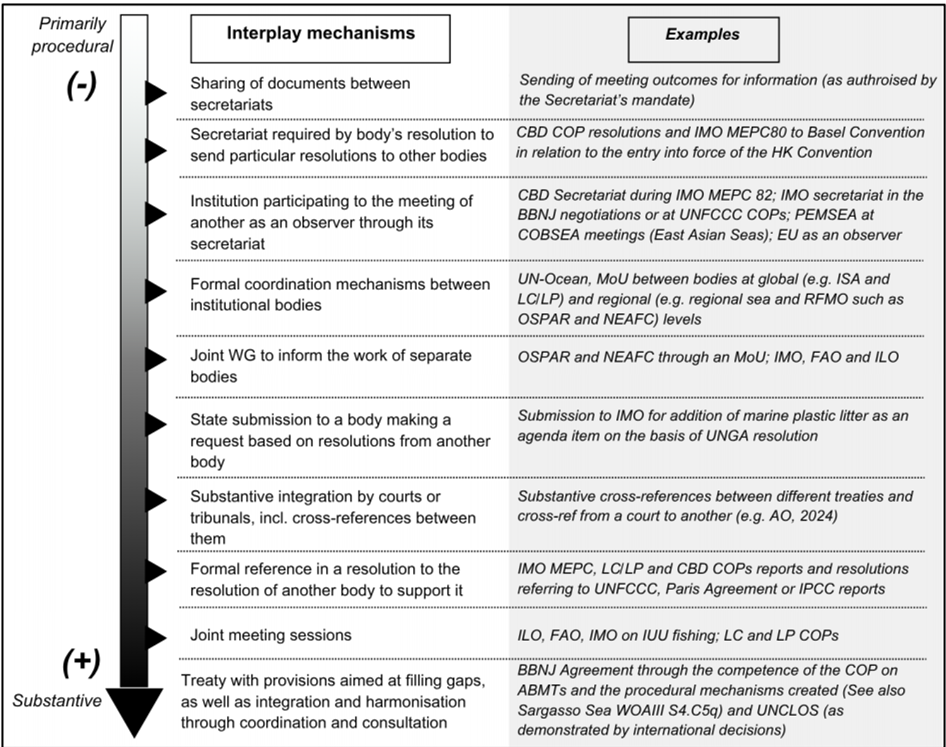
Political frameworks such as Sustainable Development Goal 14 Ref 141 and the Kunming-Montreal Global Biodiversity Framework of 2022 set objectives and provide specific targets and tools for marine environmental protection, helping to drive progress despite institutional and legal fragmentation (decision 16/35 of the Conference of the Parties to the Convention on Biological Diversity (Ref 27); Ref 28). On a positive note, a number of other mechanisms and processes that facilitate interplay and interactions between institutions and regimes, as well as the adoption of complementary norms, can also be observed (see figure IV). In addition to procedural (formal and informal) interactions between subregimes, systemic integration approaches enable several substantive interaction mechanisms, both from within and from outside the ocean regime complex (Ref 94; see also, for example, sect. 4, chap. 6). These developments support and enhance overall coherence and synergies in ocean governance through their transversal operation.
Figure IV Ocean governance legal and institutional interplay mechanisms
Source: Prepared by the writing team.
3. Transversal concepts, principles and means of implementation that underpin ocean governance
Ocean governance concepts, principles and means of implementation (hereinafter referred to as "concepts and approaches") have developed over time in different institutions of the ocean governance regime, sometimes in parallel and have gradually been incorporated into the overall ocean governance regime complex . Despite persistent uncertainties regarding their contours, legal nature and practical application (see figure V), such concepts and approaches are widely acknowledged to play a role in framing and shaping ocean governance, including in the influencing of negotiations, the interpretation of international and regional instruments and mechanism and the development of national law and policy.
Some concepts and approaches were expressly formulated at the global level in the United Nations Convention on the Law of the Sea. Many others were developed later in various texts such as declarations and guidelines that contribute to the implementation of the Convention, such as the Rio Declaration on Environment and Development of 1992, the Convention on Biological Diversity of 1992, the Food and Agriculture Organization of the United Nations (FAO) Code of Conduct for Responsible Fisheries of 1995 and the 1996 Protocol to the Convention on the Prevention of Marine Pollution by Dumping of Wastes and Other Matter, 1972 (London Protocol) Ref 161 Ref 48 Ref 166 Ref 105. Parallel narratives, shaped in part by non-State actors, can also play a central role in these processes, particularly in relation to the sustainable and inclusive ocean economy Ref 52, ocean health, blue justice Ref 6 Ref 79 and maritime and food security (Ref 21; Ref 133; Ref 134; see also subsect. 5A, subchaps. 1E and 1F; and subsect. 5B, chap. 2). Overall, these concepts and approaches can be of a procedural or substantive nature, involve scientific, social and economic sciences, and operationalize and reinforce an integrated approach.
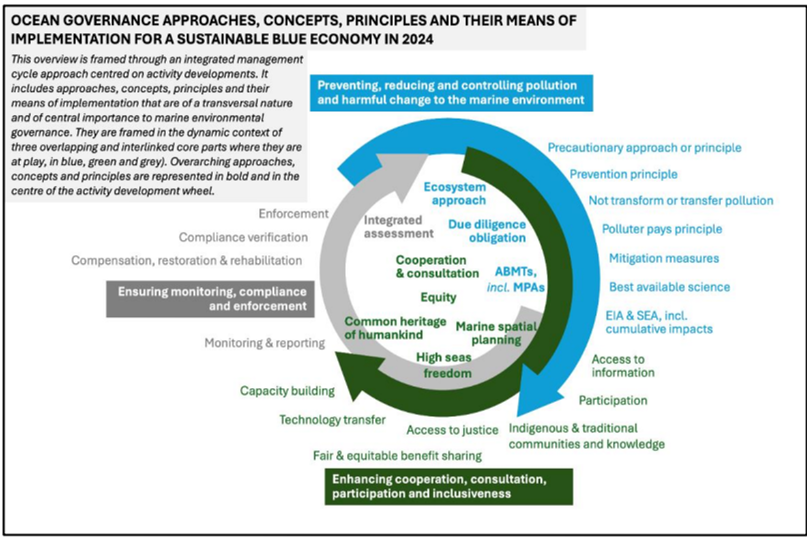
To highlight the significant overlap, articulation and circulation of these concepts and approaches, the present overview adopts a management cycle perspective, focusing on policy and activity developments over the past five years and three overlapping and interconnected drivers of marine environmental protection, presented under the headings below and illustrated in figure V. The figure is not intended to be an exhaustive representation of ocean governance.
Figure V Ocean governance approaches, concepts, principles and their means of implementation for a sustainable and inclusive ocean economy, 2024
Preventing, reducing and controlling pollution and harmful change in the marine environment
Implementation of the prevention, reduction and control of pollution of and harmful change to the marine environment (see United Nations Convention on the Law of the Sea, Part XII) brings into play several ocean governance concepts and approaches. The ecosystem approach is a central approach included in several legal instruments since its inclusion in CCAMLR in 1982 and its subsequent endorsement by the General Assembly in 2002 (Ref 103; Ref 36; see also article 7 (f) of the Agreement on Marine Biological Diversity of Areas beyond National Jurisdiction). It has evolved as an umbrella concept (see figure V) that articulates an integrated approach to ecosystem characteristics (e.g. scales and dynamics) and different sectors of activity (Ref 91; Ref 35; Ref 106; see also subsect. 5A, subchap. 1B) with regard to sustainable seas Ref 71. Stand-alone approaches, concepts and principles that are also embedded in the ecosystem approach have been used extensively in support of global policy and regulatory developments in the past five years. Examples include the precautionary principle or approach (Rio Declaration, art. 15; United Nations Framework Convention on Climate Changes, art. 3; Agreement on Marine Biological Diversity of Areas beyond National Jurisdiction, art. 7 (e); Agreement for the Implementation of the Provisions of the United Nations Convention on the Law of the Sea of 10 December, 1982 relating to the Conservation and Management of Straddling Fish Stocks and Highly Migratory Fish Stocks, art. 6; London Protocol, art. 3.1; and FAO Code of Conduct for Responsible Fisheries, art. 6.5), the prevention principle (e.g. United Nations Convention on the Law of the Sea, art. 194; see also Duvic-Paoli, 2018), the obligation not to transform or transfer pollution (United Nations Convention on the Law of the Sea, art. 195; Agreement on Marine Biological Diversity of Areas beyond National Jurisdiction, art. 7 (l)), and mitigation measures that are taken to prevent, reduce or control harm to the marine environment and ecosystems (Ref 159, 2022; see also, for example, sect. 4, subchaps. 4C and 4G; and subsect. 5A, subchap. 3A) from all sources, including climate change Ref 13.
Applicable across all branches of international law, the due diligence obligation Ref 49 Ref 10 has also had its content consolidated by decisions of several international tribunals until very recently and in a range of contexts: deep seabed mining in areas beyond national jurisdiction Ref 74, illegal, unreported and unregulated (IUU) fishing Ref 75, climate change impacts Ref 71, the aquatic environment Ref 61 and the marine environment in general Ref 116. Both customary (Ref 61; Maljean-Dubois, 2021) and treaty-based Ref 144, the due diligence standard is recognized as varying with the risks involved - for example, depending on the sensitivity of an ecosystem or the risks from the activity being undertaken (e.g. Ref 75) - and to include, among other attributes, the use of the best available science and the fulfilment of environmental impact assessments). The need for the best available science is commonly referred to by ocean governance instruments and institutions, such as in Part XIII of the United Nations Convention on the Law of the Sea and in the OSPAR North-East Atlantic Environment Strategy, 2030 (Ref 117; see also subsect. 5A, chap. 7) and enabled by scientific bodies established by treaty bodies such as the Scientific and Technical Body under article 49 of the Agreement on Marine Biological Diversity of Areas beyond National Jurisdiction. The obligation to undertake environmental impact assessments to inform decision-making has long been a procedural obligation under customary international law (Ref 61; Ref 34; Ref 71; see also Agreement on Marine Biological Diversity of Areas beyond National Jurisdiction, art. 7 (i)) as well as a direct obligation under article 206 of the United Nations Convention on the Law of the Sea, with other treaties providing particular substantive conditions in specific areas or sectors (e.g. Protocol on Environmental Protection to the Antarctic Treaty (Madrid Protocol), art. 10; CCAMLR, art. IX; London Convention on the Prevention of Marine Pollution by Dumping of Wastes and Other Matter (London Convention) of 1972, annex II; and Agreement on Marine Biological Diversity of Areas beyond National Jurisdiction, Part IV) (Ref 37; see also subsect. 5A, chap. 7) and in areas beyond national jurisdiction (including cumulative impacts, see Agreement on Marine Biological Diversity of Areas beyond National Jurisdiction, art. 1 (6)).
Global policy targets on protected areas (Sustainable Development Goal 14.5 and Kunming-Montreal Global Biodiversity Framework, sect. H, target 3) have driven global policy and regulatory developments for all area-based management tools broadly, including MPAs ( Agreement on Marine Biological Diversity of Areas beyond National Jurisdiction, Part III). Amid a call for tighter regulations in order to effectively protect their marine environment Ref 32 Ref 115, regional seas organizations and mechanisms continue to adopt new instruments. The entry into force of the Agreement on Marine Biological Diversity of Areas beyond National Jurisdiction is expected to further support this move, whether by stimulating the action of existing sectoral bodies or through the future adoption of new area-based management tools by the bodies to be established (Ref 82; see also Ref 76).
Enhancing cooperation, consultation, participation and inclusiveness
The foundational principles of ocean governance, including the common heritage of humankind (formerly mankind), high seas freedoms, and cooperation and consultation among States, have been further elaborated and reinforced in the context of the development of more recent and interlinked marine environmental governance processes such as marine spatial planning, environmental impact assessments, strategic environmental assessments, area-based management tools, participation and inclusiveness (see figure V).
The status of the common heritage of humankind relates to the seabed, the ocean floor and the subsoil in the Agreement on Marine Biological Diversity of Areas beyond National Jurisdiction, as well as the associated mineral resources, (Ref 140; see also United Nations Convention on the Law of the Sea, arts. 136 and 137; Agreement on Marine Biological Diversity of Areas beyond National Jurisdiction, art. 7 (b); and subsect. 5A, chap. 7). It is characterized by five essential attributes: non-appropriation (Convention, arts. 89 and 137), peaceful use (Convention, arts. 88 and 141), rational exploitation of resources (Convention, art. 150 (b)), international management, and equitable distribution of benefits (Ref 83; Ref 109; Ref 140; see also subsect. 5A, chap. 7). Some of these attributes, such as the peaceful use and rational exploitation of resources, are also applicable to high seas freedoms (Convention, art. 87; Agreement, art. 7 (c)).
The principle of equity has evolved under differentiated treatment (United Nations Convention on the Law of the Sea, arts. 202 and 203, Agreement on Marine Biological Diversity of Areas beyond National Jurisdiction, art. 7(d); see also subsect. 5B, chaps. 5 and 6) balanced by different provisions such as capacity-building and technology transfer (Convention, Part XIV; Agreement, Part V; see also Ref 97). In this context, the fair and equitable sharing of benefits marks a normative clarification for marine genetic resources in areas beyond national jurisdiction that can be traced back to developments under the Convention on Biological Diversity, the International Treaty on Plant Genetic Resources for Food and Agriculture and the Nagoya Protocol on Access to Genetic Resources and the Fair and Equitable Sharing of Benefits Arising from Their Utilization to the Convention on Biological Diversity (Ref 101; Ref 7; Ref 15; see also subsect. 5A, chap. 5). Another significant development is the explicit inclusion of the local, traditional and customary rights and knowledge of Indigenous Peoples, as well as of traditional and local communities that are knowledge holders on the ocean and coastal environments (Agreement, art. 7 (j)), in, for example, scientific information Ref 57 Ref 67. Consultation of Indigenous Peoples and traditional knowledge holders has been progressively embedded into a number of processes, such as the Inuit Circumpolar Council becoming an observer to IMO (see also Ref 68; Ref 53; Ref 123; Ref 131; Ref 107; see also subsect. 5A, chap. 9).
Cooperation is required in order to implement ocean governance measures and to settle disputes under, for example, articles 123, 169, 197 and 282 of the United Nations Convention on the Law of the Sea. It is given particular emphasis in the context of, for example, transboundary environmental issues Ref 72, regional seas and due regard Ref 138 Ref 48. It is also associated with consultation, including the gathering of input from a wide range of relevant governance actors (Agreement on Marine Biological Diversity of Areas beyond National Jurisdiction, arts. 8 and 21; see also Ref 33). Cooperation and meaningful consultation further support access to information, participation and access to justice, which are jointly described as "access rights" (e.g. Regional Agreement on Access to Information, Public Participation and Justice in Environmental Matters in Latin America and the Caribbean (Escazu Agreement) of 2018, art. 2 (a). Recognized in environmental treaty provisions that include transparency obligations (e.g. Convention, art. 119 (2); Convention on Access to Information, Public Participation in Decision-Making and Access to Justice in Environmental Matters (Aarhus Convention), arts. 4 and 5; Escazu Agreement, arts. 5, 6, 7.1, 8.1 and 8.2; Kunming-Montreal Global Biodiversity Framework, target 21; Agreement on Marine Biological Diversity of Areas beyond National Jurisdiction, arts. 32 and 48) Ref 126, these rights generally enable the protection (see also subsect. 5A, chap. 9) and exercise of various human rights related to a healthy environment (see also subsect. 5B, chaps. 2 and 3) and the fulfilment of the duty to protect, preserve and restore the environment (Ref 101; see also Preamble to the Aarhus Convention).
Cooperation and consultation are also central to marine spatial planning. Although other forms of planning exist, marine spatial planning is generally a planning tool of reference across international (e.g. Ref 150), regional (e.g. European Union directive on marine spatial planning, OSPAR and Baltic Marine Environment Protection Commission) and national ocean governance developments Ref 51 Ref 64 Ref 130. It was first envisaged to resolve marine and maritime use conflicts in particular marine areas under national jurisdiction Ref 40, and has since evolved Ref 150 Ref 151 as an integrated approach that can anticipate conservation in ecologically sensitive areas and secure investments for economic development Ref 38, connecting stakeholders and supporting decision-making for marine use management (see subsect. 5A, subchaps. 1B, 1C and 1D), including in transboundary contexts (Ref 54; see also subsect. 5A, chap. 9).
Enhancing monitoring, compliance and enforcement
Integrated assessments are overarching governance tools to ensure the monitoring, compensation, compliance and enforcement provided for in numerous international instruments with a view to ensuring effective protection and preservation of the marine environment Ref 25. Reporting (e.g. Convention on Biological Diversity, art. 26; London Protocol, art. 9) and monitoring (e.g. United Nations Convention on the Law of the Sea, art. 204; OSPAR, art. 6; London Protocol, annex II; Convention for Cooperation in the Protection and Sustainable Development of the Marine and Coastal Environment of the Northeast Pacific (Antigua Convention) of 2002, art. 3 (h); Convention on Wetlands of International Importance especially as Waterfowl Habitat (Ramsar Convention), art. 6 (2) (e); Convention on Biological Diversity, art. 7) are typically focused on the periodic measurement of environmental quality indicators or targets at different spatial and temporal scales to detect and document the potential changes and impact of human activities Ref 56, including with respect to specific sea areas, ecosystems and species. Marine environmental data collection, including traditional knowledge Ref 88, has been improving at the global level, as demonstrated by the present World Ocean Assessment, Ref 151, other reports on specific aspects such as marine transport (by the United Nations Conference on Trade and Development (UNCTAD)), fisheries (FAO and regional fisheries management organizations (RFMOs) (see also sect. 4, subchap. 4D); Ref 121; Ref 128) and the contribution of nature to people including ecosystem services Ref 66, although it remains largely insufficient, such as for invasive species (sect. 4, chap. 6), liquids, and solid and atmospheric inputs from land-based sources (sect. 4, chap. 6) and more generally (sect. 4, chap. 2). At the regional level, examples of knowledge improvement include quality status reporting under OSPAR in the North-East Atlantic (OSPAR Convention, art. 6) and under the Barcelona Convention in the Mediterranean Sea (Barcelona Convention, art. 12).
Monitoring and reporting also provide useful baselines for marine environmental compensation and restoration Ref 71 Ref 100. Compensation can provide redress or remediation through financial or material solutions (e.g. habitat restoration) when environmental damage to people or nature cannot be fully avoided or mitigated and rests on the "polluter pays" principle (López-Portillo and others, 2017). Restoration and rehabilitation (Ref 71; see also the Kunming-Montreal Global Biodiversity Framework) can involve public and private actors (Ramírez-Monsalve and others, 2021) in order to return damaged ecosystems to their original state or to support ecosystem recovery and promote resilience from future harmful impacts Ref 158 Ref 8.
The growing focus on compliance Ref 92 and enforcement Ref 92 encompasses illegal activities (Ref 164; Ref 87; Ref 44 Ref 45; Ref 69; Ref 89; Ref 99; Ref 157; see also subsect. 5A, subchap. 1A). Maritime security challenges can cause devastating environmental damage in addition to human and economic losses (Ho, 2006), such as the explosion of a supertanker to block key straits or the destruction of undersea pipelines, releasing toxic substances Ref 127 Ref 120. Responses to these threats have included the adoption of standards by intergovernmental organizations such as the World Customs Organization (WCO) SAFE Framework of Standards to Secure and Facilitate Global Trade, as well as capacity-building (e.g. WCO and secretariat of the Basel Convention on the Control of Transboundary Movements of Hazardous Wastes and Their Disposal, the Rotterdam Convention on the Prior Informed Consent Procedure for Certain Hazardous Chemicals and Pesticides in International Trade and the Stockholm Convention on Persistent Organic Pollutants; UNODC, 2023).
4. Conclusion
Over the past five years, substantive areas of concern in the work of relevant intergovernmental institutions have extended beyond traditional marine environmental pressures (e.g. pollution and fisheries) to more recent priorities (e.g. climate change mitigation and adaptation, marine plastics, monitoring and ocean observation) and non-traditional areas such as maritime security, migration by sea, a human-rights based approach and food security. Overarching objectives such as a sustainable and inclusive ocean economy, ocean health and blue justice are playing central roles in ocean governance developments.
The ocean governance overview provided in the present section highlights the central role of both natural and social sciences, including the knowledge systems of Indigenous Peoples and local communities and the importance of their integration into all stages of the policy cycle at all geographic scales.
References
- Aarhus Convention on Access to Information (1998). Public Participation in Decision-Making and Access to Justice in Environmental Matters.
- Abdenur, A.E., and Souza Neto, D.M. (2014). Region-Building by Rising Powers: The South Atlantic and Indian Ocean Rims Compared. Journal of the Indian Ocean Region 10 (1): 1-17.
- Al Ayachi, N. (2020). Environmental Challenges in the Atlantic Ocean and its Effects on Marine Policies, .التحديات البيئية في المحيط الأطلسي وأثرها على السياسات البحرية (Casablanca: Dar Ifriqiya Charq. (In Arabic language
- Antigua Convention (2002).
- Barkin J.S., Rashchupkina Y. (2017). Public Goods, Common Pool Resources, and International Law. American Journal of International Law, 111(2):376-394. doi: 10.1017/ajil.2017.9.
- Barros-Platiau, A.F., Gonçalves, L., and De Oliveira, C.C. (2021). A Década da Ciência Oceânica como oportunidade de justiça azul no Sul Global. Conjuntura Austral, 12(59), 11-20.
- Batista, P. D. (2024). Proposal for a Global Regulation of Digital Sequence Information, Max Planck Institute for Innovation & Competition Research Paper No. 24-10. Available at https://papers.ssrn.com/sol3/papers.cfm?abstract_id=4861106.
- Bayraktarov, E., Saunders, M.I., Abdullah, S., Mills, M., Beher, J., Possingham, H.P., Mumby, P.J., and Lovelock, C.E. (2016). The cost and feasibility of marine coastal restoration. Ecol Appl, 26: 1055-1074.
- BBNJ Agreement (2023). Agreement under the United Nations Convention on the Law of the Sea on the Conservation and Sustainable Use of Marine Biological Diversity of Areas beyond National Jurisdiction, New York, 19 June, 2023, C.N.203.2023.TREATIES-XXI. 10 July.
- Besson, S. (2023). Due Diligence in International Law. The Hague Academy Special Editions.
- Bennett, N.J., Cisneros-Montemayor, A.M., Blythe, J., Silver, J.J., Singh, G., Andrews, N., Calò, A., Christie, P., di Franco, A., Finkbeiner, E.M., Gelcich, S., Guidetti, P., Harper, S., Hotte, N., Kittinger, J.N., le Billon, P., Lister, J., López de la Lama, R., Mckinley, E, Scholtens, J., Solås, A-M., Sowman, M., Talloni-Álvarez, N., Teh, L.C.L., Voyer, M., and Sumaila, U.R. (2019). Towards a sustainable and equitable blue economy. Nature Sustainability, 2(11), 991-993.
- Bennett, N.J., Blythe, J., White, C.S., Campero, C. (2021). Blue growth and blue justice: Ten risks and solutions for the ocean economy, Marine Policy, Volume 125, 104387.
- Biermann, F., Oomen, J., Gupta, A., Ali, S.H., Conca, K., Hajer, M.A., Kashwan, P., Kotzé, L.J., Leach, M., Messner, D., Okereke, C., Persson, Å., Potočnik, J., Schlosberg, D., Scobie, M., and VanDeveer, S.D. (2022). Solar geoengineering: The case for an international non-use agreement. WIREs Climate Change, 13(3), e754.
- Blanchard, C., Harrould-Kolieb, E., Jones, E., and Taylor, M.L. The current status of deep-sea mining governance at the International Seabed Authority (2023). Marine Policy, 147: 105396.
- Blasiak, R., and others (2018). Corporate control and global governance of marine genetic resources. Science Advances, [S. 1.], v. 4, n. 6.
- Blasiak, R., and Claudet, J. (2024). Governance of the High Seas. Annual Review of Environment and Resources, 49, pp. 549-572.
- Boukhari, A. (2019). Environmental Governance in the Atlantic Ocean and its Effects on the Marine الحوكمة البيئية في المحيط الأطلسي وأثرها على (Resources. Riyadh: Dar Al Kitab Al Akadimi. (In Arabic language .الموارد البحرية
- Boyle, A. (2005). Further Development of the Law of the Sea Convention: Mechanisms For Change (2005). 54 ICLQ 563.
- Brander, S.M., Senathirajah, K, Fernandez, M.O., Weis, J.S., Kumar, E., Jahnke, A., Hartmann, N.B. Alava, J.J. Farrelly, T., Almroth, B.C., Groh, K. J., Syberg, K., Buerkert, J.S., Abeynayaka, A., Booth, A.M., Cousin, X. Herzke, D., Monclús, L., Morales-Caselles, C., Bonisoli-Alquati, A., Al-jaibachi, R., Wagner, M. (2024). The time for ambitious action is now: Science-based recommendations for plastic chemicals to inform an effective global plastic treaty, Science of The Total Environment, volume 949, 174881. https://pubmed.ncbi.nlm.nih.gov/39047828/.
- Brooks, C. M., Bloom, E., Kavanagh, A., Nocito, E.S., Watters, G.M., Weller, J. (2021). The Ross Sea, Antarctica: A highly protected MPA in international waters. Marine Policy, volume 134, 104795.
- Bueger, C. and Mallin, Felix (2023). Blue Paradigms. Understanding the intellectual revolution in global ocean politics. International Affairs, 99(4): 1719-1739, 2023.
- Campanella, V.T., ed. (2024). Routledge Handbook of Seabed Mining and the Law of the Sea. New York: Routledge Handbooks.
- Campbell, Lisa M., Noella J. Gray, Luke Fairbanks, Jennifer J. Silver, Rebecca L. Gruby, Bradford A. Dubik, and Xavier Basurto (2016). Global oceans governance: New and emerging issues. Annual review of environment and resources 41, No. 1, 517-543. Available at https://www.annualreviews.org/content/journals/10.1146/annurev-environ-102014-021121.
- Chircop, A. and Shan, D. (2020). Governance of International Shipping in the Era of Decarbonisation: New Challenges for the IMO? In P. K. Mukherjee, M. Q. Mejia and J. Xu (Eds.), Maritime Law in Motion (pp. 97-113). WMU Studies in Maritime Affairs, vol 8. Springer, Cham. https://doi.org/10.1007/978-3-030-31749-2_6.
- Cicin-Sain, B., and Knecht, R.W. (1998). Integrated coastal and ocean management: concepts and practices. Washington: Island Press. ISBN: 1559636041.
- Convention on Biological Diversity (CBD) (2022). Kunming-Montreal Global Biodiversity Framework, Montreal, 19 December, CBD/COP/DEC/15/4. https://www.cbd.int/doc/decisions/cop-15/cop-15-dec-04-en.pdf.
- CBD (2025). Decision on Cooperation with other conventions and international organizations. CBD/COP/DEC 16/35.
- CBD (2014). Sustainable Ocean Initiative, Action Plan for the Sustainable Ocean Initiative (2015-2020).
- Convention on the prevention of marine pollution by dumping of wastes and other matters (1972), 29 December, United Nations, Treaty Series, vol. 146, No. 15749.
- Convention on wetlands of international importance especially as waterfowl habitat (1972). 2 February, United Nations, Treaty Series.
- Convention for the protection of the marine environment of the North-East Atlantic (1992), 22 September, United Nations, Treaty Series, vol. 2354, No. 42279.
- Claudet, J., and others (2024). Advancing ocean equity at the nexus of development, climate, and conservation policy. Nature Ecology & Evolution. ff10.1038/s41559-024-02417-5ff. ffhal-04579762f.
- Craik, N. (2020). The duty to cooperate in the customary law of environmental impact assessment. International and Comparative Law Quarterly, 69(1), 239-260.
- Craik, N. (2007). Deliberation and legitimacy in transnational governance: the case of environmental impact assessments. Victoria University of Wellington Law Review, 38(2), 381-402.
- Curtin, Richard, and Raúl Prellezo (2010). Understanding marine ecosystem-based management: a literature review. Marine policy 34, No. 5, 821-830. https://doi.org/10.1016/j.marpol.2010.01.003.
- De Lucia, V., Iavicoli, V. (2019). From the Outer Space to Ocean Depths: the 'Spacecraft Cemetery' and the projection of the Marine Environment in areas Beyond national Jurisdiction, California Western International Law Journal, vol. 49, No. 2, 20192019.
- Doelle, M., and Sander, G. (2020). Next Generation Environmental Assessment in the Emerging High Seas Regime? An Evaluation of the State of the Negotiations, The International Journal of Marine and Coastal Law, 35(3), 498-532.
- Douvere, F. (2008). The importance of marine spatial planning in advancing ecosystem-based sea use management. Marine Policy, v. 32, n. 5, p. 762-771. DOI: https://doi.org/10.1016/j.marpol.2008.03.021.
- Duvic-Paoli, L-A. (2018). The Prevention Principle in International Environmental Law. Cambridge University Press.
- Ehler, C., Douvere, F. (2009). Marine Spatial Planning: A step-by-step approach toward ecosystem-based management. Paris: UNESCO, 99 p.
- Elisabeth M. Borgese (1978). A Constitution for the Oceans: Comments and Suggestions Regarding Part XI of the Informal Composite Negotiating Text, 15 San Diego L. Rev., 371.
- Escazu Regional Agreement on Access to Information, Public Participation in Decision-making and Access to Justice in Environmental Matters (2018).
- Fanning, L., and Mahon, R. (2020). Governance of the Global Ocean Commons: Hopelessly Fragmented or Fixable? Available at https://www.researchgate.net/publication/343919307_Governance_of_the_Global_Ocean_Commons_Hopelessly_Fragmented_or_Fixable.
- FAO (2021). International Plan of Action to Prevent, Deter and Eliminate Illegal, Unreported and Unregulated Fishing. Available at https://www.fao.org/fishery/en/publication/jobno/y1224e. Accessed on 30 May, 2024.
- FAO (2022). A policy and legal diagnostic tool for sustainable small-scale fisheries.
- FAO (2023). Report of the Thirty-fifth Session of the Committee on Fisheries, Rome, 5-9 September, 2022. FAO Fisheries and Aquaculture Report, No. 1391. Rome. https://doi.org/10.4060/cc3652en.
- FAO (2024). The State of World Fisheries and Aquaculture, 2024 - Blue Transformation in action. Rome. https://doi.org/10.4060/cd0683en.
- Forteau, M. (2019). The legal nature and content of 'due regard' obligations in recent international case law, The International Journal of Marine and Coastal Law, 34, No. 1 (2019), 25-42.
- French, D., and Stephens, T. (2014). International Law Association Study Group on Due Diligence in International Law, First Report, 7 March.
- Garcia, Beatriz, Anita Foerster, and Jolene Lin (2021). Net zero for the international shipping sector? An Analysis of the Implementation and Regulatory Challenges of the IMO Strategy on Reduction of GHG Emissions. Journal of Environmental Law 33, No. 1, 85-112.
- Gerhardinger, L.C., Quesada-Silva, M., Gonçalves, L.R., and Turra, A. (2019). Unveiling the genesis of a marine spatial planning arena in Brazil. Ocean and Coastal Management, 179, 104825. https://doi.org/10.1016/j.ocecoaman.2019.104825.
- Germond-Duret, C., Heidkamp, C.P., and Morrissey, J. (2022). (In)justice and the blue economy. The Geographical Journal, 00, 184-192. Available at https://doi.org/10.1111/geoj.12483.
- Golo, H.K., Ibrahim, S., and Erinosho, B. (2022). Integrating communities' customary laws into marine small-scale fisheries governance in Ghana: Reflections on the FAO Guidelines for Securing Sustainable Small-Scale Fisheries. Review of European Comparative & International Environmental Law (RECIEL) 31, 349-359. doi: 10.1111/reel.12478.
- Gomes-Ballesteros, M., Cervera - Núñez, C., Campillos-Llanos, M., Quintela, L., Sousa, M., Marques, F.L. Alves, Murciano, C., Alloncle, N., Sala, P., Lloret, A., Simão, A.P., Costa, A.C., Carval, D, Bailly, D. Nys, C., H. Sybill, Dilasser, J. (2021). Transboundary cooperation and mechanisms for Maritime Spatial Planning implementation. SIMNORAT project. https://www.sciencedirect.com/science/article/abs/pii/S0308597X21000440.
- Grorud-Colvert, Kirsten, Jenna Sullivan-Stack, Callum Roberts, Vanessa Constant, Barbara Horta e Costa, Elizabeth P. Pike, Naomi Kingston and others (2021). The MPA Guide: A framework to achieve global goals for the ocean. Science, 373, No. 6560: eabf0861.
- Han X., Gill M.J., Hamilton H.E., Vergara S.G. and Young B.E. (2020). Progress on National Biodiversity Indicator Reporting and Prospects for Filling Indicator Gaps in Southeast Asia, 5 Environmental and Sustainability Indicators, 100017.
- Harden-Davies, H.R., and Gjerde, K.M. (2019). Building Scientific and Technological Capacity: Role for Benefit-Sharing in the Conservation and Sustainable Use of Marine Biodiversity beyond National Jurisdiction. Ocean Yearbook, 33, 377-400.
- Hatje, V., R.L.B. Andrade, C.C. Oliveira, A. Polejack, and T. Gxaba (2021). Pollutants in the South Atlantic Ocean: Sources, Knowledge Gaps and Perspectives for the Decade of Ocean Science. Frontiers in Marine Science, 8: 644569.
- Heike K. Lotze (2021). Marine biodiversity conservation, Current Biology, Volume 31, Issue 19, Pages R1190-R1195, ISSN, 0960-9822, https://doi.org/10.1016/j.cub.2021.06.084.
- ICHR (2017). Advisory Opinion OC-23/17 of November 15 2017. https://www.corteidh.or.cr/docs/opiniones/seriea_23_ing.pdf.
- ICJ (2010), Pulp Mills on the River Uruguay (Argentina v. Uruguay), judgment, 20 April, 2010, ICJ Rep 2010, p. 14.
ICJ Advisory Opinion (2025). Obligations of States in respect of Climate Change, 23 July, 2025.
ILC Report (2024). Chapter X, A/79/10, 75th Session.
- Johnson, A.E., McClintock, W.J., Burton, O., Burton, W., Estep, A., Mengerink, K., Porter, R., Tate, S. (2020). Marine spatial planning in Barbuda: A social, ecological, geographic, and legal case study. Marine Policy, vol. 113.
- IMO (2023). Strategy on reduction of GHG emissions from ships. Res MEPC.377(80), IMO: London. https://www.imo.org/en/OurWork/Environment/Pages/2023-IMO-Strategy-on-Reduction-of-GHG-Emissions-from-Ships.aspx.
- IPBES (2019). Global assessment report on biodiversity and ecosystem services of the Intergovernmental Science-Policy Platform on Biodiversity and Ecosystem Services. E. S. Brondizio, J. Settele, S. Díaz, and H. T. Ngo, eds., IPBES secretariat, Bonn, Germany. 1148 pages. https://doi.org/10.5281/zenodo.3831673.
- IPBES (2022). Methodological Assessment Report on the Diverse Values and Valuation of Nature of the Intergovernmental Science-Policy Platform on Biodiversity and Ecosystem Services. Balvanera, P., Pascual, U., Christie, M., Baptiste, B., and González-Jiménez, D., eds., IPBES secretariat, Bonn, Germany. https://doi.org/10.5281/zenodo.6522522 pp. 541.
- IPBES (2024). Summary for Policymakers of the Thematic Assessment Report on the Underlying Causes of Biodiversity Loss and the Determinants of Transformative Change and Options for Achieving the 2050 Vision for Biodiversity of the Intergovernmental Science-Policy Platform on Biodiversity and Ecosystem Services. O'Brien, K., Garibaldi, L., Agrawal, A., Bennett, E., Biggs, O., Calderón Contreras, R., Carr, E., Frantzeskaki, N., Gosnell, H., Gurung, J., Lambertucci, S., Leventon, J., Liao, C., Reyes García, V., Shannon, L., Villasante, S., Wickson, F., Zinngrebe, Y., and Perianin, L., eds .. IPBES secretariat, Bonn, Germany. https://doi.org/10.5281/zenodo.11382230.
- Interpol (2024). Pollution crime. Available at https://www.interpol.int/en/Crimes/Environmental-crime/Pollution-crime.
- Intergovernmental Oceanographic Commission (2021). Ocean governance and marine spatial planning. IOC Policy Brief No. 5, p. 8. Available at https://unesdoc.unesco.org/ark:/48223/pf0000375723.
- ITLOS (2024). Request for an Advisory Opinion submitted by the Commission of Small Islands States on Climate Change and International Law, May 21.
- ITLOS (2001). Request for the Prescription of Provisional Measures under Article 290, Paragraph 5, of the United Nations Convention on the Law of the Sea, Ireland v. United Kingdom, Order, Case No. 10, Order, 2001/5, Nov. 13.
- ITLOS (2003). Land Reclamation in and around the Straits of Johor (Malaysia v. Singapore), Order of 10 September, 2003, ITLOS Reports, 2003.
- ITLOS (2011). Responsibilities and obligations of States sponsoring persons and entities with respect to activities in the Area. Advisory opinion of the Seabed Disputes Chamber of the International Tribunal for the Law of the Sea, February 1.
- ITLOS (2015). Request for an advisory opinion submitted by the Sub-Regional Fisheries Commission (SRFC), Advisory Opinion of April 2.
- ISA (2024). A review of the contribution of ISA to the objectives of the 2023 Agreement under UNCLOS on the Conservation and Sustainable Use of Marine Biological Diversity of Areas Beyond National Jurisdictions. https://www.isa.org.jm/wp-content/uploads/2024/06/The_contribution_of_ISA_to_the_BBNJ_objectives.pdf.
- IUCN (1995). The Law of the Sea: Priorities and Responsibilities in Implementing the Convention. Part
- I. L.A. Kimball. United Nations Convention on the Law of the Sea: A Framework for Marine Conservation. Part II. D.M. Johnston, P.M. Saunders, and P. Payayo. Conservation and Management of the Marine Environment. A Marine Conservation and Development Report. IUCN, Gland, Switzerland. 155 pp. https://portals.iucn.org/library/sites/library/files/documents/MRN-015.pdf.
- Jentoft, S., Chuenpagdee, R, Said, A.B., Isaacs, M. (2022). Blue Justice: Small-Scale Fisheries in a Sustainable Ocean Economy. Volume 26, MARE Publication Series, Ed. Springer Nature.
- Kim, R.E. (2024). The Likely Impact of the BBNJ Agreement on the Architecture of Ocean Governance. Marine Policy, 165: 106190.
- Kim, R.E. (2012). Is a New Multilateral Environmental Agreement on Ocean Acidification Necessary? Review of European Community and International Environmental Law, 21: 243-258.
- Kim, R.E. (2024). The likely impact of the BBNJ Agreement on the architecture of ocean governance. Marine Policy, 165, p.106190.
- Kiss, A.C. (1983). La notion de patrimoine commun de l'humanité. Académie de droit international, 175, 103 e s3.
- Klein, N. (2014). Maritime Space. In Handbook of Governance and Security, ed. James Sperling Cheltenham: Edward Elgar, p. 388-407.
- Koh, T.B., A Constitution for the Oceans (1983). Final Act of the Third United Nations Conference on the Law of the Sea. Introductory Material on the Convention and the Conference. New York, United Nations, xxxiii-xxxvii.
- Koh, T.T.B. (1983). A Constitution for the Oceans' remarks adapted from statements made by the President on 6 and 11 December, 1982 at the final session of the Conference at Montego Bay reproduced in The Law of the Sea. Official Text of the United Nations Convention on the Law of the Sea with Annexes an Index. Final Act of the Third United Nations Conference on the Law of the Sea. Introductory Material on the Convention and the Conference (United Nations, New York) xxxiii-xxxvii.
- Kuemlangan B. and others (2023). Enforcement approaches against illegal fishing in national fisheries legislation, Marine Policy, 105515. https://www.sciencedirect.com/science/article/pii/S0308597X23000416.
- Kumar, A., Kumar, S., Komal, Ramchiary, N., and Singh, P. (2021). Role of traditional ethnobotanical knowledge and indigenous communities in achieving sustainable development goals. Sustainability, 13(6), 3062.
- Lancaster, A., and Erinosho, B. (2023). Strengthening linkages between SDG 14 & SDG 16: contributing to the development of a legislative guide to combatting pollution crime, and its annex, 14 December.
- Langlet, A., Vadrot, A.B.M. (2023) Not 'undermining' who? Unpacking the emerging BBNJ regime complex. Available at https://www.sciencedirect.com/science/article/pii/S0308597X22004195.
- Long, Rachel D., Anthony Charles, and Robert L. Stephenson (2015). Key principles of marine ecosystem-based management. Marine Policy, 57: 53-60. https://www.sciencedirect.com/science/article/pii/S0308597X1500024X.
- Lutmar, C., and Carneiro, C.L. (2018). Compliance in International Relations, In: World Politics Online Publication, June, 2018. Available at https://edisciplinas.usp.br/pluginfile.php/4424948/mod_resource/content/1/Lutmar%20and%20Carneiro%202018.pdf.
- Mahon, R., and Fanning, L. (2019). Regional ocean governance: Polycentric arrangements and their role in global ocean governance. Marine Policy, 107, 103590.
- Maljean-Dubois (2022). Circulations de normes et réseaux d'acteurs dans la gouvernance internationale de l'environnement. Available at https://books.openedition.org/dice/2585.
- Mann Borgese, Elisabeth (1975). A Constitution for the Oceans. In Borgese, E.M. and Kreiger, D., eds., The Tides of Change: Peace, Pollution and the Potential of the Oceans, Mason/Charter, 340.
- Mangalagiu, D., Baker, E., Fidelman, P., Gonçalves, L.R., Harris, P., Hollway, J., Kim, R.E., and Rice, J. Oceans and Coastal Policy (2019). Chapter 14. In P. Ekins, J. Gupta, and P. Boileau, eds. Global Environment Outlook - GEO-6: Healthy Planet, Healthy People. Cambridge University Press, 2019.
- Marjo K. Vierros, Harriet Harden-Davies (2020). Capacity building and technology transfer for improving governance of marine areas both beyond and within national jurisdiction, Marine Policy, volume 122, 104158.
- Mazzega, P., and others (2021). Ocean governance: on the recognition of institutions named in International environmental law, In Oliveira, C.C. and others, A função do direito na gestão sustentável dos recursos minerais marinhos. Rio de Janeiro, Editora Processo, p. 77-109.
- McCarthy, A.H., Steadman, D., Richardson, H., Murphy, J., Benbow, S., Brian, J.I., Brooks, H., Costa- Domingo, G., Hazin, C., McOwen, C., Walker, J., Willer, D.F., Abdi, M., Auster, P.J., Bealey, R., Bensted- Smith, R., Broadburn, K., Carvalho, G., Collinson, T., Erinosho, B., Fabinyi, M., Febrica, S., Forbi, W.N., Garcia, SM., Goad, D., Goldsworthy, L., Govan, H., Heaphy, C., Hiddink, JG., Hosch, G., Kachelriess, D., Kinch, J., Lancaster, A.M.S.N., Le Manach, F., Matthews, T., Ortiz, A.M., Morgan, A., Motta, H., Murua, H., Namboothri, N., Ndiritu, E., Passfield, K., Pilcher, N.J., Portus, J.O., Rguez-Baron, J.M., Robertson, M., Sharma, A., Suazo, C.G., Tamini, LL., Vilata-Simón, J., Mukherjee, N. (2024). Destructive Fishing: an expert-driven definition and exploration of this quasi-concept. Conservation Letters.
- Mendis, Nishara (2022). Exploring the emerging international concept of the 'duty of ecosystem restoration'. South Asian Journal of Environmental Law and Policy, 1(1), 45-60.
- Morgera, E. (2024). Participation of Indigenous Peoples in Decision Making Over Deep-Seabed Mining". American Journal of International Law (AJIL) Unbound, 118, 93-97.
- Morgera, E., McQuaid, K., La Bianca, G., Niner, H., Shannon, L., Strand, M., Rees, S., Howell, K., Snow, B., Lancaster, A.M.S., and Sauer, W. (2023). Addressing the Ocean-Climate Nexus in the BBNJ Agreement: Strategic Environmental Assessments, Human Rights and Equity in Ocean Science. The International Journal of Marine and Coastal Law, 38(3), 447-479.
- Moynihan, M.R. (2022). An Ecosystem Approach in International Environmental Law Relevant to Transboundary Freshwater Ecosystems. Chinese Journal of Environmental Law, 6(2), 125-154.
- Naidoo, A., and others (2021). Polycentric Regional Ocean Governance Opportunity in the Benguela Current Convention. Available at https://www.frontiersin.org/journals/marine-science/articles/10.3389/fmars.2021.703451/full.
- Nakamura, J. (2023). International Fisheries Law: Past to Future. In Partelow, S., Hadjimichael, M., Hornidge, A.K., eds. Ocean Governance. MARE Publication Series, vol 25. Springer, Cham. https://doi.org/10.1007/978-3-031-20740-2_8.
- Nakamura, J.N. (2025). International Law for Small-Scale Fisheries: Connecting the Ecosystem Approach and Human Rights to Secure Participatory Fisheries Management (1st ed.). Routledge. https://doi.org/10.4324/9781003584551.
- Niner, H.J., Wilson, D., Hoareau, K., Strand, M., Whittingham, J., Mcgarry, D., Bolanle, E., Ibrahim, S., Tshiningayamwe, S., Febrica, S., Lancaster, A.M.S.N., Prokic, M. (2024). Reflections on the Past, Present, and Potential Futures of Knowledge Hierarchies in Ocean Biodiversity Governance Research. Frontiers in Marine Science.
- Nyman, E. (2020). Climate Change and Ocean Governance: Politics and Policy for Threatened Seas. Global Environmental Politics, 20 (3), 120-121.
- Oliveira, C.C., Bombaka, H.M., Barros-Platiau (2025). The principle of Common Heritage of Humankind as a bridge between deep seabed mining and biodiversity conservation. In: Liu, N. and Scott, S.V., eds. The Law of the Sea and the Planetary Crisis, Routledge, London.
- Oral, N. (2023). A 50-year reflection on global ocean governance for protection of the marine environment. In Borg, S, Attard, F.G., Fremeaux, Vella, P.M. Research Handbooks in Environmental Law series, Handbook on Ocean Governance Law, Northampton: Edward Elgar Publishing, 2023, pp. 10-23.
- Oral, N. (2015). Forty Years of the UNEP Regional Seas Programme: from past to future in Rosemary Rayfuse, ed., Research Handbook on International Marine Environmental Law (Edward Elgar) 339.
- OSPAR Commission. (2014). Regional Action Plan for Prevention and Management of Marine Litter in the North-East Atlantic (OSPAR Agreement, 2014-01). London: OSPAR Commission.
- OSPAR Commission. (2022). Regional Action Plan for Prevention and Management of Marine Litter in the North-East Atlantic 1 and 2 (OSPAR Agreements, 2014-01 and 2022-05). London: OSPAR Commission.
- Ostrom, E. (2010). Beyond Markets and States: Polycentric Governance of Complex Economic Systems. American Economic Review 100(3): 641-672.
- Pike, E., Maccarthy, J. Hameed, S., Harasta, N., Grorud-Colvert, K., Sullivan-Stack, J., Claudet, J., Horta E Costa, B., Gonçalves, E., Villagomez, E., Morgan, L. (2024). Ocean Protection Quality is Lagging Behind Quality: Applying a Scientific Framework to Assess Real Marine Protected Area. Available at https://hal.science/hal-04588181/.
- Permanent Court of Arbitration (PCA) (2016). The South China Sea Arbitration, The Republic of Philippines v. The People's Republic of China. (The Chinese government neither accepts nor recognizes so-called award on South China Sea arbitration. See http://english.scio.gov.cn/pressroom/2023-07/13/content_92131216.htm.
- Polejack, A., Gruber, S., and Wisz, M.S. (2021). Atlantic Ocean science diplomacy in action: the pole-to-pole All Atlantic Ocean Research Alliance. Humanities and Social Sciences Communications, 8:52. https://doi.org/10.1057/s41599-021-00729-6. https://www.nature.com/articles/s41599-021-00729-6.
- Protocol to the 1972 Convention on the Prevention of Marine Pollution by Dumping of Wastes and Other Matter (1996), 16 November, International Legal Materials, 1997, vol. 36, 1.
- Rayfuse, R., Jaeckel, A., and Klein, N. (2023). International Marine Environmental Law in the 21st Century. In R. Rayfuse, A. Jaeckel, and N. Klein, eds. Research Handbook on International Marine Environmental Law. Edward Elgar Publishing (pp. 2-32).
- Richardson, Michael (2004). A Time Bomb for Global Trade: Maritime-Related Terrorism in an Age of Weapons of Mass Destruction. 10.1355/9789812305381.
- Rindorf, and others (2017). Moving beyond the MSY concept to reflect multidimensional fisheries management objectives. Marine Policy, 85, 33-41.
- Rio Declaration on Environment and Development (1992). Report of the United Nations Conference on Environment and Development, Rio de Janeiro, 3-14 June, 1992, A/CONF.151/26 (Vol.1).
- Rivers, N., Strand, M., Fernandes, M., Denning, M., Lemahieu, A., Nonyane, C.L., Benkenstein, A., Snow, B. (2023). Pathways to integrate Indigenous and local knowledge in ocean governance process: lessons from the Algoa Bay Project, South Africa. Frontiers in Marine Science.
- Scheiber H.N., and Paik J-H. (2013). Regions, Institutions, and Law of the Sea: Studies in Ocean Governance, Brill.
- Scott, K. N. (2023). The LOSC: 'A Constitution for the Oceans' in the Anthropocene? Australian Year Book of International Law Online, 41(1), 269-294.
- Shields, S., Longo, A., Strand, M., and Morgera, E. (2023). Children's Human Right to Be Heard at the Ocean-climate Nexus. The International Journal of Marine and Coastal Law, 38(3), 545-580.
- Sondakh, Bernard Kent (2006). National Sovereignty and Security in the Straits of Malacca, in Mohd Nizam Basiron and Amir Dastan, Building A Comprehensive Security Environment. Kuala Lumpur: Maritime Institute of Malaysia.
- Stephenson, and others (2017). Food for Thought Practical steps toward integrating economic, social and institutional elements in fisheries policy and management. ICES Journal of Marine Science, 74(7), 1981-1989. doi: 10.1093/icesjms/fsx057. https://academic.oup.com/icesjms/article/74/7/1981/3787887.
- Stephenson, R.L., Paul, S., Pastoors, M.A., Kraan, M., Holm, P., Wiber, M., and Benson, A. (2016). Integrating fishers' knowledge research in science and management. ICES Journal of Marine Science, 73(6), 1459-1465.
- Stockbridge, J., Kuempe, C.D. (2024). Marine spatial planning for a blue economy in Australia. The Blue Economy Cooperative Research Centre. Available at https://blueeconomycrc.com.au/wp-content/uploads/2024/07/BECRC_MSP_Milestone-Report-1_A4_e050724.pdf.
- Strand, M., Morgera, E., Ntona, M., Kenny, A., Sauer, W., Gaebel, C., Lavelle, J., and Snow, B. (2022). Advancing participation in the conservation & sustainable use of marine biodiversity of areas beyond national jurisdiction (BBNJ). https://oneoceanhub.org/wp-content/uploads/2022/08/Policy-brief_7_R1_BBNJ-_OOH.pdf.
- Strand, M., Rivers, N., Snow, B. (2022). Reimagining Ocean Stewardship: Arts-Based Methods to 'Hear' and 'See' Indigenous and Local Knowledge in Ocean Management. Frontiers in Marine Science.
- Suárez-de Vivero, J.L., Mateos J.C.R., Corral, D.F., Barragán, M.J., Calado, H., Kjellevold, M., Miasik, E.J. (2019). Food security and maritime security: A new challenge for the European Union's ocean policy, Marine Policy, volume 108, 103640.
- Sun, L., Zhang, W., Hu, Z. and others (2024). Food security under global economic policy uncertainty: fresh insights from the ocean transportation of food. Marit Econ Logist, 26, 414-435.
- Tanaka, Y. (2023). The International Law of the Sea (4th ed.). Cambridge: Cambridge University Press.
- Tanaka, Y. (2023b). Basic Principles of International Marine Environmental Law. In Rayfuse, R., Jaeckel, A., and Klein, N., eds. Research Handbook on International Marine Environmental Law. Edward Elgar Publishing, pp. 81-103.
- Taylor Prue (2019). The Common Heritage of Mankind: Expanding the Oceanic Circle. In Dirk Werle and others, eds., The Future of Ocean Governance and Capacity Development: Essays in Honor of Elisabeth Mann Borgese (1918-2002). Brill Nijhoff, Leiden, 142-150.
- Treves, T. (2019). Due Regard Obligations under the 1982 UN Convention on the Law of the Sea: The Laying of Cables and Activities in the Area. International Journal of Marine and Coastal Law, vol. 34, Issue 2, pp. 167-194.
- Trevisanut, S., Giannopoulos, N., and Roland Holst, R. (2020). Regime Interaction in Ocean Governance: Problems, Theories and Methods. Brill. https://doi.org/10.1163/9789004422100.
- UNGA (1970). Resolution, 2749.
- UNGA (2015). Transforming our world: the 2030 Agenda for Sustainable Development, UNGA Res A/RES/70/1 (25 September, 2015), para. SDG 14, https://digitallibrary.un.org/record/3923923, accessed 8 February, 2026.
- United Nations Fish Stock Agreement (1995).
- United Nations Office on Drugs and Crime (UNODC) (2023). United Nations Convention against Transnational Organized Crime and the Protocols Thereto. https://www.unodc.org/unodc/en/organized-crime/intro/UNTOC.html.
- UNCLOS (1982). United Nations Convention on the Law of the Sea, adopted 10 December, 1982, entered into force 16 November, 1994, 1833 UNTS 397.
- United Nations, Department of Economic and Social Affairs (2021). Assessment of the impacts of the United Nations Ocean Conference Voluntary Commitments, Sustainable Development Goal 14. Available at https://sdgs.un.org/sites/default/files/2022-01/DESA-Oceans-VCs.pdf.
- UNODC (2024). Legislative Guide on Combating Crimes in the Fisheries Sector. Available at https://www.unodc.org/unodc/en/organized-crime/news/2024/official-launch-of-the-legislative-guide-on-combating-crimes-in-the-fisheries-sector-during-the-9th-our-ocean-conference.html.
- United Nations Office on Drugs and Crime and World Customs Organization (2021), UNODC-WCO Container Control Programme Annual Report, 2021.
- UNEP (n.d.). Global Programme of Action for the Protection of the Marine Environment from Land-based Activity (GPA), Available at https://sdgs.un.org/partnerships/global-programme-action-protection-marine-environment-land-based-activity-gpa.
- UNEP Regional Seas (2024). Milestones of UNEP's Regional Seas Programme. https://www.unep.org/topics/ocean-seas-and-coasts/regional-seas-programme.
- UNESCO-IOC/European Commission (2021). MSP global International Guide on Marine/Maritime Spatial Planning. Paris, UNESCO. (IOC Manuals and Guides No. 89). Available at https://unesdoc.unesco.org/ark:/48223/pf0000379196.
- UNESCO/IOC (2024). State of the Ocean Report.
- UNFCCC (1992), 9 May, United Nations, Treaty Series, vol.1771, p. 107.
- UNGA, 2019-2024, United Nations, General Assembly, Resolutions on Oceans and the Law of the Sea
- United Nations (1970). GA Resolution 2749 (XXV) on Declaration of Principles Governing the Sea-bed and the Ocean Floor, and the Subsoil thereof, beyond the Limits of National Jurisdiction, UN Doc A/RES/2749(XXV), 16th December, 1970 ('Resolution 2749').
- UNODC (2023). UNODC Guide on Pollution Crime and its Annex: Aphrodite Smagadi, UNEP. https://www.youtube.com/watch?v=yH4tl8k5JwA.
- UNODC (2024). Fisheries crime. https://www.unodc.org/documents/about-unodc/Campaigns/Fisheries/focus_sheet_PRINT.pdf.
- UNODC (2024). Legislative Guide for the United Nations Convention against Transnational Organized Crime and the Protocols thereto. https://www.unodc.org/unodc/en/treaties/CTOC/legislative-guide.html.
- Van Tatenhove, J.P.M., Ramírez-Monsalve, P., Carballo-Cárdenas, E., Papadopoulou, N., Smith, C.J., Alferink, L., Ounanian, K., and Long, R. (2021). The governance of marine restoration: insights from three cases in two European seas. Restor Ecol, 29: e13288.
- Vanderklift, M.A., H.D., Lovelock C.E., Murdiyarso D., Raw J.L., and Steven A.D.L. (2022). A Guide to International Climate Mitigation Policy and Finance Frameworks Relevant to the Protection and Restoration of Blue Carbon Ecosystems. Front. Mar. Sci., 9:872064.
- VanderZwaag, D. (2002). The precautionary principle and marine environmental protection: slippery shores, rough seas, and rising normative tides. Ocean Development & International Law, 33(2), pp.165- 188.
- VanderZwaag, D.L. (2019). Edging towards principled ocean governance: law of the sea and beyond. In The Future of Ocean Governance and Capacity Development (pp. 117-127). Brill Nijhoff.
- Vince, J., and others (2017). Ocean governance in the South Pacific region: Progress and plans for action. Marine Policy.
- Vivero, J.L. S., E.V. Marroni, J.C., Rodríguez Mateos, E. de Lima Figueiredo, and A. Rocha Violante (2023). Chapter 11. South Atlanticism. In Marine Spatial Planning in the Tropical Atlantic, edited by M. Bonnin and S. Lanco Bertrand. Marseille: IRD Éditions.
- Warikandwa, T.V. (2023). Fighting fisheries crimes in the fisheries industry: Practical training reflections of the efficacy of Namibia's fisheries law enforcement. Cogent Social Sciences, 9(2).
- World Trade Organisation (2022). Agreement on Fisheries Subsidies, Geneva, 17 June, WT/MIN(22)/33? WT/L/1144. https://docs.wto.org/dol2fe/Pages/SS/directdoc.aspx?filename=q:/WT/MIN22/33.pdf&Open=True.
Zhang, H. (2021). The Development of International Law of the Sea by International Courts and Tribunals: A Case Study of Due Diligence Obligation. The Korean Journal of International and Comparative Law, 9, No. 1: 132-152.
Maljean-Dubois, S. (2021). Les obligations de due diligence des États pour préserver le milieu marin et leurs conséquences en termes de responsabilité. In: Oliveira, C.C. de; Lanfranchi, M.-P.; Barros-Platiau, A.F.; Galindo, G.R.B. (eds.), A função do direito na gestão sustentável dos recursos minerais marinhos / La fonction du droit dans la gestion durable des ressources minérales marines. Editora Processo, Rio de Janeiro.
López-Portillo, J., Lewis, R.R., Saenger, P., Rovai, A., Koedam, N., Dahdouh-Guebas, F., Agraz-Hernández, C. and Rivera-Monroy, V.H. (2017). Mangrove forest restoration and rehabilitation. In: Rivera-Monroy, V.H., Lee, S.Y., Kristensen, E. and Twilley, R.R. (eds.), Mangrove Ecosystems: A Global Biogeographic Perspective: Structure, Function, and Services. Springer International Publishing, Cham, pp. 301–345.
Ramírez-Monsalve, P., Nielsen, K.N., Ballesteros, M., Kirkfeldt, T.S., Dickey-Collas, M., Delaney, A., Hegland, T.J., Raakjær, J. and Degnbol, P. (2021). Pulling mechanisms and pushing strategies: How to improve Ecosystem Approach Fisheries Management advice within the European Union’s Common Fisheries Policy. Fisheries Research, 233: 105751.